c
BACKGROUND KNOWLEDGE IN LEARNING-BASED RELATION EXTRACTION
BY
QUANG XUAN DO
DISSERTATION
Submitted in partial fulfillment of the requirements for the degree of Doctor of Philosophy in Computer Science
in the Graduate College of the
University of Illinois at Urbana-Champaign, 2012
Urbana, Illinois
Doctoral Committee:
Professor Dan Roth, Chair
Assistant Professor Julia Hockenmaier
Assistant Professor Heng Ji, City University of New York Associate Professor ChengXiang Zhai
Abstract
In this thesis, we study the importance of background knowledge in relation extraction systems. We not only demonstrate the benefits of leveraging background knowledge to improve the systems’ performance but also propose a principled framework that allows one to effectively incorporate knowledge into statistical machine learning models for relation extraction. Our work is motivated by the fact that relation extraction systems in the literature usually use evidence that is written explicitly in the input text to detect and characterize the semantic relations between target con-cepts. Although this approach achieves reasonable performance, it does not necessarily guarantee accurate extraction due to problems of poor information representation of the systems’ inputs and lack of knowledge to support logical reasoning. We argue that relation extraction systems would benefit from using one or more background knowledge sources, both in enriching the systems’ inputs and biasing the final outputs. We illustrate our framework in the context of several learning-based relation extraction tasks. The first task is Taxonomic Relation Identification where we employ an external knowledge source to construct meaning representation of the task inputs and support global inference to identify taxonomic relations between input terms. In the second task, Event Relation Discovery, we focus on identify causality relation between events in text. Our approach leverages background knowledge to perform joint inference among several classifiers that make local decisions on event causality relation. After that, we study the problem of constructing a timeline of events extracted from text,Event Timeline Construction. To address this task, we propose a new timeline representation with events mapped to absolute time intervals. In this work, we present a time interval-based global inference model that jointly assigns events into time intervals on a timeline and orders events temporally. Besides using relational constraints in the inference model, we also show that using event coreference as another source of background knowledge is beneficial to the system.
Acknowledgments
My thesis should have not been accomplished without the help of many individuals. My memory about the first days that I came to the University of Illinois at Urbana-Champaign and all people that contribute to my work is still fresh. Although I really want, I, however, realize that writing down the acknowledgement to all the individuals is frustratingly impossible. I would love to feature some of the contributions that others have had on my dissertation. This could by no means express my immense appreciation to all individuals that I am in debt for this work.
First and foremost, I would like to thank my parents, my brother Hoang Do and his wife, and my relatives (especially, the Vodinhs) for their huge support during my PhD life. Particularly, I want to express my deep gratitude to my mother, Loan Le, who has sacrificed so much for me so that I can be as I am today. Thank you, Mom. For all you have done for me, I found that writing down some acknowledgement sentences is impossibly sufficient. My gratefulness also goes to my dear wife, Nhung, for her love, support and encouragement. One of the best achievements that we have gone through together was the birth of our beloved daughter, Sophia Nhat-Phuong, just about two months before my final thesis defense. Sophia has made our life more joyful and impassioned.
I am deeply grateful to my advisor, Dan Roth, for his knowledgeable advices and supports from day one of my PhD journey. Dan was one of the most intellectually admirable individual that I have ever met and worked with. Dan was a tremendous advisor to me. He was always patient and supportive even when I was in long procrastinations. And of course, Dan has put huge influence on the improvement of my English skills. I will also always remember his great personalities in communicating and working with others. I believe that without his guidance and supports, my thesis would not have been realized. It was my true privilege to meet and work with you, Dan.
Julia Hockenmier, Heng Ji (from the City University of New York), and ChengXiang Zhai. Their academic work has inspired me much. Their insightful and thorough comments on my work indeed helped me improve my dissertation remarkably.
I was also lucky to be a member of the Cognitive Computation Group (led by Dan Roth) with several brilliant colleagues who supported me in research. My dissertation benefited from all indi-viduals with whom I had chances to collaborate during my PhD journey, including YeeSeng Chan, Ming-Wei Chang, Wei Lu, Mark Sammons, Vivek Srikumar, Yuancheng Tu, Vinod Vydiswaran and Ran Zhao. In addition, my knowledge has been enlightened by exchanging and consulting ideas from many other members of the group: Kai-Wei Chang, James Clarke, Michael Connor, Dan Goldwasser, Prateek Jindal, Alex Klementiev, Gourab Kundu, Jack Morrissey, Jeff Pasternack, Vasin Punyakanok, Lev Ratinov, Nick Rizzolo, Alla Rozovskaya, Rajhans Samdani, and Kevin Small. On another perspective, all discussions and conversations that I had with my colleagues did implicitly help me improve my English skills. Particularly, I still remember many conversations with Jeff, which seemed to go nowhere, actually benefited my English skills substantially. I also enjoyed several table tennis matches and foosball games with Ming-wei, Kai-wei and Jeff.
Besides my work, I was fortunate to spend my life with many good friends and families at UIUC, especially the members of the Vietnamese Student Community, who contributed to keeping my life balanced. It is impractical to name all of them here, but I would like to highlight some individuals who were my roommates, exercising partners, drinking buddies and also work collaborators: Loc Bui, Thu Dang, Quang Dinh, Phong Le, Tung Le, Nam Nguyen, Tuan Hoang, Hoang Nguyen, Kien Nguyen, Minh Pham, Trong Tong, Duan Tran, Anh Truong, Loan Vo, and Long Vu.
Finally, I gratefully acknowledge the sponsorship of the Vietnam Education Foundation. The work in my dissertation was supported by the Defense Advanced Research Projects Agency, Ma-chine Reading Program under Air Force Research Laboratory prime contract No. FA8750-09-C-0181, and the Army Research Laboratory under agreement W911NF-09-2-0053.
Table of Contents
List of Tables . . . viii
List of Figures . . . ix
Chapter 1 Introduction . . . 1
1.1 Thesis Contributions . . . 2
1.2 The Use of Background Knowledge in Relation Extraction . . . 4
1.3 Thesis Organization . . . 6
Chapter 2 Background . . . 8
2.1 Relation Extraction . . . 8
2.2 Incorporating Background Knowledge with Joint Inference Models . . . 11
Chapter 3 Taxonomic Relation Identification . . . 13
3.1 Introduction . . . 13
3.2 Algorithmic Approach . . . 18
3.2.1 Preliminaries . . . 18
3.2.2 Overview . . . 19
3.3 Learning Local Taxonomic Relation Classifier . . . 21
3.3.1 The Structure of Wikipedia Pages . . . 22
3.3.2 Wikipedia-based Semantic Representation . . . 23
3.3.3 Feature Extraction . . . 28
3.3.4 Non-Wikipedia Terms . . . 31
3.4 Global Inference with Relational Constraints . . . 32
3.4.1 Enforcing Relational Constraints through Global Inference . . . 32
3.4.2 Extracting Related Terms . . . 35
3.5 Experimental Study . . . 36
3.5.1 Comparison to Hierarchical Structures . . . 36
3.5.2 Comparison to Harvested Knowledge . . . 40
3.5.3 Experimental Analysis . . . 41
3.6 Related Work . . . 43
3.7 Summary . . . 44
Chapter 4 Event Relation Discovery . . . 45
4.1 Introduction . . . 45
4.2 Event Causality . . . 47
4.3 Verbal and Nominal Predicates . . . 50
4.4 Discourse and Causality . . . 52
4.4.1 Discourse Relations . . . 52
4.4.2 Discourse Relation Extraction System . . . 54
4.5 Joint Inference for Causality Extraction . . . 54
4.5.1 CEA & Discourse: Implementation Details . . . 55
4.5.2 Constraints . . . 56 4.6 Experiments . . . 58 4.6.1 Experimental Settings . . . 58 4.6.2 Evaluation . . . 59 4.7 Analysis . . . 61 4.8 Related Work . . . 62 4.8.1 Event Extraction . . . 62
4.8.2 Event Relation Discovery . . . 67
4.9 Summary . . . 69
Chapter 5 Event Timeline Construction . . . 70
5.1 Introduction . . . 70 5.2 Related Work . . . 72 5.3 Preliminaries . . . 74 5.3.1 Events . . . 74 5.3.2 Time Intervals . . . 75 5.3.3 Timeline . . . 75
5.4 Fundamental Time Interval Operations . . . 76
5.4.1 Temporal Expression Extraction . . . 78
5.4.2 Normalization to Time Intervals . . . 79
5.4.3 Comparison . . . 79
5.4.4 Experimental Study . . . 79
5.5 A Joint Timeline Model . . . 81
5.5.1 The Pairwise Classifiers . . . 82
5.5.2 Joint Inference for Event Timeline . . . 84
5.6 Incorporating Knowledge from Event Coreference . . . 87
5.7 Experimental Study . . . 90
5.7.1 Data and Setup . . . 90
5.7.2 A Baseline . . . 91
5.7.3 Our Systems . . . 91
5.7.4 Previous Work-Related Experiments . . . 93
5.8 Summary . . . 94
Chapter 6 Conclusions . . . 96
Appendix A Semantic Classes . . . 99
Appendix B Taxonomic Relational Constraints . . . 100
List of Tables
3.1 Four taxonomic relations and some examples of each relation. Note that Londonis an ambiguous concept. It can be a city, thus a sibling of Paris, but can also refer to Jack London, thus a sibling ofHemingway . . . 18 3.2 An excerpt of the structure of Wikipedia pages . . . 22 3.3 A short version of the Wikipedia representation of input pair (Bush,Gerald Ford).
Note that page Presidency of Gerald Ford is redirected to page Gerald Ford; they, therefore, get the same text and category list. . . 27 3.4 Bag-of-word similarity features of (x,y), where texts(term) and categories(term) are
the functions that extract associated texts and categories from the semantic repre-sentation ofterm. . . 29 3.5 Overlap ratio features of (x,y), where titles(term) is a function that returns the
titles of the Wikipedia pages in the Wikipedia representation of term; function cat-egories(term) was defined in Table 3.4 . . . 30 3.6 Performance, in accuracy, of the systems on Test-I and Test-II. TAREC systems
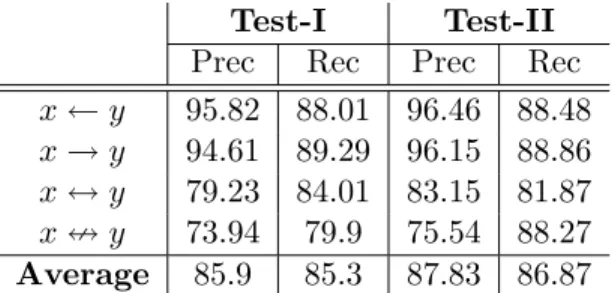
with local models simply use the local classifier to classify taxonomic relations by choosing the relation having highest confidence. . . 39 3.7 Performance of TAREC (Inference) on individual taxonomic relation. . . 42 3.8 Performance of the systems on special data sets, in accuracy. On the non-Wikipedia
test set, TAREC (Local) simply returns sibling relation. Note that TAREC uses search-based approach to build Wikipedia representation for input terms. . . 42 3.9 TAREC with different sources providing related terms for inference. . . 43 4.1 Coarse-grained and fine-grained discourse relations. . . 52 4.2 Performance of baseline systems and our approaches on extracting Causal event
relations. . . 59 4.3 Performance of the systems on extracting Causal andRelated event relations. . . 59 5.1 The performance of our extended temporal extractor on complex expressions which
contain at least one of the connectives shown in the first column. These expressions cannot be identified by existing systems. . . 80 5.2 The performance of the normalization and comparison modules. We only compare
the 191 correctly identified time intervals with their corresponding document creation time. . . 81 5.3 The statistics of our experimental data set. . . 90 5.4 Performance under various evaluation settings. All figures are averaged scores from
List of Figures
3.1 The TAREC training algorithm. . . 19 3.2 The TAREC evaluation algorithm. . . 20 3.3 The Match-based approach to constructing Wikipedia-based semantic representations. 25 3.4 Examples of n-term networks with input pair (x, y). (a) and (b) show two valid
structures, whereas (c) illustrates a relational constraints with an illegitimate structure. 33 3.5 Our Yago query patterns used to obtain related terms forx. . . 35 4.1 Precision of the topK causalityC predictions. . . 60 5.1 A graphical illustration of our timeline representation. Thee’s,t’s andI’s are events,
time points and time intervals, respectively. . . 71 5.2 The SBAR constituent in the parse tree determines an extended temporal expression
given thatin February 1947 is already captured by HeidelTime. . . 78 5.3 A simplified temporal structure of an article. There are m time intervals I1· · ·Im
and n event mentions e1· · ·en. A solid edge indicates an association between an interval and an event mention, whereas a dash edge illustrates a temporal relation between two event mentions. . . 82
Chapter 1
Introduction
In the age of information, people can be easily overwhelmed by the vast amount of information released every day. To help users access this information efficiently, we need better ways to auto-matically recognize and extract useful information from text with good and practical information extraction (IE) systems. For example, a system could regularly identify/summarize and then feed us recently published events of interest from the news.
Let us consider the following text snippet. We want to identify the events in the text (informally, we want to know who does what to whom, where and when).
Iraq held elections on 3/07/2010, to elect a new Parliament and a prime minister. The slate led by Prime Minister Nuri Kamal al-Maliki trailed one led by a former interim leader, Ayad Allawi, by 89 seats to 91.
An IE system is expected to extract the events conveyed in the text, such as holdsElec-tions(Prime Minister, Iraq, [Nuri Kamal al-Maliki, Ayad Allawi], 3/07/2010). The holdsElection event is defined by the following components:
• Predicate: held elections, is the language marker (a.k.a. event trigger) that informs the existence of an election event in the text.
• Arguments: Prime Ministeris the position of the election, Iraqis the organization holding the event, and Nuri Kamal al-Maliki and Ayad Allawi are the candidates running for the election. Furthermore, 3/07/2010 describes the temporal information of the event.
The work of this thesis argues that in order to understand the text to parse the events at that level, there is a need to use information that is not in the text, which we call here background knowledge. Without the support from background knowledge, a system may possibly make mistakes
by identifying Nuri Kamal al-Maliki and Ayad Allawi as the positions or the organizations of the election. It would be very valuable if we can tell from the background knowledge that they are both politicians, thus, they should be more likely to be the election candidates. There has been much previous work addressing problems in relation extraction. However, most of the systems focus on extracting information explicitly expressed in the given text, despite the fact that implicit background knowledge is usually essential to supporting precise extraction.
1.1
Thesis Contributions
In this thesis, we argue that background knowledge largely helps relation extraction systems to improve performance. We propose a principled framework that incorporate multiple background knowledge sources into extraction models to precisely and comprehensively recognize and extract relations from text. This thesis studies three important instances of the relation extraction problems that illustrate different aspects of information extraction and different approaches to exploit the use of background knowledge.
• Taxonomic Relation Identification: A lexicon-oriented problem, where inputs are well-segmented terms and outputs are their taxonomic relations.
• Event Relation Discovery: This problem focuses on discovering causality relations be-tween events in free text.
• Reasoning on Event Temporal Relations: We address the problem of recognizing tem-poral relations between events with an emphasis on constructing a timeline of events from text.
As we discussed in the event extraction example above, it is important to recognize that both Nuri Kamal al-Maliki and Ayad Allawi are politicians. In other words, it is essential to identify thatpoliticianholds an ancestor relation (i.e. subsumes on a taxonomy) to Nuri Kamal al-Maliki, and also toAyad Allawi. We address this problem as a taxonomic relation identification problem [Do and Roth, 2010, Do and Roth, 2012a], where we identify the taxonomic relations between any two given terms. We focus on recognizingancestor/descendantand sibling relations. For example,
the termthe US presidentwas identify as an ancestor of the termBarack Obama, whereas the term Apple Inc. is a sibling of the term Microsoft. In our work, we use a machine learning approach where an external knowledge source (e.g. Wikipedia) is extensively used to support identifying taxonomic relations. We demonstrate that background knowledge has significant contributions to this task.
For the problem of discovering event relations, we address the task of extracting causality relations between events in free text. For this problem, we not only propose a new metric to measure the association strength of event causality, but also demonstrate the necessity of discourse constraints to further improve extraction quality [Do et al., 2011].
The third problem that we address is to automatically order events that happened in a news story on an absolute timeline represented by a set of time intervals extracted from the news. Event timeline will allow us to present events and their arguments in a meaningful representation over time, which will be highly useful to satisfy users’ needs of daily information update. Specifically, we assign events to their corresponding time intervals and determine the partial temporal order among the events. In this work, we first introduce our robust and shallow temporal reasoning system that performs temporal expression extraction, normalization to time intervals and comparison [Zhao et al., 2012]. Next, we propose a joint timeline model that couples the decisions of local classifiers with respect to a set of relational constraints to improve the quality of constructing a timeline of events. This work also discusses the importance of event coreference as a background knowledge source in supporting the task at hand [Do and Roth, 2012b].
For a short summary, the most significant contribution of this thesis is proposing advanced and expressive models that combine statistical machine learning approach with background knowledge to address relation extraction tasks. To this end, this research present a principled framework and develop approaches to represent and incorporate external knowledge and computational constraints into relation extraction systems to achieve better performance for relation extraction systems. This work helps improve information extraction applications in order to better serve the real-world needs of people in the age of information.
1.2
The Use of Background Knowledge in Relation Extraction
In this section, we categorize background knowledge sources and discuss their use in relation ex-traction tasks.
We characterize background knowledge sources by four types as follows:
• Facts: the knowledge that states facts in the world. For example,Chicagolocates inIllinois, and Ernest Hemingwayis the author ofThe Old Man and the Sea.
• Common Sense: the information that can be ordinarily observed in the world. An example of common sense knowledge is transitivity closure, such as given thatPresident Bill Clinton precedes President George Bush who precedes President Barack Obama, one can infer that President Bill Clinton precedesPresident Barack Obama.
• Distributional knowledge: the knowledge that is inferred from large text collections. This type of background knowledge is also referred to asdistributional similarityanddistributional semantic. Due to the nature of this kind of knowledge, it is common to have a confidence probability associated with each piece of knowledge. For example, by counting from a huge document collection, one observes that 90% of timeBillis a nickname ofWilliam, whileTom is a nickname ofThomas with 75% of confidence.
• Linguistics: the knowledge from linguistics. For example, the type of discourse relation between two text spans can tell us if there is a causality relation between the main verbs in the text spans. In the following sentence: The first priority is search and rescue because many people are trapped under the rubble., the verb trapped signals a cause-effect relation on the verbs search and rescue via the discourse connective because. The specific linguistic knowledge of this example is that a Contingency discourse relation between two text spans indicates that the situation described in one text span causally influences the situation in the other.
In this work, we show that background knowledge can be used flexibly to make influence on different aspects of relation extraction tasks. We make use of the four types of background knowledge both in (i) elaborating tasks’ inputs and intermediate learning features, and (ii) biasing
final outputs. We exercise the use of background knowledge in the three aforementioned relation extraction tasks and show that background knowledge positively contributes to the performance gains of the systems. Specifically, we employ background knowledge in the tasks as follows:
• Taxonomic relation identification: In this task, we make use of an external knowledge source (Wikipedia) that providesfacts to enrich inputs and employcommon senseto enforce global consistency on outputs. Furthermore, we also usedistributional semantic knowledge learned from Wikipedia to construct learning features for a local classifier.
• Event relation discovery: The main contribution of this work is inventing a new metric that measures the cause-effect association strength between any two events in a text. This metric relies heavily on distributional semantic knowledge derived from a large document collection. We further improve the system performance by incorporatinglinguisticsknowledge on discourse relations in text to capture global coherence in event causality recognition as the output of the system.
• Reasoning on event temporal relations: Our work on temporal reasoning focuses on associating events to their corresponding time intervals in text and building temporal partial order among the events. We illustrate the important role of common sense knowledge in solving the task by providing important relational constraints enforcing a global agreement among local classifiers. Furthermore, linguistics knowledge on event coreference is also shown to be very beneficial in biasing the final outputs of the system.
Next, we will discuss the approaches that allow us to integrate background knowledge into the systems, based on their uses.
• Enriching tasks’ inputs: Technically, background knowledge is used to map tasks’ inputs to a more informative input space. The intuition is that background knowledge can provide more information on the inputs so that core extraction algorithms can do more reasoning on the inputs to achieve better performance on extracting target relations. For example, in the task of taxonomic relation extraction, the system is required to recognize the taxonomic relation between two terms such as (actor, Russell Crowe). It is possible that one can directly infer
the relation between the input terms if the relation of the terms has been learned in advance. However, if the terms and their relation have not been seen before, one still has to identify the relation between two terms actor and Russell Crowe, which provide very little information about themselves. In this case, we use background knowledge to first enrich the input terms and then apply the core identification algorithm on the new input space. Using facts and distributional knowledge, we can elaborate the terms as follows: actoris mapped to a new bag of wordsactor, actress, person, dramatic, comic, production, film, movie, television, theatre, radio, character, scene, ..., andRussell Crowe is mapped torussell, crowe, australian, actor, film, producer, musician, .... It is clear that we now have richer information about the input terms so that we can identify their taxonomic relation more accurately.
• Biasing final outputs: On this perspective, background knowledge is used to enforce global consistency among predicted outputs. Intuitively, the outputs in relation extraction tasks usually interact with each other to maintain a global coherent structure of relations. Back-ground knowledge provides global constraints that can be integrated into extraction systems to make influences on the final predictions. For example, in the task of taxonomic relation identification, by usingcommon sense knowledge on transitivity closure, we require a system that predicts Beethoven as a taxonomical sibling of both Mozart and Chopin to recognize sibling as the taxonomic relation betweenMozart and Chopin.
Our principled framework combines these two ways of using background knowledge into a pipeline that allows one to integrate multiple knowledge sources into relation extraction models. We show that background knowledge that is used in our proposed framework does significantly improve the performance of the systems.
1.3
Thesis Organization
The rest of the thesis is organized as follows:
• Chapter 2 provides a brief overview of the background in relation extraction and approaches to incorporating background knowledge into relation extraction tasks.
• Chapter 3 introduces the first use case where background knowledge is employed to support the task of taxonomic relation identification. In this work, we present the idea of using Wikipedia to enrich the feature space of input terms in order to effectively identify the taxonomic relation between them. Moreover, we propose relational constraints that enforce global coherence among local decisions to further improve the quality of our system.
• Chapter 4 describes our work on the event relation discovery task. In this work, we focus on extracting events in news text and retrieving causality relation between pair of events. Besides proposing a new metric to event causality discovering, we show that incorporating discourse relations as background knowledge improves the system performance significantly. • Chapter 5 addresses the problem of building a temporal reasoning system that can auto-matically order event into an absolute timeline. We demonstrate that leveraging relational constraints as background knowledge in a joint inference model remarkably improves the quality of the constructed timeline. Moreover, we present event coreference as another source of background knowledge that is also beneficial for the final system.
Chapter 2
Background
In this section, we review previous work on relation extraction and background knowledge inte-gration. We first review typical approaches that address the problem of extracting interesting relations from text. After that, we examine recent efforts in incorporating background knowledge into extraction processes.
2.1
Relation Extraction
Relation extraction is a field in natural language processing that focuses on detecting and charac-terizing the semantic relations of interest between target concepts in text [Jiang, 2012]. The role of relation extraction is more and more important because of the existence of a vast amount of unstructured data (under the form of text). Needless to say, it will be largely beneficial for human in understanding and acquiring information if relation extraction systems are realized. Intuitively, the systems will help turning unstructured data into structured knowledge bases with a focus on relations between target concepts such as entities or events. For example, in an entity relation ex-traction task, a system is expected to recognize the relation between entities, which can be person, location, organization, and so on. Examples of target relations include locate at(company, city), author(writer, book), affiliate(person, organization), etc. as in locate at(Facebook, Menlo Park), author(Dan Brown, The Da Vinci Code), affiliate(Larry Ellison, Oracle). For relations between events, some examples include: bombing event causes a demonstration event, and the bombing event precedes the demonstration event in time. We group relation extraction systems into two main groups based on their algorithmic approaches: supervised and unsupervised.
Work in the first group formulates the tasks as supervised classification problems: given a pair of target concepts, the systems classify and return the relation between the concepts. There
has been much work following this approach such as [Zhou et al., 2005, Jiang and Zhai, 2007, Chan and Roth, 2010]. In this approach, the systems either extract learning features or define kernels to classify the relation of input concepts. Usually, using correct features will produce very good performance in a supervised system. However, selecting good features is not a simple task. Some features are informative and useful to recognize correct relations while others are not, so there is a difficulty on deciding which features to use in a classifier. In order to overcome the problem of selecting good learning features, kernels are employed. Kernels can be defined at several aspects and levels such as subsequence kernels [Bunescu and Mooney, 2006], dependency trees and paths kernels [Culotta and Sorensen, 2004, Bunescu and Mooney, 2005], and also full parse tree kernels [Zelenko et al., 2003, Zhang et al., 2006]. Although the supervised approach provides the best per-formance in relation extraction, its largest hurdles are lack of annotated data and scalability. The research community of the field recently devotes a large amount of effort into developing algo-rithmic approaches that make use of no annotated data (unsupervised) or very little annotation (weakly-supervised).
In the second group, unsupervised/weakly-supervised methods are employed. Relation extrac-tion bootstrapping algorithms, such as the work in [Hearst, 1992b, Pantel and Pennacchiotti, 2006, Kozareva et al., 2008], automatically harvest related terms on large corpora by starting with a few seeds of pre-specified relations (e.g. is-a, part-of). Bootstrapping algorithms rely on a scoring function to assess the quality of terms and additional patterns extracted during bootstrapping iterations. Beside the problem of low extraction recall, another well-known limitation of these al-gorithms is that extracted related terms have to appear in a close proximity in text. For example, a classical extraction pattern used in [Hearst, 1992b] to extract hyponyms of a term is defined as follows: N P0 such as N P1, N P2,· · · ,(and |or) N Pn. In this pattern, N P1, N P2,· · · , N Pn
are extracted as the hyponyms of N P0. Obviously, this kind of lexico-syntactic patterns cannot
extract hyponyms that are far away from N P0 in text. Another issue of classical relation
extrac-tion algorithms is that they require the target relaextrac-tions to be pre-specified. This is problematic because if we move to extracting information in huge corpora, such as the Web, we may want to greedily harvest all the possible relations and their associated entities. Motivated by this in-tuition, [Banko and Etzioni, 2008, Davidov and Rappoport, 2008a] introduced Open Information
Extraction (OpenIE), a framework that can extract related terms from massive corpora without pre-specifying a list of relations. However, it can be argued that the advantage of OpenIE is also a disadvantage because for too many relations extracted; they are unfocused and not very useful for end-systems. Moreover, the relations extracted from huge data usually suffer from noise due to incoherent extractions. There has been much work in literature attempting to improve the OpenIE framework either by revising the framework itself or refining and digging out useful information from the output of OpenIE models [Ritter et al., 2008, Fader et al., 2011].
Along this direction, distributional semantic models (DSMs) recently have got more atten-tion from the community. These models leverage distribuatten-tional contexts where words appear to harvest words with their attributes and build up word representation in semantic vector space [Pad´o and Lapata, 2007, Turney and Pantel, 2010, Baroni and Lenci, 2010]. A general framework of DSMs which were described in [Baroni and Lenci, 2010] extracts significant contexts of given terms from large corpora. Consequently, a term can be represented by a vector of contexts in which it frequently appears. Any vector space model could then be used to cluster terms into semantic classes by measuring semantic similarity between their vectors of representation. Our work on the task of taxonomic relation identification (see Chapter 3) involves an experiment that compares our propose algorithmic approach with this type of knowledge.
Recently, researchers are not only focusing on extracting lexicon-oriented relations, such as taxonomic or part-of relations, but also addressing more complicated kinds of relations. One of the relation types that recently attracts more and more effort in the research community is the temporal order of events in unstructured texts. Part of this effort falls into the work of extracting causal relation between events because it is obvious that events can be partially ordered by causality relations. For example, abombingevent causes adamagingevent, thusbombingmust happen before damaging. Although prior work in event causality extraction in context is relatively sparse, there is much prior work concerning other semantic aspects of event extraction. [Ji and Grishman, 2008] extracts event mentions (belonging to a predefined list of target event types) and their associated arguments. [Chambers and Jurafsky, 2008b, Chambers and Jurafsky, 2009] chain events sharing a common (protagonist) participant. They define events as verbs and given an existing chain of events, they predict the next likely event involving the protagonist. [Riaz and Girju, 2010] directly
focus on the problem of event causality extraction by proposing the Effect Control Dependency metric to assert and build a data set of causal verb-headed text spans. We continue discuss our study on this task in Chapter 4. On the other hand, research in temporal reasoning tasks, which include detecting, extracting, normalizing and reasoning on temporal expressions and events in text, now get more attention from the community. A more detailed review on the related work of this research direction is presented in Chapter 5 (see Section 5.2).
2.2
Incorporating Background Knowledge with Joint Inference
Models
There has been work in the literature proposing approaches to integrate background knowledge into relation extraction models. In the last some years, the community has turn attention to a suc-cessful framework that allows direct knowledge injection in extraction tasks: Integer Linear Pro-gramming (ILP) for natural language processing [Roth and Yih, 2007, Clarke and Lapata, 2008, Martins et al., 2009]. By using the ILP framework, one can perform global and/or joint inferences on the outputs of a system to enforce the global consistency among the outputs. An ILP inference model is usually equipped with a list of hard or soft constraints (enforced on the system outputs) to require the outputs to agree with each other, if they are overlap. For example, a typical constraint could be: born inis a binary relation between two entities, the first entity must be apersonand the second one must be alocation. The ILP framework derives exact solutions for problems at hand.
Intuitively, the key idea of the ILP framework is maximizing an objective function, which is a linear combination of some local classifiers), while satisfying some restrictions imposed by constraints. An good example of this approach can be found in [Roth and Yih, 2007]. Recently, [Chang et al., 2007] propose a superset of machine learning linear models called the Constrained Conditional Model (CCM). CCM uses ILP as one of possible optimization models to derive exact solution to input problem.
Definition (CCM): A CCM can be represented by two weight vectors, w and ρ, given a set of feature functions {φi(.)}and a small set of constraints {Ci(.)}. The score for an assignment y∈ Y on an instance x∈ X can then be obtained by
fC(x, y) =
X
wiφi(x, y)−XρiCi(x, y), (2.1) where eachCi :X × Y → {0,1}is a Boolean function indicating whether the joint assignment(x, y) violates i-th constraint. A CCM then selectsy∗ =argmaxyfC(x;y) as its prediction.
It is worth noting that if no constraint is given, CCM is exactly the same as other linear models in learning. Furthermore, it is possible to set the value of{ρi}by using external knowledge. Usually, ρ is set to ∞if we are confident about the knowledge. If the knowledge is not perfect, we can set ρ to some positive value.
The authors argue that constraints can be much more expressive than the features used by linear models. This can be explained by the fact that constraints have effects directly on the output space of a problem. They, therefore, can correct the outputs by overwriting the predictions produced by some local linear models. Furthermore, by using constraints, one can easily enforce a global consistency among the outputs. The constraints support one to maintain a highly consistent structure of the local prediction outputs.
In addition, CCM provides a framework that simplifies the model of a complex structured output problem. The key idea is that CCM allows one to perform joint inferences with the combination of several local learned models that respect to a set of constraints. On the other hand, a complex model may have to discover and extract complex features to be able to achieve a good performance. In this thesis, we use CCM as a main inference framework to integrate background knowledge into relation extraction tasks.1
Chapter 3
Taxonomic Relation Identification
Determining whether two terms have an ancestor relation (e.g. Toyota Camryandcar) or a sibling relation (e.g. ToyotaandHonda) is an essential component of textual inference in Natural Language Processing applications such as Question Answering, Summarization, and Textual Entailment. Significant work has been done on developing knowledge sources that could support these tasks, but these resources usually suffer from low coverage, noise, and are inflexible when dealing with ambiguous and general terms, that may not appear in any stationary resource, making their use as general purpose background knowledge resources difficult. In this work, rather than building a hierarchical structure of concepts and relations, we describe an algorithmic approach that, given two terms, determines the taxonomic relation between them using a machine learning-based approach that makes use of existing resources. Moreover, we develop a global constraint-based inference process that leverages an existing knowledge base to enforce relational constraints among terms and thus improves the classifier predictions. Our experimental evaluation shows that our approach significantly outperforms other systems built upon existing well-known knowledge sources.
3.1
Introduction
Fundamental taxonomic relations such as ancestor-descendant (e.g. actor and Mel Gibson) and siblings (e.g. Mel Gibson and Tom Cruise) have been shown to hold important roles in many computational linguistics tasks, such as document clustering [Hotho et al., 2003], navigating text databases [Chakrabarti et al., 1997], Question Answering (QA) [Saxena et al., 2007] and Summa-rization [Vikas et al., 2008]. Recently, it has been shown that recognition of taxonomic relations between terms is essential to support textual inference tasks such as Textual Entailment (TE) [Dagan et al., 2006]. For example, it may be important to know that a blue Toyota Priusis
nei-ther a white Toyota Prius nor a blue Toyota Camry, and that all are cars. Work in TE has argued quite convincingly [MacCartney and Manning, 2008] that many such textual inferences are largely compositional and depend on the ability to recognize fundamental taxonomic rela-tions, such as the ancestor or sibling relarela-tions, between terms. Furthermore, several TE studies [Abad et al., 2010, Sammons et al., 2010] suggest isolating TE phenomena, including recognizing taxonomic relations, and studying them separately. They also discuss characteristics of several phenomena (e.g. contradiction) from a perspective similar to ours, but do not provide a solution.
Motivated by the needs of natural language processing tasks, and the compositionality argu-ment alluded to above, this chapter addresses the problem of classifying fundaargu-mental taxonomic relations between terms: given two well-segmented terms, the system predicts the taxonomic rela-tion between them –ancestor-descendant,siblings orno relation. In this work, the context where the terms come from is not given. We leave the idea of leveraging the context of the input terms and how to use the taxonomic relations in applications to a future extension of this work.
An input term could be any well-segmented span of words that refers to a concept. Moreover, input terms may include common nouns or proper nouns from open or closed concept classes. Some examples of input terms include mountain, George W. Bush,battle of Normandy,table, US Today, NATO, and chemical elements. In this work, we use term and concept interchangeably, even though concept is usually used to refer to nodes in hierarchical resources. For taxonomic relations, we consider that two terms hold anancestor-descendantrelation if one term is subsumed by the other w.r.t. a taxonomic structure, whereas two terms are siblingsif they share a common subsumer.
An ancestor-descendant relation and its directionality can help us infer that a text snippet mentioning a descendant term (e.g. cannabis) entails a hypothesis mentioning an ancestor term (e.g. drugs) in a similar way as in the following example, taken from a TE challenge data set.
Text: Nigeria’s NDLEA has seized 80 metric tons of cannabisin one of its largest ever hauls, officials say.
(without additional information) is not likely to entail a hypothesis about Japan since they are different countries, as in the following example:
Text: A strong earthquake struck off the southern tip of Taiwan at 12:26 UTC, trig-gering a warning from Japan’s Meteorological Agency that a 3.3 foot tsunami could be heading towards Basco, in the Philippines.
Hypothesis: An earthquake struckJapan.
Naturally, these taxonomic relations can be read off from manually generated resources such as Wordnet that explicitly represent these relations. However, it is clear that these resources have limited coverage. For example, Wordnet 3.0 [Fellbaum, 1998] consists of only around 118,000 nominal concepts, which is obviously much smaller than the number of concepts in English. In addition, very few entities and multiword concepts are covered in WordNet.
There has also been work on extending the manually built resources using automatic acquisition methods resulting in structured knowledge bases such as the Extended WordNet [Snow et al., 2006] and the YAGO ontology [Suchanek et al., 2007]. These knowledge sources only partially alleviate the coverage problem, and could be potentially impaired by noise introduced when they were compiled.
One of the well-known approaches to building offline resources is using relational patterns (e.g. X such as Y, Z) to extract related terms from text [Hearst, 1992a, Snow et al., 2006]. Un-fortunately, this approach is usually brittle. Infrequent terms are less likely to be covered, and may not be effectively extracted since they do not usually appear in close proximity with other terms (e.g. Israeli tennis playerDudi Selaand Swiss tennis championRoger Federrerrarely appear together in news text). On the other hand, knowledge sources derived by using bootstrapping algo-rithms and distributional semantic models [Pantel and Pennacchiotti, 2006, Kozareva et al., 2008, Baroni and Lenci, 2010] typically suffer from a trade-off between precision and recall, resulting ei-ther in a relatively accurate resource with low coverage or a noisy resource with broader coverage. Another limitation of structured resources, as we observe, is their inflexibility in dealing with terms that cannot be exactly mapped to existing concepts in the resources. This problem usually occurs when a resource actually contains a concept corresponding to an input term, but the concept
and the term are written with different surface strings. For example, one may not be able to map the input term Chelsea to concept Chelsea, London (an area of West London) in the Extended WordNet using an exact string-matching operation because their surface strings are not the same. Even worse, if the Extended Wordnet also maintains the conceptChelsea F.C.(an English football club based in West London) in addition to Chelsea, London, then there is no clear mechanism to map the input termChelseato the conceptChelsea, London orChelsea F.C.1
In this chapter, we present a novel approach to identifying the taxonomic relation between two input terms by exploiting the rich structure and information of Wikipedia,2 a free and collabo-ratively updated encyclopedia of concepts. It is important to emphasize that our work focuses on directly classifying relations that hold between input terms rather than building a resource of relational information among concepts. In this respect, we are distinct from Open Information Ex-traction [Banko et al., 2007], on-demand Information ExEx-traction [Sekine, 2006], and other efforts to recognize facts in a given corpus [Davidov and Rappoport, 2008b, Pa¸sca and Van Durme, 2008], which capitalize on local co-occurrence of terms to generate databases of open-ended facts. Our work is also different from the supervised relation extraction effort [Roth and Yih, 2004] that requires full text or sentences, where the two terms appear, to infer their relation.
In our work, we use Wikipedia as a background knowledge source. This resource has been shown to be very useful and powerful for many tasks in knowledge extraction such as in the work of [Suchanek et al., 2007, Ponzetto and Strube, 2007], information retrieval [Milne and Witten, 2008, Mihalcea and Csomai, 2007, Ratinov et al., 2011], and computing semantic relatedness such as in [Gabrilovich and Markovitch, 2007]. One of the most important advantages of Wikipedia is that it allows volunteers to contribute their knowledge collaboratively. Wikipedia, therefore, keeps growing over time with millions of relations and concepts, including common nouns and proper nouns (e.g. chicken,blue,Everest,US Today) and open and closed concept classes (e.g. country,foods,chemical elements). Specifically, Wikipedia was chosen for our work for the following reasons:
• Wikipedia consists of millions of pages providing rich information about concepts. The pages in Wikipedia are well organized in an informative structure. This allows us to easily leverage 1
One may write a better coreference/ambiguity resolver to deal with ambiguous terms. However, it is not feasible when the context of the input terms is not given as in this work.
2
the information in Wikipedia to support classification decisions.
• The information in Wikipedia is collaboratively generated, modified and updated. Volunteers around the world contribute to Wikipedia everyday, guaranteeing that Wikipedia is up to date with new concept pages and improving old concept pages over time. Using Wikipedia as the background knowledge is semi-dynamic in the sense that Wikipedia is continuously growing and we can easily use the latest Wikipedia version into our classification framework. • Wikipedia provides a complex system of redirect and disambiguation pages, which could be
leveraged to overcome the problems of limited coverage and lack of surface matching. • Each content page in Wikipedia contains, in addition to the concept description, also semantic
categories of the concept. We take advantage of both the text and the categories in supporting taxonomic relation classification.
Our algorithmic approach takes two well-segmented terms as input and outputs the predicted taxonomic relation between them, focusing on ancestor-descendant and sibling relations. We first exploit the Wikipedia structure to build semantic representation of each input term. Next, learn-ing features are extracted from the semantic representations of the terms. A learned multi-class classifier is then applied to the extracted features to predict a probability distribution over the relations. In addition, we present an inference model that makes use of relational constraints and the aforementioned probability distribution over the taxonomic relations of the two input terms and additional related termsto enforce a coherent structure of terms and predicted relations that support the final taxonomic relation prediction.
In the rest of this chapter, we present the overview of our algorithmic approach in Section 3.2. The learning component and the inference model of our approach are described in Sections 3.3 and 3.4. Experimental results showing the advantages of our system are described in Section 3.5. We briefly discuss related work in Section 3.6, and summarize the chapter in Section 3.7.
Examples
Label Relation Termx Term y
x←y x is anancestor of y actor Mel Gibson food rice
wine Champagne x→y x is adescendant ofy Makalu mountain
Monopoly game krooni currency
x↔y x and y aresiblings Paris London
copper oxygen London Hemingway
x=y x andy haveno relation Roja C++
egg Vega HotBot autism
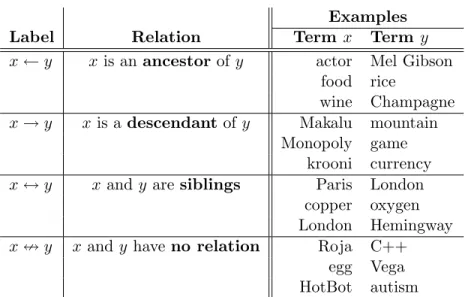
Table 3.1: Four taxonomic relations and some examples of each relation. Note that London is an ambiguous concept. It can be a city, thus a sibling of Paris, but can also refer to Jack London, thus a sibling ofHemingway
.
3.2
Algorithmic Approach
3.2.1 Preliminaries
The basic problem that we address in this work is the identification of fundamental taxonomic rela-tions between any two well-segmented terms. Instead of building structured resources that record taxonomic relations among concepts as in previous work, our system focuses on directly classifying any two input terms into fundamental taxonomic relations including ancestor-descendant,siblings orno relation.
The main component of our system is a taxonomic relation classifier that is trained on annotated data consisting of pairs of terms and their taxonomic relations. In order to directly identify the directionality of the relations between input terms, we explicitly train and evaluate the classifier on four relation labels —ancestor,descendant,siblingand no relation. Some examples in the training data, which consists of pairs of terms with four labels, are shown in Table 3.1.
It is worth noting that it is a pragmatic decision to determine whether two terms hold a taxonomic relation. For example, according to the Wikipedia category system, George W. Bush is a descendant of Presidents of the United Statesand also a descendant of people, mammals, and organisms. Without any constraint, the term George W. Bush, therefore, could be considered as
TAREC (Training)
Input Annotated data D={(x, y, rel)} Wikipedia W
Algorithm: 1. D0 =∅
2. For each (x, y, rel)∈ D
3. Rx ←WikiRepresentation(x,W) 4. Ry ←WikiRepresentation(y,W) 5. D0 =D0∪(R x,Ry, rel) 6. C ←ExtractFeaturesAndTrainClasifier(D0) 7. Return: C
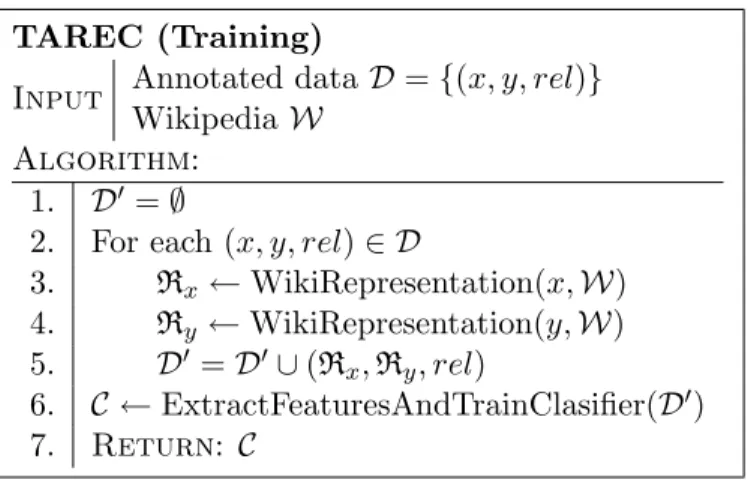
Figure 3.1: The TAREC training algorithm.
a sibling of the term oak (tree) because they share organisms as a common subsumer. Obviously, we do not want to predict that George W. Bush and oak are siblings. In this work, we make use of Wikipedia structure as a source of background knowledge and use it to infer taxonomic relations between terms. Our taxonomic relation identifier uses a constant K – the maximum level to recursively climb up the Wikipedia category structure from a given concept – as a way to control determining of taxonomic relations between terms. Note that K is fixed for all relations and concepts
3.2.2 Overview
In this section, we present the overview of our TAxonomic RElation Classification (TAREC) system. The system consists of a training and an evaluation algorithms. Briefly, the training algorithm learns from a supervised training data set a local classifier that is used evaluation time in a constraint-based inference model to make the final prediction. We describe the algorithms below.
TAREC Training Algorithm
The training algorithm of TAREC is shown in Fig. 3.1. The input to the algorithm includes supervised training data Dand Wikipedia data W. The training data consists of examples in the form of triples (x, y, rel), where x and y are two terms and rel is their taxonomic relation. The relationreldenotes the taxonomic relation from xtoy. For example, triple (newspaper,New York
TAREC (Evaluation)
Input
A pair of terms (x, y) Wikipedia W
Taxonomic relation classifierC Algorithm:
1. Rx←WikiRepresentation(x,W) 2. Ry ←WikiRepresentation(y,W) 3. Px,y ←Classify(Rx,Ry,C)
4. Zx,y ←ExtractRelatedTerms(x, y)
5. rel←ConstraintBasedInference(Px,y,Zx,y,C) 6. Return: rel
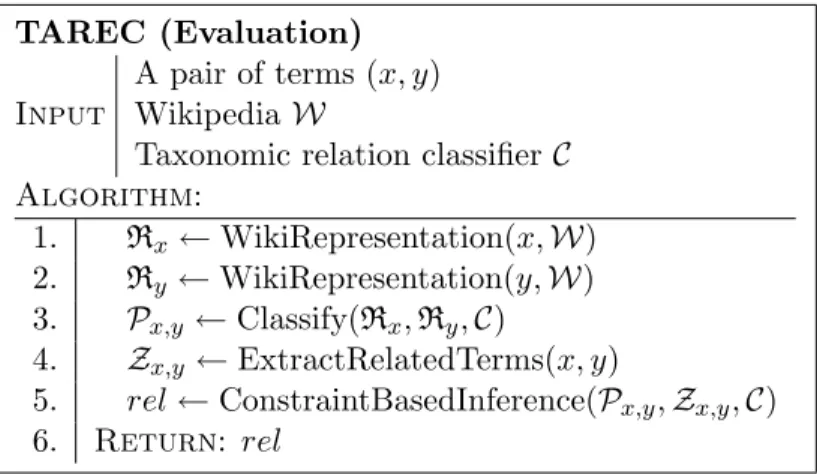
Figure 3.2: The TAREC evaluation algorithm.
Times,←) denotes thatnewspaper is an ancestor ofNew York Times, while (Canada,country,→) denotes thatCanadais a descendant ofcountry. Wikipedia dataW is a local database constructed to allow access to necessary information in Wikipedia. We will discuss this background knowledge source in more details in Section 3.3.
To identify taxonomic relations between two single terms, we first map the terms to some informative representations from which we could extract useful features. The function WikiRepre-sentation(term, W) constructs a Wikipedia-based semantic representation for the input term. A new learning example is formed from the Wikipedia representation of the two input terms and their gold taxonomic relation. The new data is then used to train a local multi-class classifier (C) to predict relations. Note that beside predicting relations, the learned classifier can also predict relation directionality due to the fact that we explicitly have four relation labels in the training data — x is an ancestor of y, x is a descendant of y, x and y are siblings, and x and y have no relation. We consider the classifier returned from the TAREC training algorithm as alocalclassifier to distinguish it from the global inference process employed in the TAREC evaluation algorithm.
TAREC Evaluation Algorithm
Given two terms (x, y), we apply the TAREC evaluation algorithm to predict their taxonomic relation. The evaluation algorithm uses the local classifier C learned using the TAREC training algorithm to predict the probability distribution over four taxonomic relation labels of (x, y) with background knowledge sourceW. As we do when training, the two input terms are first mapped to
a Wikipedia-based representation. The representations ofxandyare then classified byCto get the probability distribution, Px,y, over the relation classes. Following that, the predicted probability distribution is used in a relational constraint-based inference model that takes advantage of other related concepts, Zx,y, of (x, y) to enforce a final coherent prediction on the taxonomic relation between x and y. In the inference model, we present a novel approach that leverages related concepts of two input terms, extracted from an existing knowledge source, to form a coherent relational structure that supports an accurate global prediction of taxonomic relations between input terms. The TAREC evaluation algorithm is summarized in Fig. 3.2.
3.3
Learning Local Taxonomic Relation Classifier
The TAREC training algorithm focuses on learning to predict the probability distribution over the possible taxonomic relations between two terms. It is clear that two single terms do not provide informative features to predict a relation between them. Our key idea is that we first map input terms to a more expressive representation space that allows us to extract rich features. To accommodate this idea, we take advantage of the structure of Wikipedia pages to map input terms to corresponding pages in Wikipedia.
Conceptually, Wikipedia provides a category structure. Thus, it may help us directly read off the taxonomic relations between terms. However, since terms could be ambiguous, this could lead to uncertain situations when they are mapped to Wikipedia pages (e.g. the term Ford could be mapped to both Ford Motor Companyand presidentGerald Ford.) Furthermore, even if a term is mapped to a Wikipedia page correctly, it is not easy to directly use the Wikipedia category system to infer its relation to another term due to the fact that the taxonomic relation information may be hidden in the text of their Wikipedia pages, not simply in the categories. For example, Bill Clinton is a descendant ofAmerican, but there is no explicit Wikipedia category Americanin the Wikipedia page of Bill Clinton. Nevertheless, the fact that there are indeed categories American health activists and American humanitarians on the Bill Clinton Wikipedia page would be very helpful to inferring its taxonomic relation to the term American.
In this section, we first briefly describe the structure of Wikipedia pages, then we introduce two mapping procedures that produce different behaviors in our final systems, and finally, we present
Page Title Text Categories Regular (Non-Redirection) pages
President of the United States
The President of the United States is the head of state and head of government of the United States and is the highest political of-ficial in the United States by influence and recognition. The President leads the execu-tive branch of the federal government and is one of only two elected members of the exec-utive branch...
Presidents of the United States, Presidency of the United States
George W.
Bush
George Walker Bush; born July 6, 1946) served as the 43rd President of the United States from 2001 to 2009. He was the 46th Governor of Texas from 1995 to 2000 before being sworn in as President on January 20, 2001...
Children of Presidents of the United States, Gover-nors of Texas, Presidents of the United States, Texas Republicans...
Gerald Ford Gerald Rudolff Ford (born Leslie Lynch King, Jr.) (July 14, 1913 December 26, 2006) was the 38th President of the United States, serv-ing from 1974 to 1977, and the 40th Vice Pres-ident of the United States serving from 1973 to 1974.
Presidents of the United States, Vice Presidents of the United States, Repub-lican Party (United States) presidential nominees...
Redirect pages
US President #Redirect [[President of the United States]] (N/A) Gerald R. Ford #Redirect [[Gerald Ford]] (N/A)
Disambiguation pages
Ford #Refer [[Ford Motor Company]] Disambiguation page,
#Refer [[Gerald R. Ford]] Surnames
#Refer [[Henry Ford]] #Refer [[Ford’s Theatre]]
table #Refer [[Table (furniture)]] Disambiguation page
#Refer [[Table (information)]] #Refer [[Table (database)]]
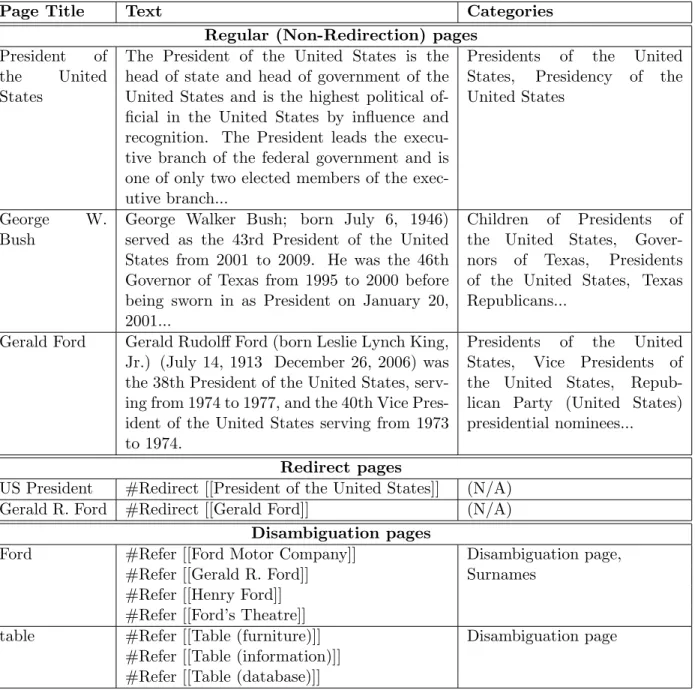
Table 3.2: An excerpt of the structure of Wikipedia pages the learning features.
3.3.1 The Structure of Wikipedia Pages
The majority of Wikipedia pages provide information about concepts (or entities). Typically, each concept page consists of three important pieces of information: a title (usually identical to the concept surface form), a body text which describes the concept, and the categories to which the
concept belongs. The upper part of Table 3.2 shows snippets of some regular pages exemplifying the information of conceptsPresident of the United States,George W. Bushand Gerald Ford.
In addition, it is common for a concept to be referred to in multiple ways. For example, Gerald Fordcan also be referred to as Gerald R. Ford,Gerald Rudolph Ford, Jr. orPresident Ford. Fixed resources, such as WordNet and the Extended WordNet, are not able to deal with this issue, whereas the Wikipedia page structure provides an excellent resource to address this problem. The reason is that Wikipedia maintains a huge system of redirect pages that redirects uncanonical concepts to their canonical form. The middle part of Table 3.2 illustrates some redirect pages and their references. Redirect pages usually do not have categories because the categories are maintained on corresponding canonical pages.
Furthermore, a term may be ambiguous and could refer to multiple concepts. Fortunately, Wikipedia provides a clear organization of ambiguous concepts in a special page structure that consists of disambiguation pages. Each disambiguation page contains several concepts that an ambiguous term may refer to. The last part of Table 3.2 shows the disambiguation pages of two terms,Fordand table, and the concepts they refer to. Note that it is possible for a referred concept to be linked to a redirect page. For instance, Ford may refer to Gerald R. Ford, which is, in turn, redirected to canonical the conceptGerald Ford.
Together, all these pieces of information make Wikipedia page structure a valuable resource when building a semantic representation for input terms.
3.3.2 Wikipedia-based Semantic Representation
In this section, we present two approaches to constructing Wikipedia-based semantic representa-tions for input terms. Both approaches are motivated by the intuition that real-world applicarepresenta-tions are usually interested in identifying relation between related terms rather than arbitrary ones. For example, it is more likely that the termFordin the pair (George W. Bush,Ford) refers to the former president of the United States,Gerald Ford, than to the car manufacturerFord Motor Companyor its founder Henry Ford. Our approaches below take this intuition into account when constructing the term’s Wikipedia semantic representation.
to the Wikipedia page associated with a concept expressed by the page title. For example, the Wikipedia page Gerald Ford is associated with the Wikipedia conceptGerald Ford.
Match-based Approach
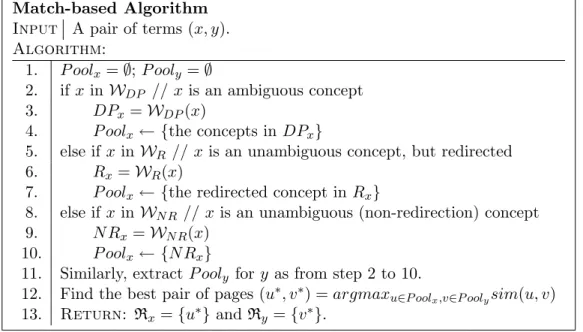
Intuitively, given a term, this approach looks for the most appropriate Wikipedia page that best matches (i.e. best describes) the term. To this end, the match-based approach maps the term to Wikipedia pages by directly looking it up and matching it with Wikipedia pages’ title. Beside regular pages, we make use of both redirect and disambiguation pages. Given a pair of terms, the output of this procedure includes two Wikipedia pages that provide the best description of the two input terms, respectively.
In this approach, each Wikipedia concept page, px (wherex is a Wikipedia concept), is repre-sented by a set of keywords, KWx. The keywords are extracted by selecting the top tokens in the body text and the categories of the page ranked by their TF-IDF scores. In this work, for each Wikipedia page, we use the first paragraph of the body text as an approximation for the whole text. We use the Porter stemmer to normalize the tokens.3 For example, Wikipedia page Gerald Fordis represented by the following list of normalized tokens{ford, presid, amend, gerald, vice, fifth, serv, fortieth, state, rudolph, nixon, unit, resign, eighth, thirti, constitut, twenti, term, person, bachil, episcopalian, adopte, waterg, wolverin, cardiovascular, nomine, recipi, communist, lawyer, rapid, omaha, scout, death, descend, yale, alumni, eagl}. In our experiments, we used a maximum of top 40 keywords ofKWx, including the top 20 keywords of the text and the top 20 keywords from the categories ofx.
Furthermore, each Wikipedia concept x is characterized by an absolute prominence score, αx, which is defined as the number of times it is hyperlinked in the whole Wikipedia corpus. Intuitively, the prominence notion of a concept encodes its popularity by measuring how often it is linked to from other Wikipedia pages. Given a pair of unambiguous concepts (x, y), we define their similarity as follows:
sim(x, y) =αx×αy× |KWx∩KWy| 3
Match-based Algorithm
Input A pair of terms (x, y). Algorithm:
1. P oolx =∅;P ooly =∅
2. ifxinWDP // x is an ambiguous concept 3. DPx=WDP(x)
4. P oolx← {the concepts in DPx}
5. else ifxinWR //x is an unambiguous concept, but redirected 6. Rx=WR(x)
7. P oolx← {the redirected concept in Rx}
8. else ifxinWN R // xis an unambiguous (non-redirection) concept 9. N Rx=WN R(x)
10. P oolx← {N Rx}
11. Similarly, extractP ooly fory as from step 2 to 10.
12. Find the best pair of pages (u∗, v∗) =argmaxu∈P oolx,v∈P oolysim(u, v)
13. Return: Rx ={u∗}and Ry ={v∗}.
Figure 3.3: The Match-based approach to constructing Wikipedia-based semantic representations. For a disambiguation pageDPx of termx (e.g. x =Ford as shown in Table 3.2), each referred concept u ∈ DPx is assigned a relative prominence score αxu = αu
maxu0∈DPxαu0, where αu is the
absolute prominence scores of u. Given a concept u ∈ DPx and a concept v ∈ DPy, we define the similarity score of pair (u, v) as follows: sim(u, v) =αux×αyv × |KWu∩KWv|. In general, if x is unambiguous (i.e. x matches a normal page or a redirected page in Wikipedia), its absolute prominence score is used. Otherwise, relative prominence score is used in the similarity metric.
Let WDP be the list of Wikipedia disambiguation pages, WR be the list of redirect pages, and WN R be the list of regular (non-redirection) pages. We useWDP(x),WR(x) and WN R(x) to denote the functions that map termxto the best corresponding Wikipedia page in WDP,WR and WN R, respectively. A term is mapped to a Wikipedia page via an exact string matching operation between the term and the title of the page.
Given input pair (x, y), the match-based approach follows the algorithm sketched in Figure 3.3 to select the best Wikipedia page for each input term.
Note that if x is unambiguous, x is mapped to a single Wikipedia page, andP oolx, therefore, has only one single member. In this case, the absolute prominence scoreαx is used in the similarity scoring function. This is similar for y and P ooly.
Search-based Approach
The key idea in our second approach is that we look for a set of relevant pages in the Wikipedia corpus to be used as a representation of a term, rather than a single page as in the match-based approach. This approach requires information retrieval techniques to search and retrieve relevant Wikipedia pages. In this work, we use the local search engine Lucene.4 The main procedure of this approach proceeds as follows:
1. Input: A pair of well-segmented terms (x, y).
2. Create a unified query by concatenatingx ANDy. For example, for pair (George W. Bush, Gerald Ford), the unified query isGeorge W. Bush AND Gerald Ford.
3. Search the complete Wikipedia corpus text using the unified query to retrieve a list of relevant pages,Lx,y.
4. Extract the top important keywords from the categories of the pages in Lx,y by ranking them using TF-IDF scores. Intuitively, this search will retrieve relevant pages for both input terms, so the top extracted keywords will tie the semantic meaning of the two input terms to each other. For example, the unified query in step (1) will retrieve relevant pages of both George W. BushandGerald Ford. From the retrieved pages, extracted keywords may include: president,politician,united,state, etc..
5. Concatenate each input term with the list of keywords extracted in step 4. For instance, George Bushwill be augmented to make a conjunctive query: George W. BushANDpresident ANDpolitician ANDunited ANDstate.
6. Search for the top relevant pages,Rx andRy of xand yusing their new queries from step 5. 7. Return: Rx and Ry as the Wikipedia representations ofx and y, respectively.
In our experiments, we use the top 10 keywords in step 4, and 10 Wikipedia pages as the maximum number of pages in the Wikipedia representation of each term returned in step 7.
Term Page Title Text Category
Gerald Ford Gerald Ford Gerald Rudolff Ford (born Leslie Lynch King, Jr.) (July 14, 1913 De-cember 26, 2006) was the 38th Pres-ident of the United States, serving from 1974 to 1977, and the 40th Vice President of the United States serving from 1973 to 1974...
Presidents of the United States, Vice Presidents of the United States, Re-publican Party (United States) presidential nomi-nees...
Presidency of Gerald Ford
Gerald Rudolff Ford (born Leslie Lynch King, Jr.) (July 14, 1913 De-cember 26, 2006) was the 38th Pres-ident of the United States, serving from 1974 to 1977, and the 40th Vice President of the United States serving from 1973 to 1974...
Presidents of the United States, Vice Presidents of the United States, Re-publican Party (United States) presidential nomi-nees...
Electoral history of Gerald Ford
Electoral history of Gerald Ford, 38th President of the United States and 40th Vice President of the United States...
Gerald Ford, Electoral his-tory of American politi-cians...
Bush George W.
Bush
George Walker Bush; born July 6, 1946) served as the 43rd President of the United States from 2001 to 2009. He was the 46th Governor of Texas from 1995 to 2000 before being sworn in as President on January 20, 2001...
Children of Presidents of the United States, Gover-nors of Texas, Presidents of the United States, Texas Republicans...
George H. W. Bush
George Herbert Walker Bush (born June 12, 1924) is an American politi-cian who served as the 41st President of the United States (198993)...
Parents of Presidents of the United States, Presi-dents of the United States, Texas Republicans... Presidency
of George W. Bush
The presidency of George W. Bush be-gan on January 20, 2001, when he was inaugurated as the 43rd President of the United States of America...
Presidencies of the United States, Presidency of George W. Bush...
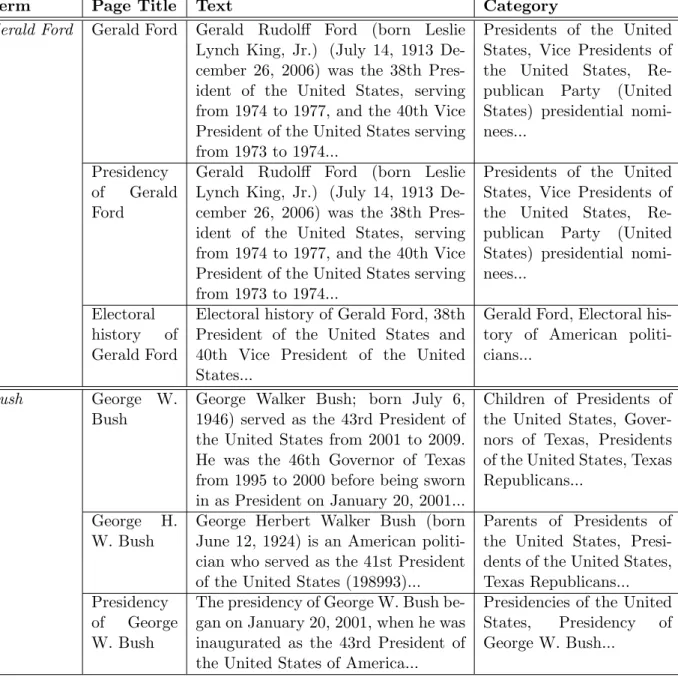
Table 3.3: A short version of the Wikipedia representation of input pair(Bush,Gerald Ford). Note that page Presidency of Gerald Ford is redirected to page Gerald Ford; they, therefore, get the same text and category list.
3.3.3 Feature Extraction
The features of a pair of terms are extracted from their Wikipedia representations. As discussed earlier (Section 3.3.1), a regular Wikipedia page of a Wikipedia concept usually consists of a title, a body text, and a list of categories to which the concept belongs. For convenience, for a term x, we usethe titles ofx,the text ofx, andthe categories of xto refer to the titles, text, and categories of the associated pages in the representation ofx. Table 3.3 shows a short version of the Wikipedia representation of two input terms Gerald Ford and Bush extracted by the search-based approach. Note that the pages in the Wikipedia representation ofBushare mostly about presidency because the term is influenced by the other term Gerald Ford, as expected in the search-based approach. In this context, the titles of Gerald Ford,the text of Gerald Fordand the categories of Gerald Ford consist of all the titles, the body text and the categories of the Wikipedia pages in the Wikipedia representation of Gerald Ford, respectively. Similar notions apply to the termBush.
In addition to the direct categories of a Wikipedia page of a term, we also collect its higher-level categories: we start from the categories of the page in its representation and recursively go up K levels on the Wikipedia category system as before. The categories of a term are the union of its direct categories and all the categories of the upper level pages.
Below we present the features extracted for an input pair of terms, (x, y), that will be used in learning the relations classifier. All features are real value.
Bag-of-words Similarity: We define four bag-of-words features as the degree of similarity among the texts and categories of x and y. The features are shown in Table 3.4. We use the cosine similarity metric to measure the value of these features. Let vtx =< w1, w2,· · · > be the
bag-of-words feature vector of the texts of termx, where wi is the indicator variable that indicates whether a particular word at positioni is present in the text ofx. Letvyc=< w1, w2,· · ·>be the
bag-of-words feature vector of the category ofy. The similarity strength between the text ofx and the categories ofy is measured as in Equation (5.4).
sim(vtx, vcy) = − → vtx•−→vyc k−→vxtkk−→vyck (3.1) 4 E.g. http://lucene.apache.org/