Streamed Learning: One-Pass SVMs
Piyush Rai, Hal Daum´e III, Suresh Venkatasubramanian
University of Utah, School of Computing
{
piyush,hal,suresh
}
@cs.utah.edu
Abstract
We present a streaming model for large-scale clas-sification (in the context ofℓ2-SVM) by leveraging
connections between learning and computational geometry. The streaming model imposes the con-straint that only a single pass over the data is al-lowed. Theℓ2-SVM is known to have an equivalent
formulation in terms of the minimum enclosing ball (MEB) problem, and an efficient algorithm based on the idea of core sets exists (CVM) [Tsang et al., 2005]. CVM learns a(1+ε)-approximate MEB for a set of points and yields an approximate solution to corresponding SVM instance. However CVM works in batch mode requiring multiple passes over the data. This paper presents a single-pass SVM which is based on the minimum enclosing ball of streaming data. We show that the MEB updates for the streaming case can be easily adapted to learn the SVM weight vector in a way similar to using on-line stochastic gradient updates. Our algorithm per-forms polylogarithmic computation at each exam-ple, and requires very small and constant storage. Experimental results show that, even in such re-strictive settings, we can learn efficiently in just one pass and get accuracies comparable to other state-of-the-art SVM solvers (batch and online). We also give an analysis of the algorithm, and discuss some open issues and possible extensions.
1
Introduction
Learning in a streaming model poses the restriction that we are constrained both in terms of time, as well as storage. Such scenarios are quite common, for example, in cases such as analyzing network traffic data, when the data arrives in a streamed fashion at a very high rate. Streaming model also applies to cases such as disk-resident large datasets which cannot be stored in memory. Unfortunately, standard learning algorithms do not scale well for such cases. To address such scenarios, we propose applying the stream model of computa-tion [Muthukrishnan, 2005] to supervised learning problems. In the stream model, we are allowed only one pass (or a small number of passes) over an ordered data set, and polylogarith-mic storage and polylogarithpolylogarith-mic computation per element.
In spite of the severe limitations imposed by the streaming framework, streaming algorithms have been successfully em-ployed in many different domains [Guha et al., 2003]. Many of the problems in geometry can be adapted to the stream-ing settstream-ing and since many learnstream-ing problems have equivalent geometric formulations, streaming algorithms naturally mo-tivate the development of efficient techniques for solving (or approximating) large-scale batch learning problems.
In this paper, we study the application of the stream model to the problem of maximum-margin classification, in the context ofℓ2-SVMs [Vapnik, 1998; Cristianini and
Shawe-Taylor, 2000]. Since the support vector machine is a widely used classification framework, we believe success here will encourage further research into other frameworks. SVMs are known to have a natural formulation in terms of the minimum enclosing ball problem in a high dimensional space [Tsang et al., 2005; 2007]. This latter problem has been extensively studied in the computational geometry literature and admits natural streaming algorithms [Zarrabi-Zadeh and Chan, 2006; Agarwal et al., 2004]. We adapt these algorithms to the clas-sification setting, provide some extensions, and outline some open issues. Our experiments show that we can learn effi-ciently in just one pass and get competetive classification ac-curacies on synthetic and real datasets.
2
Scaling up SVM Training
Support Vector Machines (SVM) are maximum-margin kernel-based linear classifiers [Cristianini and Shawe-Taylor, 2000] that are known to provide provably good generaliza-tion bounds [Vapnik, 1998]. Tradigeneraliza-tional SVM training is for-mulated in terms of a quadratic program (QP) which is typ-ically optimized by a numerical solver. For a training size ofN points, the typical time complexity isO(N3
)and stor-age required is O(N2
)and such requirements make SVMs prohibitively expensive for large scale applications. Typical approaches to large scale SVMs, such as chunking [Vapnik, 1998], decomposition methods [Chang and Lin, 2001] and SMO [Platt, 1999] work by dividing the original problem into smaller subtasks or by scaling down the training data in some manner [Yu et al., 2003; Lee and Mangasarian, 2001]. How-ever, these approaches are typically heuristic in nature: they may converge very slowly and do not provide rigorous guar-antees on training complexity [Tsang et al., 2005]. There has been a recent surge in interest in the online learning literature
for SVMs due to the success of various gradient descent ap-proaches such as stochastic gradient based methods [Zhang, 2004] and stochastic sub-gradient based approaches[Shalev-Shwartz et al., 2007]. These methods solve the SVM opti-mization problem iteratively in steps, are quite efficient, and have very small computational requirements. Another recent online algorithm LASVM [Bordes et al., 2005] combines on-line learning with active sampling and yields considerably good performance doing single pass (or more passes) over the data. However, although fast and easy to train, for most of the stochastic gradient based approaches, doing a single pass over the data does not suffice and they usually require running for several iterations before converging to a reason-able solution.
3
Two-Class Soft Margin SVM as the MEB
Problem
A minimum enclosing ball (MEB) instance is defined by a set of pointsx1, ...,xN ∈RDand a metricd:RD×RD→R≥0.
The goal is to find a point (the center)c∈RDthat minimizes the radiusR= maxnd(xn,c).
The 2-classℓ2-SVM [Tsang et al., 2005] is defined by a
hypothesis f(x) = wTϕ(x), and a training set consisting
ofN points{zn = (xn, yn)}Nn=1 withyn ∈ {−1,1} and
xn∈RD. The primal of the two-classsℓ2-SVM (we consider
the unbiased case one—the extension is straightforward) can be written as min w,ξi|| w||2+C X i=1,m ξ2 i (1) s.t. yi(w′ϕ(xi))≥1−ξi, i= 1, ..., N (2)
The only difference between theℓ2-SVM and the standard
SVM is that the penalty term has the form(CP
nξn
2
)rather than(CP
nξn).
We assume a kernel K with associated nonlinear feature mapϕ. We further assume thatKhas the propertyK(x,x) =
κ, whereκis a fixed constant [Tsang et al., 2005]. Most stan-dard kernels such as the isotropic, dot product (normalized inputs), and normalized kernels satisfy this criterion.
Suppose we replace the mappingϕ(xn)onxn by another
nonlinear mappingϕ˜(zn)onznsuch that (for unbiased case) ˜ ϕ(zn) = h ynϕ(xn);C−1/2en i ⊤ (3)
The mapping is done in a way that that the label information yn is subsumed in the new feature mapϕ˜ (essentially,
con-verting a supervised learning problem into an unsupervised one). The first term in the mapping corresponds to the feature term and the second term accounts for a regularization effect, whereCis the misclassification cost.enis a vector of
dimen-sionN, having all entries as zero, except thenthentry which
is equal to one.
It was shown in [Tsang et al., 2005] that the MEB instance
( ˜ϕ(z1),ϕ˜(z2), . . .ϕ˜(zN)), with the metric defined by the
in-duced inner product, is dual to the correspondingℓ2-SVM
instance (1). The weight vectorwof the maximum margin hypothesis can then be obtained from the centercof the MEB using the constraints induced by the Lagrangian [Tsang et al., 2007].
4
Approximate and Streaming MEBs
The minimum enclosing ball problem has been extensively studied in the computational geometry literature. An in-stance of MEB, with a metric defined by an inner product, can be solved using quadratic programming[Boyd and Van-denberghe, 2004]. However, this becomes prohibitively ex-pensive as the dimensionality and cardinality of the data in-creases; for anN-point SVM instance inDdimensions, the resulting MEB instance consists ofN points in N +D di-mensions.
Thus, attention has turned to efficient approximate solu-tions for the MEB. A δ-approximate solution to the MEB (δ >1) is a pointcsuch thatmaxnd(xn,c) ≤δR∗, where
R∗ is the radius of the true MEB solution. For example,
A (1 +ǫ)-approximation for the MEB can be obtained by extracting a very small subset (of size O(1/ǫ)) of the input called a core-set [Agarwal et al., 2005], and running an ex-act MEB algorithm on this set [B˘adoiu and Clarkson, 2002]. This is the method originally employed in the CVM [Tsang et al., 2005]. [Har-Peled et al., 2007] take a more direct ap-proach, constructing an explicit core set for the (approximate) maximum-margin hyperplane, without relying on the MEB formulation. Both these algorithms take linear training time and require very small storage. Note that aδ-approximation for the MEB directly yields a δ-approximation for the regu-larized cost function associated with the SVM problem.
Unfortunately, the core-set approach cannot be adapted to a streaming setting, since it requiresO(1/ǫ)passes over the training data. Two one-pass streaming algorithms for the MEB problem are known. The first [Agarwal et al., 2004] finds a(1 +ǫ)approximation usingO((1/ε)⌊D/2⌋)storage
and O((1/ε)⌊D/2⌋N) time. Unfortunately, the exponential
dependence onD makes this algorithm impractical. At the other end of the space-approximation tradeoff, the second al-gorithm [Zarrabi-Zadeh and Chan, 2006] stores only the cen-ter and the radius of the current ball, requiringO(D)space. This algorithm yields a 3/2-approximation to the optimal en-closing ball radius.
4.1
The StreamSVM Algorithm
We adapt the algorithm of [Zarrabi-Zadeh and Chan, 2006] for computing an approximate maximum margin classifier. The algorithm initializes with a single point (and therefore an MEB of radius zero). When a new point is read in off the stream, the algorithm checks whether or not the current MEB can enclose this point. If so, the point is discarded. If not, the point is used to suitably update the center and radius of the current MEB. All such selected points define a core set of the original point set.
Letpibe the input point causing an update to the MEB and
Bibe the resulting ball after the update. From figure 1, it is
easy to verify that the new center ci lies on the line joining
the old centerci−1and the new pointpi. The radiusriand
the centerciof the resulting MEB can be defined by simple
update equations.
ri=ri−1+δi (4)
Here2δi = (||pi−ci−1|| −ri−1)is the closest distance of
the new pointpifrom the old ballBi−1. Using these, we can
define a closed-form analytical update equation for the new ballBi:
ci=ci−1+ δi
||pi−ci−1||
(pi−ci−1) (6)
Figure 1: Ball updates
It can be shown that, for adversarially constructed data, the radius of the MEB computed by the algorithm has a lower-bound of(1 +√2)/2and a worst-case upper-bound of3/2
[Zarrabi-Zadeh and Chan, 2006].
We adapt these updates in a natural way in the augmented feature spaceϕ˜ (see Algorithm 1). Each selected point be-longs to the core set for the MEB. The support vectors of the corresponding SVM instance come from this set. It is easy to verify that the update equations for weight vector (w) and the margin (R) in StreamSVM correspond to the center and radius updates for the ball in equation 7 and 4 respectively. Theξ2
term is the distance calculation is included to account for the fact that the distance computations are being done in theD+N dimensional augmented feature spaceϕ˜which, for the linear kernel case, is given by:
˜ ϕ(zn) = h ynxn;C−1/2en i ⊤. (7)
Also note that, because we perform only a single pass over the data and theencomponents are all mutually orthogonal, we
never need to explicitly store them. The number of updates to the weight vector is limited by the number of core vectors of the MEB, which we have experimentally found to be much smaller as compared to other algorithms (such as Perceptron). The space complexity of StreamSVM is small since only the weight vector and the radius need be stored.
4.2
Kernelized StreamSVM
Although our main exposition and experiments are with linear kernels, it is straightforward to extend the algo-rithm for nonlinear kernels. In that case, algorithm 1, instead of storing the weight vector w, stores an N -dimensional vector of Lagrange coefficients α initialized as [y1, . . . ,0]. The distance computation is line 5 are
re-placed by d2
= P
n,mαnαmk(xn,xm) + k(xn,xn) −
2ynPmαmk(xn,xm) + ξ2 + 1/C, and the weight
vec-tor updates in line 7 can be replaced by Lagrange coeffi-cients updatesα1:n−1 = α1:n−1(1− 1 2(1−R/d)), αn = 1 2(1−R/d)yn. Algorithm 1 StreamSVM
1: Input: examples(xn, yn)n∈1...N, slack parameterC
2: Output: weights (w), radius (R), number of support vec-tors (M)
3: Initialize:M = 1;R= 0;ξ2
= 1,w=y1x1
4: forn= 2toNdo
5: Compute distance to center: d=p kw−ynxnk2+ξ2+ 1/C 6: ifd≥Rthen 7: w=w+1 2(1−R/d) (ynxn−w) 8: R=R+1 2(d−R) 9: ξ2 =ξ2 1−1 2(1−R/d) 2 +1 2(1−R/d) 2 10: M =M+ 1 11: end if 12: end for
Algorithm 2 StreamSVM with lookahead L
Input: examples(xn, yn)n∈1...N, slack parameterC,
looka-head parameterL≥1
Output: weights (w), radius (R), upper bound on number of support vectors (M)
1: Initialize:M = 1;R= 0;ξ2
= 1;S=∅;w=y1x1
2: forn= 2toNdo
3: Compute distance to center: d=p
kw−ynxnk2+ξ2+ 1/C
4: ifd≥Rthen
5: Add examplento the active set:
S=S∪ {ynxn}
6: if|S|=Lthen 7: Update w, R, ξ2
to enclose the ball (w, R, ξ2
)
and all points inS
8: M =M+L;S=∅ 9: end if 10: end if 11: end for 12: if|S|>0then 13: Updatew, R, ξ2
to enclose the ball(w, R, ξ2
)and all points inS
14: M =M+|S|
15: end if
4.3
StreamSVM approximation bounds and
extension to multiple balls
It was shown in [Zarrabi-Zadeh and Chan, 2006] that any streaming MEB algorithm that uses onlyO(D)storage ob-tains a lower-bound of (1 +√2)/2 and an upper-bound of 3/2 on the quality of solution (i.e., the radius of final MEB). Clearly, this is a conservative approximation and would af-fect the obtained margin of the resulting SVM classifier (and hence the classification performance). In order to do better in just a single pass, one possible conjecture could be that the algorithm must remember more. To this end, we therefore extended algorithm-1 to simultaneously storeLweight vec-tors (or “balls”). The space complexity of this algorithm is L(D+ 1)floats and it still makes only a single pass over the
data. In the MEB setting, our algorithm chooses with each arriving datapoint (that is not already enclosed in any of the balls) how the currentL+ 1balls (theLballs plus the new data point) should be merged, resulting again into a set ofL balls. At the end, the final set ofLballs are merged together to give the final MEB. A special variant of theLballs case is when all but one of theL balls are of zero radius. This amounts to storing a ball of non-zero radius and to keeping a buffer ofLmany data-points (we call this the lookahead algo-rithm - Algoalgo-rithm 2). Any incoming point, if not already en-closed in the current ball, is stored in the buffer. We solve the MEB problem (using a quadratic program of sizeL) when-ever the buffer is full. Note that algorithm 1 is a special case of algorithm 2 withL=1, with the MEB updates available in a closed analytical form (rather than having to solve a QP).
Algorithm 1 takes linear time in terms of the input size. Algorithm 2 which uses a lookahead ofLsolves a quadratic program of sizeL whenever the buffer gets full. This step takesO(L3
)times. The number of such updates isO(N/L)
(in practice, it is considerably less than N/L) and thus the over all complexity for the lookahead case isO(N L2
). For small lookaheads, this is roughlyO(N).
5
Experiments
We evaluate our algorithm on several synthetic and real datasets and compare it against several state-of-the-art SVM solvers. We use 3 crieria for evaluations: a) Single-pass classification accuracies compared against single-pass of on-line SVM solvers such as iterative sub-gradient solver Pega-sos [Shalev-Shwartz et al., 2007], LASVM [Bordes et al., 2005], and Perceptron [Rosenblatt, 1988]. b) Comparison with CVM [Tsang et al., 2005] which is a batch SVM al-gorithm based on the MEB formulation. c) Effect of using lookahead in StreamSVM. For fairness, all the algorithms used a linear kernel.
5.1
Single-Pass Classification Accuracies
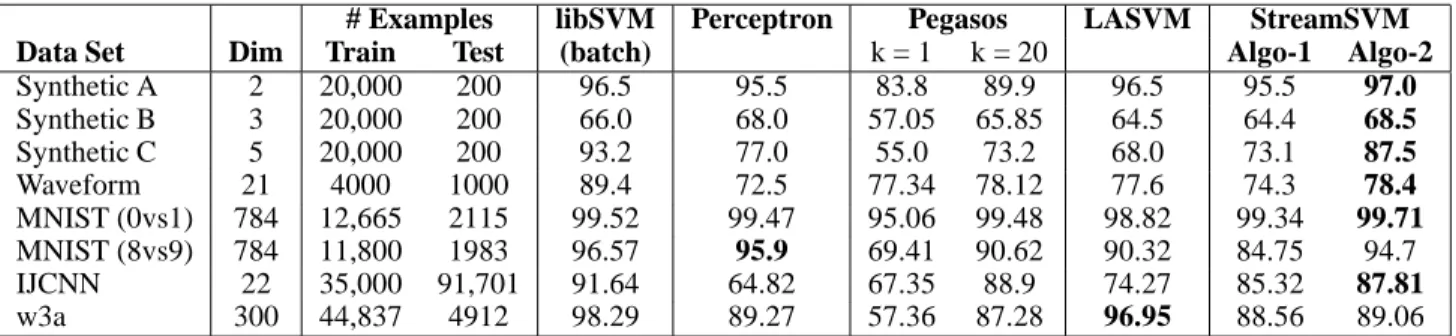
The single-pass classification accuracies of StreamSVM and other online SVM solvers are shown in table-1. Details of the datasets used are shown in table-1. To get a sense of how good the single-pass approximation of our algorithm is, we also report the classification accuracies of batch-mode (i.e., all data in memory, and multiple passes) libSVM solver with linear kernel on all the datasets. The results suggest that our single-pass algorithm StreamSVM, using a small reasonable lookahead, performs comparably to the batch-mode libSVM, and does significantly better than a single pass of other online SVM solvers.
5.2
Comparison with CVM
We compared our algorithm with CVM which, like our al-gorithm, is based on a MEB formulation. CVM is highly efficient for large datasets but it operates in batch mode, mak-ing one pass through the data for each core vector. We are interested in knowing how many passes the CVM must make over the data before it achieves an accuracy comparable to our streaming algorithm. For that purpose, we compared the ac-curacy of our single-pass StreamSVM against two and more
passes of CVM to see how long does it take for CVM to beat StreamSVM (we note here that CVM requires at least two passes over the data to return a solution). We used a lin-ear kernel for both. Shown in Figure 2 are the results on MNIST 8vs9 data and it turns out that it takes several hun-dreds of passes of CVM to beat the single pass accuracy of StreamSVM. Similar results were obtained for other datasets but we do not report them here due to space limitations.
1 2 3 4 6 15 400 724 0 10 20 30 50 55 65 75 85 95 100
CVM vs StreamSVM: MNIST Data (8 vs 9)
Number of passes of CVM
Percent Accuracy
One Pass StreamSVM CVM vs number of passes
Figure 2: MNIST 8vs9 data: Number of passes CVM takes be-fore achieving comparable single-pass accuracy of StreamSVM. X axis represents number of passes of CVM and Y axis represents the classification accuracy. 0 2 4 6 8 10 12 14 16 18 20 70 75 80 85 90 95 100 Lookahead (L) Percent Accuracy
Error bars on accuracy variations w.r.t. random streaming order (for different L)
Figure 3:Single-pass with varying lookahead on MNIST 8vs9 data: Performance w.r.t random ordering of streaming. X axis represents the lookahead parameter and Y axis represents classification accu-racy. Verticle bars represent the standard deviations in accuracies for a given lookahead.
5.3
Effect of Lookahead
We also investigated the effect of doing higher-order looka-heads on the data. For this, we variedL(the lookahead pa-rameter) and, for eachL, tested Algorithm 2 on 100 random permutations of the data stream order, also recording the stan-dard deviation of the classification accuracies with respect to
# Examples libSVM Perceptron Pegasos LASVM StreamSVM Data Set Dim Train Test (batch) k = 1 k = 20 Algo-1 Algo-2
Synthetic A 2 20,000 200 96.5 95.5 83.8 89.9 96.5 95.5 97.0 Synthetic B 3 20,000 200 66.0 68.0 57.05 65.85 64.5 64.4 68.5 Synthetic C 5 20,000 200 93.2 77.0 55.0 73.2 68.0 73.1 87.5 Waveform 21 4000 1000 89.4 72.5 77.34 78.12 77.6 74.3 78.4 MNIST (0vs1) 784 12,665 2115 99.52 99.47 95.06 99.48 98.82 99.34 99.71 MNIST (8vs9) 784 11,800 1983 96.57 95.9 69.41 90.62 90.32 84.75 94.7 IJCNN 22 35,000 91,701 91.64 64.82 67.35 88.9 74.27 85.32 87.81 w3a 300 44,837 4912 98.29 89.27 57.36 87.28 96.95 88.56 89.06
Table 1:Single pass classification accuracies of various algorithms (all using linear kernel). The synthetic datasets (A,B,C) were generated using normally distributed clusters, and were of about 85% separability. libSVM, used as the absolute benchmark, was run in batch mode (all data in memory). StreamSVM Algo-2 used a small lookahead (∼10). Note: We make the Pegasos implementation do a single sweep over data and have a user chosen block sizekfor subgradient computations (we used k=1, and k=20 akin to using a lookahead of 20). Perceptron and LASVM are also run for a single pass and do not need block sizes to be specified. All results are averaged over 20 runs (w.r.t. random orderings of the stream)
the data-order permutations. Note that the algorithm still per-forms a single pass over the data. Figure 3 shows the results on the MNIST 8vs9 data (similar results were obtained for other datasets but not shown due to space limitations). In this figure, we see two effects. Firstly, as the lookahead increase, performance goes up. This is to be expected since in the limit, as the lookahead approaches the data set size, we will solve the exact MEB problem (albeit at a high computational cost). The important thing to note here is that even with a small lookahead of10, the performance converges. Secondly, we see that the standard deviation of the result decreases as the lookahead increases. This shows experimentally that higher lookaheads make the algorithm less susceptible to badly or-dered data. This is interesting from an empirical perspective, given that we can show that in theory, any value ofL < N cannot improve upon the 3/2-approximation guaranteed for L= 1.
6
Analysis, Open Problems, and Extensions
There are several open problems that this work brings up:1. Are the (1 +√2)/2 lower-bound and the3/2 upper-bound on MEB radius indeed the best achievable in a single pass over the data?
2. Is it possible to use a richer geometric structure instead of a ball and come up with streaming variants with prov-ably good approximation bounds?
We discuss these in some more detail here.
6.1
Improving the Theoretical Bounds
One might conjecture that storing more information (i.e., more points) would give better approximation guarantees in the streaming setting. Although the empirical results showed that such approaches do result in better classification accura-cies, this is not theoretically true in many cases.
For instance, in the adversarial stream setting, one can show that neither the lookahead algorithm nor its more gen-eral case (the multiple balls algorithm) improves the bounds given by the simple no-lookahead case (Algorithm-1). In par-ticular, one can prove an identical upper- and lower-bound
for the lookahead algorithm as for the no-lookahead algo-rithm. To obtain the3/2-upper bound result, one can show a nearly identical construction as to [Zarrabi-Zadeh and Chan, 2006] whereL−1 points are packed in a small, carefully constructed cloud the boundary of the true MEB.
Alternatively, one can analyze these algorithms in the ran-dom stream setting. Here, the input points are chosen adver-sarially, but their order is permuted randomly. The lookahead model is not strengthened in this setting either: we can show both that the lower bound for no-lookahead algorithms, as well as the 3/2-upper bound for the specific no-lookahead al-gorithm described, generalize. For the former, see Figure 4. We place (N −1)/2 points around (0,1) and (N −1)/2
points around(0,−1)and one point at(1 +√2,0). The al-gorithm will only beat the (1 +√2)/2 lower bound if the singleton appears in the firstLpoints, whereLis the looka-head used. Assuming the lookalooka-head is polylogarithmic inN (which must be true for a streaming algorithm), this means that asN −→ ∞, the probability of a better bound tends to-ward zero. Note, however, that this applies only to the looka-head model, not to the more general multiple balls model, where it may be possible to obtain a tighter bounds in the ran-dom stream setting.
Figure 4:An adversarially constructed setting.
6.2
Ellipsoidal Balls
Instead of using a minimum enclosing ball of points, an al-ternative could be to use a minimum volume ellipsoid (MVE)
[Kumar et al., 2005]. An ellipsoid inRD is defined as fol-lows: {x : (x−c)′A(x
−c) <= 1} where c ∈ RD,
A∈RDxD, andA0(positive semi-definite).
Note that a ball, upon inclusion of a new point, expands equally in all dimensions which may be unnecessary. On the other hand, an ellipsoid can have several axes and scales of variations (modulated by the covariance matrixA). This al-lows the ellipsoid to expand only along those directions where needed. In addition, such an approach can also be seen along the lines of confidence weighted linear classifiers [Dredze et al., 2008]. The confidence weighted (CW) method assumes a Gaussian distribution over the space of weight vectors and updates the mean and covariance parameters upon witnessing each incoming example. Just as CW maintains the models uncertainty using a Gaussian, an ellipsoid generaization can model the uncertainty using the covariance matrixA. Recent work has shown that there exist streaming possibilities for MVE [Mukhopadhyay and Greene, 2008]. The approxima-tion gaurantees, however, are very conservative. It would be interesting to come up with improved streaming algorithms for the MVE case and adapt them for classification settings.
7
Conclusion
Within the streaming framework for learning, we have pre-sented an efficient, single-passℓ2-SVM learning algorithm
using a streaming algorithm for the minimum enclosing ball problem. We have also extended this algorithm to use a lookahead to increase robustness against poorly ordered data. Our algorithm, StreamSVM, satisfies a proven theoretical bound: it provides a 32
-approximation to the optimal solu-tion. Despite this conservative bound, our algorithm is exper-imentally competitive with alternative techniques in terms of accuracy, and learns much simpler solutions. We believe that a careful study of stream-based learning would lead to high quality scalable solutions for other classification problems, possibly with alternative losses and with tighter approxima-tion bounds.
References
[Agarwal et al., 2004] Pankaj K. Agarwal, Sariel Har-Peled, and Kasturi R. Varadarajan. Approximating extent measures of points. volume 51, pages 606–635, New York, NY, USA, 2004. ACM Press.
[Agarwal et al., 2005] P. Agarwal, S. Har-Peled, and K. Varadara-jan. Geometric approximations via coresets. Combinatorial and Computational Geometry - MSRI Publications, 52:1–30, 2005. [Bordes et al., 2005] Antoine Bordes, Seyda Ertekin, Jason
We-ston, and Leon Bottou. Fast kernel classifiers with online and active learning. volume 6, Cambridge, MA, USA, 2005. MIT Press.
[Boyd and Vandenberghe, 2004] Stephen Boyd and Lieven Van-denberghe. Convex Optimization. Cambridge University Press, 2004.
[B˘adoiu and Clarkson, 2002] Mihai B˘adoiu and Kenneth L. Clark-son. Optimal core-sets for balls. In Proc. of DIMACS Workshop on Computational Geometry, 2002.
[Chang and Lin, 2001] Chih-Chung Chang and Chih-Jen Lin. LIB-SVM: a library for support vector machines, 2001.
[Cristianini and Shawe-Taylor, 2000] Nello Cristianini and John Shawe-Taylor. An introduction to support vector machines. Cam-bridge University Press, 2000.
[Dredze et al., 2008] Mark Dredze, Koby Crammer, and Fernando Pereira. Confidence-weighted linear classification. In ICML ’08: Proceedings of the 25th international conference on Machine learning, pages 264–271, New York, NY, USA, 2008. ACM. [Guha et al., 2003] Sudipto Guha, Adam Meyerson, Nina Mishra,
Rajeev Motwani, and Liadan O’Callaghan. Clustering data streams: Theory and practice. IEEE Transactions on Knowledge and Data Engineering, 15(3):515–528, 2003.
[Har-Peled et al., 2007] Sariel Har-Peled, Dan Roth, and Dav Zi-mak. Maximum margin coresets for active and noise tolerant learning. In IJCAI, 2007.
[Kumar et al., 2005] P. Kumar, E. A. Yildirim, and Communi-cated Y. Zhang. Minimum volume enclosing ellipsoids and core sets. Journal of Optimization Theory and Applications, 126:1– 21, 2005.
[Lee and Mangasarian, 2001] Yuh-Jye Lee and Olvi L. Mangasar-ian. Rsvm: Reduced support vector machines. In Proc. of Sym-posium on Data Mining (SDM), 2001.
[Mukhopadhyay and Greene, 2008] Asish Mukhopadhyay and Eu-gene Greene. A streaming algorithm for computing an approxi-mate minimum spanning ellipse. 18th Fall Workshop on Compu-tational Geometry, 2008.
[Muthukrishnan, 2005] S. Muthukrishnan. Data streams: Algo-rithms and applications. Foundations and Trends in Theoretical Computer Science, 1(2), 2005.
[Platt, 1999] John C. Platt. Fast training of support vector machines using sequential minimal optimization. pages 185–208, Cam-bridge, MA, USA, 1999. MIT Press.
[Rosenblatt, 1988] F. Rosenblatt. The perception: a probabilistic model for information storage and organization in the brain. MIT Press, 1988.
[Shalev-Shwartz et al., 2007] Shai Shalev-Shwartz, Yoram Singer, and Nathan Srebro. Pegasos: Primal estimated sub-gradient solver for svm. In Proc. ICML, pages 807–814, New York, NY, USA, 2007. ACM Press.
[Tsang et al., 2005] Ivor W. Tsang, James T. Kwok, and Pak-Ming Cheung. Core vector machines: Fast svm training on very large data sets. volume 6, Cambridge, MA, USA, 2005. MIT Press. [Tsang et al., 2007] Ivor W. Tsang, Andras Kocsor, and James T.
Kwok. Simpler core vector machines with enclosing balls. In Proc. ICML, pages 911–918, New York, NY, USA, 2007. ACM Press.
[Vapnik, 1998] Vladimir Vapnik. Statistical learning theory. Wiley, 1998.
[Yu et al., 2003] Hwanjo Yu, Jiong Yang, and Jiawei Han. Classify-ing large data sets usClassify-ing svms with hierarchical clusters. In Proc. ACM KDD, pages 306–315, New York, NY, USA, 2003. ACM Press.
[Zarrabi-Zadeh and Chan, 2006] Hamid Zarrabi-Zadeh and Timo-thy M. Chan. A simple streaming algorithm for minimum en-closing balls. In Proc. of Canadian Conference on Computational Geometry (CCCG), 2006.
[Zhang, 2004] Tong Zhang. Solving large scale linear prediction problems using stochastic gradient descent algorithms. In ICML ’04: Proceedings of the twenty-first international conference on Machine learning, page 116, New York, NY, USA, 2004. ACM.