On the effectiveness of virtual reality in the education of software engineering
Akbulut, A., Catal, C., & Yildiz, B.
This article is made publically available in the institutional repository of Wageningen University and Research, under article 25fa of the Dutch Copyright Act, also known
as the Amendment Taverne.
Article 25fa states that the author of a short scientific work funded either wholly or partially by Dutch public funds is entitled to make that work publicly available for no consideration following a reasonable period of time after the work was first
published, provided that clear reference is made to the source of the first publication of the work.
For questions regarding the public availability of this article, please contact [email protected].
Please cite this publication as follows:
Akbulut, A., Catal, C., & Yildiz, B. (2018). On the effectiveness of virtual reality in the education of software engineering. Computer Applications in Engineering Education, 26(4), 918-927. https://doi.org/10.1002/cae.21935
Received: 29 November 2017
|
Accepted: 19 February 2018 DOI: 10.1002/cae.21935R E S E A R C H A R T I C L E
On the effectiveness of virtual reality in the education of
software engineering
Akhan Akbulut
1,2|
Cagatay Catal
3|
Burak Y
ı
ld
ı
z
41Department of Computer Engineering,
Istanbul Kültür University, Istanbul, Turkey
2Department of Computer Science, North
Carolina State University, Raleigh, North Carolina
3Information Technology Group,
Wageningen University, Wageningen, The Netherlands
4OBSS Bilişim Bilgisayar Hiz.Dan.San. ve
Tic.Ltd.Şti, Istanbul, Turkey
Correspondence
Akhan Akbulut, Department of Computer Engineering, Istanbul Kültür University, Istanbul 34156, Turkey.
Email: [email protected]
Abstract
The popularity of virtual reality headsets have been rapidly increasing. With this technology, students can efficiently interact with the course content and learn the material faster than the traditional methodologies. In addition to this benefit, virtual reality devices also draw the attention of young generation and this helps to the widespread use of this technology among students. In this study, we investigate the use of virtual reality on the performance of computer engineering bachelor science (BS) students within the scope of Data Structures course and develop a software-intensive system called “Virtual Reality Enhanced Interactive Teaching Environ-ment” (VR-ENITE). Specifically, we focus on the sorting algorithms such as selection sort, bubble sort, insertions sort, and merge sort which are relatively hard to be understood by the BS students at first glance. For the evaluation of VR-ENITE, students were divided into two groups: a group which uses VR-ENITE in addition to the traditional teaching material and the control group which utilizes from only the traditional material. In order to evaluate the performance of these two groups having 36 students in total, a multiple choice exam was delivered to all of them. According to the test results, students who used the VR-ENITE system got 12% more successful results in average than the students who are in the control group. This study experimentally shows that VR-ENITE which is based on virtual reality technology is effective for teaching software engineering courses and it has assistive capabilities for traditional teaching approaches.
K E Y W O R D S
assistive technologies, engineering education, mobile learning, multi-peer architectures, virtual reality
1
|
INTRODUCTION
Within the last decade, the use of virtual reality (VR) headsets and applications has increased dramatically in the several domains such as medical, education, and military. High-technology companies such as Facebook, Samsung, Microsoft, and Google started to increase the investment on this technology and even some startup companies were
acquired by these leading companies. For instance, Facebook acquired Oculus VR on March 25, 2014 for $2 billion [40]. VR can be described as an artificial environment, which has a specific software and headset. This system is presented to the end user in such a way that the user perceives the virtual environment as a real one. Main components of a VR system are hardware and software. Hardware can be divided into three categories, namely display systems, input devices, and 918
|
© 2018 Wiley Periodicals, Inc. wileyonlinelibrary.com/cae Comput Appl Eng Educ.2018;26:918–927.feedback devices [18]. There is a taxonomy based on display type, which is related with the immersion level [35]. For example, Oculus Development Kit 2 is an example display. Examples for VR input devices are Kinect, Leap Motion, and STEM System. There are several game engines to develop the simulation environment such as Unreal Engine, Unity, and OpenSceneGraph [18]. The realism of the VR system is affected by the image quality and the level of immersion. Since high-quality visual materials can be virtualized with the help of VR applications and headsets easily, VR technology enables to teach the advanced theoretical contents effectively. Therefore, education is one of the most applicable areas to apply this state-of-the-art solution. In conjunction with the improvement of these technologies, new teaching methodologies also emerge. For example, researchers at the University College Dublin [13] worked on a project, which involves 20 primary schools within the scope of MissionV Schools Pilot Programme and reported that VR helped to integrate students socially in the VR classroom. Therefore, students who have limited social capabilities and need different teaching styles can benefit from this technology. Also, the other advantages of VR for education purposes are increased motivation of students [1], reduced learning curve, enhancement of problem solving skills [2], ability to interact with the simplified instances of complex and expensive systems safely, interaction of geographically distributed students, and presentation of student-specific teaching method instead of general purpose teaching approach. By using VR technology, students can also be supported with practical exercises in addition to the theoretical information.
The contribution of this paper is three-fold shown as follows:
We have shown that VR technology improves the performance of computer engineering students.
We have demonstrated the practical use of multi-peer connectivity between tablet and smartphones integrated headsets.
A new teaching approach based on VR technology was validated instead of using video technology for the education of BS students.
The next section shows the related work. Section 3 explains the methodology in detail. Section 4 presents the experimental results and section 5 provides the conclusion and future work.
2
|
RELATED WORK
When interactive teaching methods are applied, students learn much better [6]. Every single student can respond to each different method differently and therefore; different methods
can create a good atmosphere for a large students group. Based on the average retention rates of different learning and teaching methods, we can list the methods from best to the worst as follows: teaching others or immediate use of learning, learning by doing, discussion group, demonstration, audio-visual, reading, and lecture [21]. According to the constructivist learning view, the student learns by interacting with the environment and they must be actively engaged in this process [18]. There are five roles for a student in such an environment as follows [43]:
Students learn by interacting with material or equipment given to them.
Students learn with hands-on learning. Students learn by problem-solving.
Students learn by searching information from several resources to answer the questions raised.
Students learn to improve the initial solution by interacting with a group of students.
The use of virtual reality technology in education has increased dramatically [10,15,17,19,20,23,27,28,31,32]. In addition to the virtual reality usage, some of the universities in Australia also work on the wearable technologies in education. University of Canberra and Macquarie University organized some workshops called wearable technologies in education within the last 2 years. Also, University of South Wales applied VR in engineering education [2]. There are several recent studies on the use of wearable technologies for education [8,36]. In fact, VR headset is just one of the wearable devices. As at 5th of November 2016, Vandrico (Vancouver, BC, Canada) wearable devices database [1] consists of 454 devices from 313 companies. These devices belong to entertainment, fitness, gaming, industrial, lifestyle, medical, and pets animals categories. Oculus Rift (Menlo Park, CA) and Samsung Gear VR are some of these devices which are VR (Samsung Electronics Co. Ltd., Gyeonggi-do, South Korea) headsets. In this study, we focus on the use of VR technology for computer engineering BS students, but it's also possible to apply wearable technologies for the same students group.
There are some studies, which apply wearable technolo-gies in education. For example, it was shown that Google Glass wearable technology is suitable for simulation-based training exercises [42] and Google Glass provides integration of information and more connectivity [11]. As we see in these two recent studies, there is a huge potential to explore the use of wearable technologies in education.
Some of the researchers work on the creation of a virtual classroom experience by using VR technologies, namely Oculus RIFT VR headset and Unity3D game engine [37] as part of distance learning. In this system, students can participate the lectures, ask questions to virtual lecturers,
and receive predefined answers in this 3D virtual environ-ment. It was demonstrated that the proposed system provides higher effectiveness compared to the traditional systems, which uses recorded video.
It is possible to design a serious game [12], which has specific learning objectives based on VR technologies. In a recent paper, researchers [4] explained the design factors of a serious game for surgical skills training. VR and Augmented Reality (AR) have also a big potential for the educational enhancements in neurosurgery [30]. Since medical education is one of the most applicable areas of VR technology, we see several novel applications in this domain. For example, researchers currently evaluate the outcomes of VR-based simulation courses such as Human-Factors in Virtual Endoscopy to integrate into the gastroenterology-training curriculum [13]. Also, VR simu-lators became popular in dental schools recently. In a recent study, researchers investigated the use of Simodont that is a VR dental simulator and found that there is a statistical significance between novice trainees and experienced dental trainees [25]. In another study, researchers compared the performance of two nursing students groups in phlebotomy performance [39]. They reported that the traditional method and the VR simulation method was equally effective and no performance metric was statistically significant among two groups. A VR environment was recently implemented in Oklahoma State University for orthopedic surgery training [5]. By the help of low-cost VR viewers such as Google Cardboard, it seems possible to apply this technology even for most classrooms in K-12 settings. However, some students might get motion sickness problem while using this technology as it was encountered in a pilot study of Jared Perrine's school [38]. Therefore, 2D options must be considered for this kind of students. As we see in this example, VR technology is not only limited with university students but also can be used in K-12 schools.
In addition to K-12 and university-level applications, VR can be used for children who need special education. In a recent study [9], educators and developers from Singapore, The Netherlands, and China work together to create a learning content for children with Autism Spectrum Disorders (ASD) in the scope of The Virtual Pink Dolphins Project. The motivation behind this project is that dolphins improve the interaction and communication skills of children with ASD. However, a real dolphin therapy is expensive and therefore, virtual pink dolphins were developed in Singapore and the system was deployed in a special needs school.
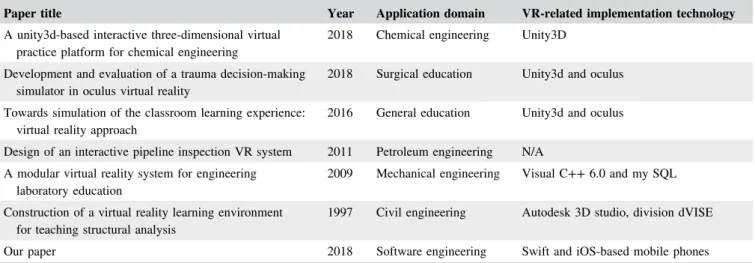
VR technology assists the theoretical lecture by providing real-world process. Faculty members in University of Nottingham [33] observed that chemical engineering students could not identify equipment at an industrial plant although it was taught in the classroom. Therefore, they developed a chemical processing plant simulation to actively engage students in the learning process. The aim of our study is similar to this study, but the department and the context are very different. In Table 1, we list VR-based educational software systems and introduce them with their application domains and technologies. As seen in this table, our VR-based software system has software engineering focus which was not studied previously.
3
|
METHODOLOGY
In this section, we present the proposed VR-ENITE system in detail. Section 3.1 shows the system architecture and its components such as instructor application and student application. Section 3.2 explains communication infrastruc-ture and multi-peer approach. Section 3.3 introduces Core Motion Framework. Section 3.4 presents the 3D application environment we used in VR-ENITE.
TABLE 1 Several VR-based educational software systems
Paper title Year Application domain VR-related implementation technology
A unity3d-based interactive three-dimensional virtual practice platform for chemical engineering
2018 Chemical engineering Unity3D
Development and evaluation of a trauma decision-making simulator in oculus virtual reality
2018 Surgical education Unity3d and oculus
Towards simulation of the classroom learning experience: virtual reality approach
2016 General education Unity3d and oculus
Design of an interactive pipeline inspection VR system 2011 Petroleum engineering N/A A modular virtual reality system for engineering
laboratory education
2009 Mechanical engineering Visual C++ 6.0 and my SQL
Construction of a virtual reality learning environment for teaching structural analysis
1997 Civil engineering Autodesk 3D studio, division dVISE
Our paper 2018 Software engineering Swift and iOS-based mobile phones 920
3.1
|
System architecture
Our proposed system consists of two different modules, namely instructor application and student application. Lecturers in VR-ENITE system initiate the learning session through instructor applications. This mobile application has been built for tablet devices in order to configure the experiments to visualize the selected sorting algorithms. Before launching the experiment session, students discover and connect to instructor application via their student applications. These multi-peer connections are established by using Bluetooth technology to form up a decentralized network structure. After the connection is established, the next key task is to maintain the connection between devices. This is generally tough to realize due to energy saving modes of mobile operating systems. Details about multi-peer connectivity is presented in section 3.3. We have imple-mented heartbeat mechanism to check the active connections in the session. If Wi-Fi is available in the network, all the applications first try to use Wi-Fi instead of Bluetooth. All the actions are operated by instructor application. The main duty of student application is to display the sorting experiment in a 3D form with VR headsets. The entire architecture is presented in Figure 1.
Due to number of peers and complexity of communication basis, the application logic needs to be superior in performance. Hence, transmission must be done in an optimized way to reduce the delays. Interactions between student applications and instructor application stats with initializing the Stream Service Manager. Peer connections are established within a period of time before the projection of experiments. Meanwhile, instructor generates the experiment parameters and design the scenario that is used to display in
the experiment. 3D scenes are activated with the command that is induced by instructor application. Operating logic of two apps is displayed in Figure 2.
3.2
|
Multipeer connectivity framework
MultiPeer Connectivity Framework of iOS has been preferred to implement the communication method on meshed network structure to run the applications smoothly on iOS devices. Traditional Bluetooth connection is established between two devices. The main idea is to pair selected devices on a short-range communication form. Alternatively, iOS's MultiPeer Connectivity Framework allows communicating with multi-ple devices on a single access [22]. Peer IDs are represented with MCPeerID objects to uniquely identify the running applications.MCSessionobjects maintain the active connec-tion between devices anMCNearbyServiceAdvertiserobjects narrate neighbor devices that student application is eager to join the active session of a specified type. Instructor application can connect to more than a single device and all the connection issues such as orchestration of connections are handled by this framework. This framework allowed us to focus on the application logic instead of dealing with infrastructure problems.
3.3
|
Core motion framework
In order to increase the reality factor of the experiment, head movements are captured and transferred to the student applications. We have used Apple's Core Motion Frame-work [3] to obtain motion data produced by built-in gyroscopes and accelerometers of smartphones. The
movement data has been unified at cameraRollNode,
cameraPitchNode, and cameraYawNode used for camera movements.
3.4
|
Implementation of 3D experiments
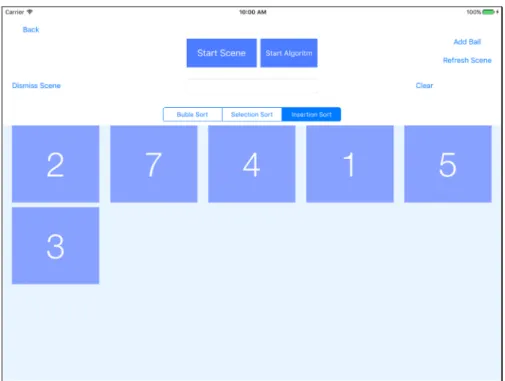
iOS provides 2D and 3D application development environ-ments via SpriteKit, Metal, and SceneKit [16]. We have used SceneKit rendering framework as our main platform because it has powerful features like shader modifiers, constraints, and skeletals. Xcode IDE has been selected to develop both instructor and student applications by using Swift 3 programming language. Instructor application acts as a configuration and control screen for all the experiments. Lecturers can create customized experiments at runtime during their experiment sessions. The numbers array gets into Bubble sort, selection sort, or insertion sort algorithms based on lecturer's preference. Instructor application control screen is shown in Figure 3.
On the other hand, student applications animate the application of selected sorting algorithm for the given array elements. This visualization is performed based on Stereos-copy technique with binocular vision. The main objective of this technique is to give and enhance the illusion depth of vision by creating a 3D view for the students. Array element moves based on the selected algorithm's working principle as
an animation during the VR session. Moving elements are highlighted with different colors to attract student's attention. Screenshot of an experiment is presented in Figure 4. Also, these experiments are empowered with the lecturer's narrative during the training session. The instructor can see students in the active session from his own application qua the active— with blue- and passive—with gray-peers as color coded. This list allows the lecturer to monitor which students use the VR-ENITE application in the class.
The most important feature that differentiates our VR-ENITE system from its alternatives is that it works on the iOS operating system. We could easily use popular VR glasses such as Oculus Rift and HTC Vive as part of this system, and we could also get benefit from game engines such as Unity3D and Unreal Engine. Since we designed training scenarios which do not require high-level visuali-zation, this decision enabled us to develop the system with native frameworks of iOS. This advantage helps students with an iOS-based smartphone to do several experiments with only a simple VR glass like Google Cardboard which is less than $10. Head Mounted Displays (HDM) such as Oculus Rift and HTC Vive, which require a computer with an external graphics card, cost around $500. For this, it is considered as a high-cost solution which limits the applicability of these systems. Apart from financial difficulties, a special laboratory must be built to use these
FIGURE 2 Operating logic of mobile applications 922
expensive devices effectively in an appropriate environment. Our VR-ENITE solution was designed to be not only low-cost but also easily accessible anywhere and at any time.
4
|
RESULTS
All the experiments of this study were performed in the year 2016 in Data Structure course at the Department of Computer Engineering in Istanbul Kültür University. Every week, 2 hr theory lecture and 2 hr lab work are given to the students as part of this course. VR-ENITE system was used during these
2 hr lab work for a specific group of students. Therefore, those students who interacted with VR-ENITE during the labora-tory hours were compared with students who did not interact with our VR-based system. If we had more lab hours for the course, we could have much better improvement compared to the traditional teaching approach. Assignments are given at each week and therefore, students can complement their theoretical knowledge with practical solutions to tough problems.
Voluntary students were divided into groups: One group gets the traditional education and the other group comple-ments the education with the VR-ENITE interaction. After
FIGURE 3 Instructor application screenshot
the trainings were finalized, multiple choice exam having 10 multiple choice questions on sorting algorithms were delivered to the students and then, all of these exams were evaluated. We applied statistical data analysis techniques to evaluate the performance of the students [29,34] and tests were conducted to check whether there is the statistically significant difference between these two groups. The significance levelα= 0.05 is determined.
Null hypothesis is that the average performance of two groups is equal to each other. After all the exams were evaluated, we calculated that the first group's average grade was 60 points. The second group's average result was 72 points. Some basic characteristics of the groups are given in Table 2.
Standard deviation for the first group was 15 and it was 13 for the second group. Sample size for these two groups was 18. When we performed T-test [24,41], we confirmed the statistical difference of these two groups. The reason of the selection of this statistical analysis technique is that our sample size is not very large (18 students in each group) and we do not know the populatiońs variability in advance. According to these results, we reject the null hypothesis and state that the second group's performance is statistically better than the first group. To apply this approach, we used SPSS statistics tool [14].
5
|
CONCLUSION AND FUTURE
WORK
Although the term VR has been used in the 1960s for the first time, it was not adopted by many end users until 2000s due to the high cost of VR devices. Now the price of headsets like Oculus Rift or Samsung Gear VR is affordable and therefore, VR is more common and applications based on VR technology are diverse.
VR currently works successfully in many industries such as real estate, house building, automotive, and scientific visualization. It not only enables innovation but also supports the decision making the process of manufacturers [7]. In addition to the industrial use of VR, it has a big potential to improve the education.
Different groups such as university students, K-12 students, children, and students with cognitive disabilities can get benefit from these systems [26]. In this study, we aimed to improve the performance of Computer Engineering students in the Data Structures course by implementing a VR system called VR-ENITE. Multi-peer connectivity has been established between lecturer's tablet and headsets of students. Lecturer can customize the content easily and then; students can access the content quickly. Instead of using video materials on sorting algorithms, students now use VR headsets and lecturer can customize the content from the tablet. We divided students into two groups as follows: Students who get information with traditional teaching
technique.
Students who interact with VR system and get information with traditional teaching material system.
These students were selected on the basis of voluntary participation and the number of students in these two groups were 36 in total (18 students in each group). After the content has been delivered to the students, we made a multiple-choice exam for these two groups. Questions are shown in the Appendix A. The first four questions were related with the bubble sort algorithm exercise, the next three questions were on selection sort algorithm, and the last three questions were on insertion sort algorithm. When the two groups’grades are calculated and compared based on the responses to these questions, we empirically showed that the group which used VR-ENITE performed better in the exam and this indicates that the system has a positive impact on the performance of students. After we evaluated all the exam sheets, we observed that the group, which uses VR system in conjunction with traditional teaching technique, was more successful than the control group. Also, students who use VR system were actively engaged in the lecture and found the topic very interesting. We decided to create similar systems when the topic in a course is difficult to be understood by our students or too theoretical to be concretized.
This observation indicates that the proposed VR system is effective to be used for software engineering courses. Also, we got very positive feedback from our students about this system and they were very motivated once they interacted with this system. Now, our students expect to use similar systems in the other courses such as Computer Organization and Computer Architecture given at our department. Although the validated system is very generic to be used for the other courses as well, it takes a considerable amount of time to prepare all the content for a specific course. In addition to the improved educational purposes, students now feel more confident to implement VR-based systems in the department. As part of future work, we plan to add new data structures and algorithms to this system such as linked lists, circular
TABLE 2 Characteristics of groups First group (traditional) Second group (VR enabled) Grade interval 40–80 40–90 Std dev of grades ±15 ±13 GPA interval 1.80–3.45 1.75–3.51 Gender 15M, 3F 14M, 4F Number of students who
took the course before
2 1
924
linked lists, stacks, queues, and double-ended queues. We will measure the satisfaction of students and lecturers from this system by using several questionnaires. Also, the usability of VR-ENITE will be evaluated and measured by using ISO standards on usability.
ORCID
Akhan Akbulut http://orcid.org/0000-0001-9789-5012
REFERENCES
1. M. M. Alam and E. B. Hamida, Surveying wearable human assistive technology for life and safety critical applications:
Standards, challenges and opportunities, Sensors. 14 (2014),
9153–9209.
2. V. Alvarez et al.,The use of wearable technologies in Australian universities: Examples from environmental science, cognitive and brain sciences and teacher training, Proceedings of the 15th World Conference on Mobile and Contextual Learning mLearn (W. Ng, ed.), University of Cyprus, Sydney, Australia, 2016, pp. 25–32. 3. Apple Inc. Core motion framework reference. Retrieved from
https://developer.apple.com/documentation/coremotion. (2014). 4. B. Baby et al.,Serious games: An overview of the game designing
factors and their application in surgical skills training, Proceedings of the 3rd international conference on computing for sustainable global development INDIACom (M. N. Hoda, ed.), BVICAM, New Delhi, 2016, pp. 2564–2569.
5. M. K. B. R. Balakrishnan, A virtual reality based environment for orthopedic surgery (VEOS). PhD thesis, Oklahoma State Univer-sity, 2015.
6. J. T. Bell and H. S. Fogler,The investigation and application of virtual reality as an educational tool, Proceedings of the american society for engineering education annual conference (D. Budny, R. Herrick, G Bjedov, and J. B. Perry, ed.), ASEE, Anaheim, CA, 1995, pp. 1718–1728.
7. L. P. Berg and J. M. Vance,Industry use of virtual reality in product
design and manufacturing: A survey, Virtual Reality.21(2016),
1–17.
8. M. Bower and D. Sturman,What are the educational affordances
of wearable technologies? Comput. Educ.88(2015), 343–353.
9. Y. Cai et al., The Virtual Pink Dolphins Project: An International Effort for Children with ASD in Special Needs Education. In Y. Cai, S. Goei, and W. Trooster (Eds.),Simulation and serious games
for education, Springer, Singapore, 2017, pp. 1–11.
10. C. Chou, H. L. Hsu, and Y. S. Yao,Construction of a virtual reality learning environment for teaching structural analysis, Comput. Appl. Eng. Educ.5(1997), 223–230.
11. T. Coffman and M. Klinger, Google glass: Using wearable technologies to enhance teaching and learning. Proceedings of 26th annual society for information technology & teacher education international conference. Association for the Advancement of Computing in Education, Chesapeake, VA, 2015, pp. 1777–1780. 12. J. Elliman, M. Loizou, and F. Loizides,Virtual reality simulation training for student nurse education. 8th international conference on games and virtual worlds for serious applications VS-Games. IEEE, Barcelona, Spain, 2016, pp. 1–2.
13. R. Gadhok, S. Murray, and E. Wood,Pth-126 virtual reality and beyond: Integrating simulation into the gastroenterology training
curriculum, Gut,65(2016), A281–A282.
14. S. B. Green and N. J. Salkind, Using SPSS for windows and macintosh: Analyzing and understanding data, Prentice Hall Press, Boston, MA, 2010.
15. M. D. P. Guimarães and B. B. Gnecco,Teaching astronomy and celestial mechanics through virtual reality, Comput. Appl. Eng. Educ.17(2009), 196–205.
16. L. Gurung et al.,ios game development using sprite kit framework with swift programming language. Oulun Ammattikorkeakoulu, Oulu University of Applied Sciences, Bachelor's Thesis, 2016. available at https://www.theseus.fi/bitstream/handle/10024/113196/Gurung_Lal. pdf.
17. C. M. Harrington et al.,Development and evaluation of a trauma decision-making simulator in Oculus virtual reality, Am. J. Surg. 215(2018), 42–47.
18. J. Harrod, Enhancing mining education through the use of a scenario-based virtual reality simulation. MSc thesis, The Univer-sity of Queensland, 2016.
19. M. Hashemipour, H. F. Manesh, and M. Bal,A modular virtual reality system for engineering laboratory education, Comput. Appl. Eng. Educ.19(2011), 305–314.
20. M. Karkoub, M. G. Her, and J. M. Chen,Design of an interactive
pipeline inspection VR system, Comput. Appl. Eng. Educ. 19
(2011), 814–825.
21. M. Kizil,Virtual reality applications in the Australian minerals industry, Conference proceedings of the 31st international sympo-sium on application of computers and operations research in the minerals industries (I. F.A. Camisani-Calzolari, ed.), The South African Institute of Mining and Metallurgy, Johannesburg, 2003, pp. 569–574.
22. D. Mark et al., Peer-to-Peer over bluetooth using multipeer connectivity.More iPhone development with objective-C. Apress, Berkeley, CA, 2015, pp. 245–287.
23. J. Matzke et al., Usefulness of virtual reality in assessment of
medical student laparoscopic skill, J. Surg. Res. 211 (2017),
191–195.
24. K. Meier, J. Brudney, and J. Bohte,Applied statistics for public and nonprofit administration. Nelson Education, Boston, MA, 2011. 25. I. Mirghani, et al.,Capturing differences in dental training using
a virtual reality simulator, Eur. J. Dent. Educ. (2016), 67–71.
http://onlinelibrary.wiley.com/doi/10.1111/eje.12245/abstract 26. M. Ott and L. Freina,A literature review on immersive virtual
reality in education: State of the art and perspectives, Conference proceedings of eLearning and Software for Education (I. Roceanu, F. Moldoveanu, S. Trausan-Matu, D. Barbieru, D. Beligan, and A. Ionita, ed.), CAROL I National Defence University Publishing House, Bucharest, Romania, 2015, pp. 133–141.
27. S-G Ouyang et al.,Unity3D-based interactive three-dimensional virtual practice platform for chemical engineering, Comput. Appl. Eng. Educ.26(2018), 91–100 https://doi.org/10.1002/cae.21863 28. J. M. Padilha et al.,Clinical virtual simulation in nursing education,
Clin. Simul. Nurs.15(2018), 13–18.
29. R. Peck, C. Olsen, and J. L. Devore,Introduction to statistics and data analysis. Cengage Learning, Boston, MA, 2015.
30. P. E. Pelargos et al.,Utilizing virtual and augmented reality for educational and clinical enhancements in neurosurgery, J. Clin. Neurosci.35(2016), 1–4.
31. M. Pfandler et al., Virtual reality-based simulators for spine
surgery: A systematic review, Spine. J.17(2017), 1352–1363.
32. E. Roy, M. M. Bakr, and R. George,The need for virtual reality
simulators in dental education: A review, Saudi. Dent. J.29(2017),
41–47.
33. D. Schofield, E. Lester, and J. Wilson,Virile: Virtual reality interactive laboratory experiments, Proceedings of innovation, good practice and research in engineering education conference. University of Sheffield, Wolverhampton, UK, 2004, pp. 225–231.
34. A. Seigel,Statistics and data analysis: An introduction. John Wiley & Sons, Inc, New York, 1988.
35. P. Stothard et al., Taxonomy of interactive computer-based visualisation systems and content for the mining industry-part one. Proceedings of first international future mining conference & exhibition. OAI, Melbourne, Australia, 2008, pp. 201–210. 36. N. Sultan,Reflective thoughts on the potential and challenges of
wearable technology for healthcare provision and medical
education, Int. J. Inf. Manage.35(2015), 521–526.
37. G. Tsaramirsis et al.,Towards simulation of the classroom learning experience: Virtual reality approach, Proceedings of the 3rd international conference on computing for sustainable global development INDIACom (M. N. Hoda, ed.), BVICAM, New Delhi, 2016, pp. 1343–1346.
38. A. Vance,The future of virtual reality in the classroom, State Educ. Stand.16(2016), 40–42.
39. A. William, V. L. Vidal, and P. John,Traditional instruction versus virtual reality simulation: A comparative study of phlebotomy training
among nursing students in Kuwait, J. Edu. Pract.7(2016), 18–25.
40. A. Williams,Reality check [virtual reality technology], Eng. Tech. 10(2015), 52–55.
41. I. H. Witten and E. Frank,Data Mining: Practical machine learning tools and techniques. Morgan Kaufmann, San Francisco, 2005. 42. T. Wu, C. Dameff, and J. Tully, Integrating google glass into
simulation-based training: Experiences and future directions, J. Biomed. Graph. Comp.4(2014), 49–54.
43. R. Yahaya, Immersive virtual reality learning environment: Learning decision-making skills in a virtual reality-enhanced learning environ-ment, PhD thesis, Queensland University of Technology, 2007.
A. AKBULUTis a postdoctoral research Scholar of Computer Science at North Carolina State University. He received the BS and MS degrees in Computer Engineering from Istanbul Kültür University, and the PhD degree in Computer Engineering from Istanbul University. Prior to joining NC State University, he was working as an assistant professor of Computer Engineering at Istanbul Kültür University for 5 years. His current research interests focus on design and performance optimization of software-intensive systems,
Internet architectures, and broadening participation in computing education and research. Dr. Akbulut is also interested in innovation in distributed systems, especially via the use of Cloud Computing Technology.
C. CATAL works at the Information Technology Group in Wageningen University, Netherlands. He worked 6 years at the Department of Computer Engineering in Istanbul Kültür University as associate professor between 2012 and 2017 and was Head of the Department for 3 years between 2014 and 2017. Prior to joining the university as academics, he worked 8 years at the Scientific and Technological Research Council of Turkey (TUBITAK), Information Technologies Institute as senior researcher and project manager and he was involved in the development of several large-scale software-intensive system projects in the research institute. He received the BS and MSc degrees in Computer Engineering from Istanbul Technical Univer-sity and the PhD degree in Computer Engineering from Yildiz Technical University, Istanbul. His research interests include machine learning, software quality, software testing, and software engineering. He is an external reviewer for EUROSTARS program funded by European Union, Research Council of Canada, and Research Council of Turkey.
B. YILDIZ received his BSc in Computer Engineering from Istanbul Kültür University in 2016. Throughout his college education, he was interested in mobile application development technologies and published games and apps in the App-Store. He has also worked on virtual reality and high-end VR technologies. He currently provides iOS mobile application development consultancy services through OBSS Company for one of the leading banks in Turkey.
How to cite this article:Akbulut A, Catal C, Yıldız B. On the effectiveness of virtual reality in the education of software engineering.Comput Appl Eng Educ. 2018;26:918–927.https://doi.org/10.1002/cae.21935
926
APPENDIX A
Exam Questions
1. In a bubble sort for list of length or answers is to compare elements ___________.
a. list[0] and list[n]
b. list[0] and list[m−1]
c. list[0] and list[1]
d. list[n−1] and list[n+1]
2. After the second iteration of bubble sort for a list of length n, the last elements are sorted.
a. two
b. three
c. n-2
d. n
3. In the bubble sort algorithm, the following code accomplishes swapping values in elements at positions index and index + 1.
a. list[index] = list[index + 1] list[index + 1] = list[index]
b. list[index + 1] = list[index + 1] list[index] = list[index + 1]
c. list[index] = temp list[index] = list[index + 1]
d. temp = list[index] list[index] = list[index + 1] list[index + 1] = temp
4. Assume that list consist of the following elements. What is the result after bubble sort completes?
a. 89 73 56 46 34 25 16 10 5 2
b. 2 56 34 25 5 16 89 46 73
c. 2 5 10 16 25 34 46 56 73 89
d. 2 10 16 25 34 46 56 73 89
5. Assuming the following list declaration, which element is at the position 0 after the first iteration of selection sort? int list[] = [16, 30, 24, 7 62, 45, 5, 55]
a. 5
b. 7
c. 16
d. 62
6. When working with the unsorted portion of a list, the second step in a selection sort is to ---.
a. Divide the list into two parts.
b. Move the smallest to the top of the list (position 0)
c. Move the smallest element to the beginning of the unsorted list
d. Find the smallest element
7. If a list of eight elements is sorted using selection sort, the unsorted list is after the second iteration.
a. List[0] . . . list[1]
b. List[0] . . . list[6]
c. List[1] . . . list[7]
d. List[2] . . . list[7]
8. When moving array values for insertion sort, to move list[4] into list[2]. First.
a. Move list[2] to list[3]
b. Delete list[2]
c. Move list[4] to list[3]
d. Copy list[4] into temp
9. With insertion sort, the variable fi is initialized to, assuming n is the length of array.
a. 0
b. 1
c. n-1
d. n
10. For a list of length n, insertion sort makes key comparisons, in the worst case.
a. n(n−1) / 4
b. n(n−1) / 2
c. n2