Technical Report no. 2004-02
Lock-Free and Practical Deques using Single-Word
Compare-And-Swap
Håkan Sundell
Philippas Tsigas
Department of Computing Science
Chalmers University of Technology and Göteborg University
SE-412 96 Göteborg, Sweden
Technical Report in Computing Science at
Chalmers University of Technology and Göteborg University
Technical Report no. 2004-02
ISSN: 1650-3023
Department of Computing Science
Chalmers University of Technology and Göteborg University
SE-412 96 Göteborg, Sweden
Abstract
We present an efficient and practical lock-free imple-mentation of a concurrent deque that is disjoint-parallel accessible and uses atomic primitives which are available in modern computer systems. Previously known lock-free algorithms of deques are either based on non-available atomic synchronization primitives, only implement a sub-set of the functionality, or are not designed for disjoint ac-cesses. Our algorithm is based on a doubly linked list, and only requires single-word compare-and-swap atomic prim-itives, even for dynamic memory sizes. We have performed an empirical study using full implementations of the most efficient algorithms of lock-free deques known. For systems with low concurrency, the algorithm by Michael shows the best performance. However, as our algorithm is designed for disjoint accesses, it performs significantly better on sys-tems with high concurrency and non-uniform memory ar-chitecture.
1
Introduction
A deque (i.e. double-ended queue) is a fundamental data structure. For example, deques are often used for imple-menting the ready queue used for scheduling of tasks in operating systems. A deque supports four operations, the PushRight, the PopRight, the PushLeft, and the PopLeft op-eration. The abstract definition of a deque is a list of values, where the PushRight/PushLeft operation adds a new value to the right/left edge of the list. The PopRight/PopLeft oper-ation correspondingly removes and returns the value on the right/left edge of the list.
To ensure consistency of a shared data object in a con-current environment, the most common method is mutual exclusion, i.e. some form of locking. Mutual exclusion de-grades the system’s overall performance [15] as it causes blocking, i.e. other concurrent operations can not make any progress while the access to the shared resource is blocked by the lock. Mutual exclusion can also cause deadlocks, priority inversion and even starvation.
Researchers have addressed these problems by propos-ing non-blockpropos-ing algorithms for shared data objects. Non-blocking methods do not involve mutual exclusion, and therefore do not suffer from the problems that block-ing could generate. Lock-free implementations are non-blocking and guarantee that regardless of the contention caused by concurrent operations and the interleaving of their sub-operations, always at least one operation will progress. However, there is a risk for starvation as the progress of some operations could cause some other opera-tions to never finish. Wait-free [8] algorithms are lock-free and moreover they avoid starvation as well, as all operations
are then guaranteed to finish in a limited number of their own steps. Recently, researchers also include obstruction-free [9] implementations to be non-blocking, although this kind of implementation is weaker than lock-free and thus does not guarantee progress of any concurrent operation.
The implementation of a lock-based concurrent deque is a trivial task, and can preferably be constructed using either a doubly linked list or a cyclic array, protected with either a single lock or with multiple locks where each lock pro-tects a part of the shared data structure. To the best of our knowledge, there exists no implementations of wait-free de-ques, but several lock-free implementations have been pro-posed. However, all previously lock-free deques lack in several important aspects, as they either only implement a subset of the operations that are normally associated with a deque and have concurrency restrictions1like Arora et al
[2], or are based on atomic hardware primitives like Double-Word Compare-And-Swap (CAS2)2which is not available in modern computer systems. Greenwald [5] presented a CAS2-based deque implementation, and there is also a publication series of a CAS2-based deque implementation [1],[4] with the latest version by Martin et al [12]. Indepen-dently of our work, Michael [13] has developed a deque im-plementation based on Compare-And-Swap (CAS)3.
How-ever, it is not disjoint-parallel accessible as all operations have to synchronize, even though they operate on different ends of the deque. Secondly, in order to use dynamic max-imum deque sizes it requires an extended CAS-operation that can atomically operate on two adjacent words, which is not available4on all modern platforms.
In this paper we present a lock-free algorithm of a con-current deque that is disjoint-parallel accessible5 (in the
sense that operations on different ends of the deque do not necessarily interfere with each other) and implemented us-ing common synchronization primitives that are available in modern systems. It can be extended to use dynamic max-imum deque sizes (in the presence of a lock-free dynamic memory handler), still using normal CAS-operations. The algorithm is described in detail later in this paper, and the aspects concerning the underlying lock-free memory man-agement are also presented. The precise semantics of the operations are defined and we give a proof that our imple-mentation is lock-free and linearizable [10].
1The algorithm by Arora et al does not support push operations on both
ends, and does not allow concurrent invocations of the push operation and a pop operation on the opposite end.
2A CAS2 operations can atomically read-and-possibly-update the
con-tents of two non-adjacent memory words. This operation is also sometimes called DCAS in the literature.
3The standard CAS operation can atomically read-and-possibly-update
the contents of a single memory word
4It is available on the Intel IA-32, but not on the Sparc or MIPS
micro-processor architectures.
5There is a general and formal definition called disjoint-access-parallel
Local Memory Processor 1 Local Memory Processor 2 Local Memory Processor n Shared Memory Interconnection Network
. . .
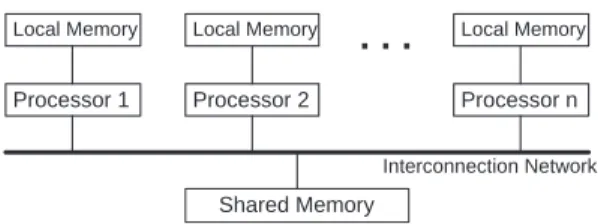
Figure 1. Shared Memory Multiprocessor Sys-tem Structure
We have performed experiments that compare the per-formance of our algorithm with two of the most efficient algorithms of lock-free deques known; [13] and [12], the latter implemented using results from [3] and [6]. Exper-iments were performed on three different multiprocessor system equipped with either 2,4 or 29 processors. All of the systems are using different operating systems. Our re-sults show that the CAS-based algorithms outperforms the CAS2-based implementations6 for any number of threads,
and for the system with full concurrency and non-uniform memory architecture our algorithm performs significantly better than the algorithm in [13].
The rest of the paper is organized as follows. In Section 2 we describe the type of systems that our implementation is aimed for. The actual algorithm is described in Section 3. In Section 4 we define the precise semantics for the op-erations on our implementation, and show their correctness by proving the lock-free and linearizability properties. The experimental evaluation is presented in Section 5. We con-clude the paper with Section 6.
2
System Description
A typical abstraction of a shared memory multi-processor system configuration is depicted in Figure 1. Each node of the system contains a processor together with its local memory. All nodes are connected to the shared memory via an interconnection network. A set of co-operating tasks is running on the system performing their respective operations. Each task is sequentially executed on one of the processors, while each processor can serve (run) many tasks at a time. The co-operating tasks, possi-bly running on different processors, use shared data objects built in the shared memory to co-ordinate and communi-cate. Tasks synchronize their operations on the shared data objects through sub-operations on top of a cache-coherent shared memory. The shared memory may not though be
6The CAS2 operation was implemented in software, using either
mu-tual exclusion or the results from [6], which presented an software CASn (CAS for n non-adjacent words) implementation.
function TAS(value:pointer to word):boolean atomic do
if *value=0 then
*value:=1;
return true; else return false;
procedure FAA(address:pointer to word, number:integer) atomic do
*address := *address + number;
function CAS(address:pointer to word, oldvalue:word,
newvalue:word):boolean
atomic do
if *address = oldvalue then
*address := newvalue;
return true; else return false;
Figure 2. The Test-And-Set (TAS), Fetch-And-Add (FAA) and Compare-And-Swap (CAS) atomic primitives.
1 2 4
3
Inserted node Deleted node
Figure 3. Concurrent insert and delete opera-tion can delete both nodes.
uniformly accessible for all nodes in the system; proces-sors can have different access times on different parts of the memory.
3
Algorithm
The algorithm is based on a doubly-linked list data struc-ture. To use the data structure as a deque, every node con-tains a value. The fields of each node item are described in Figure 4 as it is used in this implementation.
In order to make the deque construction concurrent and non-blocking, we are using three of the standard atomic synchronization primitives, Test-And-Set (TAS), Fetch-And-Add (FAA) and Compare-And-Swap (CAS). Figure 2 describes the specification of these primitives which are available in most modern platforms.
To insert or delete a node from the list we have to change the respective set of prev and next pointers. These have to be changed consistently, but not necessarily all at once. Our
solution is to treat the doubly-linked list as being a singly-linked list with auxiliary information in the prev pointers, with the next pointers being updated before the prev point-ers. Thus, the next pointers always form a consistent singly-linked list, but the prev pointers only give hints for where to find the previous node. This is possible because of the ob-servation that a “late” non-updated prev pointer will always point to a node that is directly or some steps previous of the current node, and from that “hint” position it is always possible to traverse7through the next pointers to reach the
directly previous node.
One problem, that is general for non-blocking imple-mentations that are based on the singly-linked list structure, arises when inserting a new node into the list. Because of the linked-list structure one has to make sure that the previ-ous node is not about to be deleted. If we are changing the next pointer of this previous node atomically with CAS, to point to the new node, and then immediately afterwards the previous node is deleted - then the new node will be deleted as well, as illustrated in Figure 3. There are several solu-tions to this problem. One solution is to use the CAS2 ation as it can change two pointers atomically, but this oper-ation is not available in any modern multiprocessor system. A second solution is to insert auxiliary nodes [17] between every two normal nodes, and the latest method introduced by Harris [7] is to use a deletion mark. This deletion mark is updated atomically together with the next pointer. Any concurrent insert operation will then be notified about the possibly set deletion mark, when its CAS operation will fail on updating the next pointer of the to-be-previous node. For our doubly-linked list we need to be informed also when in-serting using the prev pointer. In order to be able to atomi-cally update both the prev and the next pointer together with the deletion mark, all of these have to be put together in one memory word. For a 32-bit word this means a maximum of 32 768 (or 2 147 483 648 for a 64-bit word) possibly addressable nodes using the prev or next pointers. How-ever, as will be shown later in Section 3.4, the algorithm can easily be extended to handle dynamic maximum sizes, thus making this limit obsolete.
3.1
Memory Management
As we are concurrently (with possible preemptions) traversing nodes that will be continuously allocated and re-claimed, we have to consider several aspects of memory management. No node should be reclaimed and then later re-allocated while some other process is (or will be) travers-ing that node. This can be solved for example by careful reference counting. We have selected the lock-free memory
7As will be shown later, we have defined the deque data structure in a
way that makes it possible to traverse even through deleted nodes, as long as they are referenced in some way.
management scheme invented by Valois [17] and corrected by Michael and Scott [14], which makes use of the FAA and CAS atomic synchronization primitives. Using this scheme we can assure that a node can only be reclaimed when there is no prev or next pointer in the list that points to it. One problem with this scheme is that it can not handle cyclic garbage (i.e. 2 or more nodes that should be recycled but reference each other, and therefore each node keeps a pos-itive reference count, although they are not referenced by the main structure). Our solution is to make sure to break potential cyclic references directly before a node is possibly recycled.
Another memory management issue is how to de-reference pointers safely. If we simply de-de-reference the pointer, it might be that the corresponding node has been reclaimed before we could access it. It can also be that the deletion mark that is connected to the prev or next pointer was set, thus marking that the node is deleted. The follow-ing functions are defined for safe handlfollow-ing of the memory management:
function MALLOC_NODE() :pointer to Node
function READ_PREV(address:pointer to Link) :pointer to
Node
function READ_NEXT(address:pointer to Link) :pointer to
Node
function READ_PREV_DEL(address:pointer to Link)
:pointer to Node
function READ_NEXT_DEL(address:pointer to Link)
:pointer to Node
function COPY_NODE(node:pointer to Node) :pointer to
Node
procedure RELEASE_NODE(node:pointer to Node)
The function MALLOC_NODE allocates a new node from the memory pool of pre-allocated nodes. The function RELEASE_NODE decrements the reference counter on the corresponding given node. If the reference count reaches zero, the function then calls the ReleaseReferences function that will recursively call RELEASE_NODE on the nodes that this node has owned pointers to, and then it reclaims the node. The function COPY_NODE increases the reference counter for the corresponding given node. READ_PREV, READ_PREV_DEL, READ_NEXT and READ_NEXT_DEL atomically de-references the given link in the corresponding direction and increases the reference counter for the cor-responding node. In case the deletion mark of the link is set, the functions READ_PREV and READ_NEXT return NULL.
3.2
Pushing and Popping Nodes
The PushLeft operation, see Figure 4, first repeatingly tries in lines L4-L15 to insert the new node (node) between
union Link
_: word
hprev, next, di:hpointer to Node, pointer to Node, booleani structure Node
value: pointer to word link: union Link // Global variables head, tail: pointer to Node // Local variables
node, prev, prev2, next, next2: pointer to Node link1, link2, lastlink: union Link
function CreateNode(value:pointer to word):pointer to Node
C1 node:=MALLOC_NODE(); C2 node.value:=value; C3 return node;
procedure ReleaseReferences(node:pointer to Node)
RR1 RELEASE_NODE(node.link.prev); RR2 RELEASE_NODE(node.link.next);
procedure PushLeft(value: pointer to word)
L1 node:=CreateNode(value); L2 prev:=COPY_NODE(head); L3 next:=READ_NEXT(&prev.link); L4 while true do
L5 link1:=prev.link; L6 if link1.next6=next then L7 RELEASE_NODE(next); L8 next:=READ_NEXT(&prev.link); L9 continue; L10 node.link:=hprev,link1.next,falsei; L11 link2:=hlink1.prev,node,falsei; L12 if CAS(&prev.link,link1,link2) then L13 COPY_NODE(node); L14 break; L15 Back-Off L16 PushCommon(node,next);
procedure PushRight(value: pointer to word)
R1 node:=CreateNode(value); R2 next:=COPY_NODE(tail); R3 prev:=READ_PREV(&next.link); R4 while true do
R5 link1:=prev.link;
R6 if link1.next6=next or prevlink.d=true then
R7 prev:=HelpInsert(prev,next); R8 continue; R9 node.link:=hprev,link1.next,falsei; R10 link2:=hlink1.prev,node,falsei; R11 if CAS(&prev.link,link1,link2) then R12 COPY_NODE(node); R13 break; R14 Back-Off R15 PushCommon(node,next);
procedure PushCommon(node: pointer to Node, next: pointer to Node)
P1 while true do
P2 link1:=next.link;
P3 link2:=hnode,link1.next,falsei; P4 if link1.d=true or node.link.d=true
P5 or node.link.next6=next then
P6 break;
P7 if CAS(&next.link,link1,link2) then
P8 COPY_NODE(node);
P9 RELEASE_NODE(link1.prev); P10 if node.link.d = true then
P11 prev2:=COPY_NODE(node); P12 prev2:=HelpInsert(prev2,next); P13 RELEASE_NODE(prev2); P14 break; P15 Back-Off P16 RELEASE_NODE(next); P17 RELEASE_NODE(node);
function PopLeft(): pointer to word
PL1 prev:=COPY_NODE(head); PL2 while true do
PL3 node:=READ_NEXT(&prev.link); PL4 if node=tail then
PL5 RELEASE_NODE(node); PL6 RELEASE_NODE(prev);
PL7 return⊥;
PL8 link1:=node.link; PL9 if link1.d=true then
PL10 DeleteNext(node); PL11 RELEASE_NODE(node); PL12 continue; PL13 next:=COPY_NODE(link1.next); PL14 link2:=hlink1.prev,link1.next,truei PL15 if CAS(&node.link,link1,link2) then PL16 DeleteNext(node); PL17 prev:=HelpInsert(prev,next); PL18 RELEASE_NODE(prev); PL19 RELEASE_NODE(next); PL20 value:=node.value; PL21 break; PL22 RELEASE_NODE(node); PL23 RELEASE_NODE(next); PL24 Back-Off PL25 RemoveCrossReference(node); PL26 RELEASE_NODE(node); PL27 return value;
function PopRight(): pointer to word
PR1 next:=COPY_NODE(tail); PR2 while true do
PR3 node:=READ_PREV(&next.link); PR4 link1:=node.link;
PR5 if link1.next6=next or link1.d = true then PR6 node:=HelpInsert(node,next);
PR7 RELEASE_NODE(node);
PR8 continue;
PR9 if node=head then PR10 RELEASE_NODE(next); PR11 RELEASE_NODE(node); PR12 return⊥; PR13 prev:=COPY_NODE(link1.prev); PR14 link2:=hlink1.prev,link1.next,truei PR15 if CAS(&node.link,link1,link2) then PR16 DeleteNext(node); PR17 prev:=HelpInsert(prev,next); PR18 RELEASE_NODE(prev); PR19 RELEASE_NODE(next); PR20 value:=node.value; PR21 break; PR22 RELEASE_NODE(prev); PR23 RELEASE_NODE(node); PR24 Back-Off PR25 RemoveCrossReference(node); PR26 RELEASE_NODE(node); PR27 return value;
procedure DeleteNext(node: pointer to Node)
DN1 lastlink.d:=true;
DN2 prev:=READ_PREV_DEL(&node.link); DN3 next:=READ_NEXT_DEL(&node.link); DN4 while true do
DN5 if prev=next then break; DN6 if next.link.d = true then
DN7 next2:=READ_NEXT_DEL(&next.link); DN8 RELEASE_NODE(next);
DN9 next:=next2;
DN10 continue;
DN11 prev2:=READ_NEXT(&prev.link); DN12 if prev2=NULL then
DN13 if lastlink.d = false then
DN14 DeleteNext(prev); DN15 lastlink.d:=true; DN16 prev2:=READ_PREV_DEL(&prev.link); DN17 RELEASE_NODE(prev); DN18 prev:=prev2; DN19 continue; DN20 link1:=hprev.link.prev,prev2,falsei; DN21 if prev26=node then
DN22 lastlink.d:=false; DN23 RELEASE_NODE(prev); DN24 prev:=prev2; DN25 continue; DN26 RELEASE_NODE(prev2); DN27 link2:=hlink1.prev,node.link.next,falsei; DN28 if CAS(&prev.link,link1,link2) then DN29 COPY_NODE(link2.next); DN30 RELEASE_NODE(node); DN31 break; DN32 Back-Off DN33 RELEASE_NODE(prev); DN34 RELEASE_NODE(next);
function HelpInsert(prev: pointer to Node, node: pointer to Node)
:pointer to Node HI1 lastlink.d:=true; HI2 while true do
HI3 prev2:=READ_NEXT(&prev.link);
HI4 if prev2=NULL then
HI5 if lastlink.d = false then
HI6 DeleteNext(prev); HI7 lastlink.d:=true; HI8 prev2:=READ_PREV_DEL(&prev.link); HI9 RELEASE_NODE(prev); HI10 prev:=prev2; HI11 continue; HI12 link1:=node.link; HI13 if link1.d=true then
HI14 RELEASE_NODE(prev2);
HI15 break;
HI16 if prev26=node then HI17 lastlink.d:=false; HI18 RELEASE_NODE(prev); HI19 prev:=prev2;
HI20 continue;
HI21 RELEASE_NODE(prev2); HI22 link2:=hprev,link1.next,falsei; HI23 if CAS(&node.link,link1,link2) then
HI24 COPY_NODE(prev);
HI25 RELEASE_NODE(link1.prev); HI26 if prev.link.d=true then continue;
HI27 break;
HI28 Back-Off
HI29 return prev;
procedure RemoveCrossReference(node: pointer to Node)
RC1 while true do
RC2 link1:=node.link; RC3 prev:=link1.prev; RC4 if prev.link.d = true then
RC5 prev2:=READ_PREV_DEL(&prev.link); RC6 node.link:=hprev2,link1.next,truei; RC7 RELEASE_NODE(prev);
RC8 continue;
RC9 next:=link1.next; RC10 if next.link.d = true then
RC11 next2:=READ_NEXT_DEL(&next.link); RC12 node.link:=hlink1.prev,next2,truei; RC13 RELEASE_NODE(next);
RC14 continue;
RC15 break;
the head node (prev) and the leftmost node (next), by atomi-cally changing the next pointer of the head node. Before try-ing to update the link field, it assures in line L6 that the next node is still the very next node of head, otherwise next is up-dated in L7-L8. After the new node has been successfully inserted, it tries in lines P2-P15 to update the prev pointer of the next node. It retries until either i) it succeeds with the update, ii) it detects that either the next or new node is deleted, or iii) the next node is no longer directly next of the new node. In any of the two latter, the changes are due to concurrent Pop or Push operations, and the responsibility to update the prev pointer is then left to those. If the update succeeds, there is though the possibility that the new node was deleted (and thus the prev pointer of the next node was possibly already updated by the concurrent Pop operation) directly before the CAS in line P7, and then the prev pointer is updated by calling the HelpInsert function in line P12.
The PushRight operation, see Figure 4, first repeatedly tries in lines R4-R14 to insert the new node (node) between the rightmost node (prev and the tail node (next), by atomi-cally changing the next pointer of the prev node. Before try-ing to update the link field, it assures in line R6 that the next node is still the very next node of prev, otherwise prev is updated by calling the HelpInsert function in R7-R8, which updates the prev pointer of the next node. After the new node has been successfully inserted, it tries in lines P2-P15 to update the prev pointer of the next node, following the same scheme as for the PushLeft operation.
The PopLeft operation, see Figure 4, first repeatedly tries in lines PL2-PL24 to mark the leftmost node (node) as deleted. Before trying to update the link field, it first as-sures in line PL4 that the deque is not empty, and secondly in line PL9 that the node is not already marked for deletion. If the deque was detected to be empty, the function returns. If node was marked for deletion, it tries to update the next pointer of the prev node by calling the DeleteNext function, and then node is updated to be the leftmost node. If the prev pointer of node was incorrect, it tries to update it by calling the HelpInsert function. After the node has been success-fully marked by the successful CAS operation in line PL15, it tries in line PL16 to update the next pointer of the prev node by calling the DeleteNext function, and in line PL17 to update the prev pointer of the next node by calling the HelpInsert function. After this, it tries in line PL25 to break possible cyclic references that includes node by calling the RemoveCrossReference function.
The PopRight operation, see Figure 4, first repeatedly tries in lines PR2-PR24 to mark the rightmost node (node) as deleted. Before trying to update the link field, it assures i) in line PR5 that the node is not already marked for deletion, ii) in the same line that the prev pointer of the tail (next) node is correct, and iii) in line PR9 that the deque is not empty. If the deque was detected to be empty, the function
returns. If node was marked for deletion or the prev pointer of the next node was incorrect, it tries to update the prev pointer of the next node by calling the HelpInsert function, and then node is updated to be the rightmost node. After the node has been successfully marked it follows the same scheme as the PopLeft operation.
3.3
Helping and Back-Off
The DeleteNext procedure, see Figure 5, repeatedly tries in lines DN4-DN32 to delete (in the sense of a chain of next pointers starting from the head node) the given marked node (node) by changing the next pointer from the previous non-marked node. First, we can safely assume that the next pointer of the marked node is always referring to a node (next) to the right and the prev pointer is always referring to a node (prev) to the left (not necessarily the first). Before trying to update the link field with the CAS operation in line DN28, it assures in line DN5 that node is not already deleted, in line DN6 that the next node is not marked, in line DN12 that the prev node is not marked, and in DN21 that prev is the previous node of node. If next is marked, it is updated to be the next node. If prev is marked we might need to delete it before we can update prev to one of its previous nodes and proceed with the current deletion, but in order to avoid infinite recursion, DeleteNext is only called if a next pointer from a non-marked node to prev has been observed (i.e. lastlink.d is false). Otherwise if prev is not the previous node of node it is updated to be the next node. The HelpInsert procedure, see Figure 5, repeatedly tries in lines HI2-HI28 to correct the prev pointer of the given node (node), given a suggestion of a previous (not necessar-ily the first) node (prev). Before trying to update the link field with the CAS operation in line HI23, it assures in line HI4 that the prev node is not marked, in line HI13 that node is not marked, and in line HI16 that prev is the previous node of node. If prev is marked we might need to delete it before we can update prev to one of its previous nodes and proceed with the current insertion, but in order to avoid unnecessary recursion, DeleteNext is only called if a next pointer from a non-marked node to prev has been observed (i.e. lastlink.d is false). If node is marked, the procedure is aborted. Otherwise if prev is not the previous node of node it is updated to be the next node. If the update in line HI23 succeeds, there is though the possibility that the prev node was deleted (and thus the prev pointer of node was possibly already updated by the concurrent Pop operation) directly before the CAS operation. This is detected in line HI26 and then the update is possibly retried with a new prev node.
The RemoveCrossReference procedure, see Figure 5, tries to break cross-references between the given node (node) and any of the nodes that it references, by repeatedly updating the prev or next pointer as long as it references a
marked node. First, we can safely assume that the link field of node is not concurrently updated by any other operation. Before the procedure is finished, it assures in line RC4 that the previous node (prev) is not marked, and in line RC10 that the next node (next) is not marked. As long as prev is marked it is traversed to the left, and as long as next is marked it is traversed to the right, while continuously up-dating the link field of node in lines RC6 or RC12.
Because the DeleteNext and HelpInsert are often used in the algorithm for “helping” late operations that might other-wise stop progress of other concurrent operations, the algo-rithm is suitable for pre-emptive as well as fully concurrent systems. In fully concurrent systems though, the helping strategy as well as heavy contention on atomic primitives, can downgrade the performance significantly. Therefore the algorithm, after a number of consecutive failed CAS oper-ations (i.e. failed attempts to help concurrent operoper-ations) puts the current operation into back-off mode. When in back-off mode, the thread does nothing for a while, and in this way avoids disturbing the concurrent operations that might otherwise progress slower. The duration of the back-off is proportional to the number of threads, and for each consecutive entering of the back-off mode during one op-eration invocation, the duration of the back-off is increased exponentially.
3.4
Extending to dynamic maximum sizes
In order to allow usage of a system-wide dynamic mem-ory handler (which should be lock-free and have garbage collection capabilities), all significant bits of an arbitrary pointer value must be possible to be represented in both the next and prev pointers. In order to atomically update both the next and prev pointer together with the deletion mark, the CAS-operation would need the capability of atomically updating at least30 + 30 + 1 = 61bits on a 32-bit system (and62+62+ 1 = 125bits on a 64-bit system as the point-ers are then 64 bit). However, most current 32 and 64-bit systems only support CAS-operations of single word-size.
An interesting observation of the current algorithm is that it never changes both the prev and next pointer in the atomic updates, and the pre-condition associated with the atomic CAS-update only involves the pointer that is changed.
Therefore it is possible to keep the prev and next point-ers in separate words, duplicating the deletion mark in each of the words. Thus, full pointer values can be used, still by only using standard CAS-operations. In order to preserve the correctness of the algorithm, the deletion mark of the next pointer should always be set first, in the PopLeft/PopRight functions, and the deletion mark of the prev pointer should be possibly set in the very beginning of the DeleteNext procedure. The remaining changes are
triv-ial and the full extended algorithm is presented in Appendix A.
4
Correctness
In this section we present the proof of our algorithm. We first prove that our algorithm is a linearizable one [10] and then we prove that it is lock-free. A set of definitions that will help us to structure and shorten the proof is first ex-plained in this section. We start by defining the sequential semantics of our operations and then introduce two defini-tions concerning concurrency aspects in general.
Definition 1 We denote withQtthe abstract internal state of a deque at the timet.Qt= [v1, . . . , vn]is viewed as an list of valuesv, where|Qt| ≥ 0. The operations that can be performed on the deque are PushLeft(L), PushRight(R), PopLeft(P L) and PopRight(P R). The timet1is defined as the time just before the atomic execution of the operation that we are looking at, and the timet2is defined as the time just after the atomic execution of the same operation. In the following expressions that define the sequential semantics of our operations, the syntax isS1:O1, S2, whereS1is the conditional state before the operationO1, andS2is the re-sulting state after performing the corresponding operation:
Qt1 :L(v1), Qt2 = [v1] +Qt1 (1) Qt1 :R(v1), Qt2 =Qt1+ [v1] (2) Qt1 =∅:PL() =⊥, Qt2 =∅ (3) Qt1= [v1] +Q1:PL() =v1, Qt2=Q1 (4) Qt1 =∅:PR() =⊥, Qt2 =∅ (5) Qt1 =Q1+ [v1] :PR() =v1, Qt2 =Q1 (6)
Definition 2 In a global time model each concurrent
op-eration Op “occupies" a time interval [bOp, fOp] on the linear time axis (bOp < fOp). The precedence relation (denoted by ‘→’) is a relation that relates operations of a possible execution, Op1 → Op2 means that Op1 ends beforeOp2starts. The precedence relation is a strict par-tial order. Operations incomparable under →are called overlapping. The overlapping relation is denoted bykand is commutative, i.e. Op1 k Op2 and Op2 k Op1. The precedence relation is extended to relate sub-operations of operations. Consequently, if Op1 → Op2, then for
any sub-operationsop1and op2ofOp1 andOp2, respec-tively, it holds that op1 → op2. We also define the di-rect precedence relation→d, such that ifOp1→dOp2, then
Op1 → Op2and moreover there exists no operation Op3 such thatOp1→Op3→Op2.
Definition 3 In order for an implementation of a shared
concurrent data object to be linearizable [10], for every concurrent execution there should exist an equal (in the sense of the effect) and valid (i.e. it should respect the se-mantics of the shared data object) sequential execution that respects the partial order of the operations in the concur-rent execution.
Next we are going to study the possible concurrent exe-cutions of our implementation. First we need to define the interpretation of the abstract internal state of our implemen-tation.
Definition 4 The value v is present (∃i.Q[i] = v) in the abstract internal stateQof our implementation, when there is a connected chain of next pointers (i.e. prev.link.next) from a present node (or the head node) in the doubly linked list that connects to a node that contains the valuev, and this node is not marked as deleted (i.e. node.link.d=false).
Definition 5 The decision point of an operation is defined
as the atomic statement where the result of the operation is finitely decided, i.e. independent of the result of any sub-operations after the decision point, the operation will have the same result. We define the state-read point of an opera-tion to be the atomic statement where a sub-state of the pri-ority queue is read, and this sub-state is the state on which the decision point depends. We also define the state-change point as the atomic statement where the operation changes the abstract internal state of the priority queue after it has passed the corresponding decision point.
We will now use these points in order to show the ex-istence and location in execution history of a point where the concurrent operation can be viewed as it occurred atom-ically, i.e. the linearizability point.
Lemma 1 A PushRight operation (R(v)), takes effect atomically at one statement.
Proof: The decision, state-read and state-change point for
a PushRight operation which succeeds (R(v)), is when the CAS sub-operation in line R11 (see Figure 4) succeeds. The state of the deque was (Qt1 =Q1) directly before the pass-ing of the decision point. The prev node was the very last present node as it pointed (verified by R6 and the CAS in R11) to the tail node directly before the passing of the deci-sion point. The state of the deque directly after passing the decision point will beQt2 =Q1+ [v]as the next pointer of
the prev node was changed to point to the new node which contains the valuev. Consequently, the linearizability point will be the CAS sub-operation in line R11. 2
Lemma 2 A PushLeft operation (L(v)), takes effect atomi-cally at one statement.
Proof: The decision, state-read and state-change point for
a PushLeft operation which succeeds (L(v)), is when the CAS sub-operation in line L12 (see Figure 4) succeeds. The state of the deque was (Qt1 =Q1) directly before the pass-ing of the decision point. The state of the deque directly after passing the decision point will beQt2 = [v] +Q1as the next pointer of the head node was changed to point to the new node which contains the valuev. Consequently, the linearizability point will be the CAS sub-operation in line
L12. 2
Lemma 3 A PopRight operation which fails (P R() =⊥), takes effect atomically at one statement.
Proof: The decision point for a PopRight operation which
fails (P R() = ⊥) is the check in line PR9. Passing of the decision point together with the verification in line PR5 gives that the next pointer of the head node must have been pointing to the tail node (Qt1 =∅) directly before the read sub-operation of the link field in line PR4, i.e. the state-read point. Consequently, the linearizability point will be
the read sub-operation in line PR4. 2
Lemma 4 A PopRight operation which succeeds (P R() =
v), takes effect atomically at one statement.
Proof: The decision point for a PopRight operation which
succeeds (P R() =v) is when the CAS sub-operation in line PR15 succeeds. Passing of the decision point together with the verification in line PR5 gives that the next pointer of the to-be-deleted node must have been pointing to the tail node (Qt1 = Q1+ [v]) directly before the CAS sub-operation in line PR15, i.e. the state-read point. Directly after pass-ing the CAS sub-operation (i.e. the state-change point) the to-be-deleted node will be marked as deleted and therefore not present in the deque (Qt2 = Q1). Consequently, the linearizability point will be the CAS sub-operation in line
PR15. 2
Lemma 5 A PopLeft operation which fails (P L() = ⊥), takes effect atomically at one statement.
Proof: The decision point for a PopLeft operation which
fails (P L() = ⊥) is the check in line PL4. Passing of the decision point gives that the next pointer of the head node must have been pointing to the tail node (Qt1 =∅) directly before the read sub-operation of the link field in line PL3,
i.e. the state-read point. Consequently, the linearizability point will be the read sub-operation in line PL3. 2
Lemma 6 A PopLeft operation which succeeds (P L() =
v), takes effect atomically at one statement.
Proof: The decision point for a PopLeft operation which
succeeds (P L() = v) is when the CAS sub-operation in line PL15 succeeds. Passing of the decision point together with the verification in line PL9 gives that the next pointer of the head node must have been pointing to the present to-be-deleted node (Qt1 = [v] +Q1) directly before the read sub-operation in line PL3, i.e. the state-read point. Directly after passing the CAS sub-operation in line PL15 (i.e. the state-change point) the to-be-deleted node will be marked as deleted and therefore not present in the deque (¬∃i.Qt2[i] = v). Unfortunately this does not match the semantic definition of the operation.
However, none of the other concurrent operations lin-earizability points is dependent on the to-be-deleted node’s state as marked or not marked during the time interval from the state-read to the state-change point. Clearly, the lin-earizability points of Lemmas 1 and 2 are independent as the to-be-deleted node would be part (or not part if not present) of the correspondingQ1terms. The linearizabil-ity points of Lemmas 3 and 5 are independent, as those lin-earizability points depend on the head node’s next pointer pointing to the tail node or not. Finally, the linearizabil-ity points of Lemma 4 as well as this lemma are indepen-dent, as the to-be-deleted node would be part (or not part if not present) of the corresponding Q1 terms, otherwise the CAS sub-operation in line PL15 of this operation would have failed.
Therefore all together, we could safely interpret the to-be-deleted node to be not present already directly after pass-ing the state-read point ((Qt2=Q1). Consequently, the lin-earizability point will be the read sub-operation in line PL3.
2
Lemma 7 When the deque is idle (i.e. no operations are
being performed), all next pointers of present nodes are matched with a correct prev pointer from the correspond-ing present node (i.e. all linked nodes from the head or tail node are present in the deque).
Proof: We have to show that each operation takes
responsi-bility for that the affected prev pointer will finally be cor-rect after changing the corresponding next pointer. Af-ter successfully changing the next poinAf-ter in the PushLeft (PushRight) in line L12 (R11) operation, the correspond-ing prev pointer is tried to be changed in line P7 repeatedly until i) it either succeeds, ii) either the next or this node is deleted as detected in line P4, iii) or a new node is inserted
as detected in line P5. If a new node is inserted the cor-responding PushLeft (PushRight) operation will make sure that the prev pointer is corrected. If either the next or this node is deleted, the corresponding PopLeft (PopRight) op-eration will make sure that the prev pointer is corrected. If the prev pointer was successfully changed it is possible that this node was deleted before we changed the prev pointer of the next node. If this is detected in line P10, then the prev pointer of the next node is corrected by the HelpInsert function.
After successfully marking the to-be-deleted nodes in line PL15 (PR15), the PopLeft (PopRight) functions will make sure that the connecting next pointer of the prev node will be changed to point to the closest present node to the right, by calling the DeleteNext procedure in line PL16 (PR16). It will also make sure that the corresponding prev pointer of the next code will be corrected by calling the HelpInsert function in line PL17 (PR17).
The DeleteNext procedure will repeatedly try to change the next pointer of the prev node that points to the deleted node, until it either succeeds changing the next pointer in line DN28 or some concurrent DeleteNext already suc-ceeded as detected in line DN5.
The HelpInsert procedure will repeatedly try to change the prev pointer of the node to match with the next pointer of the prev node, until it either succeeds changing the prev pointer in line HI23 or the node is deleted as detected in line HI13. If it succeeded with changing the prev pointer, the prev node might have been deleted directly before changing the prev pointer, and therefore it is detected if the prev node is marked in line HI26 and then the procedure will continue trying to correctly change the prev pointer. 2
Lemma 8 When the deque is idle, all previously deleted
nodes are garbage collected.
Proof: We have to show that each PopRight or PopLeft
op-eration takes responsibility for that the deleted node will finally have no references to it. The possible references are caused by other nodes pointing to it. Following Lemma 7 we know that no present nodes will reference the deleted node. It remains to show that all paths of references from a deleted node will finally reference a present node, i.e. there are no cyclic referencing. After the node is deleted in lines PL16 and PL17 (PR16 and PR17), it is assured by the PopLeft (PopRight) operation by calling the RemoveCross-Reference procedure in line PL25 (PR25) that both the next and prev pointers are pointing to a present node. If any of those present nodes are deleted before the referencing deleted node is garbage collected in line , the RemoveCross-Reference procedures called by the corresponding PopLeft or PopRight operation will assure that the next and prev pointers of the previously present node will point to present nodes, and so on recursively. The RemoveCrossReference
procedure repeatedly tries to change prev pointers to point to the previous node of the referenced node until the ref-erenced node is present, detected in line RC4 and possibly changed in line RC6. The next pointer is correspondingly detected in line RC10 and possibly changed in line RC12.
2
Lemma 9 The path of prev pointers from a node is always
pointing a present node that is left of the current node.
Proof: We will look at all possibilities where the prev
pointer is set or changed. The setting in line L10 (R9) is clearly to the left as it is verified by L6 and L12 (R5 and R11). The change of the prev pointer in line P7 is to the left as verified by P5 and that nodes are never moved relatively to each other. The change of the prev pointer in line HI23 is to the left as verified by line HI3 and HI16. Finally, the change of the prev pointer in line RC6 is to the left as it is changed to the prev pointer of the previous node. 2
Lemma 10 All operations will terminate if exposed to a
limited number of concurrent changes to the deque.
Proof: The amount of changes an operation could
experi-ence is limited. Because of the referexperi-ence counting, none of the nodes which is referenced to by local variables can be garbage collected. When traversing through prev or next pointers, the memory management guarantees atomicity of the operations, thus no newly inserted or deleted nodes will be missed. We also know that the relative positions of nodes that are referenced to by local variables will not change as nodes are never moved in the deque. Most loops in the op-erations retry because a change in the state of some node(s) was detected in the ending CAS sub-operation, and then retry by re-reading the local variables (and possibly correct-ing the state of the nodes) until no concurrent changes was detected by the CAS sub-operation and therefore the CAS succeeded and the loop terminated. Those loops will clearly terminate after a limited number of concurrent changes. In-cluded in that type of loops are L4-L15, R4-R14, P1-P15, PL2-PL24 and PR2-PR24.
The loop DN4-DN32 will terminate if either the prev node is equal to the next node in line DN5 or the CAS sub-operation in line DN28 succeeds. We know from the start of the execution of the loop, that the prev node is left of the to-be-deleted node which in turn is left of the next node. Following from Lemma 9 this order will hold by travers-ing the prev node through its prev pointer and traverstravers-ing the next node through its next pointer. Consequently, traversing the prev node through the next pointer will finally cause the prev node to be directly left of the to-be-deleted node if this is not already deleted (and the CAS sub-operation in line DN28 will finally succeed), otherwise the prev node will fi-nally be directly left of the next node (and in the next step
the equality in line DN5 will hold). As long as the prev node is marked it will be traversed to the left in line DN16, and if it is the left-most marked node the prev node will be deleted by recursively calling DeleteNext in line DN14. If the prev node is not marked it will be traversed to the right. As there is a limited number of changes and thus a limited number of marked nodes left of the to-be-deleted node, the prev node will finally traverse to the right and either of the termination criteria will be fulfilled.
The loop HI2-HI28 will terminate if either the to-be-corrected node is marked in line HI13 or if the CAS sub-operation in line HI23 succeeds and prev node is not marked. We know that from the start of the execution of the loop, that the prev node is left of the to-be-corrected node. Following from Lemma 9 this order will hold by traversing the prev node through its prev pointer. Conse-quently, traversing the prev node through the next pointer will finally cause the prev node to be directly left of the to-be-corrected node if this is not deleted (and the CAS sub-operation in line HI23 will finally succeed), otherwise line HI13 will succeed. As long as the prev node is marked it will be traversed to the left in line HI8, and if it is the left-most marked node the prev node will be deleted by calling DeleteNext in line HI6. If the prev node is not marked it will be traversed to the right. As there is a limited number of changes and thus a limited number of marked nodes left of the to-be-corrected node, the prev node will finally tra-verse to the right and either of the termination criteria will be fulfilled.
The loop RC1-RC15 will terminate if both the prev node and the next node of the to-be-deleted node is not marked in line RC4 respectively line RC10. We know that from the start of the execution of the loop, the prev node is left of the deleted node and the next node is right of the to-be-deleted node. Following from Lemma 9, traversing the prev node through the next pointer will finally reach a not marked node or the head node (which is not marked), and traversing the next node through the next pointer will finally reach a not marked node or the tail node (which is not marked), and both of the termination criteria will be fulfilled. 2
Lemma 11 With respect to the retries caused by
synchro-nization, one operation will always do progress regardless of the actions by the other concurrent operations.
Proof: We now examine the possible execution paths of our
implementation. There are several potentially unbounded loops that can delay the termination of the operations. We call these loops retry-loops. If we omit the conditions that are because of the operations semantics (i.e. search-ing for the correct criteria etc.), the loop retries when sub-operations detect that a shared variable has changed value. This is detected either by a subsequent read sub-operation or a failed CAS. These shared variables are only
changed concurrently by other CAS sub-operations. Ac-cording to the definition of CAS, for any number of concur-rent CAS sub-operations, exactly one will succeed. This means that for any subsequent retry, there must be one CAS that succeeded. As this succeeding CAS will cause its retry loop to exit, and our implementation does not contain any cyclic dependencies between retry-loops that exit with CAS, this means that the corresponding PushRight, Push-Left, PopRight or PopLeft operation will progress. Conse-quently, independent of any number of concurrent opera-tions, one operation will always progress. 2
Theorem 1 The algorithm implements a correct, memory
stable, lock-free and linearizable deque.
Proof: Following from Lemmas 1, 2, 3, 4, 5 and 6 and
by using the respective linearizability points, we can create an identical (with the same semantics) sequential execution that preserves the partial order of the operations in a con-current execution. Following from Definition 3, the imple-mentation is therefore linearizable.
Lemmas 10 and 11 give that our implementation is lock-free.
Following from Lemmas 10, 1, 2, 3, 4, 5 and 6 we can conclude that all operations will terminate with the correct result.
Following from Lemma 8 we know that the maximum memory usage will be proportional to the number of present values in the deque.
2
5
Experimental Evaluation
In our experiments, each concurrent thread performed 1000 randomly chosen sequential operations on a shared deque, with a distribution of 1/4 PushRight, 1/4 PushLeft, 1/4 PopRight and 1/4 PopLeft operations. Each experiment was repeated 50 times, and an average execution time for each experiment was estimated. Exactly the same sequen-tial operations were performed for all different implementa-tions compared. Besides our implementation, we also per-formed the same experiment with the lock-free implemen-tation by Michael [13] and the implemenimplemen-tation by Martin et al [12], two of the most efficient lock-free deques that have been proposed. The algorithm by Martin et al [12] was implemented together with the corresponding memory management scheme by Detlefs et al [3]. However, as both [12] and [3] use the atomic operation CAS2 which is not available in any modern system, the CAS2 operation was implemented in software using two different approaches. The first approach was to implement CAS2 using mutual exclusion (as proposed in [12]), which should match the
optimistic performance of an imaginary CAS2 implemen-tation in hardware. The other approach was to implement CAS2 using one of the most efficient software implementa-tions of CASN known that could meet the needs of [12] and [3], i.e. the implementation by Harris et al [6].
A clean-cache operation was performed just before each sub-experiment using a different implementation. All im-plementations are written in C and compiled with the high-est optimization level. The atomic primitives are written in assembler.
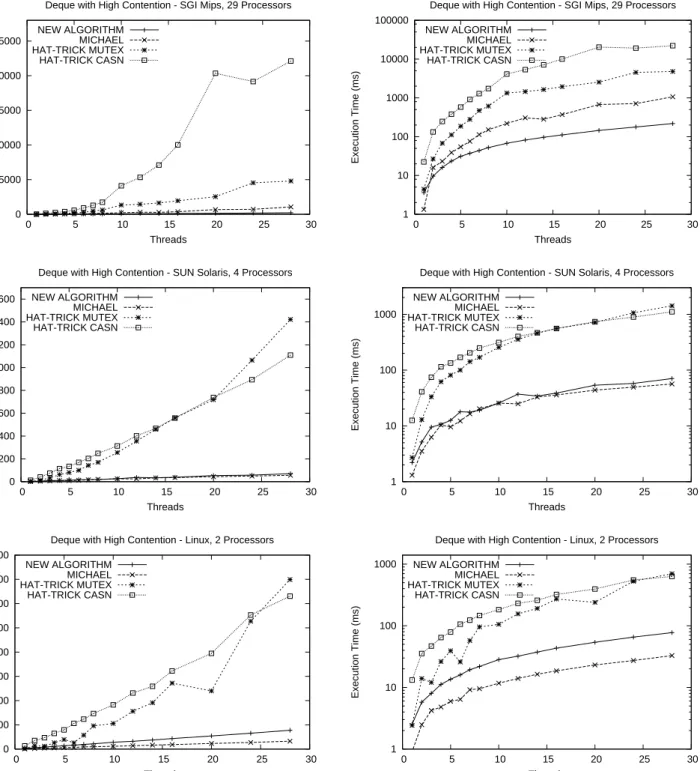
The experiments were performed using different number of threads, varying from 1 to 28 with increasing steps. Three different platforms were used, with varying number of pro-cessors and level of shared memory distribution. To get a highly pre-emptive environment, we performed our experi-ments on a Compaq dual-processor Pentium II PC running Linux, and a Sun Ultra 80 system running Solaris 2.7 with 4 processors. In order to evaluate our algorithm with full con-currency we also used a SGI Origin 2000 system running Irix 6.5 with 29 250 MHz MIPS R10000 processors. The results from the experiments are shown in Figure 6. The av-erage execution time is drawn as a function of the number of threads.
Our results show that both the CAS-based algorithms outperforms the CAS2-based implementations for any num-ber of threads. For the systems with low or medium concur-rency and uniform memory architecture, [13] has the best performance. However, for the system with full concur-rency and non-uniform memory architecture our algorithm performs significantly better than [13] from 2 threads and more, as a direct consequence of the disjoint-parallel acces-sible nature of our algorithm.
6
Conclusions
We have presented the first lock-free algorithmic imple-mentation of a concurrent deque that has all the following features: i) it is disjoint-parallel accessible with retained parallelism, ii) uses a fully described lock-free memory management scheme, and iii) uses atomic primitives which are available in modern computer systems, even when ex-tended for dynamic maximum sizes.
We have performed experiments that compare the per-formance of our algorithm with two of the most efficient algorithms of lock-free deques known, using full imple-mentations of those algorithms. The experiments show that our implementation performs significantly better on sys-tems with high concurrency and non-uniform memory ar-chitecture.
We believe that our implementation is of highly practical interest for multi-processor applications. We are currently incorporating it into the NOBLE [16] library.
0 5000 10000 15000 20000 25000 0 5 10 15 20 25 30 Execution Time (ms) Threads
Deque with High Contention - SGI Mips, 29 Processors NEW ALGORITHM MICHAEL HAT-TRICK MUTEX HAT-TRICK CASN 1 10 100 1000 10000 100000 0 5 10 15 20 25 30 Execution Time (ms) Threads
Deque with High Contention - SGI Mips, 29 Processors NEW ALGORITHM MICHAEL HAT-TRICK MUTEX HAT-TRICK CASN 0 200 400 600 800 1000 1200 1400 1600 0 5 10 15 20 25 30 Execution Time (ms) Threads
Deque with High Contention - SUN Solaris, 4 Processors NEW ALGORITHM MICHAEL HAT-TRICK MUTEX HAT-TRICK CASN 1 10 100 1000 0 5 10 15 20 25 30 Execution Time (ms) Threads
Deque with High Contention - SUN Solaris, 4 Processors NEW ALGORITHM MICHAEL HAT-TRICK MUTEX HAT-TRICK CASN 0 100 200 300 400 500 600 700 800 0 5 10 15 20 25 30 Execution Time (ms) Threads
Deque with High Contention - Linux, 2 Processors NEW ALGORITHM MICHAEL HAT-TRICK MUTEX HAT-TRICK CASN 1 10 100 1000 0 5 10 15 20 25 30 Execution Time (ms) Threads
Deque with High Contention - Linux, 2 Processors NEW ALGORITHM
MICHAEL HAT-TRICK MUTEX HAT-TRICK CASN
References
[1] O. Agesen, D. Detlefs, C. H. Flood, A. Garthwaite, P. Martin, N. Shavit, and G. L. Steele Jr., “DCAS-based concurrent deques,” in ACM Symposium on Par-allel Algorithms and Architectures, 2000, pp. 137– 146.
[2] N. S. Arora, R. D. Blumofe, and C. G. Plaxton, “Thread scheduling for multiprogrammed multipro-cessors,” in ACM Symposium on Parallel Algorithms and Architectures, 1998, pp. 119–129.
[3] D. Detlefs, P. Martin, M. Moir, and G. Steele Jr, “Lock-free reference counting,” in Proceedings of the 20th Annual ACM Symposium on Principles of Dis-tributed Computing, Aug. 2001.
[4] D. Detlefs, C. H. Flood, A. Garthwaite, P. Martin, N. Shavit, and G. L. Steele Jr., “Even better DCAS-based concurrent deques,” in International Symposium on Distributed Computing, 2000, pp. 59–73.
[5] M. Greenwald, “Non-blocking synchronization and system design,” Ph.D. dissertation, Stanford Univer-sity, Palo Alto, CA, 1999.
[6] T. Harris, K. Fraser, and I. Pratt, “A practical multi-word compare-and-swap operation,” in Proceedings of the 16th International Symposium on Distributed Computing, 2002.
[7] T. L. Harris, “A pragmatic implementation of non-blocking linked lists,” in Proceedings of the 15th Inter-national Symposium of Distributed Computing, Oct. 2001.
[8] M. Herlihy, “Wait-free synchronization,” ACM Trans-actions on Programming Languages and Systems, vol. 11, no. 1, pp. 124–149, Jan. 1991.
[9] M. Herlihy, V. Luchangco, and M. Moir,
“Obstruction-free synchronization: Double-ended queues as an example,” in Proceedings of the 23rd International Conference on Distributed Computing Systems, 2003.
[10] M. Herlihy and J. Wing, “Linearizability: a correct-ness condition for concurrent objects,” ACM Trans-actions on Programming Languages and Systems, vol. 12, no. 3, pp. 463–492, 1990.
[11] A. Israeli and L. Rappoport, “Disjoint-access-parallel implementations of strong shared memory primitives,” in Proceedings of the 13th Annual ACM Symposium on Principles of Distributed Computing. ACM, Aug. 1994, pp. 151–160.
[12] P. Martin, M. Moir, and G. Steele, “DCAS-based con-current deques supporting bulk allocation,” Sun Mi-crosystems, Tech. Rep. TR-2002-111, 2002.
[13] M. M. Michael, “CAS-based lock-free algorithm for shared deques,” in Proceedings of the 9th Interna-tional Euro-Par Conference, ser. Lecture Notes in Computer Science. Springer Verlag, Aug. 2003. [14] M. M. Michael and M. L. Scott, “Correction of a
memory management method for lock-free data struc-tures,” Computer Science Department, University of Rochester, Tech. Rep., 1995.
[15] A. Silberschatz and P. Galvin, Operating System Con-cepts. Addison Wesley, 1994.
[16] H. Sundell and P. Tsigas, “NOBLE: A non-blocking inter-process communication library,” in Proceedings of the 6th Workshop on Languages, Compilers and Run-time Systems for Scalable Computers, ser. Lec-ture Notes in Computer Science. Springer Verlag, 2002.
[17] J. D. Valois, “Lock-free data structures,” Ph.D. dis-sertation, Rensselaer Polytechnic Institute, Troy, New York, 1995.
A
The algorithm for dynamic maximum sizes
This section shows the the full details of how to extend the algorithm for dynamic maximum sizes, following the guidelines earlier presented in Section 3.4.
As the link structure now can contain full pointer values, see Figure 7 , the following functions are added for safe handling of the memory management:
function READ_NODE(address:pointer to Link) :pointer to
Node
function READ_DEL_NODE(address:pointer to Link)
:pointer to Node
The functions READ_NODE and READ_DEL_NODE atomically de-references the given link and increases the reference counter for the corresponding node. In case the deletion mark of the link is set, the function READ_NODE returns NULL.
The remaining details of the extended algorithm are showed in Figures 7 and 8.
union Link
_: word
hp, di:hpointer to Node, booleani structure Node
value: pointer to word prev: union Link next: union Link // Global variables head, tail: pointer to Node // Local variables
node,prev,prev2,next,next2: pointer to Node link1,lastlink: union Link
function CreateNode(value: pointer to word):pointer to Node
C1 node:=MALLOC_NODE(); C2 node.value:=value; C3 return node;
procedure ReleaseReferences(node: pointer to Node)
RR1 RELEASE_NODE(node.prev.p); RR2 RELEASE_NODE(node.next.p);
procedure PushLeft(value: pointer to word)
L1 node:=CreateNode(value); L2 prev:=COPY_NODE(head); L3 next:=READ_NODE(&prev.next); L4 while true do
L5 if prev.next6=hnext,falseithen
L6 RELEASE_NODE(next); L7 next:=READ_NODE(&prev.next);
L8 continue;
L9 node.prev:=hprev,falsei; L10 node.next:=hnext,falsei;
L11 if CAS(&prev.next,hnext,falsei,hnode,falsei) then L12 COPY_NODE(node);
L13 break;
L14 Back-Off
L15 PushCommon(node,next);
procedure PushRight(value: pointer to word)
R1 node:=CreateNode(value); R2 next:=COPY_NODE(tail); R3 prev:=READ_NODE(&next.prev); R4 while true do
R5 if prev.next6=hnext,falseithen
R6 prev:=HelpInsert(prev,next);
R7 continue;
R8 node.prev:=hprev,falsei; R9 node.next:=hnext,falsei;
R10 if CAS(&prev.next,hnext,falsei,hnode,falsei) then R11 COPY_NODE(node);
R12 break;
R13 Back-Off
R14 PushCommon(node,next);
procedure PushCommon(node, next: pointer to Node)
P1 while true do
P2 link1:=next.prev;
P3 if link1.d=true or node.next6=hnext,falseithen
P4 break;
P5 if CAS(&next.prev,link1,hnode,falsei) then P6 COPY_NODE(node);
P7 RELEASE_NODE(link1.p); P8 if node.prev.d = true then
P9 prev2:=COPY_NODE(node); P10 prev2:=HelpInsert(prev2,next); P11 RELEASE_NODE(prev2); P12 break; P13 Back-Off P14 RELEASE_NODE(next); P15 RELEASE_NODE(node);
function PopLeft(): pointer to word
PL1 prev:=COPY_NODE(head); PL2 while true do
PL3 node:=READ_NODE(&prev.next); PL4 if node=tail then
PL5 RELEASE_NODE(node); PL6 RELEASE_NODE(prev);
PL7 return⊥;
PL8 link1:=node.next; PL9 if link1.d=true then
PL10 DeleteNext(node); PL11 RELEASE_NODE(node);
PL12 continue;
PL13 if CAS(&node.next,link1,hlink1.p,truei) then PL14 DeleteNext(node); PL15 next:=READ_DEL_NODE(&node.next); PL16 prev:=HelpInsert(prev,next); PL17 RELEASE_NODE(prev); PL18 RELEASE_NODE(next); PL19 value:=node.value; PL20 break; PL21 RELEASE_NODE(node); PL22 Back-Off PL23 RemoveCrossReference(node); PL24 RELEASE_NODE(node); PL25 return value;
function PopRight(): pointer to word
PR1 next:=COPY_NODE(tail); PR2 node:=READ_NODE(&next.prev); PR3 while true do
PR4 if node.next6=hnext,falseithen
PR5 node:=HelpInsert(node,next);
PR6 continue;
PR7 if node=head then PR8 RELEASE_NODE(node); PR9 RELEASE_NODE(next);
PR10 return⊥;
PR11 if CAS(&node.next,hnext,falsei,hnext,truei) then PR12 DeleteNext(node); PR13 prev:=READ_DEL_NODE(&node.prev); PR14 prev:=HelpInsert(prev,next); PR15 RELEASE_NODE(prev); PR16 RELEASE_NODE(next); PR17 value:=node.value; PR18 break; PR19 Back-Off PR20 RemoveCrossReference(node); PR21 RELEASE_NODE(node); PR22 return value;
procedure DeleteNext(node: pointer to Node)
DN1 while true do DN2 link1:=node.prev; DN3 if link1.d=true or
DN4 CAS(&node.prev,link1,hlink1.p,truei) then break; DN5 lastlink.d:=true;
DN6 prev:=READ_DEL_NODE(&node.prev); DN7 next:=READ_DEL_NODE(&node.next); DN8 while true do
DN9 if prev=next then break; DN10 if next.next.d = true then
DN11 next2:=READ_DEL_NODE(&next.next); DN12 RELEASE_NODE(next);
DN13 next:=next2;
DN14 continue;
DN15 prev2:=READ_NODE(&prev.next); DN16 if prev2=NULL then
DN17 if lastlink.d = false then
DN18 DeleteNext(prev); DN19 lastlink.d:=true; DN20 prev2:=READ_DEL_NODE(&prev.prev); DN21 RELEASE_NODE(prev); DN22 prev:=prev2; DN23 continue;
DN24 if prev26=node then DN25 lastlink.d:=false; DN26 RELEASE_NODE(prev); DN27 prev:=prev2;
DN28 continue;
DN29 RELEASE_NODE(prev2);
DN30 if CAS(&prev.next,hnode,falsei,hnext,falsei) then DN31 COPY_NODE(next); DN32 RELEASE_NODE(node); DN33 break; DN34 Back-Off DN35 RELEASE_NODE(prev); DN36 RELEASE_NODE(next);
function HelpInsert(prev, node: pointer to Node)
:pointer to Node HI1 lastlink.d:=true; HI2 while true do
HI3 prev2:=READ_NODE(&prev.next);
HI4 if prev2=NULL then
HI5 if lastlink.d = false then
HI6 DeleteNext(prev); HI7 lastlink.d:=true; HI8 prev2:=READ_DEL_NODE(&prev.prev); HI9 RELEASE_NODE(prev); HI10 prev:=prev2; HI11 continue; HI12 link1:=node.prev; HI13 if link1.d=true then
HI14 RELEASE_NODE(prev2);
HI15 break;
HI16 if prev26=node then HI17 lastlink.d:=false; HI18 RELEASE_NODE(prev); HI19 prev:=prev2;
HI20 continue;
HI21 RELEASE_NODE(prev2);
HI22 if CAS(&node.prev,link1,hprev,falsei) then HI23 COPY_NODE(prev);
HI24 RELEASE_NODE(link1.p); HI25 if prev.prev.d=true then continue;
HI26 break;
HI27 Back-Off
HI28 return prev;
procedure RemoveCrossReference(node: pointer to Node)
RC1 while true do
RC2 prev:=node.prev.p; RC3 if prev.next.d = true then
RC4 prev2:=READ_DEL_NODE(&prev.prev); RC5 node.prev:=hprev2,truei;
RC6 RELEASE_NODE(prev);
RC7 continue;
RC8 next:=node.next.p; RC9 if next.next.d = true then
RC10 next2:=READ_DEL_NODE(&next.next); RC11 node.next:=hnext2,truei;
RC12 RELEASE_NODE(next);
RC13 continue;
RC14 break;