Modeling the Tail Distribution and Ratemaking: An Application of Extreme Value Theory Jianqiang Hao, Arne Bathke, and Jerry Skees1
Selected Paper prepared for presentation at the American Agricultural Economics Association Annual Meeting, Providence, Rhode Island, July 24-27, 2005
Copyright 2005 by Jianqiang Hao, Arne Bathke, and Jerry Skees. All rights reserved. Readers may make verbatim copies of this document for non-commercial purposes by any means, provided that this copyright notice appears on all such copies.
1
Hao is a former Ph.D. student in the Department of Agricultural Economics at the University of Kentucky; Bathke is Assistant Professor in the Department of Statistics at the University of Kentucky; Skees is H.B. Price Professor in the Department of Agricultural Economics at the University of Kentucky.
Modeling the Tail Distribution and Ratemaking: An Application of Extreme Value Theory
Abstract
Economic analysis of weather risk often depends on accurate assessment of the probability (P) of tail quantiles (Q). Traditional statistics mostly focuses on laws governing the average and such methods might be misleading or biased when modeling tail risks since the primary statistics are often driven by the data clustered in the center. Extreme value theory can provide a promising estimation of the tail risk since it concerns the quantification of the largest events, the smallest events, or events over the threshold in a sample and derives the laws governing tail part events. This paper applies extreme value theory to quantify excess rainfall across selected regions in India during the 1871 to 2001 period, and provides evidence for the feasibility and effectiveness of applying an extreme value model in modeling and assessing weather tail risk over alternative parametric methods.
Introduction
Economic analysis of weather risk often depends on an accurate estimation of the probability (P) or patterns depicting the stochastic nature of a random weather variable, especially the tail quantiles (Q). For example, accurate actuarial rates, which depend on a precise measurement of low tail risk, are essential elements of an actuarially sound insurance program. A few low-probability but high-consequence events often have dominant impacts in risk assessment and thus commercial investors often use the Value-at-Risk method to assess the portfolio risk with a low probability at the tail part.
Accurate ratemaking and efficient risk assessment depend on the precise forecasting of a future occurrence, especially for the tail part risk. Technology is bringing some certainty to predictions associated with weather events -- the field that has always been considered unpredictable. However, until today, the most common method of forecasting is still to use historic records of meteorological variables to derive the probability distribution of related variables (e.g., temperature, precipitation, etc) associated with various weather events (Podbury et al., 1998), that is, the probabilistic or statistical method. Thus, modeling the underlying risk distribution and assessing the impact on economic analysis are essential to weather risk management.
Considerable disagreement exists about the most appropriate characterization of risk distributions. A variety of approaches that have been used to represent risk distributions can be segmented into two primary groups: parametric methods and non-parametric methods.
Under the parametric approach, a specific family of distributions (e.g., normal, beta, gamma) is selected and parameters of this family are estimated based on the observed data using the maximum likelihood method or the generalized method of moments. This approach works well when the underlying population distribution family is correctly assigned. In agriculture, parametric techniques have been extensively applied for estimating crop-yield distributions and premium ratemaking, such as the normal distribution (e.g., Botts and Boles, 1958; Day, 1965), the beta distribution (e.g., Babcock and Hennessy, 1996; Kenkel, Busby, and Skees, 1991; Nelson and Preckel, 1989; Tirupattur, Hauser, and Chaherli, 1996), the gamma distribution (e.g., Gallager, 1986), the lognormal distribution (e.g., Jung and Ramirez, 1999; Stokes, 2000), the Su family
(e.g., Ramirez, Misra, and Field, 2003), and a mixture of several parametric distributions (Goodwin and Ker, 2002). Different parametric distributions vary in terms of their flexibility and ability to capture the crop-yield process, therefore, Sherrick, et al. (2004) discussed the modeling of alternative distributional parameterization (i.e., the beta, the logistic, the lognormal, the normal, and the Weibull distribution) and their economic importance on crop insurance valuation.
Parametric techniques are also commonly used in catastrophic risk modeling. For example, the Poisson distribution is often used to model rare and random events (i.e., earthquake occurrence), the Pareto distribution is used to estimate the flood frequency or fire loss, and the lognormal distribution is frequently used to track the earthquake motion, raindrop size, or Tornado path (Woo, 1999).
The prerequisites of functional form and distribution assumptions for the parametric approach may result in an imprecise prediction and misleading inference when the underlying distribution choice is incorrect. That is, parametric methods are susceptible to specification errors and their statistical consequences.
Nonparametric methods have been developed for the situation where we do not assume any knowledge of a specific distribution family of the underlying population. The simplest nonparametric technique is the histogram and the most commonly used nonparametric methods are based on the empirical distribution. Compared to the parametric approach, the nonparametric approach is free of functional forms and distribution assumptions (distribution free) and relatively insensitive to outliers. Therefore, this approach is impervious to specification errors and might result in more accurate and robust models (Featherstone and Kastens, 1998). However, some
nonparametric procedures (e.g., the kernel procedure) have a relatively slow rate of convergence to the true density (Silverman, 1986) and a potential difficulty in measuring rare events. Some efficiency might also be lost when prior knowledge of the underlying distribution form is available. Furthermore, it is problematic to use the nonparametric approach in analyzing multiple variables with small samples.
In agriculture, in addition to the empirical distribution and histograms, a variety of kernel functions have been used in estimating crop-yield distribution and rating crop insurance contracts, such as Turvey and Zhao (1999), Goodwin and Ker (1998), Ker and Goodwin (2000), and Ker and Coble (2003).
Traditional statistics, including both parametric and nonparametric methods, mostly focus on the laws governing averages. Basic statistical measures of risk are all based on the centered data. When modeling weather risk, our interest is not in estimating the whole distribution but the tail risk. The use of standard parametric or nonparametric methods might be misleading or biased in modeling the tail risk since the primary statistics are driven by the data clustered in the center. This bias can further cause imprecise ratemaking when designing a weather-based contingent claims. To overcome the disadvantage of applying standard methods in modeling tail risk, extreme value theory could provide a promising solution since it is primarily concerned with the quantification of the stochastic behavior of a process at usually the largest, the smallest, or the events over a threshold in a sample and derives the laws governing tail events.
This paper applies statistical techniques to quantify weather tail risk and compares the results from standard statistical distributions with an innovative approach – extreme value theory with risk estimation and premium setting. The objective of this essay is to
provide evidence for the feasibility of applying extreme value models in modeling weather tail risk and investigating its effectiveness over other alternative distributions on economic importance of premium ratemaking and risk assessment. Four parts are included in this essay. First, the essentials of tail distribution estimation is emphasized for modeling and assessing weather risk in the first part; Secondly, the statistical model for modeling the tail distribution – extreme value theory - is introduced along with the statistical properties; The third part develops a research procedure that compares the estimation and actuarial performance of the standard distributions and the extreme value model using monthly rainfall data across different regions in India over the period from 1871 to 2001. The power and efficiency of the Extreme Value Model are further demonstrated by modeling the tail risk. Finally, conclusions and recommendations are developed.
Tail Estimation -- Let the tails speak for themselves!
Traditional statistics mostly looks at the laws governing the average. Basic statistical measures of risk, mean, variance, and the third or fourth central moments, are all based on the center of the observed data. For example, consider a sample of n observations, yi, for i=1 to n. The population mean is estimated from the sample
average, i.e.,
∑
= = n i i y n y 1 1; The population variance that is used to measure the spread of
the distribution is estimated by the sample variance
∑
= − − = n i i y y n s 1 2 2 ) ( 1 1 ; The
skewness is used to measure the symmetry of the distribution. The sample estimate of the
skewness is 1 3 3 ) 1 ( ) ( s n y y a n i i − −
is a measure of the “peakiness” of the distribution. The sample estimate of the kurtosis is 4 1 4 ) 1 ( ) ( s n y y k n i i − − =
∑
=. It is obvious that the basic statistical measures of risk are all based on
the center of the data (y), and they may not be able to truly reflect the tail characteristics. However, in weather risk estimation, a few low probability events will exert a high, or even dominant impact on risk assessment and the quantification of (P, Q) combinations needs to rely on the (asymptotic) form of tail distribution. Estimation and inference based on the whole distribution might be inaccurate since the data clustered in the center of the distribution will have too much influence over the estimators. Misspecification of the distribution family can, in turn, bias the calculation of the insurance premiums and indemnity payments.
The reasons behind applying tail estimation are summarized as follows: 1) Model estimation and assessment of the model fit using standard statistical procedures are often driven by the centered values of the data; 2) A trend in frequency or magnitude might be confined to one or both tails of a distribution; 3) Alternative distributions that fit the observed data well might have different performance in a tail estimation; 4) Accurate ratemaking of weather contracts relies on tail part estimation.
Recently, some researchers (e.g., Ker and Coble, 2003) have noticed this problem and suggest modeling the conditional risk distribution instead of the whole distribution in risk assessment. However, the risk estimation and economic analysis of alternative distribution specifications on modeling conditional weather risk have not been well documented. Specifically, the performance of alternative distributions on conditional tail part risk valuation has not been addressed in most of the literature.
Extreme Value Model
Extreme value theory (EVT) dates back to the late 1920s to early 1940s following the pioneering work of Fisher and Tippett (1928), and Gnedenko (1943). In 1958 Gumbel laid out the theoretical framework of the extreme value model in his classical book. Extreme value techniques have been extensively applied in many disciplines during the last several decades, including meteorology (e.g., wind speeds, ocean wave, precipitation), engineering (e.g., quality control, wind engineering, alloy strength prediction), catastrophic phenomena (e.g., thermodynamics of earthquakes, floods, storms, hurricanes), and non-life actuaries (e.g., risk assessment, loss estimation). From the early 1990s, applications of EVT in modeling financial extremes have become more and more popular, especially measuring Value at Risk (VaR) on the tails of the Profit & Loss (P&L) distribution (Chen and Chen, 2002).
Generally, there are two principal kinds of approaches in modeling extreme values, the block maxima model (BMM) and the peak over threshold model (POT). The first approach models the largest or the smallest values for a series of identically distributed observations. For example, annual maximum sea level, the fastest race times in sport, daily minimum temperature, the largest claim in insurance, etc. This approach can be further extended to model the (r) largest order statistics. On the other hand, the peak-over-threshold approach models all large (small) observations that exceed (fall below) a high (low) threshold. This approach might be more useful for practical applications since it is more efficient to use limited resources on extreme values instead of only the largest or smallest observation. In some realistic situations, the extreme value
approach may involve a loss of information and the accuracy of estimation of a small sample size might be compromised.
Block Maxima Model (BMM)
The BMM approach focuses on the statistical behavior of the largest or smallest value in a sequence of independent random variables. In modeling weather risk and designing an efficient risk management system, it might be of particular interest when asking such a question as: “What is the probability that the maximum event for next year will exceed all previous levels?” In the actuarial industry, such information might be especially important in determining the buffer fund and probability of ruin that can jeopardize the position of the insurance or reinsurance company due to catastrophic loss.
Statistically, assume Mnbe the maximum of the process over n independent random variables with a common distribution function F.
} , , max{ 1 n n X X M = L
In theory, the distribution of Mncan be derived by (1) P(Mn ≤ z)=P(X1 ≤z,L,Xn ≤z}={F(z)}n
Since the exact distribution of Mndepends on F(z) which is unknown, the asymptotic distribution of Mnis of particular interest. However, Fn(z)→0
asn→∞, the distribution of Mndegenerates to a point. Thus, the extreme value (Mn) needs to be normalized in order to have a non-degenerate limiting distribution.
(2) n n n n a b M W = −
The Fisher-Tippet Theorem proves the existence of the limiting distribution of the normalized extreme valueWn.
(3) lim ( z) G(z) a b M P n n n n ≤ = − ∞ →
where G is a non-degenerate distribution and a generalized extreme value (GEV) family can be used to capture the above distribution.
(4) ( ) exp{ [1 ( )] 1/ξ} σ μ ξ − + − + − = z z G
Here, μ and σ(>0) are location and scale parameters, and ξ is a shape parameter. Three families of limit distributions can be obtained from the GEV family:
I (Gumbel): G(z)=exp{−exp[−(z− )]}, −∞<z<∞ σ μ as limξ →0 II (Frechet): ⎪⎩ ⎪ ⎨ ⎧ > − − ≤ = − μ σ μ ξ μ z for z z for z G }, ) ( exp{ , 0 ) ( as ξ >0 III (Weibull): ⎪⎩ ⎪ ⎨ ⎧ ≥ < − − = − μ μ σ μ ξ z r fo z for z z G , 1 }, ) ( exp{ ) ( as ξ <0
The GEV family can be easily transformed to modeling the smallest value by changing the sign. AssumeM1 =min{X1,K,Xn}, let Yi =−Xi andMn =max{Y1,K,Yn}, then Mn =−M1and Mncan be fitted by the GEV family. The maximum likelihood estimate of the parameter (μˆ,σˆ,ξˆ) for the asymptotic distribution of Mncorresponds exactly to that of the asymptotic distribution of M1, except for the sign change of the location parameter. Furthermore, the GEV family can be extended to model the rth largest or smallest order statistics and the parameters of the GEV family can be estimated in the
presence of covariates, such as trends, cycles, or actual physical variables (e.g., the Southern Oscillation Index in the rainfall process).
Maximum likelihood procedures can be employed to estimate the GEV parametersμ,σ,ξ. These estimators are unbiased, consistent, and asymptotically efficient. Although there is not always a straightforward analytical solution, the estimators can be found using standard numerical optimization algorithms.
Peak over Threshold Model (POT)
Modeling only maxima or minima can only be applied when the particular interest is in the largest or smallest event, and this method is also an inefficient approach if other data on the tail are available and of interest. Therefore, the BMM approach is too narrow to be applied to a wide range of problems. Generally, a question such as “what is the probability that the occurrence of the next event will exceed a predetermined level u (threshold)?” is more useful for weather risk analysis.
POT can compensate such shortcomings and be used to model all large (small) observations that exceed (fall below) a high (low) threshold. These exceedances are important in determining the insurance or reinsurance premium rates, claims, buffer fund, ruin probability, and may even be helpful when design preventive strategies for risk management.
Let’s assume u is the threshold and the tail events are regarded as those ofXithat exceed u {X1,L,Xr}>u}. Then the stochastic behavior of these events whose values are greater than the pre-specified threshold value u can be represented by the following conditional probability function.
(5) , 0 ) ( 1 ) ( 1 ) | ( > − + − = > + > y u F y u F u X y u X P ) ( 1 ) ( ) ( ) ( 1 ) ( ) ( ) | ( ) ( u F u F r F u F u F y u F u X y u X P y F − − = − − + = > ≤ − = μ
Where r denotes these excess of Xi above u and F is the marginal distribution of the sequence of random variables Xi..
Pickands (1975), Balkema and de Haan (1974) have shown that if block maxima have an approximate GEV distribution, then threshold excesses have a corresponding approximate distribution within the Generalized Pareto Distribution family (GPD) and the parameters of GPD are uniquely determined by those of the associated GEV distribution of block maxima. For a large enough threshold u, the distribution function of )(X −u conditional on X >ucan be approximated by
(6) ξ σ ξ 1/ ) 1 ( 1 ) ( = − + − u y y H where )σu =σ +ξ(u−μ
If 0ξ < (Weibull), the distribution of excesses has an upper bound; If 0
>
ξ (Frechet), the distribution of excesses has no upper limit. If ξ →0 (Gumbel), the
distribution can be simplified. It is exactly an exponential distribution with parameter1/σu.
Similar to the GEV distribution, maximum likelihood procedures can be utilized to estimate the GPD parameters given the threshold u.
The determination of the threshold u is crucial to perform the POT method. There exists a tradeoff between bias and variance in determining the threshold. For example, too low a threshold is likely to violate the asymptotic basis of the model and may lead to
a bias; too high a threshold will generate too few observations left to estimate the parameters of the tail distribution function and may cause high variance. Coles (2001) suggests adopting as low a threshold as possible, subject to the limit model providing a reasonable approximation. Graphically, the mean residual life plot and Hill-plot (Coles, 2001; Chen, 2002) can be performed to determine the crucial threshold u. The goodness-of-fit test suggested by Gumble (1958), and the Bootstrap methods suggested by Dekkers and de Haan (1989) can also be used to approach this problem.
Whether the fitted models are good enough to model the observed data is particularly important in statistical inference. Probability plots, quantile plots, and return level plots are often used to assess the quality of fitted GEV and GPD models. Details concerning the extreme value theory can be found in Coles (2001), and Embrechts, Kluppelburg and Mikosch (1997).
Research Design
This study provides an empirical analysis of modeling weather risk using alternative parametric distributions and extreme value theory. Premium rates of a hypothetical weather index with varying strikes are calculated and a statistical comparison is performed.
Data
Indian agriculture accounts for 24 percent of the GDP and provides work for almost 60 percent of the population. Monsoons in India can bring damaging cyclones and floods to the coastal plain. Heavy flooding in 2000 caused about 1,200 deaths in Southern India and Bangladesh (Swiss Re, 2001). Officials in Andhra Pradesh reported that by August 30, 2000 the floods had affected 3,080 villages and towns and submerged
177,987 hectares of farmland, causing damage officially estimated at 7.7 billion rupees. The real destruction far exceeded these figures.2
Parchure (2002) estimates that about 90 percent of the variation in the crop production of India is due either to inadequate rainfall or to excess rainfall. Generally, excess rain is concentrated in the months of June to September. However, the performance of the current crop insurance program in India can be considered disappointing (Kalavakonda and Mahul, 2003; Mishra, 1996; Parchure, 2002; Skees and Hess, 2003), and developing rainfall-based insurance can be considered an economically viable instrument. For example, Veeramani, Maynard and Skees (2003) suggest rainfall- based indices and options as a replacement for the current expensive area crop-yield programs for Indian rice farmers.
In this study, historic monthly rainfall from the months of June to September over 1871 to 2000 period is used across fourteen different subdivisions. The data is collected from the Indian Institute of Tropical Meteorology.
The use of time series data to estimate an underlying distribution needs the data to be identical and independent, thus a series of tests are necessary.
1) Deterministic trend or stochastic trend
The augmented Dickey Fuller (ADF) and Phillips-Perron (PP) tests were used to test for the existence of a stochastic trend on a region-by-region basis. All of the fourteen-rainfall series were found to be trend stationary and the unit root tests were rejected in all cases. The results suggest that a deterministic trend might be appropriate for the rainfall series.
2) Linear trend or higher order trend
2
The possible trend order was examined by regressing time series rainfall data against a possible time trend (e.g., linear, quadratic, cubic, or higher order) based on the significance of the F-test. Greene (2003) notes the conservative nature of this test in cases of non-normal errors.
The results indicated that only two of the fourteen regions were found to have significant linear trends (Region COAPR with a 10% significant level and Region SASSM with a 5% significant level). Region TELNG has a significant quadratic term and a fifth order term at the 10% level and the fourth term at the 5% level. Regions WMPRA and SHWBL have significant cubic terms at the 5% level and the 10% level, respectively. But none of them have significant lower order terms.
3) Autocorrelation and Normality
Durbin-Watson tests are used to indicate the incidence of the first order autocorrelation for lag one series (monthly autocorrelation) and lag four series (yearly autocorrelation). The results showed that the DW test was only rejected in one region, SASSM, at a 5% significant level. A normality test3 failed to reject in only one region, NASSM, at a 5% significant level and in two regions, BHPLT and SASSM, at a 10% significant level. Since only two regions have a deterministic trend (CORPA and SASSM), a heteroscedasticity test is not performed in this study.
Given the sporadic violations of the i.i.d. assumptions, a linear trend was imposed for regions COAPR and SASSM and the time series rainfall data were detrended by a linear term to a base year of 2001. The raw rainfall data were used for the twelve other regions. The summary statistics of rainfall data are shown in Table 1.
The mean of monthly cumulative rainfall during the period from June to September across the fourteen regions average 2800mm, indicating that excess rainfall can be a significant risk. The sample means vary considerably ranging from a low of 1784mm (TELNG) to a high of 5014mm (SHWBL). Sample medians are slightly smaller than sample means in all regions except EUPRA and NASSM, ranging from 1707mm (TELNG) to 4896mm (SHWBL) with an average of 2736mm. The variability of monthly rainfall is also different across the regions, with standard deviations ranging from 779 (TELNG) to 1655 (SHWBL). The coefficients of skewness range from 0.139 (EMPRA) to 0.743 (TELNG), with an average of 0.41 across all regions. Positive skewness calls into question the use of symmetric distribution (e.g., normal distribution) to model rainfall. The coefficients of sample kurtosis range from -0.905 (WUPRL) to 0.783 (TELNG), with an average of -0.089. Both negative kurtosis (sub-Gaussian) and positive kurtosis (super-Gaussian) appear across the different regions, showing the possibility of both “less peaked” and “more peaked” density functions. Monthly cumulative rainfall levels vary significantly across regions. For example, the maximum rainfall ranges from as low as 4894mm in COAPR to 10129mm in SHWBL; the minimum rainfall fluctuates from 4mm in WUPRL to 1531mm in SASSM. The summary statistics indicate that rainfall across regions displays significantly different distributions but predominantly positive skewness.
Research Procedure
Our interest is to provide evidence for the feasibility of applying the extreme value theory in modeling weather tail risk and to investigate its efficiency over other alternative distributions on economic importance of premium ratemaking and risk
assessment. Therefore, the focus is to compare the statistical estimation and premium ratemaking based on standard statistical methods and extreme value theory. In this study, four alternative distributions are selected as the parametric candidates and the GPD model is chosen as the extreme value candidate. Our research procedure includes the following five steps.
Step 1. Estimate the rainfall series using parametric distributions
Four parametric distributions, including the beta distribution, the gamma distribution, the lognormal distribution, and the Weibull distribution, are chosen as parametric candidates, and the maximum likelihood method is used to estimate the parameters. The actuarially fair premium rates were further calculated for a hypothetical weather-based contingent claim based on these four candidate distributions.
Step 2. Rank parametric candidates
For each of the fourteen rainfall series, four parametric candidates are ranked from the best to the worst based on several goodness of fit tests (e.g., the Kolmogorov-Smirnov test, the Cramer-von Mises test, the Anderson-Darling test, and the Chi-Square test) and the visual QQ plot. The weighted rank for each candidate is further calculated. Step 3. Estimate the rainfall series using EVT model
The GPD model is chosen to estimate the excess rainfall distribution for each region and an actuarially fair premium rate is calculated further for the weather-based contingent claim.
Step 4. Compare the economic importance of estimations based on two methods
The calculated premium rates from the extreme value theory and the best candidate from the standard statistical distributions are tested for equality of mean using a couple of nonparametric paired tests, e.g., the sign test and the Wilcoxon signed rank test. Step 5. Sensitivity analysis of different strike levels
Different feasible strikes are applied and the robustness of our results is then discussed through the sensitivity analysis.
Fitting the Alternative Parametric Distributions
Parametric techniques fit the observed data to one of the standard distributions (e.g., the beta distribution, the gamma distribution, etc) by some statistical methods (e.g., by the maximum likelihood method or the generalized moment method). In selecting the parameterization of rainfall distributions, several considerations were given to 1) Stylized features of cumulative rainfall (i.e., non-negativity, skewness); 2) Flexible parameters to adequately characterize cumulative precipitation over time periods across different regions; 3) Previous studies and empirical evidence from climatological, hydrological, and agronomical research (Barger and Thom, 1949; Thom, 1958; Ison, et al., 1971; McWhorter, et al., 1966). Four candidate distributions are considered in this study: the beta distribution4, gamma distribution, lognormal distribution, and weibull distribution.
Maximum likelihood methods were applied to solve for the parameters of the four distributions for each region sample. The log-likelihood functions and MLEs for the gamma distribution are illustrated as follows. The likelihood function for the parameters of the gamma distribution can be specified as follows:
4
The upper bound parameter, to guarantee x to be between zero and one, was set to 5% above the maximum rainfall recorded in this study.
(7) α α β β α β α β α 1 / 1 1 ) ( ) ( 1 ) , ; ( ) ; , ( ∑ Γ = = − − = =
∏
∏
xi n i i n n n i i x e x f x LThe log-likelihood function to be maximized is written as
(8) (α,β; ) log( (α)) α logβ (α 1) log /β
1 1
∑
∑
= = − − + − Γ − = n i i n i i x x n n x LogL βα, can be obtained from the first derivative of the above equation and MLEs of β
α, are unbiased, consistent and asymptotically efficient.
If any of the cumulative precipitation observations in the historical data serials are equal to zero, a censoring estimation suggested by Wilks (1990), and Martin, Barnett and Coble (2001), could be applied. The log-likelihood function for the censoring function can be written as
(8’) (α,β; ) log[ ( ;α,β)] [log( (α)) logβ] (α 1) /β
1 1
∑
∑
= = − − + + Γ − = n i i n i i w C F C N n x x N x LogLWhere C is the censoring point, for example, a small number C=0.01 inch; Nc denotes censored years in which cumulative precipitation over the contract time is recorded as zero; Nw denotes non-censoring years; and N = Nc + Nw.
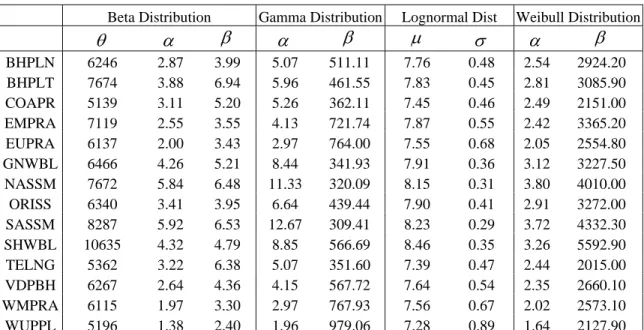
The parameters for all four distributions were estimated separately using the rainfall data from region a, and then for region b, and so on through each sample. The summary statistics of the four candidate distributions are provided in Table 2. The results further indicate that the distributions differ meaningfully across regions.
Rank Alternative Distributions
Each of the alternative distributions has two parameters to be estimated in this study and we thus have the same degrees of freedom when performing the maximum likelihood functions for the rainfall series.
Alternative distributions can be ranked for the goodness-of-fit according to some standard tests and visual QQ plot. SAS 8.2 provides several goodness-of-fit tests for the appropriateness of candidate distribution, such as the Kolmogorov-Smirnov test, the Cramer-von Mises test, the Anderson-Darling test, and the Chi-Square test. Under each test, the null hypothesis is set as: The empirical distribution is equal to the best candidate within the respective parametric family of distributions. A large p-value fails to reject the null hypothesis suggesting that the candidate distribution might be appropriate to fit the sample data. However, these goodness-of-fit tests are not optimal for comparing the tail behavior of the distributions. Therefore, also QQ plots have been generated.
The QQ plot provides the visual evidence for the goodness-of-fit of the candidate distribution. If Fˆ is a reasonable model for the population distribution, the quantile plot should be close to the unit diagonal. Since there is particular interest in the goodness-of-fit of the tail part risk rather than the whole distribution, the QQ plots may be more appropriate than the standard tests when assessing the performance of the tail part estimation.
Based on the standard goodness-of-fit tests and QQ plot, we can rank the appropriateness of the four distributions in fitting the rainfall series for each region. The following example illustrates how to rank alternative distributions for the rainfall series using the region of WMPRA. The plot of alternative distributions is shown in Figure 1. The statistics of standard goodness-of-fit tests are reported in Table 3. QQ plots of alternative distributions are provided in Figure 2.
Both the QQ plot and the standard goodness-of-fit tests suggest that the beta distribution should be the most appropriate candidate in modeling the rainfall series since
all four tests fail to reject the null hypothesis at a 10% significant level and the quantiles plot is almost an ideal unit diagonal. The Weibull distribution should be considered second after the beta distribution. From the goodness-of-fit tests and the QQ plots, the lognormal and the gamma distribution both appear to be poor candidates for fitting the rainfall series at the region of WMPRA. The tail behavior that we see in the QQ plot suggests however that the gamma distribution still provides a slightly better fit than the lognormal distribution.
After we compare the standard goodness-of-fit tests and QQ plots of these alternative distributions on a region-by-region basis, the summary of the number of times each candidate ranked first through fourth in terms of goodness-of-fit tests and QQ plot, along with a weighted average rank and the rank of average, are shown at Table 4.
The results confirm that the appropriate distribution differs across regions and the Weibull distributions fit overall the best in the majority of regions (5 in the first rank and 9 in the second rank of 14 regions, the weighted average of rank is 2.3). The fitting performance is nearly the same for the gamma and beta distribution. The gamma ranks first in 6 regions and third in 8 regions while the beta has a diversified result, ranking first in 3 regions, second in 5 regions, third in 4 regions, and fourth in 2 regions. Generally, the gamma out-performs the beta distribution and takes the overall second position. The lognormal distribution is much inferior to the other three candidates and ranks only third in 2 regions and fourth in most regions with a weighted average of 5.4.
The results are not surprising considering the microclimate pattern across regions. Actually, Sherrick, et al. (2004) also find similar results when using alternative distributions in modeling corn and soybeans in the United States. Their results suggest
that the Weibull and beta distributions are overall ranked first and second in fitting corn yield and the logistic and Weibull distributions perform first and second in modeling soybean yield for selected farms at the University of Illinois.
Distributional choice has a tremendous impact on the risk assessment and the selection of an appropriate underlying distribution can directly determine the economic effectiveness of risk hedging. Since the appropriate distribution differs across regions due to microclimate patterns, it might be best to find an appropriate candidate for each region based on the specification tests. However, such a method is time-consuming and costly for a large area. For example, crop-yield distributional modeling involves thousands of counties in the United States and rainfall series estimation includes hundreds of regions in most developing countries. Therefore, it is common to adopt the overall best distribution used in current crop insurance programs and weather index design. Unfortunately, even the overall best distribution can lead to misleading risk assessments and inaccurate premium ratemakings in some regions. For example, the Weibull distribution ranked best overall but only fitted best in 5 regions. We might lose some efficiency in the other 9 regions when applying the Weibull distribution to model the rainfall series across regions.
Fitting the POT Model
The EVT model is considered a promising alternative when modeling tail risk and can be applied in weather risk modeling when designing a weather-based contingent claim. In this part, the POT model is used to model the excess rainfall risk and the GPD is chosen as the candidate distribution.
First, the threshold (u) is decided, based on the mean residual plot on a region-by-region basis. As discussed earlier, an ideal mean excess plot should be approximately a straight line against the threshold. Next, the scale and shape parameters are estimated by the maximum likelihood method, based on the procedures provided above. Finally, a variety of statistical techniques, such as the PP plot, the QQ plot, the return level, and the density function, are plotted to check the appropriateness of the GPD in modeling excess rainfall. The parameters of GPD across regions are provided in Table 5.
Since the estimated shape parameter is ξˆ<0for all regions, the excess monthly rainfall follows the type III class of extreme value distribution, that is, the Weibull distribution. The various diagnostic plots for assessing the appropriateness of the GPD model fitted to the rainfall data across regions. None of these plots calls into question the validity of the fitted models.
Weather Index Design and Premiums Ratemaking
A weather derivative is a contract between two parties that stipulates how payment will be exchanged between the parties depending on certain meteorological conditions during the contract period. Zeng (2000) suggested that seven parameters should be specified for a weather derivative contract: 1) Contract type (call or put); 2) Contract period; 3) An official weather station from which the meteorological record is obtained; 4) Definition of the weather index underlying the contract; 5) Strike; 6) Tick or constant payment for a linear or binary payment scheme; 7) Premium.
Weather-based contingent claims provide a cross-hedging mechanism against the variability of a firm’s revenue or costs. For example, extreme heat or excess humidity can cause increased death for livestock and/or higher cooling costs. Therefore, a contingent
claim based on THI (temperature-humidity-index) can provide a viable, though not perfect, cross-hedging mechanism for livestock producers.
The contract should have a relatively simple structure but be flexible enough to capture adequate coverage and protection. In this study, the design of the weather index follows the European precipitation options proposed by Skees and Zeuli (1999) but it is in the form of call options, that is, indemnity payments are triggered when the actual monthly precipitation is above the pre-specified strike. The indemnity function is given by (9) (~) (( ),0) c c x x X Max w I =θ× −
wherexcis the the predetermined trigger for obtaining the indemnity. and θ is the the liability, that is, the maximum possible indemnity.
To formalize this study, the strike xcis defined as a fraction of the proven precipitation level,x5, that is,
(10) xc =h*x
The available fractions of proven precipitation vary from 1.2 to 1.5 in this study. The pure premium rate is the standard basis for establishing insurance actuarial policy and can be calculated based on the expected loss cost using a time series of historical data. Here, the break-even premium rate can be calculated as the average of the percentage shortfalls above the strike following Skees, Barnett and Black (1997) and Ker and Coble (2003). (11) c c c c w i c c i x x x x X E x X P x dF x x X P c ) ) | ( )( ( ) ( ) ( − = > > − =
∫
∞ 5where the expectation operator and probability measure are taken with respect to the underlying distribution (i=1 means the beta distribution, i=2 means the gamma distribution, i=3 means the lognormal distribution, i=4 denotes the Weibull distribution, and i=5 denotes GPD).
Therefore, given a risk distribution and strike level, the pure premium rates can be easily obtained from Eqn (11). Table 6 reports actuarially fair premium rates estimated for each region across five rainfall distributions with varying strike levels. The paired t-tests for equality of means of alternative parametric distributions and GPD are also provided in this table.
Among the four alternative distributions, the Weibull distribution, the overall best fitting candidate, tends to have lower pure premium rates while the lognormal distribution, the overall worst fitting candidate, tends to have higher premium rates. Due to the diversified performance of the beta and gamma distribution, the pure premium rates obtained from these two candidates are generally between the lowest level obtained from the Weibull distribution and the highest level obtained from the lognormal distribution. The results suggest that some parametric distributions might underestimate the tail risk (i.e., the Weibull distribution) while other might overestimate it (i.e., the lognormal distribution). On the other hand, the pure premium rates obtained from the GPD lie in-between those from the Weibull distribution and those from the beta and gamma distributions, suggesting that the GPD might be more appropriate in modeling tail part risk. However, further statistical tests are needed.
The strike levels that trigger the indemnity payment vary when h equals 1.2, 1.3, 1.4, and 1.5, respectively. The premium rates tend to be lower with a higher strike and
higher with a lower strike level. Furthermore, paired t-tests are performed where the GPD is chosen as the reference sample. The results show that the premium rates obtained from the Weibull distribution at h =1.5 and h=1.2, and the beta distribution at h=1.2 are insignificant from those obtained from the GPD. Others are all significant different than those obtained from the GPD. The results suggest that alternative candidates have significantly different performances in economic implications.
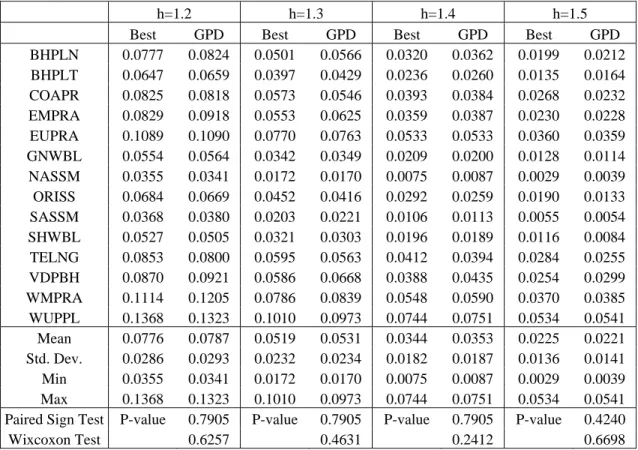
Next, we compare the premium rates from the GPD and those from the first ranked candidate based on the goodness-of-fit test and the Q-Q plot. For each region, the pure premium rate based on the best candidate among the beta distribution, the gamma distribution, or the Weibull distribution, is chosen as the base case and compared with the performance of the GPD in modeling the tail risk. Nonparametric sign test and Wilcoxon signed rank test are applied to test the equality of means and Table 7 shows the results.
The means and variability of pure premium rates from the GPD are very close to those from the best candidate across different strike levels. Furthermore, all of these tests fail to reject the null hypothesis of the equality of pure premium rates based on the GPD and the best candidate with a high p value, demonstrating that the GPD performs as good as the best standard parametric method, and it is effective and robust in modeling and assessing tail risk, and premium ratemaking
Conclusion
Accurate estimation of tail events may be of particular interest to decision makers. The EVT can be considered the-state-of-the-art procedure for estimating the downside risk of a distribution and provides promising potential for risk assessment and premium ratemaking of weather-based contingent claims.
The results also demonstrate that large differences in actuarially fair premium rates for a rainfall-based contingent claim can arise solely from the parameterization chosen to represent the underlying risk distributions and misspecification in the risk distribution (e.g., the lognormal distribution) may lead to economically significant errors in weather index premium ratemaking and assessment of expected risks.
Furthermore, when modeling the tail risk, the GPD model is promising since it performs close to the best candidate chosen by different parametric distributions. What is evident from this study is that the distributional choice has a significant impact on rating and assessing weather-based contingent claims, and so the GPD model might be effective in modeling the tail risk.
However, this study addresses a limited set of parametric distributions and only one potential weather-based contingent claim (the rainfall index). Future work could consider a wide set of distributional choices, especially nonparametric techniques, and demonstrate the effectiveness of the GPD in a general case.
References
Babcock, B., and D. Hennessy. “Input Demand under Yield and Revenue Insurance.” American Journal of Agricultural Economics 78(May 1996): 416-27.
Barger, G., and H. Thornm. “Evaluation of Drought Hazard.” Agronomy Journal 41(November 1949): 519-26.
Balkema, A. A., and L. deHaan. “Residual Lifetime at Great Age.” Annals of Probability 2(1974): 792-804.
Botts, R. R., and J. N. Boles. “Use of Normal-Curve Theory in Crop Insurance Rate Making.” Journal of Farm Economics 40(May 1958): 733-40.
Chen, M. J., and J. Chen. “Application of Quantile Regression to Estimation of Value at Risk” Working Paper, Department of Economics, National Chung-Cheng University, Taiwan, 2002.
Chen, M. J. “Estimating Values at Risk: Extreme Value Theory.” Working Paper, Department of Economics, National Chung-Cheng University, Taiwan, 2002. Coles, S. An Introduction to Statistical Modeling of Extreme Values London: Springer,
2001.
Day, R. H. “Probability Distributions of Field Crop Yields.” Journal of Farm Economics 47(1965): 713-41.
Dekkers, A. L. M., and L. deHaan. “On the Estimation of the Extreme-Value Index and Large Quantile Estimation.” Annals of Statistics 17(1989): 1795-1832.
Embrechts, P., C. Kluppelburg, and T. Mikosch. Modeling Extremal Events for Insurance and Finance New York: Springer, 1997.
Featherstone, A. M., and T. L. Kasens. “Nonparametric Estimation of Crop Yield Distributions: Implications for Rating Group-Risk Crop Insurance Contracts.” American Journal of Agricultural Economics 80(February 1998): 139-53.
Fisher, R. A., and L. H. C. Tippett. “On the Estimation of the Frequency Distributions of the Largest or Smallest Member of a Sample.” Proceedings of the Cambridge Philosophical Society 24(1928): 180-90.
Gallagher, P. “U.S. Corn Yield Capacity and Probability: Estimation and Forecasting with Non-symmetric Disturbances.” North Central Journal of Agricultural Economics 8(1986): 109-22.
Gnedenko, B. V. “Sur La Distribution Limite Du Terme Maximum d’une serie aleatoire.” Annals of Mathematics 44(1943): 423-53.
Goodwin, B. K., and A. P. Ker. “Nonparametric Estimation of Crop Yield Distributions: Implications for Rating Group-Risk Crop Insurance Contracts.” American Journal of Agricultural Economics 80(February 1998): 139-53.
Goodwin, B. K., and A. P. Ker. “Modeling Price and Yield Risk.” A Comprehensive Assessment of the Role of Risk in US Agriculture Just, R. and R. Pope, ed., pp 289-323, Norwell Maryland: Kluwer, 2002.
Greene, W. H. Econometric Analysis 5th ed. Upper Saddle River, New Jersey: Prentice Hall, 2003.
Gumbel, E. J. Statistics of Extremes New York and London: Columbia University Press, 1958.
Ison, N. T., A. M. Feyerherm, and L. D. Bark. "Wet Period Precipitation and the Gamma Distribution." Journal of Applied Meteorology 10(1971):658-65.
Jung, A. R., and C.A. Ramezani. “Valuing Risk Management Tools as Complex Derivatives: An Application to Revenue Insurance.” Journal of Financial Engineering 8(1999): 99-120.
Kalavakonda, V., and O. Mahul. “Karnataka Crop Insurance Study”. Report to the South Asia Region World Bank, Washington D.C., September 1, 2003.
Kenkel, P. I., J. C. Busby, and J. R. Skees. “A Comparison of Candidate Probability Distributions for Historical Yield Distributions.” Presented for presentation at the 1991 Annual Meeting of the SAEA, Fort Worth TX, February 1991.
Ker, A. P., and K. Coble. “Modeling Conditional Yield Densities.” American Journal of Agricultural Economics 85(May 2003): 291-304.
Ker, A. P., and B. K. Goodwin. “Nonparametric Estimation of Crop Insurance Rates Revisited.” American Journal of Agricultural Economics 83(May 2000): 463-78.
Martin, S. W., B. J. Barnett, and K. H. Coble. “Developing and Pricing Precipitation Insurance.” Journal of Agricultural and Resource Economics 26(April, 2001): 261-74.
Mishra, P. Agricultural Risk, Insurance and Income: A Study of the Impact and Design of India’s Comprehensive Crop Insurance Scheme Brookfield: Avebury Press, 1996.
Monthly Subdivisional Rainfall Data 1871-2000, Indian Institute of Tropical Meteorology, Pune, India.
Nelson, C. H., and P. V. Preckel. “The Conditional Beta Distribution as a Stochastic Production Function.” American Journal of Agricultural Economics 71(1989): 370-78.
Parchure, R. “Varsha Bonds and Options: Capital Market Solutions for Crop Insurance Problems.” National Insurance Academy Working Paper Balewadi, India. http://www.utiicm.com/rajaskparchure.html, 2002.
Pickands, J. “Statistical Inferences Using Extreme Order Statistics.” Annals of Statistics 3(1975): 119-31.
Podbury, T., T. C. Sheales, I. Hussain, and B. S. Fisher. “Use of El Nino Climate Forecasts in Australia.” American Journal of Agricultural Economics 80(November 1998): 1096-1101.
Ramirez, O. A., S. Misra, and J. Field. “Crop-Yield Distributions Revisited.” American Journal of Agricultural Economics 85(February 2003): 108-20.
Sherrick, B. J., F. C. Zanini, G. D. Schnitkey, and S. H. Irwin. “Crop Insurance Valuation Under Alternative Yield Distributions.” American Journal of Agricultural Economics 86(May 2004): 406-19.
Silverman, B. W. Density Estimation for Statistics and Data Analysis London: Chapman and Hall, 1986.
Skees, J. R., B. J. Barnett, and R. Black. “Designing and Rating an Area Yield Crop Insurance Contract.” American Journal of Agricultural Economics 79(May 1997): 430-38.
Skees, J. R., and U. Hess. “Evaluating India’s Crop Failure Policy: Focus on The Indian Crop Insurance Program.” Delivered to the South Asia Region of the World Bank, November 2003.
Skees, J. R., and K. A. Zeuli. “Using Capital Markets to Increase Water Market Efficiency.” Presented at the 1999 International Symposium on Society and Resource Management, Brisbane, Australia, 8 July 1999.
Stokes, J. R. “A Derivative Security Approach to Setting Crop Revenue Coverage Insurance Premiums.” Journal of Agricultural and Resource Economics 25(2000): 159-76.
Swiss Re. “Capital Market Innovation in the Insurance Industry.” Sigma No.3/2001. Thom, H. C. S. "A Note on the Gamma Distribution." Monthly Weather Review
Tirupattur, V., R. J. Hauser, and H. M. Chaherli. “Crop Yield and Price Distributional Effects on Revenue Hedging.” Working paper series: Office of futures and Options Research 96-05, (1996): 1-17.
Turvey, C. G., and J. Zhao. “Parametric and Nonparametric Crop Yield Distributions and Their Effects on All-Risk Crop Insurance Premiums.” Working paper WP99/05, Department of Agricultural Economics and Business, University of Guelph, Ontario, Canada.
Veeramani, V., L. Maynard, and J.R. Skees. “Assessment of the Risk Management Potential of a Rainfall Based Insurance Index and Rainfall Options in Andhra Pradesh, India.” Presented at the annual meetings of the American Agricultural Economics Association, Montreal Canada, July 2003.
Wilks, D. S. “Maximum Likelihood Estimation for the Gamma Distribution Using Data Containing Zeros.” Journal of Climate 3(December 1990): 1495-1501.
Woo, G. The Mathematics of Natural Catastrophes London: Imperial College Press, 1999.
Zeng, L. “Weather derivatives and weather insurance: concept, application, and analysis.” Bulletin of the American Meteorological Society 81(9): 2075-2082. 2000.
Table 1. Summary Statistics of Rainfall in Selected Regions of India
N Mean Median Standard
Deviation
Skewness Kurtosis Maximum Minimum
BHPLN 524 2592 2457 1098 0.440 -0.193 5949 355 BHPLT 524 2750 2725 1051 0.340 0.273 7309 340 COAPR 524 1905 1827 818 0.678 0.395 4894 382 EMPRA 524 2983 2961 1325 0.139 -0.753 6780 177 EUPRA 524 2269 2298 1151 0.271 -0.414 5845 109 GNWBL 524 2887 2775 987 0.573 0.135 6158 700 NASSM 524 3628 3648 1038 0.212 0.040 7307 845 ORISS 524 2916 2842 1084 0.368 -0.218 6038 552 SASSM 524 3919 3749 1107 0.591 0.393 7892 1531 SHWBL 524 5014 4896 1655 0.444 -0.065 10129 1241 TELNG 524 1784 1707 779 0.743 0.783 5107 255 VDPBH 524 2357 2225 1068 0.388 -0.224 5969 170 WMPRA 524 2283 2277 1175 0.307 -0.496 5824 108 WUPPL 524 1915 1912 1142 0.244 -0.905 4949 4 Average 2800 2736 1106 0.410 -0.089 6439 484 Minimum 1784 1707 779 0.139 -0.905 4894 4 Maximum 5014 4896 1655 0.743 0.783 10129 1531
Table 2. Summary Statistics of Alternative Distributions in Selected Regions of India
Beta Distribution Gamma Distribution Lognormal Dist Weibull Distribution
θ α β α β μ σ α β BHPLN 6246 2.87 3.99 5.07 511.11 7.76 0.48 2.54 2924.20 BHPLT 7674 3.88 6.94 5.96 461.55 7.83 0.45 2.81 3085.90 COAPR 5139 3.11 5.20 5.26 362.11 7.45 0.46 2.49 2151.00 EMPRA 7119 2.55 3.55 4.13 721.74 7.87 0.55 2.42 3365.20 EUPRA 6137 2.00 3.43 2.97 764.00 7.55 0.68 2.05 2554.80 GNWBL 6466 4.26 5.21 8.44 341.93 7.91 0.36 3.12 3227.50 NASSM 7672 5.84 6.48 11.33 320.09 8.15 0.31 3.80 4010.00 ORISS 6340 3.41 3.95 6.64 439.44 7.90 0.41 2.91 3272.00 SASSM 8287 5.92 6.53 12.67 309.41 8.23 0.29 3.72 4332.30 SHWBL 10635 4.32 4.79 8.85 566.69 8.46 0.35 3.26 5592.90 TELNG 5362 3.22 6.38 5.07 351.60 7.39 0.47 2.44 2015.00 VDPBH 6267 2.64 4.36 4.15 567.72 7.64 0.54 2.35 2660.10 WMPRA 6115 1.97 3.30 2.97 767.93 7.56 0.67 2.02 2573.10 WUPPL 5196 1.38 2.40 1.96 979.06 7.28 0.89 1.64 2127.90
Table 3. Goodness-of-Fit Tests for Alternative Distributions in WMPRA
Tests Statistics P-Value
Beta Kolmogorov-Smirnov D 0.0314 Pr>D >0.250
Cramer-von Mises W-Sq 0.0780 Pr>W-Sq 0.242
Anderson-Darling A-Sq 0.5204 Pr>A-Sq 0.2
Chi-Square Chi-Sq 12.5061 Pr>Chi-Sq 0.253
Gamma Kolmogorov-Smirnov D 0.0771 Pr>D <0.001
Cramer-von Mises W-Sq 0.7494 Pr>W-Sq <0.001
Anderson-Darling A-Sq 4.4289 Pr>A-Sq <0.001
Chi-Square Chi-Sq 45.0614 Pr>Chi-Sq <0.001 Lognormal Kolmogorov-Smirnov D 0.1012 Pr>D <0.010
Cramer-von Mises W-Sq 1.8238 Pr>W-Sq <0.005
Anderson-Darling A-Sq 10.8661 Pr>A-Sq <0.005
Chi-Square Chi-Sq 133.2238 Pr>Chi-Sq <0.001 Weibull Cramer-von Mises W-Sq 0.2435 Pr>W-Sq <0.010
Anderson-Darling A-Sq 1.5594 Pr>A-Sq <0.010
Chi-Square Chi-Sq 18.0760 Pr>Chi-Sq 0.054
Table 4. Rankings of Alternative Distributions
Alternative Distributions
Beta Gamma Lognormal Weibull
1st 3 6 0 5 2nd 5 0 0 9 3rd 4 8 2 0 4th 2 0 12 0 Weighted Average 3.3 3 5.4 2.3 Rank of Average 3 2 4 1
Table 5. The Parameter of GPD in Modeling Excess Rainfall across the Fourteen Regions
Generalized Pareto Distribution
u σ ξ BHPLN 2500 1329.21 -0.3376 BHPLT 3000 914.53 -0.1517 COAPR 1800 885.10 -0.2080 EMPRA 3000 1519.32 -0.3853 EUPRA 2000 1383.37 -0.3278 GNWBL 2500 1207.12 -0.2689 NASSM 4000 747.14 -0.1106 ORISS 2000 1800.78 -0.4205 SASSM 3500 1348.45 -0.2461 SHWBL 4000 2421.84 -0.3654 TELNG 2000 683.34 -0.1092 VDPBH 2000 1339.04 -0.3050 WMPRA 2000 1539.36 -0.3774 WUPPL 2000 1292.68 -0.4154
Table 6. Pure Premium Rate of Weather Index across Regions under Alternative Distributions at Varying Strikes
GPD Gamma Dist Beta Dist Lognormal Dist Weibull Dist
BHPLN. h=1.2 0.0824 0.0862 0.0804 0.1067 0.0777 h=1.3 0.0566 0.0595 0.0522 0.0791 0.0501 h=1.4 0.0362 0.0409 0.0325 0.0592 0.0320 h=1.5 0.0212 0.0285 0.0192 0.0447 0.0199 BHPLT. h=1.2 0.0659 0.0748 0.0683 0.0961 0.0647 h=1.3 0.0429 0.0503 0.0429 0.0697 0.0397 h=1.4 0.0260 0.0335 0.0259 0.0511 0.0236 h=1.5 0.0164 0.0225 0.0151 0.0377 0.0135 COAPR. h=1.2 0.0818 0.0825 0.0829 0.0990 0.0807 h=1.3 0.0546 0.0573 0.0542 0.0728 0.0530 h=1.4 0.0384 0.0393 0.0346 0.0535 0.0340 h=1.5 0.0232 0.0268 0.0213 0.0397 0.0213 EMPRA. h=1.2 0.0918 0.0997 0.0839 0.1359 0.0829 h=1.3 0.0625 0.0722 0.0550 0.1051 0.0553 h=1.4 0.0387 0.0516 0.0350 0.0820 0.0359 h=1.5 0.0228 0.0375 0.0210 0.0646 0.0230 EUPRA. h=1.2 0.1090 0.1269 0.1089 0.1916 0.1059 h=1.3 0.0763 0.0960 0.0770 0.1553 0.0753 h=1.4 0.0533 0.0736 0.0533 0.1276 0.0532 h=1.5 0.0359 0.0553 0.0360 0.1045 0.0375 GNWBL. h=1.2 0.0564 0.0554 0.0544 0.0635 0.0537 h=1.3 0.0349 0.0342 0.0310 0.0418 0.0308 h=1.4 0.0200 0.0209 0.0164 0.0277 0.0167 h=1.5 0.0114 0.0128 0.0079 0.0188 0.0087 NASSM. h=1.2 0.0341 0.0413 0.0367 0.0492 0.0355 h=1.3 0.0170 0.0236 0.0180 0.0304 0.0172 h=1.4 0.0087 0.0131 0.0079 0.0188 0.0075 h=1.5 0.0039 0.0071 0.0030 0.0115 0.0029 ORISS. h=1.2 0.0669 0.0684 0.0636 0.0837 0.0614 h=1.3 0.0416 0.0452 0.0381 0.0591 0.0370 h=1.4 0.0259 0.0292 0.0212 0.0419 0.0214 h=1.5 0.0133 0.0190 0.0111 0.0302 0.0117 SASSM. h=1.2 0.0380 0.0368 0.0371 0.0414 0.0372 h=1.3 0.0221 0.0203 0.0181 0.0242 0.0183 h=1.4 0.0113 0.0106 0.0078 0.0142 0.0081 h=1.5 0.0054 0.0055 0.0029 0.0082 0.0032 SHWBL. h=1.2 0.0505 0.0527 0.0504 0.0611 0.0495
h=1.3 0.0303 0.0321 0.0276 0.0406 0.0275 h=1.4 0.0189 0.0196 0.0138 0.0267 0.0144 h=1.5 0.0084 0.0116 0.0062 0.0175 0.0070 TELNG. h=1.2 0.0800 0.0853 0.0854 0.1033 0.0829 h=1.3 0.0563 0.0595 0.0570 0.0759 0.0548 h=1.4 0.0394 0.0412 0.0369 0.0567 0.0359 h=1.5 0.0255 0.0284 0.0234 0.0422 0.0228 VDPBH. h=1.2 0.0921 0.0994 0.0903 0.1345 0.0870 h=1.3 0.0668 0.0718 0.0608 0.1027 0.0586 h=1.4 0.0435 0.0519 0.0397 0.0800 0.0388 h=1.5 0.0299 0.0372 0.0256 0.0632 0.0254 WMPRA. h=1.2 0.1205 0.1275 0.1114 0.1866 0.1082 h=1.3 0.0839 0.0964 0.0786 0.1513 0.0776 h=1.4 0.0590 0.0723 0.0548 0.1222 0.0550 h=1.5 0.0385 0.0553 0.0370 0.1010 0.0389 WUPPL. h=1.2 0.1323 0.1691 0.1368 0.3047 0.1409 h=1.3 0.0973 0.1341 0.1010 0.2597 0.1079 h=1.4 0.0751 0.1066 0.0744 0.2224 0.0822 h=1.5 0.0541 0.0852 0.0534 0.1904 0.0623 h=1.2. Mean 0.0787 0.0861 0.0779 0.1184 0.0763 Std. Dev. 0.0293 0.0368 0.0288 0.0706 0.0292 Min 0.0341 0.0368 0.0367 0.0414 0.0355 Max 0.1323 0.1691 0.1368 0.3047 0.1409 h=1.3. Mean 0.0531 0.0609 0.0508 0.0906 0.0502 Std. Dev. 0.0234 0.0317 0.0239 0.0631 0.0250 Min 0.0170 0.0203 0.0180 0.0242 0.0172 Max 0.0973 0.1341 0.1010 0.2597 0.1079 h=1.4. Mean 0.0353 0.0432 0.0324 0.0703 0.0328 Std. Dev. 0.0187 0.0267 0.0191 0.0559 0.0205 Min 0.0087 0.0106 0.0078 0.0142 0.0075 Max 0.0751 0.1066 0.0744 0.2224 0.0822 h=1.5. Mean 0.0221 0.0309 0.0202 0.0553 0.0213 Std. Dev. 0.0141 0.0222 0.0145 0.0490 0.0163 Min 0.0039 0.0055 0.0029 0.0082 0.0029 Max 0.0541 0.0852 0.0534 0.1904 0.0623 Paired t-test h=1.2 2.8438** -0.7391 3.3454*** -1.7576 h=1.3 2.9118** -2.6339 3.3207*** -2.3237 h=1.4 3.2401 -6.2201 3.3816*** -3.1136 h=1.5 3.7676*** -6.4180 3.4638*** -1.0549
Table 7. The Actuarial Performance of the GPD and the Best Candidate
h=1.2 h=1.3 h=1.4 h=1.5 Best GPD Best GPD Best GPD Best GPD
BHPLN 0.0777 0.0824 0.0501 0.0566 0.0320 0.0362 0.0199 0.0212 BHPLT 0.0647 0.0659 0.0397 0.0429 0.0236 0.0260 0.0135 0.0164 COAPR 0.0825 0.0818 0.0573 0.0546 0.0393 0.0384 0.0268 0.0232 EMPRA 0.0829 0.0918 0.0553 0.0625 0.0359 0.0387 0.0230 0.0228 EUPRA 0.1089 0.1090 0.0770 0.0763 0.0533 0.0533 0.0360 0.0359 GNWBL 0.0554 0.0564 0.0342 0.0349 0.0209 0.0200 0.0128 0.0114 NASSM 0.0355 0.0341 0.0172 0.0170 0.0075 0.0087 0.0029 0.0039 ORISS 0.0684 0.0669 0.0452 0.0416 0.0292 0.0259 0.0190 0.0133 SASSM 0.0368 0.0380 0.0203 0.0221 0.0106 0.0113 0.0055 0.0054 SHWBL 0.0527 0.0505 0.0321 0.0303 0.0196 0.0189 0.0116 0.0084 TELNG 0.0853 0.0800 0.0595 0.0563 0.0412 0.0394 0.0284 0.0255 VDPBH 0.0870 0.0921 0.0586 0.0668 0.0388 0.0435 0.0254 0.0299 WMPRA 0.1114 0.1205 0.0786 0.0839 0.0548 0.0590 0.0370 0.0385 WUPPL 0.1368 0.1323 0.1010 0.0973 0.0744 0.0751 0.0534 0.0541 Mean 0.0776 0.0787 0.0519 0.0531 0.0344 0.0353 0.0225 0.0221 Std. Dev. 0.0286 0.0293 0.0232 0.0234 0.0182 0.0187 0.0136 0.0141 Min 0.0355 0.0341 0.0172 0.0170 0.0075 0.0087 0.0029 0.0039 Max 0.1368 0.1323 0.1010 0.0973 0.0744 0.0751 0.0534 0.0541
Paired Sign Test P-value 0.7905 P-value 0.7905 P-value 0.7905 P-value 0.4240
Figure 1. Fitting Rainfall at WUPPL by Alternative Distributions in WMPRA