Kartografické listy, 2010, 18
___________________________________________________________________________________________________
Arun DAS, Koichi KIMOTO
MAP FORMS AND MAP ERRORS IN INDIA
Das, A., Kimoto, K.: Map forms and map errors in India. Kartografické listy 2010, 18, 28
figs., 15 refs.
Abstract: Though the concept of map in India is old, the true form of map is not in use yet.
There are various forms of map perceived by the people as map. The maps are drawn to repre-sent the spatial or ground features with a specific theme with or without the properties of the map. Thus map errors have been prevalent at all levels. Recently digital cartography has brought a new orientation to map drawing in India. This paper discusses the forms of maps and types of map errors from a layman to the scholars. The main objective of the paper is to give the reader an understanding about the forms of maps and map errors in different parts of the world. Only the published maps are collected to present in this paper from various departments and agencies.
Keywords: map types, map errors, map makers, Survey of India (SOI) maps
Introduction
Maps are becoming an integral part of the human life in recent years in India. People are fin-ding the feasibility of representing or indentifying the ground features on maps easily rather by mere oral note or textual briefing. In India to convey the information, accuracy of map is not a matter. The approximate location of features in a relative context is more important than the actual position. In general, people are not bothered about the map properties or the concept. Maps are drawn as a simple tool of representing the spatial feature of a known place by a person for the per-son not aware of that spatial information. For a common man, accuracy of map is not a serious matter. Although map accuracy gained importance with the introduction of GIS, Yet the concept of Map and map drawing still persist at a primitive level. Popularizing map reading and the con-cept of map is in progress at school levels. Usage of erroneous map and preparing erroneous maps are prevalent at all levels. The lay man map is popular and this type of maps are continued to be followed in future, since it does not require any calculation or systematic learning to draw.
1. Map makers
The history of representing ground feature on the paper is recorded in the great epics of Ma-habharata and Ramayana of Hinduism religion in India. The astronomical positions and the mo-vement of the planets and stars are mentioned in the epics of Ramayana and Mahabharata proving that map making was existing in 7500 BC.
Maps in India are prepared, generated and reproduced by government, semi government, and organizations (Punmia, 2003). Individuals produce maps according to their knowledge as a ‘Map’. In most of the cases other than the people who are involved in surveying, rest of the society do not know what constitutes Map.
1.1. Central government organization: Survey of India
India was under the colonial regime has adopted the British mapping system. Many of its go-vernmental and quasi gogo-vernmental organizations use maps prepared by the Survey of India (SOI). The SOI is the authorized agency in India to produce maps. The SOI was established in the year 1767 _______________
Dr. S. Arun DAS, Assoc. Prof. Department of Studies in Geography, Manasagangotri, University of Mysore Mysore. India, e-mail: [email protected], Dr. Koichi KIMOTO, Prof. Literature Faculty, Hiroshima Jogakuin University, Hiroshima, Japan.
States of India Districts Map
Karnataka State TaluksM ap
Mysore District
Villages Map
Mysore Taluk
Cadastral Map
Hadjana Village
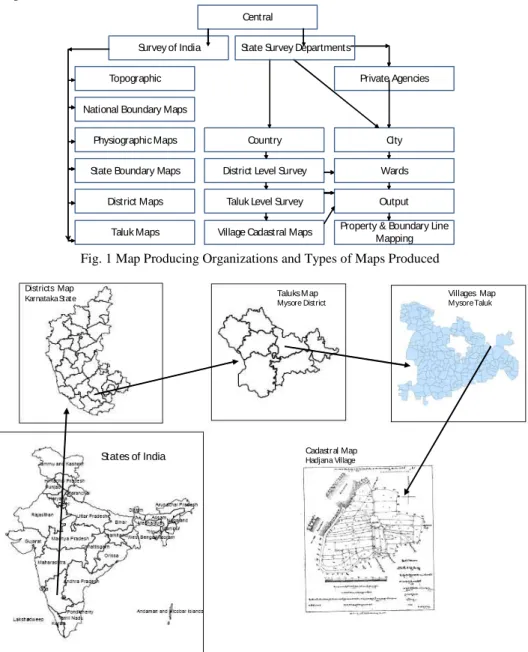
(Rampal, 1998) under the East India Company. High level of accuracy maps have been prepared by the Survey of India. After Impendence in 1947 each state possesses a Survey departmentand also private agencies (see Fig 1). In India the Country has been divided into 28 states and each sta-te boundary is divided into Districts and the districts into Taluks and Taluks comprises villages. The least administrative unit is village. The cadastral maps are prepared for generating revenue (Fig 2).
1.2. State government organization
Each state has established its own survey departments. The state survey department produces cadastral maps for the purpose of collecting revenue and also for the purpose of land records (Ca-dastral Maps, 1965). It is also the duty of the state survey department to resolve the land measure-ment disputes.
Fig. 1 Map Producing Organizations and Types of Maps Produced City Survey of India
Central
Country District Level Survey
Taluk Level Survey Topographic
National Boundary Maps Physiographic Maps State Boundary Maps
District Maps Taluk Maps
Private Agencies
Village Cadastral Maps
Output Property & Boundary Line
Mapping State Survey Departments
1.3. Private agencies
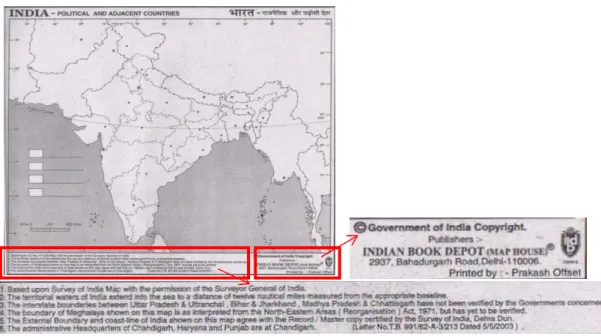
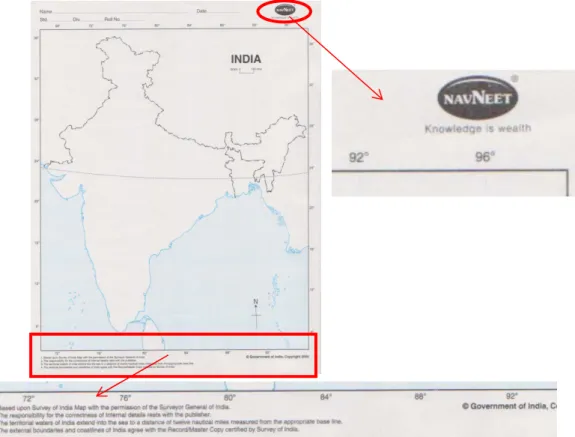
The maps prepared by the SOI are reproduced after the prior permission from the SOI by the private agencies. The prepared maps should be approved prior to publication. There are few com-panies who are preparing maps for many government and private organizations (Navneet Map Publisher, 2009) (Fig. 3,4,5).
Fig. 3 World Map Produced with the Prior Permission of SOI
1.4. Research organizations
For the purpose of research, the research scholars produce maps either by tracing the existing map (Das, 2006) or conduct the field survey. Recently maps are also produced on the basis of sa-tellite image. The maps produced by the research scholars are only to depict the ground information on the map. Scholars of non spatial discipline do not give importance for map properties (Fig. 6).
1.5. Lay man map preparations
The common people in India have conceived map means any form of drawing representing the relative locations of spatial features drawn on a plain sheet of paper, on boards, wall or cloth. The-se types of maps are drawn according to their mental image. Neither have they known the map properties nor the map furniture’s. This form of map is most widely accepted even in the learned class of people (Fig. 7, 8).
2. Forms of maps
The most appropriate and broad way of classifying maps of India are (a) Projected (The
projec-ted maps are those drawn using the defined projection) and (b) Non Projecprojec-ted maps.
2.1. Topographical maps
The SOI is an authorized central government agency which prepares National maps. The to-pographical maps are prepared by the SOI (Survey of India Maps, 2007) at different scale such as 1:250 000, 1:100 000, 1:50 000 and 1:5 000 sheets and also ¼, 1/2, and 1” toposheets. The
raphical sheets prepared during the British regime before independence, the work started from so-uthern India and was completed in Himalayan region of northern India. Toposheets are used as a base for creating regional and area of interest (AOI) maps of different scale. It is also used as the ground truth in remote sensing analysis.
2.2. Physiographic map
All types of physiographic maps are produced by the SOI. The physiographic maps are most commonly used in all fields for reproducing and for research analysis at macro level (Fig. 9,10) (Geographical Maps for Children, 2010).
Fig. 6 Research Map Produced by Geographer
2.3. Political boundary map
The SOI produces the national boundary outline map with adjacent countries and without. The state boundaries are mapped by the SOI and it also keeps updating the changing political bounda-ries of the state. The newly created states and its boundabounda-ries are mapped by the SOI (Fig. 11).
2.4. Transportation network map
Road, Sea and Air Route, Rail network maps are produced by the SOI. Large scale maps are recently prepared by the private agencies with the prior permission from the SOI (Fig. 12,13).
2.5. State boundary maps
The state maps were produced by the SOI along with district boundary and taluk boundaries. These maps were distributed to various state and central departments for further use (Fig. 11).
2.6. District boundary maps
District is the third level of administrative division in India. Most of the regional level planning is done at district level. Hence district level maps are important. These maps are prepared by the respective department based on the SOI or out source for private agency. The census of India has produced District level maps (Census of India, 1981) with taluk boundaries (Fig. 14).
2.7. Taluk boundary maps
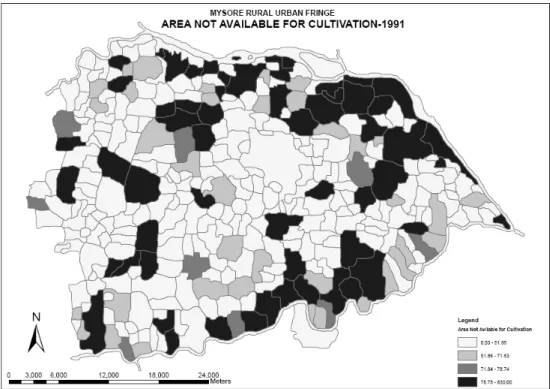
The taluk boundary maps were produced based on the SOI toposheets along with the village boundaries by the state and central government organization such as Census of India (Census of India, 1991) and also by the NRDMS (Natural Resource Data Management System NRDMS) (Mysore District Statistical Book, 1991- Fig. 15).
Fig. 9 Physiographic Map of India Fig. 10 Soil Regions of India
Fig. 13 Railway Network Map of India Fig. 14 Traced Map of Karnataka State District Boundaries
2.8. Village boundary maps
The lowest level of administrative unit is village. The village level maps are produced by the Taluk Survey Office, Census of India (Census of India, 2001) and NRDMS. Each Taluk office will have the village boundary map of its jurisdiction (National Resource Data Management System, 2008, Fig. 16, 17).
2.9. Cadastral map
Preparation of cadastral maps was started in Karnataka in the year 1863 by the British for reve-nue purpose and it was completed in 1899. As per the Karnataka State Revereve-nue Act for every 30 years a resurvey has to be done. Since 1930 every 30 years a reclassification has been done based on old cadastral maps (Cadastral Maps, 1965). The government has not taken initiative to conduct resurvey due to the expenditure incurred overriding the revenue collected (Fig. 18).
The main function of the state survey departments is only to establish the ownership line and demarcate legal property boundary to ensure boundaries.
2.10. Tourist guide maps
The tourist guide maps are produced by the respective tourism department based on either to-posheets or district maps (Tourism Report of Karnataka, 2009). Few government organizations get the map produced by the SOI for a particular theme. There are some tourist guide maps prepared by the SOI at the request of the department (Fig. 19).
2.11. Research maps
The students in the Indian universities get the map drawn for their area of interest (AOI) from some cartographer or they themselves trace it from the available map. The notion behind adding map in the study is only to give spatial context information, rather than the accuracy of the map with respect to scale or location. (Fig. 6).
Fig. 15 Mysore District Map Depicting Taluk Rainfall Prepared by National Agency
Fig. 18 Cadastral Map of Hosur Village in K.R.Pet Taluk, Mandya District
2.12. Educative maps
Maps have become one of the important and basic learning in the schools of India. The state of Karnataka has drawn maps on the school wall depicting the country, the State and the respective District and Taluk boundary map under which jurisdiction the school is located. This can be seen on each school walls operated by the state government education department of Karnataka state (Fig. 20).
2.13. City boundary and ward maps
The City Corporation and the State Survey department produce the City Boundary and the wards (Fig. 21). The City Boundary and Urban land use maps also produced by urban develop-ment authority with each spatial feature represented. The urban authority also undertakes city sur-vey for city planning purpose (Town Planning Office, 2007). Mainly the urban development aut-horities conduct survey to produce maps for planning, land acquisition, residential site auction map (Times of India News Paper, 2010) (Fig. 22).
3. Map errors
When the scientific community is struggling hard to get Zero pixel error maps, there are errors of various types in the map generated by non scientific community. The same has been used for various analyses (Including GIS). Map drawing technology in India is at the transitional period from the conventional form to the digital cartography. Despite of the transformation many forms of errors are common. The few forms of conventional cartographic errors have been discussed (it does not mean that all conventional maps are erroneous).
Fig. 19 Tourist Map of Mysore District Depicting the Tourists Spots, Road and Railway Network
Fig. 20 India and Karnataka State Maps drawn on Front Elevation of the Primary School in Shimoga District of Karnataka with District and Taluk Boundary
Fig. 22 Mysore City Residential Site Acution Map Prepared by MUDA
Fig. 21 Mysore City Ward Map Prepared by Private Agency for Mysore Urban Development Authority
3.1. Educative map errors
The educative maps are produced by various government departments and NGO’s to educate the people on certain issues. These maps lack the spatial and cartographic properties. Most of the cases it can be called a sketch rather than a map (Fig. 7, 8).
3.2. Research map errors
The research maps are produced by the students for the purpose of research and they either de-pend on the SOI topographical maps or trace the map from the already existing map traced several times, (produced by the government) for their theme, without acknowledging the accuracy. The quality of maps produced differ as per the discipline is concerned. The non earth science students are less bothered about the map properties. Whereas the map produced by the geographers, civil engineers, geologist, environmental science students maintain map properties. Despite of this the errors are common.
3.3 Reproducing errors
Most of the maps are reproduced from the maps published by survey of India. The repeated reproduction of maps leads to variation in boundary line shape, size and area (Fig. 23).
3.4. Missing theme title
While publishing map in a book or in a report the writer conceives that the map fixed with in the text region need no title. Maps lacking the theme title seldom put the coexisting spatial features more prominent than the main objective of the map. In the Fig. 24, there is an overlay of spatial feature which obscures the main theme of the map.
3.5. Un – updated administrative units
Lethargic attitude exists among the map makers in up dating the new information into the map, especially regarding the modified boundary line. The reason is, the newly formed un–disputed bo-undary line will not be available immediately to all people. Only the old maps will be in circula-tion. With little effort it is possible to get the modified map but there is an attitude of negligence. In such events many maps lack up-to-date information. The India map shown in the Fig. 25, is an old map without the addition of the newly formed States (compare this with Political Map of India, Fig. 11).
3.6. Obscure and clumsy labels
Most of the old maps prepared on paper lack map quality. These maps are free hand drawings. Only the title and the village names are clearly mentioned, the rest of the information is obscure (Fig. 26).
3.7. Missing north arrow
Another major misconception among the map makers is, when the map depiction is shown in the northern direction what is the need of showing north arrow as separate item. When a major map making organizations commits these types of errors this is followed by other map makers. This missing north arrow error is prevalent in India (Fig. 27).
3.8. Erroneous and missing scales
Map users consider a map as only a visual interpreter. Beyond this level, only few search for scale to measure. The unsaid truth is that, most of the map users are not bothered about the scale. In many maps the scale itself is wrong either due to wrong projection or repeated reproduction of the scale itself (Fig. 23, 26, 27, 28).
Fig. 23 Nanjangud Taluk Map of Mysore District Reproduced with Erroneous Boundary
Fig. 28 Missing Scale of a Tourist Map
Conclusion
India being a vast land and a land of vast population there is scope for various forms of idea to emerge and that transforms into map. People at all level use maps as per their knowledge without proper understanding of the map properties. In this process the map errors are common in various levels. The information provided in this paper belongs to one region and one man knowledge. The-re aThe-re many moThe-re forms of maps and map errors. It is also imminent from this statement that, theThe-re are also accurate maps produced by the authorized agencies of India. To eliminate the map errors the systematic study of maps has been introduced at school levels. This attempt will certainly bring down the map errors and also increase the credibility of the map. In recent years the application of spatial technology tools like GPS, DGPS, digital cartography and GIS techniques for planning and monitoring purpose will undoubtedly ensure the quality of map in future years.
References
Cadastral Maps (1965). Mysore (Karnataka State Survey Department). Census of India (1981). New Delhi (Government of India publication). Census of India (1991). New Delhi (Government of India publication). Census of India (2001). New Delhi (Government of India publication).
DAS, A. (2006). Process and pattern of urbanization and counter urbanization. Un pubplished Ph.D thesis, University of Mysore, Mysore.
Geographical Maps for Children (2010) [online]. [cit. 2010-04-27]. Dostuné na: <http://www.surveyofindia .gov.in/soi_geo.html>
Mysore District Statistical Book (1991). Mysore (Mysore District Panchyath Office).
National Resource Data Management System (2008). Mysore (Mysore District People Forum (Panchyath) Office).
Navneet Map Publishers (2009). New Delhi (Navneet).
PUNMIA, B. C. (2003). Surveying, 1. New Delhi (Laxmi Publications). RAMPAL, K. K. (1998). Surveying. Meerut (Pragathi Book Publisher). Survey of India Maps (2007). New Delhi (Government of India). Times of India News Paper, Bangalore Edition, 21.04.2010, p. 7.
Tourism Report of Karnataka (2009). Banagalore (Government of Karnataka).
Town Planning Office (2007). Comprehensive development plan. Mysore (Mysore Urban Development Aut-hority).
R e s u m é
Druhy máp a chyby na mapách v Indii
Hoci chápanie mapy v Indii je staré, skutočná mapa sa tu ešte nepoužíva. Rôzne druhy grafických výstu-pov sú vnímané ako mapa. Mapy sa pripravujú tak, aby reprezentovali objekty a ich charakteristiky, ale často im chýbajú vlastnosti, ktorými by sa mala mapa vyznačovať. S chybami na mapách sa možno stretnúť na rôznych úrovniach. Súčasná digitálna kartografia vniesla do prípravy máp v Indii novú orientáciu. Príspevok traktuje druhy máp a rôzne typy chýb na mapách, ktoré páchajú tak laici, ako aj vedci. Cieľom príspevku je poskytnúťčitateľovi predstavu o druhoch máp a chybách na mapách rôznych častí sveta. Príspevok sa za-oberá iba mapami, publikovanými rôznymi agentúrami.
Obr. 1 Organizácie produkujúce mapy a typy máp vytváraných v Indii Obr. 2 Úrovne máp administratívneho členenia Indie
Obr. 3 Mapa sveta vytvorená súkromnou organizáciou s povolením Survey of India Obr. 4 Mapa Indie vytvorená súkromnou organizáciou s povolením Survey of India Obr. 5 Mapa Indie vytvorená s povolením Survey of India
Obr. 6 Výskumná mapa vytvorená geografom
Obr. 7 Mapa vytvorená laikom (mapa vidieckeho sídla nakreslená na stene domu) Obr. 8 Mapa vytvorená laikom – znázorňuje región Mysore v štáte Karnataka Obr. 9 Fyzickogeografická mapa Indie
Obr. 10 Pôdne regióny Indie
Obr. 11 Politické rozdelenie Indie na novovytvorené štáty Obr. 12 Cestná a letecká mapa Indie
Obr. 13 Mapa železničnej siete Indie
Obr. 14 Kopírovaná mapa hraníc okresov v štáte Karnataka
Obr. 15 Mapa okresu Mysore dokumentujúca množstvo zrážok, ktorú pripravila národná agentúra Obr. 16 Mapa okresu Mysore s hranicami vidieckych sídiel, ktorá bola pripravená pomocou NRDMS Obr. 17 Mapa vidieckych sídiel s kódmi v okrese Mandaya, štát Karnataka
Obr. 18 Katastrálna mapa vidieckeho sídla Hosur v okrese Mandaya
Obr. 19 Turistické mapa okresu Mysore so športoviskami, cestnou a železničnou sieťou
Obr. 20 Mapy Indie a štátu Karnataka nakreslené na stene základnej školy v okrese Shimoga Obr. 21 Mapa časti mesta Mysore pripravená súkromnou spoločnosťou pre odbor územného plánu
Obr. 22 Aukčná mapa mesta Mysore
Obr. 23 Mapa Nanjangud taluku v okrese Mysore, reprodukovaná s nesprávnymi hranicami Obr. 24 Mapa okresu Mandaya, ktorej chýba názov obsahu
Obr. 25 Kopírované hranice politického rozdelenia Indie bez nových štátov
Obr. 26 Málo známe a nevýstižné označovanie na mape taluku v okrese Chamaraja Nagar v štáte Karnataka
Obr. 27 Chýba označenie severu
Obr. 28 Na turistickej mape chýba mierka Recenzoval:
Doc. RNDr. Ján FERANEC, DrSc., Geografický ústav SAV,