TAMS 2006—Canadian activity profile:
wildlife viewing while on trips
Newfoundland and Labrador T
Library and Archives Canada Cataloguing in Publication
TAMS 2006: Canadian activity profile: wildlife viewing while on trips
[electronic resource].
Electronic monograph in PDF format.
Mode of access: World Wide Web.
Issued also in French under title: EAPV 2006 - profil des activités au Canada,
observation de la nature en voyage.
"Travel Activities and Motivation Survey (TAMS)".
Prepared by Lang Research Inc.
ISBN 978-0-662-48587-2
Cat. no.: Iu86-31/18-2006E-PDF
1. Ecotourism--Canada. 2. National parks and reserves—Canada
--Recreational use. 3. Provincial parks and reserves--Canada--Recreational
use. 4. Wildlife watching--Canada. 5. Ecotourism--Canada--Statistics.
6. Canadians--Travel--Statistics. 7. Canadians--Travel--United States.
8. Tourism--Canada. I. Lang Research II. Canadian Tourism Commission
III. Title: Travel Activities and Motivation Survey (TAMS). IV. Title: Wildlife
viewing while on trips.
Prepared by Lang Research Inc. on behalf of:
Ontario Ministry of Tourism, Ontario Tourism Marketing Partnership
Corporation, Quebec Ministry of Tourism, Travel Manitoba, Canadian
Tourism Commission, Tourism Saskatchewan, Atlantic Canada Tourism
Partnership, Alberta Tourism, Parks, Recreation and Culture, Department
of Canadian Heritage, Tourism British Columbia, Parks Canada Agency,
Government of Yukon, Government of Northwest Territories
Table of Contents
Executive Summary
... 1
Travel Activity and Motivation Survey (TAMS)
... 2
Wildlife Viewing While on Trips
... 3
Market Incidence... 3
Incidence by Region... 4
Demographic Profile ... 4
Travel Activity (During Last Two Years) ... 6
Appeal of Selected U.S. States, Canadian Provinces and Canadian Territories... 7
Other Outdoor Activities Pursued While on Trips ... 8
Outdoor Activities Pursued in a Typical Year... 9
Culture and Entertainment Activities Pursued While on Trips ... 10
Culture and Entertainment Activities Pursued in a Typical Year ... 11
Accommodations Stayed In While on Trips... 12
Tours and Cruises Taken During Past Two Years ... 13
Benefits Sought While on Vacation ... 14
Other Attributes of a Destination Considered Important ... 15
How Destinations Are Selected ... 16
Trip Planning and Information Sources Consulted ... 17
Use of the Internet to Plan and Arrange Trips ... 18
Media Consumption Habits ... 19
Appendix One
... 20
Canadian TAMS 2006 Outdoor Activity Segmentation... 20
Appendix Two
... 22
Executive Summary
Over the last two years, 30.7% (7,605,527) of adult Canadians went wildlife viewing
while on an out-of-town, overnight trip of one or more nights. Wildlife viewing was the
second most common outdoor activity undertaken by Canadian Pleasure Travelers.
Visiting a nature park (22.8%) was the most popular activity, followed by viewing
land-based animals (10.4%), whales and other marine life (8.4%), wildflowers and flora
(7.7%), birds (7.5%), and the Northern Lights (4.4%). Of those who went wildlife
viewing, 35.3% (2,681,779) reported that this activity was the main reason for taking at
least one trip. Wildlife viewing was the outdoor activity cited eighth most often as the
main reason for taking a trip.
Relative to the average Canadian Pleasure Traveler, Wildlife Viewers are slightly more
likely to be female (52.9%), 25 to 54 years of age and married with dependent children
living at home. They are more likely to have a university education and their household
income is close to the average Canadian Pleasure Traveler ($74,554). They are
over-represented in the Western Provinces and especially in Alberta.
Wildlife Viewers frequently travel within Canada (97.9%) and were more likely than the
average Canadian Pleasure Traveler to have taken trips to other provinces or regions in
the past two years. They were especially more likely than average to have visited the
western provinces, the northern territories and Prince Edward Island.
Wildlife Viewers were more likely to have participated in outdoor activities when on trips
than the typical Canadian Pleasure Traveler and especially in nature-oriented activities
(e.g., hiking, climbing & paddling; cycling; cross-country skiing & snowshoeing,
wilderness activities). They were also more likely to have camped, stayed in the
wilderness and to have taken wilderness tours in the last two years. Wildlife Viewers
were also very active in culture and entertainment activities when traveling, and were
particularly likely to have patronized educational attractions (e.g., historical sites,
museums & galleries; science & technology exhibits; aboriginal cultural experiences).
Relative to other Canadian Pleasure Travelers, Wildlife Viewers seek vacations that are
intellectually stimulating, novel and memorable.
Wildlife Viewers were more likely than average to use the Internet to plan (69.2%) and
book travel (44.9%). They are particularly likely to use official tourism information
sources (e.g., brochures & guides, visitor information centres, websites) to plan trips.
They can be most effectively targeted effectively through travel, nature and
home-related media.
Travel Activity and Motivation Survey (TAMS)
The TAMS survey examines the recreational activities and travel habits of Canadians
and Americans. The survey examines out-of-town, overnight travel behaviour of one or
more nights over the past two years and provides detailed information on Travellers’
activities, travel motivators, places visited, type of accommodation used, impressions
of Canada, its provinces and territories, demographics and media consumption
patterns.
TAMS represents a comprehensive assessment of travel behaviour and motivators and
provides a rich and authoritative database by which to develop marketing strategies
and travel products to attract visitors to Canada. In particular, TAMS was designed to:
Identify existing and potential tourism markets;
Measure the likelihood of these tourism markets being attracted to vacation
experiences in Canada;
Create packaging opportunities for each of these markets;
Determine how to reach these markets (i.e., in terms of media strategies); and
Provide information on how to fine-tune and target existing marketing campaigns.
TAMS was sponsored by the following organizations:
Ontario Ministry of Tourism
Quebec Ministry of Tourism
Ontario Tourism Marketing Partnership Corporation
Travel Manitoba
Canadian Tourism Commission
Tourism Saskatchewan
Atlantic Canada Tourism Partnership
Parks Canada Agency
Department of Canadian Heritage
Tourism British Columbia
Alberta Tourism, Parks, Recreation and Culture
Government of Yukon
Government of Northwest Territories
Statistics Canada
The survey was conducted in Canada and the United States between January 2006
and June 2006 and it includes only adults (18 years and over). The reference period for
the data is 2004 and 2005.
The Canadian database is used in this current report. This survey was conducted by
Statistics Canada. 31,699 completed questionnaires were returned. The data have
been weighted to project the results to the Canadian population.
This report profiles persons who went wildlife viewing while on a trip and compares
them with other Canadian Pleasure Travelers (i.e., those who took at least one pleasure
trip or vacation in the last two years). This report is part of a series of 44 Activity
Wildlife Viewing While on Trips
Market Incidence
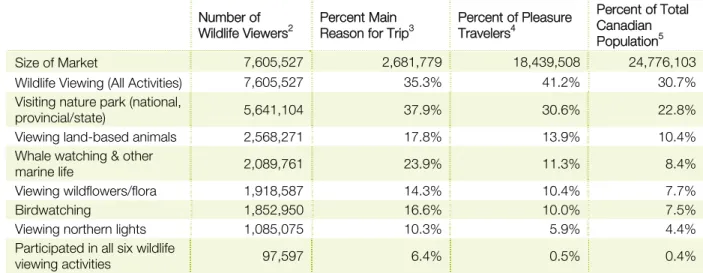
Over the last two years, one-third of adult Canadians (30.7%, or 7,605,527) went
wildlife viewing while on an out-of-town, overnight trip of one or more nights. Wildlife
viewing was the second most common outdoor activity undertaken by Canadian
Pleasure Travelers. Visiting a nature park (22.8%) was the most popular wildlife viewing
activity. Viewing land-based animals (10.4%) was next most popular, followed by
watching whales and other marine life (8.4%), viewing wildflowers and flora (7.7%),
birdwatching (7.5%) and viewing Northern Lights (4.4%). 0.4% of adult Canadians
(97,597) participated in all six wildlife viewing activities while on trips during the past
two years.
Of those who went wildlife viewing, 35.3% (2,681,779) reported that this activity was
the main reason for taking at least one trip in the past two years. Wildlife viewing was
the outdoor activity cited eighth most often as the main reason for taking a trip. Those
who visited a nature park (37.9%) were more likely than other Wildlife Viewers to report
that this activity was the main reason for taking at least one trip over the last two years.
Fig. 1 Incidence of Wildlife Viewing While on Trips
1Number of
Wildlife Viewers2
Percent Main Reason for Trip3
Percent of Pleasure Travelers4 Percent of Total Canadian Population5 Size of Market 7,605,527 2,681,779 18,439,508 24,776,103
Wildlife Viewing (All Activities) 7,605,527 35.3% 41.2% 30.7%
Visiting nature park (national,
provincial/state) 5,641,104 37.9% 30.6% 22.8%
Viewing land-based animals 2,568,271 17.8% 13.9% 10.4%
Whale watching & other
marine life 2,089,761 23.9% 11.3% 8.4%
Viewing wildflowers/flora 1,918,587 14.3% 10.4% 7.7%
Birdwatching 1,852,950 16.6% 10.0% 7.5%
Viewing northern lights 1,085,075 10.3% 5.9% 4.4%
Participated in all six wildlife
viewing activities 97,597 6.4% 0.5% 0.4%
1 - “Trips” are defined as out-of-town trips for any purpose involving an overnight stay of one or more nights. Trips NOT involving overnight stays are NOT examined in this report.
2 - “Wildlife Viewers” are defined as individuals who went wildlife viewing while on an out-of-town, overnight trip of one or more nights during the past two years and who took at least one out-of-town pleasure trip of one or more nights during the past two years. This column reports the number of individuals who participated in the activity on at least one trip during the last two years.
3 - This column reports the percent who participated in each activity who stated that the activity was the main reason for taking at least one trip during the past two years.
4 - “Pleasure Travelers” are defined as individuals who have taken at least one out-of-town pleasure trip of one or more nights in the last two years. This column reports the percent of Pleasure Travelers who participated in each activity on at least one trip during the last two years.
5 - This column reports the percent of the Total Canadian Adult Market who participated in each activity on a trip during the past two years.
Incidence by Region
Wildlife Viewers are well-represented in all regions of the country. However, they are
more likely to live in Western Canada (i.e., British Columbia, Alberta, Saskatchewan
and Manitoba) than in Central Canada (i.e., Ontario, Quebec) or the Atlantic Provinces.
Fig. 2 Geographic Distribution & Population Size of
Those Who Went Wildlife Viewing While on Trips
Total Population
Estimated Number Who Went Wildlife Viewing on a Trip
Percent of Pleasure Travelers in Region Who Went Wildlife Viewing on a Trip
Percent of Total Regional Population Who Went Wildlife Viewing on a Trip Canada 24,776,103 7,605,527 41.2% 30.7% Atlantic Provinces 1,822,494 488,618 38.5% 26.8% Quebec 5,940,869 1,636,014 39.0% 27.5% Ontario 9,671,592 2,749,560 38.4% 28.4% Manitoba 843,107 256,492 43.1% 30.4% Saskatchewan 706,325 245,973 45.4% 34.8% Alberta 2,465,540 1,000,914 49.9% 40.6% British Columbia 3,326,176 1,227,956 46.1% 36.9%
Demographic Profile
Relative to the average Canadian Pleasure Traveler, Wildlife Viewers are slightly more
likely to be female, 25 to 54 years of age and married with dependent children (less
than 18 years of age) living at home. They are more likely to have a university education
than the average Canadian Pleasure Traveler. Their household income is only slightly
above-average relative to the average Canadian Pleasure Traveler.
Fig. 3 Demographic Profile of Wildlife Viewers
Relative to All Canadian Pleasure Travelers
Wildlife Viewers Non-Wildlife
Viewers1
Pleasure
Travelers Index
2
Attribute Size of Market 7,605,527 10,833,982 18,439,508 100
Male 47.1% 50.1% 48.8% 96 Gender Female 52.9% 49.9% 51.2% 103 18 to 24 12.0% 13.3% 12.8% 94 25 to 34 22.2% 17.2% 19.3% 115 35 to 44 21.6% 19.8% 20.5% 105 45 to 54 21.1% 19.8% 20.3% 104 55 to 64 13.4% 14.6% 14.1% 95 65 Plus 9.6% 15.2% 12.9% 75 Age of Respondent
Average Age 43.2 45.5 44.5 N/A
Not married 30.4% 33.5% 32.2% 94
Marital Status
Wildlife Viewers Non-Wildlife Viewers1 Pleasure Travelers Index 2 No children under 18 68.9% 72.7% 71.1% 97 Parental Status Children under 18 31.1% 27.3% 28.9% 108
High school or less 30.3% 40.4% 36.2% 84
Some post-secondary 11.5% 10.9% 11.2% 103 Post-secondary diploma/certificate 22.3% 21.6% 21.9% 102 Education University degree 35.9% 27.0% 30.7% 117 Under $20,000 5.0% 6.2% 5.7% 88 $20,000 to $39,999 13.6% 15.1% 14.5% 94 $40,000 to $59,999 17.0% 16.2% 16.5% 103 $60,000 to $79,999 16.1% 14.6% 15.2% 106 $80,000 to $99,999 11.9% 12.4% 12.2% 98 $100,000 or more 24.5% 21.7% 22.8% 107 Household Income Not stated 11.9% 13.7% 13.0% 92
Average Household Income $74,554 $71,593 $72,829 N/A
1 -
“Non-Wildlife Viewers” are defined as individuals who took at least one out-of-town, overnight
pleasure trip of one or more nights in the last two years but did not go wildlife viewing on any
trip. The numbers of Wildlife Viewers and Non-Wildlife Viewers equal the number of Pleasure
Travelers.
2 -
The “Index” is calculated by dividing the percent for Wildlife Viewers in each group by the
percent of Pleasure Travelers in each group. The Index indicates the extent to which Wildlife
Viewers are over or under-represented relative to the average Pleasure Traveler. An index of 100
means the percent participating in the activity is the same as that of the average Canadian
Pleasure Traveler. Index values over 100 indicate that those participating in the activity are
over-represented relative to the average Canadian Pleasure Traveler. Index values less than 100
indicate that those participating in the activity are under-represented relative to the average
Canadian Pleasure Traveler.
Travel Activity (During Last Two Years)
Wildlife Viewers frequently travel within Canada (97.9%) and were more likely than the
average Canadian Pleasure Traveler to have taken trips to adjacent provinces / regions
(56.5%) and non-adjacent provinces / regions (37.4%) in the past two years. Ontario
(56.6%), Quebec (41.4%), British Columbia (37.8%) and Alberta (33.6%) were the most
common destinations. However, in relative terms, Wildlife Viewers were especially
over-represented among visitors to the western provinces and the northern territories.
Wildlife Viewers were the fourth least likely of the 21 outdoor activity types to have
taken a trip to the United States (52.7%). Their travel activity to Mexico and the
Caribbean is also below that of most other outdoor activity types (although they were
slightly more likely to have visited Mexico or overseas destinations than the typical
Canadian Pleasure Traveler).
Fig. 4 Percent Traveling within Canada and to Other Destinations during Past Two Years
Wildlife Viewers Non-Wildlife Viewers Pleasure Travelers Index
Size of Market 7,605,527 10,833,982 18,439,508 100
Canada 97.9% 92.5% 94.8% 103
Took a trip within own
province / region 92.3% 81.3% 85.9% 108
Took a trip to an adjacent
province / region 56.5% 43.0% 48.6% 116
Took a trip to non-adjacent
province / region 37.4% 27.3% 31.4% 119
Newfoundland and Labrador 4.9% 3.9% 4.3% 115
Prince Edward Island 9.5% 5.5% 7.2% 132
New Brunswick 14.2% 10.2% 11.8% 120 Nova Scotia 15.4% 10.8% 12.7% 121 Quebec 41.4% 37.2% 38.9% 106 Ontario 56.6% 51.4% 53.5% 106 Manitoba 11.1% 7.8% 9.2% 122 Saskatchewan 14.8% 9.0% 11.4% 130 Alberta 33.6% 20.4% 25.8% 130 British Columbia 37.8% 25.6% 30.6% 123 Yukon 1.7% 0.5% 1.0% 170 Northwest Territories 1.1% 0.4% 0.7% 166 Nunavut 0.5% 0.2% 0.3% 158 United States 52.7% 49.2% 50.7% 104 Mexico 13.6% 11.5% 12.4% 110 Caribbean 15.6% 15.6% 15.6% 100
Appeal of Selected U.S. States, Canadian Provinces and Canadian
Territories
The respondents were asked to rate the appeal of each of Canada’s provinces and
territories on a ten-point appeal scale where “10” is “Very Appealing” and “1” is “Very
Unappealing”. They were also asked to rate selected U.S. states (New York State,
Colorado, Florida, California, Hawaii and Arizona) to provide a frame of reference.
Overall, Wildlife Viewers were more likely than other Canadian Pleasure Travelers to
rate Canadian Provinces and Territories as appealing destinations, and especially
British Columbia, Alberta, the Atlantic Provinces and the northern territories. The appeal
of the U.S. reference states is similar among Wildlife Viewers and Non-Wildlife Viewers.
Overall, British Columbia was perceived as the most appealing destination by Wildlife
Viewers.
Fig. 5 Overall Rating of Appeal of Provinces, Territories and Selected U.S. States
on a 10-Point Appeal Rating Scale (Higher Scores=More Appealing)
0 2 4 6 8 10
Newfoundland & Labrador Prince Edward Island Nova Scotia New Brunswick Quebec Ontario Manitoba Saskatchewan Alberta British Columbia Yukon Northwest Territories Nunavut New York State Colorado Florida California Hawaii Arizona Wildlife Viewers Non-Wildlife Viewers
Other Outdoor Activities Pursued While on Trips
Wildlife Viewers were more likely than the average Canadian Pleasure Traveler to have
participated in outdoor activities while on a trip. The majority of Wildlife Viewers
participated in ocean activities (e.g., sunbathing, swimming in ocean) and went hiking,
climbing and paddling, as well as boating and swimming. Relative to the average
Canadian Pleasure Traveler, Wildlife Viewers were also especially likely to participate in
activities with a nature-theme such as wilderness activities, hiking, climbing and
paddling, horseback riding, freshwater scuba and snorkeling and cross-country skiing
and snowshoeing.
Fig. 6 Other Outdoor Activities Pursued While on Trips
(See Appendix One for a Definition of Each Type of Outdoor Activity)
Wildlife Viewers Non-Wildlife Viewers Pleasure
Travelers Index
Size of Market 7,605,527 10,833,982 18,439,508 100
Ocean Activities (e.g., swimming in
ocean, sunbathing) 64.1% 37.6% 48.5% 132
Hiking, Climbing & Paddling 56.7% 18.2% 34.1% 166 Boating & Swimming (e.g.,
motorboating, swimming in lakes) 56.4% 30.3% 41.1% 137
Sports & Games (e.g., tennis, board games)
33.7% 15.0% 22.7% 148
Fishing 29.6% 19.4% 23.6% 125
Exercising & Jogging 24.0% 10.2% 15.9% 151
Cycling 21.8% 7.7% 13.5% 161
Golfing 19.1% 17.7% 18.3% 104
Downhill Skiing & Snowboarding 18.1% 12.2% 14.6% 124
Skating (e.g., ice skating,
rollerblading) 17.7% 7.9% 12.0% 148
Cross-country Skiing &
Snowshoeing 15.4% 5.0% 9.3% 165
Snowmobiling & ATVing 14.2% 9.4% 11.3% 125
Team Sports (e.g., hockey,
baseball) 12.4% 10.6% 11.4% 109
Sailing & Surfing (e.g., sailing,
windsurfing, parasailing) 9.1% 4.3% 6.3% 145
Horseback Riding 8.5% 2.4% 4.9% 172
Hunting 5.2% 4.4% 4.7% 109
Freshwater Scuba & Snorkeling 5.0% 1.6% 3.0% 166
Wilderness Activities (e.g.,
wilderness skills course) 4.5% 0.9% 2.4% 189
Motorcycling 3.7% 2.5% 3.0% 123
Extreme Air Sports (e.g.,
Outdoor Activities Pursued in a Typical Year
Wildlife Viewers are also quite active in outdoor activities while not traveling. Wildlife
Viewers frequently go on day outings to parks and on picnics, swim, garden at home
and exercise at home or at a fitness club. However, relative to the average Canadian
Pleasure Traveler, Wildlife Viewers are especially likely to participate in nature-oriented
activities such as hiking, camping, canoeing or kayaking, cross-country skiing, and
horseback riding. They are less likely than average to play golf, ride an ATV or
snowmobile or go hunting.
Fig. 7 Outdoor Activities Pursued in a Typical Year
Wildlife Viewers Non-Wildlife Viewers Pleasure Travelers Index
Size of Market 7,605,527 10,833,982 18,439,508 100
Day outing to a park 79.1% 58.3% 66.9% 118
Swimming 66.6% 55.9% 60.3% 110 Gardening 65.4% 55.8% 59.8% 109 Exercising at home or at a fitness club 64.5% 58.5% 61.0% 106 Picnicking 62.5% 46.4% 53.1% 118 Hiking 61.9% 39.6% 48.8% 127 Cycling 52.0% 38.9% 44.3% 117 Camping 49.1% 31.2% 38.6% 127 Ice-skating 32.2% 25.9% 28.5% 113 Fishing 30.2% 28.6% 29.3% 103 Jogging 27.4% 21.7% 24.1% 114 Golfing 27.2% 30.9% 29.4% 93
Sailing or other boating 25.9% 21.7% 23.4% 111
Canoeing or kayaking 24.1% 11.8% 16.9% 143
Playing team sports 24.0% 22.2% 22.9% 105
Playing racquet sports (e.g.,
tennis or badminton) 21.9% 17.2% 19.1% 114
Downhill skiing 18.5% 14.6% 16.2% 114
Cross-country skiing 16.6% 9.5% 12.5% 133
Rollerblading 15.5% 13.6% 14.4% 108
Riding an all-terrain vehicle
(ATV) 13.7% 14.7% 14.3% 96 Snowmobiling 9.2% 10.2% 9.8% 94 Horseback riding 8.7% 5.5% 6.8% 127 Hunting 7.4% 8.0% 7.7% 95 Snowboarding 5.5% 4.7% 5.0% 109 Skateboarding 1.6% 1.6% 1.6% 101
Culture and Entertainment Activities Pursued While on Trips
Wildlife Viewers were more active than the average Canadian Pleasure Traveler in
culture and entertainment activities while on trips and especially those which are
intellectually stimulating. Relative to the average Canadian Pleasure Traveler, Wildlife
Viewers were especially attracted to educational exhibits (e.g., science & technology
exhibits; garden theme attractions) and educational participatory experiences (e.g.,
agro-tourism, aboriginal cultural experiences, participatory historical activities). They
also exhibit above-average interest in high art performances, literary and film festivals
and musical concerts.
Fig. 8 Cultural and Entertainment Activities Pursued While on Trips
(See Appendix Two for a Definition of Each Type of Culture & Entertainment Activity)
Wildlife Viewers Non-Wildlife
Viewers
Pleasure
Travelers Index
Size of Market 7,605,527 10,833,982 18,439,508 100
Shopping & Dining 91.6% 76.7% 82.9% 111
Historical Sites, Museums & Art
Galleries 77.4% 44.9% 58.3% 133
Fairs & Festivals 52.9% 27.0% 37.7% 140
Theme Parks & Exhibits 52.5% 29.8% 39.2% 134
Musical Concerts, Festivals &
Attractions 44.7% 24.3% 32.7% 137
Science & Technology Exhibits 32.8% 16.4% 23.1% 142
Wine, Beer & Food Tastings 32.3% 17.9% 23.8% 136
Casinos 29.5% 23.4% 25.9% 114
Garden Theme Attractions 28.4% 10.0% 17.6% 161
Live Theatre 26.7% 17.1% 21.1% 127
Agro-Tourism 23.5% 10.2% 15.7% 150
Aboriginal Cultural Experiences 21.5% 4.7% 11.6% 185
Professional Sporting Events 18.9% 13.4% 15.7% 120
High Art Performances 15.7% 7.7% 11.0% 143
Amateur Tournaments 15.1% 9.5% 11.8% 128
Spas 14.2% 7.1% 10.0% 142
Comedy Festivals & Clubs 13.2% 8.0% 10.1% 130
Participatory Historical Activities 12.7% 2.5% 6.7% 190
Equestrian & Western Events 9.6% 4.6% 6.7% 144
National & International Sporting Events 4.4% 2.4% 3.2% 136
Culture and Entertainment Activities Pursued in a Typical Year
Wildlife Viewers were more active than the average Canadian Pleasure Traveler while
not traveling. They exhibit particular interest in educational exhibits (e.g., botanical
gardens, museums, art galleries). They are also more likely than average to attend live
arts performances (e.g., classical music concerts, jazz, ballet, opera). On the other
hand, Wildlife Viewers are less likely to go gambling in a casino.
Fig. 9 Cultural and Entertainment Activities Pursued in a Typical Year
Wildlife Viewers Non-Wildlife
Viewers
Pleasure
Travelers Index
Size of Market 7,605,527 10,833,982 18,439,508 100
Going out to eat in restaurants 92.7% 90.7% 91.5% 101
Going to festivals or fairs 68.5% 56.5% 61.4% 112
Going to historic sites or heritage buildings 47.6% 33.5% 39.3% 121 Going to pick-your-own farms or farmers' market 47.5% 36.4% 41.0% 116
Going to amateur sporting events 44.0% 40.6% 42.0% 105
Going to museums 41.3% 26.7% 32.7% 126
Going to art galleries or art shows 39.3% 26.5% 31.8% 124
Going to live theatre 38.0% 32.5% 34.8% 109
Going to zoos or aquariums 36.6% 26.1% 30.4% 120
Going to amusement or theme parks 32.9% 26.1% 28.9% 114
Going to botanical gardens 32.2% 20.6% 25.4% 127
Going dancing 31.4% 28.8% 29.9% 105
Going to bars with live pop or rock bands 31.2% 25.2% 27.7% 113 Going to professional sporting events 31.2% 32.6% 32.1% 97
Going to rock music concerts 24.4% 21.0% 22.4% 109
Going to classical music concerts 20.0% 14.0% 16.5% 121
Going to gamble in casinos 16.3% 19.4% 18.1% 90
Going to day spas 14.8% 13.0% 13.8% 107
Staying overnight in a hotel or B&B in own city 10.7% 9.3% 9.9% 108
Going to jazz clubs 9.6% 6.1% 7.5% 127
Going to the ballet 9.2% 6.0% 7.3% 126
Going to rodeos 8.2% 6.7% 7.3% 112
Accommodations Stayed In While on Trips
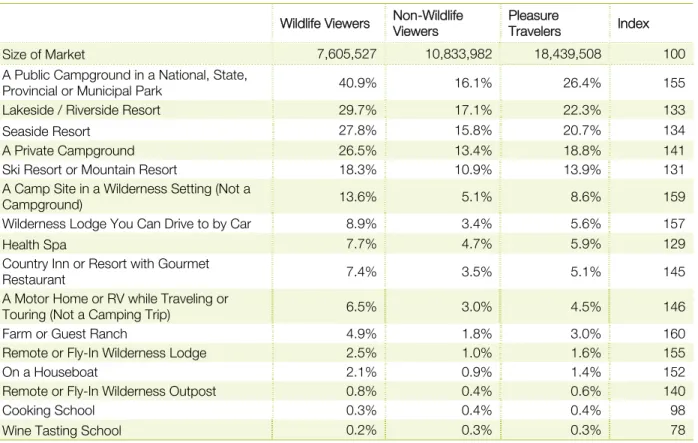
The appeal of nature to Wildlife Viewers is clearly evident in the types of
accommodation stayed in during the past two years. Wildlife Viewers most often
stayed in public campgrounds while on trips. They also frequently stayed at lakeside or
riverside resorts and were much more likely than the average Canadian Pleasure Travel
to have stayed in accommodation in a wilderness setting (e.g., wilderness lodge
accessible by car, remote or fly-in wilderness lodge or outpost).
Fig. 10 Accommodations Stayed In While on Trips
Wildlife Viewers Non-Wildlife
Viewers
Pleasure
Travelers Index
Size of Market 7,605,527 10,833,982 18,439,508 100
A Public Campground in a National, State,
Provincial or Municipal Park 40.9% 16.1% 26.4% 155
Lakeside / Riverside Resort 29.7% 17.1% 22.3% 133
Seaside Resort 27.8% 15.8% 20.7% 134
A Private Campground 26.5% 13.4% 18.8% 141
Ski Resort or Mountain Resort 18.3% 10.9% 13.9% 131
A Camp Site in a Wilderness Setting (Not a
Campground) 13.6% 5.1% 8.6% 159
Wilderness Lodge You Can Drive to by Car 8.9% 3.4% 5.6% 157
Health Spa 7.7% 4.7% 5.9% 129
Country Inn or Resort with Gourmet
Restaurant 7.4% 3.5% 5.1% 145
A Motor Home or RV while Traveling or
Touring (Not a Camping Trip) 6.5% 3.0% 4.5% 146
Farm or Guest Ranch 4.9% 1.8% 3.0% 160
Remote or Fly-In Wilderness Lodge 2.5% 1.0% 1.6% 155
On a Houseboat 2.1% 0.9% 1.4% 152
Remote or Fly-In Wilderness Outpost 0.8% 0.4% 0.6% 140
Cooking School 0.3% 0.4% 0.4% 98
Tours and Cruises Taken During Past Two Years
Wildlife Viewers were more likely than the average Canadian Pleasure Traveler to have
taken tours and cruises in the past two years. The tours taken most often taken include
sameday tours, scenic countryside drives and city tours. Relative to the average
Canadian Pleasure Traveler, Wildlife Viewers were especially likely to have taken
self-guided, multi-location tours, wilderness tours, sightseeing cruises, air tours and tours
of wineries and factories.
Fig. 11 Tours and Cruises Taken During Past Two Years
Wildlife Viewers Non-Wildlife Viewers Pleasure
Travelers Index
Size of Market 7,605,527 10,833,982 18,439,508 100
A self-guided, sameday tour while on an
overnight trip 41.6% 20.7% 29.3% 142
Around the countryside - scenic drives 33.3% 14.8% 22.4% 148
Around the city 31.2% 17.9% 23.4% 134
An organized, sameday, guided tour while
on an overnight trip 30.9% 16.1% 22.2% 139
A self-guided, overnight tour where you
stayed in different locations 27.0% 11.9% 18.1% 149
Wilderness tour 22.6% 6.3% 13.0% 173
On the water (sightseeing cruise) 20.4% 8.0% 13.1% 156
Some other type of tour 14.6% 6.5% 9.8% 149
An organized, overnight, guided tour where
you stayed in different locations 12.2% 8.6% 10.1% 121
An organized, overnight, guided tour where
you stayed in a single location 10.3% 6.1% 7.8% 132
To a casino 8.4% 5.2% 6.5% 129
To a winery 8.1% 3.9% 5.6% 144
Caribbean ocean cruise 5.2% 5.5% 5.4% 97
To a factory 4.1% 1.6% 2.6% 156
Ocean cruise – Other 3.9% 2.9% 3.3% 118
Cruise on another lake or river 3.2% 1.8% 2.4% 135
In the air as a pilot or passenger of an
airplane or helicopter 2.9% 1.2% 1.9% 153
Cruise on the St. Lawrence River 2.7% 1.4% 1.9% 138
Some other type of cruise 1.9% 1.4% 1.6% 121
Alaskan ocean cruise 1.9% 1.5% 1.6% 114
Great Lakes cruise 1.0% 0.6% 0.8% 129
Benefits Sought While on Vacation
As with most Canadian Pleasure Travelers, Wildlife Viewers generally take vacations to
get a break from their day-to-day environment, to relax and relieve stress, to create
lasting memories, to enrich family relationships, and to see or do something new or
different. However, relative to other Canadian Pleasure Travelers, Wildlife Viewers are
especially likely to seek out opportunities to learn (e.g., enrich perspective on life, gain
knowledge of the history or cultures of places, mental stimulation or challenge) while on
vacation.
Fig.12 Benefits Sought While on Vacation
(Percent Rating Each Benefit as “Highly Important”)
71.5% 67.9% 58.0% 56.8% 50.5% 48.3% 43.4% 33.3% 30.0% 20.6% 19.6% 18.2% 12.6% 10.9% 64.5% 64.4% 48.6% 50.5% 39.7% 47.6% 43.7% 24.1% 20.1% 14.9% 18.6% 13.3% 12.7% 14.5% 8.7% 10.3% 0% 10% 20% 30% 40% 50% 60% 70% 80%
To get a break from your day-to-day environment
To relax and relieve stress
To create lasting memories
To enrich your relationship with your spouse/partner/children
To see or do something new and different To have a life with no fixed
schedule
To keep family ties alive
To enrich your perspective on life
To gain knowledge of history, other cultures or other places To stimulate your mind/be intellectually challenged To renew personal connections
with people (other than family) To be challenged physically/to
feel physically energized To have stories to share back
at home
To be pampered
To seek solitude and isolation
Wildlife Viewers
Other Attributes of a Destination Considered Important
As with most Canadian Pleasure Travelers, Wildlife Viewers consider it important that
they feel safe at a destination (although to a lesser extent that the average Canadian
Pleasure Travelers). They are more likely to consider it important that a destination has
camping available and lots of things for adults to see and do
Fig. 13 Importance of Destination Attributes (% Rating Each Attribute as “Highly Important”)
62.5% 46.8% 44.5% 40.7% 29.3% 26.6% 25.5% 23.3% 21.1% 17.7% 17.3% 12.2% 10.6% 9.6% 9.4% 8.1% 5.4% 4.4% 68.5% 52.4% 42.1% 36.3% 30.4% 30.9% 24.1% 20.9% 23.5% 9.4% 15.8% 13.6% 15.4% 8.4% 13.7% 12.7% 7.6% 6.1% 0% 10% 20% 30% 40% 50% 60% 70% 80%
Feeling safe at the destination
No health concerns at the destination
Convenient access by car
Lots of things for adults to see and do
Availability of mid-range accommodation
Direct access by air
Information about the destination available on the Internet
Availability of budget accommodation Low cost package deals available
for the destination
Availability of camping
Lots of things for children to see and do
Convenient access by train/bus
Being familiar with the culture and language of the destination
Being at a place that is very different culturally than mine
Great shopping opportunities
Having friends or relatives living there Availability of luxury accommodation Destination is disabled-person-friendly Wildlife Viewers Non-Wildlife Viewers
How Destinations Are Selected
Similar to the majority of Canadian Pleasure Travelers, Wildlife Viewers tend to start
planning trips with a particular destination in mind. However, Wilderness Viewers are
somewhat more likely to begin planning a vacation by considering what activities they
would like to do.
Fig. 14 How Destinations Are Selected (Summer and Winter Vacations)
Wildlife Viewers Non-Wildlife
Viewers
Pleasure
Travelers Index
Size of Market 7,605,527 10,833,982 18,439,508 100
Summer
Started with a desired destination in mind 50.0% 47.3% 48.5% 103 Started by considering specific activities wanted
to do 15.6% 12.4% 13.8% 113
Started with a certain type of vacation experience
in mind 24.2% 23.3% 23.7% 102
Looked for packaged deals - no destination in
mind 1.2% 1.4% 1.3% 92
Considered something else first 3.9% 4.6% 4.3% 90
Don't know / Other 5.2% 10.9% 8.4% 61
Winter
Started with a desired destination in mind 47.7% 49.3% 48.6% 98 Started by considering specific activities wanted
to do 17.5% 14.0% 15.6% 112
Started with a certain type of vacation experience
in mind 21.1% 17.8% 19.3% 109
Looked for packaged deals - no destination in
mind 2.8% 3.5% 3.2% 87
Considered something else first 4.3% 4.9% 4.7% 93
Trip Planning and Information Sources Consulted
The majority of Wildlife Viewers were responsible for planning trips either on their own
(40.3%) or with someone else (16.0%).
When making vacation plans, Wildlife Viewers consulted a wider variety of sources than
the average Canadian Pleasure Traveler. The majority in this segment used the Internet,
word-of-mouth and past experiences to plan travel. Wildlife Viewers were also
particularly more likely than average to obtain trip planning information from official
travel brochures or guides and visitor information centres. They also frequently obtain
travel information from programs on television, trade, travel or sports shows,
guidebooks such as Fodor’s and from information received in the mail.
Fig. 15 Who Plans Vacations and Information Sources Consulted
Wildlife Viewers Non-Wildlife
Viewers
Pleasure
Travelers Index
Size of Market 7,605,527 10,833,982 18,439,508 100
Respondent plans trips 40.3% 43.4% 42.0% 96
Trip planning a shared
responsibility 16.0% 16.8% 16.4% 97
Who Plans Trips?
Someone else plans trips 43.8% 39.8% 41.5% 105
An Internet website 73.5% 59.0% 65.2% 113
Advice of others /
Word-of-mouth 61.2% 43.5% 51.1% 120
Past experience / Been there
before 59.8% 43.3% 50.4% 119
Maps 42.8% 24.8% 32.6% 132
Official travel guides or brochures from state / province
38.6% 16.3% 26.0% 149
A travel agent 35.7% 32.9% 34.1% 105
Visitor information centres 34.5% 15.0% 23.4% 148 Articles in
newspapers/magazines 26.7% 16.5% 20.9% 128
An auto club such as CAA 22.8% 13.8% 17.7% 129 Travel guide books such as
Fodor's 19.0% 9.6% 13.6% 139
Advertisements in
newspapers / magazines 18.3% 11.2% 14.3% 128 Travel information received in
the mail 12.1% 6.4% 8.8% 137
Programs on television 10.9% 4.9% 7.5% 145
Advertisements on television 6.3% 4.0% 5.0% 127
An electronic newsletter or
magazine received by e-mail 5.3% 3.3% 4.2% 128 Information Sources Consulted
Visits to trade, travel or
Use of the Internet to Plan and Arrange Trips
Wildlife Viewers are more likely than the average Canadian Pleasure Traveler to use the
Internet to plan (69.2%) and book (44.9%) travel. The majority of Wildlife Viewers use
hotel or resort websites and the tourism websites for specific countries, regions or
cities. Accommodation and airline tickets were the trip components most often
purchased over the Internet.
Fig. 16 Use of the Internet to Plan and Book Travel
Wildlife Viewers Non-Wildlife
Viewers
Pleasure
Travelers Index
Size of Market 7,605,527 10,833,982 18,439,508 100
Does not use the Internet 30.8% 47.9% 40.8% 75
Uses Internet to plan trips only 24.3% 20.6% 22.1% 110 Percent Using
Internet to Plan
or Book Travel Uses Internet to book part of
trip 44.9% 31.5% 37.0% 121
A website of a hotel or resort 59.8% 54.4% 57.0% 105 A tourism website of a country /
region / city 57.3% 42.7% 49.8% 115
An airline website 48.3% 44.5% 46.3% 104
A travel planning/booking
website 45.8% 45.6% 45.7% 100
A website of an attraction 40.9% 28.3% 34.5% 119
Some other website 30.2% 25.1% 27.6% 110
A cruise line website 8.3% 7.9% 8.1% 102
Types of Websites Consulted A motorcoach website 3.0% 2.0% 2.5% 121 Accommodation 71.5% 66.8% 69.2% 103 Air tickets 70.2% 68.7% 69.5% 101 Car rental 28.3% 26.0% 27.1% 104
Tickets or fees for specific
activities or attractions 26.3% 21.0% 23.6% 111
Tickets for rail, bus or boat/ship
fares 17.9% 12.8% 15.3% 117
A package containing two or
more items 15.0% 15.8% 15.4% 97 Parts of Trips Booked Over The Internet Other 4.7% 3.2% 3.9% 119
Media Consumption Habits
Wildlife Viewers are more likely than the average Canadian Pleasure Traveler to
consume travel-related media, including the travel sections of newspapers, travel
magazines, travel websites, and travel programs on television. This segment can be
most effectively targeted through media with a natural science theme (e.g., science &
geography magazines, science & nature television programming) or a home decorating
or crafts theme (e.g., house & home websites; home & garden television programming;
crafts, antiques & collectibles magazines).
Fig. 17 Media Consumption Habits
Wildlife Viewers Non-Wildlife Viewers Pleasure Travelers Index Size of Market 7,605,527 10,833,982 18,439,508 100
Reads daily newspaper 87.4% 87.1% 87.3% 100
Reads weekend edition of newspaper 87.6% 87.1% 87.3% 100 Reads local neighbourhood or
community newspapers 65.0% 59.1% 61.5% 106
Reads other types of newspapers 19.2% 15.7% 17.2% 112 Frequently or occasionally reads travel
section of daily newspaper 48.4% 43.9% 45.7% 106
Newspaper Readership
Frequently or occasionally reads travel
section of weekend newspaper 51.0% 44.8% 47.3% 108
Science and geography 22.8% 12.3% 16.6% 137
Magazines about your city 14.5% 10.2% 12.0% 121 Travel (e.g., Condé Nast) 14.1% 10.1% 11.8% 120 Crafts, antiques and collectibles 15.0% 10.8% 12.5% 120 Types of Magazines Read (Top 5 Indexed) Regional magazines 9.2% 6.9% 7.9% 117 Travel shows 35.0% 27.0% 30.3% 116
Science & nature shows 50.5% 39.2% 43.8% 115 Science fiction / Fantasy shows 20.7% 18.1% 19.2% 108 Home & garden shows 35.9% 32.9% 34.2% 105 Type of Television Programs Watched (Top 5 Indexed) History 42.9% 41.0% 41.8% 103
Jazz / Big band 10.4% 7.6% 8.8% 119
Multicultural 9.9% 7.3% 8.4% 118
Classical music 20.2% 15.2% 17.2% 117
News / Talk / Information 44.1% 36.1% 39.4% 112 Type of
Radio Programs Listened To (Top 5
Indexed) Modern rock / Alternative rock 40.9% 34.4% 37.1% 110
Travel 56.0% 46.3% 50.6% 111
Network news sites (e.g., CBC, CNN) 39.1% 33.8% 36.1% 108
House and home 30.0% 26.7% 28.1% 107
Shopping (all types) 34.9% 32.4% 33.5% 104
Types of Websites Visited (Top 5 Indexed) Health 45.1% 42.3% 43.5% 104
Appendix One
Canadian TAMS 2006 Outdoor Activity Segmentation
Activity Segment Activities in Segment
Played During a Stay at a Golf Resort with Overnight Stay
Golfing
Played an Occasional Game While on a Trip
Golf Tour Package to Play on Various Courses
Hunting for Small Game Hunting
Hunting for Big Game Hunting for Birds Fresh-Water Fishing Salt-Water Fishing Fishing
Ice Fishing Trophy Fishing
Viewing Land Based Animals Bird Watching
Whale Watching & Other Marine Life Visited National, Provincial / State Park Wildlife Viewing
Wildflowers / Flora Viewing Viewing Northern Lights
Mountain Climbing / Trekking Fresh Water Kayaking / Canoeing Rock Climbing Ocean Kayaking / Canoeing
Same Day Hiking Excursion While on a Trip of 1+ Nights
Hiking, Climbing &
Paddling Hiking / Backpacking in Wilderness Setting With Overnight Camping or
Lodging White Water Rafting
Motorboating Boating & Swimming
Water Skiing Swimming in Lakes Swimming in Oceans Snorkeling in Sea / Ocean Ocean Activities
Sunbathing, Sitting on a Beach Scuba Diving in Sea/Ocean
Sailing Parasailing Sailing & Surfing
Wind Surfing Kite Surfing
Freshwater Scuba &
Snorkeling Scuba Diving in Lakes / Rivers Snorkeling in Lakes / Rivers Exercising & Jogging Working Out in Fitness Centre Jogging or Exercising Outdoors
Overnight Touring Trip Cycling
Mountain Biking Recreational - Same Day Excursion Motorcycling Overnight Touring Trip Same Day Excursion
Horseback Riding With an Overnight Stop Same Day Excursion All Terrain Vehicle - Overnight Touring
Trip Snowmobiling As an Overnight Touring Trip Snowmobiling & ATVing
All Terrain Vehicle - Same Day Excursion Snowmobiling Day Use on Organized Trail Downhill Skiing &
Snowboarding Snowboarding Downhill Skiing Cross-country Skiing
Cross-country Skiing &
Snowshoeing Snowshoeing
Cross-country or Back Country as an Overnight Touring Trip
Wilderness Skills Courses Wilderness Activities
Ice Climbing Dog Sledding
Skating Ice Skating In-Line / Rollerblading
Parachuting Extreme Air Sports
Activity Segment Activities in Segment
Ice Hockey Curling
Football Basketball Team Sports
Baseball or Softball Soccer
Board Games Badminton
Volleyball Tennis
Beach Volleyball Sports & Games
Appendix Two
Canadian TAMS 2006 Culture and Entertainment Segmentation
Activity Segment Activities in Segment
Well-known Historic Sites or Buildings Well-known Natural Wonders Other Historic Sites, Monuments and
Buildings
Historical Replicas of Cities or Towns With Historic Re-Enactments Strolling Around a City to Observe Buildings
and Architecture Museum - Military / War Museums Art Galleries
Historical Sites, Museums & Art Galleries
Museum - General History or Heritage
Museums Paleontological/Archaeological Sites Shop Or Browse - Bookstore or Music Store Shop Or Browse – Antiques Shop Or Browse - Clothing, Shoes and
Jewellery
Shop Or Browse - Gourmet Foods in Retail Stores
Shop Or Browse - Local Arts & Crafts Studios or Exhibitions
Shop Or Browse - Greenhouse or Garden Centre
Dining - Restaurants Offering Local Ingredients and Recipes
High-End Restaurants with an International Reputation Shopping & Dining
Went to Local Outdoor Cafes Other High-End Restaurants Aboriginal Cuisine (Tasted or Sampled) Aboriginal Arts and Crafts Shows Aboriginal Heritage Attractions (e.g.,
Museums, Interpretive Centres)
Aboriginal Cultural Experiences in a Remote or Rural Setting
Aboriginal Cultural Experiences
Aboriginal Festivals & Events (e.g., Powwows) Aboriginal Outdoor Adventure and / or Sports
Farmers' Markets or Country Fairs Firework Displays
Carnivals Ethnic Festivals
Fairs & Festivals
Exhibition or Fairs Food / Drink Festivals Science or Technology Museums Children's Museums Science & Technology Theme Parks
Science & Technology Exhibits
Planetarium Went to an Imax Movie Theatre
Amusement Park Aquariums
Water Theme Park Zoos
Movie Theme Park Theme Parks & Exhibits
Wax Museums
Entertainment Farms (e.g., Corn Maze, Petting Zoo)
Classical or Symphony Concert High Art Performances
Opera Ballet or Other Dance Performances Professional Football Games Professional Golf Tournaments Professional Basketball Games Professional Ice Hockey Games Professional Sporting
Events
Professional Baseball Games Professional Soccer Games Live Theatre
Live Theatre
Theatre Festivals Live Theatre with Dinner Literary & Film Festivals Literary Festivals or Events International Film Festivals
Went to Wineries for Day Visits and Tasting Cooking / Wine Tasting Courses Tastings
Went to Breweries for Day Visits and Tasting Visited Food Processing Plants (e.g., Cheese Factory)
Activity Segment Activities in Segment
Spas Day Visit to a Health & Wellness Spas while on an Overnight Trip
Historical Re-Enactments (as an Actor) Interpretive Program at a Historic Site or National / Provincial Park
Participatory Historical Activities
Curatorial Tours Archaeological Digs
Equine (Horse) Competitions Western Theme Events (e.g., Rodeos) Equestrian & Western
Events Horse Races Dining At A Farm Agro-Tourism
Went Fruit Picking at Farms or Open Fields
Harvesting and / or Other Farm Operations
Curling Bonspiel National & International
Sporting Events Professional Figure Skating
National / International Sporting Events such as the Olympic Games
Gardens Theme
Attractions Garden Theme Park Botanical Gardens Amateur Tournaments Amateur Sports Tournaments and
Competitions
Amateur Tournaments and
Competitions other than Sports-related Music Festivals Musical Attractions
Jazz Concert Free Outdoor Performances (e.g., Theatre, Concerts) in a Park Musical Concerts,
Festivals & Attractions
Rock & Roll/Popular Music Concert Country & Western Music Concert Comedy Festivals &
Clubs Comedy Festivals
Stand-up Comedy Clubs & Other Variety Shows