The definition and development of
Open Innovation models to
assist the innovation process
Stephan Marais
Thesis presented in partial fulfilment of the requirements
for the degree of Masters of Engineering Management at the
University of Stellenbosch.
Supervisor: CSL Schutte
| Page ii The definition and development of Open Innovation models
I
Declaration
By submitting this thesis electronically, I declare that the entirety of the work contained therein is my own, original work, that I am the owner of the copyright thereof (unless to the extent explicitly otherwise stated) and that I have not previously in its entirety or in part submitted it for obtaining any qualification.
Copyright © 2010 Stellenbosch University
| Page iii The definition and development of Open Innovation models
II
Synopsis
Organisations are continuously striving to attain and maintain a competitive advantage over their peers. The innovation process provides an excellent vehicle for driving this sustained quest for competitiveness, whether on product, process or strategic level.
However, in reality the increased availability and adoption of technology force organisations to increase the speed and effectiveness of their innovation processes to match not only those of their competitors, but to deal with the ever-increasing power of the individual – the empowered, consuming, producing “prosumer”.
The innovation process itself should therefore undergo dramatic alterations to cope with – and include – these empowered prosumers. It is for this reason that the evolution of the innovation process has undergone changes, and is now moving towards the notion of Open Innovation.
Although Open Innovation has been adopted by various organisations, it was found that a well- formulated, standardised set of Open Innovation models is lacking from existing literature.
This research bridges the gap between the previous innovation models and the notion of an open approach to internal innovation, to improve the speed and effectiveness of the innovation process.
It does this by investigating two primary research fields: innovation and Open Innovation, and then merging the two fields to provide a standardised framework to incorporate Open Innovation in the standard innovation process.
The fundamentals of innovation are investigated, whereafter the focus moves to understanding a specific, existing innovation process framework, the Fugle Innovation Process Model. The second field (Open Innovation) is introduced, whereafter various literature sources (real-life examples, case studies and interviews) are used to develop (categorise, define and describe) five standard Open Innovation models.
The five developed Open Innovation models are then allocated to the investigated, standard innovation process, according to what is needed in that particular phase of the innovation process and the beneficial offerings of each Open Innovation model. The allocated models therefore provide a potential substitute for the existing internal activity associated with each of the specific phases.
The result is an existing innovation process model, populated with implementable Open Innovation models to increase not only the value of the innovation process model, but also the value to organisations who wish to deploy Open Innovation.
| Page iv The definition and development of Open Innovation models
III Opsomming
Maatskappye is voortdurend besig om ’n mededingende voordeel bo hulle mededingers te probeer verkry en te handhaaf. Die innovasieproses bied ’n uitstekende metode om hierdie doel na te streef, hetsy op produk-, proses- of strategiese vlak.
Die realiteit is egter dat die tempo waarmee tegnologie aangeneem en aanvaar word, en sodoende vrylik gebruik word, konstant toeneem. Dit dwing maatskappye om die spoed en effektiwiteit van hulle innovasieproses volhoubaar te verbeter, nie net om by te hou by hulle mededingers nie, maar ook om die maatskappy korrek te posisioneer ten opsigte van die moderne, bemagtigde verbruiker.
Die innovasieproses moet dus self ’n gedaanteverwisseling ondergaan om ruimte te bied vir die insluiting van hierdie bemagtigde verbruikers. Daarom verander die evolusionêre progressie van die innovasieproses voortdurend en is dit besig om in die rigting van “Oop Innovasie” te beweeg.
Alhoewel Oop Innovasie reeds deur verskeie maatskappye toegepas word, is daar gevind dat goed geformuleerde, standaard-, implementeerbare prosesse (of modelle) steeds in die literatuur ontbreek.
Hierdie navorsings oorbrug dus die leemte tussen die meer konvensionele “geslote innovasie” en die nuwerwetse neiging na “Oop Innovasie”, om sodoende die spoed en effektiwiteit van die interne innovasieproses te verbeter.
Dit word bereik deur die twee kernnavorsingsvelde te ondersoek: innovasie en Oop Innovasie, en dan die twee velde te kombineer om ’n gestandaardiseerde model te skep wat Oop Innovasie by die standaard-innovasieproses insluit.
Die metodiek fokus eerstens op die kernaspekte van innovasie om ’n beter begrip van die veld te ontwikkel. Daarna verskuif die klem na die beskrywing van ’n reeds bestaande innovasieproses-model, die Fugle-innovasieprosesmodel. Hierna word Oop Innovasie bekend gestel, waarna vyf implementeerbare Oop Innovasie-modelle ontwikkel word aan die hand van verskeie werklike voorbeelde, gevallestudies en onderhoude, om sodoende die modelle te groepeer, te definieer en te beskryf (voordele, nadele en vereistes).
Die vyf Oop Innovasie-modelle word hierna toegedeel aan die verskillende fases van die innovasieprosesmodel deur ’n vergelyking te tref tussen die behoeftes van elk van die fases en die proposisie wat elk van die Oop Innovasie-modelle bied.
Die resultaat is dus ’n bestaande innovasieprosesmodel waarvan die waarde verhoog is deur die insluiting van implementeerbare Oop Innovasie-modelle. Dit voeg waarde toe vir organisasies wat graag ’n Oop Innovasieproses wil instel.
| Page v The definition and development of Open Innovation models
IV Acknowledgements
Corné Schutte, the study leader, for his ever-enduring assistance and guidance on subjects and issues stretching far wider than the scope an academic research effort can ever wish to fulfil. The truthful, enlightening conversations we had concerning the work and personal sagas, with or without Scotland’s best, will forever remain with me.
Thank you for the role you played in shaping my years to come.
***
A single paragraph cannot do justice to the support I received from family members and loved ones, who encouraged me to see the light at the end of the tunnel when the hour was dire. The support, understanding and friendship received during the duration of this research effort have reshaped my viewpoint on various topics, personal and professional, for which I will forever be grateful and filled with respect.
“Gratitude is the moral memory of mankind”
| Page vi The definition and development of Open Innovation models
Table of Contents
I
Declaration ... ii
II
Synopsis ... iii
III
Opsomming ... iv
IV
Acknowledgements ... v
V
List of Figures ... x
VI
List of Tables ... xii
VII
List of Appendices... xiii
VIII
List of Acronyms and Abbreviations ... xiv
1
Introduction ... 1
1.1
Introduction ... 2
1.2
Problem statement ... 2
1.3
Research objectives and methodology ... 3
1.4
Research boundaries / Scope ... 4
1.5
Expected outcome ... 5
1.6
Document layout ... 5
2
The innovation landscape ... 9
2.1
Defining innovation ... 10
2.1.1 The definition of innovation ... 10
2.1.2 The innovation life cycle ... 11
2.2
The categorisation of innovation ... 13
2.2.1 Product innovation ... 13
2.2.2 Process innovation ... 14
2.2.3 Strategic innovation ... 14
2.3
The role of innovation ... 15
2.4
The progression of innovation models ... 16
2.5
Identifying the changes in the current landscape ... 17
2.5.1 The changing role of the individual ... 19
2.5.2 The dispersion of research and development ... 20
2.5.3 The increase in invention ... 22
| Page vii The definition and development of Open Innovation models
2.7
Chapter summary ... 26
3
The Fugle Innovation Process Model ... 27
3.1
Introducing the Fugle Innovation Process Model framework ... 28
3.2
Why the Fugle model? ... 28
3.3
The Fugle Innovation Process Model ... 30
3.4
Description of the Fugle model’s stages ... 31
3.4.1 Idea Generation / Identification Stage ... 32
3.4.2 Concept Definition Stage ... 33
3.4.3 Concept Feasibility & Refinement Stage ... 34
3.4.4 Portfolio Stage ... 35
3.4.5 Deployment Stage ... 36
3.5
Summary of the relevant Fugle stage requirements ... 37
3.5.1 Refinement & Formalisation Stage ... 37
3.5.2 Exploitation Stage ... 38
3.6
A summary of the requirements of the Fugle stages ... 39
3.7
Chapter summary ... 39
4
Introducing Open Innovation ... 40
4.1
Defining Open Innovation ... 41
4.2
The differences between Open and Closed Innovation ... 45
4.3
The potential challenges of Open Innovation ... 46
4.3.1 Exploiting internal innovation ... 46
4.3.2 Incorporating external innovation ... 47
4.3.3 Motivating outsiders to contribute ... 48
4.4
The different sources of open innovation ... 50
4.4.1 Identifying the sources ... 50
4.4.2 Customer-generated innovation ... 52
4.4.3 Suppliers, peers and outsourcing Open Innovation ... 71
4.4.4 Network collaboration ... 76
4.5
Chapter summary ... 81
5
The definition and development of the Open Innovation Models ... 82
5.1
Introduction ... 83
5.2
The development of platforming as an OI model ... 85
5.2.1 Defining platforming ... 85
5.2.2 The criteria for platforming ... 86
| Page viii The definition and development of Open Innovation models
5.3
The development of idea competitions as an OI model ... 91
5.3.1 Defining idea competitions ... 91
5.3.2 The criteria for idea competitions ... 91
5.3.3 The advantages and disadvantages of idea competitions ... 94
5.4
The development of customer immersion as an OI model ... 98
5.4.1 Defining customer immersion... 98
5.4.2 The criteria for customer immersion ... 99
5.4.3 The advantages and disadvantages of customer immersion ... 100
5.5
The development of collaborative product design and development as an OI
model 105
5.5.1 Defining collaborative product design and development ... 1055.5.2 An interview with Tracks4Africa ... 107
5.5.3 The criteria for collaborative product design and development ... 110
5.5.4 The advantages and disadvantages of collaborative product development ... 111
5.6
The development of innovation networks as an OI model ... 113
5.6.1 Defining innovation networks ... 113
5.6.2 The criteria for innovation networks ... 115
5.6.3 The advantages and disadvantages of innovation networks ... 118
5.7
Developing the summarised framework ... 119
5.8
Chapter summary ... 120
6
The allocation of the Open Innovation models to the Fugle Innovation
Process Model ... 121
6.1
Allocating the OI models to the Fugle stages ... 122
6.1.1 Idea Generation / Identification Stage ... 123
6.1.2 Concept Definition Stage ... 124
6.1.3 Concept Feasibility & Refinement Stage ... 125
6.1.4 Deployment Stage and Refinement & Formalisation Stage ... 126
6.1.5 Exploitation Stage ... 127
6.2
Summarising the model allocation ... 128
7
Verification of the OI model’s placements ... 129
7.1
The validation method ... 130
7.1.1 The validation process ... 131
7.2
Feedback from validation interviews ... 133
7.2.1 Prof Frikkie Herbst ... 133
7.2.2 Johann Groenewald ... 133
7.2.3 Truitjie van Rooyen ... 134
| Page ix The definition and development of Open Innovation models
7.2.5 Dr Heinz Essman & Dr Louis Louw ... 135
7.2.6 Ncami Sithole ... 136
7.2.7 Dr Anthon Botha ... 137
7.3
Summary of validation interviews ... 139
8
Conclusions and recommendations ... 140
8.1
Conclusions ... 141
8.1.1 Methodology summary ... 141
8.1.2 Results and concluding remarks ... 143
8.2
Recommendations for future work ... 145
8.2.1 Practical application of the models ... 145
8.2.2 Application of Open Innovation in the service industry ... 145
8.2.3 Linking strategy, change management and the relationship between Open and Closed Innovation ... 146
Bibliography ... xii
IX
Appendices ... xii
IX.I
Appendix A: A summary on Open Innovation ... xiii
| Page x The definition and development of Open Innovation models
V
List of Figures
Figure 1 - Research methodology followed ... 4
Figure 2 - The basic innovation process ... 10
Figure 3 - The innovation life cycle ... 11
Figure 4 - The categories of innovation ... 13
Figure 5 - The role innovation has to fulfil ... 15
Figure 6 - Progression of innovation models ... 16
Figure 7 - Growth in foreign R&D ... 20
Figure 8 - Changing Distribution of R&D sites... 20
Figure 9 - US utility patents (1930–2007) ... 22
Figure 10 - Venture capital investments ... 23
Figure 11 - Improving the innovation process ... 25
Figure 12 - The various innovation process models and their presence in the Life Cycle phases ... 29
Figure 13 - The Fugle Innovation Process Model ... 30
Figure 14 - The first phase of the Fugle process ... 31
Figure 15 - The Portfolio Stage with accompanying Launch Gate ... 35
Figure 16 - The second phase of the Fugle model ... 36
Figure 17 - The traditional innovation process ... 42
Figure 18 - The Open Innovation process ... 42
Figure 19 - The innovation process with supporting methodologies ... 43
Figure 20 - The challenges of Open Innovation in the R&D process ... 46
Figure 21 - Traditional supply chain ... 50
Figure 22 - The sources of Open Innovation ... 51
Figure 23 - Sources of scientific instrument innovation by innovation significance ... 52
Figure 24 - Incorporating lead-users into the product development life cycle (PDLC) ... 53
Figure 25 - Lego Mindstorms community page ... 55
Figure 26 - Apple App Store reaches one billion downloads ... 56
Figure 27 - iPhone ecosystem processes ... 57
Figure 28 - Threadless, the community-driven online apparel store ... 64
Figure 29 - The collaborative process followed by Threadless ... 65
Figure 30 - Idea Bounty's home page ... 66
Figure 31 - Idea Bounty's collaborative process ... 70
Figure 32 -Potential innovation improvements ... 72
Figure 33 - PWC CEO Survey Results ... 73
Figure 34 - Innocentive’s home page ... 78
Figure 35 - Collaboration framework ... 83
| Page xi The definition and development of Open Innovation models
Figure 37 - Examples of idea competition websites ... 95
Figure 38 - The Google Wave project timeline ... 102
Figure 39 - PDLC with customer immersion ... 102
Figure 40 - Collaborative product design and development ... 106
Figure 41 - T4A's product development process ... 109
Figure 42 - The differences between innovation networks and idea competitions ... 113
Figure 43 -Innovation networks ... 114
Figure 44 - The focus and relevant requirements of the Fugle model's stages ... 122
| Page xii The definition and development of Open Innovation models
VI List of Tables
Table 1 - The focuses and relevant requirements of the Fugle stages ... 39
Table 2 - Closed versus Open Innovation ... 45
Table 3 - Other Ideagora service providers ... 79
Table 4 - Examples of innovation network Terms & Conditions ... 116
Table 5 - Summary of OI model offerings ... 119
Table 6 - Summarised table of allocated models ... 128
| Page xiii The definition and development of Open Innovation models
VII List of Appendices
Appendix A – Summary on Open Innovation models and the allocation to the innovation process
Appendix B – Validation information
(i) Introductory document provided to all interviewees
| Page xiv The definition and development of Open Innovation models
VIII List of Acronyms and Abbreviations
CI Customer Immersion
CPD Collaborative Product Design & Development
CPU Central Processing Unit
HGP Human Genome Project
IC Idea Competitions
ICM Idea Competition Management
ICT Information and Communications Technology
IN Innovation Networks
IP Intellectual Property
IPRs Intellectual Property Rights
IT Information Technology
KM Knowledge Management
LC Life Cycle
OEM Original Equipment Manufacturer
OI Open Innovation
OS Operating System
PDLC Product Development Life Cycle
P&G Procter and Gamble
R&D Research and Development
ROI Return on Investment
VC Venture Capital
Introduction
1
This chapter provides the introductory sections of the text. It includes the problem statement, the proposed and expected solution and the methodology that will be used to reach the objective.
The guiding hypothesis will also be found in this chapter, after which the chapter concludes with a description of the logical layout and flow applied to the entirety of the text.
| Page 2 The definition and development of Open Innovation models
1.1 Introduction
Organisations are continuously striving to obtain, maintain or increase their competitive advantage. This is the primary reason for the existence of innovation, or the management of the innovation process. This process, if applied and managed correctly, thus provides the vehicle for organisations to effectively and constructively convey their objective of differentiation above their competitors – all for the unified goal of being the customer’s preferred choice.
The resemblance between this and the game of golf better depicts the scenario. All competing organisations start out on the proverbial tee, with the goal of reaching the green and cup in the least number of shots. Each player will set off in his or her own direction, with their own strategy and selection of tools, in the hope of reaching the cup as the winner.
The innovation management process thus provides the means through which the organisation can more effectively, and in a more structured manner, control how it gains the lead (competitive advantage), whether this will be through a product, process or enterprise-wide innovation, or a combination of the three.
As Michael Porter explains:
“Companies achieve competitive advantage through acts of innovation. They approach innovation in its broadest sense, including both new technologies and new ways of doing things.” (Porter, 1990)
The essence of innovation means that nothing within the organisation is left unscrutinised when searching for potential improvement – not even the innovation process itself.
The increasing pressure placed on organisations to compete for market share equates to organisations having to innovate faster and more effectively.
A research effort was undertaken to determine if it would be possible to incorporate Open Innovation into the standard innovation process. If this proves possible, methods (models) that would quantify the inclusion of Open Innovation will be developed.
1.2 Problem statement
Organisations are struggling to increase the success rate of their new product development cycles. It is a sustained struggle to better evaluate ideas and concepts that need to be developed, while the targeting and identification of what exactly customers need and want also needs to be made more accurate. This is portrayed by Pfizer: the pharmaceutical giant’s new product development failure rate is 96% (Simmons, 2003).
| Page 3 The definition and development of Open Innovation models
The problem that thus presents itself is to increase the effectiveness and accuracy of the innovation process. There is a need to better identify customer expectations and needs, while also developing valued, quality offerings at a more correctly targeted market.
This has therefore resulted in the following hypothesis:
Open Innovation models can be successfully developed and introduced at specific stages in a standard innovation process, to allow an organisation to make use of those models to improve the success rate of its standard innovation process.
1.3 Research objectives and methodology
The objective of this text is thus to identify methodologies, tools and techniques through which the effectiveness and accuracy (in terms of success) of the innovation process can be increased. This is done by investigating Open Innovation to determine whether this methodology offers the potential advantages needed to address the innovation process problem, and enhance the standard innovation process.
The area of innovation is first investigated to gain a basic understanding of what it entails. Hereafter, a specific innovation process model is chosen to which the Open Innovation models will be allocated. The Fugle Innovation Process Model is chosen for this purpose (Du Preez & Louw, A framework for managing innovation, 2008).
The Fugle model’s intermediate steps will be investigated to a specific level of detail to determine where each identified Open Innovation model will fit in to enhance and improve the conventional innovation process, based on the requirements and objectives of each Fugle stage.
The concept of Open Innovation, first defined by Henry Chesbrough in 2003 (Chesbrough, 2003), is initially discussed as a general concept, whereafter it is proven to be practical by identifying five different implementable models. The placement of these models within different parts of the innovation process is investigated and eventually validated.
The research thus investigates two major areas of research: innovation, and Open Innovation. Each area is individually discussed, followed by the concatenation of the two areas when the five researched and developed Open Innovation models are allocated to specific phases of the Fugle model.
Each of the five models will also be discussed in detail to determine the possible advantages, disadvantages, criteria and potential industries to which it is more applicable. This is achieved by investigating real-life implementations of these models, as well as through interviews with organisations who are already exploiting certain models or are following an Open Innovation mindset in their approach to business.
| Page 4 The definition and development of Open Innovation models
Refer to Figure 1 for a representation of the methodology that was followed. Note that the bulk of the research effort was put into investigating Open Innovation, and developing and defining the five implementable models. The models were all conceived from existing real-life examples and extended from the detailed literature study undertaken.
The other major facet of the research focuses on the allocation of the developed models. The discussion of innovation in general thus presents an in-depth and well-documented area of research. Figure 1 also depicts the specific chapter numbers (in red circles) that focus on the area of research.
Figure 1 - Research methodology followed
1.4 Research boundaries / Scope
As the innovation process is mostly employed in a formalised fashion in large organisations, and the duration of time involved in the completion of a successful iteration of the process often takes an excessive amount of time, the scope of this study does not allow the actual implementation of these models, or a selection of them, in a real-life context.
Instead, the models will be described conceptually, including the characteristics (advantages, disadvantages and criteria to consider when implementing the models) of each. These conceptually developed models will then be validated via an interview-based assessment where the input from industry experts from diverse backgrounds will be incorporated.
| Page 5 The definition and development of Open Innovation models
The scope of the research is therefore defined by the limits of conceptual development and assessment.
1.5 Expected outcome
The primary goal of the research effort is to determine whether Open Innovation can be incorporated into the standard innovation process. The objective of this inclusion will be to enhance the standard innovation process to increase the success rate of innovation process cycle iterations.
The secondary goal of the research is to develop (categorise, define and describe) implementable Open Innovation models. These models will then be allocated to the standard innovation process, which will allow the organisation to deploy these models if needed.
The Open Innovation models are in no way intended to replace any or all of the internal innovation process activities. The aim is to provide an organisation with the choice of deploying these models, if deemed appropriate.
It is expected that it will be found that Open Innovation can indeed be incorporated into the standard innovation process and that the development of Open Innovation models, deployable at specific points in the innovation process, is the most appropriate method to incorporate external entities into this process.
It is also expected that Open Innovation will prove to be a means of enhancing the success rate of the innovation process.
1.6 Document layout
The layout and order of the research is presented in such a fashion as to provide the most logical flow. This is achieved by investigating the two major facets of the research (the innovation process and Open Innovation) independently, before the concatenation of the two facets is done.
Each research area is initially researched in a broader, less specific manner (The innovation landscape – Chapter 2, Introducing Open Innovation – Chapter 4), before the detailed areas are tackled (The Fugle Innovation Process Model – Chapter 3, The definition and development of the Open Innovation models – Chapter 5).
| Page 6 The definition and development of Open Innovation models
The logical flow of the document can be described by the following diagram: [change in diagram:
The chapters are also allocated a different colour scheme to promote the logical flow of the document. Following is a short description of the content of each chapter.
Chapter 1 – Introduction
Chapter 1 contains the introductory sections that describe the problem statement, the objectives expected to be achieved by the research, as well as the boundaries and scope of the thesis.
The hypothesis is also defined in Chapter 1. The last section of this chapter describes the logical flow of the document, to provide the reader with guidelines regarding the layout and context of the entire document.
Chapter 2 – The innovation landscape
Chapter 2 lays the foundation by initially focusing on innovation. It provides a definition of innovation, discusses the evolution of innovation, and describes the generic innovation process.
The second half of the chapter focuses on identifying the changes currently being experienced in the innovation landscape. The scope and identification of these changes are guided by the findings of Chesbrough (2003). The goal of the identification of these changes is to serve as primary driver for the introduction of Open Innovation into the innovation process, and to assist in accommodating these changes.
| Page 7 The definition and development of Open Innovation models
Chapter 3 – The Fugle Innovation Process Model
The concept of innovation that was investigated in the previous chapter is given a more realistic depiction here, as Chapter 3 focuses on a specific, implementable innovation process model, the Fugle Innovation Process Model.
The introductory section of the chapter explains why the Fugle model is a valid representation of an innovation model, while the second half of the chapter investigates each individual phase of the Fugle model to determine its primary requirements and intended goal.
These features will be used to assist in the allocation of the developed Open Innovation models (developed in Chapter 5). The allocation is presented in Chapter 6.
Chapter 4 – Introducing Open Innovation
Chapter 4 introduces Open Innovation. The initial focus of the chapter is to define and explain the concept and methodology of Open Innovation, while also providing possible advantages and disadvantages.
The focus then moves to identifying the sources of Open Innovation, with the goal of assisting the identification of generic implementable Open Innovation models. These sources are then used in collaboration with real-life examples to determine five generic Open Innovation models. These models are defined and elaborated in the following chapter.
Chapter 5 – The definition and development of the Open Innovation models
The five models identified in the previous chapter are further investigated and developed in this chapter.
Each model is defined and its characteristics (advantages, disadvantages and criteria to consider when implementing the models) are identified. This is done through various sources, including existing literature and interviews held with existing organisations that are currently employing certain facets of either a specific model or Open Innovation in general.
| Page 8 The definition and development of Open Innovation models
The goal is to match specific Fugle phases (determined in Chapter 3) to complete the allocation of the models (in Chapter 6). The chapter concludes with a summarised tabular view of the five models, containing the aforementioned characteristics of each model.
Chapter 6 – The allocation of the Open Innovation models to the Fugle model process
The research culminates in this chapter: the two facets of the research (innovation processes and Open Innovation models) are now combined to deliver a more advantageous end result – an innovation process model equipped with potentially deployable Open Innovation models.
The allocation of the developed Open Innovation models is done by comparing their primary offering with the primary requirements of each Fugle stage.
Chapter 7 – Verification of the Open Innovation model placements
The final chapter of the body of the research focuses on the validation of the research done. This is achieved via interviews with a selection of experts from various relevant industries that each assesses the validity of a specific area of the research.
The verification focuses not only on the allocation of the models, but also on the models themselves, assessing whether the developed models do indeed have the required characteristics.
Chapter 8 – Conclusions and recommendations
The final chapter provides a summary of the research undertaken by once again reiterating the methodology followed, the results obtained from the validation, as well as aspects learnt and derived from the research.
The final section of the chapter highlights certain focus areas that may provide plausible opportunities for future related research.
the innovation landscape
2
This chapter introduces and describes innovation as a concept. It provides definitions for, as well as process descrip-tions of, the generic innovation process. The second half of the chapter details the changes currently being experi-enced in the innovation landscape, as described by Chesbrough (2003). This motivates why there is potential for Open Innovation to add value to the innovation process.
The goal of this exercise is to firstly get an understanding of what innovation is, before establishing whether there is a need to add value to the existing innovation process and commencing a study of the Open Innovation methodology. This chapter thus serves to initially describe the generic innovation process, and then identify the needs within this process that will be addressed if Open Innovation models are introduced into the process.
| Page 10 The definition and development of Open Innovation models
2.1 Defining innovation
The true meaning of innovation has in recent times been wrongfully exploited for marketing purposes, erroneously describing the scope and complexities of the innovation process. Therefore, an established definition for innovation should be presented that will serve as a point of departure for the entirety of this text.
2.1.1 The definition of innovation
Katz (2007) defines innovation as follows:The successful generation, development and implementation of new and novel ideas, which introduce new products, processes and/or strategies to a company or enhance current products, processes and/or strategies leading to commercial success and possible market leadership and creating value for stakeholders, driving economic growth and improving standards of living.
Tidd, Bessant and Pavitt (2005) suggest that organisations often confuse invention for innovation, while in their opinion innovation is “a process of turning opportunity into new ideas and putting these into widely used practice”. It is further suggested that the innovation process primarily consists of four core actions:
search select
implement, and learn.
The process, as defined by Tidd et al. (2005) is depicted in Figure 2.
Figure 2 - The basic innovation process
| Page 11 The definition and development of Open Innovation models
The actions described by Tidd et al. (2005) concern the identification and creation of new ideas or opportunities for exploitation (“Search”); the filtering of potentially viable opportunities (“Select”) and the eventual exploitation of the opportunity (“Implement”).
Figure 2 represents only the initial phases of the entire innovation life cycle. It does not describe the operational and disposal aspects of an innovation in fair detail, but these are discussed in the following section.
The innovation process framework that was selected, namely the Fugle Innovation Process Model, includes the abovementioned basic actions and will be discussed in more detail in Chapter 3.
2.1.2 The innovation life cycle
The innovation process can be presented in a life-cycle format similar to that of a product’s life cycle. Figure 3 depicts the phases of the innovation life cycle.
Figure 3 - The innovation life cycle
This representation is an elaboration and a more standardised view of the process depicted in Figure 2. Each phase presents an equally important aspect of an innovation’s life cycle. As is argued by Du Preez, Schutte, Essman, Louw and Marais (2009), each phase requires certain inputs, certain activities are performed, and specific outputs are delivered. These activities and deliverables will be discussed in more detail along with the Fugle model in Chapter 3.
The innovation life cycle also lends itself to being an actual life cycle (in contrast with a theoretical life cycle). This means the steps need not be performed in a sequential order. Steps or phases can be revisited according to the specific requirements of the cycle.
Following is a short description of the activities associated with each life-cycle phase:
Invention
Ideas and opportunities, which the organisation could potentially explore, are identified. Creativity plays an important role during this initial “fuzzy” phase of the life cycle.
Feasibility
The ideas and opportunities that were identified in the previous phase are assessed to determine the feasibility and likelihood of their success. According to Du Preez et al. (2009)
| Page 12 The definition and development of Open Innovation models
rigorous testing should also be done in this phase, together with specification development, initial design and functional analysis.
Implementation
The ideas and opportunities that were deemed feasible and were preliminarily designed in the previous phase are now further designed and implemented in the organisation, or offered to the market.
Operation
Once the process has delivered a commercially viable output, operation is undertaken. This includes activities such as the production and quality control of products, the monitoring and optimisation of processes, and the deployment of strategy.
Disposal
After a successful exploitation of the innovation, the innovation cycle enters the disposal phase, which concerns end-of-life actions. It ensures the correct disposal of the innovation with regard to environmental and legal obligations. This phase also recognises the importance of learning from the entire process iteration.
The above is a high-level description of the activities associated with each phase. It portrays the importance of having a well-established infrastructure for innovation that would optimise the performance of each phase. The adoption and usage of this life-cycle framework will improve the success rate of innovation process iterations within the organisation.
Although it is important to operate the innovation process in an optimal manner, it is also crucial to differentiate between the different categories of innovation, as each of the categories has unique goals, role-players and requirements. These categories will be discussed in the next section.
| Page 13 The definition and development of Open Innovation models
2.2 The categorisation of innovation
As is argued by Du Preez et al. (2009), the literature suggests various different types of innovations – the most prevalent being product, process, strategy and marketing innovations. Each of the innovation types (or categories) requires a unique approach, with a different set of role-players participating in the exercise.
The abovementioned innovation types can be categorised into three main types: product, process and strategic innovation. Du Preez et al. (2009) further argue that a successful innovation is often a combination of the three types of innovation (as a new strategy can result in a new product, which requires a new process).
A short description of the primary types of innovation follows.
2.2.1 Product innovation
Product innovation can include a tangible product, or a service delivered by the organisation. This can be better described as an innovation that relates to the organisation’s offering. The requirement that is prescribed by Du Preez et al. (2009) is that both parties involved (the organisation and the customer) should gain value from the transaction.
A product innovation is the category that presents itself to the external market in the most tangible manner – as opposed to process or strategic innovations, which revolve around the internal activities of the organisation. It is for this reason that product innovations will offer the greatest opportunity to incorporate external role-players into the innovation process. This is depicted in Figure 4.
Open Innovation will therefore be most applicable to product innovations.
Figure 4 - The categories of innovation
According to Du Preez et al. (2009) and Rothberg (1981), to constitute an innovation, an offering need not be an entirely new product or service. Rothberg (1981) believes product innovation from the perspective of an organisation encompasses a “change in, or an addition to the entities that comprise
| Page 14 The definition and development of Open Innovation models
its product line”. Therefore, if external role-players were to be incorporated in the product innovation process, incremental additions made by these role-players would still qualify as an innovation.
2.2.2 Process innovation
Process innovation refers to any procedure or action that is implemented to execute the transformation of resources associated with the organisation. The purpose of process innovation is to improve the effectiveness and efficiency of the activities that are used to deliver the organisation’s offering.
As is argued by Du Preez et al. (2009), the process can relate to a high-level managerial process, or to a detailed set of tasks to execute an operational process.
The goal of process innovation is to improve the competitive advantage of the organisation by providing differentiation in product delivery time or the quality of the product.
2.2.3 Strategic innovation
Strategic innovation refers to the actions performed to alter an organisation’s direction or positioning with regard to the market and its competitors. Hamel (2006) refers to strategic innovation as “Business Concept Innovation”.
A change on the strategic level of an organisation would ultimately affect the other types of innovation category activities in the organisation, as the organisation’s strategic direction and positioning will influence its offering. This, in turn, will require alterations to the processes associated with that offering.
The introduction of Open Innovation into an organisation would therefore initially be a strategic action; thereafter it will syphon through to the “lower” and operational level activities of the organisation.
| Page 15 The definition and development of Open Innovation models
2.3 The role of innovation
Innovation helps an organisation to fulfil one of its most fundamental goals: increasing its competitiveness. It is through acts of innovation that an organisation will achieve this competitive advantage over its competitors, to fulfil another fundamental goal: being successful.
Innovation, and not invention, is thus a primary candidate to drive an organisation to gain dominant market share in an industry, or to deliver a new offering to the market. This scenario is depicted in Figure 5.
Figure 5 - The role innovation has to fulfil
[Adopted from Rothwell (1992) and Du Preez et al. (2009)] It is the continual application of the cyclical innovation process that will result in an organisation’s long-term sustained competitive advantage and success.
Innovation as a concept should be strategically introduced into an organisation to drive the vision of “being an innovative organisation”. At the same time, it should be implemented on an operational level to assist in new product and process development.
| Page 16 The definition and development of Open Innovation models
2.4 The progression of innovation models
Various literature sources offer different innovation process models, with a clear progression in the development of the models from the 1930s to the current day, as is described by Du Preez and Louw (2008).
Innovation framework models have undergone a metamorphosis from simple, linear models to more complex and extended networking models, as depicted in Figure 6. The increasing importance placed on the networking aspect as the models have evolved is clearly evident.
The evolution covers the progression from the simplistic market-pull / technology-push approaches, to include the more complex requirements of parallel functions across the entire organisation, to the eventual inclusion of a networked approach to innovation.
Figure 6 - Progression of innovation models
[Du Preez et al., 2009] Open Innovation will enforce the emphasis placed on networking and external linkages by solidifying the role external entities and role-players have to fulfil in the standardised, internal innovation process.
The latest addition to this depiction of the progression of innovation models is presented by Du Preez et al. (2009). The seventh generation (Level 7 – Extended Innovation Network) represents the
| Page 17 The definition and development of Open Innovation models
culmination of the networked models (which are still primarily internally orientated) and the externally orientated Open Innovation generation.
It is for this reason that the Fugle Innovation Process Model (discussed in Chapter 3) was selected as the innovation model into which to introduce the Open Innovation models. The open-adapted Fugle model will thus present the realisation of the latest innovation model – Level 7 – as depicted in Figure 6.
Du Preez et al. (2009) argue that the progression and development of the models grow in relation to the evolvement of the knowledge and understanding of the subject matter. Therefore, it is argued, this evolution is by no means completed. The objective of this text is thus to relate the sixth generation to the seventh generation of innovation models, in the attempt to bridge the gap between the identified generations.
2.5 Identifying the changes in the current landscape
As discussed above, innovation has progressed and evolved tremendously during the last half-century. These changes are influenced and forced by a selection of drivers, including drivers relating to technology, customers, market and competition. These drivers have not only forced the evolution of the innovation process, but also altered organisations’ strategic approaches to research and development (R&D).
It is suggested by Chesbrough (2003) that any modern-day organisation’s internal R&D has lost its value as a strategic asset. Chesbrough (2003) thus states that the R&D process, which is mostly undertaken inside the organisation, has lost its effectiveness and cannot be used as an asset to compete for competitive advantage.
This is motivated by increasing pressure placed on organisations through the emergence of Web 2.0 technologies being adopted and used by their customers and competing entities.
These changes in the innovation landscape have forced organisations to adapt. Thus, modern organisations have been forced to open up their innovation processes – not only to gain a competitive advantage over their competitors, but in various instances to keep up with the competition.
This evolution in positioning acts as main motivation for the development of Open Innovation, according to Fredberg, Elmquist and Olila (2008). Chesbrough states two reasons for the emergence of Open Innovation:
The increased mobility of knowledge-workers, and
| Page 18 The definition and development of Open Innovation models
These arguments will be further researched to determine whether they have any merit as justification for researching the opening of the internal innovation process. If so, this would be a plausible methodology to incorporate and adapt to changes in the innovation landscape, and in that way possibly increase the success rate of the innovation process.
The abovementioned arguments all have one driver in common: change in technology. It is the change in technology that allows the mobility of knowledge workers and also allows the individual to source new financial alternatives, such as venture capital. This shows that technology (especially internet-related technology) is at the core of the changes experienced in the innovation landscape.
If the arguments stated by Chesbrough (2003) are deemed to be true, Open Innovation will have a role to play in the organisations of tomorrow. In that case, this research will further investigate Open Innovation with the purpose of developing implementable models to enhance the innovation process models of today.
The following subsections place the spotlight on the changes experienced in the innovation and R&D landscape. These changes will then be used to argue why a change to the existing innovation process is needed.
| Page 19 The definition and development of Open Innovation models
2.5.1 The changing role of the individual
There has been a dramatic increase in the demand placed on innovation with regard to new products and services. This can be contributed to various factors:
The increase in the influential power of the individual, enabled by Internet technologies. The rise of Web 2.0 technologies, which enable smaller companies to operate more innovatively and create more effective innovation structures, thus increasing the pressure on large organisations to enhance the effectiveness of their innovation processes.
The power of the individual is portrayed by Time magazine’s selection of the magazine’s Person of the Year award for 2006: “You”. The award was given based on the increase in contributions made by, and work done, by individuals:
Car companies are running open design contests. Reuters is carrying blog postings alongside its regular news feed. Microsoft is working overtime to fend off user-created Linux. We're looking at an explosion of productivity and innovation, and it's just getting started, as millions of minds that would otherwise have drowned in obscurity get backhauled into the global intellectual economy. (Grossman, 2006)
It is thus clear that it is not only small organisations that are potential threats to the large organisations, but also individuals.
This change in role was foreseen by Alvin Toffler, who first referred to the term “prosumer” in his 1980 book, The Third Wave (Toffler, 1980). Toffler was referring to the merging roles producers and consumers would be playing in the future. He thus predicted the revolution of mass customisable products (mass production of mass customisable products).
Organisations are thus forced to incorporate these empowered individuals (or “prosumers”) into their innovation processes to minimise the risk they pose to the established business models of large organisations.
This fusion of the role-responsibilities is ever-present in new products, showing the migration from passive consumer to active prosumer and why this fusion should be exploited now.
| Page 20 The definition and development of Open Innovation models
Figure 8 - Changing Distribution of R&D sites
2.5.2 The dispersion of research and development
According to a study done by INSEAD and Booze, Allen and Hamilton, there has been a significant dispersion of research and development away from organisations’ home countries. This study was based on 187 companies from 18 different countries with a combined R&D spending of $75bn (Doz, Wilson, Veldhoen, Goldbrunner, & Altman, 2006).
The results show a steady decline in “home country R&D sites”, which has been recognised since the 1970s. This is depicted in Figure 7.
[Doz et al., 2006] These relocations have been found to be moving towards the East (see Figure 8), especially India and China. These countries have become renowned for their ability to deliver exceptional services at a fraction of the cost, as suggested by Friedman (2005).
[Doz et al. 2006] Figure 7 - Growth in foreign R&D
| Page 21 The definition and development of Open Innovation models
Whereas China and India accounted for 3,4% of foreign R&D in 1990, these countries accounted for 13,9% of all foreign R&D done in 2004. The report also found that, of the interviewees, 75% of all new R&D sites planned for the following three years would be in the East. It was estimated that China and India would account for 31% of all R&D staff by 2007 (Doz et al., 2006).
As was mentioned before, the primary reason for this is that Chindia (as it is called by Friedman, 2005) offers low-cost but highly skilled researchers and workers. Organisations thus can’t ignore this major opportunity to increase (or at least equal) R&D success rates, with a better return on investment (ROI) at a lower cost.
This illustrates the argument made by Fredberg et al. (2008) concerning the mobility of knowledge workers. Organisations can follow any of a number of routes to maximise the returns from this landscape-change. These mobilised knowledge workers can either be sourced for their knowledge or expertise, or identified and incorporated on a more permanent basis, even though they are located outside the organisation.
Independent of the action organisations choose to take, the organisation will need a sound innovation infrastructure to support this migration. The needed communication channels, knowledge-sharing capabilities and idea-generation methodologies will have to be in place for organisations to fully embrace this opportunity.
| Page 22 The definition and development of Open Innovation models
2.5.3 The increase in invention
The driving force behind the changes in the innovation landscape is technology, but technology has also had a tremendous impact on a subset of the innovation process – the quantity of inventions produced.
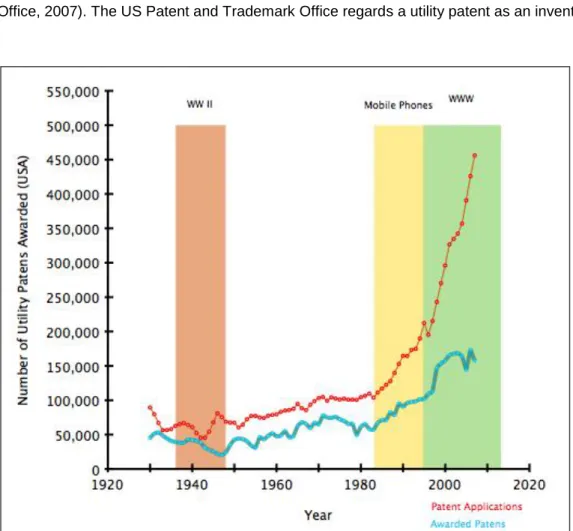
This can be deduced from Figure 9, which shows the number of utility patent registrations applied for annually, together with the actual number of utility patents awarded for the US (US Patent and Trademark Office, 2007). The US Patent and Trademark Office regards a utility patent as an invention.
[Adopted from USPTO, 2007]
Figure 9 illustrates the tremendous increase in utility patent applications experienced since the start of the World Wide Web (WWW), as it is known today, in 1994. Although there has been a relative decrease in the number of utility patents awarded (only 49,2% of applications have been awarded on average since 1994), the influx is clearly visible.
The increase in patent applications should be viewed in relation to the increase in the availability of venture capital and the amount of capital being awarded. This increase is presented in Figure 10.
| Page 23 The definition and development of Open Innovation models
Considered in combination, the increase in invention and the amount of venture capital being issued clearly portray the level of desperation that exists on the innovation landscape. Organisations (or individuals) are willing to bet more money on acquiring the “golden deal”.
This frantic increase has a cumulative effect – forcing applicants to submit patent applicants for an ever-increasing number of inventions, while venture capitalists are also experiencing changes in their approach. They are forced to award larger quantities of capital, but do so more effectively – especially since the recent global economic meltdown.
Organisations are thus willing to invest capital in other enterprises to acquire new knowledge or skills, or to reduce the possibility of disruptive innovation that might have a detrimental effect on the organisation.
Disruptive innovation was first described by Christensen (1997), and describes the influence new technologies (or inventions) can have on a firm’s existence if this aspect is not addressed correctly.
Research and development (and innovation-process) efforts are thus forced to be more effective – to minimise the risks of wasting resources, while also continually scanning the landscape (outside the organisation) to ensure the minimisation of disruptive technologies.
These efforts will introduce a “safety barrier” around the organisation to ensure that disruptive innovations are detected before they can have a major detrimental impact on the organisation’s business. If the organisation is able to successfully collaborate with external role-players to rather include or accommodate these disruptive innovations, the impact thereof can be lessened.
Figure 2.9 – Venture capital investments
$0 $2 $4 $6 $8 $10 $12 $14 $16 1995 -1 1995 -4 1996 -3 1997 -2 1998 -1 1998 -4 1999 -3 2000 -2 2001 -1 2001 -4 2002 -3 2003 -2 2004 -1 2004 -4 2005 -3 2006 -2 2007 -1 2007 -4 A ve rag e In ve stm e n t ($b n )
Average venture capital investments (per quarter)
Average Investment Trend
| Page 24 The definition and development of Open Innovation models
The reasons mentioned above prove that the arguments presented by Chesbrough (2003) have merit, and that organisations should incorporate Open Innovation into the standard innovation process to sustain competitiveness in the future.
Knowledge and knowledge workers are becoming ever more dispersed and the availability of capital is indeed increasing, driving innovation, and the openness thereof, to new heights. Although the availability of venture capital may have decreased during the latest financial turmoil, the driving force it has created and the creativity it has spurred are still intact. Organisations are also realigning themselves to be ready and act more innovatively when economic stability is re-established.
These arguments prove that the innovation (and R&D) process needs to change. The specific needs that are identified are further discussed in the following section.
| Page 25 The definition and development of Open Innovation models
2.6 Identification of the needs for change in the innovation
process
The examples mentioned in the previous section illustrate why there is a need to increase the effectiveness of the innovation process – effectiveness in the sense of increasing the quantity of successful innovation process iterations.
Empowered individuals provide a fresh source of new opportunities and ideas, spurred on by ever-increasing quantities of venture capital. This increase in the innovation funnel’s opening will require increased accuracy in filtering and selecting potential innovation projects.
According to these arguments, together with the innovation process actions suggested by Tidd et al. (2005), these improvement efforts should be targeted towards the following:
1. Improving the effectiveness of searching. The sources scanned for new ideas should be better defined and identified, to better incorporate and identify the empowered prosumer, as well as minimise the risks of disruptive innovations to the organisation.
2. Improving the accuracy of selecting. As the number of potential role-players increases and is investigated, the factors considered in the selection process should be better defined and the accuracy of their actions increased. It is therefore important to improve the selection process used to select the projects worth continuing.
3. Improving the success rate of implementation. The acquisition, execution and sustained support of any new invention should be improved. This will only be achieved by providing a more relevant, better positioned, better marketed and better priced product.
The aforementioned requirements are depicted in Figure 11. It should be established whether Open Innovation can assist in meeting these needs: generating more ideas, improving the selection process and developing better positioned products.
| Page 26 The definition and development of Open Innovation models
If the introduction of Open Innovation can address these three key areas, it can be assumed that Open Innovation will be a beneficial addition to the innovation process.
2.7 Chapter summary
The purpose of this chapter was to provide a detailed summary of what innovation entails, and to find proof that would justify an investigation of the possibility of including Open Innovation in the standard innovation process.
It was established that innovation can be approached as a process, which needs to be managed to improve its success. The different kinds of innovation, or the intended goals that innovation can cater for, were also listed and explained (product, process and strategic levels).
Various factors have driven the development of innovation as an implementable life-cycle framework. The latest generation in this evolutionary process points towards the successful inclusion of producers/consumers (“prosumers”) in the internal innovation process. This directly relates to Open Innovation.
The arguments presented for this evolution were examined and it was established that the inclusion of Open Innovation into the standard innovation process can (and should) indeed be investigated.
Introducing Open Innovation
3
Whereas the previous chapter focused on laying the foundations for innovation and introduced the concept of address-ing innovation as a process, a specific innovation process model needs be chosen and discussed onto which to place the Open Innovation models that will be developed.
Firstly, the research in this chapter focuses on establishing why the Fugle Innovation Process Model would be a valid representation of an innovation process, then the focus moves to an elaboration of the chosen process itself.
Each of the stages of the chosen innovation process model (the Fugle model) is then described in terms of the specific activities of the various stages and their primary requirements.
| Page 28 The definition and development of Open Innovation models
3.1 Introducing
the
Fugle
Innovation
Process
Model
framework
The Fugle Innovation Process Model was developed collaboratively by the Enterprise Engineering group of the Global Competitiveness Centre (situated at the Industrial Engineering Department at Stellenbosch University), the innovation consulting organisation Indutech, as well as a number of international research partners from Europe. The Fugle model was initially published by Du Preez and Louw (2008).
The intention of the innovation process, and therefore of the Fugle model, lends itself to being an iterative, repetitive process. This means that the phases, steps or activities need not be executed only once in a sequential order; stages can be revisited in any required order. The Fugle process can therefore be described as a realistic life-cycle process, as opposed to a theoretical process, as described by Du Preez et al. (2009).
3.2 Why the Fugle model?
It should firstly be explained why the Fugle Innovation Process Model framework was selected to be used throughout this text.
Research done by Van Zyl (2006) and Van Zyl, Du Preez & Schutte (2007) resulted in a summarised view of the most prominent innovation process frameworks in the landscape, categorised according to their application types and innovation process phase presence.
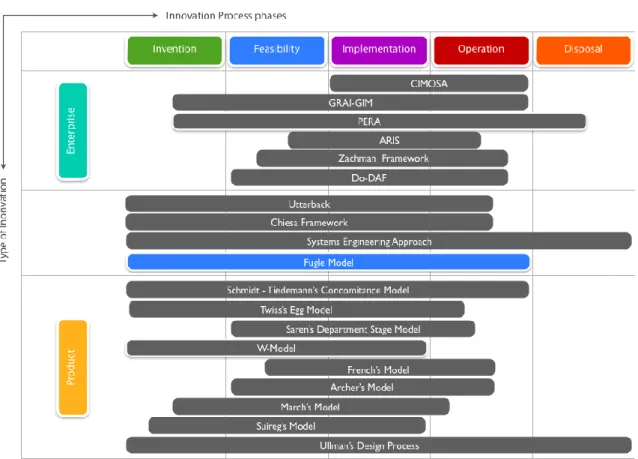
This summary was extended by Du Preez et al. (2009) to incorporate a more inclusive view of the list of models initially mentioned in the Fugle Innovation Process Model. The extended summary of the various innovation process models is depicted in Figure 12.
| Page 29 The definition and development of Open Innovation models
Figure 12 - The various innovation process models and their presence in the Life Cycle phases [Adapted from Van Zyl (2007) and Du Preez et al. (2009)]
The group of innovation process framework models situated in the middle row of Figure 12 are applicable (and usable) in a more general fashion, i.e. for product, process and enterprise innovation, as was described in section 2.2.
Since the motivation is to assess the applicability of Open Innovation to as general an innovation process as possible, a framework from the middle row (applicable to product and enterprise) should be chosen. This will ensure that the applicability of Open Innovation is investigated as generically as possible.
The same reasoning is followed with regard to the presence of the listed innovation frameworks in the different phases of the innovation process. A framework with a presence in as many of the phases as possible should be chosen to maximise the investigation of the applicability of Open Innovation.
Therefore, these selection criteria filters out the applicable innovation frameworks to leave either the Fugle model or the Systems Engineering Approach, as these frameworks have the most generic approach as well as the greatest presence throughout the different phases of the innovation process.
The Systems Engineering Approach was not chosen because of its intended goal to assist with the effective realisation of complex and successful systems. In contrast, the Fugle Innovation Process framework was specifically created to guide and manage innovation projects.
| Page 30 The definition and development of Open Innovation models
The Fugle Innovation Process framework is therefore chosen for its generic applicability to product as well as enterprise innovation, its all-round presence in the different innovation process phases, as well as its primary goal: to guide an innovation project.
3.3 The Fugle Innovation Process Model
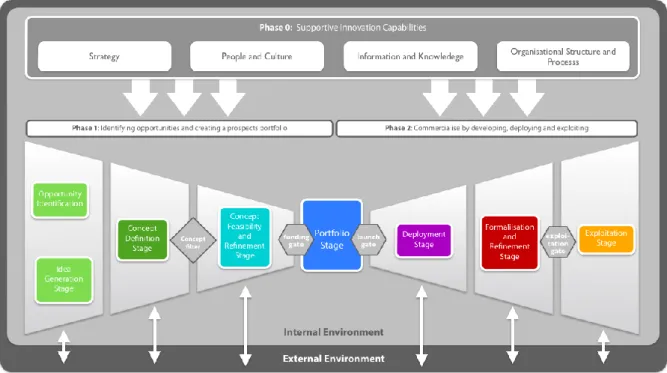
The Fugle process describes the activities associated with the “fuzzy front-end”, as well as the development and deployment activities of the second half of the innovation process. The name “Fugle” results from the concatenation of the words “funnel” – describing the first half of the process, and “bugle” – describing the second half. The two high-level phases of the model are divided by the portfolio stage, which serves as a swivel point and midway gate between the two phases.
The Fugle model is depicted in Figure 13.
Figure 13 - The Fugle Innovation Process Model
The influences of the supportive capabilities (strategy, people and culture, information and knowledge, and organisational structure and process) are also presented, as is the influence that the external environment should have. Gates and filters are found in between certain stages. These activities act as decision-making points through which the process iteration will have to pass if it were to be a successful one.
As described by Du Preez and Louw (2008), “the aim of the model is to help businesses identify, evaluate, develop, implement and exploit new products and services more efficiently and effectively within their enterprises”. The intended goal of this model relates well to the required improvements identified in section 2.6.