AN INVESTIGATION INTO THE PERCEPTIONS OF GRADE 7
LEARNERS OF THE EFFECTIVENESS OF A GUIDED READING
PROGRAMME
A minor dissertation submitted in partial fulfillment of the
requirements for the degree of Masters in Education
Presented to the Faculty of Education and Social Sciences
BY
VALERIE KOHLER
DECLARATION
I hereby declare that an investigation into the perception of Grade 7 learners of the effectiveness of a guided reading programme
is my own work and that it has not been
submitted for any degree in any other university.Signed: ……….
Valerie Kohler
ACKNOWLEDGEMENTS
I wish to thank the following individuals and organizations:
Dr Janet Condy, my supervisor, for her endless patience, guidance, constant support and selflessly sharing her knowledge with me.
Professor Rajendra Chetty, my supervisor, for his academic guidance, critical insights and continued support.
Warren Kohler, my husband, for his unconditional support and sacrifices and patience.
Ighsaan Francis, my friend, for his technical support, patience and advice.
Meggan, Matthew and Lorian, my children, for their love and understanding.
READ Educational Trust who provided the resources for the guided reading programme.
Western Cape Education Department (WCED) for granting permission to conduct the research study.
ii
ABSTRACT
Reading is a critical tool for the mastery of all learning areas and is one of the best predictors of long term learning achievement. Reading must be considered a priority area in efforts to improve the quality of basic education, particularly for learners from disadvantaged backgrounds. Many learners in South Africa come from a largely oral culture in which reading of books is not common and many come from disadvantaged communities that cannot afford to buy books.
The provincial and national systemic evaluation results (2003, 2005) for reading showed that at least 40% of Grade 3 and 6 learners were reading below grade level. In January 2005, in the present study, 50 % of the Grade 7 learners were reading below Grade 7 level. Many learners were discouraged because they could not master the reading tasks set to them. Others responded to the task with boredom and disdain. The learners who could read seem to be the only ones who were enthusiastic about starting and completing the reading tasks. By the end of the year, after using a guided reading programme, all students had developed a love for reading and many were reading on Grade 7 level.
The present empirical study is grounded in the social constructivist framework, originating from the works of Piaget (1978), Vygostky (1929) and Cambourne (2004). Their foundational principals together with the learning outcomes specified in the Revised National Curriculum Statement (2002) formed the basis of this literacy study.
A questionnaire was administered to forty-four learners at the end of a complete year where I had used the guided reading programme. The questionnaire consisted of ten closed questions and six open-ended questions. The results were analysed both quantitatively and qualitatively.
The results of this study showed that the learners responded positively to reading in groups, that learners developed an interest in reading, that they acquired reading skills that they needed to become independent readers, all of which ultimately improved their self esteem and self confidence.
iv
TABLE OF CONTENTS
ACKNOWLEDGEMENTS………i
ABSTRACT………..… ii
TABLE OF CONTENTS………..……… iv
TABLE OF FIGURES………..……… vii
TABLE OF TABLES……… viii
LIST OF ABBREVIATIONS………ix
1. INTRODUCTION... 1
1.1 Origin and background of the study ... 1
1.2 Importance of the problem ... 4
1.3 Context of the study ... 7
1.4 The approach to the study ... 8
1.5 Purose and goal of the study ... 9
1.6 Research question ... 10
1.7 Clarification of terms ... 11
1.7.1 Reading literacy ... 11
1.7.2 Phases of schooling in the South African context ... 11
1.7.3 A guided reading programme ... 11
1.7.4 Learning outcomes ... 13
1.7.5 Outcomes-based Education ... 14
1.7.6 Genre ... 14
1.8 Significance of the proposed study ... 15
1.9 Limitations of this study ... 15
1.10 Assumptions of the study ... 16
1.11 Organisation of the thesis ... 16
2. THEORETICAL FRAMEWORK AND LITERATURE REVIEW ... 18
2.1 Introduction ... 18 2.2 Theoretical framework ... 19 2.2.1 Language ... 20 2.2.2 Critical literacy... 21 2.2.3 Social learning ... 22 2.2.4 Active learning ... 23 2.2.5 Constructivism ... 24
2.3 Approaches to teaching reading ... 29
2.3.2 Phonemic Awareness ... 30
2.3.3 Decoding and comprehension ... 30
2.3.4 Shared reading ... 30
2.3.5 Guided reading ... 31
2.3.6 Group reading ... 32
2.3.7 Independent reading ... 32
2.4 Literacy themes that have arisen from this research ... 33
2.4.1 The importance of a meaning-based guided reading programme in the classroom. ... 33
2.4.2 Classroom libraries ... 34
2.4.3 Routine reading in a reading programme ... 35
2.4.4 Gender and reading ... 36
2.4.5 Reading for fun ... 37
2.4.6 Family support ... 37
2.4.7 The role of the teacher ... 38
2.4.8 Classroom management ... 39
2.5 Chapter summary ... 39
3 RESEARCH DESIGN AND METHODOLOGY ... 41
3.1 The research question ... 41
3.2 Research approach ... 41
3.2.1 Action Research ... 42
3.2.2 Questionnaires ... 43
3.2.3 Classroom observations ... 45
3.2.4 Thoroughness in approach ... 45
3.3 Methodology and design ... 46
3.3.1 Sample of this study ... 46
3.4 Data analysis of this study ... 48
3.5 Ethical considerations ... 48
3.6 Chapter summary ... 49
4 RESULTS ... 50
4.1 Introduction ... 50
4.2 Background to the analysis of the results ... 50
4.3 Findings: Answers to the four research questions ... 51
4.3.1 How did the learners receive help from their teacher or peers when reading in their groups?... 53
4.3.2 Since using the guided reading programme, how have the learners reading abilities improved? ... 56
4.3.3 Before the learners started with the reading programme, how did the learners feel about reading aloud in their groups? ... 61
4.3.4 How did the reading programme promote an interest in reading for the learners? ... 65
4.3.5 Availability and interest level of books in the classroom library ... 66
vi
4.3.7 The reading programme ... 68
4.3.8 The role of the teacher in the reading programme ... 72
4.4 Conclusion ... 73
5 DISCUSSION, RECOMMENDATIONS AND CONCLUSIONS ... 74
5.1 Introduction ... 74 5.2 Discussion ... 74 5.3 Recommendations ... 80 5.4 Conclusion ... 82 REFERENCES ... 84 APPENDICES ... 92
APPENDIX 1: AN EXPLANATION OF QUINTILE 3………..…… 91
APPENDIX 2: BASELINE ASSESSMENT FOR READING ……….……92
APPENDIX 3: LEARNER QUESTIONAIRE………. 93
APPENDIX 4: PERMISSION LETTER FROM PARENTS……… 96
APPENDIX 5: LETTER FROM WCED GRANTING PERMISSION……… 97
TABLE OF FIGURES
Figure 2.1 An overview of the component of the investigation and its conceptual framework
19
Figure 2.2 A schematic representation of Cambourne’s (1983: 33) model of learning as it applies to literacy learning
28
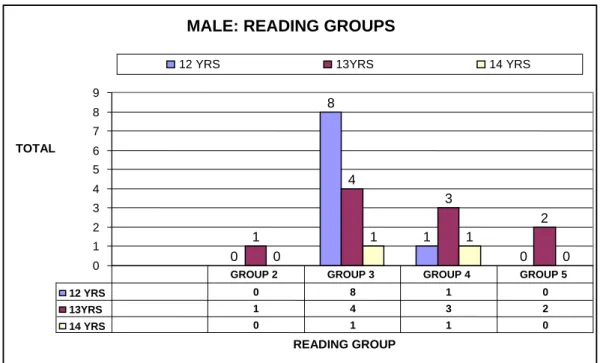
Figure 3.1 The boys in the sample 47
Figure 3.2 The girls in the sample 47
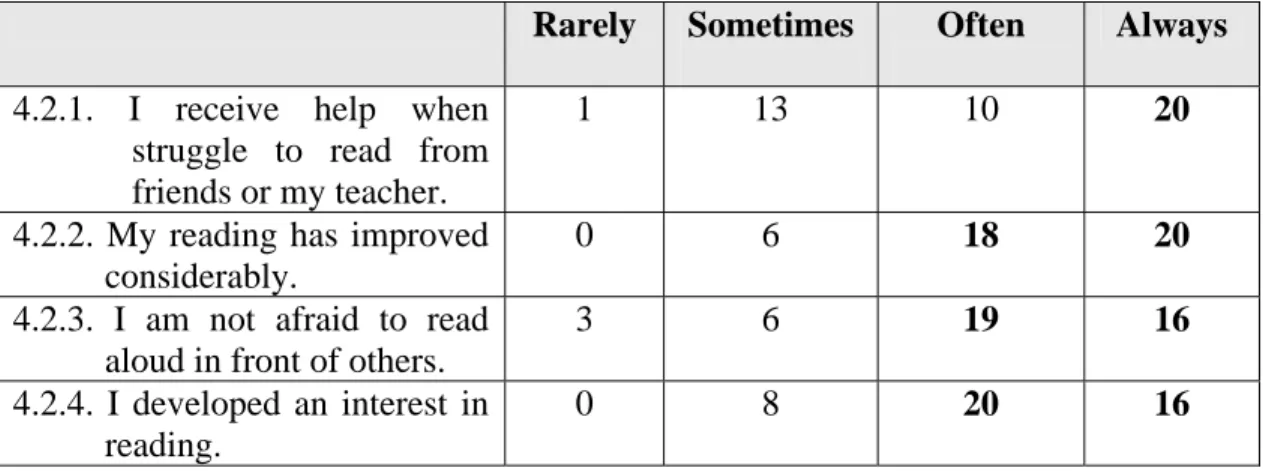
Figure 4.1 I receive help when I struggle to read from friends or my teacher
53
Figure 4.2 My reading has improved 57
Figure 4.3 I am not afraid to read aloud in front of others 63
Figure 4.4 I developed an interest in reading 65
Figure 5.1 Reading in groups has improved learners reading abilities considerably
75
Figure 5.2 Learning the meanings of unfamiliar words 76
Figure 5.3 The reading books change from easy reading to more challenging reading
77
viii
TABLE OF TABLES
Table 1.1 An overview of literacy tests conducted internationally, nationally and in the Western Cape from 2000 to 2007
5
Table 1.2 Rubric used to grade learners 12
Table 2.1 Guided reading programme 29
Table 4.1 Rubric used to grade learners 51
Table 4.2 Perceptions of the benefits of the guided reading programme by the 44 learners in the class at the end of the year
52
Table 4.3 Qualitative responses to the open-ended questions 55
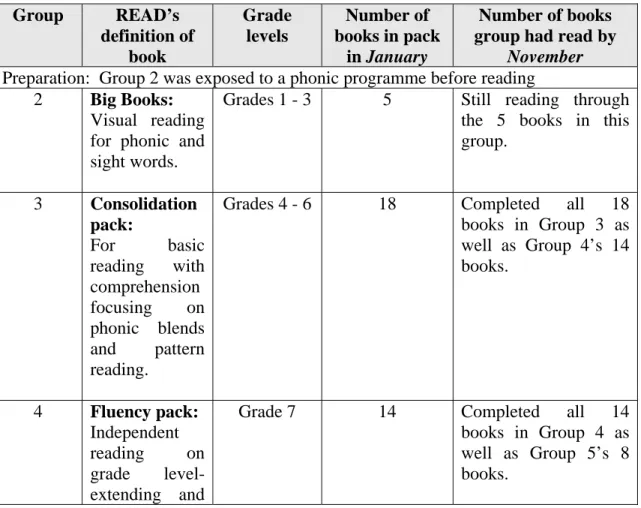
Table 4.4 The grading of the reading books and the groups at the start of the reading programme
56
Table 4.5 Chi-square test results for ‘My reading has improved considerably’ vs ‘I am not afraid to read aloud to others anymore’
59
Table 4.6 Crosstab for ‘My reading has improved considerably’ and ‘I am not afraid to read aloud to others anymore’
60
Table 4.7 My reading has improved considerably 61
Table 4.8 I am comfortable reading in my group 62
Table 4.9 The perceived benefits of the reading programme 69
Table 4.10 I have started reading on my own at home 69
Table 4.11 I have started reading on my own at school 70
Table 4.12 I like reading now more than before 71
Table 5.1 The links between the guided reading programme and the six learning outcomes of the RNCS policy document
LIST OF ABBREVIATIONS
ANC African National Congress Asymp. Sig Significance level of the test df degrees of freedom
DoE Department of Education
NAEP National Assessment of Educational Progress
No. Number
OBE Outcomes-based Education
RNCS Revised National Curriculum Statement
PIRLS Progress in International Reading Literacy Study SPSS Statistical Package for the Social Sciences
TV Television US United States
Chapter 1: Introduction 1
CHAPTER 1
1. INTRODUCTION
Many children in South Africa come from a largely oral culture in which reading of books is not common and many come from developing communities that cannot afford to buy books. Together, these factors predict that children will not get off to a good start with literacy development. The South African National Systemic Evaluation results (2001, 2003) show that 54 % of Grades 3 and 6 learners were not reading on grade level.
The present study was conducted in 2005 as a strategy to improve the literacy rates in one Grade 7 class in a developing school in the Western Cape. This study is an investigation into the perceptions of reading in a Grade 7 class consisting of forty-four learners. These learners were part of a guided reading programme for one school calendar year. The learners were asked to reflect on the effectiveness of the programme as an intervention to improve their reading ability. As part of their responses they were asked to evaluate the programme and to say whether the programme was beneficial to them or not. They expressed what they liked about the programme, whether their readingimproved and what they found challenging about the programme.
This chapter discusses the origin and the background, importance, context, approach, purpose and goals of the research project. It introduces the research question to be answered, clarification of terms, the significance, limitations and assumptions of the proposed study.
1.1 ORIGIN AND BACKGROUND OF THE STUDY
By 1994, the year of South Africa’s first democratic election,the education system was divisive, unequal and fragmented. There were eighteen different education departments (Weldon, 2005: 4) based mainly on race and ethnicity. This education system prepared
children in different ways for the positions they were expected to occupy in the social, economic and political life under the apartheid system (Prinsloo & Hanks, 2002: 21).
Since 1994, the restructuring of the education and training system has been one of the top priorities of the education authorities. The challenges that faced South Africa’s first democratically elected government led by the African National Congress (ANC), at the dawning of a democratic society were to create an educational and training system that would ensure that the human resources and potential in our society were developed to the full. It was the challenge posed by the vision of the Freedom Charter that was adopted at the Congress of the people (1955) “to open the doors of learning and culture to all”.
The vision of the new government from 1994 was therefore articulated in the new constitution (1996), the White Paper on Education and Training (1995), and the South African Schools Act (1996), which created a single, national non-discriminatory school system. It aimed to provide education of a high quality, to lay a strong foundation for developing peoples’ talents and capabilities. It hoped to democratically transform society into combating racism, sexism and all forms of discrimination and intolerance. An education system that would eradicate poverty and improve the economic well-being of society. This system would ensure the protection of our diverse cultures and languages and uphold the rights of all learners, parents and educators.
In 1996 Minister Bengu (Minister of Education) announced the launch of curriculum 2005 that marked a departure from content-based teaching and learning to Outcomes-based Education (OBE). OBE is characterised as a learner-centred approach, in which the emphasis is not what the teacher wants to achieve, but rather on what the learner should know, recognizing and building on their knowledge and experience and responding to their needs (Botha, 2002: 361-371).
This meant that curriculum development processes and delivery of learning content that was knowledge, skills, attitudes and values, should take account of the general
Chapter 1: Introduction 3 characteristics of different groups of learners. Different learning styles and rates of learning needed to be acknowledged and accommodated in the learning situation. Gultig et al. (2004:4) maintained that “learner-centredness should begin by providing learners with positive learning experiences, by affirming their worth and demonstrating respect for their various languages, cultures and personal circumstances, this is a prerequisite for all forms of learning and development”. This rationale was captured in the overview document of the (RNCS) Revised National Curriculum Statement (2002:1) which was a policy document that provided the framework for South Africa’s adoption of an outcomes-based curriculum that was written by South Africans.
The curriculum aims to develop the full potential of each leaner as a citizen of a democratic South Africa. It seeks to create lifelong learners who are confident and independent, literate, numerate and multi-skilled. Learners must develop the ability to work co-operatively as well as independently. Learners must be encouraged to reflect on their own progress and develop skills and strategies that would improve their learning performance when necessary.
The kind of teacher that is envisaged to teach within this new system, are teachers that are qualified, competent, dedicated and caring. Teachers who could be mediators of learning, interpreters and designers of learning programmes and materials, leaders administrators and managers, scholars, researchers and lifelong learners, community members, citizens and pastors, assessors and learning area/phase specialist (RNCS, 2002: 3).
Teachers play a central role in the process of improving learner performance. The teacher had to become the facilitator of learning and had to take into account the diversity of personalities in the classroom and the different styles of learning among learners. Each learner must be treated as an individual within the collective of the classroom to achieve the learning outcomes as prescribed by the RNCS policy document.
This RNCS curriculum (2002: 8) aims to develop the full potential of each learner. It seeks to create lifelong learners who are confident and independent, literate, numerate and multi-skilled, who have the ability to participate in society as critical and active citizens.
1.2 IMPORTANCE OF THE PROBLEM
Literacy development had always been a central concern of schooling. So important was learning to read that Boyer (1995: 69) contended that the success of a primary school is judged by its learners’ proficiency to read. He suggested that speaking and listening came first but reading was the top priority in primary school education.
South Africa is one of the counties that conduct national and provincial reading assessments (systemic evaluation) to determine the levels at which the learners are performing. Given stark realities of unequal education provision and huge differences in learner achievement according to race, socio-economic status and geographic locations, the country has embarked on a transitional process to equalise educational provisioning and to eradicate educational inequalities (National Grade 6 Systemic Evaluation Report, 2005).
In an open letter from the National Department of Education to all primary school principals Tyobeka (2006) wrote:
Reading is a foundational skill that all children need if they are to succeed in life. Sadly all our assessments of how well our children read reveal that a shockingly high number cannot read at the appropriate grade and age level. Many cannot simply read at all.
Pandor (2004) commented that there have been a number of studies both nationally and provincially, all of which point to unacceptable low levels of literacy amongst our learners. Table 1.1 below highlights the continued low literacy rates internationally, nationally and in the Western Cape from 2000 to 2007.
Chapter 1: Introduction 5
Table 1.1 An overview of literacy tests conducted internationally, nationally and in the Western Cape from 2000 to 2007
YEAR DEPARTMENT STUDY/TESTS GRADE RESULTS
2000 Western Cape Education Department Western Cape Education Department’s Monitoring Learning Achievement Project
Grade 4 60, 6% of all Grade 4 learners in the Western Cape obtained 50% in reading and writing literacy tasks. 2001 National Department of Education National Systemic Evaluation
Grade 3 54% of Grade 3 learners were able to work on Grade 3 literacy level. 2002 Western Cape
Education Department
Systemic Evaluation
Grade 3 43% of Grade 3 learners achieved 50% on their literacy tasks. This report also stated that the average level of the parent’s education in the Western Cape lay between Grades 9 and 10. 2003 National Department of Education National Systemic Evaluation
Grade 6 The report highlighted the inadequate language skills of learners throughout the country. The national average scores achieved in the random 5% sample were: literacy, 54%; listening comprehension, 68%; reading and writing, 39%. Learners generally performed poorly in tasks that required them to write their own responses.
2004 Western Cape Education Department
Systemic Evaluation
Grade 3 39.5 % of Grade 3 learners were able to work on Grade 3 literacy level. 2005 National Department of Education National Systemic Evaluation
Grade 6 42,1 % of all Grade 6 learners are working and achieving on grade literacy level.
YEAR DEPARTMENT STUDY/TESTS GRADE RESULTS
Education Department
Evaluation literacy had improved from
39.5 % in 2004 to 47, 7 %. There was still more than half of Grade 3 learners who were not able to read on Grade 3 literacy level. 2007 International study International Reading Literacy Study (PIRLS) Grades 4 and 5
The (PIRLS) Report summarised the findings from South Africa’s participation in the PIRLS study. The study assessed the reading skills of Grades 4 and 5 learners. A total of 40 countries and 45 education departments participated. South Africa achieved the lowest score of all 45 education systems.
In 2006 the Western Cape Education Department (WCED) developed a ten-year literacy and numeracy strategy (2006 - 2016) in response to the low literacy rates in the WCED. The literacy aspect of this strategy has eight domains for intervention:
1. a pre-school programme which will include the developing and printing of a manual for parents on the development of emergent literacy skills,
2. teacher development intended to improve the competency of teachers and teacher assistants to ensure the successful teaching of language and reading;
3. changes to classroom practice that will focus on classroom practice and the way teaching and learning happens in the classroom. Teachers will receive the necessary support to address the critical aspects of class teaching;
4. learning and teaching support material must be selected in conjunction with the teachers’ strategy and methodology for teaching literacy in the classroom. Reading material must be at an appropriate level for each individual learner in the class;
Chapter 1: Introduction 7
5. research, monitoring and support will encourage the establishment of monitoring and support committees at the school, district and provincial level;
6. co-ordination and sustainability provided by a provincial task team will be appointed to manage the roll out of the strategy. All stakeholders will be accountable to report on the support of the policy at their different levels.
7. family and community literacy personnel will be trained so that the whole community is involved in encouraging reading;and
8. advocacy will be done by means of the print and radio media to create an awareness of the literacy strategy and to promote reading in our communities.
1.3 CONTEXT OF THE STUDY
The school that was used for this study is located in a low-income area in Mitchell’s Plain on the Cape Flats. The language of these learners was complex - forty of them came from a background where parents spoke predominantly a dialect of Afrikaans and English commonly found in this area. Four learners were from IsiXhosa first language homes where they spoke a mixture of IsiXhosa, Afrikaans and English.
Sixty percent of the learners were bussed to school from surrounding informal settlements. The rest of the learners lived nearby and could walk to school.
This school falls within quintile 3 as described in Appendix 1 on page 92, which is regarded as a developing school. The learners at the school are fed daily by the Provincial Feeding Scheme which is a Department of Education (DoE) initiative that supports the learning programme in the school.
Since I was the class teacher this meant that I taught all the learning areas in the same class. This gave me a good indication of how the learners were coping with the volume of reading materials presented to them every day for seven hours.
Despite the many reading levels in the class, there were other socio-economic issues that impeded my task as a reading teacher. The lack of reading materials in the classroom created a challenge for me to enhance and encourage reading. There were no intervention programmes at the school for the Grade 7 learners, neither was there support within the school structure from the district offices of the WCED. Intervention was the sole responsibility of the language teachers. In my case, as the class as well as the language teacher, it was my responsibility to do the intervention. Since there were four different reading levels in the class, I decided to teach reading to the learners by dividing the class into four groups with each group consisting of same-ability learners and doing a variety of different reading skills.
1.4 THE APPROACH TO THE STUDY
As mentioned earlier, the national and provincial systemic evaluations conducted between 2000 and 2006 indicated that learners in general, were reading well below grade level. These tests were carried out amongst Foundation Phase (Grade 3) and Intermediate Phase (Grade 6) learners. Traditionally, teaching reading skills, assessing the reading levels of learners and having intervention programmes has always been part of the teaching and learning programme in the Foundation Phase. Other than the Concentrated Language Programme (Condy2000), which was introduced to only some developing schools in the Western Cape, the WCED has not offered any intervention programmes to assist teachers in the teaching of reading in primary classrooms.
From 2003 - 2005 the WCED supplied Grades 1 to 6 classrooms with 100 storybooks. Prior to 2006, the WCED had not supplied the Senior Phase (Grades 7 - 9) with any reading support material particularly the Grade 7 classes that form part of the primary school structure.
At the Senior Phase level, the WCED had the perception that when learners entered Grade 7, they already had 6 years of schooling and therefore they should be able to read on grade level. No documented studies have been conducted either by the DoE or by
Chapter 1: Introduction 9 WCED to assess the reading levels and reading skills of learners in Grade 7. However, teachers in the Senior Phase are confronted with learners who do not read on grade level; instead they were reading two to three levels below their grade, as experienced by myself in this study.
To achieve the six learning outcomes for Home Languages as set out by the RNCS (2002) it is necessary for all the learners to read on grade level. The guided reading programme was developed to assist learners to improve their reading so that they were able to achieve the prescribed outcomes and become independent readers.
In November 2005, learners were invited to evaluate the effectiveness of this reading intervention programme by reflecting on the various aspects and to say whether their reading abilities had improved or not. Firstly learners were asked to reflect on how they felt about reading in the classroom before the programme began and then at the end of the year. This reflection was done by means of a questionnaire with open and closed questions.
1.5 PUROSE AND GOAL OF THE STUDY
In most discussions about the nature of an effective ‘reading classroom’ the teacher usually assumes a leadership role, and determines what is taught and how it is taught.
The educational roles, tasks and goals of any literacy teacher includes the provision of an environment in which the learners can develop the competencies necessary for effective basic literacy, as well as teachers’ classroom development of functional literacy practices (Condy, 2006: 13).
The purpose of this study is therefore to share one teacher’s experiences on how developing an intervention programme, tailored to the needs of her learners, assisted her learners. Allington & McGill-Frazen (2003) argue that what is needed is supplemental, high quality instruction to accelerate reading development of learners reading below grade level. Low achieving readers need more time than they typically
receive toengage in actual reading and to participate in reading lessons focussing on connected texts.
Therefore the chief purpose of this research is to gather feedback data from the learners who were part of the guided reading programme; to have the data analysed and to evaluate the reading programme and to see how it benefited the learners.
1.6 RESEARCH QUESTION
The key question in this study is as follows:
What are the perceptions of Grade 7 learners of the effectiveness of a guided reading programme?
In an attempt to do so, this investigation will seek answers to four sub-questions:
How did the learners receive help from their teacher or peers when reading in their groups?
Since using the guided reading programme, how have the learners’ reading abilities improved?
Before the learners started with the reading programme, how did the learners feel about reading aloud in their groups?
How did the reading programme promote an interest in reading for the learners?
Chapter 1: Introduction 11
1.7 CLARIFICATION OF TERMS
1.7.1 Reading literacy
Mullis et al. (2006: 36) in the Progress in International Reading Literacy Study (PIRLS) defined reading literacy as:
the ability to understand and use those written language forms required by society and/or valued by the individual. Young readers can construct meaning from a variety of texts. They read to learn, to participate in communities of readers in school and everyday life, and for enjoyment.
Flanagan (2003: 3) defined reading as not just being able to identify the words or make the sounds. Reading is about being able to understand the text, the story, the article or whatever else it is that the learners are reading, as a whole. Reading is about being able to critically understand what has been written. So reading for meaning must come right from the start of learning to read, as it is essential to the reading process.
1.7.2 Phases of schooling in the South African context
The Foundation Phase consists of Grades R, 1, 2 and 3. The Intermediate Phase consists of Grades 4, 5 and 6 and the Senior Phase consists of Grades 7, 8 and 9.
1.7.3 A guided reading programme
The guided reading programme aims to personalise reading instruction where the teacher learns to know the reading level of each individual learner in the class. The various aspects of the programme will be defined under the following three headings, baseline assessment, guided reading programme and learning outcomes:
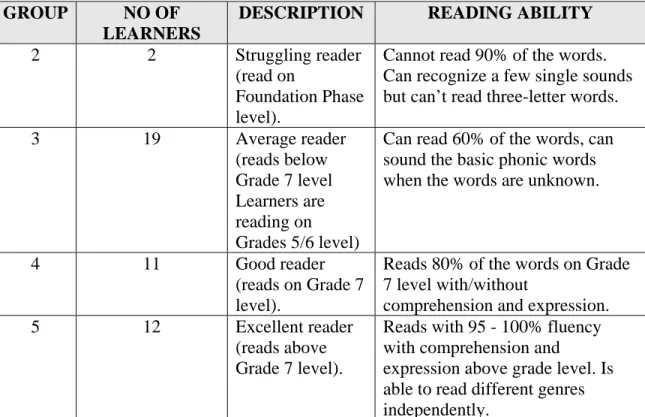
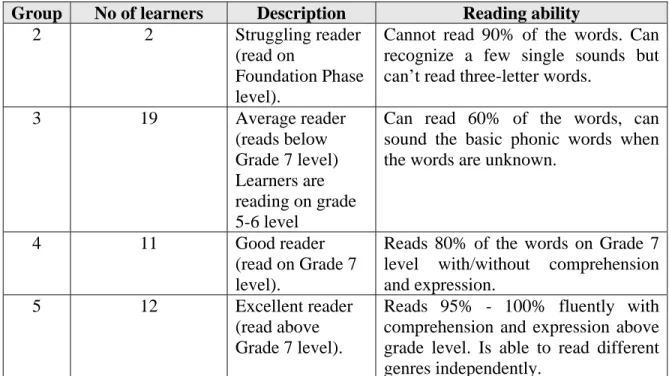
Baseline assessment: I graded the learners’ reading ability by doing a baseline assessment (Appendix 2 on page 93). Based on the results of the baseline assessment, the learners were placed in same-ability groups as described in Table 1.2. When I gave each reading group a number, I started at number 2. There were two reasons for doing
this. Firstly I wanted to develop the self-esteem of the learners and secondly, there was no-one in the class that had no skills at all!
Table 1.2 Rubric used to grade learners
GROUP NO OF
LEARNERS
DESCRIPTION READING ABILITY
2 2 Struggling reader
(read on
Foundation Phase level).
Cannot read 90% of the words. Can recognize a few single sounds but can’t read three-letter words.
3 19 Average reader (reads below Grade 7 level Learners are reading on Grades 5/6 level)
Can read 60% of the words, can sound the basic phonic words when the words are unknown.
4 11 Good reader
(reads on Grade 7 level).
Reads 80% of the words on Grade 7 level with/without
comprehension and expression.
5 12 Excellent reader
(reads above Grade 7 level).
Reads with 95 - 100% fluency with comprehension and
expression above grade level. Is able to read different genres independently.
The reading materials that were used in the programme, were also graded from easy-to-read texts to more challenging texts. Learners were given the opportunity to easy-to-read material that was targeted at their personal level of reading. As the learners’ reading improved they progressed to reading texts that were more challenging.
Guided reading programme:
Fountas & Pinnel (1996:189 -193) state that guided reading isa teaching approach that is designed to help individual learners to process a variety of challenging texts with understanding and eventually with fluency. Guided reading occurs in a small group setting. Learners are grouped with learners who are similar in ability, needs and strengths. Instruction is finely tuned to the needs of the particular group thus giving learners the opportunity to read at their personal level of development.
Chapter 1: Introduction 13 According to Tyner (2004:7), by differentiating the stages of reading instruction through small flexible groups, the diverse needs of each group are met. Good reading instruction includes a combination of strategies to teach learners to read.
This study used the rationale as outlined by Millward (2007) for guided reading. He states that reading in groups allows learners to:
discuss and explore text meanings with their peers;
develops learner’s listening, speaking and reading skills;
practice reading aloudto the group and to the teacher;
develop reading skills through practice; and
develop the ability to co-operate and work together in a group.
1.7.4 Learning outcomes
The six learning outcomes for the English Home language learning area in the RNCS (2002: 6-7) Grades R to 9 policy documents are described below. A central principle of the Languages learning area Statement is the integration of the six outcomes in teaching and assessment.
Learning Outcome 1:Listening
The learner will be able to listen for information and enjoyment and respond critically in a wide range of situations;
Learning Outcome 2: Speaking
The learner will be able to communicate confidently and effectively in a spoken language in a wide range of situations;
Learning Outcome 3: Reading and viewing
The learner will be able to read and view for information and enjoyment and respond critically to the effective, cultural and emotional values in the text;
Learning Outcome 4: Writing
The learner will be able to write different kinds of factual and imaginative texts for a wide range of purposes.
Learning Outcome 5: Thinking and reasoning
The learner will be able to use language to think and reason as well as to access, process and use information for learning; and
Learning Outcome 6:
The learner will be able to know and be able to use sounds, words and grammar of the language to create and interpret texts.
1.7.5 Outcomes-based Education
(OBE) Outcomes-based Education forms the foundation of the curriculum in South Africa. It strives to enable all learners to achieve their maximum ability. It does this by setting the outcomes to be achieved at the end of the process. The outcomes encourage a learner-centred and activity-based approach to education (RNCS, 2002:1).
OBE, according to van der Hoorst & McDonald (2005), is based on the following underlying beliefs:
all individual learners must be allowed to learn to their full potential;
every success that a learner experiences builds his or her self-esteem and this is motivation for further success. Positive and ongoing assessment is therefore essential; and
the learning environment is responsible for creating and controlling the conditions under which learners can succeed.
1.7.6 Genre
The word “genre” originated from the French (and originally Latin) that means ‘kind’ or ‘class’. A genre is a category of artistic composition marked by a distinctive style, form or content (Picket, 2003).
Chapter 1: Introduction 15
1.8 SIGNIFICANCE OF THE PROPOSED STUDY
The assumption is that when learners arrive in the Senior Phase they should be reading fluently on grade level. In reality this is not the case, as one can see by the discussion in Table 1.1. Therefore it is to be understood that there would be learners in Grade 7 who were struggling to read on grade level.
In a Grade 7 class, the teaching of basic reading skills is not part of their work plan. Reading in Grade 7 takes the form of literature studies; where the class is expected to read and critique novels that are written for that specific grade.
The present study evolved out of the concerns for my class where there were more learners reading below Grade 7 level, with few learners reading on Grade 7 level and even fewer reading above grade level. The learners in this study were last taught basic reading skills in Grade 3 when they were taught how to read in groups. In Grades 4 - 6 they did not read in groups and only had one reading period for the week as stipulated on the class timetable. This reading period took the form of whole-class reading when the entire class read from the same book. Individual learners were asked to read a few sentences aloud while the rest of the class was expected to follow the text and read silently to themselves.
When these learners arrived in Grade 7, I was concerned that not all the learners could read the novel that was selected for the class. I then decided to work with the learners on their individual reading levels. Since I am a trained Foundation Phase teacher I developed and implemented the guided reading programme specifically for this Grade 7 class.
1.9 LIMITATIONS OF THIS STUDY
This study is limited to one Grade 7 class from one school in the Western Cape. The programme that was implemented was designed for this classroom because I was the class teacher and taught all the Grade 7 learning areas to the same class. This study was
not extended to other classes in the school since there was only one English Grade 7 class. The study was based on a small sample and it was tightly controlled for dimensions relevant to the research intervention model used. This ensured greater explanatory power than could be revealed by a larger sample, although the later would have been useful for generalisability. The view that research which is not based on large quantitative sample surveys, is insufficiently generalisable to be of value in the creation of organisational knowledge for academic purposes should be challenged (Chetty, 2007: 103).
1.10 ASSUMPTIONS OF THE STUDY
The study makes the reasonable assumption that most of the learners coming to Grade 7 could not read at the appropriate grade level. It assumed that most of these learners needed extra basic reading skills to be able to interact and answer questions on their textbooks at grade level.
It was assumed that there were sufficient reading books at different reading levels for the learners. The study also assumed that many of the learners did not come from literate backgrounds where families read on a regular basis.
The study assumed that the learner’s participated voluntarily with goodwill during the reading lessons.
1.11 ORGANISATION OF THE THESIS
Chapter 1 is the introductory chapter, the research problem has been formulated, and its settings, origin and background, importance, context, approach and purpose stated. The key terms have been clarified; significance for conducting the study, limitations and assumptions of the research has been given.
Chapter 2 presents the relevant literature review with regards to language theories, the approaches to reading, the guided reading programme and the reading practitioners.
Chapter 1: Introduction 17
Chapter 3 outlines the action research approach used, a questionnaire was used. A questionnaire was used as the instrument of measurement, design and implementation of the research process. The sample size was forty-four Grade 7 learners in one class in the Western Cape.
Chapter 4 presents the results and systematically discusses the findings of the four research questions.
Chapter 5 discusses the results, draws conclusions, makes recommendations and discusses the limitations.
CHAPTER 2
2. THEORETICAL FRAMEWORK AND LITERATURE REVIEW
2.1 INTRODUCTION
The purpose of this chapter is to review published literature on the pedagogy of reading, it explores the threads of reading skills and the different methodologies used to teach reading. This chapter further defines the ideal classroom structure that learners need in order to learn to read in groups.
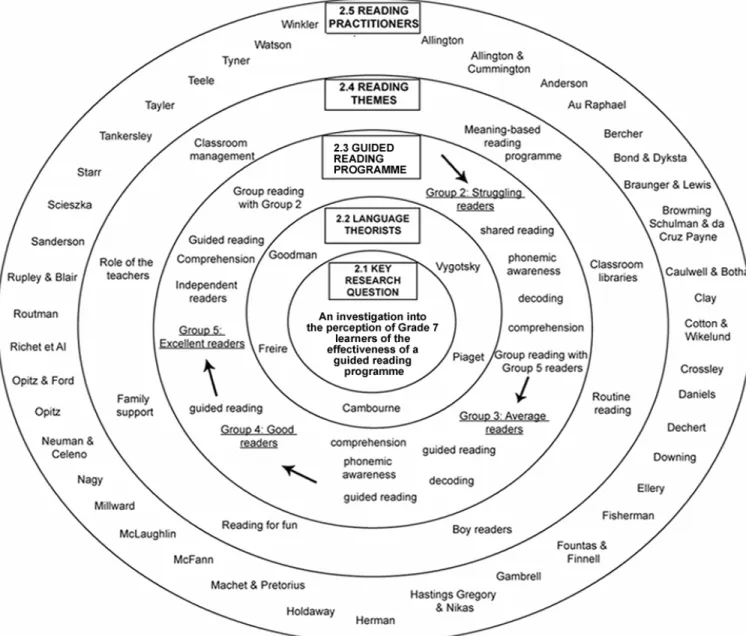
The model presented in Figure 2.1 on page 19 adapted from Condy (2006: 32) summarises the theoretical frameworks used to clarify the processes that are expected to result in learners being able to read in groups using a guided reading system.
Chapter 2: Theoretical framework and Literature review 19
Figure 2.1: An overview of the component of the investigation and its conceptual framework
2.2 THEORETICAL FRAMEWORK
Educational constructivism can be divided into personal and social constructivism. In personal constructivism it is the individual learner constructing cognitive and memory structures. Social constructivism involves a group of learners constructing cognitive and memory structures (Scheepers, 2000:3).
Constructivists like Cambourne (1995), Piaget (1978), and Vygotsky (1978) viewed learning as an active process in which learners construct knowledge as they try to comprehend their world through language development. The literature review was underpinned by the above theorists within the following key themes of this study: 1) language 2) critical literacy 3) social learning 4) active learning and 5) constructivism.
2.2.1 Language
Goodman (2005: 6) stated that language should be whole, meaningful and relevant to the learners. The teacher should encourage the learners to talk about the issues that they need to understand, to show the learners that it’s permissible to ask questions and to listen to answers, and then react and ask more questions. It is recommended (Goodman, 2005: 9) that teachers invite their learners to write what happens to them, so they can come to grips with their experiences and share them with others. According to the South African Revised National Curriculum Statement (RNCS) policy (2002:10) the Languages Curriculum recognised that learners begin to develop language knowledge from the moment they are exposed to reading and writing at home, in the environment around them and during their pre-school years. It is necessary to make the classroom an environment that encourages learners to become skilled readers and writers.
The learners should be encouraged to read for information, to cope with print that surrounds them everywhere and to enjoy a good story. Goodman (2005:6) argued that Whole Language programmes get it all together: the language, the culture, the community, the learner and the teacher. Shor & Pari (1999:1) agree that literacy is understood as a social action through language that develops the learner inside a larger culture, while critical literacy is understood as “learning to read and write as part of the process of becoming conscious of one’s experience as historically constructed within specific power relations”.
Chapter 2: Theoretical framework and Literature review 21
2.2.2 Critical literacy
Critical literacy is a means of empowering unempowered populations. Freire (1972: 55) defines critical literacy as “education as the practice of freedom as opposed to education as the practice of dominion”. Freire (1972:31) believed that the approach to critical literacy emphasized aspects like dialogue which encouraged people to work with each other in a cooperative way that would include respect and praxis which is an informed action that can be seen as enhancing the community so that learning and social change can takes place within the community. Critical literacy encouraged readers to make meaning of texts and it encouraged learners to understand how texts can influence their manner of thinking. Anderson & Irvine (in Shor & Pari, 1999: 1) confirmed the view that critical literacy is understood as “learning to read and write as part of the process of becoming conscious of one’s experience as historically constructed within specific power relations”.
Shor & Pari (1999: 1) viewed critical literacy as words rethinking worlds, self dissenting in society where literacy connects the personal with the political, and the economical with the pedagogical for rethinking our lives for promoting equality in a place of inequality. Under apartheid, Prinsloo & Janks (2002: 21) concluded that the education system prepared learners differently for the positions they were expected to occupy in social, economical and political life. The curriculum under apartheid played a powerful role in reinforcing inequality. The constitution of South Africa, (Act No 108 of 1996) provided the bases for curriculum transformation and development. The aims of the constitution are: “To heal the divisions of the past and establish a society based on democratic values, social justice and fundamental human rights” (Act 108 of 1996: 1). According to Ciardello (2004:143) the recognition of social barriers and borders of separation is a major critical literacy practice. Barriers and borders establish boundaries and foster exclusion as the learners in this sample have experienced. It is through crossing these borders of separation that learners can regain their sense of self worth as a learner and a reader. Ciardello (2004: 138) stated that critical literacy practices are literacy activities that help enlighten the learner about the multiple meanings of the text.
According to the RNCS policy document (2002: 8-9) language is an important tool for achieving human rights and social justices. In this curriculum a balanced approach to literacy development has been used. It involves reading and writing and it gives attention to the learning of phonics. Learners should become confident speakers, who have critical tools to read their world and the written texts and rewrite them in ways that expand possibilities in relation to human rights, environmental justice and social learning.
2.2.3 Social learning
Social learning focuses on the learning that occurs within a social context. It considers that people learn from each other (Ormrod, 1999). According to Wadsworth (1989: 156) Piaget’s theory on how knowledge is acquired is that children construct knowledge from their actions on the environment. Learners’ through their social interactions also construct knowledge. For Dewey (in Shor and Par, 1999: 9) language is used as a social activity where theory and experience meet for the discovery of meaning and purpose.
Piaget (in Wadsworth, 1989: 153) believes that learners who achieve certain knowledge through free investigation and spontaneous effort will later be able to retain it; they will have acquired a methodology for life. Learners however can be expected to differ in their histories of maturation, experiences, social experiences and social interaction. The learner’s history of social interactions contributes to individual differences. Cambourne (2004: 25) argues that the primary mechanism available for the learners to develop their individual understandings and knowledge is through social interactions. In the classroom the use of collaborative groups is one of the most potent forms of this mechanism because such groups provide the medium for learners to interact with other learners, testing their own understanding through listening to and reflecting on about the understandings of others (Fisher & Williams, 2006: 10).
Taking the human social context into consideration, Vygotsky (in Lee & Smagorinsky, 2000: 194) highlights the significance of this element in teaching and learning when he used the term ‘zone of proximal development’. Hedefined it as the distance between the actual developmental level as determined by independent problem solving and the level
Chapter 2: Theoretical framework and Literature review 23 of potential development as determined through problem solving under the teacher or in collaboration with more capable peers. Teachers should assist learners not to become passive recipients of knowledge but to make meaning of the actual learning material by actively participating in the learning processes. Constructivist theories emphasize the activities of both learners and teachers in the classroom as they construct and reconstruct knowledge (Cambourne, 2004: 25).
Vygotsky (in Dixon-Krauss, 1996: 20) maintains that in school instruction, the role of the teacher is to mediate shared meanings between learner and text. The teacher does not simply pass text meaning onto the learners instead the teacher provides support for the learners within the zone of proximal development as they collectively build bridges of understandings through social interaction. While the teacher is interacting with the learners, the teacher continually analyses what strategies the learners are using to solve problems and to construct meaning. Cambourne (in Braunger & Lewis, 2006: 72) describes engagement in the reading task as key to successfully learning to read and develop as a reader. There are four essential elements of engagement in learning: learners must see themselves as potential ‘doers’ as must those around them; learners must see learning as personally meaningful; learners perceive learning as a low risk and learners must have an opportunity to bond with other ‘doers’. The knowledge and understanding learners construct in any instructional setting are critically dependent on the learners’ degree of engagement with the demonstrations of literacy. Pang & Sablan (in Lee & Smagorinsky, 2000: 229) noted that Vygotsky states that teachers with high efficacy believed that all learners can be motivated and that it was their responsibility to explore with learners the tasks that will hold their attention in the active learning process.
2.2.4 Active learning
Active learning according to Zuckerman (2003: 177) is the term that refers to a diverse set of educational practices that are consistent with the constructivist theories. There are many different theoretical approaches within constructivism like Cambourne, Piaget and Vygotysky respectively. Yet they share the same basic assumption about learning, namely that it is constructed by learners in the course of both individually-motivated and
socially-motivated activities. Meyers & Jones (1993: xii) agree that it is in the classroom where active learning strategies are used, teaching and learning are more collaborative. The teacher ceases to be the centre of attention and traditionally passive learners are encouraged to participate in the learning process.
Cambourne (2004: 25) concluded that potential learners must first engage with the demonstrations that immersion provides. Engagement incorporates a range of different behaviours which include overtones of attention to see if the learners are free from anxiety and if they know that there is a purpose to their learning. Engagement also depends on active participation and if they know they are capable of achieving the outcomes. Learners can only actively participate if they are willing to try. Learning is unlikely if learners do not attend to demonstrations in which they are immersed. Sheehy (2002: 278) questions the literacy routines in the classrooms where learners are reluctant to participate in the learning process and states that we need to look at classroom literacy practices so that learners can participate in the literacy activity. To encourage the learners to socially participate in the classroom, teachers should engage with the concept learning as a form of social constructivism.
2.2.5 Constructivism
Cambourne (2004: 25) maintains that:
There is nothing so, practical as a good theory and there is nothing so theoretically interesting as good practice.
Constructivism, according to Cambourne (2004: 25) is a set of core assumptions about learners and their learning process. He expresses them as three separate but overlapping propositions:
a) what is learned cannot be separated from the context in which it is learned;
b) the purposes and goals that the learner brings to the learning situation are central to what is learned; and
c) knowledge and meaning are socially constructed through the process of negotiation, evaluation and transformation.
Chapter 2: Theoretical framework and Literature review 25 These three core propositions will be discussed in more detail below:
a. What is learned cannot be separated from the context in which it is learned.
Cambourne (2004: 25) explains that we cannot talk about what is learned separately to how it is learned - a variety of experiences all lead to the same understanding. When reading is taught, the ends of the reading instruction are very much determined by the methods used to teach it. The experiences and contexts in which learning to read is embedded will be critical to each learner’s understanding of, and ability to use reading. For example, if learners are taught that there is only one ‘correct’ interpretation of, or a ‘correct’ response to a text, these learners will become readers who more readily accept and comply with seemingly ‘authoritative’ or ‘persuasive’ reading texts than readers who are prepared to critique, contest, or question such texts.
Cambourne (20004: 27) declared that it could also mean that learners who are in classrooms where the emphasis is on oral reading, fluency and expression, will understand and use reading quite differently from those who are taught to read in ways that emphasize the construction of meaning from texts.
b. The purposes and goals that the learner brings to the learning situation are central to what is learned
Piaget (in Ginsburg and Opper, 1988: 236) continually stressed the learner’s contribution to the developmental or learning process. It is the learner who tries to solve the problem using already available structures and it is the learner who feels a subjective lack of certainty about his or her solution. The learners do not simply react to external events, but takes an active part in their own development or learning.
Vygotsky (in Zuckerman, 2003: 196) maintains that it is the learner who sets the goals, searches for the means and methods to achieve them, and engages in self control and self evaluation of the achievements that results. At the very onset of formal education, it is the
teacher who structures the conditions for the child’s actions and also designs situations that elicit the learner’s thinking and reasoning skills. Later on, the learners themselves will change the conditions to suit the learning activity and seek new ways of interacting with the learning material. A learner who recognizes the limits of his/her capabilities will ask the teacher for assistance and together they will work at the task.
c. Knowledge and meaning are socially constructed through the process of negotiation, evaluation and transformation
Cambourne (2004: 25) notes that theoretical assumptions that underpin constructivism happens when teachers assist learners not to become passive recipients of knowledge but to make meaning of their actual learning material by actively participating in their learning processes. Constructivist theories emphasize the activities of both learners and teachers in the classroom as they construct and reconstruct knowledge. Cambourne (2004: 25) argued that the primary mechanism available for the learners to develop their individual understandings and knowledge is through social interactions. In the classroom the use of collaborative groups is one the most potent forms of this mechanism because such groups provide the medium for learners to interact with other learners, testing their own understanding through listening to and reflecting about the understandings of others.
Vygotsky (in Dixon-Kraus, 1996: 20) states that in school instruction, the role of the teacher is to mediate shared meanings between learner and text. The teacher does not simply pass text meaning onto the learner instead the teacher provides learning support for the learners within the zone of proximal development as they collectively build bridges of understandings through social interaction. While the teacher is interacting with the learners, the teacher continually analyses what strategies the learners are using to solve problems and construct meaning.
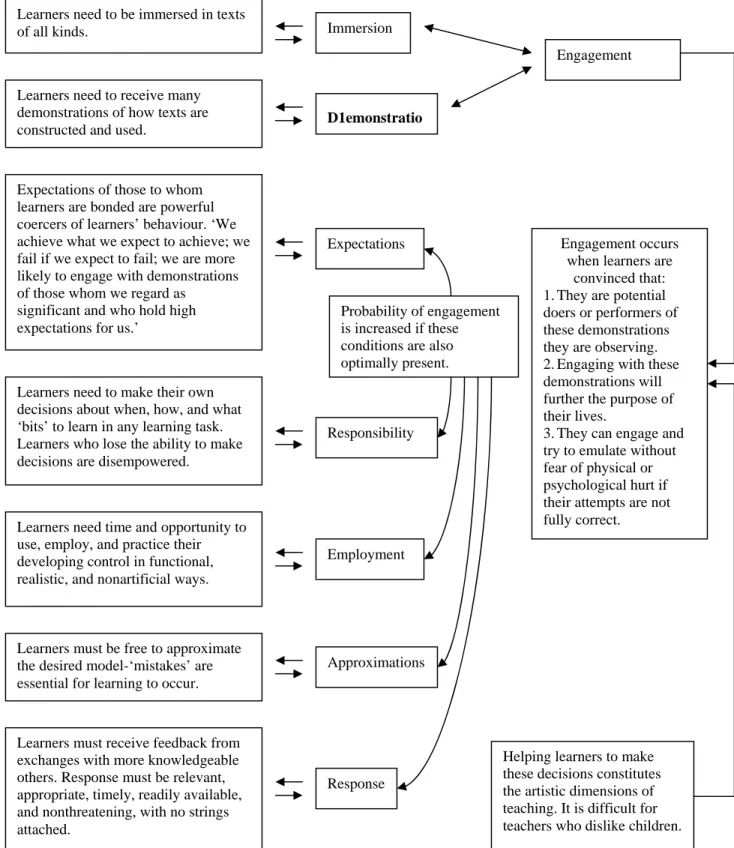
Cambourne’s (1988: 33) conditions for learning is an important task for teachers is creating conditions under which literacy learning activities makes sense for the learners. Cambourne (1988, 1995) developed a schematic representation of his theory as it applies
Chapter 2: Theoretical framework and Literature review 27 to literacy learning. This representation is presented in Figure 2.2 on page 28. He conveys the meaning that the notion that ‘conditions for learning’ are particular states of being such as doing, behaving and creating. Inclusive are a set of conditions that co-occur and both affect and are affected by each other, together allowing language to be learned.
According to Cambourne (1988,1995) conditions for learning are favourable when the teacher looks at the ‘principles of engagement’ that may be formulated as follows: learners are more likely to engage deeply with demonstrations if they believe that they are capable of ultimately learning or doing whatever is being demonstrated; if they believe that whatever is being demonstrated has some potential value, purpose and use for them; if they are free from anxiety and if the demonstrations are given by someone they respect, trust, admire and would like to emulate.
Figure 2.2: A schematic representation of Cambourne’s (1988: 33) model of learning as it applies to literacy learning
Learners need to be immersed in texts of all kinds.
Learners need to receive many demonstrations of how texts are constructed and used.
Expectations of those to whom learners are bonded are powerful coercers of learners’ behaviour. ‘We achieve what we expect to achieve; we fail if we expect to fail; we are more likely to engage with demonstrations of those whom we regard as
significant and who hold high expectations for us.’
Learners need to make their own decisions about when, how, and what ‘bits’ to learn in any learning task. Learners who lose the ability to make decisions are disempowered.
Learners need time and opportunity to use, employ, and practice their developing control in functional, realistic, and nonartificial ways.
Learners must be free to approximate the desired model-‘mistakes’ are essential for learning to occur.
Learners must receive feedback from exchanges with more knowledgeable others. Response must be relevant, appropriate, timely, readily available, and nonthreatening, with no strings attached. Immersion D1emonstratio Expectations Responsibility Employment Approximations Response Engagement Probability of engagement is increased if these conditions are also optimally present.
Engagement occurs when learners are
convinced that: 1.They are potential doers or performers of these demonstrations they are observing. 2.Engaging with these demonstrations will further the purpose of their lives.
3.They can engage and try to emulate without fear of physical or psychological hurt if their attempts are not fully correct.
Helping learners to make these decisions constitutes the artistic dimensions of teaching. It is difficult for teachers who dislike children.
Chapter 2: Theoretical framework and Literature review 29 .
2.3 APPROACHES TO TEACHING READING
A number of approaches were used in this guided reading programme to teach reading, often in one combination or another because learners use multiple and various approaches when learning to reading.
2.3.1 Guided reading programme
According to the WCED Reading Programme (2006: 8-9) at the start of the Guided Reading Programme the teacher grades the entire class into same ability reading groups by letting the learners read from a text that is specifically targeted for any relevant grade. The learners are then divided into reading groups according to Table 2.1.
Table 2.1 Guided reading programme
Group Description Approaches taught in each group
2 Struggling reader
Shared reading with teacher, group reading with group 5 learners, phonemic awareness, decoding and comprehension
3 Average reader
Guided reading, phonemic awareness, decoding and comprehension
4 Good reader Guided reading, comprehension 5 Excellent
reader
Guided reading, independent readers.
comprehension, group reading with group 2 learners
In a guided reading programme learners have an opportunity to share like reading experiences in their groups on their personal level of development in a non-threatening way. The teacher is right there with the learners, teaching them the necessary reading skills specific to the needs of each group (WCED Reading Programme 2006: 8 - 9). In the following discussion I will be referring to various sub-skills found in a guided reading programme: phonemic awareness, decoding and comprehension, shared reading, guided reading, group reading and independent reading.
2.3.2 Phonemic Awareness
Phonemic awarenessis the first thread in the tapestry of reading according to Tankersley (2003: 5) who postulates that instruction in phonemic awareness is the ability to hear and manipulate phonemes in spoken syllables and words. One of the major components that determine a learner’s readiness to learn to read is his or her understanding of how sounds work together. Learners learn that individual words are made up of phonemes that help to distinguish words from each other. According to the National Reading Panel Report (2000) the level of phonemic awareness that learners possess, when first beginning reading instruction, and their knowledge of letters are the best two predictors of how well they will learn to read during their first two years of formal reading instruction.
2.3.3 Decoding and comprehension
Caulwell & Botha (2005: 29) saw reading as comprising of two activities: decoding and comprehension. Decoding can be viewed as word recognition and knowledge of phonics, referred to as grapho-phonic knowledge. However, decoding using grapho-phonic knowledge without understanding is not reading in any meaningful sense of the term. Understanding the message or comprehension of the message is vital. Therefore decoding and comprehension, according to Machet & Pretorius (2003: 8) are equally important in the reading process and need to be focused on from the beginning. To ensure this, the learner’s syntactic, semantic and grapho-phonic knowledge needs to be built up systematically and the easiest way to do this is through stories and books. Richek et al. (2002) stated that reading is not a natural process. It takes several years and learners must persevere over a long period of time. Therefore there is no single method of teaching learners to read.
2.3.4 Shared reading
Holdaway (1997) described shared reading as: “the teacher reads and shares a book which is appealing to struggling learners”. (Routman, 2003) explained that the teacher and the learners read the text together, the teacher taking the lead and the learners following along and actively participating. This strategy involves many repeated readings of large texts, stories and poems. The title, cover of the book, and the illustrations are
Chapter 2: Theoretical framework and Literature review 31 shared and discussed with the learners before they read the book themselves. Using this methodology the learners acquire the skills of interpreting, making predictions and sequencing letters and words. The learners are encouraged to ‘echo-read’ certain parts of the book, before they were able to read on their own and placed in same ability reading groups (Botha, 2001).
2.3.5 Guided reading
Guided reading is viewed by Browning Schulman & da Cruz Payne (2000: 12) as a structured, practical way of matching reading instruction to the diverse individual readers in the classroom. Caulwell & Botha (2005: 16) indicated that during guided reading, the teacher works with a small group of same-ability learners in order to develop specific reading skills. The reading skills developed will be dictated by the needs of that particular group.
Opitz & Ford (2001: 6) believed that guided reading afforded learners more opportunities to interact with each other and the teacher. As a result of this interaction, students were more likely to understand both the text and its meaning to engage in a discussion. The teacher, according to Teele (2004: 24) scaffolds the vocabulary and the content of the text so that students can understand what they are reading.
One of the main goals of providing learners with different guided reading experiences was to show them that reading can be enjoyable and something they want to do on their own. Opitz & Ford (2001: 9) agreed that we not only teach learners to read, but to be readers. As they have success with specific texts, learners most often want to repeat the experience, which provide meaningful, purposeful practice that lead to a favourable view of reading. Tyner (2004: 65), who wrote on traditional reading instruction, often discouraged guided contextual reading until students had mastered basic alphabet and phonemic awareness skills. It was therefore important that teachers included these skills in carefully structured reading lessons for emergent readers.
2.3.6 Group reading
Group reading, is described by Millward (2007: 2) as a way of developing and improving learners’ reading skills by giving them supported practice in reading. This support is given to the learners by their peers and by the teacher.
According to Caulwell & Botha (2005: 11) group reading is a classroom reading strategy that allows learners to enjoy a more intimate contact with books while relying on peer support within a small group. During group reading, the learners work in small mixed ability groups to read books together. Individual learners take turns to read from their book. After reading, the group completed a structured activity based on the book they have read. This involved discussing the book, answering oral questions and doing some written work related to the book. By doing group work, learners have the opportunity to work together in a co-operative way. Tyner (2004: 65) implied that when doing group reading the teacher can easily assess and assist learners in acquiring the skills needed to improve reading.
2.3.7 Independent reading
Clay (1979) described independent readers as learners who pursue a larger amount of reading activity, pushing boundaries of their own skills as they try more and more material of increasing difficulty. One way to describe this independence is that the learner has learnt how to work out new words for themselves. They need less sharing and less guiding, although both types of teaching interaction are still appropriate for texts which are beyond their present level. Tyner (2004: 103) confirmed that independent readers read with speed, accuracy and proper expression. They read independently from a variety of genres and for a variety of purposes. They can quickly skim the text to retrieve information and they are able to draw conclusions in an effort to understand the text. Hastings Gregory & Nikas (2005: 81) declared that independent reading helps learners develop a sense of efficacy and nurtures a desire for reading.
Chapter 2: Theoretical framework and Literature review 33
2.4 LITERACY THEMES THAT HAVE ARISEN FROM THIS RESEARCH
This section introduces the forth ring of the framework circle – the literacy themes that have emerged from the research are: a meaning based guided reading programme, classroom libraries, routine reading, gender and reading, reading for fun, family support, the role of the teacher and classroom management. The educational reading practitioners and proponents that have been referred to in this current debate are listed alphabetically in the fifth ring depicted in Figure 2.1 on page 19.
2.4.1 The importance of a meaning-based guided reading programme in the classroom.
A comprehensive reading programmme, according to Teele (2004) must be meaning-based and provide ways for students to become engaged in the complete process of reading and writing. Readers need to have skills presented to them through different methods in order for them to understand what they are learning. In order to assist all learners in learning to read, a multifaceted, integrated approach would more effectively facilitate this process. Neuman & Celeno (in Teele, 2004) confirmed that learners who were exposed to printed materials read more and are willing to try to read more challenging work. They are able to identify words faster, which increases their vocabulary development and develops both fluency and comprehension skills more easily.
Winkler (1998: 91) extended Teele’s (2004) theory by suggesting that the class teacher set up a meaning-based graded reading programme by dividing the class into reading groups according to their reading levels. Learners can read with meaning on their personal levels of development. Beginner readers read aloud and the more advanced readers had times when they read aloud and when they read silently. Each reading session ended with a short written activity based on the reading material they have read. Learners can apply to change groups when they feel that they have mastered reading at the level of the group they have been placed in. The teacher teaches different reading skills (Tyner, 2004: 33 - 34) to different groups depending on the need of each group. In