ASSESSMENT OF KNOWLEDGE AND SKILLS (TAKS) SCORES
A Record of Study by
CATHERINE SPOTSWOOD BERKELEY-JONES
Submitted to the Office of Graduate Studies of Texas A&M University
in partial fulfillment of the requirements for the degree of DOCTOR OF EDUCATION
August 2012
ASSESSMENT OF KNOWLEDGE AND SKILLS (TAKS) SCORES
A Record of Study by
CATHERINE SPOTSWOOD BERKELEY-JONES
Submitted to the Office of Graduate Studies of Texas A&M University
in partial fulfillment of the requirements for the degree of DOCTOR OF EDUCATION
Approved by:
Chair of Committee, Virginia Collier Committee Members, Mario Torres
Alvin Larke, Jr. Lynn M. Burlbaw Head of Department, Fredrick M. Nafukho
August 2012
ABSTRACT
A Study of the Relationship Between Levels of Technology Implementation (LoTi) and Student Performance on Texas Assessment of Knowledge
and Skills (TAKS) Scores. (August 2012)
Catherine Spotswood Berkeley-Jones, B.A., Trinity University; M.Ed., Trinity University;
M.Ed., Houston Baptist University
Chair of Advisory Committee: Dr. Virginia Collier
The purpose of this study was to examine teacher Levels of Technology Implementation (LoTi) self-ratings and student Texas Assessment of Knowledge and Skills (TAKS) scores. The study assessed the relationship between LoTi ratings and TAKS scores of 6th, 7th, and 8thgrade students as reported in student records at Alamo Heights Independent School District (AHISD), San Antonio, Texas. The study
determined the degree to which teacher LoTi self-ratings were a predictor of success on student TAKS exam scores for English Language Arts and Math, as reported in student records at Alamo Heights Independent School District, San Antonio, Texas. Further, the study examined whether teacher self-reported LoTi ratings were a predictor of success on student TAKS exam scores for the variable of socioeconomic status as reported in student records at Alamo Heights Independent School District, San Antonio, Texas.
For the purpose of this study, school and student performance analysis was restricted to the Alamo Heights Junior School in the Alamo Heights Independent School District, San Antonio, Texas. The student data in the study derived from approximately 825 6th, 7th, and 8thgrade students who took the math TAKS test in 2009 and
approximately 946 6th, 7th, and 8thgrade students who took the English Language Arts (ELA) TAKS test in 2009.
The research findings for this study included:
1. In English Language Arts (ELA), a difference in achievement may be inferred between teacher LoTi levels and ELA TAKS scores.
2. In math, a difference in achievement may be inferred between teacher LoTi levels and math TAKS scores.
3. There was not a statistically significant difference between the teacher LoTi level and student mean scores on ELA TAKS for students in the low SES category.
4. There was not a statistically significant difference between the teacher LoTi level and student mean scores on math TAKS for students in the low SES category.
DEDICATION
I dedicate this work in honor of my family and in memory of my parents and brother. With heartfelt appreciation and profound love to my,
father, Charles Carter Berkeley, Jr., who was a role model for integrity and steadfast source of wise counsel; and my mother, Elsie Lunasco Berkeley, who was both gracious and graceful in her being.
brother, Norborn Carter “Skip” Berkeley, that you are at peace.
husband, Cordell – always and forever.
son, Landon Tomasson Berkeley, and daughter, Caspin Carter McCord, may you each find that which you love and inspires you to revel in the magic of every moment.
ACKNOWLEDGEMENTS
To all who had a hand in this work, on the front lines or behind the scenes, I wish to express my sincere thanks and genuine gratitude.
A special word of thanks to my advisor, Dr. Virginia Collier, for your
understanding, encouragement, and enduring patience as I found my way through many transitions. Additionally, thank you to my committee: Dr. Lynn Burlbaw, Dr. Alvin Larke, and Dr. Mario Torres. Further, I wish to acknowledge those who provided
additional guidance and support: Dr. Phil Linerode, a special debt of gratitude to you for your support and kindness throughout. A final thank you to the LoTi crew. To Joyce, I promise no more emails, phone calls, or questions.
TABLE OF CONTENTS
Page
ABSTRACT ... iii
DEDICATION ... v
ACKNOWLEDGEMENTS ... vi
TABLE OF CONTENTS ... vii
LIST OF TABLES ... ix
LIST OF FIGURES... xii
CHAPTER I INTRODUCTION ... 1
Statement of the Problem ... 4
Purpose of the Study ... 6
Research Questions ... 7
Operational Definitions ... 7
Assumptions ... 10
Limitations ... 11
Significance of the Study ... 11
Organization of the Record of Study... 12
II REVIEW OF THE LITERATURE ... 14
Characteristics of 21stCentury Learners ... 15
Historical Evolution of Technology Integration in the Classroom... 21
National, State, and Local Standards of Accountability ... 28
Technology and Pedagogy ... 45
Improving Student Achievement ... 51
Conclusion... 58
III METHODOLOGY ... 59
Population... 65
CHAPTER Page
Procedures ... 69
Data Analysis ... 71
IV PRESENTATION OF FINDINGS ... 73
Findings for Research Question 1 ... 75
Findings for Research Question 2 ... 81
Summary of Findings ... 94
V SUMMARY, CONCLUSIONS, AND RECOMMENDATIONS ... 96
Overview of the Study... 96
Findings ... 99
Implications and Recommendations for Further Study... 105
Recommendations for Further Study ... 109
Conclusions ... 110 REFERENCES... 111 APPENDIX A ... 145 APPENDIX B ... 148 APPENDIX C ... 151 APPENDIX D ... 153 APPENDIX E... 155 APPENDIX F ... 158 APPENDIX G ... 161 APPENDIX H ... 168 APPENDIX I... 173 APPENDIX J... 175 APPENDIX K ... 177 VITA ... 182
LIST OF TABLES
TABLE Page
2.1 Four Key Areas and Focus Areas of the Texas Teacher
STaR Chart ... 37 2.2 Example of Texas Teacher STaR Chart Levels of Progress:
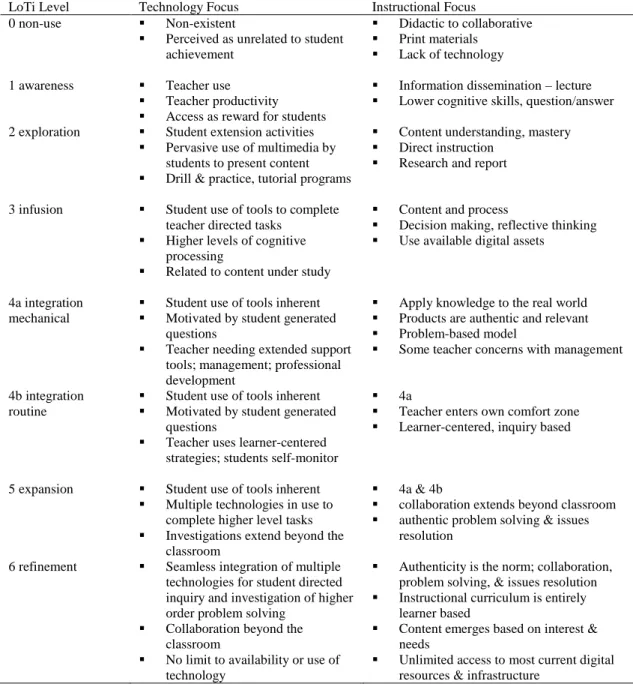
Teaching and Learning... 38 2.3 Levels of Technology Implementation ... 42 3.1 Summary of Population Comprising the Study From Alamo Heights
Junior High School in Alamo Heights Independent School District,
San Antonio, Texas ... 66 3.2 Summary of Students Meeting the Standard for TAKS in ELA/
Reading and Math in Grades 6, 7, and 8 for the State, Region 20,
and AHISD for 2009 ... 67 3.3 Summary of Students Classified as Economically Disadvantaged
Totals for the State and AHISD for 2010-2011 ... 67 4.1 Distribution in Groups by English Teacher Level of Technology
Implementation (LoTi) of Students Who Took Reading and
English Language Arts (ELA) Texas Assessment of Knowledge and Skills (TAKS) Test in the Spring of 2009 at Alamo Heights Junior
School in AHISD ... 77 4.2 Descriptive Statistics for Groups by Teacher Level of Technology
Implementation (LoTi) of Students Who Took Reading and
English Language Arts (ELA) Texas Assessment of Knowledge and Skills (TAKS) Test in the Spring of 2009 at Alamo Heights Junior
School in AHISD ... 77 4.3 Summary of Inferential Statistics Test Independent Samples of t-test
of Groups by Teacher Level of Technology Implementation (LoTi) of Students Who Took Reading and English Language Arts
(ELA) Texas Assessment of Knowledge and Skills (TAKS) Test
in the Spring of 2009 at Alamo Heights Junior School in AHISD ... 78 4.4 Distribution in Groups by Math Level of Technology Implementation
(LoTi) of Students Who Took Math Texas Assessment of Knowledge and Skills (TAKS) Test in the Spring of 2009
TABLE Page 4.5 Descriptive Statistics for Groups by Teacher Level of Technology
Implementation (LoTi) of Students Who Took Math Texas Assessment of Knowledge and Skills (TAKS) Test in the Spring
of 2009 at Alamo Heights Junior School in AHISD ... 80 4.6 Summary of Inferential Statistics Test Independent Samples of t-test
of Groups by Teacher Level of Technology Implementation (LoTi) of Students Who Took Math Texas Assessment of Knowledge and Skills (TAKS) Test in the Spring of 2009 at Alamo Heights
Junior School in AHISD ... 80 4.7 Between-Subjects Factors for Groups by English Teacher Level of
Technology Implementation (LoTi) and Economic Status of
Students Who Took Reading and English Language Arts (ELA) Texas Assessment of Knowledge and Skills (TAKS) Test in the Spring of
2009 at Alamo Heights Junior School in AHISD ... 84 4.8 Descriptive Statistics of Groups by English Teacher Level of
Technology Implementation (LoTi) and Economic Status of
Students Who Took Reading and English Language Arts (ELA) Texas Assessment of Knowledge and Skills (TAKS) Test in the Spring of
2009 at Alamo Heights Junior School in AHISD ... 85 4.9 Summary of Two-Way Analysis of Variance (ANOVA) by English
Teacher Level of Technology Implementation (LoTi) and Economic Status of Students Who Took Reading and English Language Arts (ELA) Texas Assessment of Knowledge and Skills (TAKS) Test in the Spring of 2009 at Alamo Heights Junior
School in AHISD ... 86 4.10 Between-Subjects Factors for Groups by Math Level of Technology
Implementation (LoTi) and Economic Status of Students Who Took Math Texas Assessment of Knowledge and Skills (TAKS) Test in the Spring of 2009 at Alamo Heights Junior School in AHISD ... 89 4.11 Descriptive Statistics of Groups by Math Teacher Level of
Technology Implementation (LoTi) and Economic Status of Students Who Took Math Texas Assessment of Knowledge and Skills (TAKS) Test in the Spring of 2009 at Alamo Heights
TABLE Page 4.12 Summary of Two-Way Analysis of Variance (ANOVA) by Math
Teacher Level of Technology Implementation (LoTi) and
Economic Status of Students Who Took Math Texas Assessment of Knowledge and Skills (TAKS) Test in the Spring of 2009
LIST OF FIGURES
FIGURE Page
4.1 Results of Analysis of Variance (ANOVA) Test for Interaction Between English Language Arts (ELA) Level of Technology Implementation (LoTi), Combined Student ELA TAKS Score Means, and Student Socioeconomic Status of Students Who Took Reading and English Language Arts (ELA) Texas Assessment of Knowledge and Skills (TAKS) Test in the Spring
of 2009 at Alamo Heights Junior School in AHISD ... 88 4.2 Results of Analysis of Variance (ANOVA) Test for Interaction
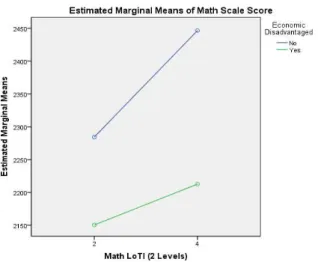
Between Math Level of Technology Implementation (LoTi), Combined Student Math TAKS Score Means, and Student Socioeconomic Status of Students Who Took Math Texas Assessment of Knowledge and Skills (TAKS) Test in the Spring
CHAPTER I INTRODUCTION
Educators are increasingly cognizant of the impact technology is having in both the personal and professional arenas of their lives (King, 2002). Technology, though changing daily, has become inextricably linked to virtually every aspect of our existence, and there is mounting evidence of a trend toward pervasive or ubiquitous computing that presents profound implications for education. As a result, educators are responding to relentless requirements at the national, state, and local levels to integrate technology into teaching and learning (Evans, Bond, & Mehlman, 2002; International Society for
Technology in Education (ISTE), 2000; King, 2002; Russell, Bebell, O’Dwyer, & O’Connor, 2003; Sandholtz & Reilly, 2004).
Transforming public education into a high technology, high-performance
learning organization that provides opportunities for all students to attain high literacy in multiple areas is a sound investment in the intellectual capital of our citizenry and imperative in the preparation of American learners to acquire the fluencies requisite in the Digital Age (Brand, 1997; Branigan, 2002; Conte, 2000; Fulton, 1997; McKenzie, 2002; North Central Regional Educational Laboratory [NCREL], 2002; Wise, 1997). However, how best to accomplish that transformation, ensure and measure to what degree, if any, the effective use of technology may improve student learning and offer a medium to close the achievement gap is the subject of much discourse and debate
____________
The style for this dissertation follows that of theAmerican Educational Research Journal.
(McNabb, Hawkes, & Rouk, 1999; NCREL, 2004; Russell et al., 2003; Wenglinsky, 2006).
Results of a 2004 survey of 200,000 U.S. students by the Net Day project concluded that students are using technology differently today, and because of the technology they are taking different approaches to their lives and their daily activities (Speak Up 2004 Report, 2005). Given the reality of globalization and rapidly
accelerating societal change, today’s students are active consumers of technology, digital natives who use cell phones, laptops, MP3 players, pagers, and a variety of social
networking venues in their daily activities to instant message, email, blog, chat, game, text, download and listen to music, share images, and browse the web, fully expecting to actively participate in and through their media (Bull, Bull, Garofalo, & Harris, 2002; Greaves Group, 2006; Jenkins, Purushotma, Clinton, Weigel, & Robison, 2007; NCREL, 2002; Prensky, 2004). Further, findings from the Speak Up 2007 survey of over 300,000 students in grades 3-12 representing all 50 states reported that students “consistently identify good tech skills as the number one skill they need to be successful in the 21st century” (Speak Up 2007 Report, 2008, p. 3).
A meta-analysis conducted by researchers at the Mid-Continent Research for Education and Learning [McREL] laboratory concluded that there are a number of instructional strategies that have a high probability to positively impact student achievement (Marzano, Pickering, & Pollock, 2001). The integration of technology to support instruction was listed among the instructional strategies that may have a positive impact on improved student achievement. Promising research on learning theory
supported the integration of technology into the curriculum to augment opportunities for learners and indicated that technologies might approach their full potential when used as cognitive learning tools that challenge learners to acquire, develop, and cultivate higher order thinking skills (Otero et al., 2005). Increasingly, researchers are seeking
confirmation that meaningful use of technology to support learning increases student success. Further, studies continue to reinforce that teachers must use strategies that address identified student needs in a way that promotes the learners’ successful
achievement of the required accountability standards (Rochelle, Pea, Hoadley, Gordin, & Means, 2000). Toward that end, literature suggests that the most productive and meaningful uses of technology occur in constructivist settings where the teacher becomes a facilitator and learners use technologies to teach themselves and others in a student-centered context that would not be possible without the technology (Boethel & Dimock, 1999; Bull et al., 2002; Jonassen, Peck, & Wilson, 1999; Ravitz, Becker, & Wong, 2000).
Despite research that the appropriate use of technologies for teaching and learning may facilitate constructivist strategies that lead to increasing student
achievement, which, absent the technology, might not otherwise be possible, there is consensus among researchers that the advent of computers in the classroom has not led to a transformation of instructional practices among the vast majority of teachers
(Brinkerhoff, 2006; Ferdig, 2006; Halverson & Smith, 2009; Ravitz et al., 2000; Russell et al., 2003; Sandholtz & Reilly, 2004). The expectation that teachers integrate
student-centered learning environment (Boethel & Dimock, 1999) and for many
teachers, the constructivist direction of the research findings are a radical departure from the traditional didactic transmission model characterized by the teacher-centered whole class instruction, tightly prescribed seatwork in which students listen, copy text, and memorize information via drill and practice (Pea, as cited in Becker & Ravitz, 2000).
Ferdig (2006) noted that one must judge the effectiveness of technology in the context for which it is meant and further that the value of the innovation must be evaluated pedagogically as it relates to goals and assessments (p. 749). Additionally, Ferdig made the distinction between supporting teachers with pedagogically sound technology and a teachers’ ability to make technology pedagogically sound. Fostering the appropriate use of technology as an instructional tool to positively impact student achievement is beyond the scope of strong content knowledge and must include strong pedagogy and pedagogical content knowledge (Margerum-Leys & Marx, 2004; Otero et al., 2005).
Statement of the Problem
Student achievement is the focus of national and state accountability systems and schools are charged with the responsibility of ensuring that all students meet or exceed standards in their respective areas. In an effort to address the national mandate for student achievement goals under NCLB Title II, Part D, Texas, along with numerous other states has incorporated technology elements in the state curriculum. The Texas Long-Range Plan for Technology (TLRPT), 1996-2010 and Chapter 32 of the Texas Education Code made explicit the expectation that all high school graduates are
computer literate. The Texas Essential Knowledge and Skills (TEKS), which outlined what each student was expected to know and be able to do at various stages of their education was the basis for the standardized testing instrument, the Texas Assessment of Knowledge and Skills (TAKS). The Technology Application TEKS (TA TEKS),
initially formed the basis for the Technology Applications courses, however, in support of the TLRPT, the 78th Legislative Regular Session in 2003 drafted SP 815, signed into law by Governor Rick Perry, which mandated that all school districts in Texas use the TA-TEKS when teaching the entire required curriculum. Teachers were also expected to meet minimum technology standards as delineated in the Texas State Board of Educator Certification (SBEC) requirements (Texas Education Agency [TEA], 2006c). These mandates, in conjunction with a district report card issued by the state that identified the percentage of students in each demographic area that met the passing standard on the TAKS, provided incentive for districts to examine instructional strategies that would increase the passing rates of all students, particularly those who were identified as ‘at risk’ of failure and by and large comprised the population of victims of the achievement gap.
The education world was quick to adopt the promise of technology and
computing. Anticipating the potential of increasing student achievement and a respective role in contributing to the booming economy in the 1990’s, schools invested significant amounts of their discretionary funds in hardware, software, and an infrastructure to support the use of digital technologies. Spending increased from $21 to $729 million dollars between 1995 and 2001 and current information estimates billions of dollars
spent on technology in schools (Daggett, 2010; Jones & Paolucci, 1998; Trotter, 2007). One report from the U. S. Department of Education (USDOE) noted that in 1998 alone, $7.3 billion of all educational disbursements went to technology and related services, approximately 2.7% of the total expenditures in education for that year; while the average school spent $113 per annum per student on technology, only $22.50 was spent to support teachers (Anderson & Becker, 2001). In the wake of significant expenditures on educational technology one dilemma is whether, and to what degree, technology impacts student achievement. The problem is that a review of existing literature in journals specific to education and technology reveals a paucity of research studies that link technology and student learning outcomes. This record of study contributes to the research on the relationship between the level of technology implementation, as
characterized by teachers employing digital-age literacy tools in an instructional setting and the corresponding level of student achievement in math and reading as measured by student scale scores on TAKS, the state standardized testing instrument.
Purpose of the Study
The purpose of this study was to examine Levels of Technology Implementation (LoTi) teacher self-ratings and Texas Assessment of Knowledge and Skills (TAKS) student scores. The study examined to what degree, if any, a relationship exists between LoTi ratings reported by teachers and TAKS scores of 6th, 7th, and 8thgrade students obtained from the Public Education Information Management System (PEIMS) and reported in student records at Alamo Heights Junior School in Alamo Heights Independent School District (AHISD), San Antonio, Texas. The study assessed the
degree to which teacher self-reported LoTi ratings are a predictor of success on TAKS scores as reported in student records at Alamo Heights Independent School District, San Antonio, Texas. In addition, the study analyzed differences in student performance using economic status as a selected demographic variable as reported in student records at Alamo Heights Independent School District, San Antonio, Texas.
Research Questions
This study was guided by the following research questions:
1. Is there a relationship between teacher self-reported LoTi ratings and TAKS scores as reported in student records for 6th, 7th, and 8thgraders at Alamo Heights Junior School, Alamo Heights Independent School District, in San Antonio, Texas?
2. Is there a relationship between teacher self-reported LoTi ratings and TAKS scores among 6th, 7th, and 8thgraders whose status is identified as
economically disadvantaged in student records at Alamo Heights Junior School, Alamo Heights Independent School District, in San Antonio, Texas?
Operational Definitions
The findings of this study are to be reviewed within the context of the following definitions of operational terminology that may include interpretation by the author: Academic Excellence Indicator System (AEIS): Statewide system database that
compiles specific information regarding the broad operations and achievements of all Texas state independent school districts and their respective public campuses. The AEIS database includes quantitative reporting on student
performance from the Texas Assessment of Knowledge and Skills (TAKS) in the form of scale scores and information from the Public Education Information Management System (PEIMS) (TEA 2011a).
Academic Excellence Indicator System-Improving TAKS (AEIS-IT): An acronym for a comprehensive test data analysis tool developed by the Education Service Center Curriculum Cooperative and available to districts for the purpose of disaggregating TAKS and student demographic data.
DataDirector: A comprehensive data repository of student information and test scores and extensive data analysis tool purchased by AHISD as an ancillary to and ultimately to replace AEIS-IT.
Demographic Variables: Economically disadvantaged status.
Economically Disadvantaged: Student who is eligible for free or reduced-price meals under the National School Lunch and Child Nutrition Program, meets
requirements for Title II of the Job Training Partnership Act (JPTA), receives food stamp benefits, or qualifies for other public assistance. In addition, if the student is under the parental or custodial care of a family with an annual income at or below the official federal poverty line regardless of public assistance, are also identified as economically disadvantaged.
Educational Technology: The use of technology to enhance the teaching and learning process.
Levels of Technology Implementation (LoTi): A term referring to a framework designed by Dr. Christopher Moersch in 1994 as a research tool to assess the
level of authentic classroom technology implementation. The framework focuses on the use of technology as a tool within the context of student based instruction with an emphasis on higher order thinking. The LoTi framework has been used as a statewide technology use survey, a district school improvement model, and classroom walkthrough tool. Three scores are gleaned from teacher responses to questions designed to measure Current Instructional Practice (CIP), Personal Computer Use (PCU), and Levels of Technology Implementation (LoTi). Predictor: An item from which one may state, tell about, or make known in advance. Public Education Information Management System (PEIMS): A statewide data
management system for public education information in the state. Student demographic data for Alamo Heights ISD was reported to the state and obtained from the PEIMS database for the purposes of this study (TEA, 2011b).
Relationship: A connection between a dependent and an independent variable as determined by a given statistical test.
Socioeconomic Status: The Texas Education Agency (TEA) categorizes student socioeconomic status as economically disadvantaged or not economically disadvantaged. Students who qualify for the free or reduced-price meal program under the National School Lunch and Child Nutrition Program are classified as economically disadvantaged.
Technology: Examples of technology in an instructional setting include but are not limited to computer work stations with laptop or desktop computers, digital video or still cameras, probes, scanners, digital projection devices, document cameras,
wireless slates, televisions, CD-DVD or VCR players, and programmable calculators.
Technology Integration: The use of technology and technology-based practices in the daily routine, administration, and work of a public school institution.
Texas Assessment of Knowledge and Skills (TAKS): Measures student mastery of the Texas Essential Knowledge and Skills (TEKS), the statewide curriculum, in reading at Grades 3-9 and in mathematics at Grades 3-11.
Texas Education Agency (TEA): Comprised of the commissioner of education and agency staff. The TEA and the State Board of Education (SBOE) guide and monitor activities and programs related to public education in Texas. Under the leadership of the commissioner of education, the TEA administers the statewide assessment program, maintains the Public Education Information Management System (PEIMS), a database of information on public schools used for a variety of purposes and operates research and information programs among numerous other duties. The TEA operational costs are supported by both state and federal funds.
Assumptions
1. The administration of the LoTi survey by the Alamo Heights Junior School was managed according to recommended guidelines for administration of the survey.
2. The respondents surveyed understood the scope of the study, the language of the instrument, were competent in self-reporting, and responded objectively and honestly to report a true reflection of their use of technology.
3. The methodology proposed and described here offered a logical and appropriate design for this particular research project.
Limitations
1. The study was limited to teachers at the Junior School in the Alamo Heights Independent School District in San Antonio, Texas.
2. The study was limited to the information acquired from the literature reviews, achievement data on TAKS, and the teacher self-report on the LoTi survey instrument.
Significance of the Study
The intent of this study was to determine whether there was a relationship between a LoTi level based on teachers’ self-report and the TAKS scores of 6th, 7th, and 8thgrade students in Alamo Heights Independent School District. There is an abundance of research on technology in schools; however, due to inherent challenges in the nature of the studies, there is a paucity of studies that provide quantitative data to address the relationship between teacher levels of technology implementation and the impact of education technology on student achievement (Wenglinsky, 1998). InA Retrospective of Twenty Years in Education Technology Policy, Culp, Honey, and Mandinach (2003) noted in their findings that:
The call for research on the impact of educational technology on schools and teaching and learning activities is a final constant theme over the past twenty years of reports. Every report recommends, at minimum, some sort of research or evaluation of the impact of education technology on students. (p. 15)
This study focused on a specific population, 6th, 7th, and 8thgrade teachers, and students in Alamo Heights Independent School District to investigate instructional practices as they related to technology implementation and student achievement as measured by state standardized test scores. Through a review of results of teacher responses to the LoTi, Level of Technology Implementation survey, and student results on TAKS, this research offers information to district leaders about how to allot resources to optimize potential for improving student achievement and contributes to existing literature to determine appropriate points of entry for further study on the impact of specific instructional practices that include fluency in utilizing digital-age tools and resources, levels of technology implementation, and student achievement.
Organization of the Record of Study
The record of study is segmented into five major areas of focus. Chapter I
includes the introduction, a statement of the problem, the purpose for the study, research questions, operational definitions, assumptions, limitations, and statement of
significance. Chapter II contains a review of the literature relevant to the integration of technology. Chapter III outlines the methodology and procedures of the research and report for the record of study to include a description of the population and
instrumentation as elements of the study. Chapter IV is guided by the research questions and details the analysis and comparison of the data collected during the study. Chapter V
highlights the researcher’s findings comprising implications, conclusions, and recommendations for further study.
CHAPTER II
REVIEW OF THE LITERATURE
The purpose of this portion of the study is to highlight germane elements of research and this review of literature encompasses five areas. Section one outlines the characteristics of multimedia savvy 21stcentury learners and posits the potential of a public school system that provides a technology-rich learning environment. Its purpose is to frame the milieu in which the integration of technology in classrooms became imperative. Section two traces the historical evolution and inherent challenges of
government and institutional policies that shape integrating technology in education as a tool to enhance student learning. Section three addresses current national and state standards of technology accountability and efforts at the state and local district level to comply. Further, this section speaks to various methods used to measure compliance with national and state technology standards. Section four targets the problematic nature of distinguishing between the roles of technology and pedagogical practice in student achievement.
Specifically, this section describes the Levels of Technology Implementation (LoTi) process as a means for assessing teachers’ perceptions of their progress toward implementing technology in their classroom providing the contextual basis for this record of study. Section five explores research on the integration of technology tools in the classroom as it relates to an increase in student achievement. As schools clamor to increase levels of student achievement, the paucity of research in the field linking technology integration to that goal is evident (Culp et al., 2003).
Characteristics of 21stCentury Learners
Communities and schools across North America advocate the infusion of technology tools into the national educational system so that all students reap the benefits of a technologically sophisticated learning environment and become fluent in multiple, layered literacies to include digital, visual, informational, textual, and technological. Many believe these skills to be tantamount to providing a quality education in the 21stcentury that promotes global awareness; financial, economic, and business acumen; as well as civic responsibility, and participatory citizenship (American Association of School Librarians [AASL], 2007; Box, Burkhardt, Fadel, Hurley,
Trilling, & Wilson, 2009; Brand, 1997; Lemke, Coughlin, Thadani, & Martin, 2003; Salpeter, 2003; Szuba, Rogers, & Malitz, 2005; U.S. Department of Labor (USDL), 1991).
In a world that is changing at a seemingly frenetic pace, high-performing organizations that will prepare learners to thrive in an environment that is
technologically rich and dynamic and empower United States citizens to maintain status as a viable world presence are required. Education must, therefore, undergo systemic transformation and educators face the daunting challenge of meeting the needs of this generation of learners who have grown up with digital technologies and learn differently than their predecessors (Barnes, Marateo, & Ferris, 2007; Daggett, 2005; Halverson & Smith, 2009; Tapscott, 1998; TEA, 2008; USDL, 1991, 1992). Data from the Speak Up 2009 Report (2010a) indicated that students envision their learning environment to be social-based, un-tethered, and digitally rich. Consequently, students are using advanced
communications and collaboration tools seamlessly in many aspects of their technology-infused lives.
Anticipating potential changes to the current educational system to accommodate learners’ ever-increasing access to technologies is an immense undertaking, and
integrating technology into the instructional setting requires a commensurate investment in building a human infrastructure to support the endeavor (Brown, 2000; Brown & Adler, 2008; Council of Chief State School Officers (CCSSO), 2006; Ertmer, 1999; MacArthur Foundation, 2006; USDOE, 2010). Yet, the integration of technology into the national education system is imperative in the preparation of American learners to become fluent in the skills and knowledge of those technologies that are essential in adapting and meeting 21stcentury challenges in a global information age (Brand, 1997; Conte, 2000; McKenzie, 1998; NCREL, 2002). As integration efforts continued, former Secretary of Education, Richard W. Riley noted, “we are far enough along in the
technological revolution and its application to learning that it is time for systematic review and analysis of what works best” (McNabb et al., 1999, opening page). He went on to state that the appropriate integration of technologies into education was one possible means of achieving the necessary changes. In the introduction to Project Red, the former Governor of Maine, Angus King (as cited in Greaves, Hayes, Wilson, Gielniak, & Peterson, 2010) pointedly noted, “A person’s economic future depends on brains, not brawn, and the best brains, or maybe more accurately, the best trained brains, will win….The modern world needs citizens who are ‘learning learning’ and can do what they were not taught” (forward). King (as cited in Greaves et al., 2010) advised that
ubiquitous technology, well-prepared and well-led teachers are required elements of successful transformation.
Beginning in 2012, the National Assessment of Educational Progress (NAEP), widely known as the Nation’s Report Card, will include a framework for measuring students’ technology acumen, along with measuring their proficiency in math, science, history, reading and other subjects, marking the first time students’ technology literacy will be assessed on a national scale (“On the Way,” 2008). The NAEP is the only nationally representative database of academic performance for American students and taking this step affirms the imperative to ensure their ability to understand and use the immensely powerful technology tools that are an integral component of the international domain in which they will compete.
Reading, math and science are the foundations of student achievement. But to compete and win in the global economy, today’s students and tomorrow’s leaders need another set of knowledge and skills. These 21st century skills include the development of global awareness and the ability to collaborate and communicate and analyze and address problems. And they need to rely on critical thinking and problem solving to create innovative solutions to the issues facing our world. Every child should have the opportunity to acquire and master these skills and our schools play a vital role in making this happen. (Dell, as cited in Box et al., 2009, p. 4)
Technology is fast becoming a vital component of mainstream education and the integration of technologies as information and instructional tools may significantly enhance student learning. Teachers today must make strategic decisions about how to make the best use of instructional time and educational objectives must clearly align with local, state, and national standards that now include significant technology
support traditional teaching practices (Apple, 2002; Learning for the 21stCentury, 2002; McKenzie, 1998; Means, 2010; Rogers, 2001; Vannatta & Fordham, 2004; Wise, 1997) or may be marginalized or banned to preclude the perceived threat of disruption to the learning environment (Christensen, Johnson, & Horn, 2008). In that context,
technologies become mere productivity and management tools that, though they may assist teachers in working more efficiently to develop and deliver lesson plans, communicate with students and the extended learning community, and continue
professional growth, the technologies fall short as tools to transform current practice and enhance learning (Fadel & Lemke, 2006; Fishman, Marx, Blumenfeld, Krajcik, & Soloway, 2004; Fulton, 1997). Though a conventional approach may be appropriate in many cases, the use of technology tools may significantly augment what teachers are able to do, providing options that are not possible without the technology (Bull et al., 2002). Rogers (2001) of the Global SchoolNet Foundation observed that
If we consider their impact on the normal life of the average American
classroom, without question computers have failed to deliver the transformation in learning that has been promised and promoted over the past fifteen years. Walk into most any classroom in most any school in America today and you’ll walk into a time warp where the basic tools of learning have not changed in decades….Teachers simply have not embraced the computer as a basic tool of learning. (p. 1)
In addition to changing how people learn, technology also affects what they need to learn. Promising research on learning theory supports the integration of technology into the curriculum to augment opportunities for learners. Further, research indicates that technologies might approach their full potential capacity when used as “mindtools” or cognitive learning tools that challenge learners to acquire, develop, and cultivate
cognitive skills while distributing expectations for outcomes to learners or technologies respectively according to which would most appropriately accomplish the task at hand (Jenkins et al., 2007; Jonassen, 1994; Salomon, Perkins, & Globerson, 1991). Goodlad (as cited in Coughlin & Lemke, 1999) has stated that “The biggest mistake we could make…is to assume that the challenge is to prepare teachers to do the usual things better” (p. 4). If our schools fail, then our society and the greater global society will fail. Whatever it costs, the price of failure will be greater than the price of education. Our children are worth it. Our planet is worth it (Costa, 1996).
Despite the technological advances in American society, teachers in general tend to continue practicing in a traditional classroom context often using outdated paradigms. Teacher-centered instructional delivery systems, though appropriate at times, do not include models such as those promoting a student-centered construction of knowledge that could amplify opportunities for learners via the appropriate integration of
technologies (Brogden & Couros, 2007; Cuban, 2000; Jonassen et al., 1999; McKenzie, 1991; Rogers, 2001; Wise, 1997). Robertson (2003) cautioned, “the task of the
educational system should be to embrace the future and empower children to learn with the tools available to them” (p. 292). It is important to remember that technologies are tools and with their use comes the incumbent responsibility of communities and districts to evaluate all available resources to determine and implement appropriate methods and contexts within which to improve students’ learning.
A glaring irony in public education is exposed when one examines the pedagogy and methodology in classrooms across America to find that computers and information
technologies are not an integral part of the teaching process. By and large, in contrast to the rapidly advancing global technological innovations surrounding them, teachers and learners in American public schools are far from being accustomed to the appropriate and efficient integration of instructional and information technologies into classrooms and curricula thereby creating a “digital disconnect” (McHale, 2005; Sherry & Jesse, 2000). There is a gap between increasingly technology savvy students and their schools as the revolution that was anticipated to take place in classrooms as a result of new technologies took place outside the schools as students used their own mobile devices that were often banned in school (Halverson & Smith, 2009).
Seemingly, learning outdated 20thcentury skills while living in the innovative 21stcentury is shortchanging students of the “Media Generation,” the “media
multitaskers” who have access to, and are immersed in, a vast and expanding array of media to which they have become accustomed (Roberts & Foehr, 2008; Shapley, Sheehan, Maloney, & Caranikas-Walker, 2010a). Conventional wisdom may indicate that traditional models of schools are culturally and institutionally entrenched or that current accountability systems reinforce a teacher-directed, whole-class delivery style though there is a growing body of knowledge suggesting that improved professional development may contribute to bridging the gap (Hill, Reeves, & Heidemeier, 2000; Lemke, Coughlin, & Reifsneider, 2009; Levin & Arafeh, 2002; Prensky, 2008; Russell et al., 2003). In this context, many posit the challenge of envisioning and instituting a 21stcentury school system (Pearlman, 2009; Salpeter, 2003).
Transcending the current model of traditional practice necessitates a paradigm shift from a conventional model toward a more constructivist orientation if indeed students are to be at the center of their own learning and capable of taking full advantage of the new environments for learning afforded by technologies (NCREL, 2002;
Pearlman, 2009; Salpeter, 2003; Stein, McRobbie, & Ginns, 2002; Windschitl & Sahl, 2002). A student-centered model for learning applies to pupils of all ages. Resurgent and emerging research reflects an emphasis on self-directed learning for both students in the form of constructivist models and teachers in the form of redesigned approaches to professional development (Beatty, 1999; Birman, Desimone, Porter, & Garet, 2000; Mizell, 2001). Promising research confirming the requisite transformation compels the examination and refinement of professional development models to reflect the evolving context of teaching and learning (Becker & Ravitz, 2000; Culp et al., 2003; King, 2002; Russell et al., 2003). Self-directed professional development embedded within the job and supported by a framework of collegiality and reflection is proving to be a solid foundation both for personal and institutional growth (Bybee & Loucks-Horsley, 2000; Guskey, 2000; Putnam & Borko, 2000; Schrum, 1999).
Historical Evolution of Technology Integration in the Classroom The National Commission on Excellence in Education (NCEE) was created in 1983 by then Secretary of Education, T. H. Bell, with a directive to examine the quality of education in the United States and issue a report on the findings. In the wake of the now infamous diatribe, an open letter to the American people in the form ofA Nation at Risk,the commission cited deficiencies in virtually every aspect of the American
educational system to include: (a) curricular content, (b) teacher expectations, (c) time spent in and out of the classroom, and (d) the shortage of teachers and the inadequate preparation of those who teach. Among the recommendations that followed from the now defunct report, The National Commission on Excellence in Education (1983) suggested that new instructional materials include the most recent uses of technology in appropriate curriculum areas. A myriad of responses ensued across the country, both supporting and refuting the findings. Nonetheless, education and educators received increasing scrutiny amidst widespread calls for reform.
In March of 1994, the Goals 2000: Educate America Act (P.L. 103-227) was signed into law for the purpose of providing resources to ensure that students would ultimately acquire the knowledge and skills necessary to live and work in the 21st century (NCREL, 1994). The imperative to integrate technology into the United States educational arena began in earnest with, then U.S. Secretary of Education, Richard W. Riley’s announcement in 1996 that $23 million dollars would be allocated in the form of Challenge Grants for Technology in Education.
The Texas State Board of Education (SBOE) had authored an initial long-range plan for technology in November of 1988 that required biennial reports to the governor and legislature detailing progress toward the implementation of the plan (TEA, 1988). Fourteen years hence, changes in the technology landscape and legislation mandated a revision of the original plan. In 1996, the Texas State Board of Education developed a revised Long-Range Plan for Technology 1996-2010 (LRPT) for review by the Texas legislative body. The revised Texas Long-Range Plan for Technology included attention
to the continuing modifications to practice in the areas of Teaching and Learning, Educator Preparation and Development, Administration and Support Services, and Infrastructure for Technology, and their respective effect on students and learning.
In 2001, the No Child Left Behind Act (NCLB) (USDOE, 2002) was instituted and in 2002 the Texas Long Range Plan for Technology, 1996-2010 was revised in an effort to align the Texas goals and objectives with the national NCLB plan to guarantee federal funds for technology for the students of Texas. Title II, Part D of the NCLB, referred to as the “Enhancing Education Through Technology Act of 2001,” specifically addressed as its primary goal, the intent to improve academic achievement of both elementary and secondary students through a comprehensive system that utilizes technology effectively. Additionally, Title II, Part D encouraged states to seek
partnerships with public or private entities and to develop an infrastructure to increase access to technology in schools, promote initiatives to increase the capacity for
technology integration, enhance further professional development of teachers and administrators via electronic means, and to utilize electronic networks and innovative methods of curriculum delivery. Further, the plan promoted family involvement in the education of their children and included a call for rigorous evaluation of federally funded programs specific to the area of student achievement (USDOE, 2004).
In 2002, the U.S. Department of Education provided an executive summary of The No Child Left Behind (NCLB) legislation with recommendations that, when implemented, provided states with more flexibility in the use of federal monies in education. The summary specifically articulated that states were given the authority to
apply up to 50% of federal funding received from four major programs: (a) Teacher Quality, (b) Educational Technology, (c) Innovative Programs, or (d) Safe and Drug-Free schools, toward any one of those programs or to support Title I programs. This revision allowed states greater flexibility in applying federal funds toward technology initiatives. Key concepts of the technology integration component of the NCLB, Title II, Part D, included building a technology infrastructure that would enable the integration of technology into the curriculum and increase access to technology and information for both students and parents. As stated in Title II, Part D, “the primary goal of this part is to improve student academic achievement through the use of technology in elementary and secondary schools” (USDOE, 2001, p. 34).
Additional goals stated in NCLB legislation of 2001, included ensuring that all students be technologically literate by completion of eighth grade, and that resources be allocated to support professional development for teachers in order to support research-based instructional models that state and local educational agencies would implement as best practices. In support of the mandate, Title II, Part D, Sec. 2416 Local of the NCLB Act of 2001 further delineated that no less than 25% of allocated funds be directed toward “ongoing, sustained, and intensive, high-quality professional development in the integration of advanced technologies, including emerging technologies into curricula and instruction and in using those technologies to create new learning environments”
(USDOE, 2001, p. 34). Though the NCLB provided a directive to incorporate
build and no existing nationwide requirements or common definitions for technological literacy.
Driven by requirements of the NCLB and continuing changes in technology and in education, the U.S. Department of Education (2004) issued a report,Toward a New Golden Age in American Education, which stated that the United States would continue to face the ever-increasing demands and competition of a global economy. Further, the report stated that to an overwhelming extent, mastery, and application of new
technologies would be essential to secure the country’s economic future. The U.S. Department of Education (2004) worked in concert with the International Society for Technology in Education (ISTE) to develop the National Educational Technology Standards for Students (NETS-S). NETS-S provided a guideline for states to incorporate principles into each content area that increased in complexity with each grade level and outlined the expectation that students be
technologically literate for matriculation to high school. The original standards released in 1998 spanned six categories and included (a) basic operations and concepts; (b) social, ethical, and human issues regarding technology; (c) technology productivity tools; (d) technology communication tools; (e) technology research tools and technology problem-solving; and (f) decision-making tools (ISTE, 1998) (Appendix A). Reflecting the changing dynamic in technology education, ISTE launched the NETS refresh effort in 2006 and revised the NET-S in 2007 to promote authentic, integrated ways for students to amplify skills that enabled them to contribute productively in a global
(a) creativity and innovation; (b) communication and collaboration; (c) research and information fluency; (d) critical thinking, problem solving, and decision making; (e) digital citizenship, and (f) technology operations and concepts (ISTE, 2007) (Appendix B).
The release of the National Education Technology Plan (NETP) by the U.S. Department of Education (2004), again mandated an update and Texas took the lead to align the state long-range technology goals with the goals and legislative requirements of the NCLB, specific to Title II, Part D. The Texas Educational Technology Advisory Committee completed a two-year research study that led to the Texas Long Range Plan for Technology, 2006-2020 (TEA, 2006b). The plan was divided into three phases: Phase I 2006-2010, Phase II 2011-2015, and Phase III 2016-2020. Essential elements of the plan and notable revisions of the original TLRPT included articulated technology proficiencies, required professional development, focused technology planning and dedicated resources, and specified expectations of the plan. Receiving much attention was the Technology Proficiency component of the plan, Vision 2020, that stated,
All professional educators (including teachers, administrators, and librarians) must master the State Board for Educator Certification (SBEC) Technology Applications standards, which are currently mandated for all beginning teachers….Students beginning in kindergarten are required to master the state Technology Applications Texas Essential Knowledge and Skills (TA TEKS) and demonstrate that they are technology literate with the needed proficiencies to acquire information, solve problems, and communicate using technology. (TEA, 2006a, p. 2)
In a sweeping statement of the intent to integrate technology into the curriculum, the SBOE mandated that the Texas Essential Knowledge and Skills (TEKS), a required curriculum framework for all core content areas, reflect 21stcentury skills and decreed
that information and communication literacy skills be fully integrated into core content instruction. The Technology Applications TEKS were embedded into the core content area TEKS with a statement that the Texas Assessment of Knowledge and Skills (TAKS) test reflect the varied skill sets requisite for citizens to maintain economic stability and function in a global, information age.
TEA released a summary progress report to the 81stTexas Legislature that outlined key findings documented from the implementation of Phase I of the TLRPT. Among results from the Texas Technology Immersion Project (TxTIP), data supported that the technology immersion had a statistically significant effect on TAKS
mathematics achievement and further that as teachers and students became more
accomplished technology users, the effects of the technology immersion on reading and mathematics achievement measured by TAKS scores generally increased (TEA, 2008). Texas is entering Phase II of the Long-Range Plan for Technology that will span 2011-2015.
The recently released revision of the National Educational Technology Plan,
Transforming American Education: Learning Powered by Technology, clearly outlines an expectation that technology be an integral element of all aspects of the educational system (USDOE, 2010). The plan addresses five critical areas: (a) learning, (b)
assessment, (c) teaching, (d) infrastructure, and (e) productivity and calls on the nation to transform education in America, to challenge basic educational assumptions and to redesign the educational system in a way that incorporates 21stcentury skill development into every aspect of teaching and learning (USDOE, 2010).
National, State, and Local Standards of Accountability
In the face of patterns of teaching that may span decades, education remains a dynamic system, simultaneously exhilarating and exhausting, in which teachers’ pedagogical practices and philosophies are constantly challenged (Becker & Ravitz, 2000; King, 2002; Learning for the 21stCentury, 2002). With each successive generation come greater challenges and conquests. Many technologies have been created over time, from typewriters to calculators, computers and personal mobile devices, and with them the call to incorporate their use into the educational landscape (CCSSO, 2006; Klopfer, Osterweil, Groff, & Haas, 2009). However, Brunner and Tally (1999) observed that educational technologies command such focus and attention that the human side of education is often forgotten (Tell, 2000). Larger percentages of the population have access to public schools than at any time in the history of our nation and yet we have not resolved the dilemma of inequity in the system (Pfeiffer, 2008; Phillips & Chin, 2003). Former Secretary of Education, Rod Paige, observed that nearly 50 years after the Civil Rights movement, inequality still has a stronghold in America’s classrooms (Paige & Witty, 2010). A new didactic digital divide developed based on varied levels of acquisition of basic technological, cultural, scientific, mathematical, visual, and information literacy’s and the potential segregation of citizens who had access to, and the know how to access and use, the information from those who did not (Bull et al., 2002; NCREL, 2002; Rideout, Roberts, & Foehr, 2005; Roberts & Foehr, 2008; Warschauer, Knobel, & Stone, 2004). In light of this development, many looked to the integration of technology in public school classrooms as a means to provide more
equitable educational opportunities for all (Hall, 2006; Oblinger & Oblinger, 2005; Pearlman, 2009). Conversations vis-à-vis the appropriate integration of technologies indicated both pain and possibility concerning the lifespan and potential impact of the digital divide phenomena (Dickard & Schneider, 2002; Hall, 2006; Ito et al., 2008).
Calls for improved practice, reform, and accountability in education are signposts of every era as the public engages in debate about how best to meet the educational needs of our society. Witness the focus on education during the Presidential Campaign of 2000 as incumbent Bill Clinton vacated his position and then vice-president Al Gore and then Governor of Texas, George W. Bush, Jr., though they differed on specifics, each elevated education to the top of their respective policy agenda. National and state standards presented a vision of technology-rich classrooms that were a significant departure from the arena in which most of today’s teachers were students (McHale, 2005; Otero et al., 2005). Politicians and educators have become keenly aware of the educational implications of technological advances evidenced by their support and the vast amounts of resources that continued to flow to build an infrastructure upon which to place additional computers and Internet connectivity in classrooms across the nation (Barron, Kemker, Harmes, & Kalaydjian, 2003; Kalmbacher, 2004). Yet the importance of teachers and students, and of teaching and learning, is easily lost amid continuing conversations regarding technology integration in schools that tend to focus on infrastructure, hardware, and software issues. As political and educational institutions sprinted to provide hardware and software to teachers and students in schools, evidence indicated that few American teachers felt adequately prepared to use technologies for
any purpose and much less ready to effectively integrate technologies in the classroom (Breuleux, Baker, & Pagliaroli, 1998; Conte, 2000; McKenzie, 2001; TEA, 2008). Evaluating technology integration and designing appropriate accountability measures is situational and takes time and commitment (Brogden & Couros, 2007). Clearly an emphasis on teacher professional development and student learning is paramount to appropriate and effective use of technologies in the classroom and attempts to diminish the digital divide phenomena (Fadel & Lemke, 2006).
“The medium is not the literacy” (McKenzie, 2002, p. 1) and though the integration of technology appeared to be a panacea for some, a greater than ever focus on standards and accountability left states and districts with the formidable task of determining how best to substantiate specific programs and practices. Pressure at all levels was being leveraged to produce accountability, yet little research was available that provided a direct correlation between technology integration and improved student learning. As the public continued to question schools and schooling in the United States, national and state standards centering student performance on standardized tests as the measure by which to gauge the success of individual teachers and districts, placed more of the burden of accountability on teachers. Yet, commensurate support for teacher professional development and training to effectively integrate technology meaningfully into instruction was insufficient and the public and educators began to acknowledge that merely having the technology in place would not directly result in further educational attainment for students (King, 2002; Vail, 2003). The issue of teaching and learning moved to the forefront of conversations that endorsed restructuring and focused efforts
on research that attempted to measure the effect of appropriate technology integration (Ferdig, 2006).
Professionalism of teachers was at a crossroads as political forces rallied to improve the educational system (Fullan & Stiegelbauer, 1991; Pearlman, 2009; Salpeter, 2003). Teachers wanted to know how technology would improve their practice, parents wanted to know whether their children were receiving a good education, administrators wanted to know whether technology professional development facilitated appropriate integration, the public wanted assurance that their tax dollars were well spent, and legislators wanted to know how well schools were doing (Guskey, 2000; Johnston & Barker, 2002; McNabb et al., 1999). Consequently, the goal of integrating information and communication technologies spawned a critical look at technology integration efforts in schools and the nature of professional development for teachers (Breuleux et al., 1998; Pitcher, 1998; Rodriguez & Knuth, 2000). Overall, research literature affirms that teacher quality is a critical factor in student learning and further indicates that effective professional development plays a key role in improving teacher quality (Center for Public Education [CPE], 2005; Colbert, Brown, Choi, & Thomas, 2008; Darling-Hammond, 2000; Wong, 2007). In their critical issue written for NCREL, Rodriguez and Knuth (2000) cited Darling-Hammond and Berry by noting that teacher quality is the most important factor in student learning. If we are to improve student learning, we must focus on the synergy between students and teachers engaged in the learning process.
Technologies have the potential to affect every person in public education yet challenges to the integration of technologies are many. Reticent teachers contributed to
the challenge of transparent infusion of technology into the curriculum. The 1995 Office of Technology Assessment report noted that numerous obstacles to technology
integration included the lack of time, limited resources, faculty attitudes and comfort levels, and little institutional support for technology use in the classroom (Beck & Wynn, 1998). However, the advent of the No Child Left Behind Act (NCLB) of 2001 (USDOE, 2002) altered the landscape of technology use in schools imposing new requirements on schools, school districts, and states to meet federal guidelines for accountability. Interestingly, the directive for states to provide the public with
disaggregated data that allowed comparison of achievement across varied demographics of student populations led to the increased use of technologies at an administrative level that would ultimately strengthen the infrastructure for technology use in the classroom (Anderson, 2005; Halverson & Smith, 2009).
The trend emphasis is directed toward integrating technology into the curriculum to achieve the goal of graduating students prepared to enter the 21stcentury with
commensurate skills to maintain the competitive edge the United States holds in the global economy (Brogden & Couros, 2007; Olson, 2004; Pearlman, 2009; USDOE, 2010). With that in mind, there are tools in place at the national, state, and local level designed to increase the degree of technology integration into teaching and learning and research efforts underway to gauge effectiveness (Pitcher, 1998).
In addition to the (NETS-S) designed for students in 1998 and refreshed in 2007, ISTE, mentioned previously, developed a series of standards to include teachers,
(NETS-T) were released in 2000 as a guideline of six performance indicators teachers should meet (Appendix C). Soon to follow, standards for administrators (NETS-A) were released in 2002 to assist in evaluating areas considered critical for school administrators to effectively support digital age learning and technology implementation (Appendix D). The NETS-T and NETS-A were reviewed and, through an extensive process including a town hall model for soliciting nationwide input, refreshed for release in 2008 and 2009 respectively. The refreshed NETS-T focused on creativity, developing and modeling digital age learning experiences, and professional leadership in contrast to the original productivity-oriented standards (Appendix E).
Similarly, the initial NETS-A emphasized the mechanical aspects of administration; the refreshed NETS-A addressed sustaining a digital age learning
culture, inspiring shared vision in support of comprehensive technology integration, and professional learning to foster the infusion of contemporary technologies (Appendix F). Further, ISTE developed criteria and an insignia that, when emblazoned on local or state technology plans, indicated alignment with ISTE standards. At the state level, “48 of the 50 states have adopted, adapted, or aligned or otherwise referenced at least one set of standards in their state technology plans, certification, licensure, curriculum plans, assessment plans, or other official state documents” (Roblyer, 2003, p. 10). According to the 2003 NETS report by state, Texas has adopted, adapted, or aligned the NETS-T and has referenced both the NETS-S and NETS-A in some form of state documentation (NETS by State, 2003). Additionally, Texas earned an overall grade of “B” from the Technology Counts 2007: A Digital Decade (2007) state-focused reporting system based
on standards rating access to, use of, and capacity to use technology within the state. The report further noted that the capacity to use technology score in Texas stems from state efforts to include expectations for technology use in the areas of teacher standards, administrator standards, initial teacher-license requirements, and initial administrator-license requirements.
The State of Texas created numerous initiatives to support technology integration with a complete restructuring of standards focused on what educators should know and be able to do, in lieu of a list of courses to complete, an area in which no previous
standards had been articulated (Freebody, Reimann, & Tiu, 2008). Texas State Board for Educator Certification (SBEC) approved certification standards in Technology
Applications for all beginning teachers, based on the Technology Applications TEKS (TA TEKS) for Grades 6-8. In fact, the Technology Application standards for all
beginning teachers contain essentially the same elements as the Technology Application standards noted in the TEKS for 8thgrade students. The TA TEKS is part of a required enrichment curriculum focusing on teaching and learning technology skills. However, they were not intended to be taught in isolation, rather they are to be embedded within the core area TEKS and the state-devised accountability measures such as the STaR Chart system and district accountability requirements to ensure that the standards are met.
In 2002, the standards became part of the Texas Examination of Educator Standards (TExES) test frameworks for pedagogy and professional development
that districts require all current teachers to demonstrate that they meet or exceed proficiencies stated in the Technology Application Standards I-V. The state anticipated that one element of the NCLB Highly Qualified teacher accountability included
documentation of technology proficiency. To ensure that there were teachers with special training to assist fellow teachers and students with integrating technology into the curriculum, the 77thTexas Legislature passed House Bill 1475 that mandated a Master Technology Teacher Certification implemented in 2003. The State Board for Educator Certification (SBEC) in Texas stated that the certification was developed to endorse teachers whose primary purpose would be to serve as a mentor to other teachers in the field of technology instruction. Additionally, Proclamation 2001 was issued in May of 2001 and called for the inclusion of instructional materials in the textbook adoption process that would be available on a subscription basis and address the Technology Application TEKS and standards.
Further affirming the imperative to integrate technology into the curriculum, the Texas Education Agency (2006a) created the School Technology and Readiness (STaR) chart as a self-assessment tool to measure the degree to which districts, campuses, and individual teachers in the state progressed toward meeting the goal of “target tech” delineated in the TLRPT. The STaR chart was implemented in three stages: (a) the first required districts to complete a summary district report, (b) the second required
individual campus reports as the basis for the district summary; and (c) the third stage, implemented in 2004-2005 on a voluntary basis by district, requested that each teacher complete an individual teacher STaR chart rubric (Appendix G). By 2006-2007,
completion of the online teacher STaR chart rubric was required for all public school teachers. Teachers in Alamo Heights Independent School District, the focus group for this record of study, participated in completing the online teacher STaR chart assessment since its inception as a voluntary tool in 2004-2005.
The Texas Teacher STaR chart results are designed to provide supporting data for the completion of the Texas Campus STaR chart, which in turn is designed to
provide supporting data for the Texas District STaR chart (Table 2.1). The teacher STaR chart rubric and the various questions comprised within measured four key areas that aligned with the TLRPT 2006-2020: (a) teaching and learning; (b) educator preparation and development; (c) leadership, administration, and instructional support; and (d) infrastructure for technology. There are six focus elements or categories within each of the four key areas of the teacher STaR chart and for each of the six focus elements, teachers responded by choosing one of four levels of that categorized their progress as (a) early tech, (b) developing tech, (c) advanced tech, or (d) target tech.
The leveled performance descriptors assisted teachers as they self-assessed their progress toward meeting “target tech” goals. Indicators in the teaching and learning and the educator preparation and development areas reflected a teacher’s self-assessed level of proficiency in the respective area. A teacher may have indicators in more than one area of progress in which case, the teacher should select the one level that is the best descriptor of technology proficiency. Indicators in the leadership, administration, and instructional support and infrastructure for technology reflected a teacher’s perception of the instructional environment in the respective area. The results of the teacher STaR