IJAEE
Challenges of Teaching and Learning of Agricultural Practical
Skills: The case of Deploying Project Method of Teaching
among Students of Awe Senior High School in the Upper East
Region, Ghana
Amuriyaga Isaac Diise
1, *Hudu Zakaria
2and Abujaja Afishata Mohammed
31Educational Supervisor, Ghana Education Service, Navrongo Municipality of the Upper East Region, Ghana 2Senior Lecturer in the Department of Agricultural Extension, Rural Development and Gender Studies, Faculty of
Agribusiness and Communication Sciences, UDS, Ghana
3Senior Lecturer in the Department of Agricultural and Consumer Sciences Education, Faculty of Agriculture,
UDS, Ghana
The paper presents findings of empirical investigation into the challenges of deploying project method of teaching agricultural among agricultural science students of Awe Senior High School in the Navrongo Municipality of the Upper East Region of Ghana. Action Research methodology was employed in which students were assigned a project of raising tomatoes seedlings. Through simple random sampling, 100 students were sampled and randomly assigned a project of raising tomato seedlings in a group of five or individually. Observations, personal interviews, focus group discussion and key informant interviews were employed in gathering data for the study. Discourse analysis, descriptive and inferential statistics were employed in analysing the data gathered. Kendell’s coefficient of concordance was applied in analysing level of agreement among students’ ranks of constraints in undertaking agricultural projects. The constraints/challenges to undertaking project method of teaching were identified as inadequate tools/equipment, large class size and grouping problem, short periods allocated to practical, poor skilled farm labourer, difficult and time consuming and high cost of materials, in decreasing order of severity. It is recommended that the school authority and Ghana Education Service (GES) should endeavour to provide adequate teaching and learning materials to schools to ensure effective application of project method of teaching for effective teaching and learning of agricultural practical.
Keywords: Project method of teaching, nursery practice, agricultural skills, teaching and learning, agricultural students and Awe SHS
INTRODUCTION
The ineffectiveness of practical skills acquisition as a result of challenges confronting school authorities and teachers in the teaching and learning of practical agricultural skills is demonstrated in agricultural science students’ general lack of technical and employable skills. Agricultural students after leaving Senior High Schools (SHSs) often lack the needed practical skills to be able to undertake basic agricultural practices and as such they are often unable to successfully engage themselves in agriculture enterprise (Darko et al, 2016 and Blackie, et al, 2009). Darko et al, (2016) observed that graduates of agricultural
science in Ghana often lacked the required skills and competencies in basic agricultural practices making them unable to engage in agricultural production as professionals.
*Corresponding author: Hudu Zakaria, Senior Lecturer in the Department of Agricultural Extension, Rural Development and Gender Studies, Faculty of Agribusiness and Communication Sciences, UDS, Ghana. Email: [email protected]
International Journal of Agricultural Education and Extension
Vol. 4(2), pp. 167-179, October, 2018. © www.premierpublishers.org, ISSN: 2167-0432Challenges of Teaching and Learning of Agricultural Practical Skills: The case of Deploying Project Method of Teaching among Students of Awe
Information gathered from literature have attributed the phenomenon of unskilled nature of agricultural graduates to ineffective teaching and learning of practical agriculture, incompetent agricultural instructors and teachers, lack of basic teaching and learning materials among others (Darko et al., 2016 and Alkali, 2010).
Interactions with students of Awe SHS reveals that they rare had practical lessons and the few they had, very few of them had the opportunity to have hand – on – experience on the learning activities. They often watched as teachers demonstrated to them basic agricultural tasks, while two or three students are allowed to try their hands on. This approach of teaching agricultural practical often reduced students to mere passive observers and as such they are unable to master the tasks. Teachers complain that the large student numbers coupled with inadequate Teaching and Learning Materials (TLMs), tools and equipment often compelled them to adopt demonstration method in teaching practical.
For instance, students were not able to demonstrate how to raise seedlings in nursery beds/boxes before transplanting, even though nursery practices is in the first year’s syllabus of the general agriculture science, a subject every agricultural science student is expected to take. Many of the students were unable to even list the basic activities in undertaking nursery practices much more independently undertake them.
The apparent poor skills of agricultural science students of Awe SHS is a manifestation of the poor handling of agricultural skills acquisition. The approaches and methods usually used in teaching agricultural practices often failed to provide students with the needed hand-on experience required to enable students master the skills. The underlying cause of students’ poor skills in agriculture is the lack of adequate TLMs, tool, equipment and facilities such as laboratory and school garden which are critical in the teaching of agricultural practical skills. In the midst of all these challenges, the school have not yet identified the best way of handling practical lessons to ensure students being equipped with requisite practical skills required to be competent as future agricultural practitioners.
The inability of the school to offer hand-on experience to students by way of allowing them to practice and try out what they have learnt in the classroom is negatively affecting students’ interest in mastering agricultural practices. The obvious lack of conducive environment in the school which is required to create the necessary learning situation and environment for skills acquisition is greatly compromising students’ competency and future employability. Deegan, Wims and Pettit (2016) stressed that blended learning which placed emphasis on students taking charge of their own learning environment is effective in imparting diverse range of practical skills in agricultural
on students. To practically demonstrate the applicability of project method of teaching agricultural skills and the constraints in implementing it, an action research involved assigning tasks to students to undertaking the raising of tomatoes seedling was implemented in the Awe SHS in the Navrongo Municipality of the Upper East Region of Ghana.
Teaching and learning of Practical agriculture
Teaching and learning of practical skills is critical component of agricultural science education. The SHS agricultural science syllabus is designed to impart both science and practical skills to students. Lunetta, Hofstein, and Clough, (2007) defined practical teaching and learning as process of creating learning experience in which students interact with materials or with secondary sources of data to observe and understand the natural world. Also, Science Community Representing Education (SCORE, 2008) defines practical lesson as any science teaching and learning activity which involves students, working individually or in small groups, manipulating and/or observing real objects and materials, as opposed to the virtual world. The term practical lesson can also be defined as an activity whereby students used their own hands to manipulate real objects during teaching and learning process or observe their teacher to manipulate a real object for them to see and practice later. During practical lessons, students observe or manipulate real objects or materials for themselves either individually or in small groups or witness teacher’s demonstrations.
Practical Lessons and Hands - on Experience
Organizing practical learning process in order to create concrete experience for learners have been a concern for researchers, teachers and academics. Practical lessons which is often referred to as practical work or Hands – on experience or sometime experiential learning is aimed at exposing students to practical reality of learning objects to enhance student’s familiarity and mastering of the objects of learning. According to existing literature, practical work (practical lesson), is the best way of learning agriculture science, it has also been reported that practical lessons makes learning more enjoyable (Collins, 2011; Osborne and Collins, 2001; Jenkins and Nelson, 2005; Toplis, 2012). Also, practical lessons had long been noted as helping ‘to arouse and maintain’ positive attitudes in students’ towards science and other related disciplines (Hodson, 1990; Swain, Monk and Johnson, 1999). The existing literature has shown that practical lessons help to enhance students’ conceptual understanding of science, scientific ideas, and allowing them to see and experience scientific phenomena (Wellington, 1998).
students’ understanding of scientific concepts and happenings around them (SCORE, 2008). Besides, practical lesson helps promote ‘hands - on’ (physical activities) and ‘brains - on’ activities (mental activities) inside and outside the laboratory, garden and school farms.
A well planned and effectively implemented practical lesson has the potential of engaging students both mentally and physically due to their direct involvement of practical activities where they use both hands and brains to perform a particular task especially during field work, science laboratory experiments and simulation experiences (Lunetta et al., 2007). There is evidence that practical lessons in agriculture does not only make lesson interesting but also makes learning enjoyable (Cerini, Murray, and Reiss, 2003; Otekunrin, Oni LO and Otekunrin, 2017). From a Social learning theory perspective group work in the practical learning is believed to help bring to bear the necessary conceptualization and internalization, and provide opportunity for discussion and reflection among learners as well as between the teacher and the students. (Lunetta et al., 2007).
Specifically, on teaching and learning of agriculture practical lessons Okorie, (2001), indicates that, practical agricultural education encompasses farming and agro-allied business organizations including other involved services and sales in agriculture. The purpose of agricultural science practical lesson is to educate present and prospective farmers for proficiency in farming. The primary role of practical agricultural teaching and learning is to equip students with the requisite knowledge, attitude, practice and skills in undertaking agricultural and farming tasks. Practical skills training of agriculture is also expected to motivate and generate entrepreneurial skills among students (Onuekwusi and Okorie, 2008).
However, studies have shown that very little attention is being paid to practical skills acquisition among SHSs students’ studying agriculture (Modebelu and Nwakpadolu, 2013; Darko, Yuan, Okyere, Ansah, and Liu, 2016) which is greatly hampering agricultural students’ competency and employability. Inadequate TLMs, tools, equipment, laboratory, school farms and gardens, as well as poorly motivated teachers and poor attitude of students towards agricultural practice have been cited as being responsible for the poor training of agricultural students. As noted by Darko, et al, (2016) that practical teaching of agricultural science in the SHSs in Ghana is greatly impeded by inadequate TLMs, ill equipped school laboratories, school farms and gardens, and poor funding of agricultural practice.
Teaching and Learning Methods in Agricultural Science
Several methods have been employed in teaching and learning of agriculture to impart the needed knowledge,
attitude, practice and skills on students. Some of them are discussed below:
The Demonstration Teaching Method
Demonstration teaching method refers to the type of teaching method in which the teacher is the principal actor while the learners watch with the intention to act later. Here the teacher systematically shows whatever the learners are expected to do at the end of the lesson by showing them how to do it and explaining the step-by-step process in undertaking the task. Mundi (2006) described it as a display or an exhibition usually done by the teacher while the students watch with keen interest. It is done by explanations by the teacher while the student watches (Nwachukwu, 2001). Agricultural science is a practical oriented course and therefore requires practical instructions and application via effective demonstration strategies.
Mundi, (2006) have highlighted the following as the characteristics and significance of demonstration teaching method:
It demands certain level of skills and practical; It is a good method for introducing new skills; It is a good method for developing understanding; It is good in showing the appropriate ways of doing
things;
It allows for very low interaction between students and materials in class,
It helps to enlist the various senses in a human being; It helps to motivate students especially when skilled
teachers carry it out;
It saves time and energy especially for the teacher
Also, demonstration method is an attention inducer and a powerful motivator in lesson delivery by the agricultural science teacher as it allows the teacher to use activities that ordinary will be too dangerous for the students to handle or carryout themselves e.g. chemical spraying and tractor operation among others.
Project Teaching Method
Challenges of Teaching and Learning of Agricultural Practical Skills: The case of Deploying Project Method of Teaching among Students of Awe
The project teaching method being the focus of this paper is given detail literature review here. The reviews identify key features of project work, describes benefits and challenges of implementing it, and discusses ways to support teachers in initiating and managing project works.
Key Features of Project Teaching Method
Project teaching method is based on the conviction that learning by doing, discussing in groups, and revisiting ideas and experiences are superior ways of gaining a better understanding of one’s environment (Katz and Chard, 2000; Krajcik, Czerniak, and Berger, 2002). Gültekin (2007) as cited by Jansen, (2012) described project teaching method as “a learning approach based on students working for a period of time in order to intensively investigate the real-world issues or problems in an interdisciplinary approach so as to produce something concrete through individual efforts or group work” (p. 96). Some other definitions of project teaching method highlight the method, emphasize, and the flexibility and responsiveness of project teaching methods to students’ input, cultural environment, and experiences (Katz and Chard, 2000; Krajcik, Blumenfeld, Marx, and Soloway, 1994). While these definitions of project work leave much room for interpretation, they do identify certain core criteria for project work as observed by Jansen, (2012).
Thomas (2000) summarized these key features of project teaching method, which since then have been widely applied in research related to Project Based Learning (PBL):
1) The project’s topic is central to learning. In project teaching method, projects represent the central learning strategy that helps students learn about concepts. Projects are not unrelated to the curriculum, nor are they there solely to enhance or illustrate the curriculum. Instead, the project becomes the curriculum (Thomas, 2000). It is via the project that students gain knowledge about disciplines and achieve learning goals.
2) The project evolves around driving questions that encourage students to investigate certain concepts (Blumenfeld et al., 1991; Fallik et al., 2008; Rivet and Krajcik, 2002; Thomas, 2000). Unlike tasks, units, or themes, project work structures learning around these purposeful questions. All the activities and investigations that are done throughout a project need to contribute to answering these questions (Blumenfeld
et al., 1991; Katz and Chard, 2000).
3) Students are engaged in in-depth investigations that allow them to construct their own knowledge, usually done by a small group, the whole class, or an individual (Katz and Chard, 2000). These investigations engage students in planning, designing, and conducting real-world research, and encourage them to collect and
analyse data and draw inferences from those data (Rivet and Krajcik, 2004; Thomas, 2000).
4) There is an emphasis on student input and autonomy. In fact, projects are student-driven to a large degree. Students make decisions throughout all stages of the project, from selecting the topic to designing the project to presenting results. Although teachers may still initiate topics, projects are founded on students’ interests (Helm, 2004; Katz and Chard, 2000; Solomon, 2003; Thomas, 2000).
5) Project work needs to be authentic and include complex questions that are relevant and meaningful to students (Buck Institute of Education, 2009). Authenticity implies responsiveness to students’ real-world environments, interests, backgrounds, and lived experiences while incorporating concepts from several other disciplines (Blumenfeld and Krajcik, 2006; Fallik et al., 2008; Thomas, 2000).
6) There is an opportunity for collaboration. Projects need to allow students to negotiate, solve problems, and encourage students to provide, accept, and integrate feedback (Gültekin, 2007; Marx et al., 1997; Solomon, 2003).
7) Projects result in final products. These products arise from the process of investigation and represent student understanding in a variety of ways.
Benefits of Project Teaching Method
Successful accomplishments of project-based learning like the Project Approach have triggered many studies to focus on the justification of project teaching method in the classroom (Katz and Chard, 2000). Much research has been done, for example, to examine the effect of project teaching method on student motivation. Project work is structured around students’ questions, lives, experiences, and abilities, and allows students to have control over their own learning process (Meyer, Turner, and Spencer, 1997; Perry, Philips, and Dowler, 2004; Katz and Chard, 2000). These key characteristics of project work have been shown to be important in increasing students’ level of engagement, self-confidence, and intrinsic motivation to learn (Chard, 2001; Ryan and Deci, 2000; Howard, 2000; Meece, Anderman, and Anderman, 2006). This increase in students’ motivation can be found across a variety of age groups, ability levels, and school settings.
Challenges of Project Work
teacher’s unwillingness to change are often cited as the main challenges to the adoption of student – centred learning as in the case of project teaching method.
Changing teaching habits towards a more student-centred approach to learning may be met by reluctance based on teachers’ well-ingrained beliefs and experiences (Brooks and Brooks, 1999; Park Rogers et al., 2010). Many teachers were never taught in project-based learning environments, nor have they been trained in dealing with concepts like project work (Brooks and Brooks, 1999). Years of experience in traditional school settings have made many of those teachers view teaching as a way for students to gain and retain knowledge, not to construct knowledge (Borko and Putnam, 1996; Brooks and Brooks, 1999; Park Rogers et al., 2010; Thomas, 2000). In the teacher-centred and structured classroom environments of these teachers, changing from a transmission model of education to encouraging investigations and inquiry is not easily achieved (Blumenfeld et al., 1991; Brooks and Brooks, 1999; Clark, 2006; Dori, Tal, and Peled, 2002; Taitelbaum, Mamlok-Naaman, Carmeli, and Hofstein, 2008; Van Driel, Bijaard, and Verloop, 2001).
RESEARCH METHODOLOGY
This section presents methodological approach employed in carrying out the research. It presents research approach adopted, description of study area, data collection method and analysis.
Research Design
Participatory Action Research (PAR) was employed in undertaking this study. In PAR, actors in the research process share ownership over the research process from the design to the results of the research as observed by Kemmis and McTaggart, (2005). In PAR, the researcher does not participate as the professional expert, but as a team member in executing the study (Kidd and Kral, 2005). As the purpose of this study was to investigate the practical constraints of deploying project teaching method in teaching agricultural practical skills by exposing students to the practical reality, PAR seemed desirable and appropriate in achieving the study objective. Practical steps in raising tomatoes seedling was agricultural skills chosen to be taught using project teaching method.
Pre-intervention – Before the Action Research
Prior to the implementation of the intervention (project method of teaching) students’ knowledge and skills on tomatoes nursery practice were assessed and recorded. Questionnaire administration, key informant interviews, focus group discussion and observation were employed to obtained information about the current situation of the
school regarding skills acquisition and students’ Knowledge, Attitude, Practices and Skills (KAPS).
In-depth interviews with the Headmaster of the School, Head of Agricultural Science Department and agricultural science teachers were undertaken to learn at first hand, the teaching and learning of agriculture science with emphasis on practical skills. Short quiz and assigning tasks to students to perform were used to gauge students’ prior KAPS regarding agricultural tasks in general and nursing practices in particular. The general agriculture science text book provided information for the short quiz and tasks assigned to students to help gauge students’ prior KAPS.
Intervention – Action Research Process
The intervention implemented for the Action Research is assigning students the tasks of raising tomatoes seedlings by using project method of teaching. Project method of teaching has evolved from the philosophy of pragmatism which is experience – centered strategy related to life-situation. Successful accomplishments of project-based learning like the project method of teaching have triggered many studies to focus on the justification of participant-based learning in achieving learning objectives (Katz and Chard, 2000).
Students were assigned task of undertaking all the activities involved in nursery practices from nursery bed preparation to transplanting of seedlings. They were provided with all the necessary materials, tools and equipment to enable them undertake all the nursery practices by themselves, either in groups or individually. Although they were made to observe the demonstration of the nursery practice after they were taken through a theoretical presentation of raising seedlings based on the general agriculture science textbook. Throughout the process of the project work, students were expected to be actively involved in making decisions about the design, enactment, and representation of the project while they learned through first-hand observations, hands-on experiences, and systematic reflection.
Challenges of Teaching and Learning of Agricultural Practical Skills: The case of Deploying Project Method of Teaching among Students of Awe
Only second and first year agricultural science students were selected to participate in this research, because the first years were yet to study nursery practices. In all, there were 52 and 57 second and third years’ students respectively. However, nine (9) students did not report as at the time of the survey, as such 100 students were involved as participants of the action research.
Post Intervention – After Action Research
After the intervention was successful implemented, data were collected to assess the effect of the intervention. Also review meeting with school authority, head of agricultural science department, agricultural science teachers and selected students were organized to review and assess the implementation of the intervention. All the activities undertaken by the team were reviewed and lessons learnt were documented to guide future projects and implementation of the findings.
Data Collection Method
Observation, personal interviews, key informant interviews and focus group discussion were methods employed in collecting data for this study. Semi-structured questionnaires and observational check list were the data collection instruments used to guide data collection. Semi-structured questionnaires were administered to students before and after the intervention (project teaching method) in which basic personal data, most frequent teaching method used, their understanding of basic concept of agriculture, their skills and practices of agriculture among others were collected. With the aid of check list, six (6) agricultural science teachers and Head of Agricultural Science Department were interviewed to obtained in-depth information on the teaching and learning of agriculture in the school.
Data Analysis
In seeking for students’ viewpoint on the challenges in undertaking agricultural project, after they had gone through it, students were asked to list and rank the constraints they faced in undertaking their projects. And Kendell’s coefficient of concordance was applied to assess the level of agreements among the ranks scores assigned by students. Kendall’s coefficient of concordance (W) which was proposed by Maurice G. Kendall and Bernard Babington Smith is a measure of the agreement among raters or judges assessing a set of subjects in ranked order (Legendre, 2010). It is used to assess the degree to which respondents in a study provided common ranking on an issue with same general property.
The limits for W must fall between zero (0) and one (1). It is one (1) when the ranks assigned by each respondent are assumed to be the same as those assigned by other respondent and zero (0) when there is maximum
disagreement among the rankings by the respondents. It should not be used to analyze sets of variables in which the negative and positive correlations have equal importance for the interpretation. In this study, W was employed to measure the degree of agreement among students in the ranking of constraints to executing project method of teaching. The W is calculated using the formulae;
mT
n
n
m
S
W
)
)(
(
)
(
12
1
2 2
Where n is the number of objects, m is the number of variables and T is a correction factor, S is a sum-of-squares statistic over the row sums of ranks Ri, and R is the mean of the Ri values computed first from the row-marginal sums of ranks Ri received by the objects:
ni
i
R
R
S
1
2
(
)
For tied ranks T is;
t
t
kg
k k
T
13
tk= the number of tied ranks in each (k) of g groups of ties. The sum is computed over all groups of ties found in all m variables of the data table. T= 0 when there are no tied values and the equation becomes;
)
)(
(
)
(
12
1
2 2
n
n
m
S
W
W is an estimate of variance of the row sums of ranks Ri divided by the maximum possible value the variance can take; this occurs when all variables are in total agreement. Hence 0 ≤ W≤ 1
W of 1 represents perfect concordance (perfect agreement) and 0 indicates perfect disagreement in the ranking.
Hypothesis on W
Null Hypothesis (Ho): There is no agreement in the rankings of constraints to the execution of project teaching method of acquiring practical nursery practice.
Testing the Significance of W
Friedman’s chi-square statistic (χ2) is obtained from W by the formula
W n
m( 1)
2
RESULTS AND DISCUSSION
This section presents results and discussion of action research empirically conducted to expose agricultural students of Awe SHS in the Navrongo Municipality to project method of teaching agricultural skills and to assess from their viewpoint and that of their teachers about the practical constraints in deploying project teaching method in the teaching of agricultural skills.
Students’ and Parental Demographic Information
Table 1, presents frequent distribution of students and parental demographic information. As shown in the table, overwhelming majority (82 percent) of the 100 students interviewed were boys. This demonstrated the male dominance nature of students perusing science related courses being experienced in the country. Inspite of the fact that women formed the majority of the country’s agricultural labour force (MOFA, 2012). Also, a little over half (54 percent) of the students interviewed were less than 18 years, while about a third (36 percent) were within the ages range of 18 – 20 years with only 10 percent being older than 20 years. These findings reflect the expected age range of SHS students considering the country educational system. The educational system in the country consists of two years pre-school (kindergarten or early childhood education), nine-year basic education and three-year secondary education. As such students in SHSs are expected to be in their late teen age.
Students before writing the Basic Education Certification Examination (BECE) are expected to fill Computerized Senior High School Placement Form in which they are required to indicate their preferred programme of study at the SHS level. As such students were asked to indicate whether agriculture was their first chosen programme. Analysis of their responses indicates that most of the students choose to offer agriculture. As shown in Table 1, majority (87 percent) of them indicated agriculture as their first choice when they were applying to enter SHS, while only 13 percent answered in the negative. They explained that although agriculture was one of the three programmes they chose but it wasn’t their first and most preferred course of study at the senior high level.
With regards to parental background, most (66 percent) of the parents of the students have no formal educational background, with only 34 percent having basic (21 percent), secondary (9 percent) and tertiary (4 percent) level of education. Also, majority (57 percent) of the parents of the students interviewed are engaged in farming and other agricultural related enterprises as their main occupation with only 43 percent saying their parents engaged in other employment activities as their main occupation even though they also engaged in some form of agricultural activitie*s as a part-time occupation.
Many (45 percent) of the students interviewed indicated that their parents engaged in mixed farming (both crops and livestock farming) some indicated that their parents mainly reared livestock (16 percent) or engaged mainly in crop production (39 percent). Therefore, the students interviewed are mainly coming from farming household background and they are expected to have a practical experience in farming and other agricultural related activities. This exposure will in no doubt have an impact on their ability to appreciate agricultural science concepts being taught in class and their interest in taking part in agricultural practices.
Table 1: Students and Parental Demographic Characteristics
Students’ and Parental Characteristics Frequency Percent (%)
Sex of Students
Boy 82 82.0 Girl 18 18.0
Total 100 100.0
Age of students
Less than 18 years 54 54.0 18 – 20 years 36 36.0 Older than 20 years 10 10.0
Total 100 100.0
Was Agric. your first choice
Yes 87 87.0 No 13 13.0
Total 100 100.0
Parental Education
No formal Education 66 66.0 Basic level 21 21.0 Secondary 9 9.0 Tertiary 4 4.0
Total 100 100.0
Main Occupation
Farming/agric. related 57 57.0 Other occupation 43 43.0
Total 100 100.0
Type of farming
Mixed farming 45 45.0 Mainly Livestock Rearing 16 16.0 Mainly crop production 39 39.0
Total 100 100.0
Source: Analysis of field Data, 2017
Teaching and Learning of Agriculture
This sub-section presents results on the type of teaching methods mostly used in the teaching and learning of agriculture. Both students and teachers were interviewed on commonly used methods in the teaching and learning of agriculture. The teachers were asked to indicate which methods they mostly used in teaching both theoretical and practical agriculture, while students’ views on how their teachers approach the teaching of agriculture were also sought.
Most used Teaching Methods
Results of analysis of the six (6) agricultural elective teachers interviewed reveals the following as common methods used in the teaching of theoretical agriculture; 1. Lecture teaching method
Challenges of Teaching and Learning of Agricultural Practical Skills: The case of Deploying Project Method of Teaching among Students of Awe
3. Classroom demonstrations 4. Questions and answers
They were of the view that, due to time and inadequate TLMs they mostly relied on lecture method of teaching to enable them cover the syllabi and their scheme of work. A General Agriculture Science teacher observed that;
‘if you don’t lecture you can’t finish the syllabi for students to write their examinations’ (Verbatim
comment of general agriculture teacher).
Even though they generally admit that the lecture methods alone are inadequate to ensuring effective teaching and learning of agriculture, but they maintained that was the only way they could cover all the topics in the agricultural curriculum. Similarly, reasons were cited in Mundi (2006) for teachers’ preference of lecture method in teaching. Responding to follow-up questions ‘which method of teaching would have been the best; they were generally of the view that combination of lecture method, discussion, demonstrations and questions and answer session would have been the best but they hardly have the time and needed TLMs to frequently do that.
With regard to the teaching of practical lessons, the following methods were mentioned as the frequently used methods in teaching practical agriculture lessons:
1. Lecture method
2. Classroom demonstration 3. Field demonstration 4. Filed trips and tours
Responding to a follow-up question on ‘how they used lecture method in teaching agriculture’, horticulture teacher said;
‘Sometimes you don’t have the required TLMs to actually demonstrate the activities for the practical so you virtual end up by lecturing the students on the process of undertaking the practical activities in an abstract manner’ (Verbatim of horticulture teacher).
They observed that practical lessons mostly required some resources such as vehicle to convey students for field trips and tours, acquiring material for field demonstration, which often limited the number of practical lessons held in a term. Agricultural science is a practical oriented course and therefore requires practical instructions and application via effective demonstration strategies.
Students’ views on how Agriculture is taught
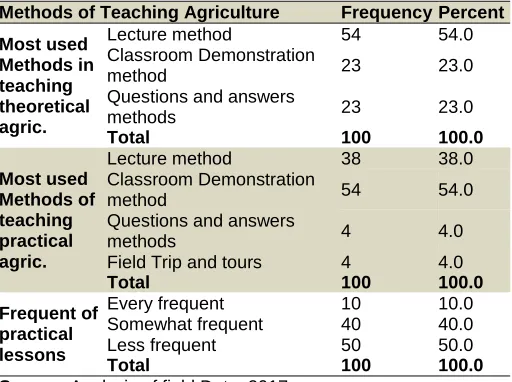
Students views on type of teaching method their teachers mostly used in the teaching of agricultural science related courses in the school were sought and the results presented in the Table 2. As shown in the Table 2, majority
(54 percent) of the students interviewed perceived that their teachers mostly used lecturing methods in teaching theoretical lessons, while 23 percent viewed classroom demonstration as the most used teaching method. However, regarding practical lessons, majority (54 percent) were of the view that classroom demonstrations are mostly used to teach them practical while 38 percent and 4 percent think that it is rather lecture method and field trips and tour respectively which are the most used teaching methods in delivering practical lessons.
Even though students interviewed generally had varying views of the most used method in the teaching and learning of theoretical and practical agriculture in their school, most of them were of the view that lecture and classroom demonstration methods are the most used teaching methods in the teaching of theoretical and practical lessons respectively.
Regarding students view on how frequent they had practical lessons in their school, which was measured on a Likert scale as ‘very frequent’, somewhat frequent’ and less frequent’. Analysis of their responses as shown in the Table 2, reveals that only 10 percent of them thought they undertake practical lessons very frequently. While half of them thought they undertake practical lessons less frequently and the remaining 40 percent viewed the frequency of their practical lessons as somewhat frequent.
Table 2: Method of teaching Agriculture in the School
Methods of Teaching Agriculture Frequency Percent
Most used Methods in teaching theoretical agric.
Lecture method 54 54.0 Classroom Demonstration
method 23 23.0 Questions and answers
methods 23 23.0
Total 100 100.0
Most used Methods of teaching practical agric.
Lecture method 38 38.0 Classroom Demonstration
method 54 54.0 Questions and answers
methods 4 4.0 Field Trip and tours 4 4.0
Total 100 100.0
Frequent of practical lessons
Every frequent 10 10.0 Somewhat frequent 40 40.0 Less frequent 50 50.0
Total 100 100.0
Source: Analysis of field Data, 2017
Students Learning of Agriculture
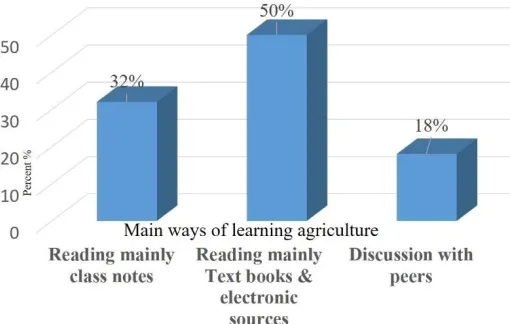
electronic sources of reading material (50 percent) or held discussions among themselves (18 percent). Thus, students interviewed relied mainly on notes taken during class lessons and their text books for their private studies.
Figure 1: Bar Graph showing students main ways of learning
Source: Analysis of field data, 2017
Students were required to indicate how actively they participated in practical lessons on three points Likert scale as ‘very active’, ‘somewhat active’ and ‘less active’. Analysis of their responses is presented in the bar graph shown in Figure 2. As shown in the figure, only a quarter (21 percent) of the students interviewed were of the view that they actively participated in practical lessons organized by their teachers. They explained that they always have to practice every activity demonstrated to them by their teachers. However, just about a half (48 percent) scored their participation in practical lessons as somewhat active and about a third (31 percent) ranked their participation in practical lessons as less active. Further probes reveal that due to limited TLMs, few number of practical lessons are actually organized by their teachers. And as such they hardly had opportunity of actively taking part in practical lessons.
Information gathered on students’ response to the question whether they make efforts to acquire practical agricultural skills by themselves shows that students hardly made extra efforts to acquire agricultural skills. The only effort they make is to identify and classify plant specimens which they indicted were enough to pass their examination. Thus, students’ motivation for undertaking practical lessons is to pass their examinations and not necessarily acquire the skills needed to be technically competent in agricultural as graduates.
This finding is worrying because the curricula of SHS general agriculture is expected to impart scientific knowledge and vocational agriculture skills on students to equip them with the requisite competencies in practicing agriculture (see MOE, 2010). However, the findings confirm the observation made by Darko et al, (2016) that
graduates of agricultural science often lacked the required skills and competencies in basic agricultural practices making them unable to engage in agricultural production as professionals.
According to existing literature, practical work (practical lesson), is the best way of learning science, it has also been reported that practical lessons makes learning more enjoyable (Osborne and Collins, 2001; Jenkins and Nelson, 2005; Toplis, 2012). However, if students participated in agricultural practice merely to pass their examinations then the impact of practical lessons will not be fully realised.
Figure 2: Bar graph showing students’ participation in practical
lessons
Source: Analysis of field data, 2017
Constraints and Challenges in Project Method of Teaching
This sub-section presents the study findings on constraints and challenges in undertaking project method of teaching from teachers’ and students’ perspectives. As such this section presents findings of the study addressing the main objective of the study which sought to ‘analyse the constraints facing the use of project teaching method in the teaching of agricultural science in the Awe Senior High School’.
Constraints/Challenges from Teachers’ point of view
During the in-depth interview sessions and focus group discussion with the teachers and school authorities (headmasters and head of agricultural science department), the question on constraints and challenges they faced in using project as method of teaching practical skills were toughly discussed. The following were commonly mentioned as constraints to their ability to organize project teaching method for their students:
Challenges of Teaching and Learning of Agricultural Practical Skills: The case of Deploying Project Method of Teaching among Students of Awe
farm nor garden, but make do with the open field available in the school which they have some few plants for teaching. The field serving as the school/garden is not fenced and do not have regular source of water. However, the school have few farm animals such as pigs, goats and sheep. The animals are kept under semi-intensive rearing system in which the animals are allowed to graze openly and are only housed during the night. The teachers were obviously worried about the lack of proper functioning school farm/garden and limited species of animal which in their view affected effective teaching and learning. The GES syllabus for general agricultural science requires schools to have functioning school farms and garden which should have at least one animal each from the common species of animals in the country (GES, 2010). Obviously worried, one teacher asked, during the focus group discussion;
‘How do you expect a teacher to give students practical projects when the school lacks functioning farm to support students undertake such projects...?’ (Verbatim comment of a
teacher).
Inadequate tools/equipment and material: Project method of teaching make use of tools and equipment to enable students have hands – on experience in carrying their projects, however, teachers observed that apart from hoe and cutlasses which students bought to school, the school did not have sufficient simple farm tools such as hand folk, travel and watering canes. Inadequate number of these farm tools coupled with the large number of students makes it practically difficulty to use project method of teaching. In carrying out this project, the researcher has sourced these simple farm tools to augment the few provided by the school to ensure every student had access to these tools which were essential in carrying nursery practices.
Inconveniences in conveying students for practical: Even though, the school had a bus for carrying students out of campus for practical work, the teachers complained, such an arrangement usually distracted classes and distorted day’s lessons. They explained that the bus cannot convey all agriculture students at once to practical sites and have to do it in many rounds and this make monitoring difficult as some truant’s students take advantage of that to abscond from school.
Insufficient funding for practical: Practical lessons are always expensive to organize, especially if it had to be undertaken outside the school compound where students have to be conveyed to practical site. Fuelling and maintaining the bus to support practical activities have been noted by the school authority as one of the challenges they faced in organizing practical sessions. The teachers observed, if you give students project which require them to go out of the school compound, then the
school have to provide fuel for the bus to convey them. One teacher at the focus group discussion lamented;
‘How can we strengthen practical lessons and give students practical projects, if anytime you requested for a bus to convey students for practical, you always get no fuel response from the headmaster...? (Verbatim comments from a teacher).
Also, the cost of practical material such as seeds for nursery, fertilizer and other agrochemicals, shading material among others are expensive for the school to purchase to support practical lessons. There is no dedicated funding to support agriculture practical and this makes it difficult to raise the needed resources to carryout practical. Also buying reagents for laboratory work is a challenge because of funding constraints.
Large class size: teachers complained of their inability to used project method of teaching because of the large student’s numbers. In project method of teaching, the teacher has to make sure that every student has a hand- on experience of the practical lessons. Because of the large class size teachers complained they will not be able to monitor students’ project effectively and as such they rarely use project method of teaching.
Poor farm manager and labourer: In the school there is a non – teaching staff in charge of the school farm and the same person also serve as farm labourer, which teachers identified as challenge in getting adequate human resource support to carry out practical teaching. Ideally the school should have had one farm manager and a number of farm labourers for crops and animals, which is not the case currently. The farm workers’ role includes maintaining the school farms/gardens and assisting teachers and student’s carryout practical lessons. The teachers indicated that, because of the inadequate farm workers they find it difficult to undertake project method of teaching. Also, the skills of the farm labourer had been described by teachers as poor and that they are unable to understand the practical students are supposed to undertake and as such cannot offer any support in that regard. One teacher observes;
‘The farm labourer also does not have the skills, how can he assist us or students in carrying out their projects’ (Verbatim comments from a teacher).
learning of agricultural skills among public second cycle institutions as lack of interest, inadequate equipment in agricultural laboratory and lack of home garden.
Constraints/Challenges from Students’ Perspective
During the interview session, students were required to indicate the constraints they faced in carrying out their project and rank constraints in order of their severity. The following were mentioned by students as constituting constraints/challenges in carrying their projects;
Poorly equipped school farm Inadequate tools/equipment
Large class size and grouping problem Short periods allocated to practical Poor skilled farm labourer
Difficult and time consuming High cost of materials
Similar constraints to agricultural skills acquisition were found in Otekunrin, et al, (2017) and Samuel, et al, (2016). Also, Darko, et al, (2016) identified similarly issues such as lack of equipment, inadequate teaching and learning materials, poorly trained and motivated teachers and lack
of school garden and laboratory as the main constraints facing teaching and learning of practical agriculture among second cycle institutions.
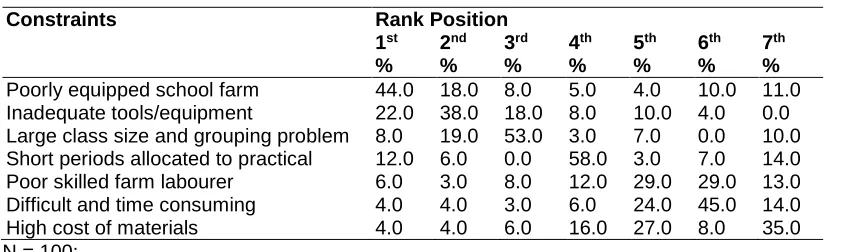
Table 3, presents frequency distribution of ranked score assigned to the constraints identified by the students, while Table 4 presents means rank score, ranked position and Kendall coefficient of concordance (w). As shown in the table 2, about 44% of the students ranked poorly equipped school farm as their number one constraints, while 22% ranked inadequate tools/equipment as their most severe constraint in carrying out their projects.
About half (53%) ranked large class size and grouping problem as their third most severe constrain in carrying out their projects, while majority (58%) ranked short periods allocated to practical as the number 4th severe constraints they faced in carrying out their projects. Also 29% of the students interviewed ranked poor skills of farm labourer as their number 6th constraint while 45% ranked difficult and time-consuming nature of project method of teaching their number 6th constraint. High cost of material was ranked by 35% of the students as the number 7th or least constraint.
Table 3 Distribution of ranks of constraints
Constraints Rank Position
1st 2nd 3rd 4th 5th 6th 7th
% % % % % % %
Poorly equipped school farm 44.0 18.0 8.0 5.0 4.0 10.0 11.0
Inadequate tools/equipment 22.0 38.0 18.0 8.0 10.0 4.0 0.0
Large class size and grouping problem 8.0 19.0 53.0 3.0 7.0 0.0 10.0 Short periods allocated to practical 12.0 6.0 0.0 58.0 3.0 7.0 14.0
Poor skilled farm labourer 6.0 3.0 8.0 12.0 29.0 29.0 13.0
Difficult and time consuming 4.0 4.0 3.0 6.0 24.0 45.0 14.0
High cost of materials 4.0 4.0 6.0 16.0 27.0 8.0 35.0
N = 100:
Source: Analysis of field survey data, 2017
To assess the level of agreement of ranks assigned by students to the constraints, Kendall’s coefficient of concordance test was conducted. The test was found to be significant with Chi-square (df = 6) = 176.374; Sig. = 0.000. Also, Kendall's Wa = 0.592 indicating that about 60% of the ranks assigned by the students were in agreement.
As shown by the mean rank score, inadequate tools/equipment was ranked as the most severe constraint followed by poorly equipped school farm. With large class size and grouping problem and short periods allocated to practical were respectively ranked as the 3rd and 4th constraint to undertaking projects, while poor skilled farm labourer and difficult and time consuming ranked as the 5th and 6th constraints respectively. High cost of materials was ranked as the least constraint to undertaking project method of teaching by students.
Table 4: Distribution of mean ranked scores
Constraints Mean
Rank
Rank Position Poorly equipped school farm 2.79 2nd
Inadequate tools/equipment 2.54 1st
Large class size and grouping problem 3.17 3rd Short periods allocated to practical 4.11 4th Poor skilled farm labourers 4.92 5th Difficult and time consuming 5.32 7th
High cost of materials 5.16 6th
N = 100; Kendall's Wa = 0.592; Chi-square = 176.374; df = 6; Sig. = 0.000;
Source: Analysis of field survey data, 2017
CONCLUSION AND RECOMMENDATIONS
Challenges of Teaching and Learning of Agricultural Practical Skills: The case of Deploying Project Method of Teaching among Students of Awe
science theory with class demonstration mostly employed in teaching practical sessions. Other methods of teaching mostly used included, classroom discussion with students, classroom demonstrations and questions and answers. The constraints/challenges to undertaking project method of teaching were identified as inadequate tools/equipment, large class size and grouping problem, short periods allocated to practical, poor skilled farm labourer, difficult and time consuming and high cost of materials, in decreasing order of severity. It is recommended that the school authority and Ghana Education Service (GES) should endeavour to provide adequate teaching and learning materials to schools to ensure effective application of project method of teaching for effective teaching and learning of agricultural practical.
REFERENCE
Alkali, M. (2010). The Case of Agriculture as the only Saviour to Nigeria’s Deing Economy. Retrieved on
05/02/2017 from
<hhttp://www.gamji.com/articles4000/NEWS.htm> Blackie, M., Mutema, M. and Ward, A. (2009). A study of
Agricultural Graduates in Eastern, Central, and Southern Africa: Demand, quality and job performance issues.
Collins, S. (2011). What do students think about science? In: R, Toplis. (Ed.), How science works: Exploring effective pedagogy and practice (pp. 14-30). Oxon:Routledge.
Darko R.O., Yuan S., Okyere D., Ansah,C.O., and Liu, J., (2016). Agricultural Science As a Component of the Curriculum of Senior High School Integrated Science in Ghana. – Its Effects and the Wayford. IJRDO - Journal of Agriculture and Research Vol2 (6).
Deegan D, Wims P and Pettit P, (2016). Practical Skills Training in Agricultural Education—A Comparison between Traditional and Blended Approaches. The Journal of Agricultural Education and Extension. Volume 22, 2016 - Issue 2.
Gültekin, M. (2007). Proje Tabanlı Öğrenmenin Beşinci Sınıf Fen Bilgisi Dersinde ÖğrenmeÜrünlerine Etkisi. Elementary Education Online, 6 (1), 93-112
Hodson, D. (1990). A critical look at practical work school science. School Science Review, 70 (256), 33-40. Jansen L, 2012. Reflections of Two Collaborating
Educators Taking A Constructivist Approach to Project Work in an Elementary Classroom. Queen’s University Kingston, Ontario, Canada. April, 2012. copyright © Laura Jansen, 2012
Jenkins, E. W., and Nelson, N. W. (2005). Important but not for me: Students' attitudes towards secondary school science in England. Research in science and Technological Education, 23 (1), 41-57.
Fallik, O., Eylon, B. S., and Rosenfeld, S. (2008). Motivating teachers to enact free-choice project-based learning in science and technology (PBLSAT): Effects
of a professional development model. Journal of Science Teacher Education, 19, 565-591
Katz, L. G., and Chard, S. C. (2000). Engaging children’s minds: The project approach. (2nd Ed.) Norwood, NJ: Ablex
Kemmis, Stephen and McTaggart, Robin (2005). Participatory action research. Communicative action and the public sphere. In Norman K. Denzin and Yvonna S. Lincoln (Eds.), Handbook of qualitative research (3rd ed., pp.559-603). Thousand Oaks, CA: Sage.
Kendall, M. G. and Babington, S. B. (1939). The problem of m rankings. Annals of Mathematical Statistics, 10: 275–287.
Kidd, S. A., and Kral, M. J. (2005). Practicing participatory action research. Journal of Counseling Psychology, 52(2), 187-195. http://dx.doi.org/10.1037/0022-0167.52.2.187 (retrieved on 10th November, 2017). Krajcik, J. S., Blumenfeld, P. C., Marx, R. W., and
Soloway, E. (1994). A collaborative model for helping middle grade teachers learn project based instruction. The Elementary School Journal, 94(5), 483–497. Krajcik, J.S., C.M. Czerniak, and Berger, C.F. (2002).
Teaching science in elementary and middle school classrooms: A project-based approach. 2nd ed. New York: McGraw Hill
Krajcik J., McNeill KL and Reiser, B. (2008). Learning Goals – driven design model developing curriculum materials that align with national standards and incorporate project – based pedagogy. Science Education, 92(1); 1 - 32
Legendre, P. (2010). Coefficient of concordance. Pp.164-169 in Encyclopedia of Research Design.1 N.J salkind, ed. SAGE Publications. Inc., Los Angeles. 1776 Pp. ISBN: 9781412961271.
Lunetta, V.N., Hofstein, A. and Clough, M. (2007). Learning and Teaching in the School Science Laboratory: An analysis of research, theory, and practice. Handbook of research on science education. (pp. 393-441).
Meece, J. L., Anderman, E. M., and Anderman, L. H. (2006). Classroom goal structure, student motivation and academic achievement. Annual Review of Psychology, 57, 487-503.
MOFA (2010). Medium Term Agriculture Sector Investment Plan (METASIP) 2011 – 2015. Ministry of Food and Agriculture (MOFA), Government of Ghana (GOG), Accra
MOFA (2012). Report of agricultural sector performance review. Ministry of Food and Agriculture (MOFA), Government of Ghana (GOG), Accra
MOFA (2015). Medium Term Agricultural Sector Investment Plan (METASIP) II, 2014 - 2017. Ministry of Food and Agriculture (MOFA), Government of Ghana (GOG), Accra
Security and National Sustainability: Journal of Educational and Social Research, 3 (4):161-170. Mundi, N. E. (2006). The state of students’ academic
achievement in secondary school agricultural science in Kogi State. Teacher Education Journal (TEJ), 12(1), 14-19.
Nwachukwu, C. E. (2001). Designing appropriate methodology in vocational and technical education for Nigeria. Nsukka - Nigeria: Faladu publishing company. Okorie, J.U. (2001). Vocational industrial education,
Owerri: League of researchers in Nigeria.
Otekunrin OA, Oni LO and Otekunrin OA., (2017). Challenges, Attitudes and Academic Performance of Agricultural Science Students in Public Secondary Schools of Ibadan North, Nigeria. Journal of Scientific Research and Reports 13(1): 1-11, 2017;
Onuekwusi, G. C. and Okorie, L, 2008. Attitude of secondary school students in Abia State towards career in Agriculture. Agricultural Journal, 2008: 3 (2), 102-106.
Osborne, J., and Collins, S. (2001). Pupils' views of the role and value of the science curriculum: a focus-group study. International Journal of Science Education, 23 (5), 441-467
Perry, N. E., Hutchinson, L., and Thauberger, C. (2008). Talking about teaching selfregulated learning: Scaffolding student teachers’ development and use of practices that promote self-regulated learning. International Journal of Educational Research, 47, 97-108.
Perry, N. E., Phillips, L., and Dowler, J. (2004). Examining features of tasks and their potential to promote self-regulated learning. Teachers College Record, 106, 1854- 1878.
Ryan, R. M., and Deci, E. L. (2000). Intrinsic and extrinsic motivations: Classic definitions and new directions. Contemporary Educational Psychology, 25, 54-67. Science Community Representing Education (SCORE,
(2008). Practical Work in Science: A Report and Proposal for a Strategic Framework. Gatsby Technical Education Project publication December, 2008.
Available on
http://www.score-education.org/media/3668/report.pdf (retrieved on 20th February, 2017)
Samuel J. E, Fawole O. P., Badiru O. I., (2016). Students’ Perception of West African Agricultural Productivity Programme Adopted Schools Programme in Oyo State, Nigeria. Journal of Agricultural Extension. Vol. 20 issue 2 (2016)
Swain, J., Monk, M., and Johnson, S. (1999). A comparative study of attitudes to the aims of practical work in science education in Egypt, Korea and the UK. International Journal of Science Education, 21 (12), 1311-1324.
Thomas, J. (2000). A Review of the Research on Project-Based Learning. The Autodesk Foundation
Toplis, R. (2012). Students’ views about secondary school science lessons: The role of practical work. Research in Science Education, 42 (3), 531-549.
Tse, S. K., Lam, W. I., Lam, Y. H., and Loh, E. K. Y. (2005). Learn to read: The performance of Hong Kong primary 4 pupils in PIRLS 2001. Hong Kong: Hong Kong University Press.
Wellington, J. (Ed.). (1998). Practical work in school science: which way now? London: Routledge.
FAO, (2012). Teaching Vocational Agriculture in Schools: National Open University of Nigeria School of Science and Technology. 14/16 Ahmadu Bello Way, P.M.B. 80067, Victoria Island, Lagos.
Accepted 8 February 2018
Citation: Diise AI, Zakaria H, Mohammed AA (2018). Challenges of Teaching and Learning of Agricultural Practical Skills: The case of Deploying Project Method of Teaching among Students of Awe Senior High School in the Upper East Region, Ghana. International Journal of Agricultural Education and Extension, 4(2): 167-179.