Geographic Load Balancing for Scalable Distributed Web Systems
Valeria Cardellini
University of Roma Tor Vergata
Roma, Italy 00133
[email protected]
Michele Colajanni
University of Modena
Modena, Italy 41100
[email protected]
Philip S. Yu
IBM T.J. Watson Research Center
Yorktown Heights, NY 10598
[email protected]
Abstract
Users of highly popular Web sites may experience long delays when accessing information. Upgrading content site infrastructure from a single node to a locally distributed Web cluster composed by multiple server nodes provides a limited relief, because the cluster wide-area connectivity may become the bottleneck. A better solution is to distribute Web clusters over the Internet by placing content nodes in strategic locations. A geographically distributed architec-ture where the Domain Name System (DNS) servers evalu-ate network proximity and users are served from the clos-est cluster reduces network impact on response time. On the other hand, serving closest requests only may cause un-balanced servers and may increase system impact on re-sponse time. To achieve a scalable Web system, we pro-pose to integrate DNS proximity scheduling with an HTTP request redirection mechanism that any Web server can ac-tivate. We demonstrate through simulation experiments that this further dispatching mechanism augments the percent-age of requests with guaranteed response time, thereby en-hancing the Quality of Service of geographically distributed Web sites. However, HTTP request redirection should be used selectively because the additional round-trip increases network impact on latency time experienced by users. As a further contribution, this paper proposes and compares various mechanisms to limit reassignments with no nega-tive consequences on load balancing.
1. Introduction
The phenomenal growth of the Web is causing enor-mous strain on users, network service providers and content providers. Geographically distributed Web systems are the most scalable architectures to handle millions of accesses per day. In this paper, we consider a Web site that uses a single URL address to make the distributed nature of the
c
2000 IEEE. Proc. of Mascots 2000, San Francisco, Aug./Sep. 2000.
service transparent to the users. The system architecture consists of various Web clusters placed in strategic Inter-net regions. Each Web cluster consists of one or more Do-main Name System (DNS) servers and replicated back-end
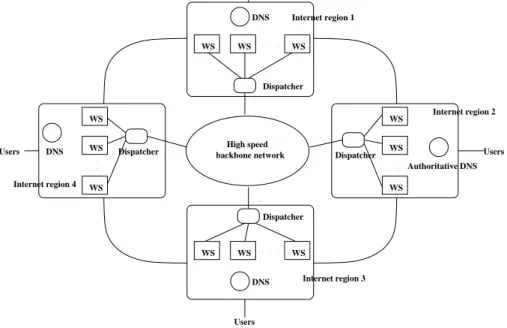
Web server machines1 that are housed together in a loca-tion of an Internet region. Figure 1 shows an example of distributed Web site consisting of four Web clusters, each of them with multiple Web server nodes (WS) that are con-nected via a fast local network. Web clusters are typically interconnected via a high speed backbone to facilitate co-operation and information exchanges among the centers. To control the totality of the requests reaching the cluster and to mask the service distribution among multiple servers, each Web cluster provides a single virtual IP address that corre-sponds to the address of a front-end server. Independently of the mechanism that a Web cluster uses to route the inter-nal load (see [12] for an overview), we refer to this front-end node as the Dispatcher. The Dispatcher acts as a centralized scheduler that receives the totality of requests reaching the Web cluster and routes them among the back-end servers in a client transparent manner. In a geographically distributed Web system, the decision on client request assignment can be taken at various network levels. A survey on distributed Web architectures can be found in [3].
The DNS servers of the Web site execute the first-level
assignment. It acts on the address lookup phase of a client
request that looks for an IP address corresponding to the URL hostname field. We assume that in a geographical context, it is appropriate to use an enhanced DNS server that implement some proximity algorithm to reply to the name resolution request. Through this mechanism, the DNS will reply with high probability with the IP address of the Web cluster Dispatcher closest to the client. DNS address caching mechanisms augment this probability because in-termediate name servers of each Internet region will tend to get the resolution of the closest cluster. The concept of Internet proximity is still an open issue that will not be ad-dressed in this paper, however many proposals exist for es-1We consider systems with homogeneous Web clusters, where any
High speed backbone network WS WS WS . . . DNS Dispatcher WS WS . . . WS DNS WS WS . . . WS DNS WS WS WS . . . Dispatcher Dispatcher Users Users Users Users Internet region 3 Internet region 2 Internet region 1 Internet region 4 Dispatcher Authoritative DNS
Figure 1. Architecture of the geographically distributed Web site.
timating static (e.g., network hops) or dynamic distances (e.g., network traffic) [5].
After the lookup phase, the page request arrives at the Dispatcher of a Web cluster that executes the second-level
assignment among the server nodes. Dispatcher algorithms
are out of the scope of this paper because we can assume that the Dispatcher is able to keep the load balanced among the servers of a Web cluster [8, 12].
The DNS assignment is a very coarse grain distribu-tion of the load among the Web clusters, because proxim-ity does not take into account heavy load fluctuations of Web workload that are amplified by the geographical con-text. Requests arrive in bursts, clients connected to the Web site are not uniformly distributed among the Internet domains, world time zones are another cause of heteroge-neous source arrivals. To address these issues, we propose a distributed architecture that integrates DNS dispatching among the Web clusters with a third-level (re)assignment that can be activated by any Web server that is in critical load condition. The redirection mechanism is done through the HTTP protocol that allows a Web server to redirect a request by specifying the appropriate status code in the re-sponse header and indicating the alternative IP address from which the client can obtain the requested document [1, 4].
Through the redirection mechanism, an over-utilized server can get immediately rid of a fraction of the requests previously assigned by the DNS and the Dispatcher. Since this dispatching acts on individual requests of Web pages, it can achieve a fine grain control level. However, HTTP server redirection should be used selectively because it adds
a round-trip latency to every re-assigned page request. The users may perceive or not an increase in the response time, depending on the load of the first contacted server. Hence, the second objective of this paper is to investigate whether it is possible to limit request redirection without affecting system load balancing. To this purpose, we propose and compare various mechanisms to limit request redirection. The goal is to guarantee that network overheads due to redi-rection have an impact on user latency time inferior to the system overhead due to an overloaded Web server. We show that strategies that limit redirection to heaviest requests can reduce substantially the amount of redirections and do not degrade Web cluster load balancing. The study is carried out through a simulation model of the Web system and net-work infrastructures. The system model details all char-acteristics of Web client/server interactions, while the net-work model is an approximate Internet vision that should provide a fair testbed to compare performance of different algorithms for geographic load balancing.
The paper is organized as follows. Section 2 analyzes re-lated work. Section 3 presents various policies for request redirection by the Web servers and for limiting the percent-age of redirected requests. Section 4 and 5 describe the sys-tem and network model, respectively. Section 6 discusses experimental results. Section 7 concludes the paper.
2. Related work
A considerable number of academic and commercial proposals regarding Web architectures with multiple nodes
have focused on how to share the load evenly, especially in locally distributed Web systems [3, 12].
Two-level dispatching schemes, where client requests are initially assigned by the DNS, and each Web server may redirect a request to any other server of the system through the HTTP redirection mechanism, have been proposed for locally distributed Web systems in [1, 4]. Other request redirection strategies that use the built-in HTTP mechanism have been proposed for geographically distributed Web sys-tems. For example, Cisco’s DistributedDirector [6] uses a centralized single-level dispatching scheme: each request reaches a dispatcher that directs it to the Web server that is closest to the client. Most of the proposed geographically distributed Web systems place one or more Web clusters in different Internet regions, for example F5 Networks and Resonate products. The first-level assignment among the Web clusters is typically carried out by the Web site DNS that implements some proximity based dispatching strategy. The originality of this paper is twofold. We consider not only sharing the load, but also minimizing the impact of WAN network delays on response times perceived by the users. Our proposal to augment the Quality of Service (QoS) of geographically distributed Web systems is to use a third-level dispatching through which over-utilized servers can immediately activate a redirection mechanism. Since request redirection may increase latency time experienced by the users, our second goal is to propose strategies that select the most suitable subset of requests to be redirected.
A quite different solution to geographical distribution of Web content is provided by companies that offer global de-livery services, such as Akamai and Mirror Image. When using this service, Web site administrators delegate the re-sponsibility for content distribution to the service company that owns a set of geographically dispersed servers. They constitute the so-called content distribution network con-taining copies of the objects. The system is integrated with a mapping service where the Web site DNS or the Web site servers work in cooperation with the company servers. This mapping service aims to redirect the page requests to a nearby company server with low-medium utilization.
3. Server redirection strategies
We consider a Web architecture distributed over a wide area that does not make convenient to use centralized load redirection policies [4]. Hence, we focus on totally dis-tributed mechanisms where redirection is activated by an alarm mechanism that checks CPU-disk utilization of each server node. Any overloaded server starts to redirect re-quests when its load exceeds a threshold load and ends when the load returns below the threshold. As a load metric, we use the server utilization evaluated during the last obser-vation period, referred to as the check-server-load interval.
Name Information
Selection policies R-all none
R-size page size
R-num page hit number
Location policies RR none
Load Web cluster load
Prox network proximity
Table 1. Server redirection policies.
Once the server has decided to activate the redirection process, the selection policy determines which requests have to be redirected. We assume that only new requests for entire pages are eligible for redirection. The straightforward solution is to redirect every request reaching an overloaded server (i.e., redirect-all policy or R-all). We also investi-gate how it is possible to limit request redirection, because it increases the network impact on response time and in-curs transfer overhead on the servers. To this purpose, we propose two schemes that redirect heaviest requests only. R-size redirects requests for Web pages larger than a cer-tain size. The motivation is that Web workload (file sizes or dynamic requests) follow a heavy-tailed distribution [11]. Hence, a very small fraction of the largest files determines a large fraction of the load. We use the average size of a static Web page and its objects as the default size thresh-old for requests of static contents, while we use the mean magnitude of the processing cost for dynamic Web page re-quests. As a further policy, R-num considers for redirection only those pages consisting of a large number of embedded objects (hits). We use the average number of hits in a Web page as the default threshold for deciding about redirection. Once selected the load to be redirected, the location
pol-icy selects the Web cluster that will receive the redirected
requests. We consider three alternatives. The stateless RR policy redirects the selected requests to all Web clusters in a round-robin way. The Load policy uses some system load information; it redirects requests to the Web cluster which has the lightest load, as observed in the past
check-cluster-load interval. The Prox policy uses some network check-cluster-load
in-formation; it redirects requests to the Web cluster that in the past check-network-load interval resulted best connected to the redirecting cluster. Information about Web cluster load and dynamic network proximity is provided through mes-sages exchanged by the Dispatchers. Table 1 summarizes the server redirection strategies we analyze. We will denote the redirection algorithms by considering selection and lo-cation policy. For example, R-size Prox is the algorithm that uses the size-based selection policy, and the network proximity location policy.
4. System and client model
We divide the Internet into geographical regions
lo-cated in different world areas. Each region contains a Web cluster, one or more DNS servers for the Web site (see Fig-ure 1), and various client domains. The popularity of the domains in each region is described through a Zipf
distri-bution with parameter that corresponds to a highly
skewed function [11].
We define the following time-dependent model to repre-sent the variability of traffic coming from Internet regions, so that the most popular region can change during the sim-ulation runs. Let be the percentage of clients
belong-ing to region at time, where
"! . This
pop-ularity function changes dynamically as in Figure 3a of [2]. To take into account world time zones, we assume that the time in region$#%!$'&)(+*) is shifted of
hours forward with respect to region.
Client arrivals to the Web system follow an exponential distribution [14], where the mean interarrival time is set to 0.05 seconds, if not otherwise specified. Each client is as-signed to one Internet region with probability ,, and
as-signed to one client domain in that region through the corre-sponding Zipf distribution. The period of visit of each client to the Web site is called session. The workload model in-corporates the most recent results on Web characterization. The high variability and self-similar nature of Web access load is modeled through heavy-tailed distributions such as Pareto, lognormal and Weibull distributions [2, 11, 14].
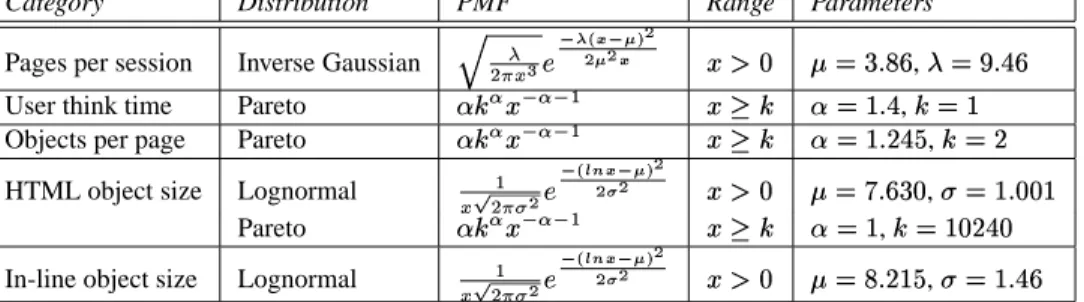
The number of consecutive Web pages a user will request from the Web system (page requests per session) follows the inverse Gaussian distribution [11]. The client’s silent time between the retrieval of two successive Web pages, namely the user think time, is modeled through a Pareto distribu-tion [11]. The self-similarity of Web traffic requests is ex-plained with the superimpositions of heavy-tailed ON-OFF periods. The number of objects that make up a whole Web page, including the base HTML object and its in-line re-ferred files, also follows a Pareto distribution [11]. Web file sizes typically show extremely high variability in size. The function that models the distribution of the object size re-quested to the Web site varies according to the object type. For HTML objects, it is obtained from a hybrid distribution, where the body follows a lognormal distribution, while the tail is given by a heavy-tailed Pareto distribution [2, 11]. For in-line objects in a page, the size distribution is obtained from the lognormal function [11]. Table 2 shows the dis-tributions, probability mass functions and parameter ranges for the workload model.
In the simulation experiments we assume that there are
.- regions. Each Web cluster has 4 homogeneous
server nodes for a total of 16 Web servers. Each simula-tion run lasts for 24 hours, and the time difference among
the regions is
/ . Most experiments are carried out for
a long-term system utilization kept around 0.6-0.65 of the capacity of the entire Web system. The time to serve each client request includes all delays at the Web cluster, such as dispatching time, parsing time, service time for the page request and all embedded objects or redirection time. If not otherwise specified, the check-server-load interval is set to 8 seconds, while check-cluster-load and check-network-load intervals are set to 16 seconds. The threshold value of server utilization that triggers the redirection mechanism is set to 0.75. No substantial changes in results were observed for thresholds equal to 0.80 or 0.85.
5. Network model
The network model aims at providing a controllable testbed where the transmission between Web clusters and clients has a cost, but the network does not represent the main bottleneck. This choice is motivated by the focus of this paper on system management algorithms. Moreover, network service providers are continuously improving net-work infrastructure to accommodate higher bandwidth.
The goal is to measure the impact of redirection on re-sponse time compared to request rere-sponse time of not redi-rected requests. For this reason, we do not consider real Internet connections, network hierarchies, and narrow net-work bandwidth in the last mile. The model for communi-cation delays is based on the following assumptions that, although simplified and subject to further improvements, introduce less arbitrary choices than pseudo-real network hierarchies and connections that could affect a fair compar-ison of the proposed algorithms.
In the model, we refer to the HTTP/1.1 protocol that uses persistent connections and pipelining that is, the connection is left open between consecutive objects transmissions or at least for 15 seconds and the browser can send multiple requests without waiting for a response. From [7] we have that the time to transmit 0 objects belonging to the same
page between region and1 is given by 243567 98;:<>=?# 7 @ A CB 5DEFHG;I+J >=K#LB 5MDNFHGOI+J =P (1) where:<>= and I+J
Q= are the round-trip time and the avail-able bandwidth between region and1 , respectively;B
5MDE
and B 5MDN
are the size of the client request and server re-sponse for each objectR , respectively. Equation 1 denotes
that the time to transmit any message over the Internet is given by the time to establish a connection plus the ratio of the message size divided by the available bandwidth. Let us first discuss the message size by distinguishing client re-quest and server response.
Although the traffic generated by Web clients is only about 6-8% of the global traffic (measured in bytes) that is,
Category Distribution PMF Range Parameters
Pages per session Inverse Gaussian S T
UWV$XZY\[^]\_a`>ba]Hcad>e e c e b fhgi jlknmHop$q ,r knsHot<q
User think time Pareto u4vHw
fyx w xyz fh{ v u k}|~ot ,v k}|
Objects per page Pareto u4v
w f x w xyz fh{ v u k}|~oat; ,v k
HTML object size Lognormal
z Xa UWV e [ ] `~ba]Hcad e eW e
fhgi jlkOoq$m~i
, k}|$oi$iO| Pareto u4v w f x w xyz fh{ v u k}| ,v k}|Mi<t$i
In-line object size Lognormal
z X UWV e [ ] `~ba]Hcade eW e
fhgi jlknpHoO|Z
,
k}|$ot<q
Table 2. Workload model.
!
G;
of the traffic generated by Web servers [13], it is impor-tant to consider the client message component because of overheads of the HTTP redirection mechanism. The size of a client requestB
5DE
is exponentially distributed with mean equal to 358 bytes and typically fits a single packet. The server response consists of multiple files with various sizes following heavy-tailed distributions such as those described in Section 4.
The second parameter in Equation 1 is the available
bandwidthI+J
Q= that measures the communication delays
be-tween two Internet regions. We assume that these delays are due to a static factor (basic bandwidth) and a dynamic factor (traffic). The basic bandwidth JaJ
>= between region and1
can be assumed deterministic. In particular, the basic band-width within a region and between this region and others is supposed to be large, medium-large, medium-narrow and
narrow. The bandwidth values reported in Table 3 are taken
in [7, 13]. We also carried out some sensitivity analysis (not shown due to space limits) as a function of the basic band-width. By halving or doubling the basic bandwidth among all Internet regions, we observed that this parameter does not affect the main conclusions of this paper.
Bandwidth type Basic bandwidth Round-trip time
Large 1.35 Mbps [40, 70] msec
Medium-large 0.9 Mbps [120, 150] msec
Medium-narrow 0.7 Mbps [180, 210] msec
Narrow 0.4 Mbps [270, 300] msec
Table 3. Network model.
We assume a good connection inside each region (that is,JaJ
large), and the same bandwidth in both directions
(that is,JJ Q=
JaJ
=). To determine the bandwidth between
the four regions, in the simulation experiments we consider the following values: JaJ
l large, JJ l medium-large, JaJ JaJ JJ medium-narrow, JaJ narrow.
We model the Internet traffic as a random parameter that reduces the basic bandwidth. This parameter changes dy-namically to take into account time zones and busy/quiet hours of each region. LetyQ= be a value between 0 and 1
that denotes how much fraction of the basic bandwidth can
be used by a connection between region and1 . Therefore,
the available bandwidth at time is IJ
Q=\,yQ= JJ
Q= .
Since the traffic depends on the number of clients in the re-gions, we assume that the fraction of bandwidth available to a connection starting from a region and ending in another one, is related to the popularity of the two end-point regions. To model this assumption, we define a discrete random vari-able , that represents the connection type and can take one
of the following three values: P lucky connection or light
network traffic,0 normal connection or mild network
traf-fic,y unlucky connection or heavy network traffic.
Let +
be the probability to have a connection of
typeL $P;¡0;¡y;¢ in region, where £¥¤
¦#L 7 ¤ ¦# §;¤ "! . The distribution of
is related to the
popu-larity of region; therefore, it is time-dependent. Let
be the fraction of bandwidth for a connection of type
starting from region . We assume that a connection can
experiment a fraction of bandwidth varying in the inter-val ¨ © , defined as ¨H£¤ © «ª Q¬H+¡!\ O®, ¨ 7 ¤ © ¯ª° Q+¡° >¬OH, ¨\§;¤ © ±ª° Q8+¡° QH . Hence,
is a random variable
uni-formly distributed in the interval¨
© , and is obtained in the
following way: first, is determined by using the
distribu-tion for +
,; then, the value for
is selected
ran-domly according to the value. The fraction of
band-width for a connection between region and1 is given by >= ²³ O ,¦#´° Q; =
. This choice takes into
ac-count different levels of popularity that any Internet region may have at time. For example, if a lot of requests will
arrive from region at time, while region1 has a low
num-ber of clients, then the traffic for a connection between re-gion and1 will result low/medium with high probability.
On the other hand, if both the regions are highly populated at time , then the connection is unlucky with high
prob-ability. Moreover, this network model includes the possi-bility that a client connected to the server through a large basic bandwidth may experiment unlucky connections due to heavy traffic. Dually, a client far from the server may ex-perience a medium bandwidth thanks to a lucky connection. Since Paxson points out that Internet paths are heavily dom-inated by a single prevalent route and that about two-thirds of the Internet paths have routes persisting for either days
or weeks [10], we consider the same available bandwidth value for the entire client session.
The last parameter in Equation 1 to be discussed is the
round trip time that denotes the time necessary to establish
the TCP connection between the client and the server inside and between Internet regions [7]. We set four intervals of round-trip delays, one for each type of bandwidth, and we choose randomly the round-trip time in the corresponding set. The interval values are reported in Table 3.
6. Experimental results
In this section we consider the objective of minimizing the response time experienced by users that access a ge-ographically distributed Web site. We use the cumulative distribution of the page response time as the main perfor-mance metric, because in a highly variable system it is more significant than average values. The page response time corresponds to the interval elapsed between the submission of the client request for a given page and the arrival at the client of all objects corresponding to the page request. It in-cludes TCP connection time, delays at Web server, network transmission time, and possible redirection overheads. To verify which proposed load management algorithm guaran-tees Quality of Service, we use also the 90-percentile of the page response time that is, the page response time limit that the Web site guarantees with 0.9 probability [9]. An-other interesting performance parameter is the percentage of
redirected requests because a further goal of this study is to
propose and compare algorithms that minimize this value. The simulator, based on the Independent Replication Method, was implemented using the CSIM18 package. Each value is the result of ten or more simulation runs (each lasting 24 hours) with different seeds. The goal was that for all simulation results the 95% confidence interval resulted to be within 5-6% of the mean.
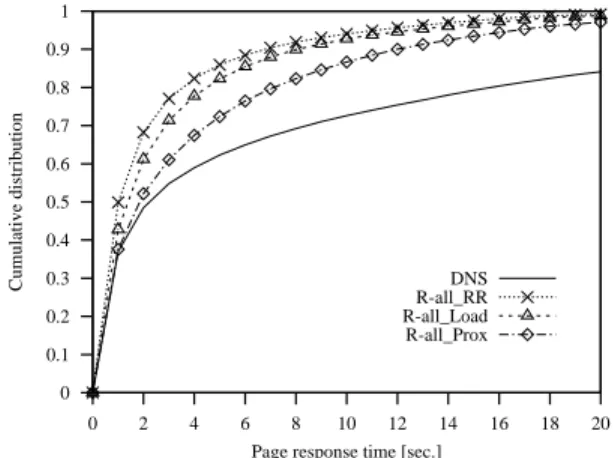
Figure 2 compares the cumulative distribution for the DNS proximity assignment with that of various redirection schemes based on the simplest selection policy (R-all) that lets an overloaded Web server to redirect all requests to a different Web cluster. This figure shows that even this naive server redirection approach achieves substantial per-formance improvement when compared to systems where scheduling is done by DNSes and Web cluster dispatchers only. All redirection policies guarantee that the maximum response time is below 20 seconds while analogous perfor-mance is guaranteed to only 80% of requests assigned by proximity-based DNS algorithms. The 90-percentile of the best redirection policy is equal to 7 seconds that is, about the value that many studies and surveys consider the ser-vice level acceptable to most Web users. The analogous service level is guaranteed to less than 70 percent of clients of Web systems based on two-level scheduling mechanisms
(see DNS curve). If we compare the three location policies (RR, Load, Prox), we observe that the circular reassignment among all Web clusters achieves best performance, the pol-icy that reassigns requests to the least loaded cluster per-forms slightly worse, while the Prox location policy redi-recting all requests to the closest Web cluster shows signif-icantly worse results. The motivation for this results is that when we reassign all requests, it seems preferable to spread the load among multiple Web clusters than concentrating all redirected load to one cluster, even if the receiver cluster is the lowest loaded or the closest. We observed that typ-ically a burst of redirected requests improves performance on the sender cluster, but causes a temporary overload on the receiver cluster that, on its turn, activates the redirec-tion mechanism. The consequence is that the Web system remains unstable for longer periods with tangible conse-quences on response time.
0 0.1 0.2 0.3 0.4 0.5 0.6 0.7 0.8 0.9 1 0 2 4 6 8 10 12 14 16 18 20 Cumulative distribution
Page response time [sec.] DNS R-all_RR R-all_Load R-all_Prox
Figure 2. Cumulative distribution of page re-sponse time for the R-all selection policy.
We next consider selection policies that limit redirection on the basis of the estimated size of the requested page (R-size) or number of hits (R-num). Due to space lim-its, we plot the results of the former policy only, even be-cause similar results are obtained for the latter algorithm. Figure 3 shows that redirecting only client requests hav-ing a size larger than the average page size improves for small response time values the performance achieved by the naive selection scheme. Now the relative performance or-der between Load and RR location policies is inverted, and size Prox performs much better than corresponding R-all Prox. This confirms that redirecting only a subset of requests reduces instability because the receiver cluster is not overwhelmed by bursts of additional requests. Hence, it becomes convenient to consider for redirection the least loaded cluster instead of proximity or circular assignments. In the following experiments we compare the
perfor-0 0.1 0.2 0.3 0.4 0.5 0.6 0.7 0.8 0.9 1 0 2 4 6 8 10 12 14 16 18 20 Cumulative distribution
Page response time [sec.] DNS R-size_RR R-size_Load R-size_Prox
Figure 3. Cumulative distribution of page re-sponse time for the R-size selection policy.
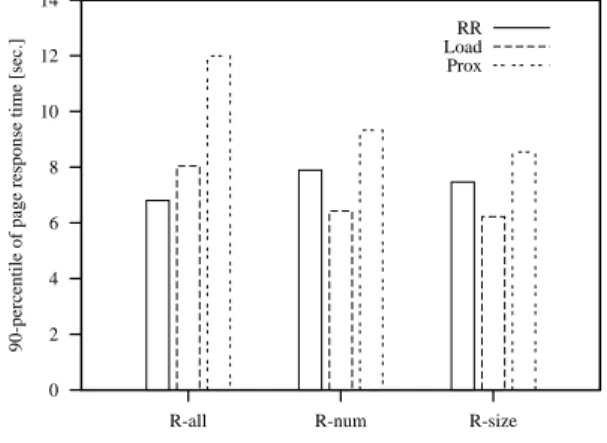
mance of various selection and location policies by taking into account the 90-percentile of the page response time that is considered the most important parameter to evalu-ate QoS of a Web system [9]. In Figure 4 the results are grouped according to the selection policy; different location policies are considered inside each group. We observe that the Prox location policy remains the worst solution for all selection policies. RR location is fine to spread evenly the load when all requests are reassigned by overloaded servers, but this effect is less important when only a subset of re-quests is reassigned. When redirection is activated only on the most resource consuming requests, it seems useful to use some state aware location policy to select the most ap-propriate Web cluster. The Load location policy performs better than the stateless RR for both R-num and R-size se-lection schemes. Finally, it is important to observe that the 90-percentile of page response time for Web systems based on two-levels scheduling (that is, DNS proximity and Web cluster dispatching) is equal to 32 seconds. This is more than six times the value achieved by the best redirection policies.
Performance shown in Figures 2, 3 and 4 are useful for algorithm comparison and must not be considered as abso-lute time values. The proposed network model is incom-parable to the complexity of real Internet. In particular, we believe that redirection may have an impact on performance even greater than that shown in previous figures when a real geographical environment is considered. Consequently, the reduction of redirections achieved by R-num and R-size se-lection policies may limit network impact on latency time even more than that shown in Figure 4. To this purpose, in Figure 5 we show the redirection percentages for the selec-tion and locaselec-tion policies considered in Figure 4. We can see that the naive selection policy tends to redirect close to
0 2 4 6 8 10 12 14
R-all R-num R-size
90-percentile of page response time [sec.]
µ
RR Load Prox
Figure 4. 90-percentile of page response time for various selection and location policies.
0 0.05 0.1 0.15 0.2 0.25
R-all R-num R-size
Redirection percentage
¶
RR Load Prox
Figure 5. Redirection percentage for various selection and location policies.
20% of the requests reaching the Web site, while the anal-ogous metrics is below 5% for R-num and R-size selection policies. This difference is consistent if we consider over-heads that each redirection causes on Web servers (e.g., time lost to open and close a TCP connection) and network (e.g., round-trip and new TCP connection delays).
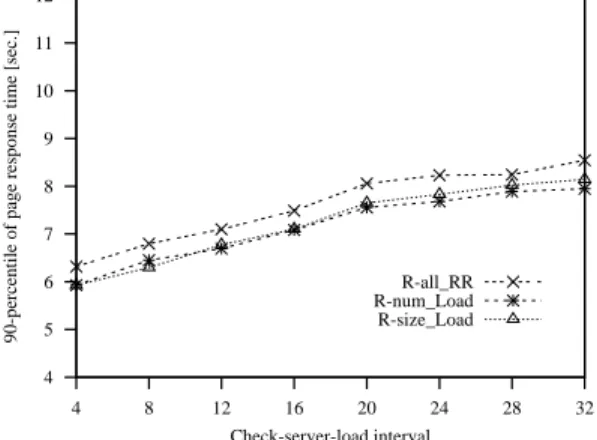
To verify the robustness of the results, in the last exper-iments we analyze the sensitivity of the selection and loca-tion strategies to some system parameters. In Figure 6 we analyze the 90-percentile of the response time as a function of the check-server-load interval for the best selection and location policies. As expected, performance of all policies tends to improve for lower values of this interval. It is rea-sonable to use relatively short periods such as 8 seconds, because server load evaluation does not necessarily imply the trigger of the redirection mechanism.
4 5 6 7 8 9 10 11 12 4 8 12 16 20 24 28 32
90-percentile of page response time [sec.]
µ
Check-server-load interval R-all_RR R-num_Load R-size_Load
Figure 6. Sensitivity to the frequency of the check-server-load interval. 4 5 6 7 8 9 10 11 12 0.5 0.55 0.6 0.65 0.7 0.75
90-percentile of page response time [sec.]
µ
System utilization R-all_RR R-num_Load R-size_Load
Figure 7. Sensitivity to the long-term system utilization.
time when the long-term utilization of the Web system varies from 0.5 to 0.75. All the policies that redirect re-quests show a similar behavior when the load increases. Al-though the limit for guaranteed response time doubles, in the Web environment subject to heavy-tailed arrivals, a 0.75 sustained utilization corresponds to a highly loaded system that would require more resources. The need of the third-level redirection mechanism is well motivated by the results of a Web site using DNS proximity algorithm only: the 90-percentile of the page response time for 0.5, 0.6, and 0.7 system utilization is equal to 10, 32 and 56 seconds, respec-tively. This shows that DNS only is not able to guarantee request response time even when the system utilization is subject to little increases.
7. Conclusions
Highly popular Web sites require a distribution of con-tent and servers over geographical regions to avoid net-work bottlenecks. Various proposals consider a geograph-ically distributed architecture where the DNS of the Web site evaluate network proximity and requests reach the clos-est Web cluster, where a Dispatcher executes second-level scheduling. We demonstrate that serving closest requests only may cause unbalanced servers and may increase sys-tem impact on response time, because arrivals from each Internet region is highly variable, depending on population, time zones, and day hour. To achieve a scalable and bal-anced Web system, we integrate DNS proximity and Dis-patcher scheduling with an HTTP redirection mechanism that any Web server can activate at its need. We show that this third-level dispatching, when integrated with some lim-itation on request redirection, is a powerful mechanism to enhance QoS of geographically distributed Web sites.
References
[1] D. Andresen, T. Yang, and O. H. Ibarra. Towards a scalable distributed WWW server on networked workstations. J. of Parallel and Distributed Computing, 42:91–100, 1997. [2] M. F. Arlitt, R. Friedrich, and T. Jin. Workload
characteri-zation of a Web proxy in a cable modem environment. ACM Performance Evaluation Review, 27(2):25–36, Aug. 1999. [3] V. Cardellini, M. Colajanni, and P. S. Yu. Dynamic load
bal-ancing on Web-server systems. IEEE Internet Computing, 3(3):28–39, May 1999.
[4] V. Cardellini, M. Colajanni, and P. S. Yu. Redirection algo-rithms for load sharing in distributed Web-server systems. In Proc. of IEEE 19th Intl’ Conf. on Distributed Computing Systems, pages 528–535, Austin, TX, June 1999.
[5] R. L. Carter and M. E. Crovella. Server selection using dy-namic path characterization in wide-area networks. In Proc. of IEEE Infocom 1997, pages 1014–1021, 1997.
[6] Cisco. Cisco DistributedDirector.
http://www.cisco.com/warp/public/cc/cisco/mkt/scale/distr/.
[7] J. Heidemann, K. Obraczka, and J. Touch. Modeling
the performance of HTTP over several transport protocols. IEEE/ACM Trans. on Networking, 5(5):616–630, Oct. 1997. [8] G. D. H. Hunt, G. S. Goldszmidt, R. P. King, and R. Mukher-jee. Network Dispatcher: A connection router for scalable Internet services. Computer Networks, 30:347–357, 1998. [9] D. Krishnamurthy and J. Rolia. Predicting the QoS of an
electronic commerce server: Those mean percentiles. In Proc. of Workshop on Internet Server Performance, Madi-son, WI, June 1998.
[10] V. Paxson. End-to-end routing behavior in the Internet.
IEEE/ACM Trans. on Networking, 5(5):601–615, Oct. 1997. [11] J. E. Pitkow. Summary of WWW characterizations. World
Wide Web, 2(1-2):3–13, Mar. 1999.
[12] T. Schroeder, S. Goddard, and B. Ramamurthy. Scalable Web server clustering technologies. IEEE Network, pages 38–45, May 2000.
[13] K. Thompson, G. J. Miller, and R. Wilder. Wide-area In-ternet traffic patterns and characteristics. IEEE Network, 6(11):10–23, Nov. 1997.
[14] W. Willinger and V. Paxson. Where Mathematics meets the
Internet. Notices of the American Mathematical Society,