ISSN: 2374-2380 (Print), 2374-2399 (Online) Copyright © The Author(s). 2015. All Rights Reserved. Published by American Research Institute for Policy Development DOI: 10.15640/jpbs.v3n1a4 URL: http://dx.doi.org/10.15640/jpbs.v3n1a4
Evidence for Rapid Decrease in Self-Reported Psychological Distress During Initial Phase
of Psychotherapy
Scott T. Meier
1Abstract
While research findings have provided support for sequential stage models of counseling and psychotherapy, more study is needed regarding change within specific phases and stages. This study employed a large, archival outpatient sample (n = 772 at Session 1) at a college counseling center to conduct a series of exploratory analyses examining the level and amount of change in 20 self-reported psychological symptoms and functioning variables during early sessions of psychotherapy. Findings replicate previous research showing rapid change during early sessions, but with psychological distress emerging as a key construct. Nearly 90% of clients entered therapy reporting moderate to high distress, and only distress scores evidenced a initial, large decrease. Clients who reported high distress also showed the largest overall improvement during early sessions. Males appeared to under-report initial distress, raising questions about the validity of self-reported distress with men. Interpretation of these results provide an expanded description of the initial, remoralization stage of psychotherapy with implications for research and clinical practice.
Keywords: Psychological distress; remoralization phase of psychotherapy; Behavioral Health Questionnaire;
progress monitoring; help-seeking
Sequential stage models of psychotherapy propose that eventual positive outcomes relate to the occurrence of certain processes over the course of therapy (Callahan, Swift, & Hynan, 2006; DiClemente & Prochaska, 1982; Howard, Lueger, Maling, & Martinovich, 1993; Howard, Moras, Brill, Martinovich, & Lutz, 1996; Prochaska, 1995; Prochaska & Norcross, 2006). Howard et al. (1996), for example, described a phase model of psychotherapy consisting of remoralization, remediation, and rehabilitation. Individuals in the first phase are demoralized in that their feelings of subjective well-being can be described as hopeless and disheartened (Frank, 1974; Yalom & Leszcz, 2005); Howard et al. (1996) described such persons as desperate and unable to cope. Phase theories indicate that interventions aimed at reducing client distress early in treatment may be crucial to improving clients’ sense of hope, satisfaction with the therapist and/or treatment, and initial progress. Recognized theoretically as a major motivational factor for seeking therapy (Clarkin & Levy, 2004; Frank, 1974), clients’ feelings of distress about their symptoms may help them to overcome the stigma associated with participating in therapy (Clarkin & Levy, 2004; Teyber & McClure, 2011). Clients may present with concerns about being abnormal or mentally ill or view their psychological and physical symptoms as signs of their inability to cope with personal problems. In the stages of change model (Prochaska, 1995; Prochaska & Norcross, 2006), the client moves through 5 stages involving degrees of preparation, action, and maintenance. In the precontemplation stage, when a client has minimal awareness of a major problem, the client experiences little distress and motivation to seek help. In the next phase, contemplation, the client becomes aware of the problem and begins to think about how to remedy it; distress should be increasing from previous levels. With the preparation stage, the client develops intent to change and begins to take preliminary actions such as seeking therapy; distress should be at its most intense.
1
A more in-depth exploration of the initial phase of counseling and psychotherapy may provide useful information and guidance for clinical researchers and practitioners. For example, how should demoralization and remoralization be assessed? In other words, what specific aspects of demoralization manifest early in therapy, such as psychological distress, and which observers are best able to report on these signs? Relatedly, what proportion of clients manifest signs related to demoralization? If the proportion is high, this implies that demoralization may be a major motivator for clients to seek therapy. Finally, for how many sessions do clients evidence signs of demoralization? Because failure to remoralize may be a potential contributor to premature termination, the answer to this question may indicate the time frame within which clinicians must work to intervene with demoralization issues. In this study we attempt to deepen knowledge of the processes involved in the initial phase of psychotherapy by exploring a large archival dataset containing multiple administrations of a measure partially developed on the basis of Howard et al.’s (1993) phase model. Using the Behavioral Health Questionnare-20 (BHQ; Kopta & Lowry, 2002), we investigated outpatients’ self-reports of psychological symptoms and functioning during early sessions of psychotherapy, when the largest amount of change often appears (Sperry, Brill, Howard, & Grissom, 1996). More specifically, we examined clients’ relative endorsement of BHQ items at the start of therapy as well as which items exhibited the largest change across early sessions.
Method
Procedure and Participants
Data collection was performed at college counseling center at a private Midwestern urban university with approximately 10,000 undergraduate, graduate, and professional students. After providing informed consent, all clients voluntarily completed a progress monitoring (PM) measure on the day of their initial intake appointment before they met with the therapist, and then completed follow-up PM forms prior to each subsequent session. In this brief therapy setting, clients completed the measure up to and including the 8th session; the process of data collection
continued for 5 academic years. Thus, these data allow an in-depth exploration of the initial phase of psychotherapy. Center therapists were psychologists or post-doctoral psychology residents who primarily provided brief relational and problem-solving counseling. The mean number of sessions per client equaled 5.43 (median equaled 4, SD equaled 4.98, range equaled 1-36). Because of the significant effort required to clean up and prepare the archival data for analysis of repeated measurements, we sampled BHQ data from Sessions 1, 2, 3, and 6 so that the resulting dataset consisted of large samples for the first 3 sessions and an adequate sample size for a later comparison. As shown in Table 1, the completed number of PM measures ranged from 772 at Session 1 to 269 at Session 6; sample size varies slightly from these totals in subsequent analyses because of missing data. No information was available regarding the reasons (e.g., attrition, lack of compliance with completion of the measure) the sample size decreased by session. At Session 1, 68% of the clinical sample was female and 32% male; 90% were White and 3% were African-American. Sixty-four percent were 18 to 21 years of age, 78% were undergraduate students, and 20% were graduate students. Similar percentages were found at Session 6 for demographic variables.
Progress Monitoring Measure
Kopta and Lowry (2002) also found high correlations between the BHQ Total score with similar scales such as the SCL-90-R (Derogatis, 1983) and Outcome Questionnaire (OQ-45; Lambert & Finch, 1999) that they interpreted as indicative of a unidimensional factor reflecting general mental health. While researchers typically employ test data at the level of aggregated subscales and total scores, they may also study item level data to examine change and associations in more fine-grained analyses. Research indicates that scores on single items evidence lower reliability and validity estimates than aggregated scales (e.g., Meier, 1984), but variance from single items must possess some amount of reliable and valid variance if these items contribute to an aggregated score. Consequently, in this study we examined both item and aggregated score data to study magnitude as well as change in the 20 domains assessed by BHQ items.
Results
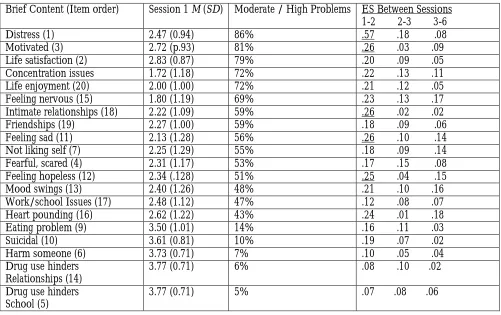
Demographic influences. Statistical relations between BHQ item scores and Total Score with gender, age, and ethnicity were examined at Session 1. No statistically significant correlations were found between ethnicity and BHQ scores or between BHQ Total Score and age or gender. Women reported higher levels of distress, fear, eating problems, nervousness, and heart pounding, while men reported greater problems with alcohol and drugs (interfering with relationships and school), suicidal thoughts, and intimate relationships. Younger clients reported more problems with self-esteem, suicidal thoughts, sadness, and mood swings, but fewer problems with intimate relationships and friendships. Initial symptom/functioning levels. We examined the percentage of clients reporting moderate to high endorsements for each BHQ item at Session 1. As shown in Table 2, 86% of clients reported moderate to high scores on the distress item, the highest percentage for any item. Endorsement ratings greater than 70% at Session 1 included items assessing motivated (81%), life satisfaction (79%), concentration (72%), and life enjoyment (72%). Items with endorsement rates greater than 50% included feeling nervous (69%), intimate relationships (59%), friendships (59%), feeling sad (56%), not liking self (55%), fearful/scared (53%), and feeling hopeless (51%). Overall, psychological distress was the most significant concern for clients, items assessing general life issues were next in terms of percent endorsed, followed by items tapping into negative affect and social functioning. Change at BHQ Total Score and item level. To gain an overall sense of therapy effectiveness, we computed an Effect Size (ES) comparing available client data in Session 1 to Session 6. Table 1 includes means and standard deviations by session number for the BHQ Total Score. Subtracting the means of the BHQ Total Score from Session 1 to Session 6, and using the Session 1 standard deviation as the denominator, Effect Size (ES) equals .62 (59.92 - 52.77 / 11.59). This ES indicates that the average client in this sample improved slightly more than one-half of a standard deviation on the BHQ total score, similar to the average ES (.68) previously reported by Smith and Glass (1977) in their meta-analysis of psychotherapy outcomes.
Table 1: Descriptive Statistics for BHQ Total Score and Distress Item by Session
Session
Number n
Coefficient alpha
BHQ Total M (SD) Mdn
Distress M (SD)
1 772 .88 52.77 (11.59 ) 53 2.47 (0.94)
2 632 .90 57.46 (11.05) 58 3.01 (0.91)
3 514 .91 58.79 (11.38) 60 3.17 (0.96)
6 269 .92 59.92 (11.87) 62 3.09 (1.02)
Note. The amount of change for the distress item between Session 1 and Session 2 was almost as large (ES = .57) as for the entire scale from Session 1 to Session 6 (ES = .62).
Table 2: BHQ Item Descriptive Statistics for Session 1 and Effect Sizes Across Early Sessions
Brief Content (Item order) Session 1 M (SD) Moderate / High Problems ES Between Sessions 1-2 2-3 3-6
Distress (1) 2.47 (0.94) 86% .57 .18 .08
Motivated (3) 2.72 (p.93) 81% .26 .03 .09
Life satisfaction (2) 2.83 (0.87) 79% .20 .09 .05
Concentration issues 1.72 (1.18) 72% .22 .13 .11
Life enjoyment (20) 2.00 (1.00) 72% .21 .12 .05
Feeling nervous (15) 1.80 (1.19) 69% .23 .13 .17
Intimate relationships (18) 2.22 (1.09) 59% .26 .02 .02
Friendships (19) 2.27 (1.00) 59% .18 .09 .06
Feeling sad (11) 2.13 (1.28) 56% .26 .10 .14
Not liking self (7) 2.25 (1.29) 55% .18 .09 .14
Fearful, scared (4) 2.31 (1.17) 53% .17 .15 .08
Feeling hopeless (12) 2.34 (.128) 51% .25 .04 .15
Mood swings (13) 2.40 (1.26) 48% .21 .10 .16
Work/school Issues (17) 2.48 (1.12) 47% .12 .08 .07
Heart pounding (16) 2.62 (1.22) 43% .24 .01 .18
Eating problem (9) 3.50 (1.01) 14% .16 .11 .03
Suicidal (10) 3.61 (0.81) 10% .19 .07 .02
Harm someone (6) 3.73 (0.71) 7% .10 .05 .04
Drug use hinders Relationships (14)
3.77 (0.71) 6% .08 .10 .02
Drug use hinders School (5)
3.77 (0.71) 5% .07 .08 .06
Note. Items are arranged in descending order by the percentage of moderate to high problems endorsed. The moderate to high problems column refers to the percentage of clients who indicated that they had moderate to high difficulties on that item domain at Session 1. Lower mean scores indicate more dysfunction or problems; negatively worded items were reversed scored. The BHQ’s 5-point response format presented different labels depending upon the item domain. Scores on items 1 – 3 ranged from 1 to 5, and on items 4 – 20 the range was 0 to 4. Effect sizes that equal or exceed .25 are underlined. Order refers to the order of the item in the BHQ.
Table 3: Distress Session 1 Improvement Probabilities for Distress Scores at Session 3
Distress
Session 1 1
Distress 2
Session 3
3
4 5
1 (High) .19 (.11) .34 (20) .19 (11) .24 (14) .03 (2)
2 .03 (5) .22 (31) .42 (61) .28 (40) .05 (7)
3 .02 (2) .16 (19) .34 (40) .44 (51) .05 (5)
4 .03 (1) .13 (5) .21 (8) .47 (18) .16 (6)
5 (Low) .25 (2) .38 (3) .38 (3)
Note. Probabilities in bold indicate improvement over time, while all others stayed the same or worsened. Sample sizes are in parentheses and blank cells have no data. Because of reverse scoring, low distress scores indicate more distress; rounding errors mean row sums may not equal 100.
To increase statistical power in the prediction of BHQ Total Scores, we created a categorical variable based on Session 1 distress scores. This distress variable had 3 values corresponding to distress item scores for responses 1 and 2 (indicating higher distress), response 3 (moderate distress), and responses 4 and 5 (lower distress). We computed one-way ANOVAs for Sessions 2, 3, and 6 using the distress categorical variable as the independent variable and an adjusted BHQ Total score (minus the distress item score) as the dependent variable. The overall F was statistically significant for Session 2 (F [2, 485] = 51.61, p < .001), 3 (F [2, 377] = 22.15, p < .001), and 6 (F [2, 183] = 3.84, p < .05). Using the Tukey HSD test, we performed pairwise comparisons among the means for all sessions (see Table 4). At Sessions 2 and 3, all means were statistically different from each other; at Session 6, only the high and low BHQ means differed. As shown in Table 4, means for BHQ Total Scores were essentially unchanged across Sessions 2, 3, and 6 for the group of clients who reported low to moderate distress at Session 1. For clients who reported high distress at Session 1, however, their means evidenced steady improvement from Session 2 to Session 6.
Table 4: Session BHQ Total Score Means By Initial Distress Scores
Session n
Distress Low
At Moderate
Session 1 High
2 449 67.25 (9.80) 60.20 (9.03) 51.14 (9.88)
3 365 66.85 (8.92) 61.32 (9.86) 53.32 (10.69)
6 185 67.37 (12.68) 61.93 (10.81) 56.26 (11.57)
Note. In contrast to clients with initial low to moderate distress, steady improvement is evident from Session 2 to Session 6 in the group of clients who reported high distress at Session 1. The sample size per session reflects individuals who provided complete BHQ data at Session 1 and at a particular session (i.e., 2, 3, or 6).
Discussion
Finally, gender differences were apparent: Distress in women appears to be adequately assessed via self-report, but males in this study reported less distress at Session 1 than did females. Although no a priori reason exists to believe men experience less distress than women, research suggests that men’s stereotypic sex roles may lead them to avoid the expression of certain types of negative affect, such as shame, fear, and sadness (Brody & Hall, 2008). Research supports the idea that women report more negative affect, including sadness and depression (Brody & Hall, 2008), raising doubts about the ability of self-report to obtain valid distress ratings from men during the initial phase. These results may have implications for the important clinical problems of premature termination and dropout. Research estimates of dropout rates range from 35% and higher, depending upon the clinical problem, population, and setting (Clarkin & Levy, 2004; Roos & Werbart, 2013). Given that clients who prematurely end therapy tend to do so after one or a few sessions (Barrett, Chua, Crits-Christoph, Gibbons, & Thompson, 2008), it is possible that clients drop out early either because their distress (a) quickly becomes too low to sustain their motivation to seek help, or (b) fails to decrease, remaining at a painfully high level. Regarding the former, clients whose distress provided a major source of motivation to seek help may find that distress reduction also diminishes their motivation to continue the often difficult work of psychotherapy.
The resulting small dose of therapy, however, may be insufficient to help clients with problems that require more sessions for other types of change to occur (Barrett et al., 2008; Bohart & Wade, 2013; Hansen, Lambert, & Forman, 2002). On the other hand, clients with high distress who fail to experience an early decrease in distress may also terminate prematurely. Yu (2012), for example, found that depressed clients with high levels of symptom distress were more likely to drop out. Although a major benefit of archival datasets is that they allow a preliminary examination of phenomena of interest via a large sample size, this approach also permits potentially uncontrolled variables to influence results. Consequently, future research should focus on replication of the distress results with other measurement methods, clinical populations, and therapy settings. While the measurement of distress was accomplished with a single self-report item, future research should replicate these findings with a multi-item scale. If future research replicates the finding of a gender difference in self-reported distress, it may be important for a clinician or another source to assess distress in male clients to obtain valid data. Greater specification of distress’s early effects in therapy could also help in the development of additional assessment and intervention approaches. Progress monitoring measures that includes assessment of and feedback regarding distress levels, for example, may provide clinicians and supervisors with an earlier opportunity to alter therapeutic strategies around client distress and subsequently decrease treatment failure and client dropout (cf. Lambert, 2012).
References
Barrett, M. S., Chua, W., Crits-Christoph, P., Gibbons, M., & Thompson, D. (2008). Early withdrawal from mental health treatment: Implications for psychotherapy practice. Psychotherapy Research: Theory, Research, Practice, Training, 45, 247-267. doi:10.1037/0033-3204.45.2.247
Bohart, A. C., & Wade, A. G. (2013). The client in psychotherapy. In M. J. Lambert (Ed.), Bergin and Garfield’s Handbook of Psychotherapy and Behavior Change (6th ed.) (pp. 219-257). New York: Wiley.
Brody, L. R., & Hall, J. A. (2008). Gender and emotion in context. In M. Lewis, J. M. Hoviland-Jones, & L. F. Barrett (Eds.), Handbook of emotion (3rd ed.; pp. 395-408). New York: Guilford.
Callahan, J. L., Swift, J. K., & Hynan, M. T. (2006). Test of the phase model of psychotherapy in a training clinic. Psychological Services, 3, 129-136. doi: 10.1037/1541-1559.3.2.129
Clarkin, J. F., & Levy, K. N. (2004). The influence of client variables on psychotherapy. In M. J. Lambert (Ed.), Bergin and Garfield’s Handbook of psychotherapy and behavior change (5th ed., pp. 194-226). New York: Wiley.
Derogatis, L. R. (1983). SCL-90-R: Administration, scoring, and procedural manual--II. Baltimore, MD: Clinical Psychometric Research.
DiClemente, C. C., & Prochaska, J. (1982). Self-change and therapy change of smoking behavior: A comparison of processes of change in cessation and maintenance. Addictive Behaviors, 7, 133-142.
Elhali, J. D., Voorhees, S., Ford, J. D., Min, K. S., & Frueh, B. C. (2009). Sociodemographic, perceived and objective need indicators of mental health treatment use and treatment-seeking intentions among primary care medical patients. Psychiatry Research, 165, 1-2. doi: 10.1016/j.psychres.2007.12.001
Frank, J. D. (1974). Psychotherapy: The restoration of morale. American Journal of Psychiatry, 131, 271-274. Hansen, N. B., Lambert, M. J., & Forman, E. M. (2002). The psychotherapy dose-response effect and its implications
Howard, K. I., Lueger, R. J., Maling, M. S., & Martinovich, Z. (1993). A phase model of psychotherapy: Causal mediation of change. Journal of Consulting and Clinical Psychology. 61, 678-685. doi: 10.1037/0022-006x.61.4.678
Howard, K. I., Moras, K., Brill, P. L., Martinovich, Z., & Lutz, W. (1996). Evaluation of psychotherapy: Efficacy, effectiveness, and patient progress. American Psychologist, 51, 1059-1064.
doi: 10.1037//0003-066X.51.10.1059
Kopta, S. M., & Lowry, J. L. (2002). Psychometric evaluation of the Behavioral Health Questionnaire-20: A brief instrument for assessing global mental health and the three phases of psychotherapy. Psychotherapy Research, 12, 413-426. doi: 10.1093/ptr/12.4.413
Lambert, M. J. (2012). Helping clinicians to use and learn from research-based systems: The OQ-Analyst. Psychotherapy, 49, 109-114. doi: 10.1037/a0027110
Lambert, M.J., & Finch, A.E. (1999). The Outcome Questionnaire. In M. E. Maruish (Ed.), The use of psychological testing for treatment planning and outcomes assessment (2nd ed.). (pp. 831-869). Hillsdale, NJ: Lawrence
Erlbaum.
Meier, S. (1984). The construct validity of burnout. Journal of Occupational Psychology, 57, 211-219. doi: 10.1111/j.2044-8325.1984.tb00163.x
Meier, S. T. (2014). Rediscovering the role of avoidance in counseling and psychotherapy. Professional Psychology, 45, 212-217. doi: 10.1037/a0036916
Meier, S. T., McDougal, J., & Bardos, A. (2008). Development of a change-sensitive outcome measure for children receiving counseling. Canadian Journal of School Psychology, 23, 148-160. doi:10.1177/0829573507307693 Prochaska, J. O. (1995). An eclectic and integrative approach: Tran theoretical therapy. In A. S. Gurman & S. B.
Messer (Eds.), Essential psychotherapies (pp. 403–440). New York: Oxford University Press.
Prochaska, J. O., & Norcross, J. (2006). Systems of psychotherapy: A transtheoretical analysis (6th ed.). Pacific Grove, CA: Wadsworth.
Roos, J., & Werbart, A. (2013). Therapist and relationship factors influencing dropout from individual psychotherapy: A literature review. Psychotherapy Research, 23, 394-418. doi:10.1080/10503307.2013.775528
Smith, M. L., & Glass, G. V. (1977). Meta-analysis of psychotherapy outcome studies. American Psychologist, 32, 752-760. doi:10.1037/0003-066X.32.9.752
Sperry, L., Brill, P. L., Howard, K. I., & Grissom, G. R. (1996). Treatment outcomes in psychotherapy and psychiatric interventions. New York: Brunner-Mazel.
Teyber, E., & McClure, F. (2011). Interpersonal process in psychotherapy (6th ed.). Pacific Grove, CA: Brooks/Cole.
Yalom, I. D., & Leszcz, M. (2005). Theory and practice of group psychotherapy (5th ed.). New York: Basic Books.