29
ISSN 1392-2785 ENGINEERING ECONOMICS. 2007. No 1 (51) THE ECONOMIC CONDITIONS OF ENTERPRISE FUNCTIONING
The Main Strategic Directions in Improving of Export Development in Lithuania
Česlovas Purlys
Vilniaus Gedimino technikos universitetas Saulėtekio al. 11, LT-10223, Vilnius
The article deals with the main problems of strate-gic directions of export selling and promotion. The ex-port development factors and their economic impact as well as efficiency of export enhancement and promotion tools up to now have not been examined enough from the viewpoint of strategy, though the special investiga-tion of the effectiveness of segregated export promoinvestiga-tion tools are badly needed. Thus the different concepts on strategies, competitive advantages, marketing and in-ternational marketing are analyzed. The best practice on export enhancement and promotion used in different countries and published in scientific articles and books are overviewed. The analysis of the main statistical data on Lithuanian export has been provided in the form of figures and diagrams. The analysis led to the conclusion that Lithuanian exports after Lithuania’s entering EU were growing up and structure has been changed from export to Eastern markets to Western ones faster. The problems discovered are the structure of goods ex-ported: 25 percent of export remains on export of oil refining products, which heavily depends on Russian oil supply, composition of Lithuanian exports by technology level: high technology goods amount less than 10 per-cent and just about 20 perper-cent of it is attributed to the high and medium quality products. The causes of such situation were weakness of Lithuanian Economic Devel-opment Agency (LEPA), not enough information on for-eign markets, low value added of exported goods, un-willingness of managers to take risk, lack of funds, very few logistic centers abroad, dependence on foreign dis-tributors, intentional delays and underdevelopment of export insurance and export enhancement and promo-tion framework. Lithuania’s membership in EU crashed barriers for Lithuanian goods composed by Russia. The export of goods and services from Lithuania to Russia has been growing successfully from 2005. The most in-teresting and new export promotion tools used in Ger-many, Austria, Pakistan, India Sweden and other devel-oped countries has been analyzed as to compare with measures and weaknesses of tools used in Lithuania. The gap between developed and developing countries like Lithuania remains significant in the development of new products, quality, structure of goods exported, per-formance of environmental and safety requirements. As the result of the research the main strategic directions for export development and promotion for Lithuania are suggested.
Keywords: competitive advantages, strategy, strategic directions, marketing, international marke-ting, export promotion.
Introduction
Having entered the EU Lithuania received additional opportunities for industry and trade globalization and entered into global market through multinational corpora-tions. The main task of small country‟s industry and trade is to develop distribution channels for selling products. The main weakness of the new EU countries is their weak experience in international marketing. The tasks for de-veloping internal markets are not simple because of tech-nological, financial, and human resources. Moreover, the Government policy is not adequate to well developed countries.
The objective of the article is to formulate sugges-tions for export development and promote strategic direc-tions based on the analyses of the main theoretical con-cepts of strategic and international marketing as well as statistical data on Lithuanian exports and best practice in different countries on export promotion.
The methodology of research was based on logic content analysis of nonfictions on strategy and interna-tional marketing, studies of the best export promotion practice in different countries and on analysis of Lithua-nian export data, as well as the results of implementation of former export promotion programs. The research was provided by the group of scientists under the leadership of the author according to the agreement between Vilnius Gediminas technical university and Lithuanian Ministry of Economy. The uncontonality of the research was that the author of the article has been working for eight years as a chief of Strategic department at the Ministry of In-dustry and Trade and the first Export promotion strategy and program for 1995-2000 has been elaborated under the leadership of the author. Thus the integrated studies of strategic and marketing theories and best practice of the developed countries on export development and promo-tion as well as the history and statistic data on Lithuanian export has been implemented in research. The results of research were accepted by the Ministry of Economy in 2005 without animadversion.
Audit of the main strategic and marketing
theories
30 strategic factors, elements and driving forces of trade internationalization. For example, K. Andrews (1994) defines strategy as an aggregation of long-term decisions. According to S. Hoffer and D. Shendler (1978), strategy defines possible problems and makes decisions to solve them, while H. Mintzberg (1962) presented three defini-tions of strategy: A – accentuates creativity, B – emphatic striving of objectives, C – “cunning lie“. M. Porter (1998) defines strategy from the competition point of view. Ac-cording to him, competitive strategy is the strategy align-ing aggressive or defensive align-ingredients. He extricates three main competitive strategies: cost leaders‟, differen-tiation and concentration strategies and five basic com-petitive forces that exporters are forced to overcome to be competitive in the international market, i.e. suppliers, buyers, industry competitors, potential entrants, and firms producing substitute products. According to T. Grundy and L. Brown (2002) strategy – half existing ideas that it covers only few are not enough developed and matched ideas. McDonalds (1993) emphasizes that strategy is the composition of environmental factors, objectives, oppor-tunities, and actions. J. Schumpeter (1942) grounded dy-namics of development while I. Ansoff (1976) – mutual interdependence of product and market (Ansoff„s matrix). A. Chandler (1962) emphasized the interdependence be-tween the strategic behavior of the entities (strategy) and the enterprise structural changes (structure). Chester Bar-nard (1948) thoughtthat there was impossible to develop all success factors at once and there must be priorities nominated. A. Branch (1994) designates four main fac-tors that must be appraised in market selection: market potential, common market and promotion factors, market accessibility and capital payback. M. Czinkota (1994) stresses the need for exporting goods to be modified in accordance with foreign market requirements: character-istics of market, attributes of product and enterprise con-ditions. P. Ghemawat (1991) suggested the model of seven forces (market forces, competitors, organization by itself, buyers‟ full satisfaction, learning, authorization and leadership). He stresses also six main entry barriers to be overcome. S. Majaro (1993) refers to 4 factors that must be taken into account while preparing strategy for entry into foreign market: objectives, market demands, re-courses available, and product. H. Chee and R. Harris (1994) suggested pay most attention to level of risk and market control. There are few Lithuanian authors also analyzing the problems of strategy formation. Observa-tion of strategies made by R. Časas (1999), contribuObserva-tions of J. Bivainis (2005) to strategic modeling, methods on measurements in marketing research suggested by V. Pranulis (1998), contribution of R. Virvylaitė (2000) on market research and A. Vasiliauskas (2004) in strategic planning had a positive impact on the research.
The analysis of the situation in Lithuania shows the concepts and problems studied are in some ways appro-priate for nowadays Lithuania. Lithuanian export meets some tendencies and problems now as it was in devel-oped countries few decades ago. But Lithuania as other countries in transition has met much more difficulties and specificity in marketing and export development because of monstrous resistance of Russian Government for im-ports from new independent countries that have ridded
themselves from the Soviet grip, globalization of markets and because huge multinationals have occupied the mar-kets world wide. The specificity of the situation still re-mains and it is not well discovered. The research of mar-keting strategies, and export development and promotion problems of countries also remains not investigated enough. In spite of openness of Lithuania for World Bank and International Monetary fund for assistance in gaining economic independence from Russia, the results of inves-tigations of World Bank and International Monetary Fund provided periodically have to be estimated critically be-cause their had their own tasks and are not so much inter-ested in export promotion of Lithuanian goods and ser-vices. The main task of WB and IMF is to save the sol-vency of the country to refund WB and/or IMF loans while the main task of Lithuanian researchers is to look for the prosperity of the country. Nowadays Lithuania is more interested in gaining bigger market share in world market and to attract newest technologies than to have positive balance of payments. The different tasks dictate different approaches to the investigation of the problems and it has been taken into account in the research.
One of the simplest in theory but quite complicated in real life is the question how to select and combine marketing objectives. According to I. Ansoff (1976), an objective contains three elements: the particular attribute that is chosen as a measure of efficiency; the yardstick of scale by which the attribute is measured; and the particu-lar value on the scale which the firm seeks to attain. Thus, the product/market strategy represents a commit-ment to a future direction for the firm. According to the matrix, proposed by I. Ansoff there are four possible stra-tegic options: selling existing products to existing mar-kets, extending existing products to new marmar-kets, devel-oping new products for new markets, develdevel-oping new products for existing markets;
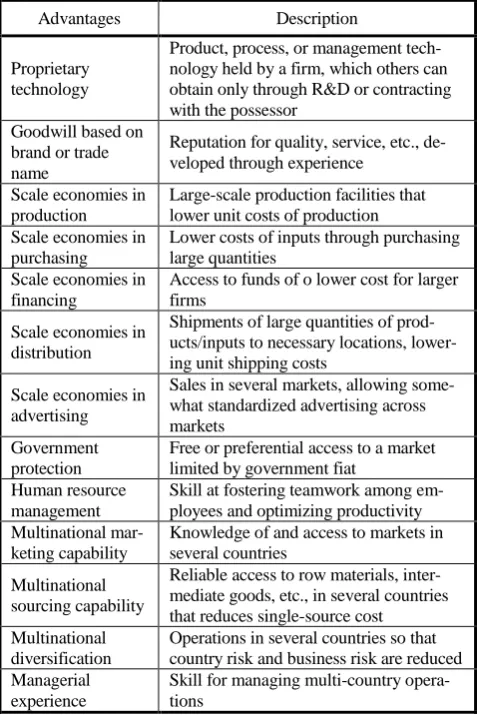
31 Knowledge of country conditions, managerial experi-ence, and skill in managing a multi-country production remain an important factor of export. The large MNEs usually hire high skilled managers, marketing and selling experts. The firms with managers who possess such skill obtain better results. Competitive advantages of multina-tional enterprises in internamultina-tional trade are presented in Table 1.
Table 1
Competitive advantages of multinational enterprises
Advantages Description
Proprietary technology
Product, process, or management tech-nology held by a firm, which others can obtain only through R&D or contracting with the possessor
Goodwill based on brand or trade name
Reputation for quality, service, etc., de-veloped through experience
Scale economies in production
Large-scale production facilities that lower unit costs of production Scale economies in
purchasing
Lower costs of inputs through purchasing large quantities
Scale economies in financing
Access to funds of o lower cost for larger firms
Scale economies in distribution
Shipments of large quantities of prod-ucts/inputs to necessary locations, lower-ing unit shipplower-ing costs
Scale economies in advertising
Sales in several markets, allowing some-what standardized advertising across markets
Government protection
Free or preferential access to a market limited by government fiat
Human resource management
Skill at fostering teamwork among em-ployees and optimizing productivity Multinational
mar-keting capability
Knowledge of and access to markets in several countries
Multinational sourcing capability
Reliable access to row materials, inter-mediate goods, etc., in several countries that reduces single-source cost Multinational
diversification
Operations in several countries so that country risk and business risk are reduced Managerial
experience
Skill for managing multi-country opera-tions
Very general guidelines to help in thinking about competitive strategies suggested by Malcolm McDonalds (1993): know the terrain on which you are fighting (the market), know the resources of your enemies (competi-tive analysis), do something with determination that the competitors aren‟t expecting are still very important for international market research.
In order to implement these general guidelines, it is necessary to analyze the market and competitors in de-tails and very carefully.
Export market research theories and
Lithua-nian exports
A fundamental point in export marketing is the need to supply the overseas consumer with the product to ac-cord with their taste, fashion, specification, design, and price and to reflect local training regulations. Very often it requires modification of the products to meet the
over-seas consumer needs: reasonable price, built-in accept-ability in terms of its quality, duraccept-ability, performance, availability at the right time and place, honest and accu-rate information on the product, reliability of supplier on delivery promises and after sale services, assistance with the stock turn-over.
Alan Branch (1994) considers the right selection of foreign market as one of the main tasks of marketing de-partments and experts. Market potential for product to be solved, as measured by market share, competition, ten-dencies in market changes, level of market development, political and economic stability in the country, state regu-lations and price to quality ratio are very important for market research. M. Czinkota (1994) suggests three crite-ria for comparing foreign markets: 1) physical critecrite-ria (geographical location of the enterprise); 2) psychological criteria: cultural, language, traditions, habits in the coun-try; 3) economic criteria (differences in economic condi-tions in the countries involved (Chee, Harris, 1994). Kot-ler, R. Zentes (Czikota, 1994) have classified the methods of selection markets into 2 groups: analytical (decision tree) and heuristic (associative). M. Czinkota suggests analytical methods as: 1) analysis of overall demand; 2) distensible dependence between revenue and demand, 3) multifactor indexes in comparison with analogies, 4) cost-revenue analysis (Czinkota, 1994)
Marketing research can be defined as the systematic gathering, recording, analysis, and interpretation of data on problems relating to the marketing of goods and' ser-vices. Gorton and Doole (Grosse, Kujawa, 1992) suggest the OPAR (objectives, planning, action, review) model for helping the researcher ensure a systematic approach to the steps of information. Downham (Grosse, Kujawa, 1992) has defined international marketing research as the research carried out in a country other than that of the sponsor. Such an information system would have to iden-tify and analyze potential markets. Johanson (Interna-tional Business, competing in the market place) stressed out, that uncertainty in international activities and the lack of market knowledge is the greatest obstacle to the trade in foreign markets. There are primarily three func-tions to carry out: scan international markets to identify and analyze the opportunities; build marketing informa-tion systems to monitor environmental trends; and carry out detailed studies for the development of marketing strategies.
After Lithuania‟s independence from Russia and the Russian crisis roughly a half of the total export was to the EU and only about 15% to CIS countries. The analysis shows that the breakthrough of Lithuanian exports took place in 1999 when foreign trade turned away from Rus-sia and other CIS countries to the EU area. In 1996 and 1997, 39-42% of total exports of Lithuania were to CIS and 37-38% to EU countries.
32 share of exports to EU-25 increased from about 60% to 65% at the end of 2005. Exported domestic production grew at a faster rate compared to the production sold in the domestic market. This was particularly evident in the
industry sectors of food, chemical products and plastics. In addition, the introduction of EU export subsidies had a positive effect on exports of food and chemical products to the non-EU countries, in particular CIS.
Figure 1. Rate of Lithuania‟s exports Source: Lithuanian Department of Statistics
Lithuanian exports are gaining market shares most dynamically in EU members, such as Spain, Belgium, France, Sweden, also in the USA, Estonia, and Poland. In these countries annual export from Lithuania increased by 40-80% in 2005.
The biggest export markets for Lithuania are the nearby countries: Russia (10.4% of total exports), Latvia (10.3%), and Germany (9.4%). The increase in export of goods was mostly determined by sales of mineral products to foreign partners. In 2005 it went up by more than 40% and accounted for nearly a half of the total export growth.
The bulk of Lithuania‟s exports consists of products of the low and medium technology industries (Figure 2).
Figure 2. Composition of Lithuanian exports by technology level Low technology industries exports, that include food products, beverages, tobacco, textiles, leather, wood, pa-per products, and basic metals, accounts for more than a half of total exports. Recently share of this group has been gradually diminishing. According to the UN statis-tics, about 40% of Lithuania‟s low technology industry export is of the highest quality.
Exports of medium technology industries are chemi-cals, plastics, and rubber. During 1999-2005, oil products accounted for 20-25 % of the total Lithuania‟s exports and their role is substantial for overall export growth per-formance. On average it contributes nearly 5 percentage
points to the total export growth. High technology indus-tries products including machinery, electrical and optical equipment, and transport equipment, amount to less than 10 percent of the total county‟s exports and just about 20 percent of it is attributed to the high or medium quality products (Figure 3).
Figure 3. Composition of Lithuanian high technology exports by quality
(UN COMTRADE and IMF staff report for the 2006 Article IV Consultation of Lithuania)
International marketing segmentation and
ex-port promotion
At the scanning stage, the manager researching inter-national markets is identifying and then analyzing oppor-tunities, to evaluate which markets to prioritize for fur-ther research and development. To do this, managers need to divide markets into groups, so they can decide which markets to give priority.
Market segmentation is the strategy by which a firm partitions a market into sub-markets or segments likely to manifest similar responses to marketing inputs. The aim is to identify the markets on which a company can con--80
-60 -40 -20 0 20 40 60 80
1997 1998 1999 2000 2001 2002 2003 2004 2005
in
p
er
ce
n
t
Lithuania's total exports exports to EU-15 exports to CIS exports to CEFTA
0% 20% 40% 60% 80% 100%
1999 2000 2001 2002 2003 2004
Low tech Medium tech High tech
0% 10% 20% 30% 40% 50% 60% 70% 80% 90% 100%
1999 2000 2001 2002 2003 2004
33 centrate its resources and efforts, so that they can achieve maximum penetration of that market. The Pareto law usually applies to international marketing strategies with entire strength. The most broad-based and well-established international firms find that 20 per cent of the countries they serve generate at least 80 per cent of the results (Koch, 1998).
International research is, in many cases, a complex, expensive and time-consuming task. Because most Lithuanian enterprises are small and medium for these reasons, as research shows, many SMEs fail to research markets to the extent that is really necessary. The key
tasks for the Lithuanian researchers are to scan markets, to identify and analyze opportunities, build up compre-hensive market profiles and carry out detailed market studies for a very few markets.
Studies of scientific literature and information avail-able on internet on economics, legal issues, and statistical data of Lithuanian exports as well as the existing gov-ernment policy and export promotion programs, provided by the author allowed to classify some countries accord-ing to the best achievements in export enhancement and promotion and identify the weaknesses of Lithuanian system of export development and promotion (Table 2).
Table 2
The results of the best practice studies and weaknesses of Lithuanian practice
No Criteria Best achievements Countries of achievement Weaknesses in Lithuania
1. Market forces Market information systems
and entry conditions USA, Canada, Germany, Finland
Weaknesses of LEPA agency. Not enough information on markets
Market selection based on
certain criteria Finland
Low attitude by managers, insufficient offensiveness, unwillingness to take risk, lack of funds
Market entering conditions Germany, Great Britain Failure to draw up the program of services, incentives
and guarantees
2. Product
development Newness of products. Japan, Germany, USA, Austria
R&D, and regional programs are implemented with difficulty
Quality assurance system Japan, Germany, Austria TQM system, ISO 9000, and EN 14000 have not been
implemented in most enterprises
Product labeling Germany, India The labels such as CE, EN, KALEEN and other have
not been obtained
Product packing World Packers‟ Association Design, ecological and utilization characteristics
3. Product delivery System “Just in time” Japan, Germany, Austria, Sweden Dependence on foreign distributors and intermediaries
Distribution system Great Britain, Austria, Germany Incapability to verify distributors and agents
Logistics Denmark Risks related to the product storage, protection and
supplies
Behavior of competitors USA Low quality of competitors‟ analysis
Trade conditions and after-sales service
Very few logistics centers abroad and weak warranty service
Quality-price ratio Austria Low quality, and low value added
Trade missions, representative offices, exhibitions
Great Britain, Denmark, Finland,
Germany Rare, weak support
4.
Payments‟ conditions and state support
Solvency of the clients, export and investment insurance
Japan, Germany, USA, Pakistan, Czech Republic, Finland
Low purchasing power, insufficient development of insurance
Payment arrears USA, and almost all Europe Intentional delay
5. Human resources Experts, trade officers,
diplo-matic and trade offices
Denmark, Finland, USA, Czech Republic
Lack of experienced experts. Very few trade offices abroad.
34 As we can see from the research results (Table 2), there is a lot to be done to reach the developed countries in export enhancement and promotion area.
The regression analysis showed close relations be-tween GDP growth and exports, external (international) environment, as well as the cultural differences and ex-ports. The analysis also revealed that many Lithuanian enterprises do not pay enough attention to cultural differ-ences of importing countries.
As a result of research the main directions of export development and promotion of Lithuanian goods and services as well as the directions for export enhancement and promotion strategy and programs were formulated and presented to the Lithuanian Ministry of Economy.
The main directions suggested for medium term and adopted by the Ministry were as follows:
1. Safeguard friendly legal and economic environ-ment against export.
2. Warrantee exporters with information about niches in foreign markets, as well as permanent and qual-ity learning.
3. Develop the information framework of Lithuanian exporters and existing foreign, latent and incipient markets.
4. Ensure the competitiveness of goods and services of Lithuanian origin on international level.
5. Develop trustworthy export enhancement and promotion infrastructure and establish close coop-eration between Governmental and business insti-tutions.
Conclusions
Research provided by the author and the team on the main problems of composition of export enhancement pro-motion strategies shows that there are quite different ap-proaches to strategic analysis, marketing research, and ex-port enhancement and promotion tools. Investigation led to the conclusion that there are some important problems in export development and promotion in Lithuania. 25 percent of exports depend on Russian oil supply, non-effective composition of Lithuanian exports, high technology goods amount only less than 10 percent, just about 20 percent of it is attributed to the high and medium quality products. There are problems concerning the information about foreign mar-kets, lack of funds, not enough developed market research institutions, very few logistic centers abroad, etc. Export promotion tools used in foreign countries like Germany, India, Great Britain, Denmark, Pakistan, showed that there is enough space for Lithuanian enterprises and Government to improve export enhancement and promotion framework. As a result of research five main strategic directions save been suggested for the Ministry of Economy in export en-hancement and promotion in Lithuania: safeguard friendly legal and economic environment against export; warrantee exporters with information about niches in foreign markets; develop information framework of existing foreign, latent and incipient markets; ensure the competitiveness of goods and services of Lithuanian origin on international level; de-velop trustworthy export enhancement and promotion infra-structure as well as certain close cooperation between gov-ernmental and business institutions.
References
1. Andrews, K. R. The Concept of Corporate Strategy. Homewood:
Irwin, 1994.
2. From Strategic Planning to Strategic Management. Ansoff, H. I.,
De. Clarck, and R. Hayes. N Y: John Willey & Sons Inc, 1976.
3. Barnard, Chester. The functions of the Executive. Cambridge,
Mass: Harvard University Press, 1948.
4. Branch, E. Alan. Elements of Export Marketing and Management.
London: Chapman and Hall, 1994.
5. Chandler, A. Strategy and Structure. Chapters in the History of the
Industrial Enterprise. Cambridge: MIT, 1962.
6. Czinkota, R. M. Marketing Capters in the History of the Industrial
Enterprise. Global Perspective. Cambridge: Pitman Publishing Co, 1994.
7. Časas, R. The Analytical Approach to the Competition Strategy
and the Process of its Formation// Ekonomika. Mokslo darbai. Vil-niaus Universiteto leidykla, 1999.
8. Ghemawat, Pankaj. Commitment. The Dynamic Strategy. N.Y:
Free Press Division of Macmillan, Inc. 1991.
9. International Business. H. Chee, R/ Harris. Harcount: Bruce and Co, 1994.
10. International Business, environments and operations by John, D.
Daniel and Lee, H. Radebaugh. HD2755.5.D35, 1994.
11. International Business, theory and managerial applications by
Grosse R., Kujawa D. 2nd ed. HD62G77, 1992.
12. International Business, competing in the global marketplace by
Charles, W. L. Hill HD62.4.H55, 1994.
13. International Business by Michael R.Czinkota, Iikka A.
Ronkai-nen, Michael, H. Moffett, 1994.
14. Koch, R. The 80/20 Principles. London: Nicolas Brealey Pbl. Ltd.,
1998.
15. Majaro, S. Internatinal marketing:a strategic approach to world
markets. Great Britain: Biddes Ltd., 1993.
16. Mc Donald, M. Marketing plans. How to prepare them: how to use
them. London: Buterworth. Heinemann, 1993.
17. Michoud, Claude and Jean - Claude Thoenig. Making Strategy and
Organization Competible. Palgrave: Macmillan, 2003.
18. Mintzberg, H. Strategy – Making in Three Models. California
Manafgement Rewiew. Winter Press,1994.
19. Porter, M. Competitive Strategy. Techniques for Analyzing
Indus-tries and Competitors. N Y: Free Press, 1998.
20. Pranulis, V. Marketingo tyrimai. Vilnius: Kronta., 1998.
21. Ricardo, D. Principles of Political Economy and Taxation, 1817..
22. Schumpeter, J. Capitalism, Socializm and Democracy. N. Y., 1942.
23. Strategic Project Management. Creating Organizational
Break-throughs/ T.Grundy, L. Brown. Thompson learning, 2002.
24. Strategy Formulation: Analytical Concepts. S. Hoffer, D.
Schen-del. St. Paul: 1978.
25. Vasiliauskas, A. Strateginis valdymas. Vilnius: Enciklopedija,
2004.
26. Viešojo sektoriaus institucijų strateginio planavimo metodologinės
nuostatos. Bivainis, J., Tunčikienė, Ž. Ūkio ekonominis ir techno-loginis vystymas, 2005, Nr. 1.
27. Virvilaitė, R. Strateginis marketingo valdymas. Kaunas:
Technolo-gija, 2000.
28. www.ekm.lt; www.lepa.lt; www.std.lt; www.export.gov/mdcp;
http://pib.nic.in, http://www.epb.gov.pk
Česlovas Purlys
Pagrindinės strateginės kryptys gerinant eksporto vystymąsi Lietuvoje
Santrauka
35 grupės matricos, S. Hoffer ir D. Shendler, .H. Mintzbergo, M. Port e-rio, darbai apie strateginį valdymą, galimybės taikyti jas rengiant marketingo strategijas. Be to, straipsnyje remtasi A. Branch, M. Czinkota, S. Majaro, H. Chee, R. Harris bei Lietuvos autorių: R. Ginevičiaus, J. Bivainio, R. Časo, I. Kuvykaitės, R. Virvilaitės, A Vasiliausko ir kt. autorių darbais. Atliekant tyrimą panaudota aut o-riaus patirtis vadovaujant pirmosios Lietuvos eksporto plėtros strat e-gijos ir programos kūrimui, dirbant Pramonės ir prekybos ministerijos Strategijos departamento direktoriumi (1995). Autoriaus patirtis di r-bant su Pasaulio banko ir Tarptautinio Valiutos Fondo ekspertais suformulavo kritinį požiūrį į PB bei TVF ekspertų atliekamus peri-odinius tyrimus, nes tiek PB, tiek TVF tyrimų tikslas yra užtikrinti tiriamos šalies mokumą sugrąžinti jiems skolas, tuo tarpu mūsų tyri-mo tikslas – ieškoti būdų, kaip padidinti užimamą pasaulinės rinkos dalį bei pritraukti naujausių technologijų, o ne užtikrinti teigiamą užsienio prekybos balansą. Tikslų skirtumas diktuoja skirtingus tyri-mo uždavinius ir metodus. Stengiantis užtikrinti tyrityri-mo objektyvumą, kritiškai pažiūrėta į PB ir TVF konsultantų bei Lietuvos lobistinių organizacijų siūlymus. Tyrimas parodė, kad analizuojant eksporto plėtros ir skatinimo problemas dar yra daug baltų dėmių ir metodik o-je, ir apibendrinant rezultatus. Pavyzdžiui, nėra duomenų apie atskirų eksporto skatinimo priemonių efektyvumą, o dėl to neįmanoma nusta-tyti visos įvykdytos programos ir panaudotų jai įgyvendinti lėšų efek-tyvumo.
Statistinių duomenų analizė rodo, kad 25 procentus Lietuvos eksporto struktūros apimties sudaro mineraliniai produktai. Tuo tarpu eksporto apimčių svyravimui didžiausią įtaką daro naftos perdirbimo įmonės UAB „ Mažeikių nafta“ eksporto apimčių svyravimai, paste-bimas nuolatinis mašinų pramonės bei žemės ūkio produktų eksporto augimas. Gerą tendenciją išlaiko plastikų ir plastikinių gaminių ek s-portas. Tačiau silpniausia vieta yra, mažos produktų, pagamintų
nau-dojant aukštas technologijas, bei produktų su didele pridėtine verte dalys bendrojoje eksporto apimtyje. Nuolatinė grėsmė – naftos pro-duktų eksporto priklausomybė nuo Rusijos naftos.
Analizuojant eksportą apibūdinančius statistinius duomenis su-sidurta su kai kuriais sunkumais: 1) statistika neišskiria eksporto apimtis ir struktūrą apibūdinančių duomenų priklausomai nuo įmonių dydžio, nors netiesioginiu tyrimu nustatyta, kad apie 90 procentų eksporto apimties sudaro 100 vidutinio dydžio įmonių eksportas; 2) pastaraisiais metais sparčiai auga paslaugų eksportas, tačiau apie paslaugų eksportą duomenų nėra; 3) nėra duomenų apie įgyvendintų ūkio plėtros programų atskirų priemonių efektyvumą.
Mokslinės literatūros ir įvairių šalių eksporto rėmimo strategijų analizė rodo, kad naudojama daug įvairių iki šiol netaikytų Lietuvoje eksporto rėmimo formų, ir kad esama galimybių tobulinti Lietuvos eksporto rėmimo sistemą (straipsnyje pateikta lentelė).
Atliktas tyrimas parodė, kad Lietuvoje, kaip ir kai kuriose kitose užsienio šalyse, svarbiausios eksporto plėtros ir skatinimo kryptys turėtų būti rinkų tyrimai (duomenų rinkimas, duomenų analizė ir jų perteikimas eksportuotojams), Lietuvoje pagamintų produktų konku-rencingumo užtikrinimas (inovacijos, kokybė, kaina, pakuotė, aptar-navimas po pardavimo), eksporto ekspertų rengimas ir eksporto in f-rastruktūros (parodos, paskirstymo kanalai, pervežimų rizikos bei uždelstų mokėjimų prevencija) plėtra.
Remiantis išanalizuotais užsienio šalių ir Lietuvos autorių dabais ir jau esama Lietuvos patirtimi bei užsienio šalių gerosios pati r-ties analize skatinant ir plėtojant eksportą, suformuluota siūlymų Lietuvos ūkio ministerijai dėl eksporto plėtros ir skatinimo strategi-nių krypčių pasirinkimo.
Raktažodžiai: konkurenciniai pranašumai, strategija, strateginės kryptys, rinkotyra, tarptautinė rinkotyra, eksporto skatinimas.
The article has been reviewed.