An Evaluation of Energy Per Particle of Bec (Bose-Einstein
Condensate) as a Function of (T/T
cº) Using Non-Interacting
and Interacting Models
RAMJEET YADAV1, P. K. VERMA, S. K. YADAV2 and L. K. MISHRA
Department of Physics, Magadh University, Bodh Gaya – 8247234 India.
1
Department of Physics, Ram Narayan Memorial College, Hunterganj, Chatra, Jharkhand, India.
2
Principal, College of Commerce, Patna, India. ABSTRACT
Using non-interacting and interacting models, energy per particle of Bose Einstein Condensate (BEC) trapped in a harmonic potential were calculated. Our theoretical evaluation indicates that energy per particle in Bose-Einstein Condensate depends linearly with the interaction parameter η.
Keywords: non-interacting, interacting models, BEC, Harmonic
potential, Energy pre particle, interaction parameter.
INTRODUCTION
In an earlier paper1, we have presented a method of calculation of condensate fraction (No/N) as a function of
(T/Tcº) for interacting and non-interacting
models with two different traps. In this paper, we have evaluated the energy per particle of BEC as a function of (T/Tcº)
using perturbation expansion2 and self-consistent calculation based on Popov approximation3
MATHEMATICAL FORMULAS USED IN THE EVALUATION
Non-interacting Bose gas4
Considering trapped bosons at finite temperature the total energy of the system can be expressed as
0
( )
( 1)
E d
eβε
ε
ερ ε
∞
=
∫
− (1)Where
ρ ε
( )is the density of state given by3 2 0
1
( ) ( ) 2 h
ρ ε
= hω
−ε
(2)
0
h
ω
=geometrical average of the oscillator frequencies1 3
0 ( )
h x y z
ω
=ω ω ω
(3a) The transition temperature at which the condensation occurs1
0 3
0
0.94
c h
T N
β
ω
Κ = h (3b)
4
0 0
3 (4)
(
)
(3)
c c
E
T
NK T
βT
ξ
ξ
=
(4)The Specific heat C E T ∂ = ∂ , Condensate fraction ° 1 ° (4a)
The specific heat of condensed Bose gas is given by 3 0
12 (4)
(
)
(3)
cC
T
NK
βT
ξ
ξ
=
(5)The entropy S is given by
3 0
3 (4)
(
)
(3)
cS
T
NK
βT
ξ
ξ
=
(6)On comparing the results with well-known theory of uniform Bose gases, we have
3
0 2
0
1 ( )
c N T
N = − T (7a)
2 2
0 2 3 3
( )[ ( )] 2
c
K T n m
β =
π
hξ
with n=N/V (7b)5 2
0 0
5 3
3 ( ) [2 ( )]( )
2 2
( c ) c
E T
NK Tβ =
ξ
ξ
T (7c)3 2 0
15 5 3
( ) /[2 ( )]( )
2 2 2 c
C T
NKβ =
ξ
ξ
T (7d)3 2 0
5 3
3 ( ) /[2 ( )]( )
2 2 c
S T
NKβ =
ξ
ξ
T (7e)EFFECTS OF INTERACTION
By taking non-interacting gas model we have seen that the fraction of atoms in the condensate
N
N 1 TT °
Energy
4
E∝T
Now, the question arises whether the prediction of ideal gas is adequate and under what condition the effect of interaction becomes sizable. The effects of two-body interactions ‘in a dilute Bose gas are expected to be significant only in the presence of the condensate, since only in this case the density become relatively high due to the occurrence of the peak in the centre of the trap. A first important consequence of repulsive forces is the broadening of the condensate peak. This effect, at zero temperature, provides a dramatic change in the density distribution also at finite T and its experimental observation is an important evidence of the role played by two-body forces. The opposite happens in the presence of attractive forces, which produce a further narrowing of the peak and a consequent increase of the peak density.5-12
Let us discuss the effects of a repulsive interaction by estimating the relevant energies of the system. At zero temperature the interacting energy per particle can be simply estimated using the Thomas-Fermi approximation int ( )2
7
E
N =
µ
where 2 5 0 0 1 15 ( ) ( )2 h h
Na a
µ
= hω
is theto compare Eint
N , or equivalently , with the thermal energy K Tβ . If K Tβ is smaller than , then one expects to observe important effects in the thermodynamic behavior due to interactions. If instead K Tβ is larger than interactions will provide only by perturbative corrections. Thus, for repulsive force the chemical potential provides an important scale of energy lying between the oscillator energy and the critical temperature:
h
ω
h0µ
K T
β c0 A usefulparameter is the ratio
1 2 6 5 0
0
( )
c h a N K Tβ a
µ
η
= =α
(8)Between the Chemical potential calculated at T = 0 in Thomas-Fermi approximation and the critical temperature for non-interacting particles in the same trap. Here
15/3/ /2 1.57 is a
numerical coefficient. If one uses the typical values for the parameters of current experiments, one finds that ranges from 0.35 to 0.40. Thus one expects that interaction effects will also be visible at values of T of the order °
In the absence of the condensate (T>TC) interaction effects are less important
because the system is very dilute. In this case, one can estimate the interaction energy using the expression int
3
T E gN
N = R where RT =2/ / is the classical radius of the thermal cloud. For temperatures of the order of Tc one finds
°~
/
~
/ (9)
This ratio depends on the interaction parameter through a higher power law as compared to the analogous ratio for the energy of the condensate, which is linear in
and the effect of Eint is hence much
smaller for non condensed atoms.
Now, using the semi-classical picture, one can write
NT =
2
/
1
(10) Using the Thomas-Fermi approximation for the effective mean field potential
(11)
This leads to the result
°
1
/!5 16
(12) Where t = T/ °
DISCUSSION OF RESULTS
In this paper, we have evaluated the energy per particle of BEC trapped gas as a function of (T/ °) using non-interacting and interacting model. Using trapped non-interacting bosons at finite temperature and taking grand canonical ensemble the expression for condensate function (NO/N)
and total energy of the system have been evaluated. These are given in equation (4a) and (4) respectively. The interaction effect has been studied by introducing a parameter
chemical potential calculated at T = 0 in Thomas-Fermi approximation. In terms of the expression for energy has been given in
equation (l2). From our calculation it appears that energy E depend upon the interaction parameter .
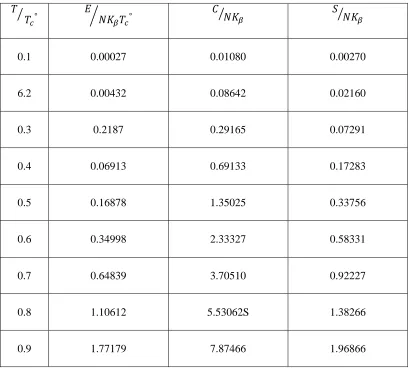
Table T1
Evaluated results of Energy per particle, specific heat and entropy of trapped Bose Gas (non-interacting models).
°
°
0.1 0.00027 0.01080 0.00270
6.2 0.00432 0.08642 0.02160
0.3 0.2187 0.29165 0.07291
0.4 0.06913 0.69133 0.17283
0.5 0.16878 1.35025 0.33756
0.6 0.34998 2.33327 0.58331
0.7 0.64839 3.70510 0.92227
0.8 1.10612 5.53062S 1.38266
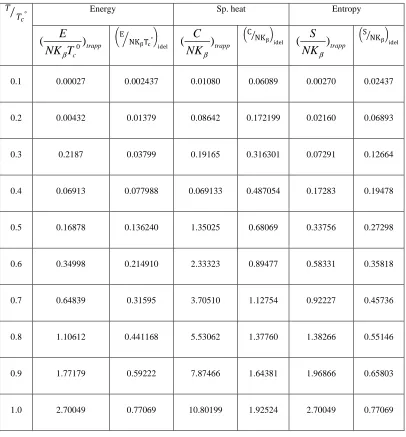
Table T2
Comparison of results of
°,
, !"
# $ and !"
for trapped Bose Gas
and ideal Bose gas as function of /°
°
Energy Sp. heat Entropy
0
(
)
trapp cE
NK T
β E NKT°
(
)
trappC
NK
βC NK
(
)
trappS
NK
βS NK
0.1 0.00027 0.002437 0.01080 0.06089 0.00270 0.02437
0.2 0.00432 0.01379 0.08642 0.172199 0.02160 0.06893
0.3 0.2187 0.03799 0.19165 0.316301 0.07291 0.12664
0.4 0.06913 0.077988 0.069133 0.487054 0.17283 0.19478
0.5 0.16878 0.136240 1.35025 0.68069 0.33756 0.27298
0.6 0.34998 0.214910 2.33323 0.89477 0.58331 0.35818
0.7 0.64839 0.31595 3.70510 1.12754 0.92227 0.45736
0.8 1.10612 0.441168 5.53062 1.37760 1.38266 0.55146
0.9 1.77179 0.59222 7.87466 1.64381 1.96866 0.65803
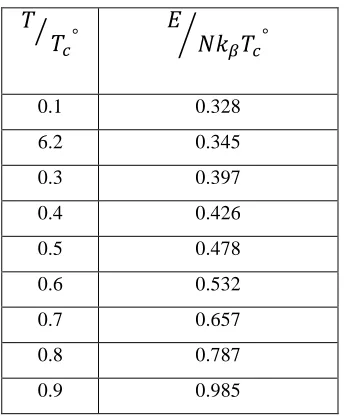
Table T3
Evaluated result of energy per particle as function of T
°
for = 0.4 using equation (12) (Interacting Model)
°
# %
°
&
0.1 0.328 6.2 0.345 0.3 0.397 0.4 0.426 0.5 0.478 0.6 0.532 0.7 0.657 0.8 0.787 0.9 0.985
REFERENCES
1. R. Yadav, S.K. Yadav and L.K. Mishra, Int. J. Chem. Sci. (IJCS) 9(3), 1236-1246 (2011).
2. A Griffin, Phys. Rev. B 53, 9341(1996). 3. V.N. Popov, Sov. Phys. JLTP 20, 1185
(1965).
4. F. Dalfovo, S. Giorgini, L. Pitaevskii, and S. Stringari., Rev. Mod. Phys. 71,463 (1999).
5. W.M. Liu , R. Micnas, A. J. Millis, H. J. Molegraff and K. Levin, Phys. Rev. Lett. (PRL) 84, 2294 (2000).
6. J.D. Reppy, Y. Tokura, T. A. Maier, P. Coleman and D. Ceperly, Phys. Rev.
Lett. (PRL) 84, 2060 (2000).
7. J.X. Dai, L. D. Carr, L. B. Ioffe, and E. W. Carlson et., Int. J. Mod. Phys. B 13, 3499 (1999).
8. S. Pearson, T. Pang and C. Chen, Phys. Rev. A 58, 4796 (1998).
9. W.M. Liu, T. D. Lee, B. Janko, J. Maly, K. Levin and R. Micnas, Phys. Rev. Lett. (PRL) 88, 17408 (2002).
10. G.X. Hu, A. Minguzzi, X. J. Liu, Y. Wang and S. Dou, J. Low Temp. Phys. (JLTP) 133, 239 (2003).
11. D. Ivanov, Phys. Rev. B 70, 104503 (2004).