Available Online at www.ijpret.com 106
INTERNATIONAL JOURNAL OF PURE AND
APPLIED RESEARCH IN ENGINEERING AND
TECHNOLOGY
A PATH FOR HORIZING YOUR INNOVATIVE WORK
AN EVALUATION OF CRITICAL TEMPERATURE (T
C) FOR BOSE-EINSTEIN
CONDENSATION (BEC) OF THE ATOM-MOLECULE MIXTURE AT THE TOTAL
FIXED ATOMIC DENSITY
KAUSHLENDRA KUMAR2, L. K. MISHRA1 1. Computer Engineering Department, Vindhya Group of Technology and Science, Khandwa Road, Indore, India. 2. Vii-Chater, Po-Pai Bigha, PS-Makhdampur Dist-Jehanabad-804424(Bihar).
Accepted Date: 23/10/2015; Published Date: 01/11/2015
\
Abstract: - Using theoretical formalism of R. A. Duine and H. T. C. Stoof (Physics Reports, 2004) we have evaluated the critical temperature TC for Bose-Einstein condensation (BEC)
for the atom-molecule mixture at the fixed total density. The evaluation has been performed for positive and negative detuning. For positive detuning, we obtained TBEC =T0 and for
negative detuning, we have TBEC =(2-5/3T0) where T0 is initial temperature. Our theoretically
evaluated results are in good agreement with the experimental data and also with other theoretical workers.
Keywords: Real-time dynamics, Effective atom-molecular theory, Heisenberg equation, Retarded molecular propagator, Positive and negative detuning, Effective atom-molecular coupling, Wigner –threshold law, Backward scattering length, Matsubara frequency, Molecular self-energy, Wick rotations.
Corresponding Author: MR. KAUSHLENDRA KUMAR
Access Online On:
www.ijpret.com
How to Cite This Article:
Available Online at www.ijpret.com 107 INTRODUCTION
In order to evaluate the critical temperature for Bose-Einstein condensation of the atom-molecule mixture at the fixed total atomic density, one studies the effective atom-molecular theory1,2. In this study, one considers the real-time dynamics of the system by deriving the Heisenberg equation of motion for the field operators that annihilate an atom and a molecule of a given space and time. To determine the Heisenberg equation of motion for these field operators, one first have to perform an analytical continuation from Matsubara frequencies to real frequencies. For simplicity, one assumes that one is close to the resonance and one is allowed to neglect the energy dependence of the effective atomic interactions and the effective atom-molecule coupling. Moreover, one takes only the leading order energy dependence of the molecular self-energy into account. Higher orders are straight forwardly included. The leading order energy dependence of the self energy is after Wick rotations and is real energies. For the positive energy E, this result is in agreement with Wigner- Threshold law3. This law gives the rate for a static with a well defined positive energy to decay into three dimensional continuum. In order to study the properties of the gas in the normal state, one considers the two- atom properties of many-body theory. One can show that the effective field theory4 correctly contains the two-atom physics of a Feshbach resonance5. Firstly, one shows that the correct Feshbach- resonant atomic scattering length is obtained after the elimination of the molecular field. Secondly, one calculates the bound energy and shows that it has the correct threshold behavior near the resonance. To get more insight in the nature of the molecular state near the resonance, one also investigates the molecular density of states.
To calculate the effective interatomic scattering length, one has to eliminate the molecular field from Heisenberg equation of motion. Since the scattering length is related to the scattering amplitude at zero energy and momentum, one is allowed to put all the time and spatial derivatives in the equation of motion for the molecular field operator equal to zero. The scattering length bear a Feshbach resonance and is given by
a(B) =abg+ ares(B)
where abg is the backward scattering length and ares(B) is the Feshbach resonance. The energy
Available Online at www.ijpret.com 108 molecular state. For negative detuning the molecular propagator has a real and negative pole corresponding to the bound state energy.
The molecular density of state is obtained by taking the imaginary part of the retarded molecular propgator6. One can discuss only the situation when one is close to resonance and approximate the retarded molecular elf-energy by the square root term resulting from Wigner threshold law. For the case of negative detuning, the molecular density of states has two contributions, one arising from the pole at the bound state energy and the second from two atom continuum. Then one defines the wave function renormalization factor Z(B). This factor goes to zero as one approach the resonance and it becomes equal to one far off resonance. Far off resonance, the bound state of the coupled channels i.e the dressed molecules is almost equal to the bound state of the closed channel potential and has zero amplitude in the open channel. This corresponds to the situation Z(B)~1.0. As the resonance is approached, the
dressed molecule contains only with an amplitude Z B( ) the closed channel bound state i.e. bare molecule. Accordingly, the contribution of the open channel becomes larger and gives rise to the threshold behavior of the bound state energy. For positive detuning the molecular density of state has only a contribution for positive energy. The lifetime of the molecular state is defined by
3
2 2
4
( ) ( )
m
g m
B B
g is the order of coupling between atom and molecule, m is the mass of the atom,
0
( )B (B B )
is the detuning. As expected, the density of states is, in the case of positive
detuning, approximately a Lorentzian expected around the detuning with a width related to the lifetime of the molecule7-10.
In this paper, we have evaluated the critical temperature for the Bose-Einstein condensation (BEC) for the atom-molecule mixture at the fixed total atomic density. Two results were given one for the exact calculation and other for treating the gas as an ideal gas mixture. The calculations were performed from positive to negative detuning.
MATERIALS AND METHODS
Available Online at www.ijpret.com 109 chemical potential, or by directly calculating the expectation value of the operator for the total density. First, one calculates the thermodynamic potential which is given by11
1 1
0,
1 1
( , ) T Tr[ln(G a)] Tr[ln(G m)]
(1)
Here G0,a(k,iωn) is non interacting atomic propagator of the atoms. Gm(k,iωn)is molecular
propagator.
1 (K T )
. The full molecular propagator is given by
2
( , ) ( ) 2 ( 2 )
2 2
B
k k
m n n
n m
G k i b i
i
(2) Here 2B m is the molecule self-energy. The total atomic density is calculated by using the
thermodynamic identity
( , )T
N
which results in total density as
1
[ ( ) 2 ( ( ) 2 )]
2
k
k k m
n N N B
V
(3)
Where εm(B) is molecular binding energy. This important results show that in equilibrium in the
normal state and for negative detuning the gas in first approximation behaves as an ideal gas mixture of atoms and the dressed molecules. The same result is found if one neglects in the Heisenberg equations of motion for the atomic and dressed molecular field operators in the interaction terms and calculate the total density in equilibrium. Then, one calculates the total density for negative detuning the contribution comes from molecular propagator. It is found to be equal to12
3
( ) ( ( ) 2 )
(2 ) 2
k
m m
dk
n Z B N B
(4)
Where Z(B) is wave function renormalization factor. The molecular self-energy is given by
2 , 4 1 ( , ) ( ( )) ] [
s n q n k
n
g
k i B
i V
(5)
Available Online at www.ijpret.com 110
(2 2 ( ) 1
( ( ) 2 ) ( )
2
k
n k k k
Z B
n N B N
V V
(6)
The molecular density becomes equal to
( )
( ( ) 2 )
m k k
Z B
n N B
V
(7)
The temperature is given in units of the critical temperature for Bose-Einstein condensation of an ideal gas of atoms with total density n as
2
2 3
0 3.31 n
T
mK
(8)
Adiabatic Sweep through the resonance
One now calculates the number of atoms and molecules of the gas during adiabatic sweep in the magnetic field, such that the detuning changes from positive to negative13. The condition for adiabatically is that the entropy of the gas is constant. The entropy is given by
S
T
(9)
where Ω is thermodynamic potential. The total number of atoms is also constant throughout the sweep. As one can see for sufficiently large absolute values of the detuning, the gas is well described by an ideal gas approximation. For simplicity, one will treat the gas here as an ideal -gas mixture since one is mostly interested in the final density of atoms and molecules and final temperature of the gas after the sweep14.
RESULTS AND DISCUSSION
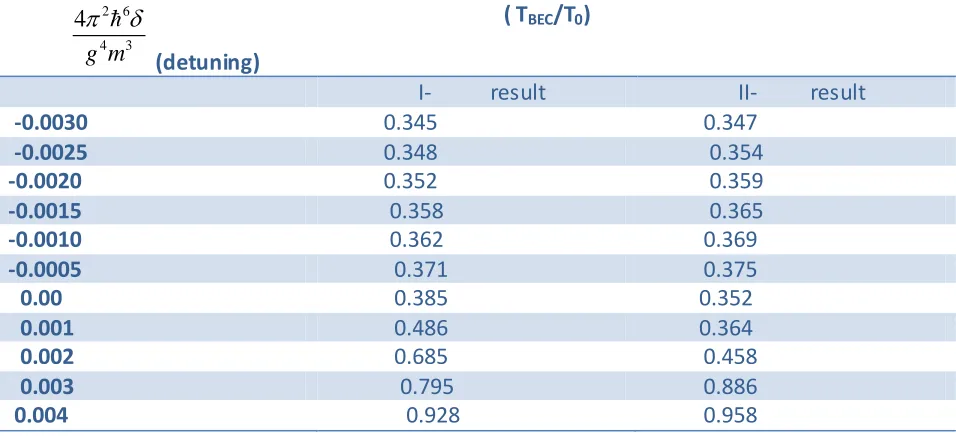
In this paper, we have evaluated the critical temperature for Bose-Einstein condensation (BEC) for the atom-molecule mixture at the fixed atomic density. The evaluation has been performed by the theoretical formalism of R. A. Duine and H. T. C. Stoof15. In table T1, we have shown the temperature of the gas as a function of detuning for a sweep through the resonance from positive to negative detuning for two initial temperature T=2 T0 and 4T0. The total density of the
Available Online at www.ijpret.com 111 cm-3. Two results were given, one for the exact calculation and other for treating the gas as an ideal gas mixture. For positive detuning and far from the resonance, one is essentially dealing with an atomic gas. Hence one has in this regime TBEC =T0. For sufficiently negative detuning, one is dealing with a gas of molecules with twice the atomic traps and one has TBEC=(2-5/3 T0). The feature in the critical temperature at zero detuning turns out to be a signature of true thermodynamic phase transition between a phase with single Bose-Einstein condensates of molecules and a phase contrary of two Bose-Einstein condensates, one of atoms and other of molecules. This was first pointed out by Sachher16. This should be contrasted with the situation of atomic Fermi gas near a Feshbach resonance, where only a BCS-BEC cross-over exists17. In table T3, we have shown the results of evaluation of fraction of atoms as a function of the detuning for an adiabatic sweep through the resonance. The total density is again kept equal to (n=1013 cm-3). The calculation were performed with two initial temperature T= 2T0 and 4T0. In
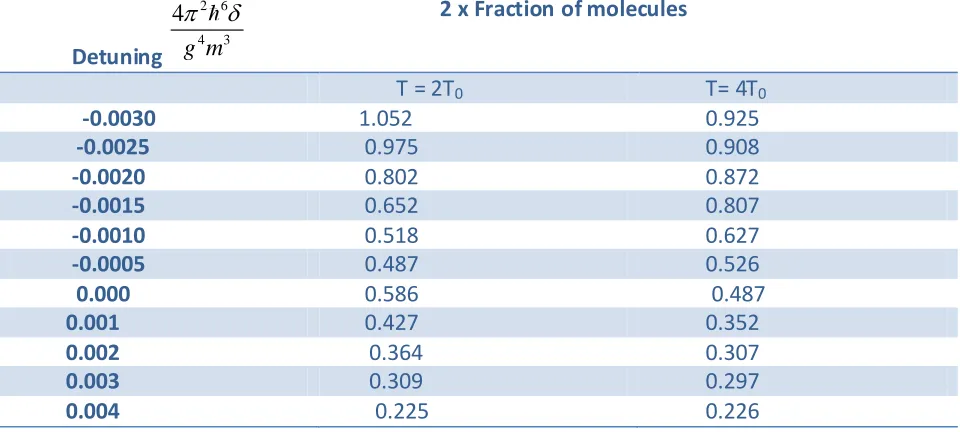
table T4, we have given the result of evaluation of twice the fraction of molecules as a function of detuning for an adiabatic sweep through the resonance. The other parameters are same as shown in table T3. There are some recent18-30 results which also reveal the similar behavior.
CONCLUSION
From the above theoretical evaluations and investigations, we have come across the following conclusions.
(1)At positive detuning, most of the atoms are free. One finds that the width in detuning of the cross-over regime is approximately equal to temperature and the result does not incorporate the effects of the nonzero lifetime of the molecules at positive detuning.
(2) For negative detuning, one observes that the ideal gas result becomes equal to the exact result. This shows that for negative detuning, one is allowed to treat the gas as an ideal -gas mixture of atoms and dressed molecules.
Table T1: Temperature of the gas as a function of the detuning for a sweep through resonance from positive to negative detuning for two initial temperature T=2T0 and 4T0. The
total atomic density of the gas is n=1013 cm-3.
Detuning
2 6
4 3
4 g m
T/T0 (T=2T0) T/T0 (T=4T0)
-0.0030 3.25 7.85
-0.0025 3.00 6.52
Available Online at www.ijpret.com 112
-0.0015 2.86 5.86
-0.0010 2.72 5.48
-0.0005 2.58 5.12
0.0 2.50 4.95
0.001 2.80 5.25
0.002 2.95 5.49
0.003 3.10 5.75
0.005 3.17 5.90
Table T2: An Evaluation of critical temperature for Bose-Einstein condensation as a function of detuning .The total density of the gas is equal to n= 1013 cm-3. I- results show the exact
calculations. II-results show the calculation for treating the gas as an ideal gas mixture.
2 6
4 3
4 g m
(detuning)
( TBEC/T0)
I- result II- result
-0.0030 0.345 0.347
-0.0025 0.348 0.354
-0.0020 0.352 0.359
-0.0015 0.358 0.365
-0.0010 0.362 0.369
-0.0005 0.371 0.375
0.00 0.385 0.352
0.001 0.486 0.364
0.002 0.685 0.458
0.003 0.795 0.886
0.004 0.928 0.958
Table T3: An evaluated result of function of atoms as a function of the detuning for an adiabatic sweep through the resonance The total density is equal to n =1013 cm-3. The
calculations have been performed for two initial temperature T=2T0 and 4T0.
Detuning
2 6
4 3
4 g m
Fraction of atoms
T =2T0 T=4T0
-0.0030 0.00 0.252
Available Online at www.ijpret.com 113
-0.0020 0.008 0.327
-0.0015 0.015 0.368
-0.0010 0.225 0.445
-0.0005 0.325 0.565
0.00 0.458 0.589
0.001 0.586 0.609
0.002 0.765 0.668
0.003 0.848 0.699
0.005 1.052 0.823
Table T4: An evaluated result of twice the fraction of molecules as a function of the detuning for an adiabatic sweep through the resonance The total density is equal to n =1013 cm-3. The
calculations have been done for two initial temperature T =2 T0 and 4T0.
Detuning
2 6
4 3
4 g m
2 x Fraction of molecules
T = 2T0 T= 4T0
-0.0030 1.052 0.925
-0.0025 0.975 0.908
-0.0020 0.802 0.872
-0.0015 0.652 0.807
-0.0010 0.518 0.627
-0.0005 0.487 0.526
0.000 0.586 0.487
0.001 0.427 0.352
0.002 0.364 0.307
0.003 0.309 0.297
0.004 0.225 0.226
REFERENCES;
1. A. J. Leggett. Rev. Mod. Phys 63, 307(2001)
2. C. J. Pethck, H. Smith, “ Bose-Einstein condensation in dilute gases ( Cambridge University Press, Cambridge 2002)
Available Online at www.ijpret.com 114 4. V. Vuletic, A.J. Kerman, C. Chin and S. Chu, Phys. Rev. Lett. (PRL) 82, 1409 (1999)
5. H. Feshbach, Ann. Phys 19, 287(1962)
6. R. A. Duine and H. T. C. Stoof, Phys Rev A65, 013603(2002)
7. S. K. Adhikari, Phys. Lett. A296, 145(2002)
8. H. Saito and M. Ueda, Phys. Rev A65, 033624(2002)
9. L. Santos and G. V. Shiyapnikov, Phys. Rev. A66, 011602(2002)
10.R. A. Duine and H. T. C. Stoof, Phys. Rev. A68, 013421(2003)
11.J. W. S. Negele and H. Orland, “ Quantum Many-Particle System (Addison-Weasley, New York, 1988)
12.S J. J. M. F. KOkkelmans, G. V. Shlyapnikov and G. Salomon, Phys. Rev. A69, 031423(2004)
13.P. Nozieres and S. Schmitt-Rink, J. Low Temp. Phys (JLTP 59, 195(1985)
14.R. A. Dunie and H. T. C. Stoof, New. J. Phys. 5, 59(2003)
15.R. A. Duine and H. T. C. Stoof, Physics Reports 396, 115(2004)
16.S. Sachdev, Phys. Rev. Lett. (PRL) 90, 033201(2003)
17.B. J. Powell and R. H. McKenzil, Phys. Rev. Lett. (PRL) 94, 047004(2005)
18.J. Geremia, J. Stockhom and H. Mubachi, Phys. Rev. A73, 042112(2006)
19.K. D.Nalson, Xiao Li and D. S. Weiss, Nature Physics 3, 566(2007)
20.W. S. Bakr, J. I. Gillen, A. Peng, S. Folling and M. Greiner, Nature 462, 7269(2009)
21.Y. Lin, S. Jung, S. Maxwell, L. Turner and E. Tiesinga, Phys. Rev. Lett.(PRL) 102, 125301(2009)
22.D. V. Vasilyev, I. V. Sokolov and E. S. Polzik, Phys. Rev. A81, 020302R(2010)
23.E. Zuethan, A. Gordeeka and A. Sorensen, Phys. Rev.A84, 043838(2011)
24.K. Hammer, A. S. Sorensen and F. S. Polzik, Rev. Mod. Phys. 84, 1041(2011)
Available Online at www.ijpret.com 115 26.C. H. Wu, J. W. Park, P. Ahmedi, S. Wall and M. W. Zwierlean, Phys. Rev. Lett. (PRL) 109, 085301(2012)
27.G. Bertainia, E. Pratini, S. Giorgini and P. Pieri, Phys. Rev. Lett. (PRL) 110, 115303(2013)
28.I. Brouzos and P. Schmelchar, Phys. Rev. A87, 023605(2013)
29.P. G. Bugnion and G. J. Condult, Phys. Rev. A88, 013601(2013)