36(3), Fall 2017, pp. 59-83- ISSN: 2008-8191
DOI: 10.22099/jtls.2017.26325.2324
The Effect of Reducing Lexical and Syntactic Complexity of Texts on Reading Comprehension
Mahmood Safari Assistant Professor
Hazrat-e Masoumeh University, Qom [email protected]
Mana Mohaghegh Montazeri M.A.
Azad University, Qom Branch [email protected]
Abstract
The present study investigated the effect of different types of text simplification (i.e., reducing the lexical and syntactic complexity of texts) on reading comprehension of English as a Foreign Language learners (EFL). Sixty female intermediate EFL learners from three intact classes in Tabarestan Language Institute in Tehran participated in the study. The intact classes were assigned to three experimental groups. Moreover, to homogenize the groups, the researchers administered a general proficiency test (TOEFL, 2003) to the participants. The results revealed no significant difference among the groups in general proficiency and reading ability. Then four reading comprehension texts from TOEFL test (2005) were simplified through lexical simplification, syntactic simplification or lexical-syntactic simplification techniques. The simplified texts, along with their reading comprehension (RC) questions, formed the three versions of the post-test, each version contained either lexically, syntactically or lexical-syntactically simplified texts. Each group took one version of the post-test. The scores were analyzed through one-way ANOVA. The results revealed a significant difference among the groups. The post hoc test indicated that the lexical-syntactic simplification group significantly outperformed the lexical simplification group and performed considerably better than the syntactic simplification group. There was no significant difference between the lexical and syntactic simplification groups, although the latter showed better results.
Keywords: lexical simplification, syntactic simplification, lexical-syntactic simplification, reading comprehension
Language input has always been an essential issue in second language learning. It is a necessary condition for language learning; learners need to be exposed to some forms of linguistic data to acquire a target language. Gass and Alvarez Torres (2005, p.2) considered it as "sine qua non of acquisition," and Ellis (2008) asserted that "all theories of L2 acquisition acknowledge a role for input" (p.205). However, it is commonly acknowledged that the input must be comprehensible for the learner to assist the process of language acquisition.
In formal language education, the input is mainly presented as texts that learners are asked to read in the classroom or at home. Some experts prefer authentic texts, texts that are written for native speakers for purposes other than language instruction. They argue that authentic texts arouse learners' interest and motivation more and expose them to real language. But most language teachers and materials developers believe that authentic texts are demanding for learners, especially those at lower levels, as they contain more complex structures and vocabulary than learners can process (McLaughlin, 1987; Sonmez, 2007). Hence, most language teaching scholars and practitioners maintain that language input must be modified in some way to be comprehensible for the learner. Proponents of text modification argue that altered texts provide more comprehensible input as they have less sophisticated linguistic features (more common words, simpler structures and more repetition and cohesion).
been linguistically simplified (Hague & Scott, 1994; Tomlinson & Masuhara, 2013; Young, 1999).
Language teachers and scholars who have been involved in the development of EFL materials realize that authentic texts are not suitable for most TEFL contexts and they agree with Widdowson (1984), who asserted "pedagogic presentation of language necessarily involves methodological contrivance" (p.218). Saggion (2017) pointed out that language learners "may have a very restricted lexicon and may not be able to understand certain grammatical constructions" (p.4). The majority of studies on the effect of text simplification have revealed a significantly positive impact of text simplification on learners' comprehension (Anani Sarab & Karimi, 2008; Blaue, 1982; Brown, 1987; Crossley & McNamara, 2016; Gardner & Hansen, 2007; Heydari, Khodabandehlou & Jahandar, 2013; Klare, 1974; Long & Ross, 1993; Moradian, Naserpoor & Tamri, 2013; Oh, 2001; Tweissi, 1998; Yano, Long & Ross, 1994), although there have been some counterarguments (Bernhardt, 1984; Leow, 1993; Parker & Chaudron, 1987; Swaffar, 1985).
However, despite the abundance of research on the effect of text simplification, there has been a lack of studies comparing the effects of different types of text simplification (lexical, syntactic, etc.). Only a few studies have examined the effects of different kinds of simplification on learners' comprehension, and the findings have been inconclusive. Keshavarz et al. (2007) found no significant difference in the effects of different types of linguistic simplification, but in Tweissi's (1998) study, lexical simplification was significantly more effective than lexical-syntactic simplification.
1. Is there any significant difference in the effects of the different types of text simplification on Iranian intermediate EFL learners’ reading comprehension?
2. Is there any significant difference in the effects of lexical simplification and syntactic simplification on Iranian intermediate EFL learners’ reading comprehension?
3. Is there any significant difference in the effects of lexical simplification and lexical-syntactic simplification on Iranian intermediate EFL learners’ reading comprehension?
4. Is there any significant difference in the effects of syntactic simplification and lexical-syntactic simplification on Iranian intermediate EFL learners’ reading comprehension?
Literature Review
language readers already know about the target language and can expand this knowledge.
Text simplification aims to provide the reader with a text that is more accessible and more comprehensible (Crossley, Allen, McNamara, 2011). Simplified texts are either adapted from authentic texts or written explicitly for the second language reader. They contain less sophisticated vocabulary, less syntactic complexity and greater cohesion (Crossley et al., 2011). McDonough, Shaw, and Masuhara (2013, p.75) pointed out that text simplification can be done according to:
1. Sentence structure. Sentence length is reduced, or a complex sentence is rewritten as some simpler ones, for example, by the replacement of relative pronouns by nouns and pronouns followed by the main verb. 2. Lexical content, so that the number of new vocabulary items is
controlled by reference to what students have already learned.
3. Grammatical structures. For instance, passives are converted to actives; simple past tense to simple present; reported in direct speech.
Studies on the effect of text simplification on reading comprehension of second language readers have provided mixed results. Some studies have refused any positive impact of text simplification on learners' reading comprehension (Bernhardt, 1984; Ghane, Oroji & Habibzadeh, 2015; Lewo, 1993; Parker & Chaudron, 1987; Swaffar, 1985; Ulijn & Strother, 1990). Parker and Chaudron (1987) revealed that linguistic simplification (simplified syntax and vocabulary) did not have a significantly positive effect on comprehension of the information. Ulijn and Strother (1990, p.38), investigating the effect of syntactic simplification on reading comprehension, found “no significant differences between subgroups reading an authentic (in original, not in adapted form) computer science text and those reading a syntactically adapted text either in comprehension or in time." However, despite the trend favoring authentic texts for all proficiency levels, the majority of texts in second language textbooks are simplified passages; most scholars and practitioners in language teaching and materials development appreciate the value of simplified texts, especially those for beginner and intermediate levels (Johnson, 1982; Shook, 1997; Young, 1999).
was no significant difference between the students who read the authentic texts and those who read elaborated texts.
Anani Sarab and Karimi (2008) investigated text modification in three conditions (using unmodified, linguistically simplified and interactionally modified texts) and found that both linguistic simplification and interactional change had significantly positive effects on the reading comprehension of Iranian EFL learners.
Despite the vast number of studies evaluating text simplification, there has been a lack of research on the effects of different types of simplification (i.e., syntactic, lexical, syntactic-lexical simplifications) on second language readers' comprehension. There have been only a few studies comparing the effects of different types of linguistic simplification, and the findings have been mixed and inconclusive. Tweissi (1998) investigated the effect of different types of text simplification on reading comprehension of 200 Omani EFL learners and found that each type of text simplification (lexical, syntactic, lexical-syntactic simplifications) was significantly more effective than using authentic texts. However, lexical simplification led to a greater gain in reading comprehension than other types of text simplification. There was no significant difference in the effects of syntactic and lexical simplifications, but lexical simplification was significantly more effective than full (lexical-syntactic) simplification.
Keshavarz et al. (2007) investigated the effects of topic familiarity and different types of linguistic simplification (lexical, syntactic and lexical-syntactic simplifications) on Iranian EFL learners' reading comprehension. They found that topic familiarity had a significant effect on the learners' comprehension but text simplification, in general, did not have such an effect. Furthermore, the study revealed that there was no significant difference among different types of text simplification (lexical, syntactic and lexical-syntactic simplifications).
intermediate EFL learners and provide some contribution to resolve the issue.
Method Participants
The participants of the study were 60 female intermediate EFL learners, with an age range of 18 to 28, learning English at Tabarestan Language Institute in Tehran, Iran. They were chosen from 67 intermediate EFL learners in three intact classes available at the institute through a general proficiency test (TOEFL 2003). The students who scored two standard deviations above and below the mean were selected. The intact classes were randomly assigned to the three experimental groups (lexical simplification, syntactic simplification, and lexical-syntactic simplification groups). According to the institute's placement procedures, the three classes were considered to be at the intermediate level and identical concerning general proficiency, but a TOEFL test (2003) was used to ensure further that the participants in the three experimental groups were homogeneous regarding general proficiency and reading ability.
Instruments
The instruments used in the present study included a general proficiency test (TOEFL, 2003) and a reading comprehension post-test in three versions.
was not distorted. The analysis revealed a relatively high-reliability index (r = .71) for the proficiency test. Finally, the results of Shapiro-Wilks test of normality (SW = .981, df = 60, p = .464) approved of the normality of the general proficiency test.
Post-test. To measure the effect of different types of text
simplification on the reading comprehension of the participants, a reading post-test in three versions was used. Four reading comprehension texts from TOEFL (2005) were simplified using three types of linguistic simplification: lexical, syntactic and lexical-syntactic simplifications. The four simplified texts along with their 40 reading comprehension questions constituted the three versions of the post-test. The three versions included the same four reading comprehension passages and the same 40 reading comprehension questions, but their passages were simplified differently (through lexical, syntactic or lexical-syntactic simplifications).
The theoretical framework of the present study was based on text simplification models proposed by McDonough, Shaw, and Masuhara (2013) and Siddharthan (2004, 2014). Siddharthan (2004) defines text simplification as "any process that reduces the syntactic or lexical complexity of a text while attempting to preserve its meaning and information content" (p.17). In the present study, complicated words and complex structures in the reading texts were simplified as described below.
In lexical simplification, different words of the texts were replaced with more common and simple words. The content words of the texts which seemed to be difficult for intermediate EFL learners were checked in Longman Communication 3000 list and Cambridge English Vocabulary Profile to figure out difficult and infrequent words. Then
Longman Contemporary Dictionary (5th edition) and Oxford Thesaurus
rewritten in ordinary non-idiomatic language. And semantically ambiguous phrases were rewritten in clear, unambiguous expressions. For instance, onset, preceding and pioneering were replaced by start, last and early respectively. The expression ‘various rock units could be dated by their relative ages’ was rewritten as ‘the relative age of different rock units could be discovered'.
In syntactic simplification, the complex structures were replaced by less complex ones; for instance, the passive sentences were changed to active ones, and the complex sentences containing subordinate clauses (relative clauses, adverb clauses or embedded noun clauses) were rewritten in two more straightforward sentences. Relative pronouns were replaced by nouns and pronouns and followed by finite verbs. Complex sentences including challenging adverb clauses were rewritten in two simpler sentences connected by appropriate conjunctions. Adverb or adjective phrases were changed to clauses or rewritten as separate
sentences. For example, the sentence ‘Specific rock types were thus
assumed to have formed at characteristically different times, the softest rocks having formed the most recently’ was rewritten in two sentences: ‘Thus they assumed that specific rock types had formed at characteristically different times. And the softest rocks had formed the most recently’. In lexical-syntactic simplification, both lexical and syntactic simplification techniques were employed. The original and differently simplified forms of a part of the post-test are presented in the Appendix.
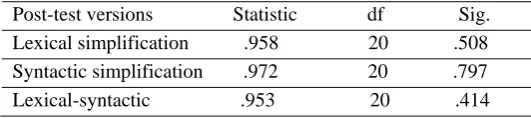
normally distributed. The p-value for all the test versions was above the critical p-value, which approved of their test normality.
Table 1.
Results of Shapiro-Wilks Normality Test on Post-test Scores
Post-test versions Statistic df Sig. Lexical simplification .958 20 .508 Syntactic simplification .972 20 .797 Lexical-syntactic .953 20 .414
Data Collection Procedure
Initially, the researchers administered a general proficiency test (TOEFL, 2003) to the 67 intermediate EFL students of the three intact classes in the institute. The participants who scored two standard deviations above and below the mean were selected for the study. There were four outliers. To have an equal number of participants in each group, 20 students were chosen in each intact class. The analysis of the TOEFL test results indicated that the participants in the three intact classes were homogenous regarding general proficiency and reading ability. Each class, containing 20 participants, was randomly assigned to one experimental group. Then four reading comprehension texts were taken from TOEFL (2005) and were simplified through three different simplification techniques: lexical, syntactic, or lexical-syntactic simplifications. The simplified texts, along with their reading comprehension questions, constituted the three versions of the post-test. Each experimental group took one version of the post-test, and their scores were analyzed through some statistical techniques to answer the research questions of the study.
Data Analysis
regarding general proficiency and reading ability respectively. Then the scores of the participants on the post-test were analyzed through a one-way ANOVA and a post hoc test (Scheffe test) to provide answers to the four research questions.
Results and Discussion
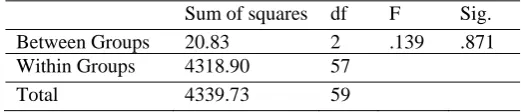
The results of the one-way ANOVA analysis comparing the performance of the participants on the general proficiency test (Table 2) revealed that there was no significant difference among the experimental
groups regarding general proficiency (F [2, 57]= .139, p= .871). The p
-value was considerably higher than the critical p-value (p=.05), which
was evidence to the fact that the differences among the groups were not statistically significant. Furthermore, the performance of the participants on the Reading Section of the general proficiency test (TOEFL, 2003) was compared through a one-way ANOVA, and the results (F [2, 57]= .183, p= .833) indicated that there was no significant difference among the groups in terms of reading ability. Thus, the groups were shown to be identical in general proficiency and reading ability on the onset of the study, and there was no statistically significant difference among them.
Table 2.
Results of ANOVA Analysis of the General Proficiency Test
Sum of squares df F Sig. Between Groups 20.83 2 .139 .871 Within Groups 4318.90 57
Total 4339.73 59
Table 3.
Descriptive Statistics of the Post-test Results
Groups N Mean Std. Deviation
Lexical simplification
20 26.55 4.74
Syntactic
simplification
20 29.55 4.90
Lexical-syntactic 20 32.65 3.70
Total 60 29.58 5.06
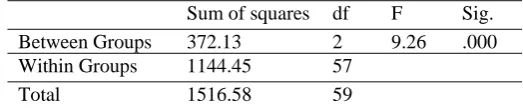
However, a one-way ANOVA analysis was required to indicate whether the difference among the groups was statistically significant or not. The results of the ANOVA analysis of the post-test results (Table 4) revealed that the difference among the three experimental groups was
significant. The p-value (.000) was significantly below the critical p
-value. Therefore, the first null hypothesis (There is no significant difference in the effects of the different types of text simplification on Iranian intermediate EFL learners' reading comprehension) was rejected.
Table 4.
Results of ANOVA Analysis of the Post-test Scores
Sum of squares df F Sig. Between Groups 372.13 2 9.26 .000 Within Groups 1144.45 57
Total 1516.58 59
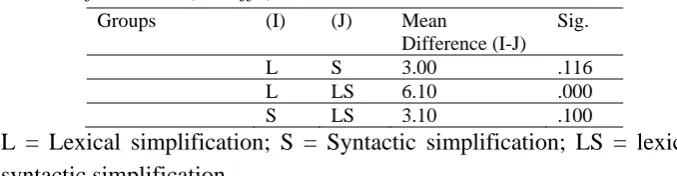
confirmed. The results indicated that lexical and syntactic simplifications have similar effects on EFL learners' reading comprehension. However, the mean difference between the lexical simplification group and the lexical-syntactic simplification group (6.10) was statistically significant.
The p-value (.000) was considerably below the critical p-value, which
revealed that lexical and syntactic simplifications together had a significantly higher effect on the EFL learners' reading comprehension than lexical simplification alone. So, the third null hypothesis (There is no significant difference in the effects of lexical simplification and lexical-syntactic simplification on Iranian intermediate EFL learners' reading comprehension) was rejected. Finally, the mean difference between the syntactic simplification and lexical-syntactic simplification groups (3.10) was not so high, and there was no statistically significant difference between the two groups (p = .100). The last null hypothesis (There is no significant difference in the effects of syntactic simplification and lexical-syntactic simplification on Iranian intermediate EFL learners' reading comprehension) was confirmed. It was shown that although lexical and syntactic simplifications together had a considerably greater effect on the learners' reading comprehension than syntactic simplification alone, there was no significant difference between them.
Table 5.
Results of Post hoc (Scheffe) Test on Post-test Scores
Groups (I) (J) Mean
Difference (I-J) Sig.
L S 3.00 .116
L LS 6.10 .000
S LS 3.10 .100
L = Lexical simplification; S = Syntactic simplification; LS = lexical-syntactic simplification
simplification in the study. It was significantly more effective than lexical simplification and considerably, although not significantly, more efficient than syntactic simplification. This finding is logically justifiable since when both syntactic and lexical complexities of a text are reduced, the second language reader will have less trouble comprehending the text. However, this finding was not in line with some previous research findings. In the study by Keshavarz et al. (2007), lexical-syntactic simplification was not significantly more effective than other types of simplification; it was even less useful than lexical simplification. In Twessi's (1998) study, lexical-syntactic simplification was substantially less effective than lexical simplification and considerably less productive than syntactic simplification. Unlike these studies, the present study indicated that lexical-syntactic simplification was more effective than lexical simplification and syntactic simplification on reading comprehension of language learners.
The study results also showed that although syntactic simplification was more effective than lexical simplification, there was no statistically significant difference in the effects of these types of simplifications on EFL learners' reading comprehension. This finding confirms the results of the studies by Tweissi (1998) and Keshavarz et al. (2007). In both studies, there was no significant difference between the performances of those who took the test with lexically simplified texts and the participants who took the test with syntactically simplified texts. However, in both studies, lexical simplification was more effective, although not significantly, than syntactic simplification. But the finding of the present study contradicted the results of the study by Arya, Hiebert, and Pearson (2001), which indicated that lexical complexity had a significant impact on American native speaker students' comprehension of science texts while syntactic complexity did not have such an effect.
comprehension. This finding is in line with the results of the studies by Tweissi (1998) and Keshavarz et al. (2007). Thus, some of the findings of the present study were in line with the findings of previous studies, and some were in contrast to previous findings. Further research is required to fill the research gap in this area and shed more light on the issue.
Conclusion and Implications
The present study investigated the effects of different types of text simplification on intermediate EFL learners' reading comprehension and revealed that lexical-syntactic simplification was the most effective. It was significantly more effective than lexical simplification and remarkably more efficient than syntactic simplification. The findings indicate that full (lexical-syntactic) simplification will benefit intermediate EFL readers the most. The less complex a text is both lexically and syntactically, the more comprehensible it will be for the learners. Both lexical and syntactic complexity may hinder reading comprehension of EFL readers, so assigned reading texts must not include too much lexical and syntactic complexity. However, there was no significant difference between lexical and syntactic simplifications, although the latter was more efficient. Thus, the findings suggest that language teachers and materials developers should involve both lexical and syntactic simplifications in preparation of materials for EFL learners, especially those at intermediate and lower levels. Moreover, the findings suggest that syntactic simplification must be paid more attention than lexical simplification, as syntactic simplification was shown to be more efficient.
EFL learners can process. But they must be informed of the effects of different types of simplification on learners' comprehension. The present study revealed that lexical and syntactic simplifications together will have a greater effect on learners' comprehension and will provide more comprehensible input. Therefore, EFL materials developers are suggested to include both lexical and syntactic simplifications in their text preparation and materials development. Materials need to be at an appropriate level for EFL learners both in lexical and syntactic complexity. If a text is syntactically simplified but lexically unmodified or vices a versa, the text will still be difficult for learners to process. Both lexical and structure complexity hinders a learners' interaction with and comprehension of a text. Thus, logically a text must be at an appropriate level concerning both lexical and syntactic complexity to provide comprehensible input for the EFL learner. Moreover, if a text is only either syntactically or lexically simplified, the text will be unnatural and will provide an erroneous source for language acquisition. Lexical and syntactic features of natural, authentic texts are normally at the same level of complexity.
students. Finally, language instruction researchers can benefit from the findings of this study and use them in their research programs. They can replicate the study or investigate topics not covered in the study.
Like most studies, the present study could not cover all the related issues and had some limitations. So, further research is required to make for the limitations of the present study and investigate other aspects of text simplification. First of all, as there is a paucity of research on the effects of different types of text simplification (lexical, syntactic, etc.) on EFL learners' reading comprehension and the research results have been inconclusive, further research is required to replicate the study to confirm, or maybe challenge, the findings of this study. Moreover, the participants of the study were female students in 18-28 age range; therefore, interested researchers can investigate the effect of different types of text simplification on reading comprehension of male students and EFL learners in other age ranges.
The present study was limited to intermediate EFL learners so that further research can investigate the effect of different types of text simplification on other proficiency levels, like beginners and advanced EFL learners. The participants of the study were limited to language institute EFL learners; further studies can investigate the effects of simplifications on learners in other contexts like high school or university. Interested researchers can also probe the effect of text simplification on other language skills. Simplified texts might enhance EFL learners' listening comprehension, and different types of simplification may influence learners' listening comprehension in different ways. Further research is required to investigate the effect of text simplification in general and different types of text simplification on listening comprehension of EFL learners.
References
Anani Sarab, M. R., & Karimi, M. (2008). The impact of simplified and interactionally modified input on reading comprehension of Iranian
EFL learners. Journal of Human Sciences, 56, 29 - 42.
Arya, D., Hiebert, E., & Pearson, D. (2011). The effects of syntactic and lexical complexity on the comprehension of elementary science
text. International Electronic Journal of Elementary Education,
4(1), 107-125.
Bernhardt, E. B. (1984). Towards an information processing perspective
in foreign language reading. Modern Language Journal, 68,
322-331.
Blau, E. K. (1982). The effect of syntax on readability for ESL students
in Puerto Rico. TESOL Quarterly, 16, 517-528.
Brown, R. L. (1987). A comparison of the comprehensibility of modified
and unmodified reading materials for ESL. University of Hawaii
Working Papers in ESL, 6, 49-79.
Cambridge English Vocabulary Profile, available at
http://www.englishprofile.org/wordlists.
Crossley, S., Allen, D., & McNamara, D. (2011). Text readability and
intuitive simplification: A comparison of readability formulas. Reading in a Foreign Language,23(1), 84-102.
Crossley, S. A., Allen, D., & McNamara, D. S. (2012). Text simplification and comprehensive input: A case for intuitive
approach. Language Teaching Research, 16, 89-108.
Crossley, S. A., & McNamara, D. S. (2016). Text-based recall and extra-textual generations resulting from simplified and authentic texts. Reading in a Foreign Language, 28(1), 1-19.
Ellis, R. (2008). The study of second language acquisition (2nd Ed.).
Oxford: Oxford University Press.
Gardner, D., & Hansen, E. (2007). Effects of lexical simplification
during unaided reading of English informational texts. TESL
Gass, S. M., & Alvarez Torres, M. J. (2005). Attention when? An investigation of the ordering effect of input and interaction. Studies in Second Language Acquisition, 27, 1-31.
Ghane, A., Oroji, M. R., & Habibzade, S. M. (2015). Simplified texts or
authentic texts: Which one is more coherent? Extensive Journal of
Applied Sciences, 3(6), 234-238.
Hague, S. A., & Scott, R. (1994). Awareness of text structure: Is there a match between readers and authors of second language texts? Foreign Language Annals, 27, 343-363.
Johnson, P. (1981). Effects on reading comprehension of language
complexity and cultural background. TESOL Quarterly, 15,
169-181.
Heydari, M., Khodabandehlou, M., & Jahandar, S. (2013). On the effectiveness of strategy-based instruction of textual simplification
on EFL learners’ reading comprehension ability. Indian Journal of
Fundamental and Applied Life Sciences, 3 (2) 176-183.
Keshavarz, M. H., Atai, M. R., & Ahmadi, H. (2007). Content schemata, linguistic simplification, and EFL readers’ comprehension and
recall. Reading in a Foreign Language, 19(1), 19–33.
Kirkpatrick, B. (1994). The Oxford paperback thesaurus. Oxford: Oxford
University Press.
Klare, G. R. (1974). Assessing readability. Reading Research Quarterly,
10, 62-102.
Leow, R. (1993). To simplify or not to simplify. Studies in Second
language Acquisition, 15, 333-355.
Long, M. H., & Ross, S. (1993). Modifications that preserve language
and content. In M. L. Tickoo (Ed.), Simplification: Theory and
application (pp. 29-52). Singapore: SEAMEO Regional Language Center.
Longman dictionary of contemporary English (5th Ed.) (2009). London:
Lucas, M. A. (1991). Systematic grammatical simplification. International Review of Applied Linguistics in Language Teaching, 29, 241-248.
McDonough, J., Shaw, Ch. Masuhara, H. (2013). Materials and methods
in ELT. New York: Wiley-Blackwell.
McLaughlin, B. (1987). Theories of second language learning. London:
Edward Arnold.
Moradian, M. R., Naserpoor, A., & Tamri, M. S. (2013). Effects of lexical simplification and elaboration of ESP texts on Iranian EFL
university students’ reading comprehension. International Journal
of Psychology and Behavioral Research, 2(6), 332-338.
Oh, S. Y. (2001). Two types of input modification and EFL reading
comprehension: Simplification versus elaboration. TESOL
Quarterly, 35(1), 69-96.
Parker, K., & Chaudron, C. (1987). The effects of linguistic simplifications and elaborative modifications on L2
comprehension. University of Hawaii Working Papers in ESL, 6,
107-133.
Rello, L., Baeza-Yates, R., Dempere, L., & Saggion. H. (2013). Frequent words improve readability, and short words improve
understandability for people with dyslexia. Proceedings of
INTERACT, 13, Cape Town, South Africa.
Saggion, H. (2017). Automatic text simplification. Toronto: Morgan &
Claypool.
Shewan, C. & Canter, G. (1971). Effects of vocabulary, syntax and sentence length on auditory comprehension in aphasic patients. Cortex, 7, 209-226.
Shook, D. (1997). Identifying and overcoming possible mismatches in
the beginning reader–literary text interaction. Hispanica, 80,
234-243.
Siddharthan, A. (2004). Syntactic simplification and text cohesion.
Siddharthan, A. (2014). A survey of research on text simplification. International Journal of Applied Linguistics, 165(2), 259–298. Sonmez, S. (2007). An overview of studies on the use of authentic texts
in language classrooms. Proceedings of the third international
online conference on second and foreign language teaching and research (pp. 51-62). The Reading Matrix Inc., United States. Swaffar, J. K. (1985). Reading authentic texts in a foreign language: A
cognitive model. Modern Language Journal, 69, 15-34.
Tomlinson, B. (2013). Are materials developing? In B. Tomlinson (Ed), Developing materials for language teaching (pp. 1-19). New York: Bloomsbury.
Tomlinson, B. & Masuhara, H. (2013). Review of adult EFL courses. ELT Journal, 67(2), 233-249.
Tweissi, A. I. (1998). The effects of the amount and the type of simplification on foreign language reading comprehension. Reading in a Foreign Language, 11, 191–206.
Ulijn, J. & Strother, J. B. (1990). The effect of syntactic simplification on
reading EST texts as L1 and L2. Journal of Research in Reading,
13(1), 38-54.
Widdowson, H. G. (1984). Explorations in applied linguistics. Oxford:
Oxford University Press.
Yano, Y., Long, M., & Ross, S. (1994). The effects of simplified and elaborated texts on foreign language reading comprehension. Language Learning, 44, 189- 219.
Young, D. J. (1999). Linguistic simplification of SL reading material:
Effective instructional practice? Modern Language Journal, 83,
Appendix
Sample texts from reading comprehension post-test in original and differently simplified forms (adopted from TOEFL 2005)
Unsimplified original text
At the turn of the twentieth century, Americans who wished to travel between cities either for work or for pleasure had limited options. The steam railroad offered the best, the most reliable and the fastest means of transport. Electric railways (trams and trolleys) provided reasonable intraurban and short-distance intercity travel. They also offered some longer routes, but only in certain parts of the country. Horse-drawn coaches were neither a competitive nor a comfortable alternative given the deplorable slate of the nation's highways; and though bicycles were popular in both town and country, they, too, were hampered by poor road surfaces. It took the mass production and ownership of cars, together with increased attention to road construction, to bring the breakthrough in travel in the 1920s. And alongside the rapid spread of the popular and individualistic auto came the slower, but significant, growth of bus transport. Not only did buses largely replace trams and trolleys in urban mass transit, but they also opened up new avenues of intercity travel both to those Americans who could not afford cars and to those car owners who preferred to leave distance driving to others.
Lexically simplified text
bicycles were widespread in both town and country, they, too, were hampered by lousy road surfaces. It needed the production of cars in large numbers and ownership of cars, together with more attention to road building, to bring the main advance in travel in the 1920s. And beside the fast spread of the famous and personal cars came the slower, but important, growth of bus transport. Not only did buses mainly replace trams and trolleys in transportation of people in large numbers in cities, but they also opened up new ways of travel between cities both to those Americans who could not buy cars and to those car owners who preferred to leave far away driving to others.
Syntactically simplified text
Lexical-syntactically simplified text: