International Journal of Agriculture, Environment and Biotechnology Citation: IJAEB: 11(1): 17-24, February 2018
DOI: 10.30954/0974-1712.2018.00178.2 ©2018New Delhi Publishers. All rights reserved
AGRONOMY
Nutrients Uptake and Available Nutrients Status in Soil as
Influenced by Sowing Methods and Herbicides in
Kharif
Maize
(
Zea mays
L.)
Gaurav, S.K. Verma*, R.S. Meena, A.C. Maurya and Sushil Kumar
Department of Agronomy, I. Ag. Sc., Banaras Hindu University, Varanasi, Uttar Pradesh, India *Corresponding author: [email protected] (ORCID ID: 0000-0001-8297-2054)Paper No. 645 Received: 22-09-2017 Accepted: 17-01-2018
ABSTRACT
An investigation was carried out at Varanasi during kharif season of 2015 and 2016 to assess the influence of three sowing methods (ridge and furrow, conventional flat bed and raised bed planting) and seven weed-control methods (tembotrione 100 g ai. ha-1 (PoE), tembotrione 125 g ai g ai. ha-1 (PoE), atrazine 1 kg
ai. ha-1 followed by one hand weeding at 30 DAS, atrazine 1 kg ai. ha-1 (PE) followed by 2, 4-D at 30 DAS
(0.5 kg ai. ha-1, PoE), pendimethalin 1 kg ai. ha-1 (PE) followed by one hand weeding at 30 DAS, weedy
check and weed free) on nutrient uptake and available nutrients in maize. Raised bed planting has sown results of the lowest weed dry matter accumulation, depletion of NPK by weeds and the highest grain and straw yield, NPK uptake by crop and the available NPKS and Zn in soil than conventional flat bed sowing and it was at par with ridge and furrow sowing. Among the herbicidal treatments, sequential application of atrazine followed by 2, 4-D at 30 was recorded with the lowest dry matter of weeds, NPK depletion by weeds and the highest yield and nutrients uptake and available nutrients in soil when compared to tembotrione 125 g ai g ai ha-1 (PoE), tembotrione 100 g ai. ha-1 (PoE) and weedy check, respectively and it
were statistically at par with weed free, atrazine 1 kg ai. ha-1 followed by one hand weeding at 30 DAS
and pendimethalin 1 kg ai. ha-1 (PE) followed by one hand weeding at 30 DAS, respectively.
Highlights
mRaised bed planting recorded the lowest weed dry weight, nutrients depletion by weeds and the highest grain and straw yield and nutrients uptake by crop and the available nutrients in soil.
mSequential application of atrazine 1 kg ai. ha-1 (PE) followed by 2, 4-D at 30 DAS (0.5 kg ai. ha-1, PoE),
recorded the lowest weed dry weight, nutrients depletion by weeds and the highest grain and straw yield and nutrients uptake by crop and the available nutrients in soil.
Keywords: Available nutrients, Maize, Nutrients uptake, Weed, Yield
Maize (Zea mays L.) is the third most important cereal crop in India after rice and wheat. The cereals occupy about 54per cent of the total cropped area of which maize occupies about 3.61 per cent of the total cropped area of India. It accounts for 9 per cent of the total food grain production in the country. Karnataka, Rajasthan, Andhra Pradesh, Maharashtra, and Uttar Pradesh are the major maize producing states, which together contribute 60 per cent of area and 70 per cent production in country (Trivedi et al. 2017). Successful maize production
depends on the correct application of production inputs that will sustain the environment as well as the agricultural production. These inputs are, inter alia, adapted cultivars, plant population, soil
tillage, fertilisation, weed, insect and disease control,
(Das et al. 2012) and the nutrient loss varies from 30 to 40% of the applied nutrients (Chopra and Angiras 2008). Management of weeds through integration of crop establishment methods with herbicides can increase the uptake of nutrients and productivity of the crop by decreasing the biomass and nutrient removal by the weeds. Chemical weed management by using pre- or post-emergence herbicides can lead to efficient and cost effective control of weeds during the critical period of crop weed competition, which may not be possible in manual or mechanical weeding due to its high cost of cultivation (Triveni et al. 2017). Keeping the above aspects in view, the present investigation was carried out to find out the effect of sowing methods and herbicides on nutrients concentration and their uptake and available nutrients status in soil in maize.
MATERIALS AND METHODS
The field experiment was conducted during kharif season of 2015 and 2016 at Agricultural Research Farm, Institute of Agricultural Sciences, Banaras Hindu University, Varanasi (25° 18´- N latitude, 83° 03´- E longitude and altitude of 129 m above mean sea level). The soil of the experimental field was sandy clay loam in texture, with slightly alkaline in reaction (pH 7.8). It was moderately fertile, being low in available organic carbon (0.359 %), available nitrogen (201 kg ha-1), available phosphorus (15.5 kg
ha-1) and potassium (233 kg ha-1). Average values
for bulk density 1.42 g cm-1, particle density 2.62
g cm-1, filed capacity 19.57 per cent, permanent
wilting point 4.31 per cent and EC were 0.181 dS
m-1. Twenty one treatment combinations of three
crop establishment methods viz. ridge and furrow, conventional flat bed and raised bed planting in the main plot and seven weed-control methods viz. tembotrione 100 g ai. ha-1 (PoE), tembotrione 125
g ai g ai ha-1 (PoE), atrazine 1 kg ai. ha-1 followed
by one hand weeding at 30 DAS, atrazine 1 kg ai.
ha-1 (PE) followed by 2, 4-D at 30 DAS (0.5 kg ai.
ha-1, PoE), pendimethalin 1 kg ai. ha-1 (PE) followed
by one hand weeding at 30 DAS, weedy check and weed free were allocated to the sub plots. They were evaluated under split-plot design with three replications. Maize variety ‘PAU 352’ was sown under different crop establishment methods at 60x20 cm row spacing by a machine. All the herbicides were applied as the treatment (pre and
post emergence) with the help of foot sprayer fitted with flat fan nozzle. The spray volume was 500 litres
water ha-1. Half amount of nitrogen and full dose
of phosphorus and potash were applied as basal at the time of sowing, ¼ part of nitrogen was top dressed at knee-high stage and remaining ¼ part of nitrogen was top dressed at tassel initiation stage. The nitrogen, phosphorus and potassium were applied in the form of urea, single super phosphate and murate of potash, respectively. Standard agronomic practices were followed to raise the crop. Weeds were removed from an area of 0.25m2
from the randomly selected 3 spots by throughing a quadrate of 0.5x0.5m at 80 days after sowing. The collected weeds were first sun-dried and then kept in an electric oven at 60o C till the weight became constant, and dry weight was expressed as g/m2.
As wide variation existed in data, number and
dry weight of weeds were transformed through
squire-root (x+0.5)methods before the analysis
of variance. Maize was harvested manually, but was threshed by power operated thresher and the yield of crop was recorded. The nutrients content and their depletion by weeds were worked out at 80 days after sowing. Available nutrients in soil and nutrient contents in crop were determined as per the standard procedures at harvest and the uptake values were worked out. Nutrient uptake (kg ha -1) were calculated by multiplying their nutrient
concentration with weed biomass and crop yield. The experimental data were analysed statistically and were interpreted.
RESULTS AND DISCUSSION
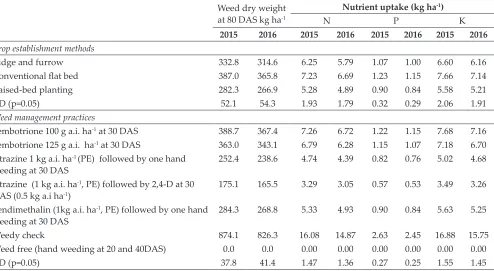
Dry weight of weed
Sowing methods significantly influenced the dry weight of weeds (Table 1). The maximum dry weight of weed was recorded under the conventional flat bed sowing, which facilitates an adequate growing environment to the weeds. Raised bed planting
recorded the lowest dry weight of weed when
sowing. Similar results were also reported by Chopra and Angiras (2008).
Weed management practices were found to reduce the dry weight of weeds than weedy check in both the years (Table 1). Removing the weeds whenever they appear under the weed free treatment resulted in complete elimination of weed competition as it resulted in zero weed dry weight. The weed free
treatments performed better than all the herbicidal treatments in reducing the biomass of weeds. Among the herbicidal treatments, sequential application of atrazine 1 kg ai. ha-1 (PE) followed
by 2, 4-D at 30 DAS (0.5 kg ai. ha-1, PoE), recorded
the lowest dry weight of weeds when compared to tembotrione 100 g ai. ha-1 (PoE), tembotrione 125
g ai g ai ha-1 (PoE) and it was statistically at par Table 1: Effect of crop establishment methods and weed management practices on nutrient content in weeds
Treatment Nutrient content (%) at 80 DAS
N P K
2015 2016 2015 2016 2015 2016
Crop establishment methods
Ridge and furrow 1.878 1.839 0.321 0.317 1.983 1.957
Conventional flat bed 1.869 1.830 0.319 0.315 1.979 1.953
Raised-bed planting 1.870 1.831 0.318 0.314 1.977 1.953
CD (p=0.05) NS NS NS NS NS NS
Weed management practices
Tembotrione 100 g a.i. ha-1 at 30 DAS 1.869 1.830 0.314 0.312 1.975 1.950
Tembotrione 125 g a.i. ha-1 at 30 DAS 1.870 1.831 0.316 0.312 1.978 1.952
Atrazine 1 kg a.i. ha-1(PE) followed by one hand weeding at 30 DAS 1.879 1.839 0.324 0.320 1.989 1.963
Atrazine (1 kg a.i. ha-1,PE) followed by 2,4-D at 30 DAS (0.5 kg a.i ha-1) 1.881 1.841 0.326 0.322 1.993 1.967
Pendimethalin (1kg a.i. ha-1, PE) followed by one hand weeding at 30 DAS 1.873 1.834 0.318 0.314 1.981 1.955
Weedy check 1.839 1.800 0.301 0.297 1.931 1.906
Weed free (hand weeding at 20 and 40DAS) 1.893 1.853 0.332 0.328 2.011 1.985
CD (p=0.05) 0.013 0.010 0.006 0.006 0.013 0.012
Table 2: Effect of crop establishment methods and weed management practices on nutrients uptake by weeds
Weed dry weight at 80 DAS kg ha-1
Nutrient uptake (kg ha-1)
N P K
2015 2016 2015 2016 2015 2016 2015 2016
Crop establishment methods
Ridge and furrow 332.8 314.6 6.25 5.79 1.07 1.00 6.60 6.16
Conventional flat bed 387.0 365.8 7.23 6.69 1.23 1.15 7.66 7.14
Raised-bed planting 282.3 266.9 5.28 4.89 0.90 0.84 5.58 5.21
CD (p=0.05) 52.1 54.3 1.93 1.79 0.32 0.29 2.06 1.91
Weed management practices
Tembotrione 100 g a.i. ha-1 at 30 DAS 388.7 367.4 7.26 6.72 1.22 1.15 7.68 7.16
Tembotrione 125 g a.i. ha-1 at 30 DAS 363.0 343.1 6.79 6.28 1.15 1.07 7.18 6.70
Atrazine 1 kg a.i. ha-1 (PE) followed by one hand
weeding at 30 DAS 252.4 238.6 4.74 4.39 0.82 0.76 5.02 4.68
Atrazine (1 kg a.i. ha-1, PE) followed by 2,4-D at 30
DAS (0.5 kg a.i ha-1)
175.1 165.5 3.29 3.05 0.57 0.53 3.49 3.26
Pendimethalin (1kg a.i. ha-1, PE) followed by one hand
weeding at 30 DAS 284.3 268.8 5.33 4.93 0.90 0.84 5.63 5.25
Weedy check 874.1 826.3 16.08 14.87 2.63 2.45 16.88 15.75
Weed free (hand weeding at 20 and 40DAS) 0.0 0.0 0.00 0.00 0.00 0.00 0.00 0.00
with atrazine 1 kg ai. ha-1 followed by one hand
weeding at 30 DAS and pendimethalin 1 kg ai. ha-1
(PE) followed by one hand weeding at 30 DAS, respectively. These findings are in conformity with the findings of (Lakshmi and Luther 2017).
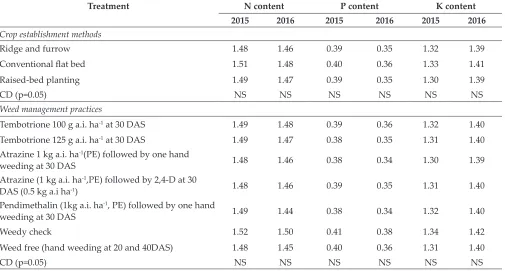
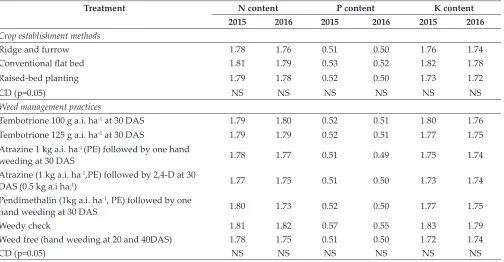
Nutrients content in weed and crop
Nutrient content in weeds and crop was unaffected by the sowing methods and herbicides during both the years. But the values of NPK content in weeds were the highest in raised bed planting and sequential application of atrazine 1 kg ai. ha-1 (PE)
followed by 2, 4-D at 30 DAS (0.5 kg ai. ha-1, PoE) in
sowing methods and herbicides, respectively during both the years (Table 2).
Nutrient depletion by weeds
The weeds usually grow faster than the associated crop plants and thus absorb the available nutrients
in more amount and lead to the deficiency of
nutrients in the crop plants (Table 3). Competition begins when the root system of the crop and weeds overlap in the exploring soil profile and shows the enhanced competition for nutrients.
The minimum depletion of nutrients (NPK) by
weeds was recorded under raised bed planting over conventional flat bed sowing and it was at par with ridge and furrow sowing. This might be due to less dry matter accumulation by weeds under raised bed planting. Vigorous growth and higher biomass of weeds resulted in more nutrient depletion under conventional flat bed sowing.
Weed management practices significantly influenced the N, P and K depletion by weeds. It was the highest under tembotrione 100 gai. ha-1 (PoE) and
tembotrione 125 g ai. ha-1 (PoE). The increase in
the depletion of N, P and K by weeds under this treatment was due to the poor control of weeds that resulted in the highest dry weight of weed. Sequential application of atrazine 1 kg ai. ha-1
(PE) followed by 2, 4-D at 30 DAS (0.5 kg ai. ha-1,
PoE), recorded the lowest dry weight and it was statistically at par with atrazine 1 kg ai. ha-1 followed
by one hand weeding at 30 DAS and pendimethalin 1 kg ai. ha-1 (PE) followed by one hand weeding at
30 DAS, respectively during both the years. This might be due to effective control of weeds that resulted in less nutrient uptake by weeds in these treatments. Weedy check registered the highest potassium uptake by weeds at 30 and 60 DAS,
Table 3: Effect of crop establishment methods and weed management practices on nutrients content in maize stover (%)
Treatment N content P content K content
2015 2016 2015 2016 2015 2016
Crop establishment methods
Ridge and furrow 1.48 1.46 0.39 0.35 1.32 1.39
Conventional flat bed 1.51 1.48 0.40 0.36 1.33 1.41
Raised-bed planting 1.49 1.47 0.39 0.35 1.30 1.39
CD (p=0.05) NS NS NS NS NS NS
Weed management practices
Tembotrione 100 g a.i. ha-1 at 30 DAS 1.49 1.48 0.39 0.36 1.32 1.40
Tembotrione 125 g a.i. ha-1 at 30 DAS 1.49 1.47 0.38 0.35 1.31 1.40
Atrazine 1 kg a.i. ha-1(PE) followed by one hand
weeding at 30 DAS 1.48 1.46 0.38 0.34 1.30 1.39
Atrazine (1 kg a.i. ha-1,PE) followed by 2,4-D at 30
DAS (0.5 kg a.i ha-1) 1.48 1.46 0.39 0.35 1.31 1.40
Pendimethalin (1kg a.i. ha-1, PE) followed by one hand
weeding at 30 DAS 1.49 1.44 0.38 0.34 1.32 1.40
Weedy check 1.52 1.50 0.41 0.38 1.34 1.42
Weed free (hand weeding at 20 and 40DAS) 1.48 1.45 0.40 0.36 1.31 1.40
which can be attributed to the lowest weed control in these treatments. Similar results were reported by Lakshmi and Luther (2017).
Grain and straw yield
Grain and straw yield is an ultimate result of
growth and yield components (Table 3 and 4). Sowing methods and herbicides showed significant influence on crop yield. Raised bed planting
recorded the highest grain and straw yield than
the conventional flat bed methods and it was at par
with ridge and furrow sowing. This result indicated that increase in yield under raised bed planting and ridge and furrow sowing was due to the better growing environment than conventional flat bed method of sowing. Results are the corroborated research findings of Malviya et al. (2012).
Significantly, the highest grain and straw yield were recorded under the sequential application of atrazine 1 kg ai. ha-1 (PE) followed by 2, 4-D at 30
DAS (0.5 kg ai. ha-1, PoE), than tembotrione 100 g ai.
ha-1 (PoE) and tembotrione 125 g ai. g ai ha-1 (PoE)
and it was statistically at par with atrazine 1 kg ai.
ha-1 followed by one hand weeding at 30 DAS and
pendimethalin 1 kg ai. ha-1 (PE) followed by one
hand weeding at 30 DAS.
The reason for higher values on growth parameter can be discussed in the light of fact that crop under this treatment had comparatively less weed competition. The reduction in weed competition in maize by the use of herbicides or hand weeding not only favoured the crop growth with abundant availability of moisture, nutrients, light and space, but also reduced the overall weed interference, facilitating vigorous growth and the development of crop plants and finally produced more grain and straw yield. The lowest grain and straw yield was recorded in weedy check because of more weed growth and poor performance of yield attributing characters. Relative weed free situation under herbicidal treatments reduced the crop weed competition and thus lead to higher vegetative growth and yield attributes that affected the grain and straw yield. These results are corroborated with the findings of Srividya et al. (2011), Sanodiya et al. (2013) and Singh et al. (2014).
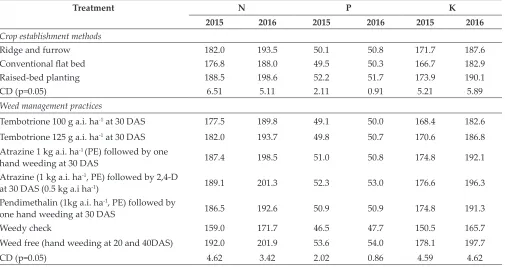
Nutrients uptake by crop
Sowing methods and herbicides application significantly influenced the N, P and K uptake by maize (Table 5). Raised bed planting recorded the maximum uptake of N, P and K, whereas it was the lowest in conventional flat bed sowing. It can be
Table 4: Effect of crop establishment methods and weed management practices on nutrients content in maize grain (%)
Treatment N content P content K content
2015 2016 2015 2016 2015 2016
Crop establishment methods
Ridge and furrow 1.78 1.76 0.51 0.50 1.76 1.74
Conventional flat bed 1.81 1.79 0.53 0.52 1.82 1.78
Raised-bed planting 1.79 1.78 0.52 0.50 1.73 1.72
CD (p=0.05) NS NS NS NS NS NS
Weed management practices
Tembotrione 100 g a.i. ha-1 at 30 DAS 1.79 1.80 0.52 0.51 1.80 1.76
Tembotrione 125 g a.i. ha-1 at 30 DAS 1.79 1.79 0.52 0.51 1.77 1.75
Atrazine 1 kg a.i. ha-1 (PE) followed by one hand
weeding at 30 DAS 1.78 1.77 0.51 0.49 1.75 1.74
Atrazine (1 kg a.i. ha-1,PE) followed by 2,4-D at 30
DAS (0.5 kg a.i ha-1) 1.77 1.75 0.51 0.50 1.73 1.74
Pendimethalin (1kg a.i. ha-1, PE) followed by one
hand weeding at 30 DAS 1.80 1.73 0.52 0.50 1.77 1.75
Weedy check 1.81 1.82 0.57 0.55 1.83 1.79
Weed free (hand weeding at 20 and 40DAS) 1.78 1.75 0.51 0.50 1.72 1.74
attributed to the better growing conditions under this (raised bed planting) treatment during growth and development of crop, which can help in the better utilization of nutrient, thereby resulting in highest yield and nutrient uptake.
Among the weed management practices, mixed application of sequential application of atrazine 1 kg ai. ha-1 (PE) followed by 2, 4-D at 30 DAS (0.5
kg ai. ha-1, PoE), recorded the highest N, P and
K by crop over tembotrione 100 g ai. ha-1 (PoE)
and tembotrione 125 g ai. ha-1 (PoE) and it was
statistically at par with atrazine 1 kg ai. ha-1 followed
by one hand weeding at 30 DAS and pendimethalin 1 kg ai. ha-1 (PE) followed by one hand weeding
at 30 DAS. The increase in the uptake of nutrients by crop was due to the fact that lower dry weight of weeds under this treatment helps in the better utilization of nutrients by crop. The higher uptake
of these nutrients was due to higher yield, higher
dry matter production and higher nutrient content in different parts of the plant. Significantly, the highest nutrients uptake was recorded under weed
free situation due to higher grain and straw yield of
maize. Higher NPK uptake by crops in weed free plots was reported by Lakshmi and Luther (2017).
This was due to the reduced depletion of nutrients by weeds and concomitant increase in the absorption
and translocation of higher concentration of these
nutrients to different maize plant parts for enhanced photosynthetic efficiency, which corroborated with the findings of Malvia et al. (2012), Sanodiya et al. (2013) and Singh et al. (2014).
Available nutrients
OC, EC and soil pH
The effect of sowing methods and herbicides on OC, EC and pH was non-significant. Among the crop establishment methods, slightly highest organic carbon and the lowest pH and electrical conductivity were found under raised bed planting followed by ridge and furrow sowing and conventional flat bed sowing, respectively (Table 6).
Amongst the herbicidal treatments, sequential application of atrazine 1 kg ai. ha-1 (PE) followed by
2, 4-D at 30 DAS (0.5 kg ai. ha-1, PoE), recorded the
highest organic carbon and lower pH and electrical
conductivity than the other weed management
practices. Similarly, weed free had maximum organic carbon and minimum pH and electrical conductivity than rest of the treatments.
Table 5: Effect of crop establishment methods and weed management practices on total nutrients uptake by maize crop (kg ha-1)
Treatment N P K
2015 2016 2015 2016 2015 2016
Crop establishment methods
Ridge and furrow 182.0 193.5 50.1 50.8 171.7 187.6
Conventional flat bed 176.8 188.0 49.5 50.3 166.7 182.9
Raised-bed planting 188.5 198.6 52.2 51.7 173.9 190.1
CD (p=0.05) 6.51 5.11 2.11 0.91 5.21 5.89
Weed management practices
Tembotrione 100 g a.i. ha-1 at 30 DAS 177.5 189.8 49.1 50.0 168.4 182.6
Tembotrione 125 g a.i. ha-1 at 30 DAS 182.0 193.7 49.8 50.7 170.6 186.8
Atrazine 1 kg a.i. ha-1 (PE) followed by one
hand weeding at 30 DAS 187.4 198.5 51.0 50.8 174.8 192.1
Atrazine (1 kg a.i. ha-1, PE) followed by 2,4-D
at 30 DAS (0.5 kg a.i ha-1) 189.1 201.3 52.3 53.0 176.6 196.3
Pendimethalin (1kg a.i. ha-1, PE) followed by
one hand weeding at 30 DAS 186.5 192.6 50.9 50.9 174.8 191.3
Weedy check 159.0 171.7 46.5 47.7 150.5 165.7
Weed free (hand weeding at 20 and 40DAS) 192.0 201.9 53.6 54.0 178.1 197.7
Table 6: Effect of crop establishment method and weed management practices on yield, OC pH and EC in kharif maize
Treatment Grain yield
(kg ha-1)
Straw yield (kg ha-1)
Organic
carbon (%) pH EC (dS m-1)
2015 2016 2015 2016 2015 2016 2015 2016 2015 2016
Crop establishment methods
Ridge and furrow 5309 5612 5928 6489 0.352 0.356 7.86 7.79 0.188 0.177
Conventional flat bed 5045 5367 5644 6211 0.350 0.352 7.86 7.79 0.189 0.179
Raised-bed planting 5494 5711 6056 6600 0.354 0.360 7.85 7.78 0.186 0.175
CD (p=0.05) 261 242 282 276 NS NS NS NS NS NS
Weed management practices
Tembotrione 100 g a.i. ha-1 at 30 DAS 5128 5388 5752 6256 0.349 0.354 7.86 7.81 0.194 0.183
Tembotrione 125 g a.i. ha-1 at 30 DAS 5260 5542 5899 6421 0.353 0.359 7.85 7.78 0.188 0.181
Atrazine 1 kg a.i. ha-1 (PE) followed by one
hand weeding at 30 DAS 5498 5764 6064 6624 0.352 0.357 7.85 7.80 0.184 0.173
Atrazine (1 kg a.i. ha-1, PE) followed by 2,4-D at
30 DAS (0.5 kg a.i ha-1) 5577 5875 6107 6737 0.353 0.360 7.85 7.80 0.181 0.173
Pendimethalin (1kg a.i. ha-1, PE) followed by
one hand weeding at 30 DAS 5392 5681 5998 6564 0.350 0.354 7.86 7.80 0.184 0.182
Weedy check 4465 4763 5131 5665 0.351 0.355 7.86 7.79 0.186 0.175
Weed free (hand weeding at 20 and 40DAS) 5656 5931 6182 6767 0.361 0.365 7.86 7.79 0.185 0.174
CD (p=0.05) 186 197 113 176 NS NS NS NS NS NS
Initial value 0.359 0.356 7.90 7.80 0.186 0.176
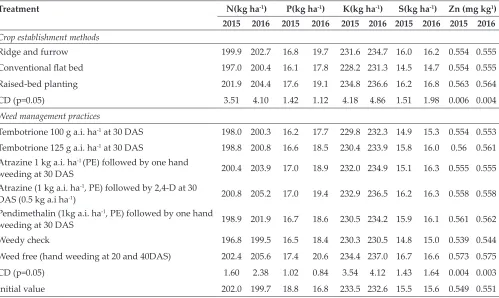
Table 7: Effect of crop establishment methods and weed management practices on available nutrients in soil
Treatment N(kg ha-1) P(kg ha-1) K(kg ha-1) S(kg ha-1) Zn (mg kg1)
2015 2016 2015 2016 2015 2016 2015 2016 2015 2016 Crop establishment methods
Ridge and furrow 199.9 202.7 16.8 19.7 231.6 234.7 16.0 16.2 0.554 0.555
Conventional flat bed 197.0 200.4 16.1 17.8 228.2 231.3 14.5 14.7 0.554 0.555
Raised-bed planting 201.9 204.4 17.6 19.1 234.8 236.6 16.2 16.8 0.563 0.564
CD (p=0.05) 3.51 4.10 1.42 1.12 4.18 4.86 1.51 1.98 0.006 0.004
Weed management practices
Tembotrione 100 g a.i. ha-1 at 30 DAS 198.0 200.3 16.2 17.7 229.8 232.3 14.9 15.3 0.554 0.553
Tembotrione 125 g a.i. ha-1 at 30 DAS 198.8 200.8 16.6 18.5 230.4 233.9 15.8 16.0 0.56 0.561
Atrazine 1 kg a.i. ha-1 (PE) followed by one hand
weeding at 30 DAS 200.4 203.9 17.0 18.9 232.0 234.9 15.1 16.3 0.555 0.555
Atrazine (1 kg a.i. ha-1, PE) followed by 2,4-D at 30
DAS (0.5 kg a.i ha-1) 200.8 205.2 17.0 19.4 232.9 236.5 16.2 16.3 0.558 0.558
Pendimethalin (1kg a.i. ha-1, PE) followed by one hand
weeding at 30 DAS 198.9 201.9 16.7 18.6 230.5 234.2 15.9 16.1 0.561 0.562
Weedy check 196.8 199.5 16.5 18.4 230.3 230.5 14.8 15.0 0.539 0.544
Weed free (hand weeding at 20 and 40DAS) 202.4 205.6 17.4 20.6 234.4 237.0 16.7 16.6 0.573 0.575
CD (p=0.05) 1.60 2.38 1.02 0.84 3.54 4.12 1.43 1.64 0.004 0.003
Available N, P, K, S and Zn in soil
The availability of N, P, K, S and Zn in soil was higher under raised bed planting and was closely followed by ridge and furrow sowing, which was significantly superior to conventional flat bed sowing during both the years (Table 6). This may be due to fact that raised bed planting lowered down the weed population and minimized the loss of nutrients by weeds, which resulted in increase in the availability of nutrients in soil.
All the weed management treatments recorded the
highest N, P, K, S and Zn availability in soil than weedy check. Weed free had more N, P, K, S and Zn availability in soil, which was closely followed by sequential application of atrazine 1 kg ai. ha-1
(PE) followed by 2, 4-D at 30 DAS (0.5 kg ai. ha-1,
PoE), atrazine 1 kg ai. ha-1 followed by one hand
weeding at 30 DAS and pendimethalin 1 kg ai. ha-1
(PE) followed by one hand weeding at 30 DAS, respectively. Whereas, weedy check had less N, P, K S, and Zn availability in soil due to higher weed dry weight and poor crop yield.
REFERENCES
Barla, S., Upasani, R.R., Puran, A.N. and Thakur, R. 2016. Weed management in maize. Indian Journal of Weed Science, 48(1): 67-69.
Das, S., Kumar, A., Jat, S.L., Parihar, C.M., Singh, A.K., Chikkappa, G.K. and Jat, M.L. 2012. Maize holds potential for diversification and livelihood security. Indian Journal of Agronomy,57: 32-37.
Kalhapure, A.H., Shete, B.T. and Dhonde, M.B. 2013. Integrated nutrient management in maize for increasing production with sustainability. International Journal of Agriculture and Food Science Technology,4(3): 195-206. Malviya, A., Malviya, N., Singh, B. and Singh, A.K. 2012.
Integrated weed management in maize (Zea mays) under rainfed conditions. Indian Journal of Dryland Agricultural Research and Development,27(1): 70-73.
Chopra, P. and Angiras, N.N. 2008. Effect of tillage and weed management on productivity and nutrient uptake of maize. Indian Journal of Agronomy,53(1): 66-69.
Sanodiya, P., Jha, A.K. and Shrivastava, A. 2013. Effect of
integrated weed management on seed yield of fodder
maize. Indian Journal of Weed Science,45(3): 214-216. Singh, S., Hiremath, S.M., Yadav, S.L., Meena, L.K. and
Chouhan, B.S. 2014. Growth and yield of maize as influenced by integrated weed management practices. Annals of Agriculture and Biological Research,19(3): 422-424. Srividya, S., Chandrasekhar, K. and Veeraraghavaiah, R. 2011.
Effect of tillage and herbicide use on weed management in maize. The Andhra Agricultural Journal,58(2): 123-126 Trivedi, V.K., Dimree, S., Meena, R.K. and Chauhan, G. 2017.
Efficient nutrient management for high crop yield and quality in maize crop. International Journal of Pure and Applied Bioscience, 5(2): 711-717.