Virtual Casting: A novel approach for casting development
process
1
Utkarsh.S. Khade,
2Dr. Vinayak. R. Naik,
3Dr. Vasudev D. Shinde,
1Assistant Professor, Mechanical Department, DKTE Maharashtra
2Professor, Mechanical Department, DKTE Maharashtra
3Professor, Mechanical Department, DKTE Maharashtra
INTRODUCTION:
Casting is known to human being since nearly 6000 yaers. It was mentioned in well known Indian epic Atharvaveda one of the principle Vedas. Outside India oldest casting seen is copper frog dated 3200 BC seen in Mesopotamia. where it is blossomed in Europe as fine art. Vannocio Biringuccio, head of papal Foundry in Rome (1500AD) is considered as father of foundry industry in west. And from that time till today there is contionus enrichment in knowledge and research in foundry industry is going on.
As foundry is prime supplier to global manufacturing industry. The casting process is unique process that is used to manufacture the components of different and critical shape more economical than other manufacturing process for metal parts. Castings are used in Pumps , Automobile , Defense , transport , Aerospace ,house hold , municipal casting ,heavy equipments , medical implants ,art subjects and machine tools. .
Generally in small and medium foundries for development of new casting or elimination for defects and rejections, conventional trial and error method is used. In this method the foundrymen’s are using their past experiences and knowledge to finalizing parameters like type of pattern , material for pattern, gating system types, gating system designs ( gating dimensions , no of gates and their locations ) , feeder types and their locations , mould box size , pouring temperature , pouring height etc which are essential for casting process. Once these parameters are finalized pattern is made, gating system is finalized and mould box is prepared and mould cavity is made. After pouring molten metal the actual casting is obtained. Though process looks simple still quality of casting affects due to various parameters and various defects can be seen in castings. It requires
Abstract:
AS foundry industry is prime supplier to various manufacturing sectors. Casting process is well known to foundrymen’s since ancient time and from that time continuous upgradation of knowledge is going on till today. Yet Indian and Global foundries facing a huge hurdle to get sound quality of casting as well as to maintain higher casting yield. Due to the liberalization and globalization polices of state governments, foundries have to compete from other foundries over globe and ultimately this results into increasing pricing and timing pressure to sustain in market. And practical solution to this botheration can be given by using virtual casting method. Which can be used for the complete process development and solving current problems.Till today in medium and small foundries the conventional practices are carried out for development of new casting and for elimination of the casting defects. This process will not only require a huge amount of resources but also more time hence its quit uneconomic operations. To make this process economic and fast virtual casting process can be used. In virtual casting process whole process is simulated using computer modeling software and simulation package. In virtual casting 3D designs of the given casting are made and it is given as input to simulation software and process parameters are finalized and simulation is carried out. From the result of simulation the clear idea regarding casting quality is obtained. If the results are not satisfactory the required changes is done in design, model and other process parameters and again simulated. The process is repeated till best results are obtained and same process is used for getting actual casting. Hence it will result into considerable amount of saving of resources and time which results into profit maximization. A case study is given in article to explain virtual casting process and its practical application.
minimum 4- 7 iterations to get sound casting with higher casting yield. In each iteration of process the precious resources and time are wasted. Which directly affects process economy.
Casting defects and their causes are as follows. Shrinkage, hot tear and distortion these are major defects seen in castings and their main cause is improper feeding (risering) system for that castings. Defects like flash, mismatch and Scab are seen due to improper mould making process. And also flow related defects such as blow holes, gas porosity, miss run etc are seen due to improperly designed gating system and wrong melting practices. Defects are directly contributed to the rejections and rejection means wastage of time and useful resources and hence less efficient casting process.
And also casting yield affects the process economy because, when molten metal is poured into the mould cavity after solidification it divided into the two components first is primary component and second are secondary components. Primary components mean nothing but the actual casting and secondary components are gating system and risering system. Hence a casting yield can be simple defined as ratio weight of Actual good saleable casting ( primary component ) to the to the weight of total metal poured ( primary casting and secondary casting ). From the definition it is clear that so as to maximize the profit weight of secondary components i.e. weight of gating system and risering system should be minimize as possible as , and this can be achieved by only minimizing weight of gating system and risering system but optimizing there dimensions should not affect the quality of casting . because gating system and risers are intended to get defect free castings . hence its very complex task to design gating system and risers system such that it will produce defect free casting as well as casting yield should be high . If foundry mens are able to design gating system and risers in this manner then the process will be more economical and profit increases.
In virtual casting process from each process is imitated using computer and software packages . 3 D modeling software and simulation packages are used in this process. Process stars from making the 3D CAD model of given casting using modeling software and then it is simulated using simulation software. Then simulation results are used to find that whether casting is sound or defected i.e. quality and also to find out casting yield. And then same procedure is applied for actual casting to get good quality of casting.
METHODOLOGY :
Fig.1: Flow chart showing conventional casting methodology
In virtual casting method, from the 2 D drawing detail, the 3D CAD model of the casting is made using modeling software. Also the model of casting is made with the gating and risers. This model with the all other parameters details value are input given to the simulation program, The input consist of the 3 D CAD model with gating and risers , material , pouring temperature , Mould cavity dimensions, core dimensions etc . once this parameters are finalized then it is given to the simulation software , considering this inputs simulation process is carried out , in simulation process we will get clear idea regarding how solidification occurs , how metal flows from the gating system , casting and finally it reaches in risers. Also the clear idea regarding casting defects is also obtained clearly by simulation results. And here only for virtual castings the skill required are only ability to make 3D model using software and knowledge of the Casting simulation programs. Its primary requirement is only Computer system compatible to work with Modeling software and Simulation software. Also the time required is very less as compared to conventional process. Hence using virtual casting method , any one can get sound quality of casting within short interval of time period . Only the bottlenecks of this process is little higher cost of the simulation software , which can be also overcome by using cloud simulation packages like E- Foundry simulation Lab by Dr. B. Ravi IIT Bombay , where foundry men’s , researchers and students can get simulation at free of cost for each time. It helps a lot for the development and modification of the sound casting
CASE STUDY:
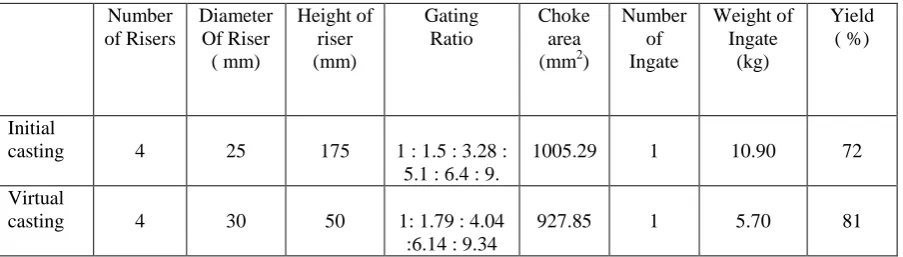
In this case study , the actual virtual casting method is used to improve the casting yield of the given casting , which was earlier little costly because of lower casting yield of the casting. The casting of the brake disc was considered for yield development purpose, the weight of the each casting is 8.10 kg and 8 castings are enclosed in a mould box to get simultaneously 8 casting from a mould cavity, For that purpose match plate patterns are used which was having two match plates , i.e. top and bottom match plates. The pattern used is gated pattern; gating system used is unpressurized gating system. Initially for getting sound casting the actual metal required is 90 kg from which the actual casting occupies 64.80 kg and remaining 25.20 kg is required for gating and feeding system and it leads to yield value of 72% , as it can be increased by optimizing the secondary components because 28 % liquid metal was required for them only . Hence so as to optimize their dimensions without affecting the quality of casting , the secondary components means gating system and feeding system are completely redesigned based on gating design procedure , gating rules , practical considerations , theoretical knowledge , feeding rules and pattern makers experience etc. and combining it various gating and feeder designs are made , for each design the 3D CAD model of casting with gating system are made and these designs are given as input with the other parameters are given input to the simulation program AutoCAST-X flow plus , simulation is carried out for each designs of the gating system , from simulation software the clear idea regarding the solidification process and mould filling process is obtained also the chances of occurring defects or not are also determined. If defects are there in results, there locations are also determined. Hence the clear idea regarding quality of casting is achieved from the simulation results. If simulation results are showing the defects, then the respective changes are made in design considering their cause. And again it is simulated to determine whether defects are eliminated or not. The virtual casting methodology is used to get sound casting. From comparing the simulation results of each design the best design is selected so as to get sound quality of the casting with the higher casting yield. With that best design the liquid metal required is 82 kg and quality is also sound. The details are as given in table 1.
Number of Risers Diameter Of Riser ( mm) Height of riser (mm) Gating Ratio Choke area (mm2)
Number of Ingate Weight of Ingate (kg) Yield ( %) Initial
casting 4 25 175 1 : 1.5 : 3.28 :
5.1 : 6.4 : 9.
1005.29 1 10.90 72
Virtual
casting 4 30 50 1: 1.79 : 4.04
:6.14 : 9.34
927.85 1 5.70 81
The simulation images are given below from them the clear idea regarding mould filling process is obtained also the casting area which suspected for defects are also detected.
Fig.3. Mould filling at 5% Fig.4. Mould filling at 10%
Fig.5. Mould filling at 20% Fig.6. Mould filling at 40%
Fig.9. Mould filling at 100%
Fig.10. Simulation results showing shrinkage porosity
Here from simulation results clear idea regarding mould filling process is obtained also the results shows the area of casting where the shrinkage porosity will be occurred . The fig. Shows the red zone means occurrence of shrinkage porosity but it seen in upper part of gating system , but as it is secondary component which is going to remove from actual casting while finishing . hence it is not part of actual casting hence shrinkage porosity is acceptable in this case . and considering this gating system the final casting is made and it is sound casting hence , it is possible to implement virtual casting for yield improvement purpose also.
CONCLUSION:
The virtual casting method can be used very effectively for modification and development of casting purpose, this method is very effective as it requires only computer system and software packages. In case study it is used for actual yield enhancement purpose , initial yield was 72 % with virtual casting it is reached up to 79 % .It is very cheap and less time consuming when compared with the conventional casting method. The large amount of resources and time is wasted in conventional trial and error method . The only limitation or requirement is little higher cost of simulation package which may not affordable for small foundries but now there is solution to this hurdle is cloud simulation and group simulation technology.
REFERENCES
[1]. B. Ravi (2008), “Casting Simulation and Optimisation: Benefits, Bottlenecks, and Best Practices,” Technical Paper for Indian Foundry Journal Special Issue .
[2]. M. Masoumi, H. Hu and J. Hedjazi, M. A. Boutorabi (2005) , “Effect of Gating Design on Mold Filling” American Foundry Society, Schaumburg, IL USA , AFS Transactions Paper 05-152(02). Pp 1-12.
[3]. B. Ravi and Durgesh Joshi (2007 ), “Feedability Analysis and Optimization Driven by Casting
Simulation,” Indian Foundry Journal 53(6) , pp 71-87 .
[4]. Feng Liu(2008),“Optimized Design of Gating/Riser System in Casting Based on CAD and Simulation
Technology,” A Thesis Submitted to the Faculty of the Worcester polytechnic institute in partial fulfilment of the requirements for the Degree of Master of Science in sManufacturing Engineering.
[5]. Shouzhu Ou, Kent Carlson, Malcolm Blair and Christoph Beckermann(2000), “Yield improvement
case study: stacked spring caps,” Proceeding of 54th SFSA Technical and Operating Conference, paper no 2.4 .
[6]. B. Ravi(2009), “Computer-aided Casting Design and Simulation”, STTP, V.N.I.T. Nagpur.
[7]. B. Ravi(2005), “ METAL CASTING : Computer Aided Design and Analysis”, PHI Learning Private
Limited, New Delhi ISBN-978-81-203-2726
[8]. Efoundry.iitb.ac.in.
[9]. U.s.khade ( 2016) , “optimization of the gating system components using 3d cad modeling and casting