S T U D Y P R O T O C O L
Open Access
Study protocol: effects of school gardens on
children
’
s physical activity
Nancy M Wells
1*, Beth M Myers
1and Charles R Henderson Jr
2Abstract
Background:Childhood obesity is an epidemic. Strategies are needed to promote children’s healthy habits related to diet and physical activity. School gardens have the potential to bolster children’s physical activity and reduce time spent in sedentary activity; however little research has examined the effect of gardens on children’s physical activity. This randomized controlled trial (RCT) examines the effect of school gardens on children’s overall physical activity and sedentary behavior; and on children’s physical activity during the school day. In addition, physical activity levels and postures are compared using direct observation, outdoors, in the garden and indoors, in the classroom.
Methods/Design:Twelve New York State schools are randomly assigned to receive the school garden intervention
or to serve in the wait-list control group that receives gardens and lessons at the end of the study. The intervention consists of a raised bed garden; access to a curriculum focused on nutrition, horticulture, and plant science and including activities and snack suggestions; resources for the school including information about food safety in the garden and related topics; a garden implementation guide provided guidance regarding planning, planting and maintaining the garden throughout the year; gardening during the summer; engaging volunteers; building community capacity, and sustaining the program.
Data are collected at baseline and 3 post-intervention follow-up waves at 6, 12, and 18 months. Physical activity (PA)“usually”and“yesterday”is measured using surveys at each wave. In addition, at-school PA is measured using accelerometry for 3 days at each wave. Direct observation (PARAGON) is used to compare PA during an indoor classroom lesson versus outdoor, garden-based lesson.
Discussion:Results of this study will provide insight regarding the potential for school gardens to increase children’s physical activity and decrease sedentary behaviors.
Trial registration: Clinicaltrial.gov # NCT02148315
Keywords: Children, Gardens, Physical activity, Sedentary behavior, Health behaviors, Schools, Randomized
controlled trial
Background
In the context of the epidemics of both childhood obes-ity [1] and children’s physical inactivity [2-4], strategies are needed to improve children’s health behaviors. Phys-ical activity (PA) has been linked to lower likelihood of chronic diseases such as overweight and obesity, cardio-vascular disease, osteoporosis, and type 2 diabetes [5-8]. Conversely, a lifestyle of sedentary behaviors is associ-ated with the onset of chronic diseases, disabilities, and
early-life mortality [9,10]. Fruit and vegetable consump-tion is similarly linked to reduced disease risk [11-14]. Schools are increasingly recognized as a promising con-text for health intervention [15,16]. A variety of school-based interventions have aimed to increase PA through, for example, increased physical education time, added recess periods, painted playground surfaces, strategies to reduce TV and computer game usage, and dance pro-grams [17,18]; however little research has focused on the possible role of school gardens in the promotion of chil-dren’s health behaviors. School gardens have the potential * Correspondence:[email protected]
1
Design & Environmental Analysis Department, College of Human Ecology, Cornell University, Ithaca, NY 14853, USA
Full list of author information is available at the end of the article
to affect both PA behaviors and dietary intake as well as to contribute to learning outcomes [19,20].
School gardens typically include an instructional garden plot and accompanying garden-based lessons. Gardens have been used to teach a variety of subjects including science, environmental studies, nutrition, language arts, and math [20]. While we know that time outdoors is a strong predictor of physical activity [21,22], there is need for research explicitly examining the effects of school gardens on children’s PA, using valid, objective measures of PA. Gardens may increase PA by bring-ing typically indoor, sedentary activities outdoors and by engaging children in hands-on, garden-based learn-ing tasks.
Research questions
This project addresses the following specific research ques-tions (adjusting for relevant sociodemographic variables):
1. Is there an effect of school gardens on children’s overall PA and sedentary behavior, as measured by self-report survey?
2. Is there an effect of school gardens on children’s PA levels during the school day, as measured with accelerometry?
3. In a within-subjects comparison, does PA, measured by direct observation, differ during an indoor classroom lesson versus during an outdoor garden lesson?
Methods/Design Study design
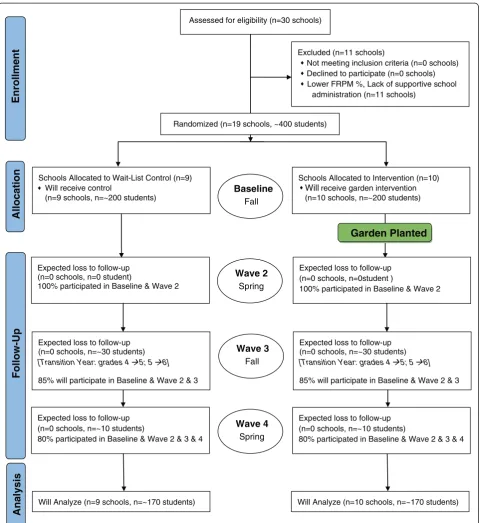
The study is a 2-year, randomized controlled trial, with baseline and three follow-ups at ~6 months, ~12 months, and ~18 months (see Figure 1). Schools are randomly assigned either to receive the garden intervention or to serve in the wait-list control group that receives the garden and garden-based curriculum at the end of the study. For both intervention and control schools, the receipt of a school garden is an incentive for participation. The study is registered with ClinicalTrials. gov, #NCT02148315. The research design and methods were deemed exempt by Cornell University’s Institutional Review Board (IRB).
Intervention
This study piggybacks on the larger, Healthy Gardens, Healthy Youth (HGHY)4-state study of school gardens’ effects on diet and related outcomes that, through USDA funding, provides the garden and curricula intervention. Classes in the garden intervention group receive: a) a 4′× 8′ raised bed garden kit; b) an educational toolkit containing lessons focused on nutrition, horticulture, and plant sci-ence (11 lessons for grades 4–5 in Year 1; and 9 lessons for
grades 5–6 in Year 2), activities (e.g., songs, tastings, obser-vations, journaling, role playing), and suggested recipes; c) a garden implementation guide that provides instruction on topics such as: how to plan, plant, and maintain the garden; gardening during the summer; engaging volunteers; building community capacity; and sustaining a school garden pro-gram; and d) on-line video training and documentation on how to use the toolkit. Lessons are led either by the class-room teacher or a Cooperative Extension Educator. Class-rooms in the control group receive a garden and access to the educational toolkit after completion of data collection.
Setting, sample size, design and randomization
School principals were approached by local Cooperative Extension educators. Data are collected in New York State elementary schools that do not already have garden and have, at least, 50% of students qualifying for free or reduced price meals (FRPM). During the study enroll-ment process, 30 New York State schools were screened for eligibility. Of the 30 schools, 19 met the inclusion cri-teria and were randomly assigned to intervention (n = 10) or control (n = 9). Data are collected at four time points (waves) during the project: a baseline assessment, and at three follow-ups. During each wave, we track the expected loss of schools and students (Figure 1) across the study. Fourth and fifth grade students (ages 8–12 at baseline) participated in this study.
Compliance with CONSORT
CONSORT guidelines [23,24] will be followed for pres-entation of results from randomized controlled trials. We will summarize the flow of both schools and individ-uals through the trial.
Data collection methods
Children’s PA is measure in three ways: 1) the Girls Health Enrichment Multi-site (GEMS) Activity Questionnaire (GAQ); 2) Accelerometry; and 3) Direct Observation; with each measure corresponding to one of the research questions.
Activity questionnaire
Accelerometry
Children wear Actigraph GT3X + or GT1M accelerome-ters during the entire (~6 hour) school day. In use with children, accelerometry data are highly correlated with energy expenditure (r = .86, .87), oxygen consumption (r = .86, .87), heart rate (r = .77, .77), and treadmill speed
(r = .90, .89) [27,28]. In the morning, trained Cooperative Extension educators or University student research assis-tants distribute the accelerometers to the children and record the belt numbers and time of day. With assistance, children attach the accelerometers to their waists with an elastic belt and plastic buckle and are instructed to follow
Allocation
Analysis
Follow-Up
Enrollment
Assessed for eligibility (n=30 schools)
Excluded (n=11 schools)
Not meeting inclusion criteria (n=0 schools) Declined to participate (n=0 schools) Lower FRPM %, Lack of supportive school
administration (n=11 schools)
Expected loss to follow-up (n=0 schools, n=0 student)
100% participated in Baseline & Wave 2 Schools Allocated to Wait-List Control (n=9)
Will receive control
(n=9 schools, n=~200 students)
Schools Allocated to Intervention (n=10) Will receive garden intervention (n=10 schools, n=~200 students) Randomized (n=19 schools, ~400 students)
Expected loss to follow-up (n=0 schools, n=~10 students)
80% participated in Baseline & Wave 2 & 3 & 4
Baseline Fall
Wave 2 Spring
Wave 3 Fall
Wave 4 Spring
Expected loss to follow-up (n=0 schools, n=0student )
100% participated in Baseline & Wave 2
Will Analyze (n=10 schools, n=~170 students) Expected loss to follow-up
(n=0 schools, n=~10 students)
80% participated in Baseline & Wave 2 & 3 & 4
Garden Planted
Will Analyze (n=9 schools, n=~170 students) Expected loss to follow-up
(n=0 schools, n=~30 students)
[Transition Year: grades 4 5; 5 6]
85% will participate in Baseline & Wave 2 & 3
Expected loss to follow-up (n=0 schools, n=~30 students)
[Transition Year: grades 4 5; 5 6]
85% will participate in Baseline & Wave 2 & 3
their normal routine. Teachers are given instructions on how to ensure children properly wear the accelerometers for the entire school day. At the end of each school day, classroom teachers collect the accelerometers and record the time of day. This procedure is followed for three days at each of the four waves of data collection.
Direct observation
To characterize children’s movements and postures dur-ing a garden lesson compared to a classroom lesson, the Physical Activity Research & Assessment tool for Garden Observation (PARAGON) [29] is employed. PARAGON’s overall test-retest reliability is .94. An Ebel of .97 (and per-cent agreement 88%) indicates strong inter-rater reliability [29]. The five primary PA codes (lying, sitting, standing, walking, vigorous activity) used in PARAGON are based on Behaviors of Eating and Activity for Children’s Health (BEACHES) PA coding and were validated using heart-rate monitors and accelerometers [30,31]; and by conver-gent validity with accelerometry [29].
Process measures
To record the fidelity of the intervention delivered to each intervention class, a“garden records”survey is completed by the Extension Educator. Garden records are completed at each intervention wave and include: fruits and vegeta-bles (FV) planted, FV harvested, the methods employed to distribute FV, and the lessons delivered to the class.
Statistical models and data analysis strategy
Treatment (control versus intervention) and time of as-sessment (Waves 1–4) are core fixed classification fac-tors. The sampling design results in a nested structure. Schools are nested within fixed factors built into the sampling design—urban/rural status; classrooms are nested within schools, and children within classrooms. These 3 classification factors are regarded as random. Other classi-fication factors and covariates that will be included in models, or at least examined for inclusion, include sex, race/ethnicity, and age of child, and school-level, and classroom-level characteristics. An important focus of analysis will be on the contextual effects of classrooms and schools and the moderation of the effects of the inter-vention by these contexts. Time in PE and recess are key classroom-level covariates.
The 3 research questions will be examined in models of the preceding type. The examination of treatment effects focuses on the treatment–time interaction. We will also examine in detail whether treatment effects are stronger for or limited to certain child or contextual characteristics. Important sociodemographic variables such as sex and ethnicity of the child will be included in the models irrespective of their moderating effects and the treatment differences adjusted for these variables.
The primary analyses will make use of general linear mixed model methods and their extensions to examine the research questions. The focus will be on (1) full model specification to account for all sources of variation, and a full examination of interactions among model factors, including examination of homogeneity of regressions to understand interactions between classification effects and covariates; (2) mixed models to take into account vari-ances associated with children and families as well as classrooms, schools, and communities, to analyze random regressions associated with children and other levels of the analysis, and to examine contextual effects of class-rooms and schools; (3) mixed models (including repeated measures and growth curves) to analyze multiple assess-ments on children; (4) generalized models to analyze dichotomous outcomes with binomial error distributions and count data assumed to have Poisson or negative bino-mial distributions; and (5) semi-parametric methods to model relations between variables without requiring a spe-cific functional form. Generalized models will be analyzed in mixed model form when random factors are included.
Accelerometry data are scored using ActiLife6 soft-ware. Thirty-second epochs [32] are converted into mi-nutes and proportions of time spent in each of the four levels of PA: 1) sedentary, 2) light PA, 3) moderate PA, 4) vigorous PA; and moderate-to-vigorous PA (MVPA) using child-specific cut-points [33,34].
Statistical power
Power calculations carried out for the original grant ap-plication indicate sufficient sample size to detect mean-ingful treatment mean differences at the level of a 2-way interaction for outcomes.
Discussion
The limitations of this study include a focus on New York State youth, which limits generalizability. In addition, the garden intervention is examined holistically, so the spe-cific activities that may be linked to increases in PA levels are not identified.
Results of this RCT will fill a gap in research literature and may provide insight regarding the potential for school gardens to increase children’s physical activity and de-crease sedentary behaviors. By employing random assign-ment, using multiple measures, and providing longitudinal data over a 2-year period, this study will be the first to assess rigorously causal links between school gardens and children’s physical activity.
Abbreviations
Competing interests
The authors declare that they have no competing interests.
Authors’contributions
NW conceived of the study. NW, BM, and CH were applicants for funding. NW and BM developed the measurement plan; CH developed the analytic strategy. All authors participated in drafting the protocol and approved the final protocol.
Acknowledgements
We thank the New York Extension Educators throughout the State as well as our Cornell University Cooperative Extension colleagues, Gretchen Ferenz and Caroline Tse, who assist with this study. Thanks also go to our partners in the larger Healthy Gardens, Healthy Youth project, from Washington State University, Iowa State University, and the University of Arkansas.
This project is funded in part by the Robert Wood Johnson Foundation through its Active Living Research Program (#69550). Federal funding was provided by the U.S. Department of Agriculture (USDA) through the Food & Nutrition Service (FNS) People’s Garden pilot program (Project #CN-CGP-11-0047) and by the Cornell University Agricultural Experiment Station (Hatch funds) (#NYC-327-465) and Cornell Cooperative Extension (Smith Lever funds) through the National Institutes for Food and Agriculture (NIFA), USDA. Additional funding for this study of gardens and physical activity came from: Cornell University’s Atkinson Center for a Sustainable Future (ACSF); The College of Human Ecology, Cornell University; and the Cornell Cooperative Extension Summer Intern Program.
The contents of this publication do not necessarily reflect the view or policies of the U.S. Department of Agriculture, nor does mention of trade names, commercial products, or organizations imply endorsement by the U.S. Government.
Author details
1Design & Environmental Analysis Department, College of Human Ecology,
Cornell University, Ithaca, NY 14853, USA.2Department of Human Development, College of Human Ecology, Cornell University, Ithaca, NY 14853, USA.
Received: 20 June 2014 Accepted: 11 September 2014 Published: 8 December 2014
References
1. Ogden C, Carroll M, Curtin L, Lamb M, Flegal K:Prevalence of high body mass index in US children and adolescents, 2007–2008.J Am Med Assoc
2010,303(3):242–249.
2. NASPE:Physical Activity for Children: a Statement of Guildelines for Children Ages 5–12.2nd edition. Reston, VA: National Association for Sport and Physical Education; 2004.
3. Pate R, Freedson P, Sallis J, Taylor W, Sirard J, Trost S, Dowda M:Compliance with physical activity guidelines: prevalence in a population of children and youth.Ann Epidemiol2002,12:303–308.
4. Troiano R, Berrigan D, Dodd K, Masse L, Tilert T, McDowell M:Physical activity in the United States measured by accelerometer.Med Sci Sports Exerc
2008,40(1):181–188.
5. Biddle SJ, Gorely T, Stensel D:Health-enhancing physical activity and sedentary behaviour in children and adolescents.J Sports Sci2004,
22(8):679–701.
6. Pate RR, Pratt M, Blair SN, Haskell WL, Macera CA, Bouchard C, Buchner D, Ettinger W, Heath GW, King AC, Krista A, Leon A, Marcus B, Morris J, Paffenbarger R, Patrick K, Pollock M, Rippe J, Sallis J, Wilmore J:Physical activity and public health: a recommendation from the Centers for Disease Control and Prevention and the American College of Sports Medicine.J Am Med Assoc1995,273(5):402.
7. Fletcher G, Balady G, Blair S, Blumenthal J, Caspersen C, Chaitman B, Pollack M:Statement on exercise: benefits and recommendations for physical activity programs for all Americans. A statement for health professionals by the Committee on Exercise and Cardiac Rehabilitation of the Council on Clinical Cardiology, American Heart Association.Circulation1996,
94(4):857–862.
8. Boreham C, Riddoch C:The physical activity, fitness and health of children.
J Sports Sci2001,19(12):915–929.
9. Blair S, Brodney S:Effects of physical inactivity and obesity on morbidity and mortality: current evidence and research issues.Med Sci Sports Exerc
1999,31:S646–S662.
10. Tremblay M, LeBlanc A, Kho M, Suanders T, Larouche R, Colley RC, Goldfield G, Gorber S:Systematic review of sedentary behaviour and health indicators in school-aged children and youth.Int J Behav Nutr Phys Act
2011,8(1):98.
11. He F, Nowson C, Lucas M, MacGregor G:Increased consumption of fruit and vegetables is realted to a reduced risk of conronary heart disease: meta-analysis of cohort studies.J Hum Hypertens2007,
21:717–728.
12. Lock K, Pomerleau J, Causer L, Altmann DR, McKee M:The global burden of disease attributable to low consumption of fruit and vegetabels: implications for the global strategy on diet.Bull World Health Organ
2005,83(2):100–108.
13. Holman DM, White MC:Dietary behaviors related to cancer prevention among pre-adolescents and adolescents: the gap between recommendations and reality.Nutr J2011,10(1):60.
14. Carter P, Gray LJ, Troughton J:Fruit and vegetable intake and incidence of type 2 diabetes mellitus: systematic review and meta-analysis.
BMJ2010,341:c4229.
15. Story M, Nanney MS, Schwartz MB:Schools and obesity prevention: creating school environments and policies to promote healthy eating and physical Activity.Milbank Q2009,87(1):71–100.
16. Centers for Disease Control and Prevention:School Health Guidelines to Promote Healthy Eating and Physical Activity.InMMWR. vol. 60.Atlanta GA: CDC & US Department of Health and Human Services; 2011:1–76. http://www.cdc.gov/mmwr/pdf/rr/rr6005.pdf.
17. Brown T, Summerbell C:Systematic review of school-based interventions that focus on changing dietary intake and physical activity levels to prevent childhood obesity: an update to the obestiy guidance produced by the National institute for Health and Clinical Excellence.Obes Rev2008,
10:110–141.
18. Jago R, Baranowski T:Non-curricular approaches for increasing physical activity in youth: a review.Prev Med2004,39:157–163.
19. Ozer EJ:The effects of school gardens on students and schools: conceptualization and considerations for maximizing healthy development.Health Educ Behav2007,34(6):846–863.
20. Graham H, Beall DL, Lussier M, McLaughlin P, Zidenberg-Cherr S:Use of school gardens in academic instruction.J Nutr Educ Behav2005,
37(3):147–151.
21. Ferreira I, van der Horst K, Wendel-Vox W, van Lenthe F, Brug J:Environmental correlates of physcial activity in youth–a review and update.Obes Rev
2006,8:129–154.
22. Sallis J, Prochaska J, Taylor W:A review of correlates of physical activity of children and adolescents.Med Sci Sports Exerc2000,32(5):963–975. 23. Schultz K, Altman D, Moher D:CONSORT 2010 statement: updated
guidelines for reporting parallel group randomised trials.BMJ2010,
340(c332):698–702.
24. Moher D, Hopewell S, Schulz K, Montori V, Gotzsche P, Devereaux P, Elbourne D, Egger M, Altman D:CONSORT 2010 Explanation and Elaboration: updated guidelines for reporting parallel group randomised trials.BMJ2010,340:c869.
25. Treuth M, Sherwood N, Baranowski T, Butte N, Jacobs D, McClanahan B, Gao S, Rochon J, Zhou A, Robinson T, Pruitt L, Haskell W, Obarzanek E:
Physical activity self-report and accelerometry measures from the Girls Enrichment Multi-site Studies.Prev Med2004,38:S43–S49.
26. Sallis J, Strikmiller P, Harsha D, Feldman H, Ehlinger S, Stone E, Williston J, Woods S:Validation of interviewer- and self-administered physical activity checklists for fifth grade students.Med Sci Sports Exerc1996,
28(7):840–851.
27. Trost S, Ward D, Moorehead S, Watson P, Riner W, Burke J:Validity of the computer science and application (CSA) activity monitor in children.
Med Sci Sports Exerc1998,30(4):629–633.
28. Freedson P, Miller K:Objective monitoring of physical activity using motion sensors and heart rate.Res Q Exerc Sport2000,71(2):21–29. 29. Myers B, Wells N:Children’s physical activity while gardening: development
of a valid and reliable direct observation tool.J Phys Act HealthIn Press. 30. Rowe P, Schuldheisz J, vander Mars H:Validation of SOFIT for measuring
physical activity of first- to eighth-grade students.Pediatr Exerc Sci2003,
31. McKenzie T, Sallis J, Nader P, Patterson T, JP E, CC B, Rupp J, Atkins C, Buono M, Nelson J:BEACHES: an observational system for assessing children’s eating and physical activity behaviors and associated events.J Appl Behav Anal
1991,24(1):141–151. Spring.
32. Klesges RC, Klesges LM, Swenson AM, Pheley AM:A validation of two motion sensors in the prediction of child and adult physical activity levels.
Am J Epidemiol1985,122(3):400–410.
33. Evenson K, Catellier D, Gill K, Ondrak K, McMurray R:Calibration of two objective measures of physical activity for children.J Sports Sci2008,
26(14):1557–1565.
34. Trost SG, Loprinizi PD, Moore R, Pfeiffer KA:Comparison of accelerometer cut points for predicting activity intensity in youth.Medicine & Science in Sports & Exercise2011,43(7):1360–1368.
doi:10.1186/2049-3258-72-43
Cite this article as:Wellset al.:Study protocol: effects of school gardens on children’s physical activity.Archives of Public Health201472:43.
Submit your next manuscript to BioMed Central and take full advantage of:
• Convenient online submission
• Thorough peer review
• No space constraints or color figure charges
• Immediate publication on acceptance
• Inclusion in PubMed, CAS, Scopus and Google Scholar
• Research which is freely available for redistribution