Modelling and Simulation of Thermal Actuator Using
Polysilicon Material
GIRIJA. M. NIMBAL, S. V. HALSE, NAZIYA, FIRDOUS G., SUVARNA.V and B. JYOTI
Karnataka State Women’s University Bijapur, INDIA.
(Received on: June 20, 2013)
ABSTRACT
Electro-thermal micro actuators that operate by virtue of constrained thermal expansion induced by Joule heating have recently received considerable attention. We use electro-thermal actuation to create monolithic compliant devices with embedded actuation in which the actuator and the mechanism are indistinguishable. These devices can be made at micro (micron size) or meson (hundreds of iron stone a millimetre size) scales using any conducting material. The scaling effects on these devices, and also present a comparative study of essential and natural boundary conditions used in the thermal analysis. This present paper consists of a two thermal actuator made of polysilicon. The actuator is activated through thermal expansion. The temperature increase required to deform the two actuators, and thus displace the actuator is obtained through Joule heating. The greater expansion of the actuator arms, compared to the another arm, causes a bending of the actuator. The material properties of polysilicon are temperature dependent, which means that the involved physics phenomena are fully coupled. The electric current through the another arms increases the temperature in the actuator, which in turn causes thermal expansion and changes the electrical conductivity of the material.
Keywords: MEMS, Thermal Actuator, Comsol Multiphysics.
INTRODUCTION
The operating principle of electro-thermal micro actuators is the constrained
the key device for micro-systems to perform physical functions. Micro- mechanical actuators have become the hallmark of micro-electro mechanical systems (MEMS) since their inception about thirty years ago. The actuation principles that have been used are electrostatic1, piezo-electric2, electromagnetic3, electro-thermal4,5, thermo-pneumatic6, electrochemical7, electro- and magnetostrictive, shape memory and mass transport effects. Large displacements (more than 20 µm) and large forces (more than 40 mN) made the electro-thermal actuation one of the most popular actuation mechanisms. The electro thermal actuators are designed
by the solution of thermo-elastic deformation and heat transfer problem. Many authors have solved the heat transfer problem analytically, we consider that the beam has no internal heat sources and the radiation is neglected. Here the convection heat transfer coefficient h is unit form on all the surfaces, and the physical properties thermal conductivity k, specific heat at constant pressure Cp, density ρ is constant. The length l is considered sufficiently larger than the height a and the width b to neglect the variation of the temperature T along axes
y and z. consequently.
MODEL GEOMETRY
Fig.1 Geometric Model of Thermal Actuator
All three arms are mechanically fixed at the base of the three anchors. The dimples can move freely in the plane of the substrate (the xy-plane in the figure) but do not move in the direction perpendicular to the substrate (the z direction). The temperature of the base of the three anchors and the three dimples is fixed to that of the
different heat transfer coefficients for the actuator’s upper and other surfaces. In this paper attempt has been made to calculate and simulate deformation in thermal actuator for different geometry. Polysilicon is selected as material for the substrate. The material properties of the polisilicon accounted are young’s modulus (163GPa), Poisson’s ratio (0.22) density (ρ= 2330Kgm3). The analytical equation used to calculate for thermal actuator is given by equation (1)
ρ Cp utrans.T= .(k.T) +Q (1)
MESH
The figure shows the deformation of thermal actuator in comsol multiphysics top of the portion where voltage is applied and is separated by grounded actuator by gap of 2µm is shown in 2. The element size of the parameters are maximum element size is 1.32E-5, Minimum element size 96E-7, Maximum element Growth rate 1.4, Resolution of curvature 0.4 Resolution of narrow regions 0.7 and the mesh element has 5670.
Fig.2 Thermal actuator mesh
MODELLING IN COMSOL:
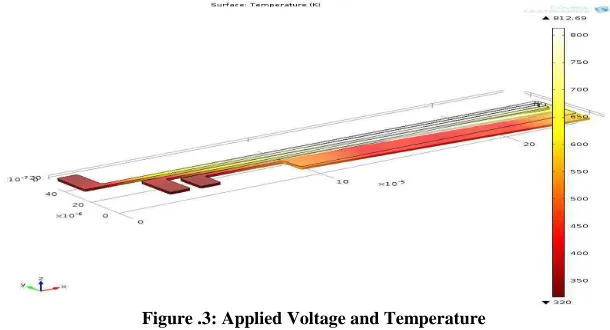
The present paper shows the how the thermal actuator using different applied
voltage which gives different Temperature is observed respect temperature. Is shown in figure 3. Applied Voltage and Temperature. Figure 4 shows the electric potential of slice.
Figure 4: Electric potential for Slice
RESULTS
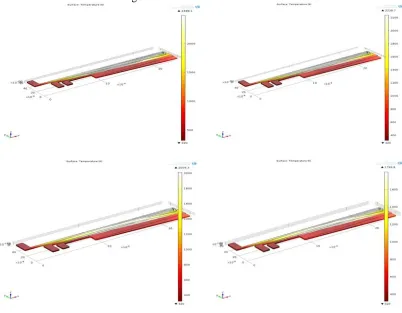
The result part shows the how the applied voltage increasing then temperature is increased is shown in below figures.
CONCLUSION
The temperature increase required to deform the two actuators, and thus displace the actuator is obtained through Joule heating. The greater expansion of the
arms increases the temperature in the actuator, which in turn causes thermal expansion and changes the electrical conductivity of the material. The micro actuator is subjected to controlled thermal expansion by applying a voltage through parts of the structure which induces joule heating of the parts. The external expansion causes the actuation to deflect. The simulation predicts the deflection as a function of the operating conditions for different designs.
REFERENCES
1. Guckel, H., Klein, J., Christenson, T., Skrobis, K., Laudon, M., and Lovell, E.G., Thermo Magnetic Metal Flexure Actuators, Solid State Sensors and Actuators Workshop, Hilton Head Island, pp. 73-75 (1992).
2. Comtois, J. and Bright, V.Surface Micromachined Polysilicon Thermal Actuator Arrays and Applications, Hilton Head, p. 174 (1996).
3. Moulton, T., "Analysis and Design of Electro-Thermal-Compliant Micro Devices," Center for Sensor Technologies at the University of Pennsylvania technical report # TR-CST31DEC, pp. 13-26 (1997).
4. Moulton, T. and Ananthasuresh, G.K. Micromechanical Devices with Embedded Electro Thermal-Compliant Actuation, Micro-Electro-Mechanical Systems (MEMS) Symposium at the IMECE (1999).
5. Lin, L. and Chiao, M. Electrothermal Responses of Line shape Microstructures, Sensors and Actuator
A, 55, pp. 35-41 (1996).
6. Huang, Q. and Lee, N., Analysis and Design o Polysilicon Thermal Flexure Actuator, J. Micromech. Microeng, 9, pp. 64-70 (1998).