Available Online At www.ijpret.com
INTERNATIONAL JOURNAL OF PURE AND
APPLIED RESEARCH IN ENGINEERING AND
TECHNOLOGY
A PATH FOR HORIZING YOUR INNOVATIVE WORK
UTILITY BASED LOAD BALANCING WITH GRID COMPUTING APPROACH
PROF. A. D. ISALKAR, PROF. S. T. KHANDARE
1. Department of Computer Science & Engg. Scholar, BNCOE, Pusad, India
2. Associate Professor, Department of Computer Science & Engg., BNCOE, Pusad, India
1.
Accepted Date:
27/02/2013
Publish Date:
01/04/2013
Keywords
Grid,
Utility,
Computing,
ULB,
Load.
Corresponding Author
Mr. A. D. Isalkar
Abstract
Available Online At www.ijpret.com
INTRODUCTION
As the number of nodes on a Grid increases,
the pressure on the resource system to
sustain the resource requirements of all the
concurrently executing applications (or
threads) increases. One of the keys to
obtaining high performance from such
architectures is to manage the load on
same Grid efficiently so that resources from
other Grids are reduced. This paper
investigates the problem of balancing the
load among shared resources [1].
A few static load balancing techniques are
Round robin algorithm, Randomized
algorithm, simulated annealing or genetic
algorithms, and Dynamic load balancing
algorithms make changes to the distribution
of work among workstations at run-time;
they use current or recent load information
when making distribution decisions.
Multicomputer with utility-based load
balancing allocate/reallocate resources at
runtime based on utility, which may
determine when and whose tasks can be
migrated. As a result, utility-based load
balancing algorithms can provide a major
improvement in performance over static
algorithms. However, this comes at the
additional cost of collecting and maintaining
load information, so it is important to keep
these overheads within reasonable limits
[2,3,4].
To balance the load based on application's
utility for the resource, we propose
Utility-Based Load Balancing Algorithm (ULB). An
important component of ULB is the
monitoring circuits that can obtain the
information about utility of resource for all
the competing applications at runtime. For
the ULB scheme to be practical, it is
important that the utility circuit (UCKT)
have low overhead. The information
collected by UCKT is used by a
ULB algorithm to decide the amount of
resources allocated to each competing
application.
2. Background and Motivation
The load balancing problem is closely
related to scheduling and resource
allocation. It is concerned with all
techniques allowing an evenly distribution
of the workload among the available
Available Online At www.ijpret.com needed to perform all tasks, the workload
has to be evenly distributed over all nodes
which are based on their processing
capabilities. This is why load balancing is
needed. The main objective of a load
balancing consists primarily to optimize the
average response time of applications; this
often means the maintenance the workload
proportionally equivalent on the whole
system resources. Load balancing is usually
described as either load balancing or load
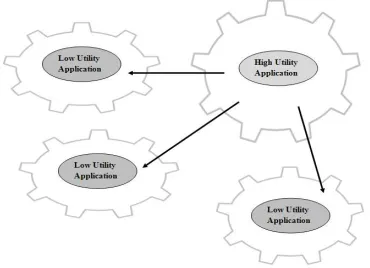
sharing. Figure 1 shows the Job Migration.
Figure 1: Application migration for Load
Balancing over Grid
Load balancing improve performance by
reducing the sharing of resources among
the executing applications. Thus, the utility
of resources for an application can be
directly correlated improvement in
performance of the application when the
resource is shared. The utility of resource
varies widely across applications. The
applications are classified into three
categories based on how much each of
them benefits as the resource is increased.
The applications which requires more
resources is have low utility, whereas
applications which requires less resources
have high utility and others have saturating
utility. If two applications having low utility
are executed together on Grid, then their
performance is not sensitive to the amount
of resource available to each application.
Similarly, when an application with high
utility is run with any other application, its
performance is highly sensitive to the
amount of resource available to it. In such
cases, it is important to balance the
resources judiciously by taking utility
information into account.
3. Utility-Based Load Balancing (ULB)
3.1Framework
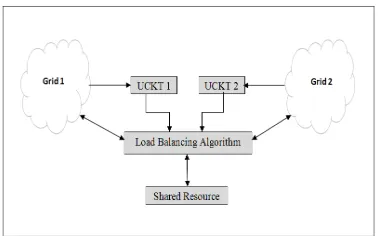
Figure 2 shows the framework to support
ULB between two applications that execute
simultaneously. One of the two applications
execute on Grid1 and the other on Grid2.
Available Online At www.ijpret.com that tracks the utility information of the
application executing on it. The UCKT circuit
is separated from the shared resource,
which allows the UCKT circuit to obtain
utility information about an application for
all the ways in the Grid, independent of the
contention from the application executing
on the other Grid. The Load Balancing
algorithm uses the information collected by
the UCKT to decide the load balancing for
each Grid. The migration engine of the
shared resource is augmented to support
the migration allocated by the Load
Balancing algorithm.
Figure 2: Framework of Utility Based Load
Balancing technique.
3.2Utility Circuits (UCKT)
Determining the utility information of an
application requires a mechanism that
tracks the number of resources required by
each computing application. To compute
the utility information for the baseline, the
utility circuit is required to track resource
information. A straight-forward, but
expensive, method to obtain this
information is to have resource
requirement. The utility information from
Grid is provided to Load Balancing
algorithm which makes decision for
balancing the load on demand basis.
3.3Load Balancing Algorithm
The Load Balancing algorithm reads the
utility information from all the UCKT circuits
of each of the competing applications. The
Load Balancing algorithm tries to minimize
the load incurred by all the applications.
The utility information in the UCKT directly
correlates with the managing load for a
given application. Thus, reducing the most
balance is equivalent to maximizing the
combined utility. If A and B are two
applications with utility functions UA and
Available Online At www.ijpret.com decisions, the combined utility (U) of A and
B is computed for all possible Grids (N).
Utot = UAi1+ UB(N-i)1 … For i = 1 to
N-1
The partition that gives the maximum value
for U is selected. In our studies, we
guarantee that the load balancing algorithm
gives at least resource to each application,
so starvation problem can be reduce. We
invoke the balancing algorithm once every
five million cycles (a design choice based on
simulation results). After each balancing
interval, the counters in all UCKTs are
halved. This allows the UCKT to retain past
information while giving importance to
recent information.
3.4 Algorithm
Algorithm : Greedy Approach
balance = N /* Num resource to be
allocated */
allocations[i] = 0 for each competing
application i
while(balance) do:
foreach application i, do: /* get utility for
next 1 block */
alloc = allocations[i]
Unext[i] = get_util_value(i, alloc, alloc+1)
winner = application with maximum value
of Unext
allocations[winner]++
balance = balance-1 return allocations
get_util_value(p, a, b):
U = change in performance for application p
when the number of resource assigned to it
increases from a to b return U
4. Analysis
4. 1 Performance Metrics
There are several metrics to quantify the
performance of a system in which multiple
applications execute concurrently. We
discuss the three metrics commonly used in
the literature: weighted speedup, sum of
IPCs, and harmonic mean of normalized
Available Online At www.ijpret.com be the IPC of the ith application when it
concurrently executes with other
applications and SingleIPCi be the IPC of the
same application when it executes in
isolation. Then, for a system in which N
threads execute concurrently, the three
metrics are given by:
Weighted Speedup = ∑ . . . (2)
IPCsum= IPCi . . . (3)
IPCnorm_hmean =
∑
⁄ ( ⁄ )
The Weighted Speedup metric indicates
reduction in execution time. The IPC metric
indicates the throughput of the system but
it can be unfair to a low IPC application. The
IPCsum metric balances both fairness and
performance [9]. We will use Weighted
Speedup as the metric for quantifying the
performance of multicomputer
configurations throughout the paper.
Evaluation with the IPC metric will also be
discussed for some of the key results in the
paper.
5. Related Work
5.1. Related work in Load Balancing
Stone et al. [16] investigated optimal
(static) load balancing of resources between
two or more applications when the
information about change in resource
requirement for varying resource size is
available for each of the competing
application. However, such information is
hard to obtain statically for all applications
as it may depend on the input set of the
application. The objective of our study is to
dynamically balance the load by computing
this information at runtime. Moreover,
dynamic load balancing can adapt to the
time-varying phase behavior of the
competing applications, which makes it
possible for dynamic load balancing to out
perform even the best static load balancing
[13].
Dynamic load balancing of shared resource
was first investigated by Suh et al. [17][18].
Describes a low-overhead scheme that uses
recency position of the resource for the
lines in the Grid to estimate the utility of
the cache for each application. However,
obtaining the utility information from each
application has the following shortcomings:
(1) the number of lines in each set for which
Available Online At www.ijpret.com given application is also dependent on the
other application. (2) The recency position
at which the application gets a resource is
also affected by the other application,
which means that the utility information
computed for an application is dependent
on (and polluted by) the concurrently
executing application. ULB avoids these
problems by separating the utility circuit
from the main resource so that the utility
information of the application is
independent of other concurrently
executing applications.
5.2 Related work in resource allocation
In the Grid systems domain, Zhou et al. [19]
looked at resource allocation for competing
applications using miss ratio curve. The
objective of both their study and our study
is the same, however, their study deals with
the allocation of physical resource,
whereas, our study deals with the allocation
of resource for load balancing. The
hardware solution proposed in [19] stores
an extra tag entry for each resource in a
separate hardware structure for each
competing application.
6. Conclusion
Traditional designs for a shared resource
balancing use static lad balancing scheme
among competing applications on a
demand basis. The application that accesses
more unique resource in a given interval
gets more resource than an application that
accesses less unique resource in that
interval. However, the benefit (reduction in
resource) those applications get for a given
amount of resources may not correlate with
the demand. This paper proposes
Utility-Based Load Balancing (ULB) to divide the
resource among competing applications
based on the benefit (utility) of resource for
each application and makes the following
contributions:
1. It proposes a low hardware overhead,
utility circuit to estimate the utility of the
resources for each application.
2. It proposes the Greedy Algorithm, as a
scalable alternative to evaluating every
possible load balancing decisions when
there are a large number of applications
sharing a resource.
Available Online At www.ijpret.com 1. [Kumar,2011] U. Karthick Kumar “A
Dynamic Load Balancing Algorithm in
Computational Grid Using Fair
Scheduling ”, International Journal Of
Computer Science and Informatics, Vol.
8, Issue 5, No 1, September 2011 ISSN
(Online): 1694-0814.
2. [Vivekanandan & Ramyachitra, 2011]
Dr. K. Vivekanandan, D.Ramyachitra, “A
Study on Scheduling in Grid
Environment”, International Journal on
Computer Science and Engineering
(IJCSE), ISSN : 0975-3397 Vol. 3 No. 2
Feb 2011.
3. [Kumar & Singhal,2012] Sachin Kumar
Niraj Singhal, “ A Priority based Dynamic
Load Balancing Approach in a Grid
based Distributed Computing Network”,
International Journal of Computer
Applications (0975 – 8887), Volume 49–
No.5, July 2012
4. [Kaur & Singh, 2012] Pawandeep Kaur,
Harshpreet Singh, “Adaptive dynamic
load balancing in grid computing an
approach,” International journal of
engineering science & advanced
technology , ISSN: 2250–3676
Volume-2, Issue-3, 625 – 63Volume-2, May-Jun 2012.
5. [Gogulan & Kavitha,2012] R.Gogulan,
A.Kavitha, U.Karthick Kumar, “Max Min
fair scheduling algorithm using in grid
scheduling with load balancing”,
International Journal of Research in
Computer Science, ISSN 2249-8265
Volume 2 Issue 3 (2012) pp. 41-49.
6. [Srivastava, 2011] Prabhat Kr.
Srivastava, “Improving Performance in
Load Balancing Problem on the Grid
Computing System”, International
Journal of Computer Applications (0975
– 8887), Volume 16– No.1, February
2011
7. [Zheng,Tham &Veeravalli, 2010]Qin
Zheng Chen-Khong Tham Bharadwaj
Veeravalli, “Dynamic Load Balancing and
Pricing Dynamic Load Balancing and
Pricing in Grid Computing with
Communication Delay, November 2,
2010
8. [Engelen ,2008] Prof. Robert van
Available Online At www.ijpret.com Grid Computing”, Advanced Topics
Spring 2008.
9. [Yagoubi & Slimani, 2007] Belabbas
Yagoubi and Yahya Slimani, “Dynamic
Load Balancing Strategy for Grid
Computing,” Journal of Information
Technology and Applications ,Vol. 1 No.
4 Mar ch,2007, pp. 285-296
10.[Yagoubi & Slimani, 2006] Belabbas
Yagoubi and Yahya Slimani, “Dynamic
Load Balancing Strategy for Grid
Computing,” World Academy of Science,
Engineering and Technology 19 2006.
11.[Jacob & brown, 2005] Bart Jacob,
Michael Brown, Kentaro Fukui, Nihar
Trivedi ,“An Introduction to grid
computing”, IBM/Redbooks December
2005.
12.[Dobber, Koole & van der Mei ,2004]
Menno Dobber, Ger Koole, and Rob van
der Mei, “Dynamic Load Balancing for a
Grid Application”,pp. 342–352, 2004.
13.[Chang, 2004] Prof. Ruay-Shiung Chang ,
“Grid Architecture”, March 2004.
14.[Jacob , 2003] Bart Jacob , “Grid
computing: What are the key
components? Taking advantage of Grid
computing for application enablement”,
ITSO Redbooks Project Leader, IBM June
2003.
15.[Buyya ,Abramson & Giddy] Rajkumar
Buyya, David Abramson, and Jonathan
Giddy, “ A Case for Economy Grid
Architecture for Service Oriented Grid
Computing”.
16.“Introduction to Grid Computing “,The
Globus Project™ Argonne National
Laboratory USC Information Sciences
Institute.
17.[Malik,2000] Shahzad Malik, “ Dynamic
Load Balancing in a Network of
Workstations”, November 29,2000
18.[Kokkinos & Christodoulopoulos]P.
Kokkinos, K. Christodoulopoulos, N.
Doulamis, and E. Varvarigos, “Quality of
Service Scheduling of Computation and
Communication Resources in Grid
Networks”.
19.[Buyya ,Abramson & Giddy] Rajkumar
Available Online At www.ijpret.com Giddy, “ A Case for Economy Grid
Architecture for Service Oriented Grid