Volume 7, Number 3, pp. 9–25. http://www.scpe.org c 2006 SWPS
MANAGING HETEROGENEITY IN A GRID PARALLEL HASKELL
A. D. AL ZAIN , P. W. TRINDER , G. J. MICHAELSON∗, AND H-W. LOIDL†
Abstract. Computational Grids potentially offer cheap large-scale high-performance systems, but are a very challenging architecture, being heterogeneous, shared and hierarchical. Rather than requiring a programmer to explicitly manage this complex
environment, we recommend using a high-level parallel functional language, likeGpH, with largely automatic management of
parallel coordination.
We presentGRID-GUM, an initial port of the distributed virtual shared-memory implementation ofGpHfor computational
Grids. We show that,GRID-GUMdelivers acceptable speedups on relatively low latency homogeneous and heterogeneous
compu-tational Grids. Moreover, we find that for heterogeneous compucompu-tationalGrids, load management limits performance.
We present the initial design ofGRID-GUM2, that incorporates new load management mechanisms that cheaply and effectively
combine static and dynamic information to adapt to heterogeneousGrids. The mechanisms are evaluated by measuring four
non-trivial programs with different parallel properties. The measurements show that the new mechanisms improve load distribution over the original implementation, reducing runtime by factors ranging from 17% to 57%, and the greatest improvement is obtained for the most dynamic program.
Key words. Parallel Computing, Programming Languages
1. Introduction. Hardware price/performance ratios and improved middleware and network technologies make cluster computing and computational Grids increasingly attractive. These architectures are typically heterogeneous in the sense that they combine processing elements with different CPU speeds and memory characteristics. Parallel programming on such heterogeneous architectures is more challenging than on classical homogeneous high performance architectures.
Rather than requiring the programmer to explicitly manage low level issues such as heterogeneity we ad-vocate a high-level parallel programming language, specifically Glasgow parallel Haskell (GpH), where the programmer controls only a few key parallel coordination aspects. The remaining coordination aspects, includ-ing heterogeneity, are dynamically managed by a sophisticated runtime environment, Gum. Gum has been engineered to deliver good performance on classical HPCs and clusters [1].
This paper presentsGRID-GUM, a port of Gum to computational Grids using the de-facto standard Globus Toolkit, in Section 4. Measurements in Section 6 show thatGRID-GUMgives good performance in some instances, e. g. on homogeneous low-latency multi-clusters. However for heterogeneous architectures load management emerges as the performance-limiting issue.
We present the initial design ofGRID-GUM2 in Section 7, which incorporates new load distribution mech-anisms for virtual shared-memory over a wide area network. The new mechmech-anisms are decentralised, obtaining complete static information during start up, and then cheaply propagating partial dynamic information during execution. The effectiveness of the new mechanisms for multi-clustersGridenvironment is investigated using four non-trivial programs from a range of application areas, and with varying degrees of irregular parallelism and using both data parallel and divide-and-conquer paradigms in Section 8. Related work is discussed in Section 9, and we conclude in Section 10.
2. Grids & the Globus Toolkit.
2.1. Overview. Gridtechnology is an infrastructure which provides the ability to dynamically link dis-tributed resources as an ensemble to support these execution of large scale, resource-intensive applications [19]. The idea behind the Grid is to serve as an enabling technology for a broad set of applications in sci-ence, business, entertainment, health and other areas. Using Berman’s classification [19], we are working with computationalGrids, which use the Gridto aggregate substantial computational resources in order to tackle problems that cannot be solved on a single system
2.2. Globus Toolkit. The Globus Toolkit is open source software with an open architecture, comprising a collection of software components designed to support the development of applications for high performance distributed computing environments or “Grids” [20]. The three main components are:
∗School of Mathematical and Computer Sciences, Heriot-Watt University, Riccarton, Edinburgh EH14 4AS, U. K.
({ceeatia,trinder,greg}@macs.hw.ac.uk)
†Ludwig-Maximilians-Universit¨at M¨unchen, Institut f¨ur Informatik, D 80538 M¨unchen, Germany,
• Resource Management: allocation and management ofGridresources; • Information Services: providing information aboutGridresources; • Data Management: accessing and managing data in aGridenvironment.
Globus Toolkit is similar to a distributed operating system with uniform access to system features. Globus Toolkit uses a standard application programming interface (API) for sending data and work to other machines which can be expressed in terms of extensibleresource specification language (RSL), which is used as a common notation for describing resource requirements. While, RSL is no more sophisticated than other systems for cluster computing e. g. a Beowulf cluster running standard Linux distribution, there are components which might be very useful forGRID-GUMin the long run: for example for monitoring system behaviour.
TheGridarchitecture in the Globus Toolkit [26] identifies the fundamental system components, specifies the purpose and function of these components, and indicates how these components interact with one another.
Gridlayers defines a slim API for resource and connectivity protocols, so that collective services have a simple interface to work with; on fabric layer, many and often specialised resources are covered (e.g. storage, sensors), not just the usual for parallel computing such as memory, CPU etc. The fabric layer provides the resources that are shared by the Grid: CPU time, storage, sensors. The connectivity layer defines the core communication and authentication protocols required forGrid-specific multi-clusters transactions. In the resource layer there are information protocolsthat tells us about the state of the resource andmanagement protocolsthat negotiate access to a resource. The collective layer includes directory services, scheduling, data replication services, workload management, col-laboratory services and monitoring services.
3. Gum and GpH.
3.1. GpH. GpHis a parallel dialect of the functional language Haskell. Its only extension to Haskell is a primitive, par, which indicates a possible parallel execution for a program expression. All dynamic control of the parallelism is completely implicit. This programming model encourages the generation of massive amounts of fine-grained parallelism and puts even higher importance on the efficiency of its management in the runtime environment.
3.2. Gum. Gum(Graph reduction for a Unified Machine model) is a parallel runtime environment, imple-ments a functional language and is based on parallel graph reduction [7]. In this model a program is represented as a graph structure and parallelism is exploited by reducing independent subgraphs in parallel. The most nat-ural implementation of parallel graph reduction uses a shared heap for memory management.Gumimplements a virtual shared heap on a distributed memory model, usingPvmas generic communication library for transfer-ring data. For efficient compilation we use a state-of-the-art, optimising compiler, namely the Glasgow Haskell Compiler [2]. OriginallyGumwas defined for homogeneous clusters and currently does not consider information on latencies or the load on other nodes. Gum uses blind load distributed mechanism, where requests are sent to random processing elements (PEs).
Gumhas a simple run-time model. Essentially, in the course of execution, PEs generatesparksrepresenting potential parallel activities which may subsequently be realised as threads. Idle PEs which lack local sparks may request work from other randomly chosen PEs by sending them fish messages. If a fished PE does not have spare sparks then it will pass the message onto another PE. Thus,Gumutilises apullapproach for work stealing to dynamically balance activity across PEs.
In a homogeneous HPC, theGummodel assumes that all PEs have the same processing and communication characteristics. It is also assumed that a parallel program has sole use of the HPC so its performance is not affected by unpredictable concurrent usage. Thus load balance inGum may be maintained without reference to run-time loads, with communication overhead from excess fishing restricted through a very simple throttling mechanism.
3.3. Communication Libraries. Gumis independent of the library used to communicate between PEs.
Gum was originally based on the Pvm communication library but now has been adapted to use Mpi, in particularMpichandMpich-G2. We summarise these libraries before considering their integration intoGum.
Mpich, built on top of services provided from the Globus Toolkit to support efficient, transparent execution in the Grid heterogeneous environments.
4. GRID-GUM. To port GpH to computationalGrids itsGum runtime environment must be ported to the Gridcollective layer as depicted in Figure 4.1. Gum sits above the collective layer provided by Globus Toolkit, which in turn provides a unified distributed environment on the clusters comprising the underlying
Grid. Such integration depends on the provision of appropriate communication libraries within the collective layer to linkGumtransparently to theGrid: this is considered in more detail in the next section.
GUM Parallel Program
GpH
Grid Collective Layer
Computational Grid
High Level Grid RTE
runs−on
runs−on compiles−to
Fig. 4.1.System Architecture
GRID-GUM extends the existing Gum memory management, and thread management techniques. In particular, it implements a virtual shared heap over a wide-area network [3]. The communication management inGRID-GUMis similar toGum, but it uses a different communication library: built aroundMpich-G2, and hence the Globus Toolkit [8] as middle-ware. WhileGumuses a system manager process to start and stop parallel execution,GRID-GUMgenerates an RSL file internally at the beginning of the execution. This file contains: the PE name, port number, and certificate name, environment variables, arguments for the executable program, the directory where the executable program is located in the specified PE, and the executable program’s name. This RSL file is used byMpichG2 to spawn the specified number of PEs.
PE 1
run
spark activate
run
spark PE 2
FISH
activate
Spark Pool
Thread Pool
CPU awake
block Closure
Blocking Queue
Spark Pool
Thread Pool
CPU awake
block Closure
Blocking Queue
SCHEDULE
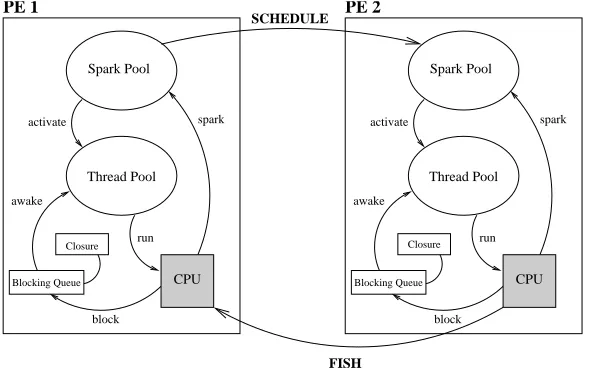
Fig. 4.2.Interaction of the components of aGumprocessing element.
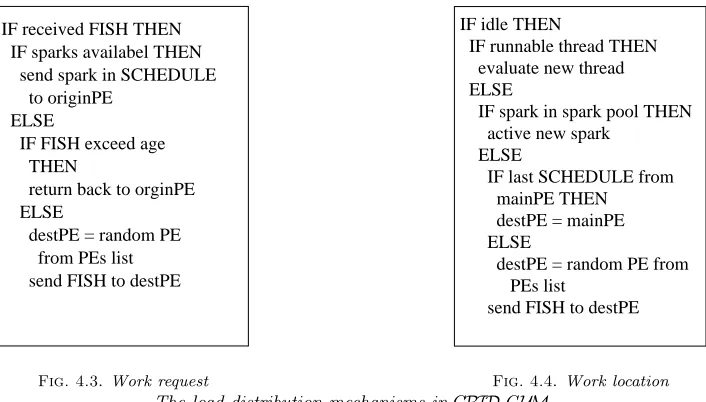
The thick arrows between the PEs in Figure 4.2 show load distribution messages exchanged inGRID-GUM. Initially all processors, except for the main PE, will be idle, with no local sparks available. PE2 sends aFISH message to a random-chosen PE. On arrival of this message, PE1 will search for a spark and, if available, send it to PE2. This mechanism is usually calledwork stealing orpassive load distribution, since an idle processor has to ask for work.GRID-GUMalso improves load distribution by usingLimited Thread mechanism which includes specifying a hard limit on the total number of live threads, i. e. runnable or blocked threads in the thread pool. Figure 4 summarises theGRID-GUM load distribution mechanism, it deals locating work (Figure 4.4), and handling work requests (Figure 4.3), where these activities are performed in the main scheduler loop between thread time slices.
IF received FISH THEN IF sparks availabel THEN send spark in SCHEDULE to originPE
ELSE
THEN
return back to orginPE ELSE
destPE = random PE from PEs list send FISH to destPE IF FISH exceed age
Fig. 4.3.Work request
IF idle THEN
IF runnable thread THEN
IF spark in spark pool THEN evaluate new thread
ELSE
active new spark ELSE
IF last SCHEDULE from mainPE THEN destPE = mainPE ELSE
PEs list
send FISH to destPE destPE = random PE from
Fig. 4.4.Work location
The load distribution mechanisms in GRID-GUM
5. Measurement Framework.
5.1. Hardware Apparatus. The measurements have been performed on five Beowulf clusters: three located at Heriot-Watt Riccarton campus (Edin1, Edin2,andEdin3), a cluster located at Ludwig-Maximilians University Munich (Muni), and a cluster located at Heriot-Watt boarder campus(SBC); see Tables 5.1 and 5.2 for the characteristic of these Beowulfs.
All run-times in the coming tables represent the median of three executions to ameliorate the impact of operating system and shared network interaction. In addition, tables include at the bottom, the minimum, maximum and the geometric mean (root mean square) values.
Table 5.1
Characteristics of Beowulf Clusters
CPU Cache Memory
MHz kB kB
Edin1 534 128 254856
Edin2 1395 256 191164
Edin3 1816 512 247816
SBC 933 256 110292
Muni 1529 256 515500
Table 5.2
Approximate Latency between Clusters (ms)
Edin1 Edin2 Edin3 SBC Muni
Edin1 0.20 0.27 0.35 2.03 35.8
Edin2 0.27 0.15 0.20 2.03 35.8
Edin3 0.35 0.20 0.20 2.03 35.8
SBC 2.03 2.03 2.03 0.15 32.8
Muni 35.8 35.8 35.8 32.8 0.13
communication degree,parFib,queensandsumEuler, and the other three have relatively high communication degree,raytracer,matMult, andlinSolv.
TheparFibcomputes Fibonacci numbers. ThesumEulerprogram computes the sum over the application of the Euler totient function over an integer list. The queensprogram places a chess pieces on a board. The raytracercalculates a 2D image of a given scene of 3D objects by tracing all rays in a given scene of 3D objects by tracing all rays in a given grid, or window. The matMultmultiples two matrices. The linSolv program finds an exact solution of a linear system of equations. See Table 5.3
Table 5.3
Programs Characteristics and Performance
Program Application Area Paradigm Regularity
queens AI Div-Conq. Regular
parFib Numeric Div-Conq. Regular
linSolv Symb. algebra Data Para. Limit irreg. sumEuler Nume. Analysis Data Para. Irregular
matMult Numeric Divi-Conq. Irregular
raytracer Graphic Data Para. High irreg.
6. GRID-GUMPerformance. In developingGRID-GUM, a crucial first step was to ensure thatGumcould seamlessly supportGpH in a Gridenvironment. In particular, it was important to demonstrate conclusively that the HPC-oriented Gum communication layer could be modified for transparent use in a heterogeneous
Grid. As discussed above,Gumcommunication is based onPvm, where communication in widely usedGrid
environments like Globus Toolkit is based on special forms ofMpi. While there is some evidence that Pvm
and Mpi offer comparable behaviours, it was not known whether the additional Grid control layers might add unacceptable overheads costs toGum, rendering its use inappropriate for parallel functional programming support in aGrid.
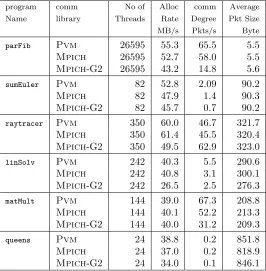
Table 6.1
Dynamic Program Properties on 16 PEs
program comm No of Alloc comm Average
Name library Threads Rate Degree Pkt Size
MB/s Pkts/s Byte
parFib Pvm 26595 55.3 65.5 5.5
Mpich 26595 52.7 58.0 5.5
Mpich-G2 26595 43.2 14.8 5.6
sumEuler Pvm 82 52.8 2.09 90.2
Mpich 82 47.9 1.4 90.3
Mpich-G2 82 45.7 0.7 90.2
raytracer Pvm 350 60.0 46.7 321.7
Mpich 350 61.4 45.5 320.4
Mpich-G2 350 49.5 62.9 323.0
linSolv Pvm 242 40.3 5.5 290.6
Mpich 242 40.8 3.1 300.1
Mpich-G2 242 26.5 2.5 276.3
matMult Pvm 144 39.0 67.3 208.8
Mpich 144 40.1 52.2 213.3
Mpich-G2 144 40.0 31.2 209.3
queens Pvm 24 38.8 0.2 851.8
Mpich 24 37.0 0.2 818.9
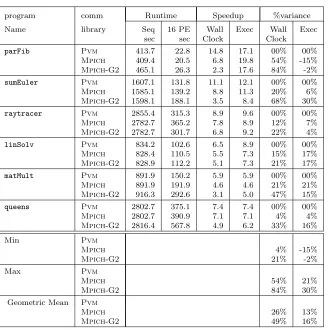
Table 6.2 Speedup on 16 PEs
program comm Runtime Speedup %variance
Name library Seq 16 PE Wall Exec Wall Exec
sec sec Clock Clock
parFib Pvm 413.7 22.8 14.8 17.1 00% 00%
Mpich 409.4 20.5 6.8 19.8 54% -15%
Mpich-G2 465.1 26.3 2.3 17.6 84% -2%
sumEuler Pvm 1607.1 131.8 11.1 12.1 00% 00%
Mpich 1585.1 139.2 8.8 11.3 20% 6%
Mpich-G2 1598.1 188.1 3.5 8.4 68% 30%
raytracer Pvm 2855.4 315.3 8.9 9.6 00% 00%
Mpich 2782.7 365.2 7.8 8.9 12% 7%
Mpich-G2 2782.7 301.7 6.8 9.2 22% 4%
linSolv Pvm 834.2 102.6 6.5 8.9 00% 00%
Mpich 828.4 110.5 5.5 7.3 15% 17%
Mpich-G2 828.9 112.2 5.1 7.3 21% 17%
matMult Pvm 891.9 150.2 5.9 5.9 00% 00%
Mpich 891.9 191.9 4.6 4.6 21% 21%
Mpich-G2 916.3 292.6 3.1 5.0 47% 15%
queens Pvm 2802.7 375.1 7.4 7.4 00% 00%
Mpich 2802.7 390.9 7.1 7.1 4% 4%
Mpich-G2 2816.4 567.8 4.9 6.2 33% 16%
Min Pvm
Mpich 4% -15%
Mpich-G2 21% -2%
Max Pvm
Mpich 54% 21%
Mpich-G2 84% 30%
Geometric Mean Pvm
Mpich 26% 13%
Mpich-G2 49% 16%
6.1. Communication Library Impact. This experiment investigates the impact of using different com-munication libraries on the performance on a single cluster.
The measurements in this section have been performed on the Edin1 cluster. In Table 6.2, the fifth and sixth columns record the wall-clock and execution speedup. The wall-clock time is the execution time plus the startup time. The seventh and the last columns show the percentage variance of the wall-clock and execution speedup relative to theGum/Pvmimplementation speedup.
Overall, theGum/Pvmimplementation consistently shows the best wall-clock speedup and Gum/Mpich -G2 the worst marked as the average packet size, in Gum level, shrinks. As shown in measurements in the Table 6.1, the average packet size is relatively small for parFib, and sumEuler, and the wall-clock speedup variance is big between the differentGum implementations for these programs. Forraytracer,matMult, and linSolvthe average packet size is significantly larger and the wall-clock speedup variance is smaller.
The main source of overhead for the communication is the time needed for packing and unpacking in the communication libraries. Good performance for small packets is important for Gum, since parallel functional programs have massive amount of fine grained parallelism including many small messages. This is untypical for general parallel applications, and Mpi implementations may well be tuned for the common case of large packet sizes. However, the big difference betweenMpichandMpich-G2 is related to the extra startup security checking overhead which Globus Toolkit adds forMpich-G2
Comparison of the execution-time speedup of theGumimplementations with the differentGpHprograms shows that no implementation is always better than the others. However, the differences in execution-time speedup are less marked than the differences on the wall-clock speedup.
To summarise:
• For small programsGum with Pvmgives the best wall clock speedup and Gum withMpich-G2 the worst (Table 6.2);
• Mpich-G2 has a high startup cost relative to PvmorMpich(Table 6.2).
6.2. GRID-GUMon Multiple Clusters.
6.2.1. Low Latency Multi-Cluster. This experiment investigates the performance impact of executing
GpHprograms on multiple heterogeneous clusters with moderate latency interconnect.
Table 6.3
Heterogeneous Clusters and Low Latency Interconnect Results
raytracer queens(13)
Speedup Rtime Speedup Rtime
F S Sec. F S Sec.
F 1.0 3.3 1483.3 1.0 3.2 719.5
S 0.3 1.0 4894.0 0.3 1.0 2324.7
FF 1.9 6.3 772.8 1.8 6.0 384.6
FS 1.2 4.0 1199.4 0.9 3.0 753.5
SS 0.5 1.8 2698.5 0.6 1.9 1176.9
SF 0.7 2.3 2106.1 1.0 3.4 666.3
FFF 2.7 8.9 545.1 2.8 9.3 249.5
FFS 2.0 6.7 728.6 0.9 3.0 768.2
FSS 1.4 4.8 1002.3 0.9 3.1 733.6
SSS 0.8 2.9 1663.0 0.9 2.9 795.7
SSF 1.4 4.6 1047.8 1.1 3.7 627.6
SFF 1.4 4.8 1002.1 1.5 4.8 478.3
raytracer queens(13)
Speedup Rtime Speedup Rtime
F S Sec. F S Sec.
FFFF 3.4 11.4 425.9 2.7 9.0 258.2
FFFS 2.7 9.0 538.8 1.4 4.8 483.0
FFSS 2.2 7.2 675.7 1.2 4.0 578.0
FSSS 1.7 5.8 833.1 1.2 4.1 561.6
SSSS 1.1 3.8 1280.9 0.9 3.1 741.6
SSSF 1.6 5.3 916.2 1.2 4.1 560.3
SSFF 1.4 4.8 1006.7 1.2 4.1 563.5
SFFF 1.4 4.6 1046.3 1.9 6.1 375.5
FFFFF 4.0 12.9 376.7 4.0 12.8 181.1
FFFFS 3.5 11.5 422.9 2.8 9.1 254.5
FFFSS 2.9 9.4 519.2 1.3 4.2 544.9
FFSSS 2.4 7.9 615.3 1.3 4.3 530.1
FSSSS 1.9 6.4 755.6 1.2 4.0 577.7
SSSSF 1.7 5.7 850.7 1.2 4.1 560.5
SSSFF 1.8 6.2 786.0 1.5 4.9 474.3
SSFFF 1.8 6.1 790.4 1.9 6.1 375.4
SFFFF 1.9 6.5 747.6 2.2 7.3 316.5
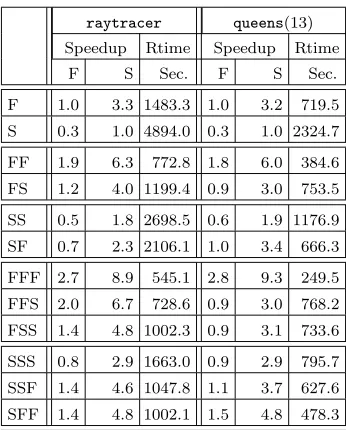
The measurements in Table 6.3 use Mpich communication library on SBC and Edin3 Beowulf clusters described in Table 5.1. Each SBC machine is labelledS (Slow) and each Edin3 machine is labelled F (Fast).
Two programs are measured: raytracerwith relatively high communication degree, andqueenswith relatively low communication degree. The first column shows different combinations of machines. The second and the fifth columns record the speedup using F’s sequential runtime forraytracer and queens respectively. The third
and the sixth columns records the speedup usingS’s sequential runtime, and the fourth and the last columns
show the wall-clock time. The first machine in the configuration string is where the program starts.
Table 6.3 shows that, replacing a local machineSby a faster remote machineF decreases the runtime and
increases the speedup. For example in Table 6.3, SSS cluster requires 1663.0s to finish the computation of
raytracer; however, ifS machine has been replaced byF remote machine, the runtime is decreased by 37%.
Interestingly, this result supports the idea of using a fast remote machine to improve the performance of aGpH
parallel program, and it shows thatGRID-GUMcan cope with moderate latency network without modification. However, it is observable thatGRID-GUM, with its blind load mechanism, often gives unsatisfactory schedul-ing in heterogeneousGridmulti-clusters. For example, replacing one of theF F F machines by a slower remote
machineS increases the runtime of queensfrom 249.5s to 768.2s, i. e. by a factor of three. Likewise, adding a
slower remote machineS to twoF F local machines increases the runtime ofqueensfrom 384.6s to 768.2s i. e.
by a factor of two.
Main_mp.mpi 12 2 350 350 UK4 +RTS -qp8 -H32M -s Wed Sep 14 13:49:52 BST 2005 GUMGUMGUMGUMGUMGUMGUMGUMGUMGUMGUMGUMGUMGUMGUMGUMGUMGUMGUMGUM
0 1 2 3 4 5 6 7
0 50.0 k 100.0 k 150.0 k 200.0 k 250.0 k 300.0 k 350.0 k 400.0 k
Main_mp.mpi 12 2 350 350 UK4 +RTS -qp8 -H32M -s Tue Oct 26 14:50:20 CEST 2004 GUM
GUMGUMGUMGUMGUMGUMGUMGUMGUMGUMGUMGUMGUMGUMGUMGUMGUMGUMGUM
0 1 2 3 4 5 6 7
0 20.0 k 40.0 k 60.0 k 80.0 k 100.0 k120.0 k140.0 k160.0 k180.0 k200.0 k220.0 k240.0 k260.0 k280.0 k300.0 k320.0 k340.0 k360.0 k
a) Homogeneous clusters b) Heterogeneous cluster
Fig. 6.1.per PE Activity Profile forraytracer
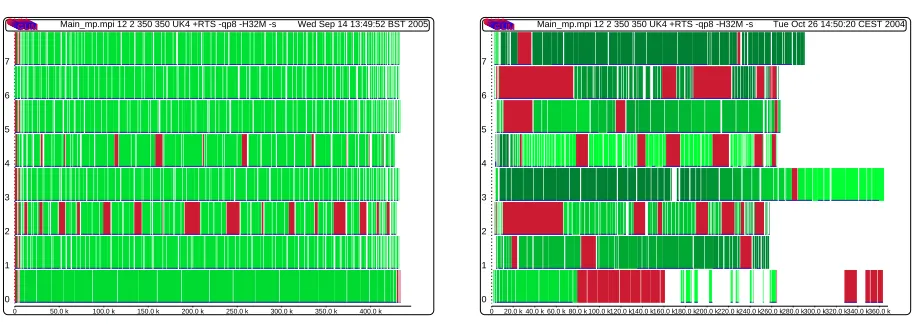
(green in a colour profile) indicating a larger number of runnable threads. Gaps in the horizontal lines (red areas in the colour profile) indicate idleness.
Figure 6.1.a depicts the performance on homogeneous cluster where all PEs have the same CPU speed. Figure 6.1.b depicts the performance on heterogeneous cluster where there are four fast machines (0-3) and four slow machines (4-7). All PEs in Figure 6.1.a are uniformly loaded, and finish at the same time, in contrast the PEs in Figure 6.1.b have numerous idle periods, and finish at different times. Figure 6.1.b also shows long idle periods at the beginning of the computation, where only a small amount of parallelism is available, and blocking on data that is remotely evaluated will cause the entire PE to remain idle until new work is obtained (see the start of PE 6). Matching the profile in Figure 6.1.a, the fast processors in Figure 6.1.b (0-3) show a fairly balanced load and finish at about the same time. Towards the end only PE 3 has useful work, and the main PE 0 has to wait for it to finish. Considering the runtime of the heterogeneous cluster, 368.0s, is almost
two times greater than the runtime of the homogeneous cluster, 220.0s.
To summarise:
• Replacing a local PE with a faster remote PE reduces execution time (Table 6.3);
• GRID-GUM’s load balancing mechanism does not deliver good scheduling in a heterogeneous Grid
multi-clusters (Figure 6.1);
• In a moderate latency configuration, latency is not the dominating factor, sinceGRID-GUMcan overlap communication with computation, provided a sufficient amount of parallelism is available (Table 6.3).
6.2.2. High Latency Multi-Cluster. This experiment investigates the performance impact of executing
GpHprograms on multiple homogeneous clusters with a high latency interconnect. We measure programs with both low and high communication degrees.
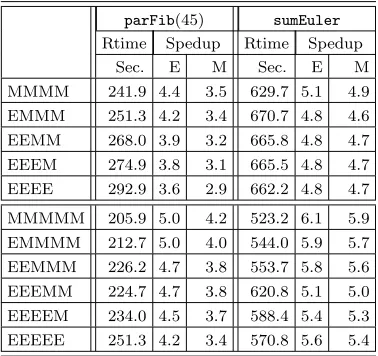
The measurements in Table 6.4, and 6.5 use Mpich-G2 communication library on the Muni and Edin2 Beowulf clusters described Table 5.1. Each Muni machine is labelledM and each Edin2 machine is labelledE
Five programs have been tested: two programs with relatively low communication degree parFib, and sumEuler, and three programs with relatively high communication degreeraytracer,linSolv, andmatMult, see Table 6.1.
For programs with a low communication degree, Table 6.4 shows that adding a remote machineM decreases
the runtime. Even on multi-clusters configurations with very high latency between the clusters, the additional computational power outweighs the expensive but infrequent communication. It also shows that replacing a local machineE by a remote machineM does not grossly deteriorate performance. For example, in Table 6.4,
in anEEEconfigurationsumEulerrequires 899.7s to finish, machineM is addedEEEM the runtime decreases
by 26.0%. Furthermore, replacing a local machine E by a remote machine M, yielding aEEM configuration,
shows little change in the runtime (3.5%). In short, using remote machines in high latency communications
does not have impact on the performance of low communication degree programs.
lo-Table 6.4
Low Communication Degree Programs
parFib(45) sumEuler
Rtime Spedup Rtime Spedup
Sec. E M Sec. E M
M 867.5 1.2 1.0 3138.5 1.0 1.0
E 1070.1 1.0 0.8 3227.6 1.0 0.9
MM 431.0 2.2 2.0 1270.4 2.5 2.4
EM 480.6 2.2 1.8 1308.8 2.4 2.3
EE 536.8 1.9 1.6 1332.8 2.4 2.3
MMM 298.8 3.5 2.9 869.9 3.7 3.6
EMM 331.1 3.2 2.6 838.7 3.8 3.7
EEM 338.9 3.1 2.5 867.9 3.7 3.6
EEE 374.8 2.8 2.3 899.7 3.5 3.4
parFib(45) sumEuler
Rtime Spedup Rtime Spedup
Sec. E M Sec. E M
MMMM 241.9 4.4 3.5 629.7 5.1 4.9
EMMM 251.3 4.2 3.4 670.7 4.8 4.6
EEMM 268.0 3.9 3.2 665.8 4.8 4.7
EEEM 274.9 3.8 3.1 665.5 4.8 4.7
EEEE 292.9 3.6 2.9 662.2 4.8 4.7
MMMMM 205.9 5.0 4.2 523.2 6.1 5.9
EMMMM 212.7 5.0 4.0 544.0 5.9 5.7
EEMMM 226.2 4.7 3.8 553.7 5.8 5.6
EEEMM 224.7 4.7 3.8 620.8 5.1 5.0
EEEEM 234.0 4.5 3.7 588.4 5.4 5.3
EEEEE 251.3 4.2 3.4 570.8 5.6 5.4
cal machines EE takes 174.9s, if one of the local machine is replaced by a remote machine EM, the
run-time increases by 41.4%. Note that for all programs the runtime increases when adding a remote machine
in such a way. Furthermore, a configuration of the form EM M . . . M is always worst among the
config-urations with the same number of PEs. This is because the local machine E, which has all the work in
the beginning of the execution, has to communicate with the other machines through a high latency net-work, which becomes a bottleneck in the execution. Finally, configurations of the form E . . . E or M . . . M
are usually the best configurations, because all machines communicate with others through the low latency network.
testLinSolv_mp.mpi 31 83 +RTS -qp4 -H64M -s Wed Jul 6 13:58:50 BST 2005 GUM
GUMGUMGUMGUMGUMGUMGUMGUMGUMGUMGUMGUMGUMGUMGUMGUMGUMGUMGUM
0 1 2 3
0 5.0 k 10.0 k 15.0 k 20.0 k 25.0 k 30.0 k 35.0 k 40.0 k 45.0 k 50.0 k 55.0 k 60.0 k 65.0 k 70.0 k 75.0 k 80.0 k
testLinSolv_mp.mpi 31 83 +RTS -qp4 -H64M -s Wed Jul 6 14:06:34 BST 2005 GUM
GUMGUMGUMGUMGUMGUMGUMGUMGUMGUMGUMGUMGUMGUMGUMGUMGUMGUMGUM
0 1 2 3
0 20.0 k 40.0 k 60.0 k 80.0 k 100.0 k 120.0 k
a) Homogeneous low latency interconnect b) Heterogeneous high latency interconnect
Fig. 6.2.per PE Activity Profile forlinSolvon multi-Clusters
GRID-GUM shows relatively poor performance on high latency interconnect multi-clusters for many pro-grams. For example, Figure 6.2 showsGRID-GUMper-PE activity profile forlinSolvon a homogeneous low and a heterogeneous high latency interconnect multi-clusters. Figure 6.2.a depicts the performance on homo-geneous low latency interconnect cluster. Figure 6.2.b depicts the performance on heterohomo-geneous high latency interconnect where PE 0 & PE 1 and PE 2 & PE 3 are connected pairwise by a low latency network, and with a high latency network between the pairs.
Table 6.5
High Communication Degree Programs
raytracer matMult linSolv
Rtime Speedup Rtime Speedup Rtime Speedup
Sec. E M Sec. E M Sec. E M
M 903.8 1.1 1.0 265.8 0.9 1.0 290.0 1.0 1.0
E 1027.8 1.0 0.8 259.9 1.0 1.0 299.3 1.0 0.9
MM 548.6 1.8 1.4 228.8 1.1 1.1 196.5 1.5 1.4
EM 624.6 1.6 1.4 393.0 0.6 0.6 232.0 1.2 1.2
EE 545.7 1.8 1.6 227.8 1.1 1.1 164.9 1.8 1.7
MMM 383.7 2.6 2.3 133.0 1.9 1.9 139.4 2.1 2.0
EMM 535.8 1.9 1.6 297.7 0.8 0.8 231.8 1.2 1.2
EEM 494.9 2.0 1.8 201.9 1.2 1.3 141.1 2.1 2.0
EEE 387.5 2.6 2.3 137.8 1.8 1.9 136.8 2.1 2.1
MMMM 312.8 3.2 2.8 121.9 2.1 2.1 119.5 2.5 2.4
EMMM 497.6 2.0 1.8 295.0 0.8 0.9 142.5 2.1 2.0
EEMM 421.7 2.4 2.1 213.9 1.2 1.2 134.9 2.2 2.1
EEEM 377.9 2.7 2.3 145.9 1.7 1.8 120.9 2.4 2.3
EEEE 326.4 3.1 2.7 114.8 2.2 2.3 117.1 2.5 2.4
MMMMM 287.8 3.5 3.1 108.6 2.3 2.4 104.4 2.8 2.7
EMMMM 473.8 2.1 1.9 290.8 0.8 0.9 147.0 2.0 1.9
EEMMM 413.7 2.4 2.1 228.8 1.1 1.1 142.1 2.1 2.0
EEEMM 378.7 2.7 2.3 150.9 1.7 1.7 104.9 2.8 2.7
EEEEM 329.9 3.1 2.7 125.1 2.0 2.1 107.7 2.7 2.7
EEEEE 279.8 3.6 3.2 95.9 2.7 2.7 102.9 2.9 2.8
To summarise:
• For high communication degree programsGRID-GUMdelivers poor performance on high latency multi-clusters (Table 6.5);
• For low communication degree programsGRID-GUM can delver good performance on high latency multi-clusters (Table 6.4);
• The poor performance ofGRID-GUM on high latency multi-clusters is primarily due to poor load management (Figure 6.2).
7. GRID-GUM2. Based on the results in previous section, it is essential to modifyGRID-GUMfor execution on a computationalGrid, (GRID-GUM2).GRID-GUM2 uses the monitored information to provide a good load distribution over theGridusing the following policies:
• An idle PE sends a FISH message only to a PE that has high load relative to its CPU speed. • PEs have a preference for obtaining work from PEs that currently have low communication latency. • The recipient PE switches from passive to active load distribution if a FISH message received from
another cluster.
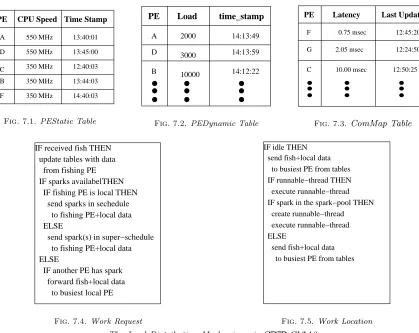
The newGRID-GUM2 mechanism has two main components: information collection and adaptive load distribution. The information collection is supported by a monitoring mechanism to provide the current state information of theGridnetwork. The monitoring mechanism performs during the whole course of execution. It collects static information like CPU speed at the start of program inPEStatictable (Figure 7.1), and dynamic information such as load and latency during the execution in PEDynamic and ComMap tables (Figures 7.2 and 7.3) respectively. The adaptive load distribution ofGRID-GUM2 comprises the following aspects:
PE
550 MHz 550 MHz
350 MHz 350 MHz
Time Stamp
350 MHz
13:40:01 13:45:00 12:40:03 13:44:03 14:40:03 A
D
C B F
CPU Speed
Fig. 7.1.PEStatic Table
Load time_stamp
2000 14:13:49
3000 14:13:59
10000 14:12:22
PE
A
B D
Fig. 7.2.PEDynamic Table
PE
0.75 msec
Last Update 12:45:20 F
Latency
C 10.00 msec 12:50:25 G 2.05 msec 12:24:50
Fig. 7.3.ComMap Table
IF received fish THEN update tables with data from fishing PE IF sparks availabelTHEN IF fishing PE is local THEN send sparks in sechedule to fishing PE+local data ELSE
send spark(s) in super−schedule to fishing PE+local data ELSE
IF another PE has spark forward fish+local data to busiest local PE
Fig. 7.4.Work Request
IF idle THEN
to busiest PE from tables IF runnable−thread THEN execute runnable−thread IF spark in the spark−pool THEN create runnable−thread execute runnable−thread ELSE
send fish+local data to busiest PE from tables send fish+local data
Fig. 7.5.Work Location
The Load Distribution Mechanisms in GRID-GUM2
heavily loaded.
• Dependent load distribution:GRID-GUM2 aims for an efficient load distribution mechanism to a single parallel program with dependent tasks.
• Decentralised information services:GRID-GUM2 maintains a decentralised scheme where every PE is responsible for maintaining state information of some nearby PEs and share it with other PEs. • Dynamic load distribution:GRID-GUM2 assumes that limited knowledge about the load and PEs are
availablea priori, and load distribution decisions have to be made during the execution.
• Decentralised load distribution organisation:GRID-GUM2 distributes the load distribution decision to every PE. Therefore, each PE acts as both a load distributer and a computational resource.
• Redistribution support:GRID-GUM2 supports work placement which enhance system reliability and flexibility.
• Adaptive load distribution: GRID-GUM2 is a mainly passive load distribution system where lightly loaded PEs have to explicitly ask for work from PEs with excess load. However, if an idle PE requests work from a PE residing outside its cluster and the request originated from relatively powerful cluster, it changes from a passive to an active system and the recipient PE sends more work to the idle PE. The core ofGRID-GUM2 load distribution can be summarised as work location (Figure 7.4), and work request handling (Figure 7.5).
8. GRID-GUM2 Performance on Heterogeneous Architecture. This experiment investigates the performance impact of using the adaptive load distribution ofGRID-GUM2 on multiple heterogeneous clusters with moderate latency interconnect.
The measurements in Table 8.1 useGRID-GUMandGRID-GUM2 on Edin1 and Edin2 Beowulf clusters described in Table 5.1. Four GpH programs are measured in this experiment: queens, sumEuler, linSolv andraytracerdescribed in Section 5. In Table 8.1, The second and third columns record the run-time using
GRID-GUM2.
Table 8.1
Performance On Heterogeneous Architecture
Program Run-time (s) Improvement %
GRID-GUM GRID-GUM2
queens 668 310 53%
sumEuler 570 279 51%
linSolv 217 180 17%
raytracer 1340 572 57%
Min 17%
Max 57%
Geometric
47.3% Mean
Table 8.1 shows that,GRID-GUM2 outperformsGRID-GUMon multiple heterogeneous clusters with moder-ate lmoder-atency interconnect as far as the execution time is concerned.GRID-GUM2 shows run-time improvements between 17% and 57%. The greatest improvement are given with the most dynamic program, raytracer. Through the rest of this sub-section we consider studying in more details the behaviour ofraytracerin multi-clusters heterogeneous architecture.
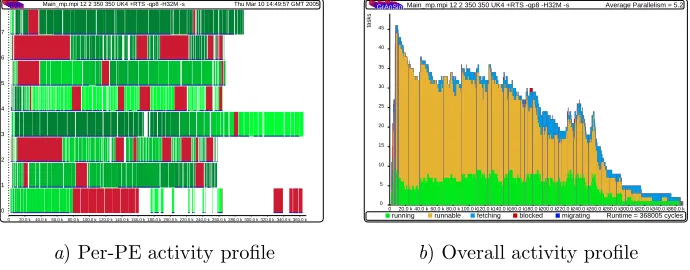
raytracerhas highly irregular execution, and consequently is very sensitive to changes in parallel environ-ment. Figure 8.1 shows per-PE and overall activity profiles forraytracer, with execution on four fast machines (0,2,4,6), and four slow machines (1,3,5,7). A per-PE activity profile shows the behaviour for each of the PEs (y-axis) over execution time (x-axis). An overall activity profile shows the behaviour of the program at each instant of its execution.
Main_mp.mpi 12 2 350 350 UK4 +RTS -qp8 -H32M -s Thu Mar 10 14:49:57 GMT 2005 GUM
GUM GUMGUMGUMGUMGUMGUMGUMGUMGUMGUMGUMGUMGUMGUMGUMGUMGUMGUM
0 1 2 3 4 5 6 7
0 20.0 k40.0 k60.0 k80.0 k 100.0 k 120.0 k 140.0 k 160.0 k 180.0 k 200.0 k 220.0 k 240.0 k 260.0 k 280.0 k 300.0 k 320.0 k 340.0 k 360.0 k
Main_mp.mpi 12 2 350 350 UK4 +RTS -qp8 -H32M -s
running runnable fetching blocked migrating
0 20.0 k 40.0 k 60.0 k 80.0 k 100.0 k120.0 k140.0 k160.0 k180.0 k200.0 k220.0 k240.0 k260.0 k280.0 k300.0 k320.0 k340.0 k360.0 k
tasks
0 5 10 15 20 25 30 35 40 45
cycles 368005 Runtime = Average Parallelism = 5.2 GrAnSimGrAnSimGrAnSimGrAnSimGrAnSimGrAnSimGrAnSimGrAnSimGrAnSimGrAnSimGrAnSimGrAnSimGrAnSimGrAnSimGrAnSimGrAnSimGrAnSimGrAnSimGrAnSimGrAnSim
a) Per-PE activity profile b) Overall activity profile
Fig. 8.1.GRID-GUM: raytracerwith350X350Image on a Heterogeneous multi-Clusters
Figure 8.1.a shows a poor load distribution ofGRID-GUM with raytracer to calculate an image with resolution 350×350 using eight heterogeneous machines, i. e. four fast and four slow machines. PEs as depicted in Figure 8.1 have numerous idle period and finish at different time. From Figure 8.1.b, it is observable that there are a considerable number of runnable threads waiting to be evaluated at most of the execution time. This may explain the poor load distribution inGRID-GUM. PEs with slow CPU speed in a heterogeneous architecture inGRID-GUMshow the same demand of seeking work as PEs with fast CPU speed. This concludes that PEs with slow CPU speed accumulate and activate sparks as PEs with fast CPU speed. If a spark has been activated, it remains in its local PE as runnable or blocked thread in the thread pool and it can not be evaluated by another PE. Considering that PEs have different capabilities of evaluating their own threads explains the reason that there are many runnable threads are waiting to be evaluated while there are some PEs are idle.
forraytracerto calculate an image with resolution 350×350, with execution on four fast machines (0,2,4,6), and four slow machines (1,3,5,7).GRID-GUMin this experiment uses a hard limit of 1 on the total number of live threads in the thread pool.
Main_mp.mpi 12 2 350 350 UK4 +RTS -qp8 -qt1 -H32M -s Thu Mar 10 15:00:37 GMT 2005 GUMGUMGUMGUMGUMGUMGUMGUMGUMGUMGUMGUMGUMGUMGUMGUMGUMGUMGUMGUM
0 1 2 3 4 5 6 7
0 20.0 k 40.0 k 60.0 k 80.0 k 100.0 k 120.0 k 140.0 k 160.0 k 180.0 k 200.0 k 220.0 k
Main_mp.mpi 12 2 350 350 UK4 +RTS -qp8 -qt1 -H32M -s
running runnable fetching blocked migrating
0 20.0 k 40.0 k 60.0 k 80.0 k 100.0 k120.0 k 140.0 k 160.0 k 180.0 k200.0 k 220.0 k
tasks 0 0 1 1 2 2 3 3 4 4 5 5 6 6 7 7 8 8 9 cycles 234626 Runtime = Average Parallelism = 7.2 GrAnSim
GrAnSimGrAnSimGrAnSimGrAnSimGrAnSimGrAnSimGrAnSimGrAnSimGrAnSimGrAnSimGrAnSimGrAnSimGrAnSimGrAnSimGrAnSimGrAnSimGrAnSimGrAnSimGrAnSim
a) Per-PE activity profile b) Overall activity profile
Fig. 8.2.GRID-GUMwith Thread Limitation: raytracerwith350X350Image on a Heterogeneous multi-Clusters In Figure 8.2,GRID-GUM with thread limitation shows an efficient load distribution in a heterogeneous architecture with moderate latency interconnect. it completes the image manipulation in 327 s, while the version ofGRID-GUM does not employ thread limitation requires 441 s. Expectedly, for the same problem
GRID-GUM2 has similar performance, i. e. 338 s, withGRID-GUMusing thread limitation (Figure 8.3).
Main_mp.mpi 12 2 350 350 UK4 +RTS -qp8 -H32M -s Wed Sep 14 17:36:05 BST 2005 GUMGUMGUMGUMGUMGUMGUMGUMGUMGUMGUMGUMGUMGUMGUMGUMGUMGUMGUMGUM
0 1 2 3 4 5 6 7
0 20.0 k 40.0 k 60.0 k 80.0 k 100.0 k120.0 k140.0 k160.0 k180.0 k200.0 k220.0 k240.0 k
Main_mp.mpi 12 2 350 350 UK4 +RTS -qp8 -H32M -s
running runnable fetching blocked migrating
0 20.0 k 40.0 k 60.0 k 80.0 k 100.0 k 120.0 k 140.0 k 160.0 k 180.0 k 200.0 k 220.0 k 240.0 k
tasks 0 0 1 1 2 2 3 3 4 4 5 5 6 6 7 7 8 8 9 cycles 247869 Runtime = Average Parallelism = 7.2 GrAnSim
GrAnSimGrAnSimGrAnSimGrAnSimGrAnSimGrAnSimGrAnSimGrAnSimGrAnSimGrAnSimGrAnSimGrAnSimGrAnSimGrAnSimGrAnSimGrAnSimGrAnSimGrAnSimGrAnSim
a) Per-PE activity profile b) Overall activity profile
Fig. 8.3.GRID-GUM2: raytracerwith350X350Image on a Heterogeneous multi-Clusters
However,GRID-GUM’s load distribution efficiency regress when the size of the input increased even with thread limitation. Figure 8.4 shows per-PE and overall activity profiles forraytracer to calculate an image with resolution 500×500, with execution on four fast machines (0,2,4,6), and four slow machines (1,3,5,7).
GRID-GUMin this experiment uses a hard limit of 1 on the total number of live threads in the thread pool. PEs in Figure 8.4.a finish at the same time, but they still have numerous idle periods which deteriorate the performance. This idle periods are caused by the dependencies between threads in raytracer. These dependencies are effected badly by the thread limitation, which causes PEs to remain idle waiting for certain threads to be evaluated. Figure 8.4.b shows that the idle periods are not caused by lack of tasks to be evaluated. Generally speaking, thread limitation has a serious impinge on many programs performance. Figure 8.5 shows per-PE profiles forlinSolvwith and without thread limitation on 8 homogeneous machines from Edin1 Beowulf cluster.
From Figure 8.5,GRID-GUM delivers better performance with linSolvwithout using thread limitation.
GRID-GUMrequires 2802 s to finishlinSolvcomputation using thread limitation, unlike when thread limitation is excludedGRID-GUMrequires only 1521 s to finish the same computation in the same platform.
Main_mp.mpi 12 5 500 500 UK4 +RTS -qp8 -qt1 -H32M -s Wed Sep 14 18:22:50 BST 2005 GUM
GUM GUMGUMGUMGUMGUMGUMGUMGUMGUMGUMGUMGUMGUMGUMGUMGUMGUMGUM
0 1 2 3 4 5 6 7
0 50.0 k 100.0 k150.0 k200.0 k250.0 k300.0 k350.0 k400.0 k450.0 k500.0 k550.0 k600.0 k
Main_mp.mpi 12 5 500 500 UK4 +RTS -qp8 -qt1 -H32M -s
running runnable fetching blocked migrating
0 50.0 k 100.0 k 150.0 k 200.0 k 250.0 k 300.0 k 350.0 k 400.0 k 450.0 k 500.0 k 550.0 k 600.0 k
tasks 0 0 1 1 2 2 3 3 4 4 5 5 6 6 7 7 8 8 9 cycles 647985 Runtime = Average Parallelism = 5.4 GrAnSimGrAnSimGrAnSimGrAnSimGrAnSimGrAnSimGrAnSimGrAnSimGrAnSimGrAnSimGrAnSimGrAnSimGrAnSimGrAnSimGrAnSimGrAnSimGrAnSimGrAnSimGrAnSimGrAnSim
a) Per-PE activity profile b) Overall activity profile
Fig. 8.4.GRID-GUMwith Thread Limitation: raytracerwith500X500Image on a Heterogeneous multi-Clusters
testLinSolv_mp.mpi 31 81 +RTS -qp8 -qt1 -H128M -s Fri Sep 16 14:22:41 BST 2005 GUM
GUM GUMGUMGUMGUMGUMGUMGUMGUMGUMGUMGUMGUMGUMGUMGUMGUMGUMGUM
0 1 2 3 4 5 6 7
0 200.0 k400.0 k600.0 k800.0 k1.0 M 1.2 M 1.4 M 1.6 M 1.8 M 2.0 M 2.2 M 2.4 M 2.6 M
testLinSolv_mp.mpi 31 81 +RTS -qp8 -H128M -s Fri Sep 16 11:51:07 BST 2005 GUM
GUM GUMGUMGUMGUMGUMGUMGUMGUMGUMGUMGUMGUMGUMGUMGUMGUMGUMGUM
0 1 2 3 4 5 6 7
0 200.0 k 400.0 k 600.0 k 800.0 k 1.0 M 1.2 M 1.4 M
a) With thread limitation b) With no thread limitation
Fig. 8.5.GRID-GUM:linSolvon a Heterogeneous multi-Clusters
PEs in Figure 8.6.a are fairly balanced and and finish at about the same time. Figure 8.6.b shows thatGRID -GUM2 scores a good average parallelism in 8 PEs, 6.9, and generates enough tasks for all PEs at each instant of
the execution time. Finally,GRID-GUM2 outperformsGRID-GUMwith thread limitation inraytracerwhen the image resolution increases from 350×350 to 500×500, the execution time forGRID-GUM2 andGRID-GUM with thread limitation is 572 s and 814 s, respectively.
To summarise:
• GRID-GUM2 shows efficiency and automatic management of data and work on heterogeneous multi-clustersGridenvironment (Table 8.1);
• For some programs, thread limitation improves the performance ofGRID-GUMon heterogeneous multi-clusters but not for all (Figures 8.2 and 8.5);
• GRID-GUM2 outperformsGRID-GUM andGRID-GUM with thread limitation for large input sizes (Figures 8.6 and 8.4).
9. Related Work. The most closely related to our philosophy of semi-implicit management of parallelism in a high level language is the ConCert system [10] system and the Hemlock compiler [11], which translates a subset of ML to machine code, for execution on aGrid architecture. In contrast to our work, parallelism is expressed via explicit synchronisation.
Under the topic of meta-computing several projects, like Harness [12], aim at provide functionality similar toGRID-GUM2. The characteristic difference toGRID-GUM2 is the automatic management of parallelism within one parallel program.
Alt et al apply skeletons to computational Grids [13]. This work focuses on providing the application user with skeletons to capture common patterns of Grid abstractions. However, our aim is to provide more general programming language support for parallelism through an implementation that incorporates new im-plicit dynamic coordination-management strategies. Aldinucci et al also apply skeletons to computational
Main_mp.mpi 12 5 500 500 UK4 +RTS -qp8 -H32M -s Wed Sep 14 18:25:35 BST 2005 GUMGUMGUMGUMGUMGUMGUMGUMGUMGUMGUMGUMGUMGUMGUMGUMGUMGUMGUMGUM
0 1 2 3 4 5 6 7
0 50.0 k 100.0 k 150.0 k 200.0 k 250.0 k 300.0 k 350.0 k 400.0 k 450.0 k
Main_mp.mpi 12 5 500 500 UK4 +RTS -qp8 -H32M -s
running runnable fetching blocked migrating
0 50.0 k 100.0 k 150.0 k 200.0 k 250.0 k 300.0 k 350.0 k 400.0 k 450.0 k
tasks
0 0 1 1 2 2 3 3 4 4 5 5 6 6 7 7 8 8 9
cycles 470757 Runtime = Average Parallelism = 6.9 GrAnSim
GrAnSimGrAnSimGrAnSimGrAnSimGrAnSimGrAnSimGrAnSimGrAnSimGrAnSimGrAnSimGrAnSimGrAnSimGrAnSimGrAnSimGrAnSimGrAnSimGrAnSimGrAnSimGrAnSim
a) Per-PE activity profile b) Overall activity profile
Fig. 8.6.GRID-GUM2: raytracerwith500×500Image on a Heterogeneous multi-Clusters
10. Conclusion. We have presented and measured twoGrid-enabled runtime environments for theGpH
high-level parallel programming language.
Measurements ofGRID-GUMshowed that for large programs, the performance ofGumon a single cluster is largely independent of the communication library used. Despite being designed for homogeneous clusters,
GRID-GUM delivers good and predictable speedups onGrid multi-clusters with a low latency interconnect. In contrast, onGridmulti-clusters with heterogeneous architecture,GRID-GUMdoes not deliver good perfor-mance due to poor scheduling. In addition, onGridmulti-clusters with a high latency interconnect, Grid-GUM only delivers acceptable speedups for low communication degree programs.
We have presented the initial design ofGRID-GUM2 that incorporates new load management mechanisms, informed by theGRID-GUM results. GRID-GUM2 achieves good parallel performance for a typical set of symbolic applications running on two heterogeneous clusters connected via the Globus Toolkit, realising a small but typical computational Grid. The improved performance is achieved by dynamically distributing work between the machines on top of a virtual shared memory implementation. No explicit thread placement or scheduling has to be done by the programmer. In particular, our system makes contributions towards load distribution on such wide-area networks
We conclude that, with appropriate load management strategies, acceptable performance can be obtained on hereogeneous computational Grids from a distributed virtual shared heap implementation of a high-level parallel language.
REFERENCES
[1] H-W. Loidl, F. Rubio, N. Scaife, K. Hammond, S. Horiguchi, U. Klusik, R. Loogen, G. J. Michaelson, R. Pe˜na, ´
A. J. Reb´on Portillo, S. Priebe and P. W. Trinder,Comparing Parallel Functional Languages: Programming and Performance, in Higher-order and Symbolic Computation, Kluwer Academic Publishers, 16(3),2003.
[2] GHC,The Glasgow Haskell Compiler, Department of Computing Science, University of Glasgow
(http://www.dcs.gla.ac.uk/), January 1998, “The Glasgow Haskell Compiler compiles code written in the functional
programming language Haskell” URL:http://www.dcs.gla.ac.uk/fp/software/ghc/
[3] P. W. Trinder, K. Hammond, J. S. Mattson Jr., A. S. Partridge and S. L. Peyton Jones, GUM: a Portable Parallel Implementation of Haskell, in PLDI’96—Conf. on Programming Language Design and Implementation, 1996, Philadephia USA.
[4] T. L. Casavant and J. G. Kuhl,A Taxonomy of Scheduling in General-Purpose Distribution Computing Systems, in IEEE Transactions on Software Engineering, 14(2),1988, ISSN 0098-5589, pages 141–154, IEEE Press, Piscataway NJ USA. [5] Y-T. Wang, and R. J. T. Morris,Load Sharing in Distributed Systems, In Scheduling and Load Balancing in Parallel
and Distributed Systems, 1995, Shirazi, A. and Hurson, A. R. and Kavi, K. M., eds, IEEE Transactions on Software Engineering, pp. 7–20, ACM.
[6] D. L. Eager, E. D. Lazowska and J. Zahorjan, A comparison of receiver-initiated and sender-initiated adaptive load shar-ing (extended abstract), in SIGMETRICS ’85: Proceedings of the 1985 ACM SIGMETRICS conference on Measurement and modeling of computer systems, 1985, ISBN 0-89791-169-5, pp. 1–3, Austin Texas United States, ACM Press. [7] S. L.Peyton Jones, C. Clack, J. Salkild and M. Hardie,GRIP—a High-Performance Architecture for Parallel Graph
Reduction, in Intl. Conf. on Functional Programming Languages and Computer Architecture, pp. 98–112, September 1987, LNCS 274, Portland Oregon, Springer-Verlag.
[9] A. Al Zain, P. Trinder, H-W. Loidl and G. Michaelson,Grid-GUM: Towards Grid-Enabled Haskell, in Draft Proceedings
of IFL’04—Intl. Workshop on the Implementation of Functional Languages, Septamber 2004, L¨ubeck Germany.
[10] Trustless Grid Computing in ConCert,B-Y. Evan Chang, K. Crary, M. DeLap, R. Harper, J. Liszka, T. Murphy VII, and F. Pfenning, In Proceedings of the GRID 2002 Workshop, 2536 of LNCS, Springer-Verlag, 2001.
[11] T. Murphy VII,Hemlock and Concert v2 Framework, Talk at Carnegie Mellon University, August 2003
[12] M. Beck, J. Dongarra, G. Fagg, A. Geist, P. Gray, M. Kohl, J. Migliardi, K. Moore, T. Moore P. Papadopoulos, S. Scott and V. Sunderam HARNESS: A Next Generation Distributed Virtual Machine, in Future Generation Computer Systems, 15(5/6):571-582, October 1991, Special Issue in Metacomputing.
[13] M. Alt, H. Bischof and S. Gorlatch,Program Development for Computational Grids Using Skeletons and Performance Prediction, in CMPP’02—Int. Workshop on Constructive Methods for Parallel Programming, June 2002.
[14] M. Aldinucci, M. Dnelutto and D¨unnweber,Optimization Techniques for Implementing Parallel Sckeletons in Grid Envi-ronments, in CMPP’04—Intl. Workshop on Constructive Methods for Parallel Programming, July 2004, Stirling Scotland [15] M. Litzkow, M. Livny and M. Mutka,Condor- A Hunter of Idle Workstations, in Proc. the 8th
InternationalConference of Distributed Computing Systems, San Jose, California, June 1988.
[16] J. Frey and T. Tannenbaum and M. Livny and I. Foster and S. Tuecke,Condor-G: A Computation Management Agent for Multi-Institutional Grids,in HPDC10 — Tenth International Symposium on High Performance Distributed Computing, August, 2001, IEEE Press.
[17] F. Berman and R. Wolski,The AppLeS Project: A Status Report, 1997.
[18] A. S. Grimshaw, M. J. Lewis, A. J. Ferrari and J. F. Karpovich,Architectural Support for Extensibility and Autonomy in Wide-Area Distributed Object Systems, Department of Computer Science, University of Virginia, 1998, Technical Report, CS-98–12.
[19] F. Berman, G. Fox and T. Hey,The Grid: past, present, future, in Grid Computing—Making the Global Infrastructure a Reality, pp. 9–50, John Wiley & Sons, Ltd, West Sussex, England, 2003.
[20] I. Foster and C. Kesselman, The Globus project: a status report, in Future Generation Computer Systems, 15(5–6), pp. 607–621, 1999.
[21] A. Geist, A. Beguelin, J. Dongerra, W. Jiang, R. Manchek and V. Sunderam,PVM: Parallel Virtual Machine, MIT, 1994.
[22] W. Gropp, E. Lusk and A. Skjellum,Using MPI: Portable Parallel Programming with the Message-Passing Interface, MIT, second ed. , 1999
[23] W. Gropp, E. Lusk, N. Doss and A. Skjellum,A high-performance, portable implementation of the MPI Message-Passing Interface standard, in Parallel Computing, 1996, 22(6), pp. 789–828.
[24] G. A. Geist, J. A. Kohl and P. M. Papadopoulos,PVM and MPI: A comparison of features, in Calculateurs Parallels, 8(2), 1996.
[25] N. Karonis, B. Toonen and I. Foster,MPICH-G2: A Grid-Enabled Implementation of the Message Passing Interface., in Journal of Parallel and Distributed Computing, 2003.
[26] I. Foster, C. Kesselman and S. Tuecke,The Anatomy of the Grid: Enabling Scalable Virtual Organizations, in Int. J. Supercomputer Applications, 2001.
[27] S. Zhou,X. Zheng, J. Wang and P. Delisle, Utopia: a Load Sharing Facility for Large, Heterogeneous Distributed Computer Systems, in Software—Practise and Experience, 23(12), pp. 1305–1336, 1993.
[28] Sun Microsystems,Grid-Engine Project, 2001,http://gridengine.sunsource.net/
Appendix A:sumEuler.
module Main(main) where
import System(getArgs) import Strategies
sumTotient :: Int ->---lower limit of the interval Int ->---upper limit of the interval Int ->---chunk size
Int
sumTotient lower upper c =
sum ( map (sum . map euler) (splitAtN c [upper, upper-1 .. lower]) ‘using‘ parList rnf)
euler :: Int -> Int
euler n = length (filter (relprime n) [1 .. n-1])
relprime :: Int -> Int -> Bool relprime x y = hcf x y == 1
hcf :: Int -> Int -> Int hcf x 0 = x
hcf x y = hcf y (rem x y)
mkList :: Int -> Int -> [Int]
mkList lower upper = reverse (enumFromTo lower upper)
splitAtN :: Int -> [a] -> [[a]] splitAtN n [] = []
splitAtN n xs = ys : splitAtN n zs
where (ys,zs) = splitAt n xs main = do args <- getArgs
let
lower = read (args!!0) :: Int---lower limit of the interval upper = read (args!!1) :: Int---upper limit of the interval c = read (args!!2) :: Int---chunksize
putStrLn ("Sum of Totients between [" ++
(show lower) ++ ‘‘.." ++ (show upper) ++ ‘‘] is ‘‘ ++ show (sumTotient lower upper c))
Edited by: Fr´ed´eric Loulergue
Received: October 20, 2005