B. Sujatha*
Narayana Pharmacy College,Chinthareddy Palem, Nellore, Andhra Pradesh
E-mail: [email protected] Address for correspondence
B. Sujatha et al. / JGTPS/5(3)-(2014) 1973–1978
EFFECT OF SUPERDISINTEGRANTS ON RELEASE OF DOMPERIDONE FROM FAST
DISSOLVING TABLETS
INTRODUCTION
Fast dissolving tablets are the solid dosage form of the medicament placed in the mouth. These tablets dissolve or disintegrate in the mouth rapidly in the absence of water. Fast dissolving tablets have several advantages like suitability for geriatric and pediatric patients, who experience difficulties in swallowing, beneficial in cases such as motion sickness, episodes of allergic attack or coughing, where an ultra rapid onset of action required, an increased bioavailability, particularly in cases of insoluble and hydrophobic drugs, due to rapid disintegration and dissolution of these tablets1. Fast disintegrating tablets are gaining prominence as new drug-delivery systems. For this purpose several super disintegrants such as Crosscarmellose (Cross linked Cellulose), Crosspovidone, Sodium starch glycolate etc. were widely used. These superdisintegrants can perform several mechanisms like swelling, porosity and capillary action (wicking), deformation, disintegrating particle/particle repulsive forces. Domperidone is a dopamine receptor antagonist and is mainly used in the treatment of emesis. Dopamine is a specific blocker of dopamine receptors2, 3. It speeds gastrointestinal peristalsis, causes prolactin release, and is used as antiemetic and tool in the study of dopaminergic mechanisms. It is well absorbed from oral route4. Generally the oral dose of Domperidoneis 10 to 40 mg.
The antiemetic properties of Domperidone are related to its dopamine receptor blocking activity at both the chemoreceptor trigger zone and at the gastric level5. It has strong affinities for the D2 and D3 dopamine receptors, which are found in the chemoreceptor trigger zone, located just outside the blood brain barrier, regulates nausea and vomiting. Domperidone after oral dosing undergoes extensive gastric and hepatic first pass metabolism resulting in low bioavailability. To minimize this, fast dissolving tablets were prepared and evaluated for various parameters like weight variation, hardness, friability, wetting, disintegration and in-vitrodissolution.
Materials and Methods
Domperidone was a gift sample from RA chem. Pharma ltd.(Hyderabad), Mannitol, Microcrystalline cellulose, Sodium starch glycolate, Crosscarmellose sodium, Starch, Magnesium stearate, Sodium stearyl fumarate, Acesulfame potassium etc were gifted from RA chem. Pharma ltd.( Hyderabad). All other chemicals used were of analytical grade.
Methods
Preparation of Domperidone Tablets:
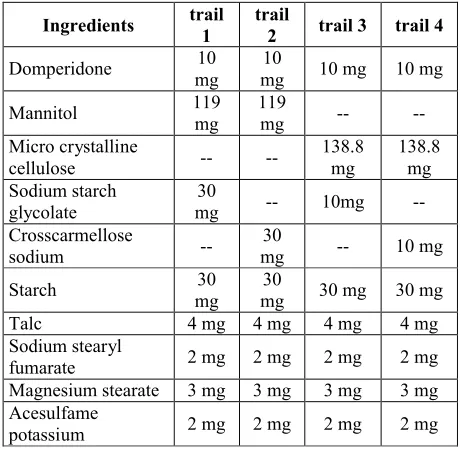
The orodispersible tablets were prepared by direct compression method according to formula given in Table 1. A total number of four formulations were prepared, For formulation F1, the required amount of Domperidone, SSG, starch, Mannitol, Aspartame potassium, starch, Mannitol, , sodium steryl fumerate , talc were taken in a stainless steel bowl and mixed thoroughly for 15 minutes Finally, lubrication was performed by adding magnesium stearate, and mixing for additional 5 minutes. The dry mixture was compressed The purpose of present study is to prepare fast dissolving tablets of domperidone by direct compression. To over come the problems such as difficulty in swallowing, inconvenience in administration during travelling, there is a need to develop fast dissolving tablets of domperidone as an anti emetic.. Domperidone is an anti emetic drug and is having dopamine receptor blocking activity. domperidone tablets were prepared by using different combinations of superdisintegrants and all tablets are evaluated for different tests like hardness test, friability test, wetting time , In vitro disintegration and In vitrodissolution studies. Tablets containing sodium starch glycolate and microcrystalline cellulose shows optimum results with disintegration time less than 20 sec and drug release was found to be 99 %.
Keywords:Domperidone, direct compression, fast dissolves tablets, sodium starch glycolate and micro crystalline cellulose.
ABSTRACT
B. Sujatha*
G. R. K. Mohan
M. Krishna Veni
P. Yanadaiah
B. Suman Kumar
Narayana Pharmacy College, Chinthareddy Palem,Nellore,
Andhra Pradesh
Journal of Global Trends in Pharmaceutical Sciences
Journal home page: www.jgtps.com
ISSN: 2230-7346
into tablets with a Rimek 8 station tablet press (B-tooling). In cases of formulation F2 drug, Mannitol, Croscarmellose sodium, talc, Acesulfame potassium, sodium starch glycolate , magnesium stearate, starch were mixed thoroughly in a stainless steel bowl for 10 minutes. The dry mixture was compressed into tablets. In formulation F3 and F4 drug, microcrystalline cellulose, starch, talc, Acesulfame potassium, sodium steryl fumerate , magnesium stearate, sodium starch glycolate with (minimum dose) were mixed , in formulation F4, instead of sodium starch glycolate , croscarmellose sodium were taken and mixed thoroughly and finally compressed into tablets.
Preparation of Domperidone fast dissolving tablets: All the materials were passed through 30# screens prior to mixing. The Prepared drug materials properly blended and mixed. Lubricate the blended mass with magnesium stearate for 5 minutes. The feeded matter was directly compressed into round tablets using on a rimek rotary tablet machine.
FORMULATION BATCHES:
Table 1: Formulation batches of Domperidone tablets
Ingredients trail 1 trail 2 trail 3 trail 4
Domperidone 10
mg
10
mg 10 mg 10 mg
Mannitol 119 mg 119 mg --
--Micro crystalline
cellulose -- -- 138.8 mg 138.8 mg Sodium starch
glycolate mg30 -- 10mg
--Crosscarmellose
sodium -- mg30 -- 10 mg
Starch 30
mg
30
mg 30 mg 30 mg
Talc 4 mg 4 mg 4 mg 4 mg
Sodium stearyl
fumarate 2 mg 2 mg 2 mg 2 mg
Magnesium stearate 3 mg 3 mg 3 mg 3 mg Acesulfame
potassium 2 mg 2 mg 2 mg 2 mg
COMPRESSION SPECIFICATIONS: Table 2: Compression specifications Description White rounded tablets
Tooling B Tooling
Hardness 4 Kg/cm2
Friability Not more than 1% Uniformity of Weight ± 7.5%
EVALUATION OF TABLETS: Pre compression parameters:
The overall objective of preformulation testing is to generate information useful to the formulation in
Preformulation parameters like bulk density, tapped density, and flow properties (Angle of repose, compressibility index, and hausner ratio etc were evaluated.)
Bulk density6:
Bulk density is the ratio of the weight of a powder to the volume it occupies. It is expressed as gm/ml.
Bulk density = W / Vo
Tapped density= W / VF
Angle of Repose7:
Angle of repose is defined as the maximum angle possible between the surface of a pile of the powder and the horizontal plane.
Φ = Tan-1h/r Compressibility Index7:
Compressibility is indirectly related to the relative flow rate, cohesiveness and particle size of a powder.
Compressibility index=T.D-B.D/T.D*100 Hausner ratio7:
It indicates the flow property of the powder and measured by the ratio of tapped density to bulk density.
Hausner ratio=T.D\B.D Post compression parameters: Size and shape:
The size and shape of tablets can be dimensionally described, monitored, and control. The compressed tablet’s shape and dimensions are determined by the tooling during compression process.
Thickness:
The thickness of a tablet was the only dimensional variable related to the process.10 tablets were measured for their thickness and diameter with vernier calipers. Average thickness and diameter were calculated.
Hardness8:
Tablet hardness has been defined as the force required breaking a tablet in a diametric compression test. To perform this test, there is a Tablet Hardness tester (Monsanto tester). The tablet is placed between two anvils, force is applied to the anvils and the crushing strength that just causes the tablet to break is recorded. Hardness is thus some times termed as the tablet crushing strength.
Friability8:
The friability of tablets is determined by friability apparatus (). 20 tablets were taken and weighed. After weighing the tablets were placed in the friabilator and subjected to the combined effects of abrasion and shock by utilizing a plastic chamber that revolves at 25 rpm for 4 minutes dropping the tablets from a distance of six inches with each revolution. After operation the tablets were de-dusted and reweighed. Friability is determined by
F=100 (1-W0/Wt)
Where, W0 = Wt of tablets before friability test. Wt = Wt of tablets after friability test.
In-vitrodisintegration test9:
37ºC ± 2ºC was used as a disintegration media and the time in seconds taken for complete disintegration of the tablet with no palable mass remaining in the apparatus was measured in seconds.
Wetting time9:
The wetting time of the tablets can be measured using a simple procedure. Five circular tissue papers of 10 cm diameter are placed in a petridish with a 10 cm diameter. A tablet is carefully placed on the surface of the tissue paper. The time required for water to reach upper surface of the tablet is noted as a wetting time.
In-vitroDissolution study: Dissolution parameters:
Medium : 0.1N Hydrochloric acid
Apparatus :Type -2 Paddle
RPM :50 rpm 45 min
Temperature :37+0.50C
Time intervals :0,5,10,20,30,45
Dissolution by :U.V Visible Spectroscopy
Results:
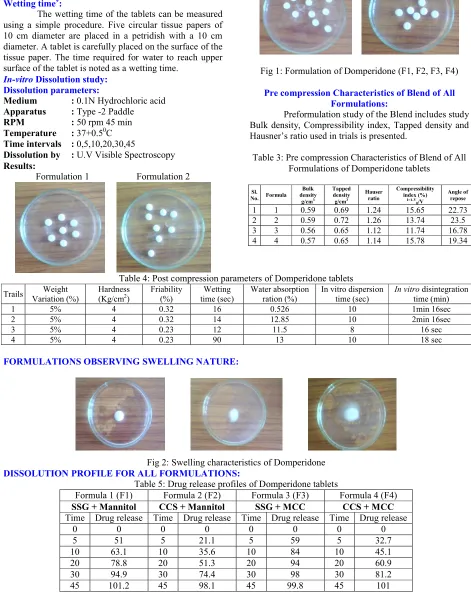
Formulation 1 Formulation 2
Formulation 3 Formulation 4
Fig 1: Formulation of Domperidone (F1, F2, F3, F4)
Pre compression Characteristics of Blend of All Formulations:
Preformulation study of the Blend includes study Bulk density, Compressibility index, Tapped density and Hausner’s ratio used in trials is presented.
Table 3: Pre compression Characteristics of Blend of All Formulations of Domperidone tablets
Sl.
No. Formula
Bulk density
g/cm3
Tapped density g/cm3
Hauser ratio
Compressibility index (%)
I=1-V 0/V
Angle of repose
1 1 0.59 0.69 1.24 15.65 22.73
2 2 0.59 0.72 1.26 13.74 23.5
3 3 0.56 0.65 1.12 11.74 16.78
4 4 0.57 0.65 1.14 15.78 19.34
Table 4: Post compression parameters of Domperidone tablets Trails Weight
Variation (%)
Hardness
(Kg/cm2) Friability (%) time (sec)Wetting Water absorption ration (%) In vitro dispersion time (sec) In vitrotime (min)disintegration
1 5% 4 0.32 16 0.526 10 1min 16sec
2 5% 4 0.32 14 12.85 10 2min 16sec
3 5% 4 0.23 12 11.5 8 16 sec
4 5% 4 0.23 90 13 10 18 sec
FORMULATIONS OBSERVING SWELLING NATURE:
Fig 2: Swelling characteristics of Domperidone DISSOLUTION PROFILE FOR ALL FORMULATIONS:
Table 5: Drug release profiles of Domperidone tablets
Formula 1 (F1) Formula 2 (F2) Formula 3 (F3) Formula 4 (F4)
SSG + Mannitol CCS + Mannitol SSG + MCC CCS + MCC
Time Drug release Time Drug release Time Drug release Time Drug release
0 0 0 0 0 0 0 0
5 51 5 21.1 5 59 5 32.7
10 63.1 10 35.6 10 84 10 45.1
20 78.8 20 51.3 20 94 20 60.9
30 94.9 30 74.4 30 98 30 81.2
Fig 3: Dissolution Profile for Domperidone with SSG- Sodium starch glycolate and Mannitol
Fig 4: Dissolution Profile of Domperidone with Crosscarmellose sodium and Mannitol
Fig 5: Dissolution Profile of Domperidone with Sodium starch glycolate and microcrystalline cellulose.
Fig 6: Dissolution Profile of Domperidone with CCS- Croscarmellose sodium, MCC- Micro crystalline cellulose
Fig 7: Comparative Dissolution Profile for Domperidone all batches
DISCUSSION
Direct compression method is used to manufacture tablets.
Organoleptic consideration:
The most important step of ODT formulations in terms of achieving patient compliance is the optimization of taste and mouth-feel. This becomes very important when dealing with bitter drugs like Domperidone. Aspartame potassium was used to provide sweetness and as to mask the bitter taste of the drug. Sugar based diluent, Mannitol, was used to further improve the taste. These sugar based diluents also provide the necessary bulk volume and physical properties of the tablet apart from imparting better mouth feeling to the patient. Particularly, Mannitol imparts multidimensional benefits as it has good aqueous solubility and good wetting properties facilitating tablet breakdown .micro crystalline cellulose also acts as disintegrant and aid in the disintegration of tablets.
Hardness and friability considerations:
As observed from Table 4, hardness value of tablets of all batches was found same .In case of friability all batches shows optimum value and formulation 3 shows friability value with in the limit. Tablets of formulations F1, F2, F3 and F4 gave satisfactory results in terms of hardness and friability and are indicative of sufficient mechanical strength which can withstand stresses of packaging, transportation and handling without adversely affecting the disintegration property.
Disintegration consideration:
Proper use of Super disintegrants plays a vital role in the successful development of orodispersible tablet formulations. In this study, the superdisintegrants sodium starch glycolate (SSG) and croscarmellose sodium were used to achieve fast disintegration property. Micro crystalline cellulose was also used as a disintegrating aid which helps to rupture the tablet quickly. The disintegrants principally affect the rate of disintegration and hence the dissolution. The optimization of disintegrant concentration is crucial since it has been observed that, below the optimum level, tablet disintegration time is inversely proportional to disintegrant concentration. Above the critical concentration level, disintegration time remains
approximately constant or even increases. Formulation 3 shows low disintegration profile compared to all other formulations.
Dissolution:
When compared the formulation 1 and 3, formulation 3 shows best release profile than 1. In formulation 3, MCC acts as diluent as well as disintegrant. So it acts as additive to SSG and accelerate the action of SSG. When compared the formulation 2 & 4, formulation 4 shows good release. Formulation 2 and 4 contains croscarmellose sodium acts as superdisintegrant. From 3 & 4, 3 shows best release profile than 4 with minimum dose. So SSG acts as good super disintegrant than CCS. MCC acts as best diluent for preparation of Domperidone fast dissolving tablets.
CONCLUSION
Orodispersible tablets of Domperidone were successfully prepared by direct compression which is the simplest and cost effective method of tablet manufacturing. The use of combination of excipients can be utilized effectively for optimizing the desirable features of ODTs, namely disintegration, hardness, friability, taste masking and mouth feel. Aspartame is used to eliminate its bitter taste. Formulations with super disintegrants and microcrystalline cellulose were showing lower disintegration time i.e. below 20sec and higher water absorption ratio and 99% drug release. Formulations containing combination of super disintegrants and Mannitol were showing higher disintegration timings, Final conclusion is formulations 3 showing excellent results i.e. lower disintegration, wetting timings and 99% drug release. The results of this preliminary study indicate that satisfactory orodispersible tablets of Domperidone can be effectively produced by simple formulation and manufacturing approaches.
REFERENCES:
1. Ghosh, T., Ghosh, A. and Prasad, D. A review on new generation orodispersible tablets and its future prospective. 2011; Int. J. Pharm. Pharm. Sci. 3, 1-7.
3. Chang R, Guo X, Burnside B and Couch R: A review of fast dissolving tablets. Pharm Tech North Am 2000; 12: 52-58.
4. Bi Y, Sunada H, Yonezawa Y, Danjo K and Iida K: Preparation and evaluation of compressed tablets rapidly disintegrating in the oral cavity. Chem Pharm Bull 1996; 44: 2121-2127.
5. Patel MM, Patel DM. Fast dissolving valdecoxib tablets containing solid dispersion of valdecoxib. Ind J Pharm Sci. 2006; 68 (2):222-226.
6. Panigrahi D, Baghel S, Mishra B. Mouth dissolving tablet: An overview of preparation techniques, evalution and patented technologies. Journal of pharmaceutical research. July 2005, vol.4, no.3: 33-38.
7. Kaushik D, Dureja H., Saini TR. Formulation and evaluation of olanzapine mouth dissolving tablet by effervescent formulation approach. Indian Drugs. 2004; 41: 410–412
8. Lachman L, Lieberman A and Kinig JL, The Theory and Practice of Industrial Pharmacy, 4th ed, Varghese Publishing House, Bombay, 1991, 67-68.
9. Battue SK, Repay MA, Maunder S and Rio MY, Formulation and evaluation of rapidly disintegrating tablet Fenoverine tablets: Effect of superdisintegrants, Drug Dev Ind Pharm, 2007, 33, 1225–1232.
How to cite this article:
B. Sujatha* G. R. K. Mohan M, Krishna veni , P. Yanadaiah , B. Suman kumar: Effect of superdisintegrants on release of Domperidone from fast dissolving Tablets 5(3): 1973-1978. (2014)