Available Online at www.ijpret.com
131
INTERNATIONAL JOURNAL OF PURE AND
APPLIED RESEARCH IN ENGINEERING AND
TECHNOLOGY
A PATH FOR HORIZING YOUR INNOVATIVE WORK
CRYOGENIC ENGINES
VIKAS B SINGH, AMIR A.K KHAN, PRASAD R PATIL, SHAIKH MD. ASHRAF MD. N
SE MECH Engg, GMVIT, Tala, Raigad.
Accepted Date: 27/02/2014 ; Published Date: 01/05/2014
\
Abstract: Cryogenic treatment is a material science and involves the process of reducing the temperature of component over an extended period of time to extreme cold levels, usually slightly below -250⁰C. The user of
vapour compression circuit is to provide pre-cooling emphasis the dependence of cryogenic cooling technology on refrigeration and the synergy between the two technologies. It is apparent that gas compression and reduction in temperature as a result of throttling are common to both systems. The differences are the thermodynamic properties of working fluid and temperature range of cycle. The significance of critical temperature is also apparent. In the vapour compression cycle shows all the processes occur below the critical temperature, as it typical for such cycles, and therefore condensation of the working fluid is possible simply by rejecting heat to a sink at lower temperature. A cryogenic engine is typical rocket engine designed to either escape Earth’s gravity to send probes into spaced or to lift satellites into orbit. They use liquid fuels that are cooled to very low temperatures and which would otherwise be in gaseous state at normal atmospheric pressure and temperature, such as hydrogen and oxygen. These fuels are utilized in one of two main designs to produce propellant force. Either the hydrogen is vaporized as the fuel and ignited by the oxidizer of oxygen to generate standard hot rocket thrust, or they are mixed to creatsuper hot stream that exits the engine nozzle and creates thrust.
Keywords: Rocket engine, Cryogenic technology, Cryogenic Temperature, liquid Hydrogen and Oxygen, Newton third law of Mechanics.
Corresponding Author: MR. VIKAS B SINGH
Access Online On:
www.ijpret.com
How to Cite This Article:
Vikas Singh, IJPRET, 2014; Volume 2 (9): 131-135
Available Online at www.ijpret.com
132
INTRODUCTION
Fig 1. Working model of Cryogenic Engine
“Cryogenic” stems from Greek and means “the production of freezing cold”; however the term is used as today as a synonym for the low temperature. It is not well defined at the point on this temperature scale refrigeration end and Cryogenics begins. Cryogenics typically involves a deep freezing process, usually one that takes object down below 240⁰F and changes molecular
alignment of the material structure. This change creates the new property. Cryogenic process has been researched and developed by universities and NASA since the mid sixties after NASA discovered that deep space exploration vehicles had improved their structural integrity due to extended exposure to Cryogenic temperature.
The terms Cryogenics, Cryobiology are frequently confused and given below:-
1. Cryogenics:-The branch of Physics and Engineering that involves the study of very low
temperatures, how to produce them, and how materials behave at those temperatures.
2. Cryobiology: - The branch of Biology involving the study of the effects of low temperatures
on organisms (most often for the purpose of achieving Cryopreservation).
2. Types of Cryogenic Treatment:-
1. Shallow Cryogenics, made the the objects to temperature of approximately 1200⁰F.
Available Online at www.ijpret.com
133
3. Deep Cryogenics Treatment, subjects to the temperature of approximately -3000⁰F.
2. MAIN BODY OF CRYOGENIC TECHNOLOGY:-
A Cryogenic technology is a process of involvement of including of usage of rocket propellants at Cryogenic temperature. It can be combination of liquid fuels such as:- Liquid –Oxygen (LOX), and liquid Hydrogen (LH2) as an oxidizer and fuel in the different mixtures of proportions. The
mixture of fuels offers the highest energy efficiency for the rocket engines that produces very high amount of thrust. Here, the Oxygen remains liquid only at the temperature below (-183⁰C)
and Hydrogen at below (-253⁰C) . This is a type of rocket engine that is functionally designed to
use the oxidizer which must be refrigerated in the liquid state. Sometimes, the liquid Nitrogen(LN2) is sometimes used as fuel because the exhaust is also Nitrogen. Liquid Oxygen is
injected below critical temperature but above critical pressure. In our atmosphere Nitrogen is nearly about 78%. Nitrogen is anon pollutant gas and during exhaust no other harmful gases are produced. Hence its efficiency is very high than any other Jet engines.
Fig 2.Part of Cryogenic Engine
PRODUCTION OF LOW TEMPERATURE:-
The following methods are involved to produce the low temperature in cryogenic:
1. Heat conduction :-When the two bodies are in contact, heat flows from the bodies at higher
temperature to the body with a lower temperature. Conduction can occur between any and all forms of matter, whether gas, liquid, or solid. It is essential in the production of cryogenic temperatures and environment.
2. Evaporative cooling:-humans are familiar with this process because it is a mechanism in
Available Online at www.ijpret.com
134
than the atoms and molecules in the liquid state. When we add heat energy to the particles in a liquid, it will become gaseous.
3. Joule-Thomson effect:-The Joule-Thomson effect is an important part of our lives today,
even though we may not aware of it. Ordinary house hold refrigeration and air conditioners operates onthis principle. First a gas is pressurized and cooled to an intermediate temperature by contact with a colder gas or liquid. Then the gas is expanded, and its temperature drops still further. The heat needed to keep this cycle operating comes from the inside of refrigerator or the interior or a room the interior of a room, producing the desired cooling effect.
3. WORKING:-
Cryogenic engine works on the principle of newton’s third law ‘Action and Reaction are equal and opposite in direction’. Rocket engine operates through force of its exhaust pushing it backwards.
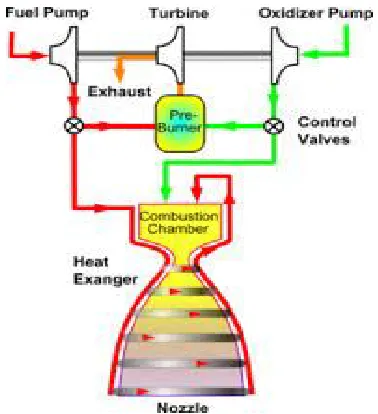
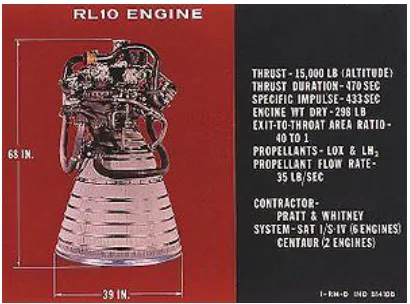
Figure shows that an RL-10 CRE which involves the staged combustion cycle for engine efficiency.
1. Gas generator:-It delivers sufficient amount of driver gas at designed temperature and
pressure which generates propellant supply of thrust chamber.
2. Turbo pumps:-They receive liquid propellant at low pressure from tanks and supply to
combustion chamber.
3. Thrust chamber:-Thrust is generating by conversion of chemical energy in to gases kinetic
energy. In this combustion liquid propellants in combustion chamber through the nozzles which are converging/diverging sections.
4. Nozzles:-The pressure generated in combustion chamber can be used to increase the thrust
by acceleration of combustion gas.
The Thrust equation of 1D- flows of ideal gas at constant pressure is:
F= mue+ (Pe - P∞) Ae
Where: Ue is exhaust gas value at exist area.
Available Online at www.ijpret.com
135
P∞ is ambient pressure.
4. ADVANTAGES:-
1. High Energy per unit mass:-
Propellants like oxygen and hydrogen in liquid form give very high amounts of energy per unit mass due to which the amount of fuel to be carried aboard the rockets decreases.
2. Clean Fuels:-
Hydrogen and oxygen are extremely clean fuels. When they combine, they give out only water. This water is thrown out of the nozzle in form of very hot vapour. Thus the rocket is nothing but a high burning steam engine
3. Economical:-
Use of oxygen and hydrogen as fuels is very economical, as liquid oxygen costs less than gasoline.
5. CONCLUSION:-
We can conclude that as per the Newton’s third law of mechanism: Action and Reaction are equal and opposite in direction and magnitude. The thrust produced in rocket engine is outward and that in the jet engine is inwards. Hence, the efficiency of the cryogenic rocket engine is greater than the jet engine and it is very much economical by the use of liquid hydrogen and oxygen as a fuel and oxygen
REFERENCES:-
1. Cryogenic Technology Development for Exploration Missions by David J. Chato
2. Current leads for use in Cryogenic devices, principle of designs and formulae for calculations by Yu. L. Buyanov
3. Challenges in Cryogen Development Present & the future by N K Gupta