Organized by C.O.E.T, Akola, ISTE, New Delhi & IWWA. Available Online at www.ijpret.com449
INTERNATIONAL JOURNAL OF PURE AND
APPLIED RESEARCH IN ENGINEERING AND
TECHNOLOGY
A PATH FOR HORIZING YOUR INNOVATIVE WORK
EFFECT ON FLEXURAL STRENGTH OF FLY ASH BASED GEOPOLYMER CONCRETE
BY USING OVEN HEAT CURING
PROF. PRADNYA K. JAMDADE, PROF. KASHINATH N. ZAMARE
Assistant Professor, Dept. of Civil, Pravara Rural Engineering College, Loni (Ahmednagar), MS, India
Accepted Date: 07/09/2016; Published Date: 24/09/2016
Abstract: Around 120 million tone of fly ash get accumulated every year at the thermal power stations in India. Similarly aggregate crusher units produce enormous quantities of stone dust, a waste product, produced during crushing of rubble. Due to scarcity of land disposal becomes a serious problem. Because of the growing concern with environmental issues and increasing interest in conservation of energy and resources, every country has to face the challenging problem that how to use or dispose this by-product within the framework of its economic structure. Due to this the fly ash is used as ingredients in concrete which enhance the properties of concrete and utilization of fly ash is helpful for consumption. In this study the alkaline solution of sodium silicate and sodium hydroxide is mixed with processed fly ash to become geopolymer concrete. This concrete is cured at different condition and different temperature so as to increase the strength of concrete.
Keywords: Geopolymer Concrete, Processed Fly ash.
Corresponding Author:PROF. PRADNYA K. JAMDADE
Co Author: PROF. KASHINATH N. ZAMARE
Access Online On:
www.ijpret.com
How to Cite This Article:
Pradnya K. Jamdade, IJPRET, 2016; Volume 5 (2): 449-455 PAPER-QR CODE
SPECIAL ISSUE FOR
INTERNATIONAL CONFERENCE ON
“INNOVATIONS IN SCIENCE & TECHNOLOGY:
Organized by C.O.E.T, Akola, ISTE, New Delhi & IWWA. Available Online at www.ijpret.com450
INTRODUCTION
Geopolymer concrete is a new technique in which cement is totally replaced by pozzolanic material like fly ash which is rich in silicon and aluminum and activated by alkaline solutions. The demand of concrete is increased day by day all over the world to complete the need of development of infrastructure facilities. Almost all of this concrete is currently made using OPC, leading to a massive global cement industry. Every year the production of Portland cement is increasing with the increasing demand of construction. Therefore the rate of production of carbon dioxide released to the atmosphere is also increasing. Each ton of Portland cement releases a ton of carbon dioxide into the atmosphere. The greenhouse gas emission from the production of Portland cement is about 1.35 billion tons annually, which is about 7% of the total greenhouse gas emission. Therefore, it is necessary to find alternatives to make the concrete more environment friendly.
II. FINALIZATION OF PARAMETER
Following parameters were fixed on the basis of various trial mix test conducted by various Authors: [5,7,9,10,11,12]
Fixed Parameter:
Percentage replacement of cement by fly ash: 100%
Sodium Silicate to Sodium Hydroxide Solution: 2.5
Solution to Fly ash ratio: 0.61
Type of curing: Oven heat curing
Variable Parameter:
Temperature: 60°C, 90°C, 120°C and Duration of Curing: 6,12,18,24 hours.
III. SYSTEM DEVELOPMENT
Organized by C.O.E.T, Akola, ISTE, New Delhi & IWWA. Available Online at www.ijpret.com451 make the solution. For preparing 15M solution of Sodium Hydroxide in one liter solution the following steps to be adopted.
For preparation of 1M solution 40 gms sodium hydroxide pellets which is in solid form were dissolved in 1 liter water. Where 40 is the molecular weight of NaOH . The heat evaluation rate is so high at the time of mixing pellets into water. Due to Sodium hydroxide solution was prepared one day prior to the casting of concrete cubes to avoid any pollution during the mixing of constituents of geopolymer concrete. Similarly, we prepare 15 M solution for geopolymer concrete by adding 15 X 40 = 600 gms sodium pellets then we get 15 M one liter sodium hydroxide solution. Then all constituents of concrete were thoroughly mixed in concrete mixer. Then, required quantity of Sodium Hydroxide and sodium silicate solution with appropriate proportion was added and mixed until homogeneous mix was formed. After making the homogeneous mix, workability test by slump cone and compaction factor is carried out. Then, beams of size 100 mm X 100 mm X 500 mm were supported symmetrically over a span of 400mm in the machine in such a manner at the load is applied to the upper most surface as cast in the mold. . Then after demoulding of beams, all the specimens were cured in
oven at 600C, 900C and 1200C for 6, 12, 18 and 24 hours duration. All beams are tested under
two-point loading in Universal Testing Machine. The load as increased until the specimen failed and the failure load is recorded All tests were conducted according to Indian standard code procedure. The compressive strength and split tensile strength test results are tabulated and discussed in details and some important conclusions are made.
IV. RESULT AND DISCUSSION
Sr. No. Temperature (0C) Curing Time (Hrs) Avg. Flexural Strength
(N/mm2)
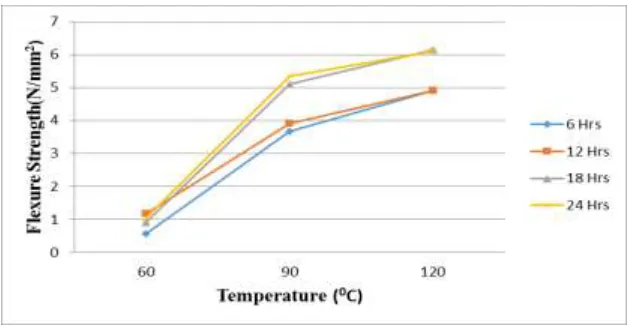
1 600C 6 0.57
12 1.17
18 0.91
24 1.05
2 900C 6 3.67
Organized by C.O.E.T, Akola, ISTE, New Delhi & IWWA. Available Online at www.ijpret.com452
18 5.10
24 5.35
3 1200C 6 4.90
12 4.91
18 6.15
24 6.10
Table No. 1 Effect of duration of curing in oven on Flexural Strength
For processed fly ash at 60°C, 90°C and 120°C.
Organized by C.O.E.T, Akola, ISTE, New Delhi & IWWA. Available Online at www.ijpret.com453
Failure pattern of Geopolymer concrete beam in universal testing machine
Graph 1. Show the effect of temperature on flexural strength of Geopolymer concrete at various temperature conditions like 60°C, 90°C and 120°C. The flexure strength results for geopolymer concrete are shown in Table 1. From graph it is observed that the general behavior of graph for 90°C temperature it will move upward till for the 24 hours. In case of 120°C temperature the strength will increases up to 18 hours then strength will decreases due to
overheating of geopolymer concrete. Therefore after the 1200C the temperature for
geopolymer concrete will not be useful. That is the behavior of 120°C graph shows that the overheating reduces the strength.
V. CONCLUSION
1. The rate of gain of strength is slow at 60°C but high at 120°C.
2. The flexure strength beyond 1200C is not significant for 24 hours of curing but it is
significant at 18 hrs of curing time.
3. The rate of gain of flexure strength for 600C is not satisfactory at 6, 12, 18 and 24hrs of curing time.
4. The optimum strength achieved at 900C in between 18 to 24hrs duration.
5. Variation in curing time as well as in temperature plays important role for polymerization in
geopolymer concrete.
6. Longer curing time improved the polymerization process resulting in higher compressive
strength of Geopolymer concrete.
7. Curing temperature and its duration are also important in the activation of geopolymer
concrete.
8. Geopolymer concrete is more environmental friendly.
Organized by C.O.E.T, Akola, ISTE, New Delhi & IWWA. Available Online at www.ijpret.com454
REFERENCES
1. B. V. Rangan “Mix Design and Production of Fly ash based geopolymer Concrete” Indian
Concrete Journal, 2008.
2. Binod Kumar; G. K. Tike; and P. K. Nanda “Evaluation of Properties of High-Volume Fly-Ash
Concrete for Pavements” Journal of Materials in Civil Engineering, ASCE Vol. 19, No. 10, October 1, 2007.
3. D. Hardjito, S.E. Wallah, D.M.J. Sumajouw, and B.V. Rangan “Properties of Geopolymer
Concrete with Fly Ash as Source Material: Effect of Mixture Composition”, the Seventh CANMET/ACI International Conference on Recent Advances in Concrete Technology, May 26-29, 2004, Las Vegas, USA.
4. Prabir K. Sarker , RashedulHaque, Karamchand V. Ramgolam “Fracture behaviour of heat
cured fly ash based geopolymer concrete” Journal of Elsevier 11 August 2012.
5. R. Anuradha, v. sreevidya, r. venktasubramani and B. V Rangan “Modified guidelines for
geopolymer concrete mix design using Indian Standards” Asian Journal of Civil Engineering, Vol 13 No 3, 2012, page 353-364.
6. S. E. Wallah and b. V. Rangan “low-calcium fly ash-based geopolymer concrete: long-term
properties”, Research Report GC 2 Faculty of Engineering Curtin University of Technology Perth, Australia 2006.
7. Subhash v. Patankar, Sanjay s. Jamkar, Yuwarajm. Ghugal, “Effect of fly ash fineness on
workability and compressive strength of geopolymer concrete” The Indian Concrete Journal, April 2013.
8. Subhash v. Patankar, Sanjay s. Jamkar, Yuwaraj m. Ghugal, “Effect of Water-to- Geopolymer
Binder Ratio on the Production of Fly ash Based Geopolymer Concrete” International Conference on Recent Trends in engineering Technology - 2013(ICRTET2013) Organized By: SNJB's Late Sau. K. B. Jain College of Engineering, Chandwad.
9. Subhash v. Patankar, Sanjay s. Jamkar, Yuwaraj m. Ghugal, “effect of water-to-geopolymer
binder ratio on the production of fly ash based geopolymer concrete” international journal of advanced technology in civil engineering, issn: 2231 –5721, volume-2, issue-1, 2013.
10. Subhash V. Patankar, Yuwaraj M. Ghugal, Sanjay S. Jamkar “Selection of Suitable Quantity
Organized by C.O.E.T, Akola, ISTE, New Delhi & IWWA. Available Online at www.ijpret.com455 Proceedings of 3rd International Conference on Recent Trends in Engineering & Technology (ICRTET’2014).
11. Subhash v. Patankar, yuwaraj m. Ghugal, sanjay s. Jamkar “effect of grading of fine
aggregate on flow and compressive strength of geopolymer concrete” ukieri concrete congress in concrete construction.
12. Sunilaa George, Dr.R.Thenmozhi “Flexural Behaviour of Activated Fly Ash Concrete”