Available Online at www.ijpret.com 59
INTERNATIONAL JOURNAL OF PURE AND
APPLIED RESEARCH IN ENGINEERING AND
TECHNOLOGY
A PATH FOR HORIZING YOUR INNOVATIVE WORK
FAILURE ANALYSIS AND PERFORMANCE EVALUATION OF THE SOLAR
PANEL FRAME
INGALE JA1, PATIL VH2, PATIL AA3
1. P. G. Student, GF’s Godavari C. O. E. Jalgaon, India
2. HOD, Mechanical Engineering Department, GF’s Godavari C. O. E. Jalgaon, India. 3. Asst. Prof. Mechanical Engineering Department, GF’s Godavari C. O. E. Jalgaon, India
Accepted Date: 29/07/2014; Published Date: 01/08/2014
\
Abstract: Thermal effects on frame structures of solar panels exposed to solar radiation
are significant and complicated. The temperature variation within a year may result in damage in frame structures with covering glass considering the solar radiation. The temperature distribution of solar panel was investigated through a systematic thermal analysis in ANSYS for different kind of materials like Aluminum Alloy, Mullite, and Nickel Cromium Aluminate with same ambient temperature. Furthermore, a parametric study was conducted to investigate the influence of various solar radiation parameters and orientation of solar panel on the temperature distribution under solar radiation. Find out all the conditions which resulted by different materials then the methodology developed is allowed to evaluate the most suitable material for solar panel frame assembly which gives good performance and to avoid possible structural damages on photovoltaic cells.
Keywords: Evaluation, Solar Panel Frame, failure analysis, Force analysis and Thermal
Deformation
Corresponding Author: Mr. JITESH A. INGALE
Access Online On:
www.ijpret.com
How to Cite This Article:
Ingale JA, Patil VH, Patil AA; IJPRET, 2014; Volume 2 (12): 59-70
Available Online at www.ijpret.com 60
INTRODUCTION
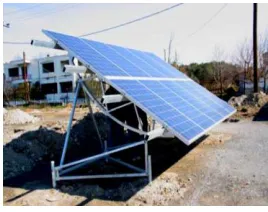
Now a day the demand for clean, renewable energy sources is increasing. With the gradual depletion of fossil fuels in our planet, the application of solar energy becomes very popular currently in the world. A wide variety of design solutions is suggested so as to achieve maximum efficiency. In order to collect solar power effectively, it is necessary to use large areas of solar panels properly aligned to the sun. Solar energy can be directly utilized through a variety of devices such as solar collectors or photovoltaic cells as shown in figure 1.1.
Figure 1.1: Arrangement 1 of Solar Panel Set Up
Photovoltaic or solar panels that produce electricity are affected by their operating temperature, which are primarily a product of the ambient air temperature as well as the level of sunlight. While the length and strength of sunlight received are more important factors in a solar panel's power production efficiency, temperature and other environmental factors can reduce efficiency and lower the solar panel's energy output.
In a ground installation a frame is built for your solar cells that tilts them up to an optimal angle (usually 30 degrees) and faces the correct way. The frame can be built out of galvanized steel or aluminum, and is attached to the ground via a concrete foundation. In many cases the frame will be a rigid half a frame like structure.
Available Online at www.ijpret.com 61
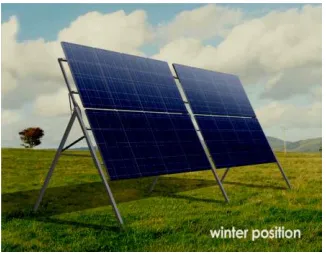
Where achieving the maximum possible efficiency is an aim (such as in commercial or very large installations) it is possible to have half a-frames that are manually tilt adjustable, so that in winter when the sun is lower in the sky the cells can be tilted up for greater exposure. The seasonadjustable PV mount is believed to provide as much as a 25% increase in yield from solar panels in comparison to fixed frames. Adjusting the angle of solar panels during the year ensures that the panels maintain a better alignment with the sun. The frame has three fixed positions that the panels can be locked into a winter position which is shown in figure 1.3.
Figure 1.3: An Adjustable Tilt Ground Mounted Solar PV Frame
This perpendicular alignment to the sun allows the panels to see an increased yield of 15% in the winter months and 25% in the summer months in comparison to fixed mounting frames. The mounting frames are extremely flexible. They can facilitate any number of PV panels that are required. The standard arrangements are in sets of 8 panels, so you can have 8, 16, 24, 32 or 40 panels in one continuous row. Each time you increase by another set of 8 you only require one additional frame and standing and not a complete new set. These halves the installation time required in preparing new foundations as well as reducing materials.
Available Online at www.ijpret.com 62
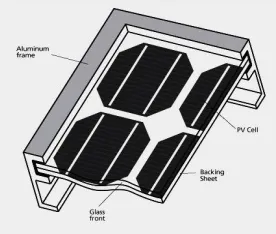
Figure 1.4: A Small Part of a Module with Cells
1.3 Objective of Dissertation
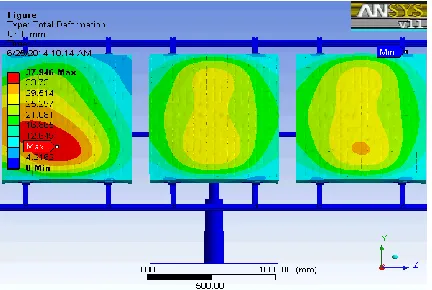
Decay of solar panels frame depends not only on chemical action of pollution and atmospheric agents, but also on thermal stress caused by solar radiation. Solar panels are subjected to thermal stress due to solar radiation as shown in figure 1.7, variable on different points of the module, which produces a particular deformation state.
Figure 1.5: Typical Structure of Solar Array with Frame
Available Online at www.ijpret.com 63
Figure 1.6: Damaged View of Covering Glass
To overcome this problem a parametric study is conducted to investigate the influence of various solar radiation parameters and orientation of solar panel on the temperature distribution under solar radiation.Find out all the conditions which resulted by different materials then the methodology developed is allowed to evaluate the most suitable material for solar panel frame assembly which gives good performance and to avoid possible structural damages on photovoltaic cells.
2.0 LITERATURE SURVEY
To understand the background of the dissertation, research papers dealing with the thermal analysis and force analysis of the solar panel have been studied. Some of the research papers reviews are given below
Available Online at www.ijpret.com 64
designed to take rotational loads for 90° for safe operation. So the design should consider the loads coming on the structure for 90° rotation along with inertia effect of the rotating members. The mechanism should withstand the aerodynamic loads, inertia loads and rotation loads along with friction loads. The design should consider aerodynamic factors for load calculations and design should satisfy all the functional requirements.
Buratti C. and Goretti M. [2005], [2] studied the experimental evaluation and mapping of the deformations induced by thermal stress on photovoltaic panels. The aim of author is to evaluate deformation state due to temperature on photovoltaic modules surface. Laboratory measurements were carried out employing single grid strain gauges, in order to determine stress in significant points of four different samples subjected to temperature variations. Experimental data were used to draw thermal expansion maps, to predict the highest stress values, according to materials and assembling. Finally results were analyzed and compared, in order to characterize the performances expected from photovoltaic panels and to prevent cell breaking.
Available Online at www.ijpret.com 65
3.0 Aluminum Alloy Results
Figure 3.1: Maximum Temperature Result for Aluminium Alloy
Figure 3.2: Total Heat Flux for Aluminium Alloy
Available Online at www.ijpret.com 66
Figure 3.4: Maximum Shear Stress induced in Aluminium Alloy
3.1 Mullite Results
Figure 3.5: Maximum Temperature Result for Mullite
Available Online at www.ijpret.com 67
Figure 3.7: Total Deformation induced in Mullite
4.0 RESULTS AND DISCUSSION
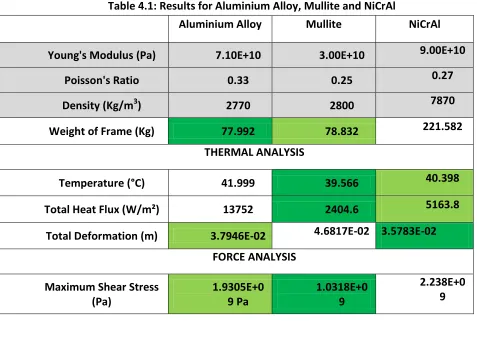
The results obtained from the above Finite Element Analysis of aluminum alloy, mullite and NiCrAl is collected and makes it in tabulated form. These Result table is shown in below. The dark green color shows best result and light green color shows better results.
Table 4.1: Results for Aluminium Alloy, Mullite and NiCrAl
Aluminium Alloy Mullite NiCrAl
Young's Modulus (Pa) 7.10E+10 3.00E+10 9.00E+10
Poisson's Ratio 0.33 0.25 0.27
Density (Kg/m3) 2770 2800 7870
Weight of Frame (Kg) 77.992 78.832 221.582
THERMAL ANALYSIS
Temperature (°C) 41.999 39.566 40.398
Total Heat Flux (W/m²) 13752 2404.6 5163.8
Total Deformation (m) 3.7946E-02 4.6817E-02 3.5783E-02
FORCE ANALYSIS
Maximum Shear Stress (Pa)
1.9305E+0 9 Pa
1.0318E+0 9
Available Online at www.ijpret.com 68
5.0 Graphical Results
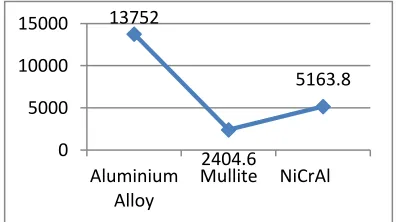
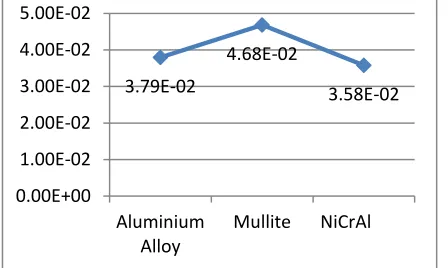
From the above calculated values of each material for different properties which is shown in above tables, the graphs are plotted. On X axis by taking All three materials and on Y axis each property is taken. The resulted graphs are shown below for each property
Figure 5.1: Materials vs. Weight of Frame (Kg)
Figure 5.2: Materials vs. Temperature (°C)
Figure 5.3: Materials vs. Total Heat Flux (W/m2) 77.992 78.832 221.58 2 0 50 100 150 200 250 Aluminium Alloy
Mullite NiCrAl
41.999 39.566 40.398 38 39 40 41 42 43 Aluminium Alloy
Mullite NiCrAl
13752 2404.6 5163.8 0 5000 10000 15000 Aluminium Alloy
Available Online at www.ijpret.com 69
Figure 5.4: Materials vs. Total Deformation (m)
Figure 5.5: Materials vs. Maximum Shear Stress (Pa)
From the above tabulated result sheets and graphs, the mullite is 3 times best, 1 time better, Nickel Chromium Aluminate is 1 time best, 2 times better and Aluminum Alloy is 1 time best, 2 times better in all conditions. So the mullite is best material for solar panel frame assembly which gives best results.
6.0 CONCLUSION
Photovoltaic panels are subjected to thermal stress due to solar radiation, variable on different points of the module, which produces a particular deformation state. Thermal expansion may have negative consequences for the cells, according to materials assembling. Evaluation of deformations induced by thermal stress on the panel front side, directly exposed to the sun in working conditions was carried out with the help of ANSYS for different kind of materials like aluminium alloy, mullite, and nickel chromium aluminate with same ambient temperature. The methodology developed is allowed to evaluate the most suitable material for solar panel frame assembly which gives good performance and to avoid possible structural damages on photovoltaic cells. 3.79E-02 4.68E-02 3.58E-02 0.00E+00 1.00E-02 2.00E-02 3.00E-02 4.00E-02 5.00E-02 Aluminium Alloy
Mullite NiCrAl
1.93E+0 9 1.03E+0 9 2.24E+0 9 0.00E+00 5.00E+08 1.00E+09 1.50E+09 2.00E+09 2.50E+09 Aluminium Alloy
Available Online at www.ijpret.com 70
Analysis result showed that for weight, maximum temperatures, total heat flux, total deformations and maximum shear stress the mullite is 3 times best, 1 time better, Nickel Chromium Aluminate is 1 time best, 2 times better and Aluminium Alloy is 1 time best, 2 times betterin all conditions which is shown in result table by dark green and light green color. From this I concluded that the best material for solar panel frame assembly is mullite which gives best performance as compared to other materials.
7.0 REFERENCES
1. Ravindra Naik, Vinayakumar B. Melmari, Adarsh Adeppa. “Analysis and Optimization Solar Panel Supporting Structures Using F.E.M” International Journal of Engineering and Innovative Technology (IJEIT) Volume 2, Issue 7, ISSN: 2277-3754, January 2013.
2. Buratti C. and Goretti M. “Experimental Evaluation and Mapping of the deformations induced by thermal stress on Photovoltaic Panels”, 4th International conference on heat transfer, fluid mechanics and thermodynamics, Cairo, Egypt. HEFAT2005, Paper number: BC4.
3. Hongbo Liu, Zhihua Chen and Ting Zhou “Theoretical and experimental study on the temperature distribution of H- shaped steel members under solar radiation”, Journal of Applied Thermal Engineering 37 (2012) pp. 329-335.
4. Xiaoyan Wang, Hongbin Geng, Shiyu He, Y.O. Pokhyl, K.V. Koval “Effect of thermal expansion coefficient on the stress distribution in solar panel”, International journal of Adhesion and adhesives 27 (2007) pp. 288-297.
5. Chih-Kuang Lin, Chen-Yu Dai, Jiunn-Chi Wu “Analysis of structural deformation and deformation-induced solar radiation misalignment in a tracking photovoltaic system”, Journal of Renewable Energy 59 (2013) pp. 65-74.
6. E. L. Kruger, M. Adriazola, A. Matoski, S. lwakiri “Thermal analysis of wood-cement panels: Heat flux and indoor temperature measurement in test cells”, Journal of Construction and Building Materials 23 (2009) pp. 2299-2305.
7. Junlan Li, Shaoze Yan, Renyu Cai “Thermal analysis of composite solar array subjected to space heat flux” Journal of Aerospace Science and Technology 27 (2013) pp. 84–94.