Development of an automatic chili drying controller based on
computer vision
Kiattisin Kanjanawanishkul
1*, Lamul Wiset
2, Nattapol Poomsa-ad
3,
Siwanut Sreelohor
1(1. Mechatronics Research Unit, Faculty of Engineering, Mahasarakham University, Maha Sarakham 44150, Thailand; 2. Postharvest Technology and Agricultural Machinery Research Unit, Faculty of Engineering, Mahasarakham University,
Maha Sarakham 44150, Thailand;
3. Drying Technology for Agricultural Products Research Unit, Faculty of Engineering, Mahasarakham University, Maha Sarakham 44150, Thailand)
Abstract: Color of dried chilies is one of the most key factors that influences consumers’ preference. It is mainly affected by the drying process. Traditionally, drying temperature is fixed during the drying process without regard to the quality of chilies being dried. Thus, the aim of this research is to develop a controller for the chili drying process that determines the drying temperature according to the change of chili color. To measure the chili color, we built a hot air tray dryer incorporated with a computer vision system which measures the chili color during drying. We converted the RGB color model to the L*a*b* color model and calculated the change of the a* component (Δa). If Δa within15 minutes was less than 2, then, the drying temperature was set to 90°C for ten minutes and set back to 80°C, otherwise, it was set to 80°C. The experimental results showed that the drying time was shortened, compared to the 80°C drying temperature. The color of dried chilies was improved, compared to the 90°C drying temperature.
Keywords: dried chili color, image processing, drying control, closed-loop control
Citation: Kanjanawanishkul, K., L. Wiset, N. Poomsa-ad, and S. Sreelohor. 2019. Development of an automatic chili drying controller based on computer vision. Agricultural Engineering International: CIGR Journal, 21(2): 143–148.
1 Introduction
Drying is one of the most popular food preservation
methods and it is value-added to agricultural products.
The drying process is related to the moisture reduction in
food which reduces the risk that micro-organisms will
grow. Furthermore, it also stops the enzyme action or
retard the chemical and bio-chemical reaction which
incorporates with water, resulting in spoiled food.
Furthermore, the drying process reduces the weight and
the volume of the product, resulting in reduction of
Received date: 2018-06-19 Accepted date: 2018-11-01
*Corresponding author: Kiattisin Kanjanawanishkul, assistant professor, Mechatronics Research Unit, Faculty of Engineering, Mahasarakham University, Kantharawichai, Maha Sarakham, 44150, Thailand. Tel: +66-4375-4316. Email: Kiattisin.k@ msu.ac.th.
expense used for transport and store. In some special
cases, drying leads to the by-products, e.g., easier
consuming and better tastes.
The drying process is a complicated process since it is
related to heat and mass transfer. During drying, products
are changed in physical and chemical properties in a
desired and undesired ways. In particular, dehydration
and heat exposure during drying lead to the dramatic
change of cell structure. The phenomenon creates the
change in physical properties (e.g., shape and volume)
and change in color and texture of the product. The
change affects the preference of the consumers.
The drying process with high efficiency has to take
the food quality after drying into account. The main
quality indexes of dried food include rehydration,
nutritional values, color, smell, taste, shape, etc.
operators. In general, a number of factors that affect the
quality of products during drying are manipulated
variables. For example, manipulated variables of the hot
air tray dryer are the drying temperature, flow rate of hot
air. If these values are set improperly, the quality of
drying food may be worse dramatically. Thus, to maintain
the best quality and to reduce the drying cost, researchers
of the drying research community focus on experiments
that find the optimal settings of those variables for such
products. After that, these drying settings will be constant
throughout the drying process. The idea of this scheme is
called “open-loop control”. Obviously, the final product
quality is not guaranteed because characteristics and
conditions of products during drying are not measured;
thus, preset variable values may not be optimal any
longer for the current conditions of the products. Besides,
variable adjustments on the fly based on the current
conditions of the product can also reduce the energy
consumption of the drying process. For example,
moisture contents in the fresh products are initially rather
high. The energy requirements are high. When the drying
process is running for a while, the moisture contents of
the product decrease. If the open-loop drying controller is
adopted, the energy applying to the process cannot be
adjusted freely. On the other hand, the energy
requirements, when the closed-loop controller is
implemented, can be changed according to the current
conditions of the product. That is, the change of the
moisture contents decreases, the energy requirements can
also decrease.
As mentioned above, to reduce the drying cost and
increase the quality of the dried products, a closed-loop
control scheme is an interesting and challenging idea. In
the literature, a closed-loop controller for the drying
process is still very rare. For example, Dufour et al.
(2004) developed a model predictive control for the
infrared drying process. During drying, the controller
evaluated the optimal control output with given drying
constraints. Abdel-Jabbar et al. (2005) designed a state
observer to estimate the moisture content online for
drying quality control. They also developed a linear
model to describe drying behaviors in the fluidized bed
dryer. Martynenko and Yang (2007) developed an
intelligent control system for ginseng drying. They
proposed a neural network model using color and texture
of ginseng to estimate the moisture content of ginseng.
The drying temperature was changed according to the
estimated moisture content. Han et al. (2012) proposed a
model predictive control for cereal drying considering
drying constraints into account.
One of the main problems concerning this technique
is how to measure the product quality online. The
common solution is to use computer vision. The
computer vision has been employed in a variety of food
and agricultural research (Davies, 2009). For example,
Hatamipour and Mowla (2002) studied the shrinkage of
carrot during drying in an inert medium fluidized bed
dryer. Ebrahimi et al. (2012) employed image processing
techniques to measure the shape change of banana slice
during drying. Khazaei et al. (2013) proposed a method
based on the computer vision to evaluate the dried grape.
They addressed the shrinkage and quality during drying.
Di Scala et al. (2013) studied the effect of drying
conditions to color, water holding capacity, and the
amount of phenolic of apples. Huang et al. (2014)
developed a regression model to estimate the color and
moisture content of soybean during drying using a
hyperspectral imaging technique. Amjad et al. (2015)
assessed the effect of drying temperature homogeneity on
color and shrinkage of potato slices by analyzing the
captured images.
In our work, a computer vision system with an image
processing algorithm is adopted to extract the quality
information from the image of the chilies being dried.
The controller takes this information to adjust the control
input of the temperature controller. When the control
input is changed, the manipulated variable of the dryer is
also changed, resulting in change in chili properties.
Based on this idea, the control input can be optimized to
maintain the acceptable quality of the dried chilies, and to
reduce the drying cost and the drying time.
The rest of the paper is structured as follows: in
Section 2, the characteristics of the chilies were
investigated before the experiment. Then, the tray dryer
with the proposed two-loop control law was explained in
Finally, we concluded in Section 4.
2 Materials and methods
2.1 Characteristics of raw material
Freshly harvested chilies (Capsicum annuum c.v.
Jinda) were purchased from a local market in Maha
Sarakham province. Fully ripened chilies were purely red.
They were cleaned, packed in plastic bags and stored in a
refrigerator at 13°C for 2-3 days before the experiment.
2.2 The proposed drying control
Conventionally, sun drying is a cheap way to produce
dried chilies. Chilies are exposed directly to sunlight.
However, the sun drying method takes 3-5 days
(depending on weather conditions) to get the desired
moisture content (less than 13%wb). To reduce the drying
time, one of the most common dryers is the hot air tray
dryer, since it is not costly and it is simple.
In this work, we propose a novel control scheme
consisting of two control loops as shown in Figure 1. The
inner loop is the conventional temperature control, while
the outer loop is the quality control loop. For the inner
control loop, the temperature of the dryer was controlled
by a proportional-integral-derivative (PID) temperature
controller with silicon controlled rectifier (SCR) outputs
being able to adjust the voltage output. The drying air
was heated using an electric 5-kW heater. The
temperature of the chamber was measured by a
thermocouple type k. The air was flown to the drying
chamber using a blower with a 1/2 HP induction motor.
We built it with a drying chamber of 50×50×48 cm. The
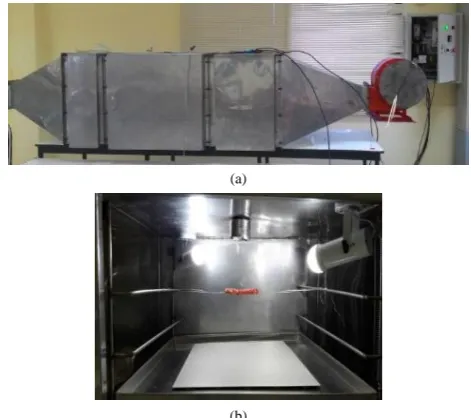
tray dryer fully functioned is shown in Figure 2(a).
Figure 1 Diagram of two control loops for the drying process For the outer control loop, the CMOS camera (Basler
acA2400-14gm) with 6 mm lens was mounted on the top
of the drying chamber to capture the image of chilies
being dried. The lighting source consisted of two 7-Watt
LED bulbs (see Figure 2(b)). The image processing
algorithm was proposed to extract the quality information
from the image. In this work, the quality information was
the color change of the chilies. The outer controller
determined the drying temperature of the dryer
automatically using this information. Then, the drying
temperature was sent to the inner loop.
(a)
(b)
Figure 2 (a) The fully functioned dryer (b) camera and lighting sources
Conventionally, to monitor the quality of the product
being dried, a sampling method is adopted. That is the
product is taken out of the drying chamber to be
measured outside the dryer. In general, moisture contents,
color and chemical properties are measured using
laboratory instruments. Apparently, the sampling method
is not practical and intervenes the drying process. On the
other hand, in this work, computer vision has been used
in the outer loop control to replace human inspectors.
This technique is less time consuming and is
non-destructive. It is also able to monitor the whole area
of the products continuously. To implement the outer
loop with the computer vision system, we used a
Raspberry Pi single board computer for the whole drying
process control. We installed the OpenCV library for
image processing, the Pylon Library for camera interface,
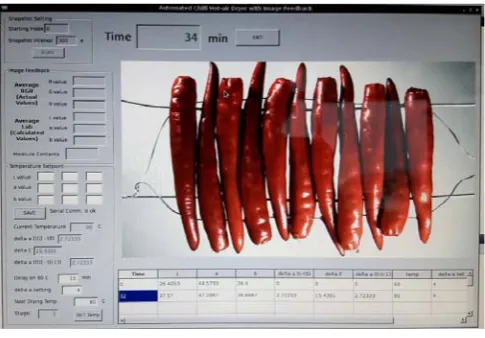
and the Qt framework for user interface as shown in
Figure 3. The user interface program can control the dryer
manually and automatically. Also, it can record the
required information into the database, e.g., time, color
values. It captures an image from the camera and
processes the image based on the following image
processing algorithm:
interest out of the original image;
(2) Extract the chili region from the background using
the Otsu’s method;
(3) Find the average RGB values of the chili region;
(4) Convert the average RGB color model to the
L*a*b* color model;
(5) Calculate the change of the average a* component
between two sampling time intervals.
Figure 3 User interface for our proposed drying control As mentioned above, a few research projects address
the drying controller. Thus, we proposed the following
drying control scheme consisting of two control loops:
(1) Set the drying temperature to 90°C;
(2) Capture the image of chilies being dried in the
chamber;
(3) Process the image based on the given image
processing algorithm;
(4) Calculate the change of the a* component (Δa);
(5) Set the desired drying temperature as follows: If
Δa is less than 2, then, the drying temperature is set to
90°C for ten minutes and set back to 80°C, otherwise, it is
set to 80°C;
(6) Send the desired drying temperature to the PID
temperature control via serial communication;
(7) Repeat step (2) at every 15 minutes until the
desired moisture content is met.
The reason for setting such drying temperature is that,
chilies contain high moisture contents at the beginning,
thus drying temperature should be high. When the chili
color is dramatically changed, the drying temperature
should be decreased automatically. The change of the a*
component (Δa) is considered a main criterion for
determining the drying temperature since the a*
component represents the green-red color.
3 Results and discussion
In the first experiment, the color and the moisture
content of chilies being dried were measured when the
drying temperature was set to 70°C, 80°C, and 90°C. In
the second experiment, the proposed two control loop
scheme using the result from the computer vision as a
feedback of quality was evaluated.
3.1 Chili color and moisture content
The fresh chilies were taken from the refrigerator and
were wired in a row as shown in Figure 3. The initial
weight was recorded and color was measured by a hunter
lab colorimeter. Then, they were held in the drying
chamber. The drying temperature was set to 70°C, 80°C,
and 90°C. The speed of the outlet air was 1 m s-1. The
chilies were taken out of the drying chamber at every 30
minutes to measure the weight and the color, repeated
three times and the average was calculated. The image of
the chilies was captured every five minutes. This
experiment was repeated twice.
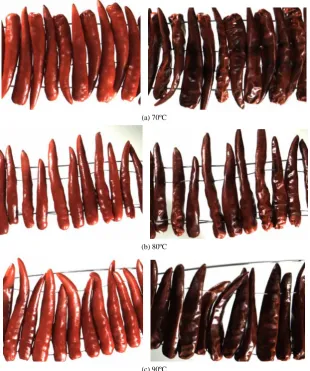
Figure 4 shows comparison of final results when the
moisture content of chili was less than 13%wb.
Apparently, the higher the drying temperature was, the
shorter the drying time lasted, but the worse the color was
obtained. We also found that although there was a
different lighting condition, the a* components estimated
by using the image processing algorithm and the a*
component measured by the colorimeter were alike, but
with some offsets.
3.2 A two-loop control scheme
In this experiment, the proposed control scheme was
implemented to adjust the drying temperature during
drying automatically. As seen in Figure 5 and Table 1, the
proposed drying method shortened the drying time,
compared to the results when the drying temperature was
set to 80ºC. The change of the a* component was less
than the case that the drying temperature was set to 90ºC.
Moreover, during the drying process, we found that the
drying temperature was switched to 90ºC three times, i.e.,
at the drying time of 90, 150, and 195 minutes.
Apparently, our proposed drying method can compromise
between the drying time and the color change by
(a) 70ºC
(b) 80ºC
(c) 90ºC
Figure 4 Comparison between the fresh chilies before experiment and dried chilies when the drying temperature was (a) 70ºC, (b) 80ºC, and (c) 90ºC
(a) (b)
Figure 5 (a) Fresh chilies before experiment and (b) dried chilies after experiment using our proposed drying method
Table 1 Conventional drying method vs. proposed drying method
Drying Temperature (ºC)
Initial Moisture
Content (% wb) Δa Drying Time 70 73.8 +/- 0.58 14.83 +/- 1.16 7 hrs 00 mins 80 75.7 +/- 0.74 14.77 +/- 1.66 4 hrs 30 mins 90 74.7 +/- 1.03 20.15 +/- 1.76 3 hrs 30 mins Proposed method 77.3 +/- 0.82 14.94 +/- 1.47 3 hrs 45 mins
4 Conclusions
The proposed drying control scheme consists of two
loops. The inner loop is the PID temperature control
which is commonly used in the conventional drying
methods. The main contribution of this work is the outer
loop which uses the quality information as a feedback to
the controller and then the control output is adjusted
according to that quality information. In this work as a
case study, the chosen material was chili and the drying
method was the tray dryer since it is simple, cheap, and
addressed in this work was the change of the color. It was
extracted from the captured image using the image
processing algorithm. As seen in the experimental results,
the color of the dried chilies was improved and the drying
time was shortened when our proposed drying controller
was employed.
In the future, we would like to develop a smart drying
controller which considers more factors, e.g., the
shrinkage of the chilies being dried and the speed of the
hot air in the chamber.
Acknowledgements
The work was supported by the Higher Education
Research Promotion and National Research University
Project of Thailand, Office of the Higher Education
Commission (grant number 5808007/2558).
References
Abdel-Jabbar, N. M., R. Y. Jumah, and M. Q. Al-Haj Ali. 2005. State estimation and state feedback control for continuous fluidized bed dryers. Journal of Food Engineering, 70(2): 197–203.
Amjad, W., O. Hensel, and A. Munir. 2015. Batch drying of potato slices: kinetic changes of colour and shrinkage in response of uniformly distributed drying temperature. Agricultural Engineering International: CIGR Journal, 17(3):
296–308.
Davies, E. R. 2009. The application of machine vision to food and agriculture: a review. The Imaging Science Journal, 57(4):
197–217.
Di Scala, K., G. Meschino, A. Vega-Galvez, R. Lemus-Mondaca, S. Roura, and R. Mascheroni. 2013. An artificial neural network model for prediction of quality characteristics of apples during convective dehydration. Food Science and Technology, 33(3): 411–416.
Dufour P., P. Laurent, and C. Xu. 2004. Model predictive control of the water based painting drying using a humidity profile soft sensor and a temperature measurement. In International Drying Symposium, 911–918. Sao Paulo, Brazil, 22-25
August.
Ebrahimi, M. A., S. S. Mohtasebi, S. S. Rafiee, and S. Hosseinpour. 2012. Investigation of banana slices shrinkage using image processing technique. Australian Journal of Crop Science, 6(5): 938–945.
Han, F., C. Zuo, W. Wu, J. Li, and Z. Liu. 2012. Model predictive control of the grain drying process. Mathematical Problems in Engineering, (2012): 1–12.
Hatamipour, M. S., and D. Mowla. 2002. Shrinkage of carrots during drying in an inert medium fluidized bed. Journal of Food Engineering, 55(3): 247–252.
Huang, M., Q. Wang, M. Zhang, and Q. Zhu. 2014. Prediction of color and moisture content for vegetable soybean during drying using hyperspectral imaging technology. Journal of Food Engineering, 128(2014): 24–30.
Khazaei, N. B., T. T. Hashjin, H. Ghassemian, M. H. Khoshtaghaza, and A. Banakar. 2013. Application of machine vision in modeling of grape drying process. Journal of Agricultural Science and Technology, 15(6): 1095–1106.
Martynenko, A. I., and S. X. Yang. 2007. An intelligent control system for thermal processing of biomaterials. In 2007 IEEE International Conf. on Networking, Sensing and Control,