The Thirty-Third AAAI Conference on Artificial Intelligence (AAAI-19)
Representing and Learning Grammars in Answer Set Programming
Mark Law
Imperial College London, UKAlessandra Russo
Imperial College London, UKElisa Bertino
Purdue University, USAKrysia Broda
Imperial College London, UKJorge Lobo
ICREA - Universitat Pompeu Fabra [email protected]
Abstract
In this paper we introduce an extension of context-free gram-mars calledanswer set grammars(ASGs). These grammars allow annotations on production rules, written in the lan-guage of Answer Set Programming (ASP), which can express context-sensitive constraints. We investigate the complexity of various classes of ASG with respect to two decision prob-lems: deciding whether a given string belongs to the language of an ASG and deciding whether the language of an ASG is non-empty. Specifically, we show that the complexity of these decision problems can be lowered by restricting the subset of the ASP language used in the annotations. To aid the applica-bility of these grammars to computational problems that re-quire context-sensitive parsers for partially known languages, we propose a learning task for inducing the annotations of an ASG. We characterise the complexity of this task and present an algorithm for solving it. An evaluation of a (prototype) implementation is also discussed.
Introduction
All computational problems can be characterised as the task of recognising a language. Many of these languages can be captured by grammars. For example, finite state automata can be characterised by regular grammars, pushdown au-tomata by context-free grammars (CFGs), linear bounded automata by context-sensitive grammars and Turing ma-chines by unrestricted grammars. Grammars are useful in many situations where the problem to solve is that of recog-nising the sentences of a language. For instance, grammars are useful to automatically generate parsers of programming languages. Typically, the problem of parser generation is, roughly speaking, done in two steps: firstly a CFG is de-fined and secondly either the grammar, or the parser gener-ated by the grammar, is annotgener-ated or modified to capture the language; e.g. a CFG is used, together with annotations, as input to YACC (Johnson 1975) in order to generate parsers.
Parsers are used in many situations. However, in practice there are situations where a parser’s grammar may be un-known or a parser’s implementation does not match its spec-ification. For instance, in the context of automatic test gen-eration for program debugging, known asfuzzing (Sutton,
Copyright c2019, Association for the Advancement of Artificial Intelligence (www.aaai.org). All rights reserved.
Greene, and Amini 2007), hand written grammars may con-tain errors, meaning automatically generated test instances may fail in the programs parser (Godefroid, Peleg, and Singh 2017). Another example arises in the domain of signature-based intrusion detection systems. Signatures of attacks are specified as regular expressions. Writing these signatures is difficult, and the definitions are usually incomplete: there are attacks that are not detected by the signature and strings that are classified as attacks when they are not, e.g. (Alnabulsi, Islam, and Mamun 2014). This is also the case in automatic classification of logs, where signatures are used and speci-fied as regular expressions to parse the logs into classes, and, as in the case of intrusion detection, often there are incorrect classifications, e.g. (Tang, Tao, and Chang-Shing 2011).
The contribution of this paper is twofold. Firstly, a class of grammars, calledAnswer Set Grammars(ASG) is defined. These grammars are CFGs with annotations, which go be-yond CFGs and are able to express some context-sensitive languages, including some which are not polynomially de-cidable. Secondly, a framework that given an ASG and two sets of strings,E+andE−, learns a target ASG that has the same context-free component as the input grammar, and ev-ery string inE+ (resp.E−) is accepted (resp. rejected) by the target grammar. This framework is intended as a first step towards addressing problems such as the three described above, by automatically modifying the grammars.
ASG annotations are expressed as Answer Set Programs (ASP). They are inspired by extensions of CFGs, such as attribute grammars (Knuth 1968) and definite clause gram-mars (Pereira and Warren 1980), which are capable of ex-pressing context-sensitive conditions. The former extend CFGs with attributes and production rules with assignments to these attributes and constraints on the values that these at-tributes can take. The latter extend CFGs with variables that can be passed up and down the parse tree. ASGs differ from both attribute grammars and DCGs in that the annotations are purely declarative and are not subject to procedural con-straints. ASGs have a high degree of expressiveness and by restricting the fragment of ASP used by the ASG, languages of different complexities can be characterised.
ASG that preserves the context-free component of the input grammar. This can be interpreted in many cases as learn-ing semantic constraints of a language when its syntax is al-ready known. This is indeed the case of automatic modifica-tion of grammars, common to the three problems described above. Our framework differs from existing approaches of grammar induction (Angluin 1987; Javed et al. 2004; Fredouille et al. 2007), where the task is instead to learn the entire grammar of a language from a set of positive and neg-ative examples of strings in that language. As shown by our evaluation results, learning only the annotations of an ASG makes the computational task easier than learning the whole grammar. In what follows we present: (1) the formalisation of our notion of ASGs; (2) results on the computational com-plexity of deciding whether a given string is a member of the language of a given ASG and deciding whether the language of a given ASG is non-empty; (3) the formalisation of the task of learning annotations of ASGs; and (4) a characteri-sation of the complexity of this learning task, and an algo-rithm that solves the learning task. We begin by recalling the relevant notation in the next section, and then present each contribution in turn. We conclude the paper with discussions of related and future work.
Notation and Terminology
In this section we introduce notions and terminologies used throughout the paper. Given atomsh,b1, . . .bn,c1, . . . ,cm, a normal rule is h: - b1, . . . ,bn, not c1, . . . , not cm, wherehis thehead andb1, . . . ,bn, not c1, . . . , not cm (collectively) is the body of the rule, and “not” repre-sents negation as failure. Rules of the form : -b1, . . . ,bn, not c1, . . . , not cmare calledconstraints. A variable in a rule is said to besafeif it occurs in at least one positive lit-eral (i.e. thebi’s in the above rule) in the body of the rule. In this paper, we assume an ASP program to be a set of nor-mal rule and constraints. The Herbrand Base of a program P, denotedHBP, is the set of variable free (ground) atoms
that can be formed from predicates and constants inP. The subsets ofHBP are called (Herbrand) interpretations ofP.
Given a programP and an interpretationI ⊆HBP, the
reductPIis constructed from the grounding ofPin 3 steps:
firstly, remove rules whose bodies contain the negation of an atom inI; secondly, remove all negative literals from the re-maining rules; and finally, replace the head of any constraint with⊥(where⊥∈/HBP). AnyI⊆HBP is ananswer set
ofP if it is the minimal model of the reductPI. We denote
the set of answer sets of a programP withAS(P). Given an answer setA ∈ AS(P), a ground normal rule ofP is satisfied byAif the head is inAor the body is not satisfied byA. A ground constraint is satisfied when the body is not satisfied. A constraint therefore has the effect of eliminating all answer sets ofPthat satisfy the body of the constraint. A programP isstratifiedif it can be partitioned into (disjoint) strataP1, . . . , Pnsuch that for each predicatep, ifpoccurs
positively (resp. negatively) in the body of a rule inPithen
every rule inP withpin the head is inP1, . . . , Pi (resp.
P1, . . . , Pi−1). The notation ++denotes list concatenation (e.g.[1,2,3]++[4,5] = [1,2,3,4,5]).
Answer Set Grammars
This section formalises Answer Set Grammars (ASGs). We first recall the definition of a CFG (Sipser 1997).
Definition 1. A context-free-grammar GCF is a tuple
hGN, GT, GP R, GSi where GN is a (finite) set of
non-terminal nodes, GT is a (finite) set, disjoint from GN, of
terminal nodes,GP Ris a set of production rules of the form
n0→n1. . . nk, wheren0∈GN and eachni∈GN ∪GT.
GS ∈GN is the start node ofGCF.
Terminal nodes correspond to the characters of the alphabet that appear in the strings generated by the grammar. So, for each node n ∈ GT, we say that n yields the string “n”.
Production rules are used to generate all possible strings in the formal language formalised as the context-free grammar. So, for any production rulen0 → n1. . . nk inGP R, if for
eachi ∈ [1, k],ni yields the stringsithen we say thatn0 yieldsthe string “s1. . . sk”. A string sis said to be in the
language of a grammarG, denoted asL(G), if and only if the start nodeGS of the grammaryieldsthe strings. We can
now define the notion of a parse tree for a CFG.
Definition 2. LetGCF =hGN, GT, GP R, GSibe a CFG.
A parse treeP T ofGCF consists of a nodenode(P T)in
GT∪GN, a list of parse trees, denotedchildren(P T), and
ifnode(P T)∈GN, a rulerule(P T)∈P R, such that
1. Ifnode(P T)∈GT, thenchildren(P T)is empty.
2. If node(P T) ∈ GN, then rule(P T) is of the form
node(P T) → n1. . . nk where each ni is equal to
node(children(P T)[i])and|children(P T)|=k.
For any parse treeP Twe definestr(P T)as: (1)node(P T) if node(P T) ∈ GT; and (2) str(P T1). . . str(P Tn)
oth-erwise (where[P T1, . . . , P Tn] =children(P T)). A parse
treeP T ofGCF is a parse tree for a stringsifnode(P T) =
GSands=str(P T).1
We can represent each nodenin a parse tree by its trace, trace(n), through the tree. The trace of the root is the empty list[]; theithchild of the root is[i]; thejthchild of theith
child of the root is[i, j], and so on.
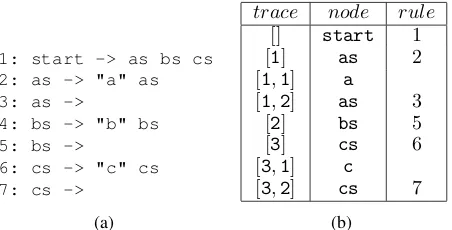
Example 1. Consider the CFG given in Figure 1. Note that we give each production rule a unique integer identifier. There is exactly one2 parse treeP T ofGCF for the string
ac, which is given by the table in Figure 1.
AnAnswer Set Grammarextends a context-free grammar (CFG) by expressing semantic conditions, written in ASP, on the production rules. To allow the semantic conditions to refer to the structure of the CFG, we use the notion of anno-tated ASP programs. These are programs whose atoms have annotations that refer to nodes of the parse tree of a CFG. Specifically, an annotated ASP program is an ASP program
1
Note that in the case that a string is empty, all nodes of the tree will correspond to non-terminals. The leaf nodes of the tree will be non-terminals with an empty list of children. For “” to be accepted, it is therefore necessary for at least one production rule to have no terminal or non-terminal symbols on the right hand side.
2
1: start -> as bs cs 2: as -> "a" as
3: as ->
4: bs -> "b" bs
5: bs ->
6: cs -> "c" cs 7: cs ->
(a)
trace node rule
[] start 1
[1] as 2 [1,1] a
[1,2] as 3 [2] bs 5 [3] cs 6 [3,1] c
[3,2] cs 7
(b)
Figure 1: A CFG foraibjckand the parse tree forac.
where some atoms have beenannotatedwith a ground term. For instance, the annotated atoma(1)@2represents the atom a(1)with the annotation2. When computing the answer sets of an annotated program, annotated atoms are treated as or-dinary atoms, wherea@k,a@landaare distinct atoms. We can now define the notion of annotated production rules.
Definition 3. An annotated production ruleis of the form n0 → n1. . . nkP wheren0 → n1. . . nk is an ordinary
CFG production rule andP is an annotated ASP program, where every annotation is an integer between1andk.
Definition 4. An answer set grammar G is a tuple hGN, GT, GP R, GSi where GN is a (finite) set of
non-terminal nodes,GT is a (finite) set, disjoint fromGN of
ter-minal nodes,GP Ris a set of annotated production rules and
GS ∈GN is the start node ofG.
Note that a CFG can be represented as an ASG where all production rules are unannotated (i.e. the annotation of every production rules is empty). Given any ASGG, we denote withGCFthe context-free part of the grammar; i.e. the CFG
constructed fromG by removing the ASP programs from each production rule. Example 2 presents an example ASG, and explains the intuition of an ASGs semantics, which is then formalised for general ASGs in Definitions 5 and 6.
Example 2. The following is an example of an ASGG.
1: start -> as bs cs {
:- size(X)@1, not size(X)@2. :- size(X)@1, not size(X)@3. }
2: as -> "a" as { size(X+1) :- size(X)@2. } 3: as -> { size(0). }
4: bs -> "b" bs { size(X+1) :- size(X)@2. } 5: bs -> { size(0). }
6: cs -> "c" cs { size(X+1) :- size(X)@2. } 7: cs -> { size(0). }
The languageL(G)of the above ASG is a subset of the lan-guageL(GCF)of the CFG in Example 1, which represents
aibjck. The above ASGGcaptures the languageanbncn, wheren≥0. The intuition of the annotations is that in each production rule from 2-7,sizerepresents the size of the cur-rent string. The atomsize(X)@2in production rule 2 means that the size of the string represented by the second child of the current node (as) isX. The constraints in production rule 1 enforce that the number ofa’s,b’s andc’s are equal.
A parse tree P T of an ASG Gfor a stringsis defined similarly to the context-free case (with the difference that production rules are annotated production rules). We can use a parse tree of an ASG to construct an annotated ASP pro-gram, which allows us to test whether the parse tree con-forms to the semantic conditions of the ASG.
Definition 5. Let G be an ASG and P T be a parse tree.G[P T]is the program{rule(n)@trace(n)|n∈P T}, where for any production rulen0 → n1. . . nkP, and any
tracet,P R@tis the program constructed by replacing all annotated atoms a@i with the atom a@(t++[i]) and all unannotated atomsawith the atoma@t.
Definition 6. LetGbe an ASG andstr be a string of ter-minal nodes.str∈ L(G)if and only if there is a parse tree P T ofGforstrsuch thatG[P T]is satisfiable.
To check, for instance, whetherac∈ L(G), whereGis the ASG given in Example 2, we need to check whetherG[P T] is satisfiable. For the stringac, the unique parse tree is that given in Figure 1. Therefore theG[P T]is the program:
:- size(X)@[1], not size(X)@[2]. :- size(X)@[1], not size(X)@[3]. size(X+1)@[1] :- size(X)@[1, 2]. size(0)@[1, 2].
size(0)@[2].
size(X+1)@[3] :- size(X)@[3, 2]. size(0)@[3, 2].
This program is clearly unsatisfiable, as size(1)@[1] is guaranteed to be true in all answer sets and size(1)@[2] is guaranteed to be false in all answer sets, meaning that the first constraint is guaranteed to be violated. If we instead check the stringabc, this leads to the program:
:- size(X)@[1], not size(X)@[2]. :- size(X)@[1], not size(X)@[3]. size(X+1)@[1] :- size(X)@[1, 2]. size(0)@[1, 2].
size(X+1)@[2] :- size(X)@[2, 2]. size(0)@[2, 2].
size(X+1)@[3] :- size(X)@[3, 2]. size(0)@[3, 2].
This program has exactly one answer set:{size(0)@[1,2], size(1)@[1], size(0)@[2,2], size(1)@[2], size(0)@[3,2], size(1)@[3]}meaning thatabc ∈ L(G). This answer set actually reflects the size of the substring in each node of the parse tree (other than the root and the terminal nodes, which do not define size), as shown in the following table.
trace node size [ ] start
-[1] as 1
[1,1] a
-[1,2] as 0
[2] bs 1
[2,1] b
-[2,2] bs 0
[3] cs 1
[3,1] c
-[3,2] cs 0
or equal todsuch thatG[P T]is satisfiable. We denote the set of all strings that are accepted byGat depthdasLd(G).
Answer Set Grammar Induction
In this section, we formalise our framework for learning an-swer set grammars. Informally, our framework takes as input an ASGG(or even simply a CFG), and two sets of strings, E+ andE−, and learns an ASGG0
such thatG0CF is the same asGCF, and every string inE+(resp.E−) is accepted
(resp. rejected) byG0. The framework enables learning the ASP part of an ASG. We are not learning the “context-free” part of the grammar, but only the semantic conditions, as-suming therefore that the syntax of the target language is known, but the semantics is unknown. To perform the learn-ing, our framework uses recent advances in Inductive Learn-ing of ASP (ILASP) from (Law, Russo, and Broda 2015a).
Similarly to most ILP techniques, our framework includes a notion of a hypothesis space, which defines the set of rules that can form possible learned outcomes, referred to as possiblehypotheses. For convenience, hypothesis spaces are often characterised by a set ofmode declarations (Mug-gleton 1995). We use a similar approach, but in order to give the flexibility that some predicates may only be used in some production rules, we add a parameter called the scopeof a mode declaration. We build upon the notion of ILASP mode declarations given in (Law, Russo, and Broda 2014), allowing declarations specifying which atoms can ap-pear in the head and body of rules in the hypothesis space (#modeh’s and#modeb’s, respectively) whose arguments may be placeholders for variables and constants of given types (denotedvar(t)andconst(t), respectively). For in-stance the mode declaration #modeb(p(var(t)),[1,2,3]) means thatp(X), for any variableXof type3t, may occur in the body of rules which are used to annotate production rules 1–3. AnASG hypothesis spaceis a set of pairs of the form
hP Rid, Ri, whereP Ridis an identifier for a production rule
andR is an annotated ASP rule. Each pairhP Rid, Riin a
hypothesis space means thatRcan be added to the annota-tion ofP R. Given any ASGGand any hypothesis (a subset of the hypothesis space)H,G:His the ASG constructed by addingRto the annotation ofP Rfor eachhP Rid, RiinH.
As with any other form of grammar induction, to learn an ASG we also need examples of strings that should, or should not, be accepted by the final grammar. For instance, if we were aiming to learn the grammar anbncn, we might give examples like “abc” and “aabbcc”, as strings that should be accepted, and “aabcc” as a string that should not be ac-cepted. Definition 7 formalises the ASG learning task.
Definition 7. An ASG learning task T is of the form hG, SM, E+, E−i, whereGis an ASG called the existing
grammar,SM is an ASG hypothesis space andE+andE−
are sets of strings called thepositiveandnegativeexamples,
3
The only restriction imposed by types is that no variable can appear twice in the same rule with dif-ferent types. For example, given mode declarations
{#modeh(p(var(t1)),[1]),#modeb(q(var(t2)),[1])}, we cannot addp(X) : -q(X)to the annotation of production rule 1.
Horn Stratified Unstratified Propositional NP NP NP
First-order EXP EXP NEXP
Table 1: Complexity classes for propositional and first-order ASGs (each element of the table is the class for which BAM and BAS are both complete).
respectively. Aninductive solutionofT at depthdis a hy-pothesisH ⊆SM such that (1)∀s∈E+, s∈ Ld(G:H);
and (2)∀s∈E−, s6∈ Ld(G:H).ILPd
ASG(T)denotes the
set of all inductive solutions ofT at depthd.
Note that the existing grammar of an ASG learning task may or may not contain annotations on some or all of the produc-tion rules. The annotaproduc-tions that are present constitute what is known asbackground knowledgein conventional ILP, as they encode knowledge that is already known. In the ex-treme, this knowledge can all be learned (this is the case when the existing grammar is a pure CFG), but as shown in our evaluation, when semantic conditions are known, in-cluding them in the existing grammar can reduce the number of examples and time needed to learn the correct grammar.
Computational Complexity
We consider two classes of decision problem. The first ad-dresses the complexity of existing ASGs, and the second the complexity of the learning task. Our results are presented in terms of a bound on the depth of parse trees, i.e. there is a fixed bounddon the depth of parse trees in this section.
Grammar Decision Problems
• Bounded-ASG-membership(BAM) is the problem of de-ciding whether an ASG accepts a string.
• Bounded-ASG-satisfiability(BAS) is the problem of de-ciding whether an ASG has a non-empty language.
The results are summarised in Table 1. An ASG Gis un-stratified if there is at least one parse tree P T of G such thatG[P T]is unstratified. Results in the second row are for function free first-order ASP annotations.
Propositional results. In proving the complexity results we make use of two chains of reductions: (1) Horn BAS to Horn BAM to stratified BAM to unstratified BAM to unstrat-ified BAS; and (2) Horn BAS to stratunstrat-ified BAS to unstratunstrat-ified BAS. Note that all but the first and last reductions of chain (1) hold trivially, so it remains to show these two non-trivial cases, which are special cases of Theorems 1 and 2.
Theorem 1. For any fragmentFof ASP,FBAS reduces to FBAM.
Theorem 2. For any fragmentFof ASP that contains con-straints and negation as failure,FBAM reduces toFBAS.
The proof of Theorem 2 (omitted4) shows that given a string sand an ASG G, we can extend Gusing stratified normal rules and constraints to yield a grammarG0 that is satisfiable at depthdiffsis inLd(G0). Due to the chains of
reductions, to show the results in the first row of Table 1 (for both decision problems), it remains to show that Horn BAS is NP-hard and unstratified BAS is in NP.
Theorem 3. Propositional Horn BAS is NP-hard.
Proof. We reduce satisfiability of a set of propo-sitional clauses C to propositional Horn BAS. Let V = {v1, . . . , vn} be the set of atoms in C.
For any clause c ∈ C, constraint(c) represents an annotated constraint form of c (e.g. v1 ∨ ¬v2 ∨ ¬v3 is represented as : -not v@1,v@2,v@3.). Con-sider the ASG G consisting of the production rule start→a1. . .an{constraint(c)|c∈C}and for eachi∈ [1, n]the production rulesai→ {v.}andai→ {not v.}.
Note that C is satisfiable iff there is an interpretation I ⊆ V such that {v@i.|vi∈I} ∪ {not v@i.|vi6∈I} ∪
{constraint(c)|c∈C}is satisfiable. There is one parse tree ofGcorresponding to eachI ⊆ V; hence there is a parse treeP T ofGstG[P T]is satisfiable iffCis satisfiable.
Theorem 4. Propositional unstratified BAS is in NP.
The proof of Theorem 4 (omitted), reduces propositional unstratified BAS to the satisfiability of an ASP program con-sisting of propositional normal rules and constraints, which is in NP (Leone et al. 2006).
First order results. Theorems 1 and 2 show two chains of reductions in the first-order case: (1) Horn BAS to Horn BAM to stratified BAM to stratified BAS; and (2) unstrati-fied BAS to unstratiunstrati-fied BAM to unstratiunstrati-fied BAS. Thus, to prove the remaining results in Table 1, it suffices to show that Horn BAS is EXP-hard, stratified BAS is in EXP and unstratified BAS is both in NEXP and NEXP-hard. We first show the two hardness results.
Theorem 5. First order Horn BAS is EXP-hard.
Proof. We reduce an arbitrary EXP-hard problemDto first order Horn BAS. As EXP is closed under complement,D¯ (the complement ofD) must also be in EXP. Hence, as cau-tious entailment of (function-free) first order Horn programs is EXP-complete (Leone et al. 2006), there is a first order Horn programP and a ground atomasuch thatP |=c aiff
¯
Dreturns yes. Hence,P∪ {: -a.}is satisfiable iffD¯ returns no, which is the case iffDreturns yes. Consider the ASGG with a single production rulestart→P∪ {: -a.}. Note that
Ld(G)is non-empty iffP ∪ {:
-a.} is satisfiable, which is the case iffDreturns yes.
Theorem 6. First order unstratified BAS is NEXP-hard.
4
All proofs omitted from the paper can be found at https://www. doc.ic.ac.uk/∼ml1909/AAAI19 proofs.pdf.
Horn Stratified Unstratified Bounded-verification DP DP DP Bounded-satisfiability ΣP
2 ΣP2 ΣP2
Table 2: Complexity results for learning propositional ASGs. Each entry in the table is the complexity class for which the given decision problem is complete.
Proof. LetP be an arbitrary (function-free) first order un-stratified ASP program andabe an atom. Deciding whether P |=b ais NEXP-hard (Leone et al. 2006). Hence, it
suf-fices to reduce deciding whetherP |=b a to deciding the
satisfiability of a first order unstratified-ASG G. Consider the ASGGthat contains a single production rulestart → P∪ {: - not a.}.Ld(G)is non-empty iffP∪ {: - not a.}
is satisfiable, which is the case iffP |=ba.
It remains to show that first order stratified BAS is in EXP and first order unstratified BAS is in NEXP.
Theorem 7. First order stratified BAS is in EXP.
The proof of Theorem 7 (omitted) reduces the decision problem to deciding the satisfiability of a stratified first-order (function free) ASP program, which is in EXP (Leone et al. 2006).
Theorem 8. First order unstratified BAS in NEXP.
The proof of Theorem 8 (omitted) reduces the deci-sion problem to deciding the satisfiability of an unstrati-fied first-order (function free) ASP program, which is in NEXP (Leone et al. 2006).
One observation to make is that for all the hardness proofs one can use grammars that generate finite languages. Hence, the complexity of the context-free part of the grammar has no effect on the complexity of the ASG. Nevertheless, the grammar is needed to get the lower bound of the classes of ASGs since Horn ASP alone is in P. The results also show that we would need first order Horn to capture CSGs. How-ever, it is an open question whether there is a class of ASGs exactly capturing CSGs since they are PSPACE-complete.
Learning Decision Problems
The results in this section are all for propositional learning tasks5. We consider the following decision problems:
• Bounded-verification(BV) is the problem of deciding if a given hypothesis is a solution of a given learning task.
• Bounded-task-satisfiability(BTS) is the problem of decid-ing whether a given learndecid-ing task has any solutions.
Complexity results for learning are summarised in Table 2. As there are trivial reductions from Horn to stratified to un-stratified BV, the following two theorems suffice to show the completeness results for BV.
Theorem 9. Horn BV is DP-hard.
Theorem 10. Unstratified BV is in DP.
5
Problems in DP can be reduced to a pair of decision prob-lems, one in NP and one in co-NP, such that the original decision problem returns yes iff both of the new decision problems return yes. The (omitted) proof of Theorem 9 re-duces the DP-complete problem of deciding whether one set of propositional clauses is satisfiable and another is unsatis-fiable to Horn BV. Similarly, we prove the unstratified case is in DP by reducing it to this DP-complete problem.
Again due to the trivial reductions from Horn to stratified to unstratified BTS, the next two theorems suffice to show the remaining completeness results in Table 2.
Theorem 11. Horn BTS isΣP2-hard.
The (omitted) proof reduces deciding the validity of a re-stricted form of quantified boolean formula (a knownΣP
2 -complete problem) to Horn BTS. It remains to show that unstratified BTS is inΣP
2.
Theorem 12. Unstratified BTS is inΣP2.
Proof. We show that a non-deterministic Turing Machine (NDTM) with access to an NP oracle could check satisfi-ability of any ASG learning task T = hG, SM, E+, E−i
in polynomial time. An NDTM can have|SM| choices to
make (corresponding to selecting each pair in the hypoth-esis space as part of the hypothhypoth-esis). As unstratified BV is in DP (by Theorem 10), this hypothesis can then be verified in polynomial time using an NP oracle, with two queries, answering yes iff the first query returns yes and the second query returns no. Such an NDTM terminates answering yes iff the task is satisfiable (as there is a path through the Turing Machine which answers yes iff there is a hypothesis inSM
which is an inductive solution of the task).
A key observation to make is that the complexities for BV and BTS under propositional ASP are identical to the complexities for verification and satisfiability ofILPcontext
LAS
tasks (Law, Russo, and Broda 2018). These equivalences provided a strong hint that we could solve any ASG learning task by encoding it as anILPLAScontexttask, and use the exist-ing ILASP (Law, Russo, and Broda 2015a) system to solve the ASG learning task. We show in the next section how this can be done. Furthermore, we show that, with some restric-tions, stratified BTS is in NP. The complexity of the learning task for the function-free first order case is an open question.
Learning ASGs with ILASP
This section describes our method for solving ASG learn-ing tasks. We use the ILASP (Inductive Learnlearn-ing of Answer Set Programs) system (Law, Russo, and Broda 2015a), as a black box. We transform our task into a task that can be solved by ILASP. For completeness, we summarise existing notions that are key for the learning tasks solved by ILASP.
Definition 8. ((Law, Russo, and Broda 2016)) A context-dependent partial interpretation (CDPI) is a pair e = hheinc, eexci, ectxi, where heinc, eexci is pair of sets of
atoms andectxis an ASP program, called acontext. A
pro-gram P is said to accepteiff there is an answer set Aof P∪ectxsuch thateinc⊆Aandeexc∩A=∅.
AnILPLAScontextlearning task can be defined as follows.
Definition 9. An ILPLAScontext task is a tuple T = hB, SM,hE+, E−iiwhereBis an ASP program,SM is the
set of rules allowed in the hypotheses andE+andE− are
finite sets of CDPIs called, respectively, positive and nega-tive examples. A hypothesisH ⊆SM is an inductive
solu-tion ofT (writtenH ∈ ILPLAScontext(T)) if and only if: (1) ∀e+∈E+,B∪H acceptse+; and (2)∀e− ∈E−,B∪H
does not accepte−.
Definition 9 is a simplified version of the full ILPLOAScontext framework presented in (Law, Russo, and Broda 2016). To define the transformation of an ASG learning task into an ILPcontext
LAS task, we use the following notation. For
any ASP rule R,RX(P Rid) denotes the rule constructed
from R in two steps: (1) replacing each annotated atom a@[t1, . . . ,tn]with the atomann(a,X++[t1, . . . ,tn]); and (2) adding the atom pr(PRid,X)to the body of the rule.6 The mapping in Definition 10 translates each rule R that occurs (resp. could occur) in the annotation of each pro-duction ruleP RtoRX(P Rid)putting it in the background
knowledge (resp. hypothesis space) of theILPLAScontexttask. The intuition is that for any ILPcontext
LAS hypothesis H
and any parse tree G[P T] (for some string s),B ∪H ∪ {pr(rule(n)id,trace(n)).|n∈P T} is satisfiable if and only if(G:H0)[P T]is satisfiable (whereH0is the ASG hy-pothesis represented by H). Contexts of the positive (resp. negative) examples ensure that for each positive (resp. neg-ative) string example there is at least one7 (resp. no) parse tree ofGsuch that(G:H0)[P T]is satisfiable.
Definition 10. Let d be a positive integer and T = hG, SM, E+, E−ibe an ASG learning task.LAS(T, d)is
theILPLAScontexttaskhB, SMLAS, ELAS+ , ELAS− i, where the in-dividual components are defined as follows.
• B=
(
RX(P Rid)
P R∈GP R,
P R=n→n1. . . nkP,
R∈P
)
• SMLAS={RX(P Rid)|hP Rid, Ri ∈SM}
• ELAS+ contains one CDPIhh∅,∅i, Cifor each strings∈ E+, where given{P T1, . . . , P T
m}, the set of parse trees
ofs for GCF at depth d, C = {1{pt1, . . . ,ptm}1.} ∪
{pr(rule(n)id,trace(n)) : -pti.|i∈[1, m], n∈P Ti}
• ELAS− is the set of CDPIs of the form hh∅,∅i, {pr(rule(n)id,trace(n)).|n∈P T}i, where P T is a parse tree of a string inE−forGCF.
Given any hypothesisH ⊆SLAS
M , we writeH
ASGto
de-note the hypothesis{hP Rid, Ri ∈SM |RX(P Rid)∈H}.
Theorem 13 shows that we can use the mapping in Def-inition 10 to translate any ASG learning taskT and depth d, and use ILASP to find the solutions inILPd
ASG(T). The
proof of Theorem 13 is omitted.
Theorem 13. Let T be an ASG learning task. ILPd
ASG(T) =
HASG |H ∈ILPcontext
LAS (LAS(T, d))
6
Lists are represented as pairs (for example,X++[t1, . . . ,t3]is
represented as(((X,t1),t2),t3)).
7
Learning Stratified ASGs
Deciding satisfiability for a generalILPLAScontext task isΣP2 complete (in the propositional case); however, if there are no negative examples then the complexity is only N P -complete. ILASP tasks with no negative examples tend to run faster in ILASP than equivalent tasks with negative ex-amples, so when it is possible to modify the representation to eliminate negative examples it is often advantageous to do so. When ASGs are stratified, the representation in Def-inition 10 can be modified to use only positive examples. This can be achieved by representing each constraint: -body as the rule vio: -body(where viois a new atom that in-dicates that at least one constraint has been violated). The positive CDPI examples inLAS(T, d)are then extended to indicate that the unique answer set of the (stratified) pro-gram should not provevio(which is equivalent to saying that none of the constraints should be violated). The nega-tive examples inLAS(T, d)are represented similarly (again as positive examples), but indicating that the unique answer set of the (stratified) program must containvio. This means that the unique answer set must violate at least one constraint to cover the example. If each example string has only a poly-nomial number of parse trees then this task is polypoly-nomial in size of the ASG learning task8. Hence propositional strati-fied BTS is in NP, provided that each example string has a polynomial number of parse trees.
Evaluation
This section summarises experimental results of using our approach to induce ASGs. The approach was evaluated on several context-sensitive languages, including some lan-guages drawn from a related paper targeting learning mildly context-sensitive (MCS) languages represented as linear in-dexed grammars (LIGs) (Nakamura and Imada 2011). The languages learned in this section are:
• Thecopylanguage:ww, wherewis a non-empty string of a’s andb’s. The input language was a CFG corresponding to the languagew1w2wherew1andw2are both non-empty strings ofa’s andb’s.
• The language anbncm,n ≤ m: the input language was a CFG corresponding to the languageaibjckand the task was to learn annotations expressing thati=j≤k.
• The languageanbncn. We considered four different learn-ing tasks for this language:
– A: the input language was a CFG representingaibjck. The task was to learn in the annotations thati=j=k. – B: the input language was a CFG representinganbncm.
The task was to learn in the annotations thatn=m. – C: the input language was an ASGGsuch thatGCF
representsaibjck, but the existing annotations corre-spond toi=j. The task was to extend the annotations
8
The mapping can be converted to a propositional mapping by replacingRXwithRTfor each trace[t1, . . . , ti], wherei∈[0, d] and eachtj ∈[1,max k], wheremax kis the number of terminal and non-terminal nodes in the body of the longest production rule. There are a polynomial number of such traces, so this “grounding” of the problem is still polynomial in the size of the input problem.
to express thati =k. There is slightly less to learn in this task than inanbncnB, as some of the annotations necessary to express thati=kare already present (i.e. definition ofsizein theasproduction rules); however the hypothesis space is larger in this task, as there are more production rules which could be annotated. – D: the input language was a CFG representing the
lan-guage(a|b|c)∗. The task was to learn annotations ex-pressing that alla’s occur before all b’s, which occur before allc’s, and that the number ofa’s,b’s andc’s are equal. Essentially this task corresponds to learning both the CFG and the ASG annotations, as the input ASG represents the full language ofa’s,b’s andc’s.
• The languageanbmcndm: the input language was a CFG corresponding to the languageaibjckdland the task was to learn annotations expressing thati=kandj=l.
• The subset-sumlanguage: the input language was a CFG corresponding to the language of sets of integers be-tween−5 and5(e.g.{−5,4,1}). The task was to learn annotations expressing that at least one non-empty subset of the integers in the string sums to0. Note that this lan-guage is not MCS – for a lanlan-guage to be MCS, its mem-bership decision problem must be inP, but deciding if at least one non-empty subset of a set of integers sums to0 is NP-complete (Garey and Johnson 1979).
• The graph-col language: the input language was an ASG representing the languageanbmwhere eachais an integer in[0,3], representing the nodes of a graph, and each bis a pair of integers representing a directed edge (only those integers used as nodes could be used in edges). To avoid equivalent strings we enforced that the nodes and edges were ordered lexicographically. The task was to learn to restrict the language to 3-colourable graphs. We tested this with two ASGs representing the same in-put language:
– A: the input ASG had no “duplicate” production rules, meaning that the only way to express 3-colourability was to learn an unstratified ASG using a loop to simu-late the choice of colour for each node.
– B: the input ASG had 3 “duplicate” production rules for node, meaning that the learned ASG could express the choice of colour by using one production rule for each choice of colour. In this case, we restricted the hypothesis space to only Horn clauses.
Language Final Time
Total Time
E+ E− SM
copy 174.6s 404.8s 3 10 55
anbncm,n≤m 1.0s 6.4s 2 8 45
anbncnA 1.1s 5.1s 1 7 45
anbncnB 0.3s 1.3s 1 3 28
anbncnC 0.5s 1.4s 1 2 45
anbncnD 1004.0s 13314.9s 1 45 66
anbmcndm 1.8s 12.1s 2 10 64
subset-sum 336.9s 657.5s 3 9 479
graph-colA 90.1s 256.9s 4 4 297
graph-colB 11.5s 23.8s 2 2 117
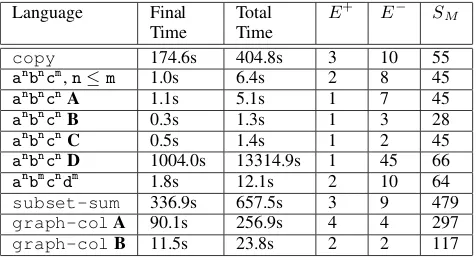
Table 3: A summary of the results of our evaluation.Final TimeandTotal Timeshow the learning time (on an Ubuntu 14.04 desktop machine with a 3.4 GHz IntelR CoreTM i7-3770 processor and 16GB RAM) taken in the final itera-tion and the total learning time, respectively.|E+|and|E−|
show the number of positive and negative examples needed to learn the target language in each case.|SM|is the
num-ber of rules in the hypothesis space. Note that a hypothesis space ofnrules leads to2npotential hypotheses.
also the case for ASGs. Therefore, when computing coun-terexamples we put an upper bound on the depth of parse trees to make the computation feasible. In each case the bound was high enough that the final grammar was equiv-alent to the target grammar (this was manually checked).
Table 3 summarises the results of our evaluation. The fouranbncnexamples show the effect of narrowing (in the case of BandC) and widening (in the case of D) the ini-tial language. In the case ofD, essentially the CFG needed to be learned, in addition to the constraints represented by the original ASG annotations (in A). In general, the more specific the initial language, the fewer examples are needed to learn the constrained target language. In each case, fewer positive examples were needed than negative exam-ples, which is to be expected as the task is to constrain the initial language (of which the target language is a subset). The graph colouring experiment shows that by restricting a learning task to the Horn case, fewer examples (and signifi-cantly less time) may be needed. However, it should be noted that constructing the input language for thegraph-colB task required prior knowledge of how many duplicate pro-duction rules were needed and that the level of choice is therefore not learned, but is given as background knowledge. On the other hand, thegraph-colAtask may have taken longer and required more examples, but it did not require such prior knowledge. This is an indication that in real set-tings if the required level of choice is known a priori then inputting it in the initial language will save time, but in cases where it is unknown then unstratified ASGs are necessary.
(Nakamura and Imada 2011) evaluate their LIG learner on each of the above languages other thansubset-sum, graph-coland the variations ofanbncn. LIGs make no distinction between the context-free part of the grammar so in their case the entire LIG was learned from scratch. As expected, our own running times are significantly shorter
in most cases. We are slower for the copy language and theDvariation ofanbncn. Thecopylanguage has a much more natural representation in LIG, which allows the use of a stack to “store” the copied string, whereas ASP does not have a natural efficient representation of lists or stacks. TheDvariation ofanbncntakes significantly longer in our case (1004s compared to 18s) as our ASG learner was not designed to learn the full language of an ASG, but to re-strict an existing context-free language. As shown in the other three cases, when starting from a more restricted CFG, our approach is able to use the existing grammar to find the complete ASG much faster than either method can learn the entire grammar from scratch. As LIGs are MCS, the ap-proach in (Nakamura and Imada 2011) could not learn the subset-sumorgraph-collanguages.
Our evaluation assumed an oracle giving counterexam-ples. This is not uncommon in grammar induction (e.g. (An-gluin 1987; Sakakibara 1990)). Induction from randomly observed examples is more challenging and in general we cannot be sure that the learned hypothesis is correct (it may only be correct on the seen examples). In practice, this means that the learner should be deployed incrementally, with the option to relearn on seeing a new counterexample. The hypothesis spaces in our evaluation were constructed from the target hypotheses, allowing predicates to be used in the head/body if they occurred there in the target hypothesis. In practice, when the target hypotheses are unknown, larger hypothesis spaces must be used, which may mean that more examples are required to learn the correct grammar.
Related Work
Context-sensitive grammars are often used in specifying the semantics of programming languages. For instance, attribute grammars (Knuth 1968; 1990) are used in tools for gener-ating parsers and compilers (for example, YACC (Mason and Brown 1990) and ANTLR (Parr and Quong 1995)). At-tribute grammars are defined in terms ofsynthesisedand in-herited attributes, which are passed up and down (respec-tively) the parse tree of a CFG. Each atom in the Herbrand Base of an ASP program in an ASG can be thought of as a boolean attribute. These attributes can be defined in terms of the values of parent nodes (similarly to inherited attributes) by using rules in the production rule of the parent node to pass attributes to the child – this is achieved using rules with annotated atoms in the head. Synthesised attributes, on the other hand, can be simulated by using rules with annotations in the body – this causes attribute values to be “passed” from the child to the parent. Through first order representations, ASGs can simulate attributes of non-boolean types; e.g. in theanbncn, the predicatesizeis used to record the (inte-ger) size of the string.
Example 3. Consider the following ASG, which corre-sponds to conjunctions in ASP. For simplicity, we assume there are production rules defining literals whose ASP rules define the predicateuses var(V), which is true if and only if the literal uses the variable V, and the atom positive which is true if and only if the literal is positive. The ASP programs in the production rules check whether the conjunc-tion is safe, i.e. whether every variable that occurs in the conjunction occurs in at least one positive literal in the con-junction. The start node of the grammar isconjunction.
conjunction -> literal {
safe(V):- uses_var(V)@1, positive@1. :- uses_var(V)@1, not safe(V). }
conjunction -> conjunction "," literal { safe(V):- safe(V)@1. safe(V)@1:- safe(V). safe(V):- safe(V)@3. safe(V)@3:- safe(V). }
In the second production rule,safe/1acts as both a syn-thesised attribute and an inherited attribute. As ASP uses the closed world assumption, there must be some external support forsafe(V)to be satisfied – i.e. at least one of the nodes in the first production rule must provesafe(V). This means that for each node of the parse tree corresponding to aconjunction,safe(V)holds iff there is at least one pos-itive literal in the conjunction that uses the variableV.
Note that although annotated head atoms allow more declarative representations, they do not affect the complexity results presented earlier in the paper – if we were to consider a new class of “strictly stratified” ASGs, where annotations could only appear in the body, the hardness proofs would still apply as they do not make use of annotated head atoms.
An additional advantage of using a logic programming formalism to express the semantic conditions is that there is a large amount of work on Inductive Logic Program-ming (for example, (Muggleton 1991; 1995; Ray 2009; Sakama and Inoue 2009; Corapi, Russo, and Lupu 2010; Muggleton et al. 2012; Law, Russo, and Broda 2015b)). This means that we can delegate the learning of the ASP programs to an existing ILP system for learning ASP pro-grams (Law, Russo, and Broda 2015a).
There has been a lot of work on Grammar Induction (for example, (Angluin 1987; Wyard 1993)). In (Fredouille et al. 2007; Muggleton et al. 2014), various ILP approaches have been used to learn CFGs in the form of DCGs. There is also some work on learning CSGs (e.g. (Oates et al. 2006; Yoshinaka 2009; Imada and Nakamura 2010; Nakamura and Imada 2011)), but we are not aware of any work on learning attribute grammars, or learning semantic conditions on top of an existing CFG. Such a task is useful to provide practical solutions to the problems of parser corrections described in the introduction, as it is faster to learn to restrict the existing grammar than to learn the whole grammar from scratch.
Conclusion
In this paper we have presented a method for learning context-sensitive constraints on an existing CFG, expressed in ASP. Grammars have been previously used to encode
more typical AI problems such as scheduling constraints in (Kadioglu and Sellmann 2008; Drescher and Walsh 2011). By extending CFGs with ASP we cover a larger class of problems through the added context-sensitive constraints. Our second contribution is more foundational, expanding the results on automatic generation of finite state controllers (Bonet, Palacios, and Geffner 2010; Hu and De Giacomo 2013), and the more recent results on automatic genera-tion of hierarchical controllers and CFGs (Segovia-Aguas, Jim´enez, and Jonsson 2016), by providing a better under-standing of the complexity of learning more complex au-tomata, e.g. the ones captured by some CSGs.
In the general case, the complexity of verification and sat-isfiability is the same as the equivalent complexity results for the ASP learning task, but we have shown that by restrict-ing the language of ASP that is allowed in the grammar, the complexity of these decision problems can be significantly lowered. We have shown that in such special cases, a more efficient representation of the learning task can be used.
Just as it is interesting to consider the implications of us-ing different classes of ASP program to annotate production rules, it is also possible to consider using other formalisms in the production rule annotations, such as Constraint Sat-isfaction Problems (CSP) or Satisfiability Modulo Theories (SMT). It may be that other formalisms allow more expres-sive languages to be captured or that the complexity of de-cision problems for grammars annotated using other for-malisms is lower than for ASGs. Our choice of ASP in this paper allowed us to delegate the learning of the annotations to an existing ASP learner.
The ASG learning task presented in this paper takes an initial grammar as input, which allows known concepts to be given as background knowledge, aiding the learning pro-cess. Our assumption that the CFG is known at the beginning means that this method is appropriate for tasks where the un-derlying syntax of the language is known, but (some of) the semantic constraints are unknown.
Acknowledgements
This research was sponsored by the U.S. Army Research Laboratory and the U.K. Ministry of Defence under Agree-ment Number W911NF-16-3-0001. The views and conclu-sions contained in this document are those of the authors and should not be interpreted as representing the official policies, either expressed or implied, of the U.S. Army Research Lab-oratory, the U.S. Government, the U.K. Ministry of Defence or the U.K. Government. The U.S. and U.K. Governments are authorized to reproduce and distribute reprints for Gov-ernment purposes notwithstanding any copyright notation hereon. It was also partially supported by the Spanish Min-istry of Economy and Competitiveness under Grant Num-bers TIN-2016-81032-P & MDM-2015-0502.
References
Alnabulsi, H.; Islam, M. R.; and Mamun, Q. 2014. Detecting SQL injection attacks using SNORT IDS. InAsia-Pacific World Congress on Computer Science and Engineering, 1–7.
Bonet, B.; Palacios, H.; and Geffner, H. 2010. Automatic deriva-tion of finite-state machines for behavior control. InAAAI. Corapi, D.; Russo, A.; and Lupu, E. 2010. Inductive logic program-ming as abductive search. InLIPIcs-Leibniz International Proceed-ings in Informatics, volume 7. Schloss Dagstuhl-Leibniz-Zentrum fuer Informatik.
Drescher, C., and Walsh, T. 2011. Modelling grammar constraints with answer set programming. In LIPIcs-Leibniz International Proceedings in Informatics, volume 11. Schloss Dagstuhl-Leibniz-Zentrum fuer Informatik.
Fredouille, D. C.; Bryant, C. H.; Jayawickreme, C. K.; Jupe, S.; and Topp, S. 2007. An ILP refinement operator for biological grammar learning. In Muggleton, S.; Otero, R.; and Tamaddoni-Nezhad, A., eds.,Inductive Logic Programming, 214–228. Berlin, Heidelberg: Springer Berlin Heidelberg.
Garey, M., and Johnson, D. 1979.Computers and Intractability: A Guide to the Theory of NP-Completeness. Freeman, San Francisco, CA.
Godefroid, P.; Peleg, H.; and Singh, R. 2017. Learn&fuzz: Ma-chine learning for input fuzzing. In Proceedings of the 32nd IEEE/ACM International Conference on Automated Software En-gineering, 50–59. IEEE Press.
Hu, Y., and De Giacomo, G. 2013. A generic technique for syn-thesizing bounded finite-state controllers. InICAPS.
Imada, K., and Nakamura, K. 2010. Search for minimal and semi-minimal rule sets in incremental learning of context-free and defi-nite clause grammars.IEICE TRANSACTIONS on Information and Systems93(5):1197–1204.
Javed, F.; Bryant, B. R.; ˇCrepinˇsek, M.; Mernik, M.; and Sprague, A. 2004. Context-free grammar induction using genetic program-ming. InProceedings of the 42nd annual Southeast regional con-ference, 404–405. ACM.
Johnson, S. C. 1975.Yacc: Yet Another Compiler Compiler. Mur-ray hill, New Jersey, USA: Bell Laboratories.
Kadioglu, S., and Sellmann, M. 2008. Efficient context-free gram-mar constraints. InAAAI, 310–316.
Knuth, D. E. 1968. Semantics of context-free languages. Mathe-matical Systems Theory2(2):127–145.
Knuth, D. E. 1990. The genesis of attribute grammars. In Proceed-ings of the International Conference on Attribute Grammars and Their Applications, WAGA, 1–12. New York, NY, USA: Springer-Verlag New York, Inc.
Law, M.; Russo, A.; and Broda, K. 2014. Inductive learning of answer set programs. In Ferm´e, E., and Leite, J., eds., Proceed-ings of the Fourteenth European Conference on Logics in Artificial Intelligence, 2014, Funchal, Madeira, Portugal, September 24-26, 2014., volume 8761 ofLecture Notes in Computer Science, 311– 325. Springer.
Law, M.; Russo, A.; and Broda, K. 2015a. The ILASP system for learning answer set programs. https://www.doc.ic.ac.uk/∼ml1909/ ILASP.
Law, M.; Russo, A.; and Broda, K. 2015b. Learning weak con-straints in answer set programming. Theory and Practice of Logic Programming15(4-5):511–525.
Law, M.; Russo, A.; and Broda, K. 2016. Iterative learning of answer set programs from context dependent examples. Theory and Practice of Logic Programming16(5-6):834–848.
Law, M.; Russo, A.; and Broda, K. 2018. The complexity and generality of learning answer set programs. Artificial Intelligence 259:110–146.
Leone, N.; Pfeifer, G.; Faber, W.; Eiter, T.; Gottlob, G.; Perri, S.; and Scarcello, F. 2006. The dlv system for knowledge represen-tation and reasoning. ACM Transactions on Computational Logic (TOCL)7(3):499–562.
Mason, T., and Brown, D. 1990. Lex & Yacc. Sebastopol, CA, USA: O’Reilly & Associates, Inc.
Muggleton, S.; De Raedt, L.; Poole, D.; Bratko, I.; Flach, P.; Inoue, K.; and Srinivasan, A. 2012. ILP turns 20. Machine Learning 86(1):3–23.
Muggleton, S. H.; Lin, D.; Pahlavi, N.; and Tamaddoni-Nezhad, A. 2014. Meta-interpretive learning: Application to grammatical inference.Machine Learning94(1):25–49.
Muggleton, S. 1991. Inductive logic programming. New Genera-tion Computing8(4):295–318.
Muggleton, S. 1995. Inverse entailment and Progol.New Genera-tion Computing13(3-4):245–286.
Nakamura, K., and Imada, K. 2011. Towards incremental learning of mildly context-sensitive grammars. InMachine Learning and Applications and Workshops, 2011 10th International Conference on, volume 1, 223–228. IEEE.
Oates, T.; Armstrong, T.; Bonache, L. B.; and Atamas, M. 2006. Inferring grammars for mildly context sensitive languages in polynomial-time. In Sakakibara, Y.; Kobayashi, S.; Sato, K.; Nishino, T.; and Tomita, E., eds., Grammatical Inference: Algo-rithms and Applications, 137–147. Berlin, Heidelberg: Springer Berlin Heidelberg.
Parr, T. J., and Quong, R. W. 1995. ANTLR: A predicated-LL (k) parser generator. Software: Practice and Experience25(7):789– 810.
Pereira, F. C. N., and Warren, D. H. D. 1980. Definite clause gram-mars for language analysis - a survey of the formalism and a com-parison with augmented transition networks.Artificial Intelligence 13:231–278.
Ray, O. 2009. Nonmonotonic abductive inductive learning. Jour-nal of Applied Logic7(3):329–340.
Sakakibara, Y. 1990. Learning context-free grammars from struc-tural data in polynomial time.Theoretical Computer Science 76(2-3):223–242.
Sakama, C., and Inoue, K. 2009. Brave induction: A logical frame-work for learning from incomplete information.Machine Learning 76(1):3–35.
Segovia-Aguas, J.; Jim´enez, S.; and Jonsson, A. 2016. Hierarchical finite state controllers for generalized planning. InInternational Joint Conference on Artificial Intelligence.
Sipser, M. 1997.Introduction to the Theory of Computation. PWS Publishing.
Sutton, M.; Greene, A.; and Amini, P. 2007.Fuzzing: Brute Force Vulnerability Discovery. Addison-Wesley Professional.
Tang, L.; Tao, L.; and Chang-Shing, P. 2011. Logsig: Generat-ing system events from raw textual logs. InProceedings of the 20th ACM International Conference on Information and Knowl-edge Management, 785–794. ACM.
Wyard, P. 1993. Context free grammar induction using genetic algorithms. InGrammatical Inference: Theory, Applications and Alternatives, IEE Colloquium on, P11–1. IET.