R E S E A R C H
Open Access
Musical note analysis of solo violin recordings
using recursive regularization
Yi-Ju Lin, Tien-Ming Wang
*, Ta-Chun Chen, Yin-Lin Chen, Wei-Chen Chang and Alvin WY Su
Abstract
Composers may not provide instructions for playing their works, especially for instrument solos, and therefore, different musicians may give very different interpretations of the same work. Such differences usually lead to time, amplitude, or frequency variations of musical notes in a phrase in the signal point of view. This paper proposes a frame-based recursive regularization method for time-dependent analysis of each note presenting in solo violin recordings. The system of equations evolves when a new frame is added and an old frame is dropped to track the varying characteristics of violin playing. This method is compared with a time-dependent non-negative matrix factorization method. The complete recordings of both BWV 1005 No. 3 played by Kuijken and 24 Caprices op. 1 no. 24 in A minor played by Paganini are used for the transcription experiment, where the proposed method performs strongly. The analysis results of a short passage extracted from BWV 1005 No. 3 performed by three famous violinists reveal numerous differences in the styles and performances of these violinists.
Introduction
Analyses of performances are mostly subjective in the domain of musicology. Objective analysis has become possible with advances in information technologies and sound/music analysis tools, such as pitch/partial tracking, score alignment/following, melody tracking, and extrac-tion. Non-negative matrix factorization (NMF) [1] is a popular tool for musical signal analysis such as pitch esti-mation, chord recognition, and automatic transcription [2-4]. In NMF, the matrix of the input magnitude spec-trum is decomposed into the product of two matrices. One matrix is formed by a certain number of magnitude spectra and is called the template matrix or dictionary matrix. The other matrix is the intensity information of the notes and is called the intensity matrix or activation matrix. When considering the decomposition of audio recordings, these matrices are, for both NMF and the pro-posed method, related to several notes, each with a quasi-harmonic spectrum activating during a specific time period. Furthermore, NMF is usually used on the Fourier spectrogram which is easy to apply time-frequency mask-ing but hard to extract time-varymask-ing sources. Some addi-tional models are needed to enforce the procedure of
*Correspondence: [email protected]
SCREAM Laboratory, Department of Computer Science Information Engineering, National Cheng-Kung University, Tainan 701, Taiwan
decomposition, such as time-dependent parametric and harmonic templates [5] and Markov-chained base [6]. On the other hand, decomposing constant-Q spectrograms is difficult to apply time-frequency masking but shows good potential to deal with spreading of higher harmonic fre-quencies when the pitch is getting higher, such like scale invariance across linear frequency [7] and shift invari-ance across log-frequency [8]. State-of-the-art methods in these areas can be found in the annual Music Information Retrieval Evaluation eXchange (MIREX) [9].
Good results can be achieved when the number of notes and/or the spectra information of notes is knowna priori. In the analysis of polyphonic recordings, to determine the number of notes appearing in a single time frame is firstly discussed. A harmonic structure is generally desir-able, and the spectral bases are usually constrained to be harmonic in the applications [10]. A fixed number of tem-plates are usually set in previous works according to the note range of interest. Pitches of a violin can, however, vary continually, and fixed pitch templates are unsuitable in the analysis of bowed string instruments. Two issues are then welcome to be discussed in this work: (a) how to determine the exact number of notes and (b) how to model the time-varying notes with suitable templates.
Methods to estimate the possible number of notes have been discussed in [11,12]. In [13], a dynamic note
number detection for NMF is proposed to analyze solo bowed string instrument recordings. Since fixed template is employed in [13], a note with a time-varying spectrum which resulted from performing skills such as vibrato and portamento is encouraged to be obtained by using multi-ple templates. In [5], the time-dependent parametric and harmonic templates are applied to NMF when the pitch of a note varies. The method provides a parametric repre-sentation of the harmonic atoms, which can depend on a fundamental frequency parameter, a chirp parameter, and so on with respect to time. It can therefore represent a time-varying note by using only one single template.
Recursive regularization [14] has been widely applied in the areas of system identification, image restoration, noise reduction, echo cancellation, and blind deconvolu-tion [15,16]. The proposed method decomposes the mag-nitude spectrogram into the product of a template matrix and an intensity matrix based on the modified version of the previous work in high-resolution image reconstruc-tion [16]. In this work, a new algorithm is developed such that the two matrices are updated whenever a new frame is added and an old frame is dropped. This online scheme is similar to the so-called online dictionary learning but does not keep a global dictionary for identified patterns, i.e., musical notes of the same pitch. To analyze violin solo recordings, we regard each note as one single source in this paper. Some works have been proposed for online dictionary learning using L2 norms [17,18], KL diver-gence [19], and IS diverdiver-gence [20]. Here, we considered L2 norms to simplify the derivations of the proposed recur-sive algorithm. Similar to [16], the new iterative update procedure also eliminates the matrix inversion operation to reduce the computational complexity. Because the con-vergence of the recursive regularization has been well addressed, those who are interested could find related materials in [16]. The systematic flow proposed in the pre-vious work [13] to find a new note template is modified for the application of this work. The concepts of harmonic and sparseness constraint [21,22] are also adopted. The proposed method is compared with the time-dependent NMF method [5] by using the complete recordings of BWV 1005 No. 3 played by Kuijken [23] and 24 Caprices op. 1 no. 24 in A minor played by Paganini [24]. Finally, the proposed method is tested using Bach solo violin recordings by three violinists, that is, Arthur Grumiaux, Sigiswald Kuijken, and Hilary Hahn [23,25,26]. It is easy to identify the differences in their playing styles when note-by-note spectral and intensity information is avail-able. The insightful discussions will be discussed in the ‘Results’ section.
The remainder of this paper is organized as fol-lows: The ‘Formulation of regularized analysis system’ section presents the basic formulation of the decom-position problem using the regularization method. The
‘Frame-based recursive regularization analysis’ section presents the frame-based recursive regularization anal-ysis method. We then present some experiments and corresponding results in the ‘Experiments’ and ‘Results’ sections. Lastly, the ‘Conclusions’ section offers the con-clusion and the discussion of future works.
Formulation of regularized analysis system
Letmbe the number of consecutive frames. Each frame has 2nsamples. Discrete Fourier transform (DFT) is per-formed for each frame to obtain its magnitude informa-tion. We obtain anm-by-nmatrix,V, whereVjirepresents the magnitude of the ith Fourier coefficient of the jth frame. Let r be the number of pitches present in these frames. We obtain anr-by-ntemplate matrix,W, where Wki represents the magnitude of theith Fourier coeffi-cient of the kth template. Finally, we obtain an m-by-r intensity matrix,H, whereHjkrepresents the intensity of thekth template of thejth frame. Hence,W andHare used to constructV, as follows:
V=HW. (1)
A cost function can be set as
D= V−HW2. (2)
Subsequently, the template matrix and the intensity matrix can be obtained easily as
W=(HH)−1(HV) (3)
H=(WW)−1(WV). (4)
The result can be obtained by evaluating (3) and (4) iteratively. Although (1) is similar to NMF in its formu-lation, (3) and (4) do not enforce the factorization of a non-negative matrix into two non-negative matrices, in comparison to NMF. Since the goal is to get a rea-sonable distribution of frequency energies, the negative elements ofWandHcan be set to zeros to re-evaluate the equations and obtain a non-negative result in every itera-tion. Notice that the matrixVis represented as (1) rather thanV=WHcommonly used in NMF-related literatures to make the derivatives of following formulations more readable without loss of generality.
To improve (3) and (4), a penalty term is added to sup-port a temporal smoothness mechanism in the context of the proposed online scheme. For example, (2) can be modified to
whereλis a corresponding penalty factor to achieve spec-tral smoothness. Similarly,CHandγ are the terms related to temporal smoothness. The solution becomes
W=(HH+λI)−1(HV+λCW), (6) H=(WW+γI)−1(WV+γC
H). (7) In our experience, the system described by (6) and (7) requires a smaller number of iterations than NMF to con-verge. Furthermore, the system also requires a smaller number of frames than NMF to obtain reasonably good results. The ‘Experiments’ section presents the simulation results of the proposed method and a comparison to other methods.
The proposed method is designed by considering the following issues. Firstly, it is crucial to determine the exact number of templates to obtain reasonably good results. Such an issue is widely discussed in [13] for con-ventional NMF-based methods. Secondly, it is crucial to determine in which manner the penalty term is set in (5). Finally, matrix inversion consumes substantial computing power, compared to the gradient descent algorithms used in NMF. These problems are discussed in the following section.
Frame-based recursive regularization analysis
Refined update rules
This section presents the high computation complexity problem caused by matrix inversions. The template and intensity matrices can be adaptively learned from the cur-rent input frame and some previous input frames. For brevity, we present only the derivation to recursively eval-uate the time-varying template matrixW. The derivation of the update rule for the intensity matrixHis omitted. Let the system start with the firstminput frames.mmust not be large when the signal varies rapidly. Let the r-by-ntemplate matrix for thelth input frame be denoted by W(l), which is obtained using frame-l, frame-(l−1),. . ., and frame-(l− m+1).V(l) and H(l) are subsequently defined as
V(l)=[v(l−m+1)v(l−m+2)v(l−m+3) . . .v(l)] (8)
H(l)=[h(l−m+1)h(l−m+2)h(l−m+3) . . .h(l)], (9)
where
v(q)=[vq1vq2vq3. . .vqr] (10)
h(q)=[hq1hq2hq3. . .hqr], (11) l−m+1 ≤ q ≤ l. Hence, the cost function in (5) for frame-lis rewritten as
J= V(l)−H(l)W(l)2+λW(l)−CW(l)2
+γH(l)−CH(l)2. (12)
Subsequently, the template matrix is obtained as
W(l)=(H(l)H(l)+λI)−1(H(l)V+λC
W(l)). (13) Therefore, to obtain the template matrix and the corre-sponding intensity values for every new input frame, (6) and (7) must be re-evaluated when a new input frame is added. A recursive procedure is proposed to reduce the number of matrix inversions. First, two new matrices are defined as
P(l)=(H(l)H(l)+λI)−1 (14)
R(l)=H(l)V(l)+λC
W(l), (15) where
P(l)=
⎛ ⎜ ⎜ ⎜ ⎜ ⎜ ⎜ ⎝
h(l−m+1) . . .h(l)×
⎡ ⎢ ⎢ ⎢ ⎢ ⎢ ⎢ ⎣
h(l−m+1) h(l−m+2)
. . . h(l)
⎤ ⎥ ⎥ ⎥ ⎥ ⎥ ⎥ ⎦
+λI ⎞ ⎟ ⎟ ⎟ ⎟ ⎟ ⎟ ⎠ −1 = l
k=l−m+1
h(k)h(k)+λI
−1
(16)
R(l) = h(l−m+1) . . .h(l)×
⎡ ⎢ ⎢ ⎢ ⎢ ⎢ ⎢ ⎣
v(l−m+1) v(l−m+2)
. . . h(l)
⎤ ⎥ ⎥ ⎥ ⎥ ⎥ ⎥ ⎦
+λCW(l)
= l
k=l−m+1
h(k)v(k)+λCW(l).
(17)
Therefore,W(l)=P(l)R(l)and the template matrix for frame-(l+1) can also be calculated byW(l+1)=P(l+1) R(l+1).
Similar to (16) and (17), we obtain
P(l+1)=
⎛ ⎜ ⎜ ⎜ ⎜ ⎜ ⎜ ⎝
h(l−m+2) . . .h(l+1)
× ⎡ ⎢ ⎢ ⎢ ⎢ ⎢ ⎢ ⎣
h(l−m+2) h(l−m+3)
. . . h(l+1)
⎤ ⎥ ⎥ ⎥ ⎥ ⎥ ⎥ ⎦
+λI ⎞ ⎟ ⎟ ⎟ ⎟ ⎟ ⎟ ⎠ −1 =
l+1
k=l−m+2
h(k)h(k)+λI
−1
R(l+1)= h(l−m+2) . . .h(l+1) × ⎡ ⎢ ⎢ ⎢ ⎢ ⎢ ⎢ ⎣
v(l−m+2) v(l−m+3)
. . . v(l+1)
⎤ ⎥ ⎥ ⎥ ⎥ ⎥ ⎥ ⎦
+λCW(l+1)
= l+1 k=l−m+2
h(k)v(k)+λC
W(l+1). (19)
We define
˜ P(l)=
⎛ ⎜ ⎜ ⎜ ⎜ ⎜ ⎜ ⎝
0h(l−m+2) . . .h(l)
× ⎡ ⎢ ⎢ ⎢ ⎢ ⎢ ⎢ ⎣ 0 h(l−m+2)
. . . h(l)
⎤ ⎥ ⎥ ⎥ ⎥ ⎥ ⎥ ⎦
+λI ⎞ ⎟ ⎟ ⎟ ⎟ ⎟ ⎟ ⎠ −1 = l
k=l−m+1
h(k)h(k)
+λI−h(l−m+1)h(l−m+1)
−1 .
(20)
By using the Woodbury matrix identity [27],
(A+BCD)−1=A−1−A−1B(DA−1B+C−1)−1DA−1
(21)
holds withA=P(l)−1=lk=l−m+1h(k)h(k)+λI,B= h(l−m+1),C= −1, andD=h(l−m+1). Therefore,
we obtainP˜(l)without matrix inversion by
˜
P(l)=P(l)−Ph((ll)−hm(l+−m+1)h(l−m+1)P(l) 1)P(l)h(l−m+1)−1.
(22)
Next,
P(l+1)= ⎛
⎝ l
k=l−m+2
h(k)h(k)
+λI+h(l+1)h(l+1) ⎞ ⎠
−1 .
(23)
By using (21) withA= ˜P(l)−1=l
k=l−m+2h(k)h(k)+
λI,B=h(l+1),C= +1, andD=h(l+1), we obtain P(l+1)= ˜P(l)− P˜(l)h
(l+1)h(l+1)P˜(l)
h(l+1)P˜(l)h(l+1)+1. (24)
A matrix inversion is unnecessary when R(l + 1) is achieved by
˜
R(l)=R(l)−h(l−m+1)h(l−m+1)−λCW(l) (25)
R(l+1)= ˜R(l)+h(l+1)h(l+1)+λCW(l+1). (26) The oldest frame is removed by using (22) and (25), and the new input frame is added by using (24) and (26). Hence, the template matrix for each new input frame can be computed recursively without matrix inversion by using the results generated by previous input frames. Since both frequency response and intensity of a note evolve slowly in a short time,CWandCHare determined
Start
Note detection using WGCDV UpdateWandH
If new notes are detected Note
template extraction
Add a new frame Initialize Guard template
If equation (31) holds
If any new frame is available
End Yes
No
UpdateWandH
If new notes are detected Note
template extraction
Note detection using WGCDV
Yes Drop the notes Yes No No No Yes
Remove the first frame
Figure 2An example of extracted harmonic structures.The original Guard template is separated into C4 and D4 constrained templates and a new Guard template. Sound source: Kuijken’s recording on BWV 1005 No. 3 [23].
time(frame)
frequency(Hz)
Original
0 200 400 600 800 1000 0
1000 2000 3000 4000 5000
-100 -95 -90 -85 -80 -75 -70
(a)
time(frame)
frequency(Hz)
Time-dependent parametric NMF
0 200 400 600 800 1000 0
1000 2000 3000 4000 5000
-105 -100 -95 -90 -85 -80 -75 -70
Proposed method
time(frame)
frequency(Hz)
0 200 400 600 800 1000 0
1000 2000 3000 4000 5000
-110 -105 -100 -95 -90 -85 -80 -75 -70
(b)
(c)
(a)
(b)
(c)
time(frame)
frequency(Hz)
Original
0 200 400 600 800 0
500 1000 1500 2000
-100 -95 -90 -85 -80 -75 -70
time(frame)
frequency(Hz)
NMF
0 200 400 600 800 0
500 1000 1500 2000
-100 -95 -90 -85 -80 -75 -70
time(frame)
frequency(Hz)
Time-dependent parametric NMF
0 200 400 600 800 0
500 1000 1500 2000
-100 -95 -90 -85 -80 -75 -70
time(frames)
frequency(Hz)
Proposed method
0 200 400 600 800 0
500 1000 1500 2000
-100 -95 -90 -85 -80 -75 -70
(d)
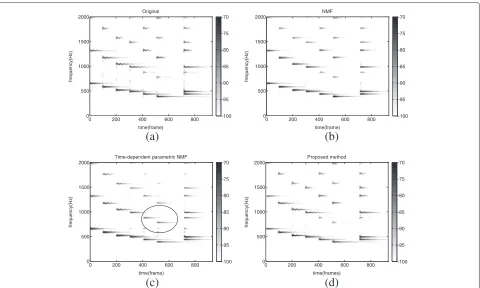
Figure 4Six vibrating notes presented in the following order: E5, D5, C5, B4, A4, G4, and A4+B4.The spectrograms of(a)the original,(b)the harmonic-constrained NMF [13],(c)time-depend parametric NMF [5], and(d)the proposed method of G4, A4, B4, C5, D5, and E5 notes that include vibrato.
by the the results ofW andHobtained in the previous update iteration, i.e.,CWis updated byCW(l+1)=W(l). The intensity matrix is subsequently calculated. Similar to (13), the intensity matrix for the (l−m+1)th frame, the (l−m+2)th frame,. . ., and thelth frame is obtained as
H(l)=W(l)W(l)+γI−1(W(l)V(l)+γCH). (27)
Subsequently, the intensity information corresponding to the template matrix of the (l+1)th frame is computed as
h(l+1)= W(l+1)W(l+1)+γI−1 ×W(l+1)v(l+1)+γCH(l+1)
.
(28)
In (28),CH(l+1) can be set toH(l) because it is assumed that the intensity cannot change abruptly. The forgetting factorsλandγ can determine the effects of old frames. They are both set to 100 in this work. The time-varying template matrix and the corresponding intensity matrix can be calculated alternatively when a new input frame is added. Further details and the overall procedure are presented in the following section.
Analysis procedure
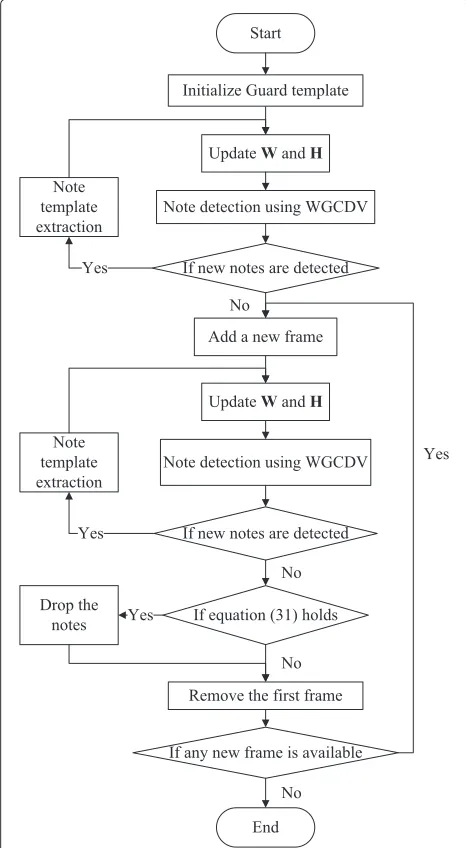
As shown in Figure 1, the analysis system started from only one template initialized with random values, which is called Guard template. An initialization loop determines all possible note templates and evaluates the template matrix and the intensity matrix in the same time. After the initialization loop, the main loop takes care of the new frame addition, the new note template detection, the offset note template evaluation, and the old frame removal. For the new note template detection, we used the weighted greatest common divisor and vote (WGCDV) [28] method to detect new tones in Guard template by using a floating point GCD lookup table and a frame-based correction method. WGCDV estimates F0 in three steps: (a) locates the peaks of the frequency response of
Table 1 Objective performance comparison
SIR SAR SDR
NMF with harmonic constraints [13] 26.08 6.19 6.13
Time-dependent parametric NMF [5] 23.06 6.78 6.56
Proposed method 29.08 6.74 6.70
Table 2 Transcription results 1
Accuracy (Acc), % Precision (P), % Recall (R), % F-measure (F), %
NMF with harmonic constraints [13] 79.64 86.27 90.97 88.56
Time-dependent parametric NMF [5] 81.94 86.87 93.53 90.08
RR without online scheme [14] 77.45 78.81 97.82 87.29
Proposed method 83.36 97.28 85.35 90.93
Transcription report of the proposed work in the analysis of Kuijken’s recording on BWV 1005 No. 3.
the current frame and regards them as possible partials, (b) finds a likely GCD value for each partial pair using a lookup table method, (c) weights the likely GCD val-ues and voting the deterministic GCD according to the spectral energy. Once a harmonic structure is recognized within Guard template at the current frame, these har-monic peaks will be extracted from Guard template and a corresponding new template is added to the original template matrix.
Figure 2 shows an example of extracted harmonic struc-tures of C4 and D4 notes from the original Guard template by using a mask function,S. As shown in Figure 2, each mask function represented in a dashed line can be defined by a harmonic set corresponding to the detected note as follows:
Sj= N
p=1
I(pfj−,pfj+), (29)
whereI(α,β) = 1 in the interval [α,β]; otherwise, it is 0.fj is the fundamental frequency of thejth recognized tone, andpis the partial index.is set at 3% of the partial frequency,pfj.
Subsequently, the new template is computed by
Wlj=Slj⊗Wl0, (30)
whereSlj is the mask function of frame-l. In (30),Wl0 =
[Wl01Wl02. . .Wl0n]T represents the original Guard
tem-plate of frame-l, and⊗is the element-wise multiplication. The number of templates,r, is equal toj+1. The proce-dure described in the previous section is performed again for frame-(l+1) to obtain the new template matrix and intensity matrix.
A re-estimation of the pitch of each note based on the updated template matrix is necessary because all tem-plates, as well as pitches, can vary by frame. Consequently, the mask functions of all templates must be updated. Because each template contains only one harmonic set, CW(l+ 1) in Equation 13 is computed byS(l)⊗W(l), where S(l) =
Sl
0Sl1. . .Slr
T
. Based on Equation 5, the iterative update procedure forcesW(l+1)to retain har-monic structures for all the notes as much as possible, depending on the regularization parameter,λ.
Finally, a musical note is muted eventually after it is played for a while. In this study, a note is removed from the analysis process by removing its template and the cor-responding intensity information. A note can be removed if
l−k
q=l
|hqi| ≤T, 1≤i≤r. (31)
That is, theith note is removed after frame-lif Equation 31 holds.Tis empirically set to 0.1 in this work. By removing such notes, the computation complexity is also reduced.
Experiments
Database
Two excerpts are generated by a MIDI synthesizer for pre-liminary tests. Firstly, a synthetic chirp signal is generated, and its pitch varies from C5 to A5 in 1,000 time frames. The second test uses a signal with vibrating notes includ-ing six notes in the followinclud-ing order: E5, D5, C5, B4, A4, G4, and A4+B4. A vibrato effect is generated by setting proper MIDI commands. All parameter sets are the same as those in the previous test. Moreover, two recordings, the BWV 1005 No. 3 performed by Kuijken [23] and RWC database
Table 3 Transcription results 2
Accuracy (Acc), % Precision (P), % Recall (R), % F-measure (F), %
NMF with harmonic constraints [13] 56.22 57.09 97.64 71.98
Time-dependent parametric NMF [5] 74.11 75.29 97.94 85.13
RR without online scheme [14] 49.27 50.71 94.93 66.01
Proposed method 76.26 85.99 87.08 86.53
C038 [24], are used to evaluate the accuracy of all meth-ods, as proposed in [29]. The former contains 587 notes that are manually annotated as the ground truth. The lat-ter contains 1,745 notes whose ground truth is provided from the syncRWC annotations [30].
Parameters
The window size is 4,096 samples, the hop size is 256 samples, and the sampling rate is 44.1 kHz. A Hamming window and 4096-FFT are subsequently applied.
Performance evaluation
An objective measure for evaluating the performance of a source separation method proposed in [31] is adopted for the following discussion. To compare dif-ferent approaches, the signal-to-distortion ratio (SDR), the artifact ratio (SAR), and the signal-to-interference ratio (SIR) are computed with each note as the target. In this work, we considered each note as a sep-arate source. The SIR, SAR, and SDR values of these notes are averaged respectively.
To evaluate the performance of music transcription, we chose note-level metrics with a tolerance of one window before and after the reference onset time. Overall accuracy is defined as
Acc= TP
FP+FN+TP, (32)
where TP (true positives) is the number of correctly tran-scribed voiced notes (within a quarter tone distance in frequency and 50-ms onset distance in time), FP (false positives) is the number of unvoiced notes transcribed as voiced, and FN (false negatives) is the number of voiced notes transcribed as unvoiced. This measure is defined for note-based onset evaluation in this case and is bounded by 0 and 1, with 1 corresponding to perfect transcription. Another metric, calledF-measure, is defined as
F=2 P·R
P+R, (33)
whereas
P= TP
TP+FP (34)
R= TP
TP+FN, (35)
wherePandRrepresent the precision rate and recall rate, respectively.
Results
The first preliminary test: glissando
The first part of this section presents a comparison of the proposed method by using a glissando signal to the conventional NMF method with harmonic constraints on matrix W [32] and the time-dependent parametric
Table 4 Complexity comparison
Numbers of matrix multiplications Big-O
Update rules (m−k+1)(2nrk+2r2n+2r2k+2rn+2rk) O(mkrn) of NMF
Proposed (m−k)(2r2n+9rn+2r3+15r2+4r) O(mr2n) update rules +(2r2n+2krn+4r3+(2k+2)r2)
The complexity of the proposed update rule is compared with the NMF update method.
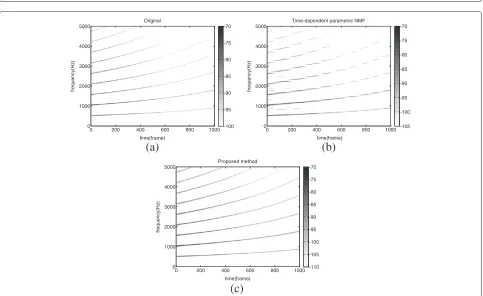
NMF method [5] that uses the same harmonic struc-ture for different notes of the same instrument. For the time-dependent parametric NMF, 10 templates are used to cover the possible pitch range of the signals. For the proposed method, it started with the initialized Guard template, and the required number of templates is determined adaptively during the analysis process. Figure 3a shows the original spectrogram of the note, and Figure 3b,c shows the reconstructed spectrograms that resulted from the time-dependent NMF method and the proposed method, respectively. In [5], the pitch of a template is constrained to vary within a fixed semitone; therefore, a number of discontinuous effects occurred among the templates, as shown in Figure 3b. Moreover, 10 note templates are required for the time-dependent NMF approach in this case. Because the pitch of a tem-plate is allowed to vary freely in the proposed method, only one template is required to represent the chirp signal. This accounts for the superior performance of the pro-posed method in which the signal varies more than one semitone.
The second preliminary test: vibrato
In this case, a synthetic signal with six vibrating notes appearing in the following order, E5, D5, C5, B4, A4, G4, and A4+B4, is used. Figure 4 shows the simulation results. Figure 4b shows that the harmonic-constrained NMF is limited in presenting the signal with frequency modula-tion because of the consistency of the templates. As dis-cussed in [13], separation performance can be improved by increasing the number of templates for each note. The time-dependent parametric NMF performs efficiently in signal that includes vibrato effects; the result is shown in Figure 4c. The only disadvantage is that the ampli-tudes of the partials are not determined independently
from time to time, as shown in the circled region of Figure 4c. The amplitude set trends toward the average among all played notes. The spectrogram obtained from the proposed method is closer to the original spectro-gram than those obtained from NMF methods. Table 1 shows the separation results of all methods. The time-dependent NMF experiences a number of interference errors from the additional partial energy shown in the circled region of Figure 4c. By considering the SAR, the proposed method preserves most of the vibrato effects in all cases, whereas the harmonic-constrained NMF pre-serves only steady partial energies. Based on the success of both measures, the proposed method scores the highest SDR as well.
Main experiments
The system is tested on the complete recordings of BWV 1005 No. 3 played by Kuijken [23] and 24 Caprices op. 1 no. 24 in A minor played by Paganini from RWC database [24]. A total of 587+1,745 notes are annotated as the ground truth. The analysis is performed blindly; however, pitches outside the possible range are excluded. Additional score information is also excluded from the process.
Table 2 shows the results of analyzing Kuijken’s record-ing. It indicates that 501 notes are correctly detected (TP), 14 detected notes are not in the score (FP), 86 of 587 notes are not detected (FN), 18 notes are missed because their octave notes are too strong, 4 notes are missed because
(a)
(b)
(c)
their perfect fifth notes are too strong, 56 notes remain in Guard templates because the automatic detection method fails to extract them from Guard template, and 8 notes are mixed with other detected notes because their pitches are close to those of certain high intensity notes. Hence, the following results are obtained: precision rate= 501/(501+14)=97.28%, recall rate=501/(501+86)= 85.35%, accuracy=501/(501+14+86) = 83.36%, and F-measure=90.93%.
The second recording contains more complicated per-forming styles with larger amount of notes than the first one. False alarms are enormously increased compared
with the first recording especially in NMF case, since the energies of overlapping partials of voiced notes and unvoiced notes interfere each other in the intensity matrix H. The performance of the proposed method maintains balance between precision and recall rate. Its number of unvoiced notes transcribed as voiced and voiced notes transcribed as unvoiced is lower than NMF and TD-NMF. That shows our approach is more stable than NMF and TD-NMF.
In Tables 2 and 3, the recursive regularization method without the online scheme means that the sliding frame size is maximized to the whole signal duration. It is
(a)
(b)
(c)
notable that, according to accuracy and F-measure of the transcription report, the results of this conven-tional recursive regularization method provides a baseline performance of the proposed algorithm. This work takes advantages of high-speed property of recursive regular-ization and improves the performance by imposing the proposed online scheme.
Complexity
In addition, the complexity of the proposed update rules is compared with the NMF as shown in Table 4. Letnbe the number of frequency bins,mbe the number of frames, andrbe the number of templates. Supposeminput frames are set to be processed and onlyk frames are analyzed for each iteration, wherek < m. For each iteration, the complexities of two update rules are O(krn) and O(r2n).
The complexity of the proposed update rules is similar to traditional NMF update rules in the case of regarding Euclidean distance as the cost function. Under the similar computational complexity, the proposed method is able to handle the time-varying music features and offer better results.
Performance analysis
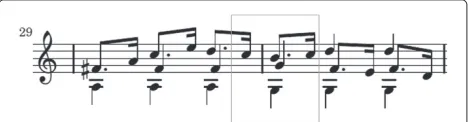
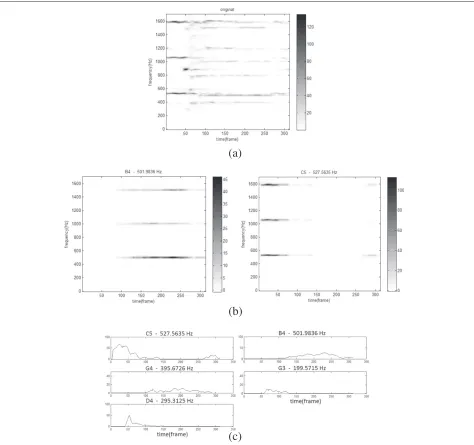
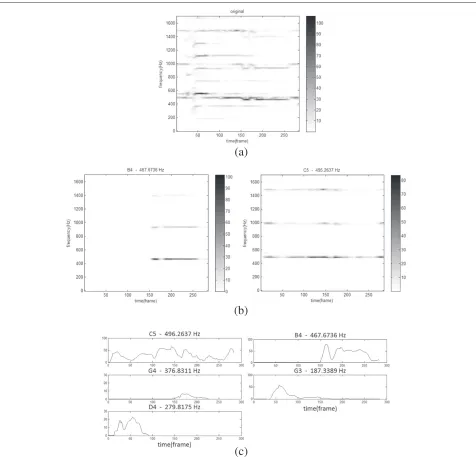
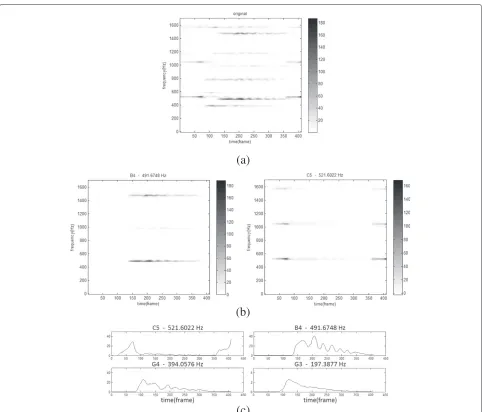
Here, the proposed method attempts to analyze the per-formances of three violinists of different generations: Arthur Grumiaux, Sigiswald Kuijken, and Hilary Hahn. The signals are extracted from their CDs [23,25,26]. The following passages excerpted from BWV 1005 No. 3 are used to compare their performances. The musical score is shown in Figure 5. This study analyzes the signals of the short period during five notes in the bracket. The
(a)
(b)
(c)
original spectrograms and the analysis results are shown in Figures 6, 7, and 8.
According to the figures, a notable difference is that the pitches of Kuijken’s performance are one semitone lower than those of the other violinists’ since the instruments are usually used in historically informed performances (HIP), and musicians usually follow the tradition of the period during which the music is composed. Secondly, violin-ists use vibrato techniques frequently. We can observe the vibrato effects of B4 note in the performance played by Hahn, as shown in Figure 8, compared to those played by Grumiaux and Kuijken, as shown in Figures 6 and 7, respectively. Thirdly, Kuijken’s style is distinct. He freely used numerous trills, which were not indicated in the score of Bach’s solo violin works. This can be viewed in Figure 7b,c. As shown in Figures 6c and 8c, C5 is off and B4 is on. After B4 continues for a period of time, it is off and C5 is on again. Moreover, C5 is the strongest note in Grumiaux’s playing, whereas B4 is the most prominent note in Hahn’s playing. Comparatively, Kuijken played equal intensity on these two notes. Hahn’s recording sounded brighter than the other two recordings since the spectral energy of the G3 note in Hahn’s record-ing is larger than the others’. This may be caused by the decision of her balance engineer since the lower notes are weak in amplitude in all of her recordings. A notable mis-take is also observed, that is, both Kuijken and Grumiaux played an extra D4 note, which is not in the original score. This may be a coincidence, or it is possible that they used a different score edition. Finally, their tempi also differ con-siderably. Kuijken used 1.68 s (290 frames) to finish the short passage, whereas Grumiaux used 1.83 s, and Hahn used 2.37 s. Hahn’s tempo is 40% slower than Kuijken’s. As an HIP musician, Kuijken played faster than the other violinists.
Conclusions
A recursive regularization analysis method is proposed to analyze acoustic recordings of solo violin works. Similar to NMF, the proposed method factorizes the matrix formed with the Fourier magnitude coefficients of multiple frames into a template matrix and an intensity matrix. The frame-by-frame-based procedure is designed for time-varying musical signals, such as solo violin recordings. The sys-tem of equations is updated by adding a new frame and dropping an old frame to avoid the problems of most NMF methods when the signal varies substantially. The pro-posed method is compared to the time-dependent NMF method by using two synthesized signals and exhibited superior SDR performances. The objective performance of the proposed method is also verified. For Kuijken’s recording of BWV 1005 No. 3, the precision rate is 97.28%, the recall rate is 85.35%, and theF-measure is 90.93%. For a larger recording database from RWC C038, the precision
rate is 85.99%, the recall rate is 87.08%, and theF-measure is 86.53%. It shows the stability of our approach. Finally, the proposed method is used to analyze the recordings of J.S. Bach’s BWV 1005 No. 3 by three violinists, that is, Arthur Grumiaux, Sigiswald Kuijken, and Hilary Hahn. The results show that the time-varying characteristics of most notes appearing in the recordings can be tracked efficiently. The styles of the three violinists are easily distinguished through the separated results.
We are currently investigating possible approaches to improve the extraction of new notes from Guard template. An octave error may occur in our case because of the over-lapping partials of the octave notes. In addition, because of the basis of the least-squares method, the performance of the proposed method with respect to signals of small amplitude, such as higher partials, is not as effective as NMF using other types of cost functions such as KL and IS divergences. The derivation of other cost functions into the proposed method may improve performance. More-over, a supervised learning procedure can be introduced if note activations are available. Note activations can not only eliminate pitch detection errors but also constrain the intensity matrix for each note. As our approach pre-serves more musical characteristic details in the note level, nearly perfect decomposition is possible if it incorporates with more constraints, such as timbre, inharmonic bias, and phase. Therefore, many music information retrieval tasks are suitable to take our approach as a preprocessing, for example, player identification or expressive remix.
Competing interests
The authors declare that they have no competing interests.
Acknowledgements
The authors would like to thank the National Science Council, ROC, for its financial support of this work, under contract no. NSC98-2221-E-006-158-MY3.
Received: 17 July 2013 Accepted: 16 May 2014
References
1. DD Lee, HS Seung, Learning the parts of objects by non-negative matrix factorization. Nature.401(6755), 788–791 (1999)
2. P Smaragdis, JC Brown, Non-negative matrix factorization for polyphonic music transcription, inProc. IEEE Workshop on Applications of Signal Processing to Audio and Acoustics(New Paltz, NY, 19–22 Oct. 2003), pp. 177–180
3. T Virtanen, Monaural sound source separation by nonnegative matrix factorization with temporal continuity and sparseness criteria. Audio Speech Lang. Process. IEEE Trans. on.15(3), 1066–1074 (2007) 4. CT Lee, YH Yang, H Chen, Automatic transcription of piano music by
sparse representation of magnitude spectra, inIEEE International Conference on Multimedia and Expo (ICME)(Taipei, Taiwan, 11–15 July 2011), pp. 1–6
5. R Hennequin, R Badeau, B David, Time-dependent parametric and harmonic templates in non-negative matrix factorization, inProc. of the 13th Int. Conference on Digital Audio Effects(Graz, Austria, 6–10 Sept. 2010) 6. M Nakano, JL Roux, H Kameoka, Nonnegative matrix factorization with
on Latent Variable Analysis and Signal Separation(St. Malo, France, 27–30 Sept. 2010), pp. 149–156
7. R Hennequin, Scale-invariant probabilistic latent component analysis, in Proc. IEEE Workshop on Applications of Signal Processing to Audio and Acoustics(New Paltz, NY, 16–19 Oct. 2011)
8. P Smaragdis, Relative-pitch tracking of multiple arbitrary sounds. J. Acoust. Soc. Am.125, 3406–3413 (2009)
9. MIREX, Music Information Retrieval Evaluation eXchange (MIREX.) http:// www.music-ir.org/mirex/wiki/MIREX_HOME. Accessed 19 May 2011 10. N Bertin, R Badeau, E Vincent, Enforcing harmonicity and smoothness in
Bayesian non-negative matrix factorization applied to polyphonic music transcription. Audio Speech Lang. Process. IEEE Trans. on.18(3), 538–549 (2010)
11. C Yeh, A Roebel, X Rodet, Multiple fundamental frequency estimation and polyphony inference of polyphonic music signals. Audio Speech Lang. Process. IEEE Trans. on.18(6), 1116–1126 (2010)
12. WC Chang, WY Su, C Yeh, A Roebel, X Rodet, Multiple-F0 tracking based on a high-order HMM model, inProc. of the 11th Int. Conference on Digital Audio Effects (DAFx-08)(Espoo, Finland, 1–4 Sept. 2008)
13. TM Wang, YL Chen, WH Liao, A Su, Analysis and trans-synthesis of acoustic bowed-string instrument recordings–a case study using Bach cello suites, inInternational Conference on Digital Audio Effects (DAFX) (IRCAM, Paris, France, 19–23 Sept. 2011)
14. M Unser, A Aldroubi, M Eden, Recursive regularization filters: design, properties, and applications. IEEE Trans. on Pattern Anal. Mach. Intell. 13(3), 272–277 (1991)
15. F Nesta, P Svaizer, M Omologo, Convolutive BSS of short mixtures by ICA recursively regularized across frequencies. Audio Speech Lang. Process. IEEE Trans. on.19(3), 624–639 (2011)
16. SP Kim, WY Su, Recursive high-resolution reconstruction of blurred multiframe images. Image Process. IEEE Trans. on.2(4), 534–539 (1993) 17. J Mairal, F Bach, J Ponce, G Sapiro, Online learning for matrix factorization
and sparse coding. J. Mach. Learn. Res.11, 19–60 (2010)
18. F Wang, C Tan, AC König, P Li, Efficient document clustering via online nonnegative matrix factorizations, inProc. SIAM , Hilton Phoenix East/Mesa (Mesa, USA, 28–30 Apr 2011)
19. Z Duan, G Mysore, P Smaragdis, Online PLCA for real-time semi-supervised source separation. Latent Variable Anal. Signal Sep.7191, 34–41 (2012) 20. A Lefevre, F Bach, C Févotte, Online algorithms for nonnegative matrix factorization with the Itakura-Saito divergence, inProc. WASPAA(IEEE, New Paltz, NY, 16–19 Oct. 2011), pp. 313–316
21. E Vincent, N Berlin, R Badeau, Harmonic and inharmonic nonnegative matrix factorization for polyphonic pitch transcription, inProc. of International Conference on Acoustics, Speech and Signal Processing(IEEE, Las Vegas, Nevada, USA, 2008), pp. 109–112
22. PO Hoyer, Non-negative matrix factorization with sparseness constraints. J. Mach. Learn. Res.5, 1457–1469 (2004)
23. S Kuijken,Bach: Sonatas & Partitas, BWV 1001-1006, CD 1(Deutsche Harmonia Mundi, 1990)
24. M GOTO, RWC Music Database. http://staff.aist.go.jp/m.goto/RWC-MDB/. Accessed 13–17 Oct. 2002
25. A Grumiaux,Bach: Sonatas & Partitas (BWV 1001-1006), CD 1(Philips, 2006) 26. H Hahn,Hilary Hahn plays Bach(Sony, 1997)
27. MA Woodbury, Inverting modified matrices. Memorandum Rep.42, 106 (1950)
28. YS Siao, WC Chang, WY Su, Pitch detection/tracking strategy for musical recordings of solo bowed-string and wind instruments. J. Inf. Sci. Eng. 25(4), 1239–1253 (2009)
29. S Dixon, On the computer recognition of solo piano music, inProceedings of Australasian Computer Music Conference(Brisbane, Australia, 17 Jul 2011), pp. 31–37
30. M GOTO, Music synchronization for RWC Music Database (classical music). http://staff.aist.go.jp/m.goto/RWC-MDB/AIST-Annotation/ SyncRWC/. Accessed 24 Sept. 2010
31. E Vincent, R Gribonval, C Févotte, Performance measurement in blind audio source separation. IEEE Trans. on Audio Speech Lang. Process. 14(4), 1462–1469 (2006)
32. S Ewert, M Müller, Using score-informed constraints for NMF-based source separation, inProc. IEEE International Conference on Acoustics, Speech and Signal Processing (ICASSP)(Kyoto, Japan, 25–30 Mar 2012)
doi:10.1186/s13636-014-0025-6
Cite this article as:Linet al.:Musical note analysis of solo violin recordings using recursive regularization.EURASIP Journal on Audio, Speech, and Music Processing20142014:25.
Submit your manuscript to a
journal and benefi t from:
7Convenient online submission
7 Rigorous peer review
7Immediate publication on acceptance
7 Open access: articles freely available online
7High visibility within the fi eld
7 Retaining the copyright to your article