R E S E A R C H
Open Access
Inter- and transdisciplinary perspective on the
integration of ecological processes into
ecosystem services analysis in a mountain region
Robert Huber
1*, Simon Briner
2, Harald Bugmann
3, Ché Elkin
3, Christian Hirschi
4, Roman Seidl
5, Rebecca Snell
3and Andreas Rigling
1Abstract
Introduction:Ecosystem goods and services (EGS) studies have had little impact on policy processes and
real-world decision-making due to limited understanding of the interactions and feedbacks among ecological, social and economic processes. Here we present an inter- and transdisciplinary analysis of global change impacts on EGS provision in a European mountain region. Our aim is to evaluate the projected influence of ecological, economic and social drivers on future EGS provision and to show possible ways to address the predominant limitations of EGS studies.
Methods:The integrated findings from ecological experiments, mechanistic models of landscape dynamics, socio-economic land-use models, policy analysis and transdisciplinary stakeholder interactions are presented consecutively. Four regionally downscaled global change scenarios, for a case study region near Visp, Switzerland (350 km2), were used to examine the impacts of climate and socio-economic changes on four ecosystem services, i.e., food provision, timber production, net greenhouse gas emissions and protection from natural hazards.
Results:Our simulation results reveal four key aspects that influence the future provision of mountain EGS. First, we show the high spatial and temporal heterogeneity of EGS provision even in a small case study region. Second, we find that climate change impacts are much more pronounced for forest EGS, while changes to agricultural EGS result primarily from shifts in economic conditions. Third, our modeling results reveal the complex trade-offs associated with the different scenarios. Fourth, simulations illustrate the importance of interactions between environmental shifts and economic decisions. We discuss our simulation results with respect to both existing policy networks and transdisciplinary stakeholder interactions.
Conclusion:We describe a framework based on experiments and observations that effectively supports the integration of ecological processes into an integrative modeling chain of EGS provision in mountain regions, the political decision-making process and also transdisciplinary stakeholder interactions.
Keywords:Interdisciplinary research; Ecosystem services; Modeling; Scenario analysis; Policy process; Transdisciplinary research; Mountain regions
* Correspondence:[email protected] 1
Forest Dynamics, Swiss Federal Research Institute WSL, Zürcherstrasse 111, CH-8903 Birmensdorf, Switzerland
Full list of author information is available at the end of the article
Introduction
The concept of ecosystem goods and services (EGS) pro-vides a framework to analyze relationships between society and ecology in complex social-ecological systems (Reyers et al. 2010; MEA 2005). While there is no universally ac-cepted typology of EGS (Haines-Young and Potschin 2009; Braat and de Groot 2012; Gómez-Baggethun et al. 2010), most EGS studies combine an evaluation of biophysical structures and processes with an evaluation of human, so-cial and economic components that determine EGS bene-fits or values (Braat and de Groot 2012). Although a wide range of EGS studies have used this approach (reviewed in Seppelt et al. 2011), a challenge still remains, namely the effective integration of ecological, economic and social components into an internally consistent framework that can be used to project future changes in EGS and their response to different driving forces.
For many stakeholders, including government agencies (Euliss et al. 2011), it is important to have robust and consistent approaches when assessing the effect of manage-ment actions on ecological processes and changes in EGS. Such approaches, however, are confronted with four main challenges. First, the ecological understanding of EGS is often limited (Kremen 2005), and there is a lack of quanti-tative relationships among biodiversity, ecosystem compo-nents and processes and services (de Groot et al. 2010). In addition, even if a mechanistic understanding of these processes exists, feedbacks between and within social and ecological systems are often ignored (Nicholson et al. 2009) or prone to inconsistencies (Cumming et al. 2005). Second, EGS studies often neglect the economic aspects of margin-ality, ecosystem transitions and substitution effects (Fisher et al. 2008; Bateman et al. 2011; Farley 2012), and some-times fail to consider socially relevant and stakeholder-oriented approaches (Cowling et al. 2008; Reed et al. 2009). Third, valuation and monetization of EGS must be placed in a relevant socio-cultural context (Braat and de Groot 2012; Nelson et al. 2009) to ensure that the economic valu-ation of EGS is accurate and reflects regional characteristics (de Groot et al. 2012; Hein et al. 2006; Schaeffer 2008; Polasky and Segerson 2009). Fourth, while the EGS view-point facilitates an analysis of ecological processes from the ecological systems perspective, various scale differences and cross-scale dynamics (Young 2002; Cash et al. 2006) still make it difficult to obtain an integrative overview of ecological and human systems.
Thus, due to a limited understanding of the interactions and feedbacks among ecological, social, economic and political processes, EGS studies have, historically, had little impact on policy processes and real decision-making (Daily et al. 2009; Carpenter et al. 2009). Consequently, a wide range of inter- and transdisciplinary frameworks have emerged in recent years, not only to analyze EGS in the context of social-ecological systems (e.g., Chapin et al.
2006; Wainger and Mazzotta 2011; Diaz et al. 2011; Oteros-Rozas et al. 2012; Polasky and Segerson 2009; Col-lins et al. 2011; Rounsevell et al. 2010; Kremen et al. 2007; Seidl et al. 2013), but also to meet the challenge of defining indicators that allow an understanding of the feedbacks and interactions in EGS analyses (van Oudenhoven et al. 2012; Müller and Burkhard 2012; Wainger and Mazzotta 2011). In addition, modeling studies that link ecological process models with socio-economic land-use models and incorp-orate feedback mechanisms (Claessens et al. 2009; Bithell and Brasington 2009; Schreinemachers and Berger 2011; Gibon et al. 2010; Huber et al. 2013a) have become state-of-the-art in ecosystem services analysis.
This inter- and transdisciplinary study is part of the
“Mountland” project, where we address global change im-pacts on EGS in three different European mountain regions (Huber et al. 2013b). The aim of the project was to identify land-use practices and alternative policy solutions that ensure the provision of EGS from agricultural land use and forestry in mountain regions subject to climate and land-use changes. The main results from this project, which was conducted in the three different case study regions, are summarized and synthesized in Huber et al. (2013c). The simulation results presented here complement this work by providing an overview of our integrative assessment consid-ering all four scenario families in the Special Report on Emission Scenarios (SRES) from the Intergovernmental Panel on Climate Change (IPCC 2000). The value of this contribution lies in the illustration of a successful applica-tion of inter- and transdisciplinary research from joint sce-nario development to simulation results and policy analysis in one case study region. We analyze and describe the spatial and temporal variance and similarities between regionally downscaled SRES and the four associated climate scenarios with regard to the provision of four mountain EGS (i.e., food provision, timber production, net green-house gas emissions and protection from natural hazards) in the case study region Visp, Switzerland. The comprehen-sive nature of our analysis allows us to assess how and where within the landscape climate and socio-economic factors influence EGS provision. The integration of our interdisciplinary results as well as transdisciplinary stake-holder interactions permit us to illustrate the importance of considering ecological processes throughout an integrative assessment of EGS provision. The discussion illustrates how we used inter- and transdisciplinary research to over-come limitations and to further our understanding of the interlinked ecological, social and economic processes in EGS studies.
Data, methods and interdisciplinary workflow Case study region
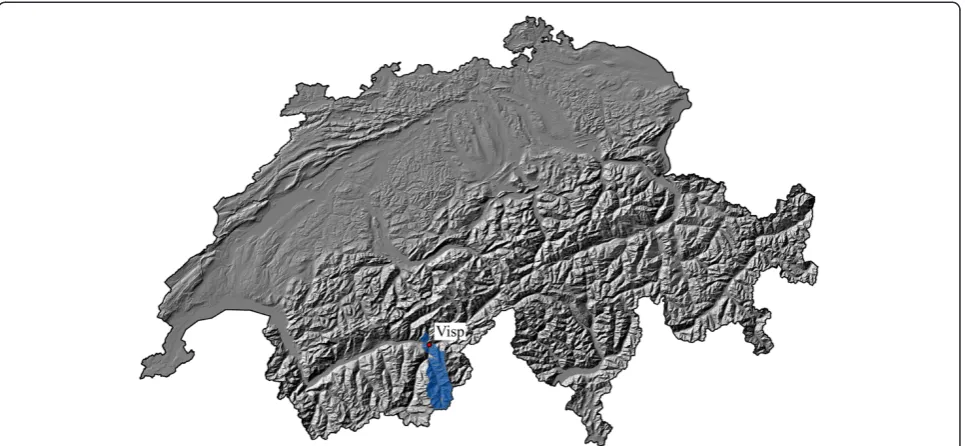
the dynamics and diversity of mountain protection forests and grasslands and the influence of disturbances, in par-ticular fire, insect and pathogen damage brought about by climate change (Rigling et al. 2013). The study area covers 350 km2 and has 15,000 inhabitants. Visp is a booming urban hotspot with industry and international traffic corri-dors. Saas Fee and Visperterminen are important destina-tions for summer and winter tourism. The Baltschieder valley is a remote, uninhabited Alpine side-valley with no infrastructure. Unproductive land accounts for 62% of the area, while 20% of the area is covered by forest and about 16% is used for agriculture. More than 98% of this agricul-tural land is grassland, and agriculagricul-tural activities focus mainly on milk and meat production. Winter wheat and corn are the main crops cultivated in the bottom of the valley around Visp. On average, individual farmers cultivate less than 10 ha of agricultural land and keep around seven livestock units. Agricultural land use and forestry play an important role in the provision of recreation areas and hab-itats for plants and wildlife. Forest management is mainly in the hands of regional forest managers, with the primary aim of maintaining healthy forests that provide protection from rock fall and avalanche hazards. Timber production is of secondary importance due to high labor cost and low timber prices.
Methodologies
The combination of different methodological approaches within the project allows us to produce a robust evalu-ation of future EGS provision in mountain regions under global change, taking interactions between the eco-logical, socio-economic and policy domains into account
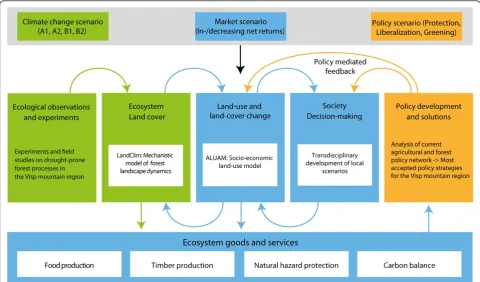
(Huber et al. 2013b). The main research findings from the Mountland project have been published in different interdisciplinary and disciplinary manuscripts (see Table 1). Thus, the workflow presented here does not describe every method in detail but instead focuses on the conceptual and practical link between the method-ologies and the description of the interacting simulation frameworks. Figure 2 shows the general framework and the iterative procedure followed by the different research groups. More information on the technical integration of models and the corresponding assumptions can be found in the corresponding articles cited in Table 1.
Scenario development
We began our inter- and transdisciplinary research by formulating “context scenarios.” In these scenarios, the consequences of global change at climate, market and policy levels are downscaled to the Visp region and sum-marized in regionally specific storylines consistent with the four IPCC SRES scenarios (Walz et al. 2013). We employed a formal technique of scenario construction which combines expert judgment with a quantitative, indicator-based selection algorithm. The resulting sce-narios reflect the potential development pathways and interactions of major drivers for ecosystem service man-agement and provide the input for a model-based ana-lysis of ecosystem development and land-use decision-making.
Ecological experiments and modeling
To integrate knowledge of ecological processes into the Mountland model chain (green fields in Figure 2),
Table 1 Research methodologies applied in the Mountland project
Research discipline and focus Methodology Description References
Ecology (impact of global change on forest processes and ecosystem goods and services)
Experiments Afforestation (irrigated/non-irrigated, altitudinal gradients, transplantations)
Eilmann et al.2010,2011
Rain-out shelter (under shelter/open land) Eilmann and Rigling2012
Rigling et al.2013
Thinnings (understory/overstory removal)
Monitoring National forest inventory and plots from the long-term ecosystem monitoring program
Weber et al.2008; Wermelinger et al.2008; Zweifel et al.2009; Rigling et al.2010; Heiniger et al.
2011
Additional temporal monitoring of plots (e.g., for insects, mistletoe, pathogens)
Modeling Forest dynamics and future forest states were simulated using the landscape-scale model LandClim
Elkin and Bugmann2010; Elkin et al.2012,2013
Socio-economic (land-use change analysis under global change)
Modeling Modeling concomitant effects of climate and land-use change on the provision of ecosystem goods and services using an activity-based, spatially explicit economic land allocation model
Briner et al.2012,2013a,b
Formative scenario analysis
Constructing consistent regional multi-scale scenarios by transdis-ciplinary processes
Brand et al.2013
Policy analysis (identification of best accepted policy strategies)
Policy network and policy preferences analysis
Network structures and governance modes in adaptation policies in the Canton of Valais; role of network governance in enhancing sustainable development in mountain areas
Ingold et al.2010; Hirschi
2010
Network dynamics and policy preferences in Swiss agricultural and forest policy
Hirschi et al.2013
findings from local ecological field studies and drought experiments (Brunner et al. 2009; Dobbertin et al. 2010; Eilmann and Rigling 2012; Eilmann et al. 2009, 2013; Rigling et al. 2013) were analyzed to improve the exist-ing mechanistic forest model LandClim (Schumacher et al. 2004). LandClim is a spatially explicit process-based model that incorporates competition-driven forest dynamics and landscape-level disturbances to simulate forest dynamics at a landscape scale. LandClim was designed to examine the impact of climate change and forest management on forest development and structure (Schumacher and Bugmann 2006). The model simulates forest growth in 25 × 25 m cells using simplified versions of tree recruitment, growth and competition processes. Individual cells are linked by the spatially explicit processes of seed dispersal, landscape disturbances and forest management. Forest growth is determined by climatic parameters, soil properties, topography, and large-scale disturbances, as well as forest management. We used our findings from the ecological field studies and drought experiments in the Visp region to calibrate and validate the LandClim simulations. Thus, empirical information on the effects of climate change on drought-prone forests in the Visp region (e.g., germin-ation, growth and mortality of different tree species) was integrated into LandClim. This improved the ability of LandClim to simulate forest dynamics and project the impact of climate and land-use change on the spatially explicit provision of EGS at the landscape scale (Elkin et al. 2012).
Socio-economic modeling
The simulation results from LandClim were used as input for the analysis of socio-economic impacts (blue fields in Figure 2). The economic land-use optimization model ALUAM (Briner et al. 2012) simulates the competition between different agricultural land uses and forestry. The model results explicitly consider feedbacks and trade-offs between the economic gains from primary production and the provision of EGS under different scenarios (Briner et al. 2013a, b). The simple, modular structure of ALUAM facili-tates a linkup of economic aspects with ecological and biophysical elements and the integration of datasets from different sources. Since the model also permits the intro-duction of possible new activities (e.g., irrigation), it is suit-able for the simulation of strategies for adaptation to global change. In ALUAM, we assume that economic agents are profit maximizers. Combined with limited resources, repre-sented by model restrictions, this normative model ap-proach incorporates the fundamental economic problem at the margins, which is to make the most of limited resources (Buysse et al. 2007).
In ALUAM, decisions at the parcel, farm and regional level are optimized in such a way that aggregated land
rent is maximized. At the parcel level, decisions concern land-use activities such as crop production, grassland in-tensity or timber production. Farm-level decisions relate to animal husbandry and flows of fodder and nutrients. Land use links the parcel level with livestock activities through fodder and nutrient balances. At the regional level, resources such as hirable workforce and number of animals available for grazing on summer pastures are only available to a limited extent and are therefore balanced over the whole region. Resource demands of activities at lower levels have to be evaluated to calculate these regional balances. A comparative static approach was used to assess the impact of our four scenarios in 2050 and 2080. We would refer to Briner et al. (2012, 2013a) for details regarding validation and sensitivity analysis of the model simulation.
A crop simulation model was used to integrate infor-mation concerning the impact of climate change on agri-cultural crop yields into ALUAM. This model calculates future yields of relevant crops using data on optimal and absolute crop growing conditions from the Food and Agriculture Organization (FAO) of the United Nations (FAO 2007). We fit a relative crop yield curve for temperature and precipitation values using an incom-plete beta distribution. These species-specific crop yield curves serve to calculate the relative yield of crops and grassland for each landscape cell (100 × 100 m) in the case study landscape based on monthly precipitation and temperature values.
Transdisciplinary process
from applying agent-based techniques and use compara-tive static results. Given the long timeframe considered in our simulations (2080), the use of existing preferences is implausible.
Policy assessment
Finally, the model chain also allows for the integration of the knowledge on relevant policy issues studied (or-ange fields in Figure 2). We developed a policy-oriented indicator system for agricultural ecosystem services that can be linked to model-based scenario assessments (Hirschi et al. 2013). Specifically, we used policy network analysis to investigate the structural configuration of the relevant policy subsystems and analyzed the policy pref-erences of the main political actors in those policy sub-systems to assess the feasibility of different policy options in the political process (Ingold et al. 2010; Hirschi 2010). This approach permits us to integrate policy-mediated feedback effects in our model chain. If the modeling outcome deviates greatly from the norma-tive state of the corresponding indicator (i.e., derived from political goals as formulated in official policy docu-ments of the federal government, and not from quantita-tive valuations), a policy change seems indicated.
Indicators of ecosystem services Food provision
A wheat-equivalent index was calculated to assess food production. It considered the different values of crops and grassland for human nutrition, recognizing that grassland has a lower human nutritional value because grass must first be converted into milk or meat by animals. Crops that can be digested directly by humans, such as wheat, have a higher nutritional value than grassland. For a detailed description of the index, see Briner et al. (2012). During the optimization process, food provision was calculated as a direct function of the number of animals and the proportion of land in differ-ent land-use categories. Food production is impacted by climate change through the spatially explicit yield data provided by the crop model on which the optimization process is based.
Timber production
Potential timber production within each landscape cell was calculated using the LandClim model (Briner et al. 2012; Temperli et al. 2012). We implemented a forest management regime whereby forest stands are evaluated every 20 years to determine if the stand is ready to be entered and timber removed. If the average height of the dominant trees within a stand (largest 100 trees ha-1) is greater than 15 m, all trees with a diameter at breast height (DBH) greater than 20 cm are harvested. On average, harvested trees had a DBH between 25 and
30 cm. This management routine was used to obtain a potential timber production value for each cell in the landscape. The actual value of timber harvested was cal-culated in the ALUAM model, whereby production costs and timber prices were also taken into consideration.
Natural hazard protection
The ability of forests to provide protection against gravi-tational hazards, such as rock fall, depends on the loca-tion of forest stands as well as on the tree species mix, the structural profile, the rooting stability of live trees and the regeneration potential of the forest. We devel-oped a metric that assesses the protection that forests provide against rock fall (Rockfall Protection Index RFPI; for details see Briner et al. 2013b). Rock fall protection was calculated using simulated forest data from Land-Clim. We then transferred the spatially explicit protec-tion data to ALUAM, where the optimizaprotec-tion process aggregated the potential RFPI of all parcels used as forests or fallow land to calculate the regional protection index.
Carbon sequestration/release
In our simulations, net greenhouse gas emissions are influenced by the amount of greenhouse gas (GHG) emitted by agriculture and the carbon sequestered (or emitted) by forests. In general, animal-based food pro-duction increases greenhouse gas emissions, and forest growth and timber production enhance sequestration. We accounted for all GHG emissions from agricultural activities, including indirect N2O emissions associated
with N losses. The amount of greenhouse gases emitted depends primarily on the number of livestock kept in the region. Land use also has an impact on greenhouse gas emissions, as the number of tractor hours on exten-sively used grassland is lower than on intenexten-sively used grassland, and CO2 emissions are lower as well. In
addition, nitrogen throughput is lower on extensively used land, causing lower nitrous oxide emissions. Carbon sequestration by forests was calculated as the amount of carbon immobilized each year in above-ground tree biomass. We assume that forest products lead to a displacement of fossil fuel–intensive products in housing construction and, thus, to a significant reduc-tion in atmospheric carbon if timber is harvested (Perez-Garcia et al. 2005). Only emissions inside the region were considered, and storage as soil organic carbon (e.g., Freibauer et al. 2004; Lal 2005) was not taken into account.
Scenarios
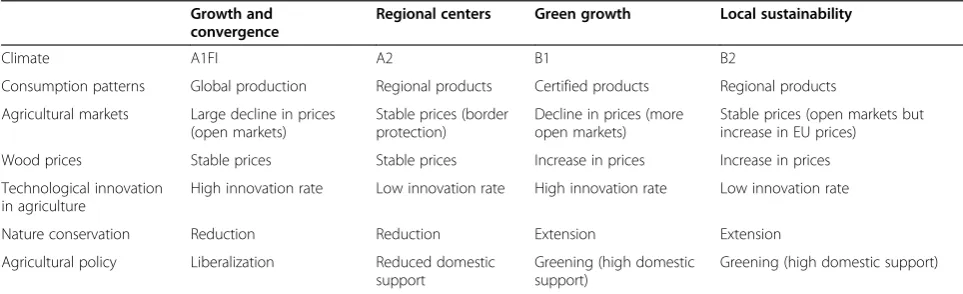
storylines that represent local conditions while remaining consistent with the global projections (Walz et al. 2013). This supports the view that global develop-ment and local land managedevelop-ment are interdependent (Pahl-Wostl 2009). We used these storylines to adapt the economic scenarios provided by Abildtrup et al. (2006) to meet Swiss conditions. This allowed us to an-chor the “context scenarios” in the overall climatic and socio-economic developments on a European level since this is most relevant for Swiss agricultural market devel-opments. The scenarios provided in Abildtrup et al. (2006) provide a detailed and comprehensive develop-ment of prices and costs for different agricultural activities under the four global change scenarios. Table 2 summarizes the assumptions underlying the regional context scenarios (for details regarding driving forces, e.g., productivity changes and production resources, we refer to Walz et al. 2013).
The regional context scenarioGrowth and convergenceis based on the SRES scenario A1FI, which implies rapid eco-nomic growth and an increase in average temperature of 4°C by 2080. Global production processes put pressure on agricultural prices in Switzerland (with a high border pro-tection and high domestic support—e.g., direct payments— for the agricultural sector). Agricultural policies are driven by market liberalization and a decrease in domestic sup-port. To increase productivity, technological innovation in agriculture is high. Wood prices are assumed to remain constant.
Global development in the scenario Regional centers is characterized by a growing focus on self-sufficiency and preservation of local identities. The A2 scenario of the IPCC is assumed to be the underlying climate change sce-nario. The heterogeneous world in this scenario results in a more regional consumption pattern. Innovation rates in agriculture are rather low, and agricultural farm gate prices remain constant. Nature conservation policies decline, and national agricultural policy is dominated by protective measures (i.e., tariffs).
The Green growth scenario is characterized by more nature conservation policies and a greening of agricul-tural policy. Agriculagricul-tural markets are less protected than today, but consumption patterns focus on certified prod-ucts representing higher environmental standards. At the same time, innovation rates in agriculture are high. Despite more open market policies, there is only a slight decrease in agricultural farm gate prices, and the price of timber rises. The climate projection is based on the B1 scenario of the IPCC.
Local sustainability summarizes a context scenario which combines the B2 scenario with regional consump-tion patterns. The agricultural sector is characterized by low innovation rates and a decline in farm gate prices. Policies focus on more greening in the agricultural sector and more nature conservation. Timber prices are assumed to rise.
A summary of the parameter changes in ALUAM is presented in Additional file 1 (Table A1). Lastly, it is noteworthy that an increase in world market prices does not automatically translate into increasing prices on Swiss agricultural markets. Support for agricultural pro-duction in Switzerland still rates as one of the highest worldwide, and farm gate prices for milk and meat are over 40% higher compared to the European level (Huber and Lehmann 2010).
Results
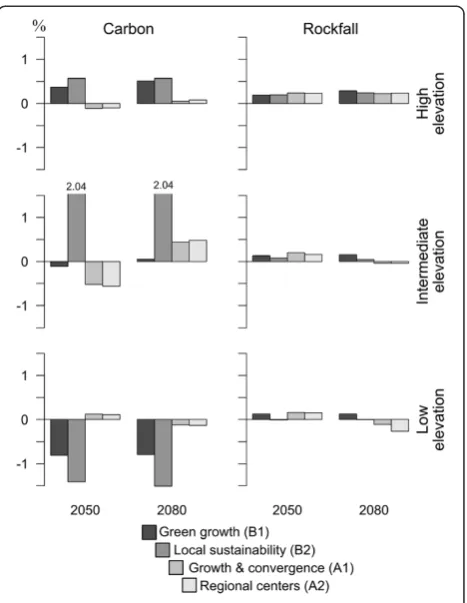
Simulation results for relative changes in EGS provision for the years 2050 and 2080 are presented for food and timber provision (Figure 3) and for carbon sequestration and rock fall protection (Figure 4). To reflect the different climatic and ecological conditions in the case study region, we dis-tinguish between low elevations in the main valley around Visp (400–800 m a.s.l.), intermediate elevations (800– 1,600 m a.s.l.) and high elevations (above 1,600 m a.s.l.). The scenarios are laid out according to the gradient with respect to the transitions from moderate to severe climate change impacts (B1, B2, A1, A2).
Table 2“Context scenarios”for the case study region Visp
Growth and convergence
Regional centers Green growth Local sustainability
Climate A1FI A2 B1 B2
Consumption patterns Global production Regional products Certified products Regional products
Agricultural markets Large decline in prices (open markets)
Stable prices (border protection)
Decline in prices (more open markets)
Stable prices (open markets but increase in EU prices)
Wood prices Stable prices Stable prices Increase in prices Increase in prices
Technological innovation in agriculture
High innovation rate Low innovation rate High innovation rate Low innovation rate
Nature conservation Reduction Reduction Extension Extension
Agricultural policy Liberalization Reduced domestic
support
Greening (high domestic support)
Food provision
Food production shows high variability between the fam-ilies of A and B scenarios as well as between the two B scenarios. There are no appreciable differences between the two time steps 2050 and 2080 for any of the eleva-tions. Specifically, food production declines strongly in the A scenarios. In the scenarioGrowth and convergence (A1), low prices for food and a reduction in agricultural support are projected to result in low intensity farming based mainly on low input meat and milk production. Two developments drive this drop in food provision. At low elevations, a shift from crop to milk production leads to a significant decline in food provision due to the lower human nutritional value of grassland compared to arable land. At higher elevations, simulation results show a decrease in the number of animals and land abandonment at marginal agronomic sites (for details of this scenario, see Briner et al. 2012). The results of the scenario Regional centers (A2) are based on the same two mechanisms. In contrast to theGrowth and conver-gence (A1)scenario, however, these effects are not due to more open markets, but to a combination of low domes-tic support (i.e., direct payments) and an increase in costs which are associated with a more heterogeneous
world in the A2 scenario. Food production is also lower in theGreen growth (B1)scenario. However, some of the losses in economic returns are compensated by an increase in ecologically oriented direct payments. In the last scenario, Local sustainability (B2), these additional payments are combined with constant prices based on an increased level of European production prices. In this case, simulation results imply the reverse of the effects seen in the other scenarios. First, food production does not decline at lower elevations since arable land is used for crop production. Second, there is an increase in the number of animals kept for meat production (suckler cows and sheep) at intermediate and high elevations.
Timber production
Climate change is projected to have a differential impact on potential timber production along the elevational gra-dient and through time (Figure A1 in Additional file 1). At lower sites, drought leads to a decline in potential timber production and a shift towards more drought-tolerant species. The reduction is accentuated for more severe climate scenarios (e.g., Growth and convergence [A1]andRegional centers [A2])after 2050 when drought
Figure 3Simulation results for relative changes in food production and timber harvest across three elevation bands (low, intermediate, high) for four global change scenarios in Visp.Changes are always compared to year 2010.
years become more frequent. In contrast, at intermediate and high elevations climate change is projected to increase potential timber production. However, the ALUAM simulation of the actual harvest, which also takes prices and costs for different types of wood into account, indicates that timber production declines in all scenarios and at all elevations (Figure 3). There are two reasons for this development. First, an increase in energy prices (i.e., fuel) makes the production of timber unprof-itable on steep terrain even given a slight rise in prices under the scenarios Green growth (B1) and Local sus-tainability (B2). Second, drought-induced tree shifts lead to a scarcity of more profitable tree species, mainly at low and intermediate elevations. At low elevations, these effects are combined with a simulated reduction in po-tential timber production which is particularly accentu-ated in the scenarios Growth and convergence (A1) and Regional centers (A2) in 2080. The increase in potential timber production at high elevations is dominated by Picea abies, which is found to be less profitable in our simulations compared to the current market situation. In addition to the direct impacts of changes in climate and market forces, forest EGS provision at high eleva-tions is affected by land-use change, i.e., when agricul-tural land is abandoned. However, the direct impact of climate and wood market changes are projected to have a greater effect on the state of the forest, and thus on timber production, than land-use changes (Briner et al. 2013a).
Natural hazard protection
In our case study region, climate change influences not only timber production but also the protection that
forests provide against natural hazards such as rock fall. Thus, changes in natural hazard protection reflect general forest development, and this is dominated by a drought-induced decline in biomass and a shift towards more drought-tolerant tree species at low elevations and an increase in biomass production at higher elevations. Figure 5 illustrates the spatial heterogeneity in changes of the projected rock fall protection index by 2080 under the four scenarios. Rock fall protection decreases at lower elevations under the more severe climate scenarios and remains above the 2010 level only in the Green growth (B1) scenario. In contrast, protection from rock fall increases at high elevations in all scenarios. At inter-mediate elevations, rock fall protection declines slightly by 2080 in the scenarios based on more severe climate change, such as Growth and convergence (A1) and Re-gional centers (A2)which is illustrated by the aggregated indicator in Figure 4.
Carbon sequestration/release
Results in Figure 4 imply that greenhouse gas sequestra-tion and release will differ significantly across scenarios and elevational gradients and over time. Projected in-creases in crop production and reductions in livestock numbers at lower elevations result in lower greenhouse gas emissions by agriculture in the scenarios Green growth (B1)and Local sustainability (B2)by 2050. How-ever, simulation results for the Growth and convergence (A1) and Regional centers (A2) scenarios indicate a shift from crop to milk production and, thus, a slight increase in greenhouse gas emissions. The extensification of animal production is projected to reduce greenhouse gas emissions by 2080 in these scenarios. These effects
compensate the lower carbon sequestration by forests arising from the decline in timber production and the drought-induced reduction in forest biomass. The in-crease in the number of animals at intermediate eleva-tions in the Local sustainability (B2) scenario results in a large rise in greenhouse gas emissions compared to the 2010 level. In the other scenarios, however, the decline of timber harvesting and the corresponding loss of car-bon sequestration outweigh the reduced greenhouse gas emission induced by a lower number of animals for the year 2080. This effect also leads to changes in net carbon sequestration at high elevations. The substantial reduc-tion in timber harvest decreases net greenhouse gas sequestration for all scenarios by 2080. Thus, the effect of reduced greenhouse gas emissions induced by a lower level of food provision in the Growth and convergence (A1), Regional centers (A2) and Green growth (B1) sce-narios is not evident in the net balance of greenhouse gas emissions and carbon sequestration.
Discussion
Discussion of scenario analysis
Our simulation results illustrate the effect of global change impacts on EGS in a mountain case study region based on regional socio-economic and climate scenarios that are consistent with global IPCC SRES scenarios. Overall, given the different scenarios, the variance be-tween the expected effects is high, even within IPCC SRES scenarios from the same family, such as Green growth (B1)andLocal sustainability (B2).
The key findings can be summarized in four points. First, the scenario analysis revealed the spatial and tem-poral heterogeneity of EGS provision, even at a rather small (350 km2) regional scale. In this inner-alpine case study region, we found that EGS are highly vulnerable at all elevations, depending on the rate of climate change and the magnitude of socio-economic changes. Second, simulation results indicate that the impact of climatic change is much more pronounced for forest EGS com-pared to agricultural EGS. This reflects our findings that at low elevations, increasing drought is projected to re-duce both forest biomass and provoke a switch towards more drought-tolerant tree species (Elkin et al. 2013). These results correspond with our experimental research in the same area, which provided important data for modeling drought and management effects for different tree species (Eilmann and Rigling 2012; Eilmann et al. 2009; Rigling et al. 2013). In contrast, changes to agricul-tural EGS were found to be due primarily to shifts in economic conditions that alter land use and land man-agement (Briner et al. 2012, 2013a). Third, our simula-tion results suggest that trade-offs between different EGS will differ under the different scenarios, such as be-tween food provision at higher elevations and increased
agricultural greenhouse gas emissions. These trade-offs depend on the complex interactions of underlying structural and environmental conditions that are driven by socio-economic and climatic factors (Briner et al. 2013b). The emergence of trade-offs in an integrated modeling framework allowed us to address the economic aspects of marginality and substitution effects which are important in the valuation of EGS (e.g., Fisher et al. 2008; Bateman et al. 2011; Farley 2012). Fourth, our results demonstrate that land use and the associated provision of EGS are not only influenced directly by environmental shifts and economic decisions, but also depend strongly on the interactions between these two components (Briner et al. 2012).
As has been emphasized by many other authors (e.g., de Groot et al. 2002, 2010; Haines-Young and Potschin 2009; Carpenter et al. 2009), this latter aspect demon-strates the importance of including ecological processes in socio-economic modeling frameworks for the assess-ment of EGS. Ecological processes, such as the develop-ment of tree species under drought conditions or the variance in agricultural crop and grassland yields at higher temperatures and different elevational gradients, form a fundamental basis for the quantitative assessment of EGS changes. This would not have been possible in individual studies addressing forestry and agricultural activities in isolated socio-economic or ecological frame-works without feedbacks. This has also been demon-strated in other modeling studies addressing erosion (Claessens et al. 2009), hydrological cycles (Bithell and Brasington 2009), natural reforestation (Gibon et al. 2010) and habitat conservation (Huber et al. 2013a).
analysis especially with respect to carbon sequestration (see Seppelt et al. 2011).
Integrated modeling results in the context of policy processes and stakeholder interactions
Our modeling results emphasize the importance of het-erogeneity, trade-offs and feedbacks in the assessment of future EGS provision in mountain regions (see also Hu-ber et al. 2013c). However, quantitative scenario analysis will not suffice to bring EGS into policy and real decision-making processes, since societal values and pol-itical trade-offs must also be taken into account (Daily et al. 2009). In this context, taking into account policy processes and the consideration of stakeholders who actually manage resources in the respective area is a crucial aspect for EGS studies (e.g., Cowling et al. 2008; Daily and Matson 2008; Reed et al. 2009). Our research approach considered these factors by analyzing the policy network of central land use policies as well as by developing regional scenarios for the Visp area in collab-oration with key stakeholders who are closely linked to the context scenarios presented here. We defined six consistent, multi-scale scenarios covering the global, the Swiss and the regional levels (i.e., the combination of the
“context scenarios” presented here with local scenarios developed by the stakeholders). The scenarios represent possible futures and indicate strategies to cope with local and global challenges (Brand et al. 2013).
The results from the scenario development have two implications. First, when confronted with the consequences of global change impacts, local stakeholders became aware of a wider systematic and realistic picture. In our local scenario workshops, for example, stakeholders did not con-sider two out of the six multi-scale scenarios at the outset of the transdisciplinary process since the critical combin-ation of climatic and economic risks in the region were im-plicitly avoided in the stakeholder discussions (Brand et al. 2013). Thus, the consideration of ecological processes and the use of mechanistic ecological models to produce quan-titative projections of future states in transdisciplinary approaches turned out to be a useful means of confronting stakeholders with unwelcome, but nevertheless possible, prospects for the future rather than defining scenarios based on wishful thinking. Second, the results from the interdisciplinary process reveal that two impact factors (i.e., spatial planning and budget) represent the most important control factors for strategies addressing the challenges gen-erated by global change in mountain regions. More import-antly, local identity and the affinity local residents have to the region, its products and traditions, emerged as the most important, but also most ambivalent, elements of the social-ecological system analyzed. Thus, traditional land-use activities will play a crucial and yet unpredictable role in the future development of the Visp region.
In addition to stakeholder integration, the incorpor-ation of more specific knowledge regarding the existing political structures and policy variables helped to make model-based ex-ante assessments of the future provision of EGS politically more realistic and, thus, more useful and relevant for actual policy-making processes (Hirschi et al. 2013). Within the Mountland project, we analyzed the political network structure of local infrastructure projects (Ingold et al. 2010) and the governance modes of regional adaptation measures, as well as the political dynamics and policy preferences in national agricultural and forest policy networks (Hirschi et al. 2013). The analyses revealed two central elements of relevant policy processes to effectively address the vulnerability of EGS in mountain regions. First, the promotion of integrative approaches, i.e., increased coordination of sectoral pol-icies, and second, a more network-oriented management and steering of political processes with better integration of local stakeholders (Huber et al. 2013c).
However, our findings also reveal two important limi-tations that hinder the integration of EGS assessments, and thus a better consideration of ecological processes in policy-making. For instance, Ingold et al. (2010) showed that existing local policy projects give high con-sideration to regional planning as well as communal and economic interests, while most of the actors defending ecological concerns are not well embedded in the relevant information-exchange networks. Since there is a high degree of uncertainty, informal processes are most likely to gain increasing importance in the context of adaptation to climate change. In addition, our analysis of agricultural and forest policy networks showed a strong path-dependence and sectoral orientation of these two important land-use policies. This, combined with the dominance of economic interests, particularly in the agricultural sector, make major policy reforms in both sectors quite unlikely at present (Hirschi et al. 2013).
Conclusions
of ecological processes in transdisciplinary approaches. It also reveals existing enabling factors and limitations that should be considered for a better integration of ecological processes in actual policy-making that wishes to address EGS provision.
Additional file
Additional file 1:Appendix The Appendix consists of a) additional simulation results showing the potential increase in timber production based on forest development in our scenarios and b) a table and extended explanations of price and cost assumptions in our scenarios.
Competing interests
The authors declare that they have no competing interests.
Authors’contributions
HB and AR designed the research; SB, CE and RSe performed simulation analyses, CH performed policy analysis, RS performed transdisciplinary research; RH wrote the manuscript; SB, CE, RSe, CH, RSn, HB and AR reviewed and commented on various versions of the manuscript. All authors read and approved the final manuscript.
Acknowledgements
This work was supported by the CCES (Competence Centre Environment and Sustainability of the ETH Domain, Switzerland) as part of the Mountland project. We thank Jenny Bays for language corrections and the two anonymous reviewers, as well as the editors, for their constructive and helpful comments on earlier versions of the manuscript.
Author details 1
Forest Dynamics, Swiss Federal Research Institute WSL, Zürcherstrasse 111, CH-8903 Birmensdorf, Switzerland.2Department of Environmental Systems
Science, Agri-food and Agri-environmental Economics Group, ETH Zurich, CH-8092 Zurich, Switzerland.3Department of Environmental Systems Science,
Forest Ecology, ETH Zurich, CH-8092 Zurich, Switzerland.4Department of Environmental Systems Science, Environmental Policy and Economics, ETH Zurich, CH-8092 Zurich, Switzerland.5Department of Environmental Systems Science, Natural and Social Science Interface, ETH Zurich, CH-8092 Zurich, Switzerland.
Received: 5 April 2013 Accepted: 7 November 2013 Published: 24 March 2014
References
Abildtrup J, Audsley E, Fekete-Farkas M, Giupponi C, Gylling M, Rosato P, Rounsevell M (2006) Socio-economic scenario development for the assessment of climate change impacts on agricultural land use: a pairwise comparison approach. Environ Sci Pol 9(2):101–115
Bateman I, Mace G, Fezzi C, Atkinson G, Turner K (2011) Economic analysis for ecosystem service assessments. Environ Resour Econ 48(2):177–218. doi:10.1007/ s10640-010-9418-x.
Bithell M, Brasington J (2009) Coupling agent-based models of subsistence farming with individual-based forest models and dynamic models of water distribution. Environ Model Softw 24(2):173–190
Braat LC, de Groot R (2012) The ecosystem services agenda: bridging the worlds of natural science and economics, conservation and development, and public and private policy. Ecosyst Serv 1(1):4–15
Brand F, Seidl R, Le QB, Brändle J, Scholz RW (2013) Constructing consistent multiscale scenarios by transdisciplinary processes: the case of mountain regions facing global change. Ecol Soc 18(2):43
Briner S, Huber R, Elkin C, Grêt-Regamey A (2012) Assessing the impacts of economic and climate changes on land-use in mountain regions: a spatial dynamic modeling approach. Agr Ecosyst Environ 149(2012):50–63 Briner S, Elkin C, Huber R (2013a) Evaluating the relative impact of climate
and economic changes on forest and agricultural ecosystem services
in mountain regions. J Environ Manage 129(0):414–422. doi:http://dx.doi.org/10.1016/j.jenvman.2013.07.018.
Briner S, Huber R, Bebi P, Elkin C, Schmatz DR, Grêt-Regamey A (2013b) Trade-offs between ecosystem services in a mountain region. Ecol Soc 18(3). doi:10.5751/ES-05576-180335.
Brunner I, Pannatier EG, Frey B, Rigling A, Landolt W, Zimmermann S, Dobbertin M (2009) Morphological and physiological responses of Scots pine fine roots to water supply in a dry climatic region in Switzerland. Tree Physiol 29(4):541–550. doi:10.1093/treephys/tpn046.
Buysse J, van Huylenbroeck G, Lauwers L (2007) Normative, positive and econometric mathematical programming as tools for incorporation of multifunctionality in agricultural policy modelling. Agr Ecosyst Environ 120:70–81
Carpenter SR, Mooney HA, Agard J, Capistrano D, DeFries RS, Diaz S, Dietz T, Duraiappah AK, Oteng-Yeboah A, Pereira HM, Perrings C, Reid WV, Sarukhan J, Scholes RJ, Whyte A (2009) Science for managing ecosystem services: beyond the Millennium Ecosystem Assessment. Proc Natl Acad Sci USA 106(5):1305–1312. doi:10.1073/pnas.0808772106.
Cash DW, Adger WN, Berkes F, Garden P, Lebel L, Olsson P, Pritchard L, Young O (2006) Scale and cross-scale dynamics: governance and information in a multilevel world. Ecol Soc 11(2):8
Chapin FS, Lovecraft AL, Zavaleta ES, Nelson J, Robards MD, Kofinas GP, Trainor SF, Peterson GD, Huntington HP, Naylor RL (2006) Policy strategies to address sustainability of Alaskan boreal forests in response to a directionally changing climate. Proc Natl Acad Sci USA
103(45):16637–16643. doi:10.1073/pnas.0606955103.
Claessens L, Schoorl JM, Verburg PH, Geraedts L, Veldkamp A (2009) Modelling interactions and feedback mechanisms between land use change and landscape processes. Agric Ecosyst Environ 129(1–3):157–170
Collins SL, Carpenter SR, Swinton SM, Orenstein DE, Childers DL, Gragson TL, Grimm NB, Grove JM, Harlan SL, Kaye JP, Knapp AK, Kofinas GP, Magnuson JJ, McDowell WH, Melack JM, Ogden LA, Robertson GP, Smith MD, Whitmer AC (2011) An integrated conceptual framework for long-term social-ecological research. Front Ecol Environ 9(6):351–357. doi:10.1890/100068.
Cowling RM, Egoh B, Knight AT, O’Farrell PJ, Reyers B, Rouget M, Roux DJ, Welz A, Wilhelm-Rechman A (2008) An operational model for mainstreaming ecosys-tem services for implementation. Proc Natl Acad Sci USA 105(28):9483–9488. doi:10.1073/pnas.0706559105.
Cumming G, Alcamo J, Sala O, Swart R, Bennett E, Zurek M (2005) Are existing global scenarios consistent with ecological feedbacks? Ecosystems 8(2):143–152. doi:10.1007/s10021-004-0075-1.
Daily GC, Matson PA (2008) Ecosystem services: from theory to implementation. Proc Natl Acad Sci USA 105(28):9455–9456. doi:10.1073/pnas.0804960105. Daily GC, Polasky S, Goldstein J, Kareiva PM, Mooney HA, Pejchar L, Ricketts TH,
Salzman J, Shallenberger R (2009) Ecosystem services in decision making: time to deliver. Front Ecol Environ 7(1):21–28. doi:10.1890/080025. de Groot RS, Wilson MA, Boumans RMJ (2002) A typology for the classification,
description and valuation of ecosystem functions, goods and services. Ecol Econ 41(3):393–408
de Groot RS, Alkemade R, Braat L, Hein L, Willemen L (2010) Challenges in integrating the concept of ecosystem services and values in landscape planning, management and decision making. Ecol Complex 7(3):260–272. doi:http://dx.doi.org/10.1016/j.ecocom.2009.10.006.
de Groot R, Brander L, van der Ploeg S, Costanza R, Bernard F, Braat L, Christie M, Crossman N, Ghermandi A, Hein L, Hussain S, Kumar P, McVittie A, Portela R, Rodriguez LC, ten Brink P, van Beukering P (2012) Global estimates of the value of ecosystems and their services in monetary units. Ecosyst Serv 1(1):50–61. doi:http://dx.doi.org/10.1016/j.ecoser.2012.07.005.
Diaz S, Quétier F, Caceres DM, Trainor SF, Pérez-Harguindeguy N, Bret-Harte MS, Finegan B, Pena-Claros M, Poorter L (2011) Linking functional diversity and social actor strategies in a framework for interdisciplinary analysis of nature’s benefits to society. Proc Natl Acad Sci USA 108(3):895–902. doi:10.1073/pnas.1017993108.
Dobbertin M, Eilmann B, Bleuler P, Giuggiola A, Graf Pannatier E, Landolt W, Schleppi P, Rigling A (2010) Effect of irrigation on needle morphology, shoot and stem growth in a drought-exposed Pinus sylvestris forest. Tree Physiol 30(3):346–360. doi:10.1093/treephys/tpp123
FAO (Food and Agriculture Organization of the UN) (2007) Ecocrop. http://ecocrop.fao. org/ecocrop/srv/en/home.
Eilmann B, Zweifel R, Buchmann N, Fonti P, Rigling A (2009) Drought-induced adaptation of the xylem in Scots pine and pubescent oak. Tree Physiol 29(8):1011–1020. doi:10.1093/treephys/tpp035.
Eilmann B, Buchmann N, Siegwolf R, Saurer M, Cherubini P, Rigling A (2010) Fast response of Scots pine to improved water availability reflected in tree-ring width andδ13C. Plant Cell Environ 33(8):1351–1360. doi:10.1111/j.1365-3040.2010.02153.x.
Eilmann B, Zweifel R, Buchmann N, Graf Pannatier E, Rigling A (2011) Drought alters timing, quantity, and quality of wood formation in Scots pine. J Exp Bot 62(8):2763–2771. doi:10.1093/jxb/erq443.
Eilmann B, Dobbertin M, Rigling A (2013) Growth response of Scots pine with different crown transparency status to drought release. Ann For Sci 70(7):685–693. doi:10.1007/s13595-013-0310-z.
Elkin C, Bugmann H (2010) Impact of climate change on ecosystem services in the Valais, Switzerland. In: Price M (ed) Europe’s ecological backbone: recognising the true value of our mountains. European Environment Agency, Copenhagen, pp 67–70
Elkin C, Reineking B, Bigler C, Bugmann H (2012) Do small-grain processes matter for landscape scale questions? Sensitivity of a forest landscape model to the formulation of tree growth rate. Landsc Ecol 27(5):697–711. doi:10.1007/ s10980-012-9718-3.
Elkin C, Gutiérrez AG, Leuzinger S, Manusch C, Temperli C, Rasche L, Bugmann H (2013) A 2°C warmer world is not safe for ecosystem services in the European Alps. Glob Chang Biol 19(6):1827–1840. doi:10.1111/gcb.12156. Euliss NH, Smith LM, Liu S, Duffy WG, Faulkner SP, Gleason RA, Eckles SD (2011)
Integrating estimates of ecosystem services from conservation programs and practices into models for decision makers. Ecol Appl 21(sp1):S128–S134. doi:10.1890/09-0285.1.
Farley J (2012) Ecosystem services: the economics debate. Ecosyst Serv 1(1):40–49 Fisher B, Turner K, Zylstra M, Brouwer R, Groot R, Farber S, Ferraro P, Green R,
Hadley D, Harlow J, Jefferiss P, Kirkby C, Morling P, Mowatt S, Naidoo R, Paavola J, Strassburg B, Yu D, Balmford A (2008) Ecosystem services and economic theory: integration for policy-relevant research. Ecol Appl 18(8):2050–2067. doi:10.1890/07-1537.1.
Freibauer A, Rounsevell MDA, Smith P, Verhagen J (2004) Carbon sequestration in the agricultural soils of Europe. Geoderma 122(1):1–23. doi:http://dx.doi.org/10.1016/j.geoderma.2004.01.021.
Gibon A, Sheeren D, Monteil C, Ladet S, Balent G (2010) Modelling and simulating change in reforesting mountain landscapes using a social-ecological framework. Landsc Ecol 25(2):267–285
Gómez-Baggethun E, de Groot R, Lomas PL, Montes C (2010) The history of ecosystem services in economic theory and practice: from early notions to markets and payment schemes. Ecol Econ 69(6):1209–1218
Haines-Young RH, Potschin MB (2009) Methodologies for defining and assessing ecosystem services. Final report, JNCC:69, project code C08-0170-0062. Centre for Environmental Management, Nottingham
Hein L, van Koppen K, de Groot RS, van Ierland EC (2006) Spatial scales, stakeholders and the valuation of ecosystem services. Ecol Econ 57(2):209–228
Heiniger U, Theile F, Rigling A, Rigling D (2011) Blue-stain infections in roots, stems and branches of declining Pinus sylvestris trees in a dry inner alpine valley in Switzerland. For Pathol 41(6):501–509. doi:10.1111/j.1439-0329.2011.00713.x.
Hirschi C (2010) Strengthening regional cohesion: collaborative networks and sustainable development in Swiss rural areas. Ecol Soc 115(4):16. URL: http:// www.ecologyandsociety.org/vol15/iss4/art16/
Hirschi C, Widmer A, Briner S, Huber R (2013) Combining policy network and model-based scenario analyses: an assessment of future ecosystem goods and services in Swiss mountain regions. Ecol Soc 18(2). doi:10.5751/ES-05480-180242.
Huber R, Lehmann B (2010) WTO agreement on agriculture: potential consequences for agricultural production and land-use patterns in the Swiss lowlands. Dan J Geogr 109(2):131–145
Huber R, Briner S, Peringer A, Lauber S, Seidl R, Widmer A, Gillet F, Buttler A, Le QB, Hirschi C (2013a) Modeling social-ecological feedback effects in the im-plementation of payments for environmental services in pasture-woodlands. Ecol Soc 18(2). doi:10.5751/ES-05487-180241.
Huber R, Bugmann H, Buttler A, Rigling A (2013b) Sustainable land-use practices in European mountain regions under global change: an integrated research approach. Ecol Soc 18(3). doi:10.5751/ES-05375-180337.
Huber R, Rigling A, Bebi P, Brand FS, Briner S, Buttler A, Elkin C, Gillet F, Grêt-Regamey A, Hirschi C, Lischke H, Scholz RW, Seidl R, Spiegelberger T, Walz A,
Zimmermann W, Bugmann H (2013c) Sustainable land use in mountain regions under global change: synthesis across scales and disciplines. Ecol Soc 18(3). doi:10.5751/ES-05499-180336.
Ingold K, Balsiger J, Hirschi C (2010) Climate change in mountain regions: how local communities adapt to extreme events. Local Environ 15(7):651–661. doi:10.1080/13549839.2010.498811.
IPCC (2000) Emissions scenarios—summary for policymakers. A special report of IPCC Working Group III, Intergovernmental Panel on Climate Change. IPCC, Geneva Kremen C (2005) Managing ecosystem services: what do we need to know about
their ecology? Ecol Lett 8(5):468–479. doi:10.1111/j.1461-0248.2005.00751.x. Kremen C, Williams NM, Aizen MA, Gemmill-Herren B, LeBuhn G, Minckley R,
Packer L, Potts SG, Ta R, Steffan-Dewenter I, Vázquez DP, Winfree R, Adams L, Crone EE, Greenleaf SS, Keitt TH, Klein A-M, Regetz J, Ricketts TH (2007) Pollination and other ecosystem services produced by mobile organisms: a conceptual framework for the effects of land-use change. Ecol Lett 10 (4):299–314. doi:10.1111/j.1461-0248.2007.01018.x.
Lal R (2005) Forest soils and carbon sequestration. For Ecol Manage 220(1–3):242–258. doi:http://dx.doi.org/10.1016/j.foreco.2005.08.015. MEA (2005) Millennium Ecosystem Assessment, ecosystems and human
well-being: synthesis. Island Press, Washington DC
Müller F, Burkhard B (2012) The indicator side of ecosystem services. Ecosyst Serv 1(1):26–30
Nelson E, Mendoza G, Regetz J, Polasky S, Tallis H, Cameron D, Chan KMA, Daily GC, Goldstein J, Kareiva PM, Lonsdorf E, Naidoo R, Ricketts TH, Shaw M (2009) Modeling multiple ecosystem services, biodiversity conservation, commodity production, and tradeoffs at landscape scales. Front Ecol Environ 7(1):4–11. doi:10.1890/080023.
Nicholson E, Mace GM, Armsworth PR, Atkinson G, Buckle S, Clements T, Ewers RM, Fa JE, Gardner TA, Gibbons J, Grenyer R, Metcalfe R, Mourato S, Muûls M, Osborn D, Reuman DC, Watson C, Milner-Gulland EJ (2009) Priority research areas for ecosystem services in a changing world. J Appl Ecol 46(6):1139–1144. doi:10.1111/j.1365-2664.2009.01716.x.
Oteros-Rozas E, Gonzalez J, Martin-Lopez B, Lopez C, Zorrilla-Miras P, Montes C (2012) Evaluating ecosystem services in transhumance cultural landscapesan interdisciplinary and participatory framework. GAIA Ecol Perspect Sci Soc 21(3):185–193
Pahl-Wostl C (2009) A conceptual framework for analysing adaptive capacity and multi-level learning processes in resource governance regimes. Glob Environ Chang 19(3):354–365. doi:http://dx.doi.org/10.1016/j.gloenvcha.2009.06.001. Perez-Garcia J, Lippke B, Comnick J, Manriquez C (2005) An assessment of carbon
pools, storage, and wood products market substitution using life-cycle analysis results. Wood Fiber Sci 37:140–148
Polasky S, Segerson K (2009) Integrating ecology and economics in the study of ecosystem services: some lessons learned. Annu Rev Resour Econ 1(1):409–434. doi:10.1146/annurev.resource.050708.144110.
Reed MS, Bonn A, Slee W, Beharry-Borg N, Birch J, Brown I, Burt TP, Chapman D, Chap-man PJ, Clay GD, Cornell SJ, Fraser EDG, Glass JH, Holden J, Hodgson JA, Hubacek K, Irvine B, Jin N, Kirkby MJ, Kunin WE, Moore O, Moseley D, Prell C, Price MF, Quinn CH, Redpath S, Reid C, Stagl S, Stringer LC, Termansen M (2009) The future of the uplands. Land Use Pol 26(Supplement 1):S204–S216
Reyers B, Roux DJ, O’Farrell PJ (2010) Can ecosystem services lead ecology on a transdisciplinary pathway? Environ Conserv 37(04):501–511. doi:10.1017/ S0376892910000846.
Rigling A, Eilmann B, Koechli R, Dobbertin M (2010) Mistletoe-induced crown degrad-ation in Scots pine in a xeric environment. Tree Physiol 30(7):845–852. doi:10.1093/ treephys/tpq038.
Rigling A, Bigler C, Eilmann B, Feldmeyer-Christe E, Gimmi U, Ginzler C, Graf U, Mayer P, Vacchiano G, Weber P, Wohlgemuth T, Zweifel R, Dobbertin M (2013) Driving factors of a vegetation shift from Scots pine to pubescent oak in dry Alpine forests. Glob Chang Biol 19(1):229–240. doi:10.1111/gcb.12038.
Rounsevell MDA, Arneth A (2011) Representing human behaviour and decisional processes in land system models as an integral component of the earth system. Glob Environ Chang 21(3):840–843
Rounsevell M, Dawson T, Harrison P (2010) A conceptual framework to assess the effects of environmental change on ecosystem services. Biodivers Conserv 19(10):2823–2842. doi:10.1007/s10531-010-9838-5.
Schaeffer PV (2008) Thoughts concerning the economic valuation of landscapes. J Environ Manage 89(3):146–154
Schumacher S, Bugmann H (2006) The relative importance of climatic effects, wildfires and management for future forest landscape dynamics in the Swiss Alps. Glob Chang Biol 12(8):1435–1450. doi:10.1111/j.1365-2486.2006.01188.x. Schumacher S, Bugmann H, Mladenoff DJ (2004) Improving the formulation of
tree growth and succession in a spatially explicit landscape model. Ecol Model 180(1):175–194
Seidl R, Brand F, Stauffacher M, Krütli P, Le Q, Spörri A, Meylan G, Moser C, González M, Scholz R (2013) Science with society in the anthropocene. AMBIO 42(1):5–12. doi:10.1007/s13280-012-0363-5.
Seppelt R, Dormann CF, Eppink FV, Lautenbach S, Schmidt S (2011) A quantitative review of ecosystem service studies: approaches, shortcomings and the road ahead. J Appl Ecol 48(3):630–636. doi:10.1111/j.1365-2664.2010.01952.x.
Temperli C, Bugmann HKM, Elkin C (2012) Adaptive management for competing forest goods and services under climate change. Ecol Appl 22:2065–2077. doi:10.1890/12-0210.1.
van Oudenhoven APE, Petz K, Alkemade R, Hein L, de Groot RS (2012) Framework for systematic indicator selection to assess effects of land management on ecosystem services. Ecol Indic 21:110–122. doi:10.1016/j. ecolind.2012.01.012.
Wainger L, Mazzotta M (2011) Realizing the potential of ecosystem services: a framework for relating ecological changes to economic benefits. Environ Manage 48(4):710–733. doi:10.1007/s00267-011-9726-0.
Walz A, Braendle JM, Lang DJ, Brand F, Briner S, Elkin C, Hirschi C, Huber R, Lischke H, Schmatz DR (2013) Experience from downscaling IPCC-SRES scenarios to specific national-level focus scenarios for ecosystem service management. Technol Forecast Soc Change. (in press), doi:http://dx.doi.org/10.1016/j.techfore.2013.08.014.
Weber P, Bugmann H, Fonti P, Rigling A (2008) Using a retrospective dynamic competition index to reconstruct forest succession. For Ecol Manage 254(1):96–106
Wermelinger B, Rigling A, Schneider Mathis D, Dobbertin M (2008) Assessing the role of bark- and wood-boring insects in the decline of Scots pine (Pinus sylvestris) in the Swiss Rhone valley. Ecol Entomol 33(2):239–249. doi:10.1111/j.1365-2311.2007.00960.x.
Young O (2002) The institutional dimensions of environmental change: fit, interplay, and scale. MIT Press, Cambridge
Zweifel R, Rigling A, Dobbertin M (2009) Species-specific stomatal response of trees to drought—a link to vegetation dynamics? J Veg Sci 20(3):442–454. doi:10.1111/j.1654-1103.2009.05701.x.
doi:10.1186/2192-1709-3-9
Cite this article as:Huberet al.:Inter- and transdisciplinary perspective on the integration of ecological processes into ecosystem services analysis in a mountain region.Ecological Processes20143:9.
Submit your manuscript to a
journal and benefi t from:
7Convenient online submission
7Rigorous peer review
7Immediate publication on acceptance
7Open access: articles freely available online 7High visibility within the fi eld
7Retaining the copyright to your article