Issues
ISSN: 2146-4138
available at http: www.econjournals.com
International Journal of Economics and Financial Issues, 2016, 6(S8) 280-287.
Special Issue for “Fundamental and Applied Research in Economics and Management: New Perspectives”
Mechanisms of Coordinated Distribution of the Effect from
Export/Import Transactions
M. I. Geraskin
1, A. A. Ajupov
2*, A. A. Kurilova
31Samara State Aerospace University Named after Academician S.P. Korolev (National Research University), Samara, 443086, Russia, 2Kazan Federal University, Kazan, 420008, Russia, 3Togliatti State University, Togliatti, 445667, Russia. *Email: [email protected] ABSTRACT
Economic mathematical model for coordinating economic interests of the regions (companies) and state budgets within the system of export/import transactions is developed. Nash equilibrium mechanisms for hierarchical and nonhierarchical coordination of effect distribution and mechanism of comprehensive coordination of export/import indicators are presented. The author has developed a two-sector model of export/import transactions and the optimal mechanisms for it. There has been carried out a simulation of coordination mechanisms for crude oil (Russia) and oil extraction equipment (Germany).
Keywords: Export, Import, Coordination Model, Effect Distribution Mechanism, Hierarchical System, Nonhierarchical System, Nash Equilibrium
JEL Classifications: O150, E660, R130
1. INTRODUCTION
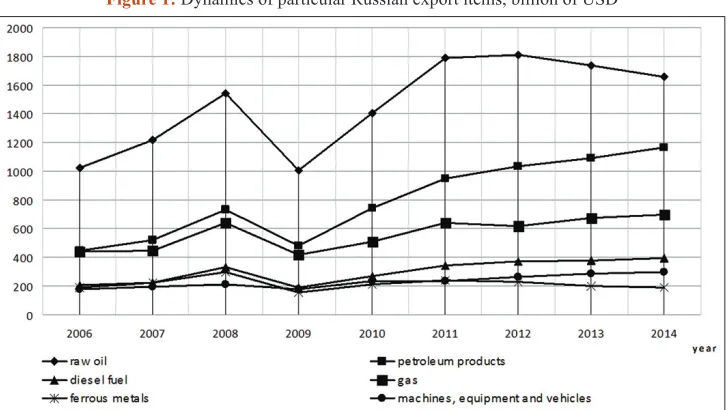
The post-Soviet Russian economy demonstrates the trends of international trade growth. For the period from 1994 to 2014 the export volume has increased by 4.5 times in comparable prices (the average annual growth rate is 5.54%); import volume has increased by 3.2 times (3.16% per year). The volume of the foreign trade turnover has increased by 3.9 times (4.63% per year) and in 2014 amounted to 48% of gross domestic product (GDP), which proves that Russia is steadily moving to the open economy at the turn of the XX-XXI centuries following the terminology introduced by Grauwe (1983). Russian economy is firmly oriented at export, for export has exceeded import by 1.47 times averagely for the period from 1994 to 2014. Main export items for the period of 2006-2014 were (Figure 1): Oil and petroleum products (55-64% of export), gas (13.1-11.5%), machines, equipment and vehicles (5.2-4.8%). Within the structure of import the largest share in 2006-2014 belonged to machines and equipment (60.3-65.3%) and vehicles (12.6-7.2%).
Due to the fact that Russian export consists mainly of raw materials, particular regions where natural resources are allocated, like Samara Region whose share in Russian export has been
between 14.2% and 11.2% in 2006-2014, are national determinants of foreign trade. It is worthy to note a high degree of concentration of Russian mining and extracting business. The total share of the two largest oil companies (Rosneft OJSC and Ritek-Lukoil OJSC) in oil and petroleum products export was 90.2-92.7% in 2006-2014. Thus the problem of interests’ coordination within international trade relations seems to be an urgent one for a number of regions and companies in the economy of Russia.
However, if the interest rate at the importing country is higher than the world rate, its decrease after integration into world trading system will result in positive external effect, particularly in economic growth acceleration (Koh and Marion, 1987).
Game-theory model for countries’ interests’ coordination by Hamada (Hamada, 1979) investigated in Luciani and Ghassan (2015), Barrell et al. (2003), Collier and Venables (2011), Turner et al. (2011) is specified for the markets structured in the form of international cartels. The model enables us to determine macroeconomic indicators for exporting and importing countries (volumes and prices of the international turnover) according to the criteria of minimizing wealth regret function, aggregated as a weighted average. Analysis of indifference curves built according to welfare functions showed that Nash equilibriums established for the international trade systems without coordination measures turn out to be uncoordinated in terms of high welfare losses. Pareto efficient equilibriums maximizing the aggregated welfare of the system are
unstable and are available only with stabilizers introduction.
Generally, both approaches are based on coordinating the indicators of export/import transactions; thus they suppose the choice of the coordinated values of export and import volumes according to profit criteria (national effect). In some cases a desired result may not be achieved by these means. For example, if there are no cartels in the markets or if the prices are inelastic to tariffs. In this respect, the article suggests the model for indirect coordination of exporters’ (importers’) interests with the interests of the national economy. The model is based on coordinating redistribution of their effects gained when export (import) indicators are actually uncoordinated.
2. MODELS AND MECHANISM FOR
COORDINATED EFFECT DISTRIBUTION
2.1. Hierarchical Coordination
We consider a system of regions (companies) that belong to different national economies (subsystems), which is formed
within the process of export/import transactions. The agents of subsystems are regional economies or the companies of the corresponding country. Let us call its central authority for development planning (the government, the Ministry of Economy, etc.) the center of the subsystem. The system indicators are export/ import volumes, regional GDP, the sum of taxes paid to the budget of the center. The goal for hierarchical coordinated distribution is defined as follows: To find the indicators’ values, which maximize the agents’ criterion at the set of optimums according to the criteria of the center.
Let us introduce the following notation: K is a number of
subsystems (countries), indexed by k K ; Jk is the number of
regions (companies) with the kth subsystem, j J
k
, participating in export/import transactions; Ik is the number of indicators, which characterize export/import transactions of the kth subsystem,
i I k.
The goal of the center of the kth subsystem is defined as follows:
To find the optimal vector Y according to the following criteria:
ykj Arg f r y
y A k
jk kj j
k k 0
0
0
=
(
)
∈
max , (1)
On the set of indicators
Ak Y y R y y y k K j J i I
ji k
ji k kji ji k k k
0 =
{
={ }
∈ +: min0 ≤ ≤ max0 , ∈ , ∈ , ∈}
, where “min” and “max” indexes stand for the admissible boundaries of indicators; f r yk k Kj k
j k
0
(
,)
, ∈ is a criterion function of the center of the kth subsystem; agents’ type characteristicsr k K j Jjk k
, , specify the features of the regions (companies): Consumption norms for material, human and financial resources and characteristics of customs regulation.
The goal of the jth region (company) of the kth subsystem is
defined as follows: To define the optimal vector Y according to the following criteria:
Figure 1: Dynamics of particular Russian export items, billion of USD
y Arg f r y k K j J g y f r y
j k
y A j
k
jk kj k kj kj
jk jk j k
j k
* max , , , , *
,
=
(
)
∈ ∈( )
=
∈
jj k
(
)
, (2)On the set of admissible indicators:
Ajk Y R y y y k K j J i I
ji k kji ji k k k
=
{
∈ +: min ≤ ≤ max , ∈ , ∈ , ∈}
,where f r yjk k K j J
jk, kj , , k
(
)
∈ ∈ is a criterion function of thejthagent of the kth subsystem; g y k K j J
j k
j k
k
* , ,
( )
∈ ∈ is a set ofmaximums of the criterion function of the jth agent of the kth
subsystem.
Let us introduce the following assumptions (Figure 2) ensuring the existence and uniqueness of the solution of the problems 1 and 2: (1) sets of admissible plans Ak
0 , Akj are convex; (2) criterion
function of the agent f r yjk j k
j k
,
(
)
and criterion function of the center f r ykjk kj
0
(
,)
are concave. The first assumption is valid due to the fact that when one indicator is growing (for example, the export volume), the potential for another indicator’s growth is reducing (for example, the export of a different commodity), as the limited production capacities are getting reoriented. The second assumption is valid for the fact that the marginal efficiency of the indicators as resources of the criterion functions of the agent (center) is decreasing with their growth.The states chosen by the agents according to criteria 2generally may be different from the states determined according to the criterion of the center (1), which characterizes the efficiency of the hierarchical system of the kth national economy. Thus, the system
accumulates contradictions and the efficiency of particular agents decreases in comparison to the states reachable under the condition (Burkov and Novikov, 1999) that the interests of the regions and the center have been coordinated:
∆g ykj g y f r y
j k
j k
j k
jk jk kj
* * ,
( )
=( )
−(
0)
=0 (3)Thus let us define the coordination of economic indicators as such a state of a hierarchical subsystem when the optimum of the center provides maximization of the agents’ criteria.
Let us introduce the coordination mechanism as the effect c y ykj
(
kj*, kj0)
reallocation from the center to the jth agent. Theeffect from agents’ integration into the system is determined according the following condition:
f r y cjk
(
jk, kj*, kj)
= f r yjk(
jk, kj0)
+c y ykj(
kj*, kj0)
(4)In these terms the condition 3 takes the following form:
c y ykj
(
kj*, kj0)
≥∆g ykj( )
kj* (5)2.2. Nonhierarchical Coordination
Regardless of the existence of the center, let us consider the system of regions (companies) participating in the international commodity turnover and choosing the optimal vectors of indicators according to the criterion 2. Let us asses the efficiency of export/import transactions by F0 criterion equal to the aggregate effect of all the agents from such transactions. Let us consider a nonhierarchical agent system as a quasihierarchical system, which has an imaginary center. The goal of such an imaginary center is to maximize F0 criterion. The center is an “imaginary” one for his interests express the integration goal and do not violate the agents’ interests, as the effect is redistributed between them.
The integration goal of a nonhierarchical system is defined as a goal of the imaginary center in a form similar to 1 as follows: To find an optimal vector Z according to the following criterion:
zkj F r z k K j J
z A j
k j k
k j
k z
=
(
)
∈ ∈∈
Arg max 0 , , , (6)
On a following set of admissible indicators:
AZ=
{
Z={ }
zkj ∈R y+: minji k≤zkji≤ymaxji k,k K j J i I∈ , ∈ k, ∈ k}
By vector Z =
{ }
zkj let us denote such a value of vectorY =
{ }
ykji , which meets the requirement 6. Deviation of the value of criterion function of the jth agent under the plan determinedin accordance with criterion 2 from the value obtained by plan implementation according to criterion 6 is expressed as follows:
∆g zkj
( )
kj = g ykj( )
kj* − f r zjk(
jk, kj)
> =0 0( ), (7)And enables us to make conclusion whether there are any contradictions within a system.
Let us find the effect djk, which an agent gets from integration
according to the following condition:
f r y djk
(
jk, kj*, kj)
= f r zjk(
jk, kj)
+d y zkj(
kj*, kj)
(8) In this case the condition of nonhierarchical coordination isexpressed as follows:
d y zjk
(
kj*, kj)
≥ ∆g zkj( )
kj (9)Quasihierarchical system’s integration effect is redistributed between the agents:
F d y zkj kj kj j J
k K k
0=
(
)
∈
∈
∑
∑
*,(10)
Due to the fact that the losses of agents’ criterion functions 7 are explained by criterion F0, maximization, the necessary and sufficient condition for coordination 9 is Nash equilibrium distribution of the effect of the system between the agents. This is such a distribution, which meets losses (regrets) compensation requirement (Novikov, 2013). Equilibrium compensation is achieved when the effect is distributed proportionally to the losses (regrets) of each agent suffered in order to achieve the effect:
d y z g z
g z F
j k
j k
j
k j
k j k
j k
j k
j J
k K k
*, .
(
)
=( )
( )
∈∈
∑
∑
∆
∆ 0 (11)
Equilibrium of a nonhierarchical system reflects the mutual benefit from international commodity turnover for all the agents of the system. Let us prove this by the following propositions. Their demonstrations are given in the Appendix.
2.2.1. Proposition 1
Nash equilibrium of a nonhierarchical system if established if and only if the aggregate losses (regrets) of all the system agents they suffer from the turnover do not exceed the aggregate effect.
d y zkj g z
j J j
k j k
j k
j k
j J k K
k K
∑
∈∑
∈ k∑
∈∑
∈ k(
*, 0)
≥ ∆( )
(12)
2.2.2. Proposition 2
The state of a nonhierarchical system is regarded to be coordinated if and only if the condition 12 is met and the effect is distributed in accordance with the mechanism 11.
2.3. Comprehensive Coordination
Let us consider a nonhierarchical system of regions (companies) involved in export/import turnover built in a nonhierarchical “center – region (company)” system. Let us denote the set of maximums of criterion function of the center of the kth national
economy by h yk f r y k K
j
k k
j k
j k
0
( )
0 = 0(
, 0)
, ∈ . In case the agents choose the value of economic indicators zkj according to criterion F0, the center of kth subsystem is deprived of a part of its criterion’smaximum due to the contribution of jth agent, which equals:
∆h zk h y f r z
j
k k
j
k k
jk kj
0
( )
= 0( )
0 − 0(
,)
Coordination mechanism is based on the fact that the agents transfer part of the effect d y zkj
j k
j k
*,
(
)
obtained from export/ import turnover to the center of kth subsystem in order tomaximize this center’s criterion. The condition for comprehensive coordination is expressed as follows:
d y zjk g z h z
j k
j k
j k
j
k k
j k
*, 0
0
(
)
≥∆( )
+∆( )
(13)Meeting condition 13 is guaranteed if condition 9 is met, while a nonhierarchical coordination within the system of “region (company) – region (company)” (regardless of kth center existence)
is provided by meeting condition 13 and proportional effect distribution, similarly 11:
(
*)
( )
( )
0( )
( )
0 0, .
∈ ∈
∆ + ∆
=
∆ + ∆
∑ ∑
kk k k k
j j j
k k k
y j j k k k k
j j j
k K j J
g z h z
d y z F
g z h z (14)
Coordination conditions 9 and 13 are interpreted in Figure 1. The set of admissible values of indicators Aj is shown as an area beneath the
curve А1А2. Isolines (indifference curves) of the criterion function
of the jth agent f
j(yj) and the center f0(yj) at tangent points Е and
Н with the curve А1А2 determine the corresponding optimums f yj
( )
*j , f y0( )
0j . The isoline of criterion F0(zj) is tangent to thecurve А1А2 at point B, showing the optimum of hierarchical system. The effect losses that the agent suffers when getting integrated Δgj(zj) are interpreted as parallel translation of the isoline fj(yj) from
Е point to В. Similarly, isoline f0(yj) translation from point Н to В
reflects the losses (regrets) of the center Δh0(zj). Integration effect
dj(zj) is expressed by isoline fj(yj) shifting up to the point D where the effect is sufficient to maximize the agents’ and center’s criteria.
3. EFFECT DISTRIBUTION MECHANISMS
SIMULATION
3.1. Two-sector Model of Export/Import Transactions Let us formally describe two-commodity foreign trade market as two sectors. One of them comprises all countries (and corresponding companies), which export the first commodity to the countries of the second sector. The second sector exports the second commodity to the countries of the first sector. Let us assume that in each sector the commodity is produced by one company only or by several companies using similar technology. Let us index countries by
k K .
Let us introduce the following assumptions: (1) Tax systems of the countries establish valorem export and import tariffs for the specific tariffs may be converted to valorem ones by relating them to commodity prices; (2) prices do not increase along with the sales growth which is common for oligopoly markets, monopolistic competition markets and for markets under recession, for instance, market of oil and petroleum products in present conditions; (3) sectors’ production functions are convex to the volumes of imported resources, so the marginal efficiency of the resources is decreasing along with the output growth; (4) sectors form a market structure of mutual monopoly-monopsony type, thus the export of the first sector equals the import of the second one and vice versa. Let us assume that prices for the goods of exporters and importers are expressed in one currency, i.e. converted into comparable values according to the currency exchange rates applicable in corresponding countries.
Let us introduce the following notation: y1k, y2k
a r e e x p o r t / i m p o r t v o l u m e s o f t h e kt h c o u n t r y ;
rk=
{
p a bk, , ,k k ϕ ϕ1k, 2k, , , , ,c nk k α βk k k K∈}
is the vector of agent type characteristics where pk is a price for commodity exported from the kth country; afunctions pk(y1k); αk, βk are coefficients for output functions y1k(y2k);
φ1k, φ2k are export and import tariffs of the kth country; ck are
average production costs at the kth country except for the prices
for imported resources; nk is an imported resource utilization rate for the technology of the kth country (for equipment it is
equal to depreciation rate and for raw materials it is equal to 1). With regard to this notation, let us express the conjectures 1-3 as follows:
pk= a y ak k1bk, k >0,bk< 0,| | ,bk <1k K∈ , (15) y1k =αky2βkk,αk >0 0, < βk <1,k K∈ (16)
y1k = y k K n2n, ∈ \ . (17)
Let us find the effects of the centers as a sum of export and import fees obtained from transactions of the corresponding country calculated on the basis of valorem tariffs:
f k r yk k ik ik ikp y k K
i
0
1 2
, , ,
,
(
)
= ∈=
∑
ϕAnd on substitution of 15let us find the criterion functions of the centers (1).
f r yk k k k k ka ybk k na ybnk k K n
0 ( , )=ϕ1 1 +1+ϕ2 2+1, ∈ \ . (18) Agents’ effects should be defined as companies’ profit from export transaction taking into consideration that imported resources are used in technology:
(
,) (
1 1)
1(
1 2)
2 , \ ,k k k k k k k k k n k
f r y = − p −c y − + n p y k K n∈
And on substitution of 15, 16let us find the criterion functions of the agents (2).
(
) (
1)
1 1(
2)
11
, 1 1
, \ .
n k
bk
k k k k k k k k k k n b
k k
f r y a y c y n a
y k K n
a +
= − − − +
∈
(19)
Criterion function for a nonhierarchical system (6) is determined on the basis of the optimal cartel as a maximum sum of agents’ criteria.
(
)
(
)
(
)
(
)
{
}
0 ,
, \
1 1 2 2
, \
, , max ,
1 1 ,
k
k k k x k K k k n k K k n
k k k k k k n k k k k n
F r y x f p c
p c y n c y
∈ ∈
∈
= =
− − − +
∑
∑
(20)
Where maximum is found for all vectors xk =
{
p c k K nk, ,n ∈ \}
, which define the kth sector selling the commodity for market priceand the nth sector selling the commodity for the price equal to the
costs.
The solution of problems 1, 2, 6 for criterion functions 18-20 is expressed as follows.
3.1.1. Proposition 3
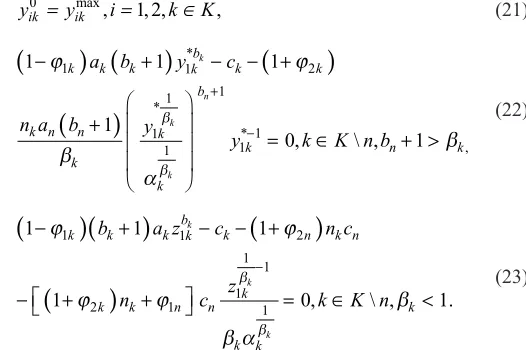
Optimal mechanisms for problems 1, 2, 6 at 18-20 are expressed as follows:
yik0 = yikmax,i=1 2, ,k K∈ , (21)
(
) (
)
(
)
(
)
*
1 1 2
1 1 *
* 1 1
1 ,
1
1 1 1
1
0, \ , 1
k
n
k
k
b
k k k k k k
b k n n k
k n k
k
k
a b y c
n a b y
y k K n b
+
−
− + − − +
+
= ∈ + >
(22)
(
)(
)
(
)
(
)
1 1 2
1 1 1
2 1 1
1 1 1
1 0, \ , 1.
k
k
k
b
k k k k k n k n k
k k n n k
k k
b a z c n c
z
n c k K n
−
− + − − +
− + + = ∈ <
(23)
Computational solution of nonlinear equations 22, 23 provides us with individual optimums of the agents and the optimum of the cartel. Optimal mechanisms 21-23 investigation shows that there are contradictions between centers that are interested in maximizing export and import volumes and exporting companies whose maximum profit is reached at internal points of admissible
sets Ak. Individual optimums of the companies and the optimum of a whole two-sector system as a cartel do not coincide also. Thus we need to coordinate the effects on the basis of mechanism (14).
3.2. Simulation of Export/Import Transactions for the Oil Market
Let us consider export/import transactions of the Russian oil extracting industry at the example of oil extracting company Rosneft OJSC (Russia) and drilling equipment producer Bentec GmbH (Germany). Table 1 shows the type characteristics used in the models of agents (companies) and centers (Russia and Germany). Commodity price regression coefficients (crude oil and equipment) are got from statistical analysis of dynamics of export/ import prices and volumes for the period 2014-2015.
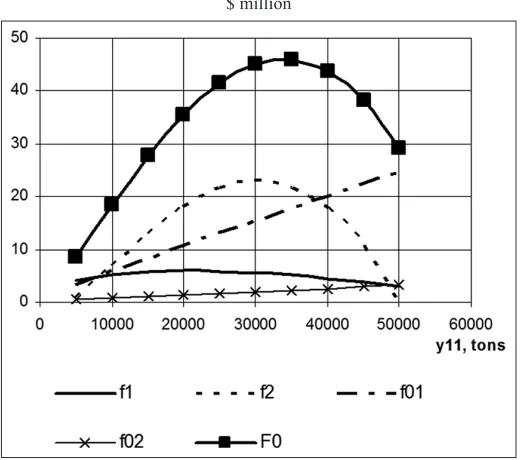
Figure 3 shows the criterion function curves of the agents, centers and integrated system of agents as a cartel depending on the export volume of the first country y11 taking into consideration that export and import volumes of the countries are connected by relations 16 and 17. These plots demonstrate that export/import transactions are not coordinated: Export volume maximizing
criterion f1 is sufficiently lower than the optimum according to
criterion f2, which in its turn is lower of the optimal export volume according to criterion F0. Criteria of the centers f01, f02 reach their maximums at the margins of companies’ production capacities.
this relation, distribution (14) is carried out for the additional effect F z0( )−g k Kk, ∈ . As a result, the optimal vector of indicators Z
enables to carry out export/import transactions to mutual benefit, which results in agents’ effects increase and providing compensation for the losses (regrets) of the centers.
4. CONCLUSION
Investigation of the problem of coordinating economic interests of the agents of foreign trade resulted in three types of coordinated states that should be chosen: Hierarchical coordination of the interests of national centers and regions (local companies), interest coordination of the regions (companies) within international cartels, comprehensive coordination of the centers and regions (companies) of different countries. Hierarchical coordination is provided by effect redistribution by means of inter-budgetary transfers from the center to regional budgets or by subsidies
for the companies. Nonhierarchical coordination is possible if the agents within a cartel get enough effect to compensate their losses (regrets) from integration. Thus effect distribution between the agents proportional to their losses (regrets) can be implemented in practice by discriminating export/import tariffs or in the form of markups (discounts) for supplies. Interests of the centers and interests of exporters/importers are coordinated if the effect derived from export/import transactions is enough to compensate not only the agents’ losses but also the losses of the national centers (budgets) they suffered from the deviation of optimal strategies of the agents from the priorities established by the center.
REFERENCES
Barrell, R., Duru, K., Hurst, I. (2003), International monetary policy coordination: An evaluation using a large econometric model. Economic Modelling, 20(3), 507-527.
Brander, J., Spencer, B. (1984), Tariff protection and imperfect competition. In: Kierzkowsky, H., editor. Monopolistic Competition and International Trade. Oxford: Oxford University Press.
Brander, J., Taylor, M. (1998), Open access renewable resources: Trade and trade policy in a two-country model. Journal of International Economics, 44, 181-209.
Burkov, V., Novikov, D. (1999), Models and methods of multiprojects’ management. Systems Science, 25(2), 5-14.
Collier, P., Venables, A. (2011), Illusory revenues; import tariffs in resource-rich and aid-rich economies. Journal of Development Economics, 94, 202-206.
Copeland, B., Taylor, M. (2009), Trade, tragedy and the commons. American Economic Review, 99, 725-749.
Grauwe, P. (1983), De Macroeconomic Theory for the Open Economy. London: Gower.
Hamada, K. (1979), Macroeconomic strategy and coordination under alternative exchange rates. In: Dornbuch, R., Frenkel, J.A., editors. International Economic Policy. Baltimore, MD: Johns Hopkins University Press.
Javonic, M. (2014), International Economic Integration: Problems and Prospects. London: Routledge.
Keen, M., Ligthar, J. (2002), Coordinating tariff reduction and domestic tax reform. Journal of International Economics, 56(2), 489-507.
Table 1: Agent type characteristics
k ak, $ bk αk, tons (pcs.) βk φ1k Φ2k ck, $ nk y
kmax,
tons (pcs.)
1 37500 −0.37 1430 0.4 0.3 0.1 100 0.1 40000
2 2240000 −0.53 0.000004 1.9 0.1 0.05 15000 1 4000
Table 2: Coordination of export/import transactions
k y
k
1* , tons (pcs.) y2*k, tons
(pcs.)
y10k y20k, tons (pcs.)
z1k, tons (pcs.) z2k, tons (pcs.) gk, $ million fk(z), $ million
1 20235 753 40000 35090 2983 5.98 13.28
2 28000 1617 4000 22.25 22.74
k Δgk (z), $ million h0k, $ million h0k(z), $ million Δh0k(z), $ million F z g
k k K
0( )− , ∈
∑
$ million
dk(z), $ million fk(dk), $ million
1 −7.29 19.97 17.84 2.13 7.78 7.45 20.73
2 −0.49 2.59 2.33 0.26 0.33 23.07
Koh, M., Marion, N. (1987), The implications of knowledge-based growth for the optimality of open capital market. Working Paper, Dartmouth College.
Krugman, P., editor. (1986), Strategic Trade Policy and the New International Economics. Cambridge, MA: MIT Press.
Luciani, G., Ghassan, S. (2015), The Politics of Arab Integration. London:
Routledge.
Novikov, D. (2003), Theory of Control in Organizations. New York: Nova Science Publishers.
Turner, A., Farrimond, J., Hill, J. (2011), The oil trading markets, 2003-10: Analysis of market behaviour and possible policy responses. Oxford Review of Economic Policy, 27, 33-67.
APPENDIX
Proof of proposition 1: Nash equilibrium is such a vector Zn z
j kN
=
{ }
that makes it profitable for every agent to choose its corresponding component if other agents also choose equilibrium components:fjk z d z f z d z
j kN
j k
j kN
jk kj jk kHj
, , − , , −
(
)
≥(
)
, (A1)Where index “Н” denotes Nash equilibrium vector of indicators of the jth agent of the kth subsystem, while environmental agents are
denoted by index “−j”.
Let us prove the necessity. Suppose 12 is fulfilled, while А1 is not, i.e. fjk z d z f z d z
j kN
j k
j kN
jk kj kj kHj
, , − , , −
(
)
<(
)
. In this case the jth agentof the kth subsystem has an opportunity to increase the value of its efficiency criterion by changing the vector of indicators and with
provision for the sufficiency of the effect to compensate losses (regrets) of all the agents, there will be found such a vector ZN z
j kN
=
{ }
that will establish equilibrium. Let us prove the sufficiency. Suppose А1 is fulfilled and 12 is not, i.e. d y zjk kj kj g zkj kjj J k K j J
k K k k
*, 0 .
(
)
<( )
∈ ∈ ∈
∈
∑
∑
∑
∑
∆In this case the losses (regrets) are compensated not to all the agents, i.e. there are the agents that are interested in increasing their efficiency criterion by changing the vector of indicators. Thus it is not an equilibrium state.
Proof of proposition 2: Let us prove the necessity. Suppose conditions 11 and 12 are fulfilled, while condition 9 is not fulfilled, i.e.
d y zjk
(
kj*, kj0)
< ∆g zkj( )
kj . In this case, with provision for 11, we shall obtain d y zd y z g z
F
j k
j k
j k
j k
j k
j k
j k
j k
j J
k K k
*
*
,
,
0
0
0
(
)
<(
)
( )
∈
∈
∑
∑
∆, and
with provision for 10 it follows that 1< 0
( )
(
)
∈ ∈
∈ ∈
∑
∑
∑
∑
∆g z d y z
j k
j k
j J k K
j k
j k
j k
j J k K
k
k
*, , i.e. aggregate losses (regrets) of the system exceed the aggregate effect
derived from interactions, which violates (11). Let us prove the sufficiency. Suppose 9 is fulfilled, while conditions 11 and 12 are not,
i.e. for example,d y z g z
g z F
j k
j k
j
k j
k j k
j k
j k
j J
k K k
*, 0 .
0
(
)
<( )
( )
∈∈
∑
∑
∆
∆ . In this case d y z
g z
g z d y z
j k
j k
j
k j
k j k
j k
j k
j J k K
j k
j k
j k
j k
*, 0 . *, 0
(
)
<( )
( )
(
)
∈
∈
∑
∑
∆
∆
∑
k K∈∑
∈∈Jk, and
according to 12 this inequality is not fulfilled in equilibrium state. The following case is impossible for the effect is limited (10).
Proof of proposition 3: Let us express criterion 18 with provision for 16.
f r yk k k k ka ky kk bk k na ybnk k K n
0 1 2
1
2 2 1
( , )=ϕ
(
α β)
+ +ϕ + , ∈ \ ,And let us write a necessary optimum condition of the problem 1 for it:
f kyk k ka bk kykk bk k kykk k na bn yyb k
0 2 1 1 2 2 1 2 1 2
Whence it follows 21. Let us write the necessary optimum condition for the problem 2 under 19:
(
) (
)
(
)
(
)
1 1 1 * */ 1 * 1
1 2 1 1 1
1 1 1 0, \ ,
n k k k k b k n n
b k
ky k k k ik k k k
k
k
n a b y
f a b y c y k K n
+ − + = − + − − + = ∈
Whence it follows 22. The analysis of the maximum sufficient condition
(
)
(
)
(
)
(
) ( )
1
1
1 1
* 1 *
* 1 * 1
// 1 * 1 1 * 2
1 1 2 1 1 1 1 1 1
1 1
1 1 1 1 0, \ ,
n n
k k
k k
k n
k k k
b b
k n n
b k k
ky k k k k k k n b k k k
k
k
k k k
n a b y y
f a b b y b y y y k K n
+ − − − − + +
= − + − + + − < ∈
(
)
(
)
(
)
(
)
1 1 * 1 * * 1// 1 * 2
1 1 2 1 1 1 1
1 1 1
1 1 1 0, \ ,
n
k
k k
k n n
k k k
b k n n
b k n
ky k k k k k k k k b b
k
k
k k k
n a b y b
f a b b y − y y− k K n
+ + + +
= − + − + − < ∈
Demonstrates that with provision for |bk|<1, bk<0 over 15 maximum is reached if bn k k b k b n k n k
+ − >
+ +
1 1 0
1 1
β α β α β , i.e. if bn+1>βk Suppose we found the solution of the problem 20xk x k K f p ck
k K k n k n
k
=
(
)
∈ ∈
∑
Arg max ,
, , \ , then let us transform 20 with provision for export/ import balance (17).
(
) (
)
(
)
(
)
(
)
(
)
(
)
0 1 1 2 2 1 1 2 2
1 2 1 2 1 2
, 1 (1 ) 1 1
1 1 1 , \
k k k k k k k k n k n n n n n k n n
k k k n k n k k k n n k
F r y p c y n c y c c y n c y
p c n c y n c y k K n
= − − − + + − − − + = − − − + − + + ∈
And then insert 15 and 16.
(
) (
)
(
)
(
)
1 1
0 , 1 1 1 1 2 1 1 2 1 , \
k k
b k
k k k k k k n k n k k k n n
k
y
F r y = − a y − − +c n c y − + n + c k K n∈
(A2)
Let us write the necessary optimum condition for the problem 6 with regard of А2:
(
)(
)
(
)
(
)
1
1 1
/ 1
0 1 1 1 1 1 2 1 2 1 1 0, \
k
k
bk k
y k k k k k n k n k k n n
k k k
y
F b a y c n c n c k K n
− = − + − − + − + + = ∈
Which with provision for the notation of the solution of the problem 6 by vector Z gives 23. The sufficient maximum condition.
(
)(
)
(
)
1
1 2 1
// 1
0 1 1 2 1 1
1
1 1 k 1 1 k 0, \
k
k
b k
y k k k k k k k n n
k
k k
y
F b a b y n c k K n
−
−
= − + − + + − < ∈
Is fulfilled ∀y1k>0 if 1 1 0