Issues
ISSN: 2146-4138
available at http: www.econjournals.com
International Journal of Economics and Financial Issues, 2015, 5(Special Issue) 34-39.
2nd AFAP INTERNATIONAL CONFERENCE ON ENTREPRENEURSHIP AND BUSINESS MANAGEMENT (AICEBM 2015), 10-11 January 2015, Universiti Teknologi Malaysia, Kuala Lumpur, Malaysia.
Does User Search Behaviour Mediate User Knowledge and
Search Satisfaction?
Fadhilah Mat Yamin
1*, T. Ramayah
2, Wan Hussain Wan Ishak
31School of Technology Management and Logistics, Universiti Utara Malaysia, Sintok, Kedah, Malaysia, 2School of Business,
Universiti Sains Malaysia, Penang, Malaysia, 3School of Computing, Universiti Utara Malaysia, Sintok, Kedah, Malaysia.
*Email: [email protected]
ABSTRACT
Information searching in web environment is habitually tedious and challenging task. Rapid growth of web information infrastructure has led to the rapid publication of information on web environment. Too many information publish on web cause information overload problem that preclude the success of information searching. Thus, reduce the search satisfaction. This study has identified that user knowledge lead to user search behaviour and user search behaviour lead to search satisfaction. This paper discusses the investigation empirically through the search log analysis and questionnaire. The respondents were among the students at a local university in Malaysia. The findings support that the user search behaviour has a mediator effect on the relationship between the user knowledge and search satisfaction.
Keywords: Search Satisfaction, User Search Behavior, User Knowledge, Web Searching, Search System JEL Classifications:M000
1. INTRODUCTION
Information environment can be categorized into conventional/ traditional and web environment (Park et al., 2005). In these environments, even though the users share the same aim, but the behaviours exhibited by the users are different. A library is an example of conventional/traditional information environment. Searching for information in a library requires several activities such as user has to refer to the collection catalogue or the librarian to allocate the material, find the rack that situates the material, and scan all the materials to find the correct one and finally pick-up the wanted material. Searching in this environment is a tedious work and time consuming. Furthermore, there is a possibility that the material is not in place.
The web environment offers a flexibility that does not exist in conventional/traditional environment. In web environment, the information is vast, unlimited and the availability is guaranteed except when technical problem occurred. The retrieval of the
information can be made at any time without physical constraint. Locating the information is simply by a simple query through the search system. In this environment, the typical search behaviours are browsing, formulating and reformulating query, evaluating the search results, interface navigation, etc. To date, web environment is the most popular environment for information searching and retrieval as shown by Internet World Stats (2014).
The need for information demand users to search for information that satisfies them, especially in decision making process. As a consequences, even with little effort users want fast result and they give up quickly if they don’t get what they are looking for. The use of search engine and other search system on the Internet
has enabled the access and retrieve of information from the
users are given with too many information than they can handle within a given time frame (Liang et al., 2007). In particular, information overload in the online environment bring users to less satisfied, less confident, and more confused (Lee and Lee, 2004; Chen et al., 2007).
Information need among individuals are varies depending on the goal that they are trying to achieve. Information need is form at the initial stage of search activity. It can be identified based on the understanding of the search task. Search task is the instruction that contains what information to search for. Furthermore, user’s behaviour, which indicates how user’s responded or act to achieve the goal, will be different as behaviour is unique among individuals (Wieman, 1922; Rasli et al., 2014). Search behaviour is a strategy undertaken by the user in searching for information. Nachmias and Gilad (2002) defined search behaviour or search strategy as a user plan that consists of a series of actions (steps), aimed at searching information. In order to successfully find useful information on the web, users need to consider the usage of their searching strategies to generate better outcome (Tu et al., 2008). Zhang et al., (2005) define search behaviour as the micro level of behaviour when a user interacts with a specific information retrieval system to search for relevant information. During the search process user has to utilize different behavioural strategies and sometimes changes the strategy in order to achieve the information need. The satisfaction of the searching is a predominant aspect of the search activity as the satisfaction will indicate the fulfilment of user’s need determined in the evaluation phase. As highlighted in Norman (1988), the evaluation is a part of human’s actions (Bhatti et al., 2010).
This paper investigates the mediation effect of search behaviour on user knowledge and search satisfaction. The next section shows that there is a relationship between user knowledge and search behaviour, user knowledge and search satisfaction, and search behaviour and search satisfaction.
2. LITERATURE REVIEW
Information search on the web is a complex process. The components of information seeking and searching processes as proposed by Marchionini (1995) and Sutcliffe and Ennis (1998) are similar but not identical. The major difference of those processes is the sequence of the execution of the components. Correspondingly, in every model the main components are the identification of the problem or search task analysis, information need articulation, formulation of the query, results evaluation, and decision to repeat or to stop the searching. Theoretically, users will stop searching when they have found what they are looking for or feel satisfied with what they have achieved.
Problem identification starts with task in hand that users have to search for. According to Broder (2002) the task will determine the information need which is verbalized and translated into a query posed to a search system. At this stage users need to understand the task. The complexity of the search tasks is also an important factor in users’ ability to find relevant information and their satisfaction (Bell and Ruthven, 2004; Khan et al., 2014). Complex task might be difficult to understand compared to less complex task.
Information need is the perceived need for information. Information need is also associated with the search task. The task particularly will state the kind of information that the user should acquire. Allen (1996) raises a question “how can users express their information needs in their own terms and still obtain information that will meet their information need?” The Allen question is concerned with users’ knowledge and strategy to address their need (Nazir and Shah, 2014). In particular, different user might use different set of queries to achieve the same need.
Once the information need has been identified, the next step is how to represent the information need to suitable query. Queries
are considered as formal statements of the information needs
therefore, the quality of information retrieval depends on the user formulated query. The length of the query for example will influence the search results. Short queries are used to initiate the search when the users are not familiar with the subject (Barsky and Bar-Ilan, 2005). This shows that the effect of user knowledge on query formulation (Danjuma and Rasli, 2013). In contrast to short query, long queries can be used to address more specific need of the user. This query allows users to naturally and fully describe their information need (Shapiro and Taksa, 2003). As Shapiro and Taksa (2003) have demonstrated, a long query in web environment is practical and can substantially improve the quality of information retrieval. Therefore, understanding and knowing how to formulate the query will benefit best the user.
Query reformulation is a modification to a search query that addresses the same information need (Shapiro and Taksa, 2003; Huang and Efthimiadis, 2009). According to Huang and Efthimiadis (2009), examples of query reformulation are word reorder, white apace and punctuation, word removal, word addition, acronym formation and expansion, substring, abbreviation, word substitution and spelling correction. Users can also benefit from an improved search experience when performing reformulation (Huang and Efthimiadis, 2009). Experience is a kind of knowledge that is produced from repeating process of searching. After the search session, user will typically update his or her knowledge about the query manipulation and how to use the search system.
Query reformulation also is a part of user’s strategy to improve the search results (Tu et al., 2008). This strategy is also called user’s behaviour (Nachmias and Gilad, 2002). Nachmias and Gilad (2002) define search behaviour as a user plan that consists of a series of actions (steps), aimed at searching information and satisfaction of the search result. The search results are considered relevant to the users when it matches the query entered during the search session (Rieh, 2002).
the search results such as examine, print, save and bookmark the results. Actually, satisfaction level is subjective to different researchers. Satisfaction influenced by user knowledge which means users typically evaluate the search session based on the topic. Additionally, a best strategy that users applied is also influence by his/her knowledge on the search system itself.
Knowledge has been identified as the key for understanding the task and information need. The query reformulation is also interrelated with user knowledge. As addressed by Huang and Efthimiadis (2009) the query reformulation will increase the user experience which will improve user’s search skills. Another important component of search processes is search results evaluation. At this stage, users will use their basic knowledge to evaluate the search results and decide whether the information is adequate or not.
Marchionini and White (2007) indicate two types of knowledge that prevailing users’ seeking process; familiarity with the topic or subject and familiarity with the search system. Familiarity with the topic or subject is vital as the first stage of typical searching process begins with problem identification or analysis of the search task and information needs articulation. This knowledge will also drive
users to choose the most suitable query related to the search task.
The familiarity with the search system will help users to search comfortably (Gorrell, 2008). Basically, search system provides a basic search facility and advanced search facilities to improve the search results (Manning et al., 2008). Certain search system such as Google incorporates Boolean operator as a built-in mechanism for the searching. The Boolean operator will be automatically added in between the search terms to ensure that the results contain all or some of the keywords.
Besides knowledge, the behaviour of the users has been found to be one of the important factors for the success of search (Tu et al., 2008; White et al., 2008; Huntington et al., 2006; Agichtein et al., 2006). As highlighted by Nachmias and Gilad (2002), users will apply numerous strategies in order to achieve their goal. These strategies are applied during the reformulation of the query (Tu et al., 2008; White et al., 2008).
The query formulated by users can be classified as breadth, depth or combination of breadth and depth type of query. The concepts of breadth and depth of query are not new in the field of consumer behaviour and computer science. As illustrated by Hodkinson and Kiel (2003), in consumer behaviour these concepts are similar to the way a consumer moving through a shopping complex to find what he/she desires. While in computer science these concepts are formulated as search algorithms that search a problem space to find the specific solution (Korf, 1996). Even though, these two fields view breadth and depth of search differently, the nature, aim and the final outcome of both activities are similar that is to get the solution at minimum cost (reduce search time). The characteristic of broad and narrow queries are similar to the concept of breadth and depth of search. Therefore, broad queries can be conceptualized as breadth query manipulation, while narrow query can be conceptualized as depth query manipulation.
In IR context, these concepts describe how user formulate and manipulate the query in order to achieve their information need (satisfaction).
The initiation of search behaviour is the impact of users’ knowledge (White et al., 2008; Zhang et al., 2005; Wildemuth, 2004). Wildemuth (2004) conceptualized user behaviour as the search tactics that is the patterns of term use in queries. His study found that user tactics changed over time as their domain knowledge changed. Consistently, Zhang et al. (2005) reveal that the user behaviour towards the searching increases when the domain knowledge increases. The user behaviour is observed as does more searches or queries and uses more terms in queries. Similarly, analyses of the interaction log of the search system by White et al. (2008) indicate that expert user’ issues longer queries than non-experts and the expert users are also found using more technical query terms than the non-experts.
The relationships that exist between user knowledge and search behaviour, user knowledge and search satisfaction, and search
behaviour and search satisfaction indicate that search behaviour
is an intervention between user knowledge and search satisfaction. This relationship indicates that search behaviour is a mediator. According to Baron and Kenny (1986), a mediating variable is the third variable that explains the indirect relationship between independent and dependent variables. To be considered as mediating variable, it must be significantly related to independent and dependent variables. Wu and Zumbo (2008) describe meditational model as “the independent variable is presumed to cause the mediator, and in turn, the mediator causes the dependent variable.” Thus, it is expected that;
H1: User search behaviour mediates the relationship between user knowledge and search satisfaction.
H2: Breadth search query mediates the relationship between topic understanding and search satisfaction.
H3: Breadth search query mediates the relationship between search system understanding and search satisfaction.
H4: Depth search query mediates the relationship between topic understanding and search satisfaction.
H5: Depth search query mediates the relationship between search system understanding and search satisfaction.
3. METHODOLOGY
The respondents are randomly selected from a list of final year undergraduate students. This study involves search satisfaction as dependent variable, user knowledge as the independent variable and user search behaviour as the mediator.
satisfaction of information. In this study, only information dimension and its elements was adopted. The items under information construct are; information relevancy, information accuracy, information comprehensibility and information comprehensiveness. The respondent assessment of the search satisfaction items was obtained based on five point scale that ranges from 1 to 5 (1 = Strongly disagree, 2 = Disagree, 3 = Neutral, 4 = Agree to 5 = Strongly agree).
User search behaviour on query formulation as the mediating role was measured based on number of attempts or effort performed by users on formulating the queries. User search behaviour variable consists of breadth search query and depth search query. The attempts refer to the frequencies of query formulation by each user. The queries were recorded in the search log. The search log was retrieved and sorted according to user ID. Queries entered by users were categorized either as breadth or depth search query. Each search query was examined (marking) and classified according to the measurement. Queries that are classified as breadth search query category are direct keyword, wide search and general knowledge. Depth search query category is including complex search, computer convention usage and Boolean search. The total number of queries for each category was counted and the mean was calculated.
The independent variable, user knowledge was measured by topic and search system understanding. “Homestay” and “Search System” are selected as the topic. 10 multiple choice questions (A to D), 10 true and false questions and 10 subjective questions were constructed for each topic. The validity of questions has been verified by the domain expertise. Two experts have been identified that is one person for the question related to the “Homestay” and the other for the “Search System”. Both knowledge (topic understanding and web search system understanding) was mark and the marks interval is between 0% and 100%.
4. FINDINGS
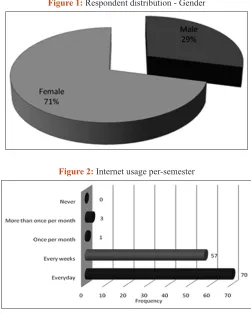
The total number of the respondents involved in this study was 131 respondents. The gender distribution was 93 for females and 38 for males (Figure 1). The respondent’s age below 25 years old is the largest respondent group with the percentage of 96.2%. The respondent with the age between 25 to 30 and 31 to 35 are the medium and the lowest group with the percentage of 3.1% and 0.7% respectively.
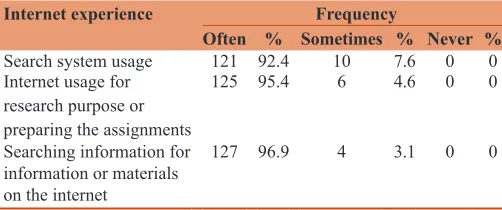
The questionnaire also reveals that none of the students had ever used the internet (0%). The frequency of the internet usage is however varies among the respondents. The frequencies are every day, every week, once per month, and more than once per month with 54.4%, 43.5%, 0.8%, and 2.3% of respondents respectively (Figure 2). The respondents’ demographic information
is summarized in Table 1.
Table 2 summarizes the respondents’ internet experience. The Table 2 shows that all respondents have the experience on the usage of the internet search engine. The results indicate that 121 respondents often used the search engine, while 10 other
respondents used the search engine less often. Most of the respondents (95.4%) indicate that they often used the Internet for research or assignment purposes. Another 4.6% sometimes did use the Internet for the same purposes.
4.1. The Mediation Impact of Breadth Search Query on the Relationship Between User Knowledge and Search Satisfaction
The breadth search query was hypothesized to mediate the relationship between user knowledge dimensions and search satisfaction. The two dimensions of user knowledge were found to influence the breadth search query and search satisfaction significantly. It was also found that the breadth search query also has a significant influence on search satisfaction. This indicates that there is a possible mediation impact of breadth search query on the relationship between user knowledge dimensions and search satisfaction.
Figure 1: Respondent distribution - Gender
Figure 2: Internet usage per-semester
Table 1: Respondents’ demographic information
Demographic
variables Categories Frequency %
Age <25 years 126 96.2
25-30 years 4 3.1
31-35 years 1 0.7
Gender Male 38 29
Female 93 71
Internet usage
per semester Everyday 70 53.4
Every week 57 43.5
Once per month 1 0.8
More than once per month 3 2.3
The analysis was performed in two steps. In Step 1, 16% of the search satisfaction can be explained by the user knowledge variable. The R2 increased up to 0.23 after the mediator variable was
plugged in. In Step 2, both of the dimensions of user knowledge were found to be significantly influenced the search satisfaction upon the introduction of mediating variable; breadth search query. The breadth search query as mediating variable is statistically significant (P < 0.01) on search satisfaction with β = 0.28.
When the breadth search query is plugged in, the β value for topic understanding has increased from β = 0.29 to β = 0.35. This findings show that breadth search query has no mediation effect on the relationship between topic understanding and search satisfaction. However, breadth search query was found to have partial mediation effect between search system understanding and search satisfaction.
4.2. The Mediation Impact of Depth Search Query on the Relationship Between User Knowledge and Search Satisfaction
The depth search query was hypothesized to mediate the relationship between user knowledge dimensions and search satisfaction. The two dimensions of user knowledge were found to influence the breadth search query and search satisfaction, significantly while the depth search query also significantly influenced search satisfaction. This indicates that there is a possible mediation impact of depth search query on the relationship between user knowledge dimensions and search satisfaction.
This analysis was also performed in two steps. In Step 1, 16% of the search satisfaction can be explained by the user knowledge variable. In Step 2, upon the introduction of the mediating variable depth search query, the R2 has increased up to 19%. Depth search
query as mediating variable is statistically significant on search satisfaction with β = 0.23. However, only the topic understanding has a significant relationship on search satisfaction (β = 0.21,
P < 0.01).
The analysis also shows that depth search query is partially mediated the relationship between topic understanding and search satisfaction, and fully mediated the relationship between search system understanding and search satisfaction.
5. DISCUSSION AND CONCLUSION
The finding shows that breadth search query has no mediation effect on the relationship between topic understanding and search
satisfaction. This finding concludes that users with low topic understanding do not necessarily formulate query through breadth search query. Users also have the potential to formulate the search query through depth search query with certain circumstances. One of the circumstances is guessing the query or by choosing the keywords from the search task provided. This action provides an opportunity for the users to formulate query which is categorized as depth search query.
The findings of the study have shown that breadth search query is partially mediating the relationship between search system understanding and search satisfaction. This relationship shows that low search system understanding does not lead to breadth search query and search satisfaction. This study also reveals that users with low knowledge in search system can also formulate query based on depth search query strategy.
The second dimension of user search behaviour is depth search query. The findings show that depth search query is fully mediating the relationship between search system understanding and search satisfaction. These results indicate that users with high knowledge in search system can formulate the query more in depth and lead to higher search satisfaction. The findings of the study reveal that depth search query is also a partial mediation on the relationship between topic understanding and search satisfaction. This result indicates that there is a possibility that users with high topic knowledge cannot search in depth due to the limited knowledge on the search system facilities.
These results provide evidence that system understanding is an important dimension that contributes to the search satisfaction when depth search behaviour is applied as mediator. The results also suggest that depth search query is vital to increase the search satisfaction. Depth search query is also shown to have an effect on the relationship between the topic understanding and search satisfaction.
Similarly, breadth search query has shown to have an effect on the relationship between search system understanding and search satisfaction, but no mediation effect on the relationship between topic understanding and search satisfaction.
REFERENCES
Agichtein, E., Brill, E., Dumais, S. (2006), Improving web search ranking by incorporating user behaviour information. Proceedings of the 29th Annual International ACM SIGIR Conference on Research and
Development in Information Retrieval. p19-26.
Allen, B. (1996), Expressing information needs. Book Series: Library and Information Science. Vol. 96. Bingley: Emerald Group Publishing Limited. p126-151.
Baron, R.M., Kenny, D.A. (1986), The moderator-mediator variable distinction in social psychological research: conceptual, strategic and statistical considerations. Journal of Personality and Social Psychology, 51(6), 1173-1182.
Barsky, E., Bar-Ilan, J. (2005), From the search problem through query formulation to results on the web. Online Information Review, 29(1), 75.
Beg, M.M.S., Ahmad, N. (2007), Web search enhancement by mining user
Table 2: Internet experience and usage
Internet experience Frequency
Often % Sometimes % Never % Search system usage 121 92.4 10 7.6 0 0 Internet usage for
research purpose or preparing the assignments
125 95.4 6 4.6 0 0
Searching information for
information or materials on the internet
actions. Journal of Information Science, 177, 5203-5218.
Bell, D.J., Ruthven, I. (2004), Searcher’s assessments of task complexity for web searching. Advances in Information Retrieval. Berlin/ Heidelberg: Springer. p57-71.
Bhatti, M.N., Qureshi, M.I., Zaman, K. (2010), Future of air travel industry: relation of growth and consumer satisfaction. International Journal of Economics and Research, 1(1), 19-37.
Broder, A. (2002), A taxonomy of web search. SIGIR Forum, 36(2), 3-10. Available from: http://www.scholar.google.com/ scholar?hl=en&lr=&q=A.Broder.+A+taxonomy+of+web+search. &btnG=Search.
Chen, Y.C., Shang, R.A., Kao, C.Y. (2007), The effects of information overload on the outcomes of on-line consumption behaviour. Proceedings of International Conference on Wireless Communications, Networking and Mobile Computing. p3791-3794. Danjuma, I., Rasli, A. (2013), Higher education and knowledge economy:
a focus on Nigeria. Sains Humanika, 64(3), 87-91.
Eppler, M.J., Mengis, J. (2004), The concept of information overload: a review of literature from organization science, accounting, marketing, MIS, and related disciplines.The Information Society, 20, 325-344.
Glover, E.J., Lawrence, S., Gordon, M.D., Birmingham, W.P., Giles, C.L. (2001), Web search - your way. Communications of the ACM, 44(12), 97-102.
Gorrell, M. (2008), The 21st century searcher: how the growth of search
engines affected the redesign of EBSCOhost. Against the Grain, 20(3), 22, 24. Available from: http://www.ebscoweb.com/thisTopic. php?marketID=21&topicID=1064. [Last retrieved on 2010 May 20]. Hodkinson, C., Kiel, G. (2003), Understanding web information search
behaviour: a exploratory model. Journal of End User Computing, 15(4), 27-48.
Huang, J., Efthimiadis, E.N. (2009), Analyzing and evaluating query reformulation strategies in web search logs. Conference on Information and Knowledge Management (CIKM’09). Proceeding of the 18th ACM Conference on Information and Knowledge
Management, Hong Kong, China. p77-86.
Huntington, P., Nicholas, D., Jamali, H.R. (2006), Employing log metrics to evaluate search behaviour and success: case study BBC search engine. Journal of Information Science, 33(5): 584-597.
Internet World Stats. (2014), Internet world stats. Available from: http:// www.internetworldstats.com/stats.htm.
Khan, F., Yusoff, R.M., Khan, A. (2014), Effect of human resource practices on job satisfaction in Pakistan. Sains Humanika, 1(1), 5-11. Korf, R.E. (1996), Artificial intelligence search algorithms. In: Handbook
of Algorithms and Theory of Computation.. Boca Raton, FL: CRC Press.
Lee, B.K., Lee, W.N. (2004), The effect of information overload on consumer choice quality in an online environment. Psychology and Marketing, 21(3), 159-183.
Liang, T., Lai, H., Ku, Y. (2007), Personalized content recommendation and user satisfaction: theoretical synthesis and empirical findings. Journal of Management Information System, 23(3), 45-70. Manning, C.D., Raghavan, P., Schütze, H. (2008), Introduction to
Information Retrieval. UK: Cambridge University Press.
Marchionini, G., White, R. (2007), Find what you need, understand what you find. International Journal of Human-Computer Interaction, 23(3), 205-237.
Marchionini, G. (1995), Information Seeking in Electronic Environments. Cambridge, MA: Cambridge University Press.
Muylle, S., Moenaert, R., Despontin, M. (2004), The conceptualization and empirical validation of web site user satisfaction. Information and Management, 41, 543-560.
Nachmias, R., Gilad, A. (2002), Needle in a hyper stack: searching information on the world wide web. Journal of Research on Technology in Education, 34(4), 475-486.
Nazir, T., Shah, S.F.H. (2014), Mediating effect of knowledge sharing between participative decision making, transformational leadership and organization performance. Journal of Management Info, 1(1), 1-12.
Norman, D.A. (1988), The Psychology of Everyday Things. New York: Basic Books.
Park, S., Lee, J.H., Bae, H.J. (2005), End user searching: a web log analysis of NAVER, a Korean web search engine. Library of Information Science Research, 27, 203-221.
Rasli, A.M., Norhalim, N., Kowang, T.O., Qureshi, M.I. (2014), Applying managerial competencies to overcome business constraints and create values evidence from small technology-based firms in Malaysia. Journal of Management Info, 3(1), 99-121.
Rieh, S.Y. (2002), Judgement of information quality and cognitive authority in the web. Journal of the American Society for Information Science and Technology, 53(2), 145-161.
Rijsbergen, C.J. (1979), Information Retrieval System. London: Butterworths.
Shapiro, J., Taksa, I. (2003), Constructing Web Search Queries from the User’s Information Need Expressed in a Natural Language. Proceedings of the 2003 ACM Symposium on Applied Computing (SAC’03). doi: 10.1145/952532.952758.
Sihvonen, A., Vakkari, P. (2004), Subject knowledge, thesaurus assisted query expansion and search success. Journal of the American Society for Information Science, 55(11), 963-969.
Sutcliffe, A., Ennis, M. (1998), Towards a cognitive theory of information retrieval. Interacting with Computers, 10, 321-351.
Tabatabai, D., Shore, B.M. (2005), How experts and novices search the web. Library and Information Science Research, 27, 222-248. Tu, Y., Shih, M., Tsai, C. (2008), Eight graders’ web searching strategies
and outcomes: the role of task types, web experiences and epistemological beliefs. Computers and Education, 51(3), 1142-1153. White, R.W., Dumais, S., Teevan, J. (2008), How medical expertise
influences web search interaction. In: Proceeding of the 31st Annual
International ACM SIGIR Conference on Research and Development in Information Retrieval, Singapore. p791-792.
Wieman, H.N. (1922), The unique in human behaviour. Psychological Review, 29(6), 414-424.
Wildemuth, B.M. (2004), The effects of domain knowledge on search tactic formulation. Journal of the American Society for Information Science and Technology, 55(3), 246-258.
Wu, A.D., Zumbo, B.D. (2008), Understanding and using mediators and moderators. Social Indicators Research, 87(3), 367-392.