1
Change Process for a Laboratory Program
Stefan G. Hutha, Emma Yenchb, Ian Pottera and Elizabeth Johnsonb
Corresponding author: [email protected]
aDepartment of Chemistry, La Trobe University, Bundoora, Victoria 3086, Australia
bFaculty of Science, Technology and Engineering, La Trobe University, Bundoora, Victoria 3086, Australia
Keywords: laboratory curriculum, chemistry, skills, change process, evaluation, motivation
International Journal of Innovation in Science and Mathematics Education, 21(4), 1-12, 2013
Abstract
Conventional science laboratory teaching has frequently been criticised for delivering poor student learning outcomes at great expense. Although many paedagogically valuable practical activities and laboratory curriculum concepts have been described in the literature, their implementation in university teaching programs has been very slow, which suggests that model activities alone are not sufficient for bringing about educational change. Successful laboratory curriculum reform requires the conception of pathways for change. The chemistry laboratory program at La Trobe University, Australia, has entered the second year of a redevelopment project that aims to modernise the curriculum and introduce a skill development focus. A four-year change plan, including a comprehensive evaluation strategy, has been devised. Four factors were identified that enabled the development and implementation of the project, which include strong backing from the chemistry department, a shared responsibility model for laboratory teaching, synergies with a university-wide curriculum reform process and support from a national learning and teaching peer network. The scale of the project and the difficulty in motivating all stakeholders to actively participate, present significant challenges for the project.
Introduction
Improved learning outcomes from laboratory programs have been a long-term target for curriculum reform, as shown by decades of innovative teaching practice in chemistry published in the discipline-based education literature. Much literature exists on paedagogically valuable practical activities as well as on the positive effects of making small modifications to conventional practicals (Abraham 2011; Eilks & Byers, 2010; George, Read, Barrie, Bucat, Buntine, Crisp, Jamie, & Kable, 2009; Hofstein & Lunetta, 2004; Kelly & Finlayson, 2007; McGarvey, 2004; Reid & Shah, 2007). Positive examples of changes to an entire lab curriculum are less common, but do exist (Ege, Coppola, & Lawton, 1997; Flynn & Biggs, 2012; Hollenbeck, Wixson, Geske, Dodge, Tseng, Clauss, & Blackwell, 2006; Vianna, Sleet & Johnstone, 1999). Whole-of-curriculum strategies have the advantage of reinforcing a novel approach to learning, which, in turn, fosters a larger effect on learning outcomes. The disadvantage is the project scale, which imposes significant cost in time and resources.
2
detailed consideration of materials and infrastructure; the cost associated with these, alongside design and staff development, must be accounted for when considering curriculum reform.
Successful curriculum review of laboratory programs requires consideration of incentives, motivations, supporting factors and pathways for changes. Reports in the discipline tertiary education literature rarely include any of this information, but instead focus exclusively on the technical and paedagogical aspects of the teaching innovations. Case studies offer a view of the complexities of the curriculum reform process. The aim of this report is to identify the factors that have motivated, guided and enabled curriculum renewal in the revision of the chemistry laboratory program at La Trobe University.
Background:
Environment for change
La Trobe University is one of the larger universities in Victoria with about 25000 undergraduate enrolments. Its main campus is located in Melbourne’s northern suburbs (Bundoora) and it operates further campuses in Melbourne’s city and in four of Victoria’s regional centres. The majority of students in the chemistry program at the Bundoora campus are enrolled in the general Bachelor of Science (BSc) degree, with small numbers enrolled in specialist degrees (B. Medicinal Chemistry, B. Nanotechnology). Up to 900 students enter the first-year chemistry subjects; about 100 students continue chemistry at second-year and 50 at third-year level.
The chemistry teaching program has recently been affected by significant changes at all organisational levels. The Department of Chemistry has undergone a generational change after nine senior academics retired between 2000 and 2010. Of the currently twelve academic staff, four have been appointed between 2007 and 2010 and another four since 2010. The new lecturers have brought new research interests and educational styles, which has revitalised the chemistry program, but has also led to inconsistencies, particularly between the lecture and laboratory components.
The changes on the departmental level coincided with a university-wide curriculum reform process, Design for Learning (DfL), which is still in progress (Jones, 2012). The core aims of
the DfL project were to establish a course-based design approach based on constructive
alignment (Biggs, 1996) and to improve the student experience, particularly concerning transition, academic skills and the first year experience (Channock, Horton, Reedman, & Stephenson, 2012). For each course and major in the University it involved an initial review and consultation period to define and map learning outcomes, followed by a staged three-year implementation phase in which the curriculum at year levels one, two and three were sequentially aligned with newly defined learning outcomes (graduate capabilities) at discipline, course and subject level. In chemistry, DfL has so far resulted in changes to the degree and subject structure and, to some extent, to content and teaching methods (e.g., assessment). Since all chemistry subjects include laboratory components, the laboratory programs had to be adjusted to fit the new subject structure. In science at La Trobe University, laboratory programs offer capacity for small group teaching and have been targeted by curriculum development teams as potential vehicles for embedding core skills emphasized by DfL such as inquiry, analysis, communication and teamwork.
3
outcomes. In Australia, government-funded projects have developed threshold learning outcomes for tertiary science courses (Jones, Yates, & Kelder, 2011). A new national regulator for higher education (the Tertiary Education Quality and Standards Agency, TEQSA) will require that ‘assessment is effective and expected student learning outcomes are achieved’ (Australian Government, 2011). Similarly, the latest version of the American Chemical Society’s course accreditation guidelines now specifies that ‘Approved programs should have an established process by which they assess the development of student skills’, such as communication or teamwork skills (American Chemical Society, 2008). The Royal Australian Chemical Society (RACI) is in the process of reviewing its own accreditation requirements. The debate about these issues has been boosted by the government-supported establishment of science education networks, including the Science and Mathematics Network (SaMnet) and the Chemistry Discipline Network (Chemnet).
The departmental, institutional and disciplinary environment, all provide impetus and opportunities for change. The curriculum descriptions produced by networks, regulators and accrediting bodies provided the framework and established aspirations for translation into an ambitious new laboratory program in the Department of Chemistry, the implementation of which we shall now describe.
The chemistry laboratory program at La Trobe University
The laboratory program before redevelopment
Up to 2012, the chemistry laboratory programs at La Trobe Bundoora followed a conventional curriculum consisting of predominantly recipe-style experiments in the areas of analytical, physical and synthetic (organic and inorganic) chemistry. Few experiments had been added or updated since the 1980s. Every experiment was assessed by a laboratory report. Although the laboratory components were embedded in the subjects, there was little connection between lecture content and laboratory work (with the exception of two small subjects offered for specialist degrees). Feedback surveys indicate that the majority of students enjoyed the laboratory work and considered it a worthwhile learning experience. However, the high workload and the lack of correspondence between lab and lectures were frequently criticised.
The laboratory programs at the senior undergraduate level (years 2 and 3) were administered by academic staff members on top of their research and lecture commitments, which was one of the main reasons for the inadequate maintenance of the programs. The need to substantially redevelop the laboratory curriculum as well as to improve the management of laboratory teaching was recognised by the chemistry department and led to the creation of a full-time laboratory coordinator position in 2011. The appointment of a new coordinator for the first-year laboratories one year earlier had set a positive precedence as it had improved the management of the program and enabled innovative approaches to be implemented.
Program analysis
4
Table 1: Analysis of the intrinsic strengths and weaknesses and the external opportunities and threats of the senior chemistry laboratory programs.
STRENGTHS
Staff: experienced technical staff &
demonstrators; new generation of motivated academics; new coordinator position. Teaching materials: Substantial stock of
tried and tested experiments.
Classes: flexibility through relatively small class sizes (~30 students/class).
Student experience: Hands-on program (including student use of instruments).
Majority of students have a positive attitude to lab work.
WEAKNESSES
Structure: lack of clear concept inefficiency, repetitiveness, lack of transparency
Content: lack of connection or synchro-nisation between laboratory and lectures. Teaching materials: many outdated
experiments; instructions often poorly written Assessment almost exclusively based on lab
reports not very suitable for assessing lab skills; excessive student workload. Standard of student performance unsatisfactory. Resources: very limited in regard to staffing
and equipment. OPPORTUNITIES
Curriculum reform: Subject review and reorganisation (Design for Learning) from 2011 facilitates change
Students: Successful reorganisation of 1st-year chemistry potential for more well-prepared and motivated students in years 2 and 3.
Resources: Move to new, upgraded teaching laboratories in 2013
THREATS
Cost: Pressure to reduce number of demonstrator hours
Students: Uncertainty in student number and skill level due to removal of enrolment caps
A review of student work (laboratory reports) showed that, even at 3rd-year, many students were not able to adequately analyse, present or discuss their laboratory data and often lacked understanding of central chemical concepts underlying the laboratory experiments. Moreover, observations in the laboratory revealed large variations in the quality of laboratory technique among students. This contrasts with high pass rates for the laboratory components (90 % and above in 3rd year). Evidently, many students were able to pass despite significant gaps in knowledge or skills.
The reasons for the unsatisfactory student performance cannot be attributed solely to the laboratory programs. However, we suspected that several aspects of the programs were contributing factors, including:
• The lack of an overarching, guiding concept and structure. Although the programs had ‘themes’ in regard to the broad field of chemistry they covered (e.g., synthetic chemistry), students were essentially allocated a random assortment of practical activities, making it difficult to see connections and transfer insights from one activity to the next.
5
• A lack of guidance for both students and demonstrators in regard to data recording, analysis and communication. The instructions on report writing consisted of two pages in the laboratory manual; marking criteria varied from experiment to experiment and were rarely made explicit to students. As there were no clear guidelines, students sometimes received contradictory feedback from different demonstrators.
• Inconsistent instruction on laboratory technique, as this was largely left to demonstrators without specific prior training.
All of these problems were to be addressed in a laboratory redevelopment plan.
A plan for change
The primary objective of the laboratory redevelopment plan was to improve student-learning outcomes. However, other objectives also had to be met. Firstly, the new program had to be consistent with the DfL goals and the revised chemistry curriculum. Secondly, the changes had to be sustainable in the long term and therefore minimize laboratory running costs. Thirdly, the new program had to be attractive to students and contribute to increasing enrolments. It was also imperative that the effects of the changes should be measurable to justify the investment.
The redevelopment started as an internal department initiative (with advice from educational advisers from other disciplines). In January 2012, the project was endorsed as action-learning project by the Australian Science and Mathematics Network (SaMnet), which gave the project a formal structure, including a designated project team and defined goals and timelines. It also reinforced the team members’ perception of the project as a research undertaking as well as a teaching innovation.
Educational objectives
According to Abraham (2011), laboratory learning can involve concepts, skills and processes, facts and attitudes. In practice, a practical laboratory experience is likely to incorporate all of these categories; however, it is desirable to emphasise a single learning goal to give students focus and make the task achievable. In this project, we chose to place skills, rather than chemical concepts, at the core of our laboratory curriculum, an approach similar to the one suggested by Benett and O’Neale (1998). ‘Skills’ in terms of this program was broadly interpreted to include all skills that contribute to a successful experiment – these include not only chemistry-specific skills (e.g., handling chemicals and glassware), but also generic skills, such as data recording and analysis, communication and teamwork skills and critical thinking.
6
underrepresented in the chemistry subjects. It was also hypothesised that raising students’ practical skill level through systematic instruction and practice would enable them to shift their attention from the technical details of a practical to the chemical questions underpinning it.
The focus on skills development suggested an approach of mixed instructional styles to target different types of skills. Existing highly prescriptive practicals used in the laboratory programs were to be adapted for the development of basic laboratory skills, with independent inquiry experiments planned in the future to address higher-order thinking skills (Abraham, 2005, Trout, Lee, Moog, & Rickey, 2008). This adaptive re-use approach promised to yield tangible results quickly.
Timeline and planned changes
Due to the complexity of the laboratory teaching program and limited resources, it was clear that the redevelopment had to proceed via gradual modification of the existing activities rather than the rollout of a complete new program, which could cause major disruptions for students and excessive workload for staff. However, it was also important to make visible progress in the short term to create a momentum for change and to keep all involved parties motivated. At the same time, the redevelopment had to follow the timeline of the DfL process because the organisation and content of the laboratory components was linked to the chemistry subjects, which were substantially reorganised during this period. In addition, the move to new laboratory teaching spaces in early 2013 had to be taken into consideration.
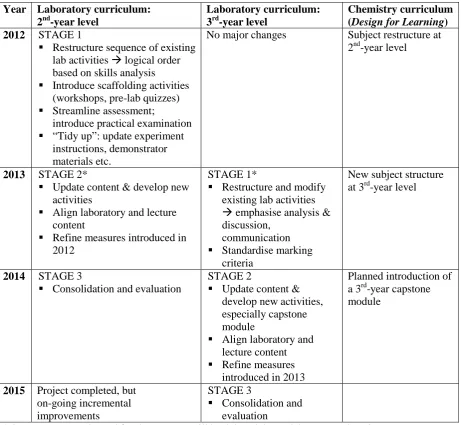
These considerations resulted in a three-stage, three-year plan for each year level (Table 2). The first stage involved re-ordering the existing laboratory activities to create a coherent, overarching structure that systematically introduces students to laboratory-relevant skills. This system would be supported by new scaffolding activities and materials, such as workshops, pre-lab quizzes, on-line materials and adjusted assessment. In the second stage, new laboratory activities would be created that focus on specific skill development and align with the lecture content. Finally, stage three would be dedicated to consolidation, refinement and evaluation of the changes. The redevelopment began at 2nd-year level in 2012 and one year later for the 3rd-year program.
The first stage of this plan was successfully implemented in 2012. The most notable changes included a revised sequence of laboratory activities based on the skills involved in the experimental task, starting off with a newly developed introductory lab skills activity and culminating in a practical examination to assess the acquired skills. Workshops on data analysis in Microsoft Excel and the analysis of spectroscopic data in organic and inorganic synthesis supported the practical activities. Only one full laboratory report per semester was required, for which detailed feedback was provided in the draft stage. Other laboratory reports were short and used a standard template. The revision and update of the practical instructions (for approximately 30 experiments at 2nd-year level) was commenced but not completed in 2012.
7
Continuing refinement and renewal is an essential part of a good laboratory program even after the redevelopment project has come to a close.
Table 2: Planned project timeline and implementation of changes.
Year Laboratory curriculum: 2nd-year level
Laboratory curriculum: 3rd-year level
Chemistry curriculum (Design for Learning) 2012 STAGE 1
Restructure sequence of existing
lab activities logical order based on skills analysis
Introduce scaffolding activities (workshops, pre-lab quizzes)
Streamline assessment;
introduce practical examination
“Tidy up”: update experiment
instructions, demonstrator materials etc.
No major changes Subject restructure at
2nd-year level
2013 STAGE 2*
Update content & develop new activities
Align laboratory and lecture
content
Refine measures introduced in
2012
STAGE 1*
Restructure and modify
existing lab activities emphasise analysis & discussion,
communication
Standardise marking
criteria
New subject structure at 3rd-year level
2014 STAGE 3
Consolidation and evaluation
STAGE 2
Update content & develop new activities, especially capstone module
Align laboratory and
lecture content
Refine measures
introduced in 2013
Planned introduction of a 3rd-year capstone module
2015 Project completed, but on-going incremental improvements
STAGE 3
Consolidation and
evaluation
* Some measures planned for these stages will be delayed due to laboratory relocation.
Engagement of stakeholders
Sustainable change in teaching requires that all stakeholders are able to contribute and thereby develop a sense of ownership of the innovation, eventually creating a cultural change in the organisation (Dancy & Henderson, 2008). In the case of the La Trobe laboratory programs, stakeholders include laboratory and subject coordinators, technical staff, demonstrators and students as well as the chemistry department and, to some extent, the school and faculty. Many of these stakeholders were aware of the problems of the laboratory programs and were already broadly supportive of attempts to ‘fix’ them. However, there was no consensus on how this should be done, or indeed on the goals of laboratory teaching.
8
laboratory coordinator to consider the differing views in the project planning. Students were informed of the change process at the start of semester and invited to participate informally through discussion with teaching staff and formally through a group of surveys. Students generously contributed their views on their own learning, on the delivery of the revised program and on its relationship to the broader chemistry curriculum. The laboratory coordinator was available for questions and concerns during every laboratory class.
The project plans and progress have been communicated to a wider audience through presentations at institutional and national conferences (Huth, Yench, Potter, & Johnson, 2012). This has not only provided opportunities to receive valuable feedback from experienced members of the teaching community, it has also increased the status of the project. External acknowledgment can make the project more acceptable to colleagues, deans and other stakeholders who may be sceptical or disinterested about proposed change.
Resources
The laboratory redevelopment project has been funded exclusively through the regular budget allocated to laboratory teaching. Small additional contributions from the chemistry department have been used for conference attendances and pizza lunches for focus groups. The project team has also been able to draw on teaching and learning expertise at the university, including the curriculum fellows appointed to support the DfL process (Johnson, Bird, Fyffe, & Yench, 2012) and the University’s Curriculum, Teaching and Learning Centre.
Evaluation
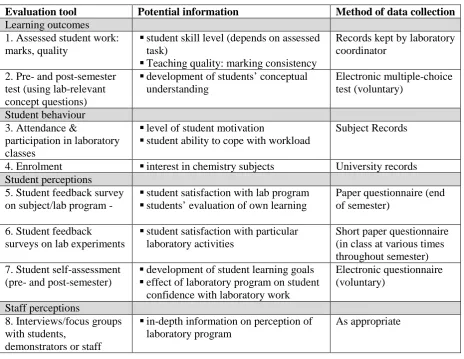
Meaningful documentation and evaluation of the effects of changes in teaching practice is an indispensable part of sustainable educational reform, yet this aspect is often neglected (Henderson, Beach, & Finkelstein, 2011). Evaluation of curriculum reform is a complex task which varies with the objectives of the project. In this case the project team embedded evaluation of student learning through assessment, student and staff perceptions and student behaviour. The evaluation process for the project includes adaptation of existing validated instruments as well as more informal and responsive data collection. The objective was to paint a multi-facetted picture of the project’s effects (Table 3).
The evaluation strategy makes use of material collected during normal delivery of subjects and recognizes the complementary nature of the collected data. Student surveys of individual labs, the lab program and their own learning were modelled on the ASELL student learning experience survey tool (ASELL, 2013; George et al., 2009). Feedback from staff and demonstrators is crucial for obtaining a complete picture of the impact of the changes. Evaluation of student achievement in assessed work will be facilitated by transition to electronic submission of reports which has been included in the revised practical program.
Discussion
9
Table 3: Selected evaluation tools of the redevelopment project.
Evaluation tool Potential information Method of data collection
Learning outcomes 1. Assessed student work: marks, quality
student skill level (depends on assessed task)
Teaching quality: marking consistency
Records kept by laboratory coordinator
2. Pre- and post-semester test (using lab-relevant concept questions)
development of students’ conceptual understanding
Electronic multiple-choice test (voluntary)
Student behaviour 3. Attendance &
participation in laboratory classes
level of student motivation
student ability to cope with workload
Subject Records
4. Enrolment interest in chemistry subjects University records
Student perceptions 5. Student feedback survey on subject/lab program -
student satisfaction with lab program students’ evaluation of own learning
Paper questionnaire (end of semester)
6. Student feedback
surveys on lab experiments
student satisfaction with particular laboratory activities
Short paper questionnaire (in class at various times throughout semester) 7. Student self-assessment
(pre- and post-semester)
development of student learning goals effect of laboratory program on student
confidence with laboratory work
Electronic questionnaire (voluntary)
Staff perceptions
8. Interviews/focus groups with students,
demonstrators or staff
in-depth information on perception of laboratory program
As appropriate
Enabling factors
Three key enabling factors have supported this whole-of-program curriculum renewal project. The disciplinary team forms a strong collaboration, which embeds the new laboratory program within the chemistry curriculum. The institutional context of broad-scale curriculum reform provides opportunities to leverage expertise and resources. External links provide resources, ideas and advice as well as public recognition for the work.
1. Disciplinary team gives depth and breadth
The foundation of this project lies in the strong support of the chemistry department at La Trobe University, who recognised the problems in the laboratory program and committed to long-term redevelopment. Importantly, the department decided on a shared responsibility model for laboratory teaching, in which the newly appointed senior lab coordinator is responsible for the laboratory components, but has to consult with the respective subject coordinators on content and format of the program. Changes to the laboratory program necessarily involve all academic staff since all lecture programs are structurally linked to laboratory teaching. The laboratory coordinator therefore acts as a facilitator who communicates with lecturers, technical staff, demonstrators, students and others (such as laboratory staff from other science disciplines or institutions) to create a coherent laboratory-teaching program across all chemistry subjects and year levels.
10
interactions with close colleagues can be an effective model for developing a shared understanding (Fraser, 2006; Haigh, 2005). This departmental grouping inherent in this project offers a basis for long-term change.
2. Institutional context can provide opportunities
The project also benefitted from the climate of change created by the Design for Learning process. The institutional project has provided targeted academic development and educational design expertise to support the project. Broad scale reform has generated capacity to align changes in the laboratory with parallel changes in partner disciplines contributing to shared courses. Moreover, DfL has generated a university-wide debate on teaching and learning that prepared the ground for teaching innovation projects (Jones, 2012).
3. External interactions offer new ideas
External interactions have supplied ideas and tools for curriculum reform. The ASELL project (ASELL, 2013) has been an important vehicle for reform of laboratory classes in Australian universities and recently has developed tools for analysis of laboratory programs. This project has drawn on ASELL evaluation tools and its findings.
Discussion with peers from other universities has also been very valuable. Establishment of the chemistry lab reform project as part of the SaMnet leadership project (SaMnet, 2013) gave the project a defined identity, clear goals, a project team and a timeline. Most importantly, the SaMnet national network has provided a platform to exchange ideas and receive advice from peers working with equivalent programs.
Challenges
The first stage of project implementation was deemed successful in so far as significant disruptions were avoided and students valued their learning experience in the laboratory program, as indicated in feedback surveys. However, problems such as long turnaround times for report marking and miscommunication between laboratory coordinator, demonstrators and students regarding the new rules and procedures revealed vulnerabilities in the structure of the redevelopment project. Key concerns are the excessive workload for laboratory staff and the limited engagement of chemistry academics in the reform process.
1. How feasible are scale and timing of the project?
A reform process that imposes high workloads on key staff members is at risk of experiencing damaging disruptions. In the current project, extending the planning phase and delaying the start of the project would have allowed, for example, the design of assessment items that directly relate to student learning outcomes, the development of a communication strategy and other measures that could enhance the project’s chances of success. However, external factors, including the schedule of chemistry curriculum restructure and the psychological momentum gained from new staff appointments, were deemed to outweigh the concerns about planning. It was felt that the synergy of the enabling factors discussed above had created a narrow window of opportunity for successful reform.
2. How can active stakeholder participation be achieved?
11
the informal consultation approach was effective in integrating differing views from within the department, it lacked a dedicated forum in which the proposed changes could be presented and discussed and basic decisions could be made as a collective.
Brownell and Tanner (2012) suggested that a strong discipline-based, research-focused professional identity could also be a factor for the reluctance of many academics to engage in educational reform. Projects that combine teaching innovations with research interests could be a vehicle to overcome such barriers. This will be tested in stage two of the laboratory redevelopment project, where the design of new laboratory experiments will require the chemical expertise of academics and the educational experience of the project team.
Conclusion
Reform of the chemistry laboratory program at La Trobe University has demonstrated the importance of a planned and collegiate approach to achieve whole-of-program curriculum renewal. The case study has demonstrated the benefit of seeking out multiple sources of support from within the university (colleagues, department, faculty) as well as from professional networks outside the institution.
References
Abraham, M. R. (2005). Inquiry and the learning cycle approach. In N. J. Pienta, M. M. Cooper & T. J.
Greenbowe (Eds.), Chemists’ guide to effective teaching (pp. 41-52). Upper Saddle River, NJ: Prentice Hall. Abraham, M. R. (2011). What can be learned from laboratory activities? Revisiting 32 years of research.
Journal of Chemical Education, 88, 1020-1025.
American Chemical Society (2008). Undergraduate professional education in chemistry. Retrieved April 4, 2013, from
http://portal.acs.org/portal/PublicWebSite/about/governance/committees/training/acsapproved/degreeprogra m/WPCP_008491.
ASELL (2013). Advancing science by enhancing learning in the laboratory. Retrieved April 8, 2013, from http://www.asell.org/.
Australian Government (2011). Tertiary Education Quality and Standards Agency Act 2011. Higher Education Standards Framework (Threshold Standards), explanatory statement. Retrieved April 4, 2013, from http://www.comlaw.gov.au/Details/F2012L00003/Explanatory%20Statement/Text.
Bennett, S. W., & O’Neale, K. (1998). Skills development and practical work in chemistry. University Chemistry Education, 2(2), 58-62.
Biggs, J. (1996). Enhancing teaching through constructive alignment. Higher Education 32, 347-364. Brownell, S. E., & Tanner, K. D. (2012). Barriers to faculty pedagogical change: lack of training, time,
incentives, and tensions with professional identity? CBE—Life Sciences Education, 11, 339–346.
Channock K., Horton C., Reedman, M. and Stephenson, B. (2012). Collaborating to embed academic literacies and personal support in first year discipline subjects. Journal of University Teaching & Learning Practice,
9(3). Retrieved April 4, 2013, from http://ro.uow.edu.au/jutlp/vol9/iss3/3.
Dancy, M. H., & Henderson, C. (2008). Barriers and promises in STEM reform National Academies of Science promising practices workshop. Washington, DC: National Academies of Science.
Ege, S. N., Coppola, B. P., & Lawton, R. G. (1997). The University of Michigan undergraduate chemistry curriculum 1. Philosophy, curriculum, and the nature of change. Journal of Chemical Education, 74(1), 74-83.
Eilks, I., & Byers, B. (2010). The need for innovative methods of teaching and learning chemistry in higher education – reflections from a project of the European Chemistry Thematic Network. Chemistry Education Research and Practice, 11, 233-240.
Flynn, A. B., & Biggs, R. (2012). The development and implementation of a problem-based learning format in a fourth-year undergraduate synthetic organic and medicinal chemistry laboratory course. Journal of Chemical Education, 89, 52-57.
Fraser, S. P. (2006). Shaping the university curriculum through partnerships and critical conversations.
12
George, A. V., Read, J. R., Barrie, S. C., Bucat, R. B., Buntine, M. A., Crisp, G. T., Jamie, I. M., & Kable, S. H. (2009). What Makes a Good Laboratory Learning Exercise? Student Feedback from the ACELL Project. In M. Gupta-Bhowon, S. Jhaumeer-Laulloo, H. Li Kam Wah & P. Ramasami (Eds.), Chemistry Education in the ICT Age (pp. 363-376): Springer: Dordrecht, NL.
Haigh, N. (2005). Everyday conversation as a context for professional learning and development. International Journal for Academic Development, 10(1), 3-16.
Hanson, S., & Overton, T. (2010). Skills required by new chemistry graduates and their development in degree programmes Hull: The Higher Education Academy UK Physical Sciences Centre.
Henderson, C., Beach, A., & Finkelstein, N. (2011). Facilitating change in undergraduate STEM instructional practices: An analytic review of the literature. Journal of Research in Science Teaching 48, 952-984. Hofstein, A., & Lunetta, V. N. (2004). The laboratory in science education: foundations for the twenty-first
century. Science Education, 88, 28-54.
Hollenbeck, J. J., Wixson, E. N., Geske, G. D., Dodge, M. W., Tseng, T. A., Clauss, A. D., Blackwell, H. E. (2006). A new model for transitioning students from the undergraduate teaching laboratory to the research laboratory. Journal of Chemical Education, 83(12), 1835-1843.
Huth, S. G., Yench, E., Potter, I., & Johnson, E. (2012). Change process for a laboratory program. In M.Sharma and A.Yeung (Eds.), Proceedings of the Australian Conference on Science and Mathematics Education 2012, (p. 48), UniServe Science: University of Sydney.
Johnson, E. D., Bird, F. L., Fyffe, J., & Yench, E. (2012). Champions or helpers: leadership in curriculum reform in science. Journal of University Teaching & Learning Practice, 9(3).
Johnstone, A. H. (1997). Chemistry Teaching—Science or Alchemy? Journal of Chemical Education, 74(3), 262-268.
Jones, A. N. (2012). Commentary: curriculum alignment and after: prompts, positions and prospects at La Trobe University. Journal of University Teaching & Learning Practice, 9(3).
Jones, S., Yates, B., & Kelder, J. (2011). Learning and Teaching Academic Standards Project: Science Learning and Teaching Academic Standards Statement. Sydney: Australian Learning and Teaching Council.
Kelly, O., & Finlayson, O. E. (2007). Providing solutions through problem-based learning for the undergraduate 1st year chemistry laboratory. Chemistry Education Research and Practice, 8(3), 347-361.
McGarvey, D. J. (2004). Experimenting with undergraduate practicals. University Chemistry Education, 8, 58-65.
Reid, N., & Shah, I. (2007). The role of laboratory work in university chemistry. Chemistry Education Research and Practice, 8(2), 172-185.
Rice, J. W., Thomas, S. M., & O’Toole, P. (2009). Tertiary science education in the 21st Century. Australian Learning and Teaching Council. Retrieved April 6, 2012, from http://www.olt.gov.au/resources?text=rice. SaMnet (2013). Science and Mathematics Network of Australian university educators. Retrieved April 8, 2013,
from http://samnetaustralia.blogspot.com.au/.
Trout, L., Lee, C., Moog, R., & Rickey, D. (2008). Inquiry learning: What is it? How do you do it? In S. L. Bretz (Ed.), Chemistry in the National Science Education Standards: Models for Meaningful Learning (pp. 29-43). Washington, DC: American Chemical Society.