Available online at:
http://ejournal.upi.edu/index.php/IJAL/article/view/13282 doi: 10.17509/ijal.v8i2.13282
The effect of explicit instruction of formulaic language on
EFL argumentative writing quality
Armağan Bakili Akkoç
1*, Jingjing Qin
2, and Erkan Karabacak
31
European Union Office, Yıldız Technical University, Istanbul, Turkey, [email protected]
2
English Department, College of Education, Zayed University, Abu Dhabi, UAE, [email protected]
3
English Language Teaching Department, Yeditepe University, Istanbul, Turkey, [email protected]
ABSTRACT
This study investigated the effects of explicit teaching of formulaic language on the overall quality of Turkish EFL university students’ argumentative writing. Forty-four freshmen and twenty-seven sophomores participated in the study, with half of them assigned to the experimental group and the other to the control group. Forty target formulaic language items were explicitly taught to the experimental group with a variety of activities for four hours in two weeks. The experimental group was found to increase the overall quality scores of their writing significantly after the intervention. They also outperformed the control group in the immediate post-test although a decrease was observed in the delayed post-test. Moreover, a significantly positive correlation was observed between the frequency of the formulaic language items used and the overall quality scores of the essays. It seemed that the explicit instruction of the target items raised the students’ awareness of formulaic language and improved the overall quality of their writing.
Keywords: Academic writing; argumentative writing; EFL university students; explicit teaching; formulaic language
First Received:
10 June 2018
Revised:
29 August 2018
Accepted:
1 September 2018
Final Proof Received:
24 September 2018
Published:
30 September 2018
How to cite (in APA style):
Akkoç, A. B., Qin, J., & Karabacak, E. (2018). The effect of explicit instruction of formulaic language on EFL argumentative writing quality. Indonesian Journal of Applied Linguistics, 8, 358-369. doi: 10.17509/ijal.v8i2.13282
INTRODUCTION
The formulaic nature of a language has been the subject of growing interest to researchers recently, as it is thought to be a key component of language and essential for the way a language is used, processed, and acquired (Durrant, 2008; Millar, 2011; Schmitt & Carter, 2004; Wood, 2002). It has many functions and also provides valuable data to understand language development (Ellis, 2012; Meunier, 2012; Wood, 2006). Formulaic language, which can be seen in many forms such as collocations, lexical bundles, and idioms, is found to have facilitative processing advantages not only for speakers but also for hearers by reducing the cognitive load on the brain to generate or comprehend an utterance. This is because the lexical items embedded in formulaic language are stored and retrieved holistically (Conklin & Schmitt, 2012; Jiang &
Nekrasova, 2007) as if they were a single lexical item (Alipour & Zarea, 2013; Schmitt & Carter, 2004; Wood, 2006, 2009).
ubiquitously in the language. Otherwise, they, even the advanced ones, may have some challenges, such as being incompetent and correspondingly linguistically inappropriate to the related professional community (Li & Schmitt, 2009, Ortaçtepe, 2013; Peters & Pauwels, 2015). A great number of existing studies have identified lists of formulaic language items in general or specific to a discipline (Byrd & Coxhead, 2010; Liu, 2011; Martinez & Schmitt, 2012; Simpson-Vlach & Ellis, 2010), focused on the use and functions of them (Biber, Conrad, & Cortes, 2004; Byrd & Coxhead, 2010; Cortes, 2006; Hyland, 2008b; Jablonkai, 2009; Li & Schmitt, 2009; Staples, Egbert, Biber, & McClair, 2013) and suggested practical exercises (Alali & Schmitt, 2012; Cortes, 2004, 2006; Jones & Haywood, 2004; Peters, 2012) so as to define them in a better way and provide a well-framed methodology to make it easier to teach or learn formulaic language items.
Although considerable research has been carried out on the formulaic language in various discourses, there seems to be relatively fewer studies on the effects of the explicit teaching of formulaic language within a pedagogical dimension. Most of the studies focused merely on activities or techniques such as noticing-awareness raising (Boers, Eychmans, Kappel, Stengers, & Demecheleer, 2006), typographic salience (Bishop, 2004; Peters, 2012), memorization (Wray, 2004; Wray & Fitzpatrick, 2008), rote rehearsal (Szudarski & Conklin, 2014), repetition (Alali & Schmitt, 2012; Webb, Newton, & Chang, 2013), glossed sentence and cloze tasks (Webb & Kagimoto, 2009), concordance and corpus instruction (Chan & Liou, 2005; Sun & Wang, 2003), and contrastive analysis and translation (Laufer & Girsai, 2008). There are a few intervention studies on a targeted aim at academic writing (Cortes, 2006; Jones & Haywood, 2004; Peters & Pauwels, 2015). They tend to focus on teaching formulaic language only, that is, selecting the formulaic language items, teaching them with a variety of activities and techniques, having students practice and produce them, and finally evaluating and giving feedback. However, these studies are case studies in general, and the participants involved were so few that the results, which may shed light on teaching of formulaic language, were suggested to be considered tentatively by the researchers.
One of the pioneering studies to explore whether teaching of formulaic language can lead to any improvement in the proficiency of the students was carried out by Jones and Haywood (2004) who used a variety of standard awareness raising exercises (e.g., highlighting identified target formulaic language items in reading texts, deeper processing exercises such as classifying them according to meaning or structure) for the experimental group of 10 students during ten teaching weeks. They observed the success in raising students’ awareness of formulaic language, but this awareness did not lead to any general increase in the use of the items in students’ later output. Likewise, Cortes (2006) adopted similar techniques with some
refinements such as contextualized examples from corpus, paraphrasing activities and discussion sessions, with the participation of eight native English-speaking university students who were taught formulaic language via five 20-minutes micro lessons in an intensive history writing class. It was found that treatment raised the students’ awareness toward the use, frequency, and function of formulaic language items in published articles although the awareness did not turn into success in the written production of the students, which was similar to the findings of the study by Jones and Haywood (2004).
Following Jones and Haywood (2004), Čolović-Marković (2012) designed her study by including more participants, extending the treatment duration and diversifying the activities. The results of her study indicated that the performance of the treatment group, in controlled situations (e.g., C-tests), was significantly higher than that of the control group. However, in uncontrolled situations, namely, essays written as a sign of overall quality, the results were in line with Jones and Haywood’s (2004) findings.
Two other studies focusing on the explicit teaching of formulaic language items were carried out by Peters and Pauwels (2015) and Alhassan and Wood (2015). For three weeks with 29 participants in an EFL class, Peters and Pauwels (2015) focused on the teaching of certain formulaic language items by some activities categorised as recognition (underlining), cued output (fill in the gap, rephrase, use in a sentence) and recognition + cued output activities. Alhassan and Wood (2015) carried out their research over ten weeks with the participation of 12 mixed-level students by using not only contextualized but also decontextualized activities. On the contrary to the prior studies, both studies demonstrated that the explicit teaching of the targeted items was effective since the students receiving explicit instruction presented higher success and used a wider range of formulaic language items in the post-test and the delayed post-test. Moreover, Peters and Pauwels (2015) found that cued output activities caused more learning gains than recognition activities, and Alhassan and Wood (2015) found that students could internalize the target items as there was no significant difference between the post-test and the delayed-post-test.
classroom time allows since it is believed that even single words have to be encountered no fewer than eight times for the meaning to be learned (Waring & Takaki, 2003; Webb & Kagimoto, 2009). The challenges that the learners experience and the lack of current methods and materials in acquiring formulaic language proficiently, as mentioned earlier, clearly indicate that there is a need for explicit instruction of formulaic language supported by useful techniques and activities. This should be based on a well-framed methodology with pedagogical concerns, because simple exposure to formulaic language in written or spoken materials does not result in automatic acquisition (Cortes, 2002, 2004; Jones & Haywood, 2004; Meunier, 2012). Thus, a considerable number of studies were carried out to examine to what extent the explicit teaching of formulaic language is effective through some activities and techniques with the involvement of a few participants; however, many of them simply focused on awareness raising, processing of it, or the frequency of use rather than the overall quality that the use of formulaic language can have an effect on the writing. Thus, this study aims to demonstrate the effectiveness of the explicit teaching of formulaic language on the overall argumentative quality of EFL university students’ argumentative writing, with the involvement of more participants than the previous studies and within a well-framed methodology which are embedded in an existing curriculum rather than random activities and techniques.
The present study aimed to explore specifically the following research questions:
1. Is there any difference between the overall argumentative quality of the essays before and after the treatment for the students who were explicitly taught target formulaic language items?
2. Is there any difference between the overall argumentative quality of the essays written by the students who were explicitly taught target formulaic language items and that of those written by the students who were not explicitly taught?
3. Is there any difference in the use of target formulaic items between the pre-test essays and post-test essays by the experimental group and also the experimental and the control group?
4. Is there a relationship between the use of target formulaic language items (both types and tokens) used and the overall argumentative quality of the essays?
METHOD Participants
This study took place in a private research-intensive university in Turkey. A total of 85 students majoring in English Language Teaching (ELT) with ages ranging from 18 to 21 participated in the study. One class of freshmen and one class of sophomore were assigned to
the experimental group, and another class of freshmen and sophomore to the control group. In the end, only 71 students fulfilled all the writing tasks, and thus their data were used in the final analysis.
The students either took one-year English preparation class or were exempt from the preparation classes if their scores were beyond 79 on the TOEFL or 6.5 on the IELTS. Their English proficiency, therefore, was considered upper-intermediate to advanced level. At the time of this research, freshmen were taking the course “English Composition-I” and sophomores “Academic Reading & Writing” courses. In the study, there were three instructors different from the researchers, two of whom were teaching the classes in the control group based on the regular curriculum while the third one was teaching both classes in the experimental group.
The target formulaic language items
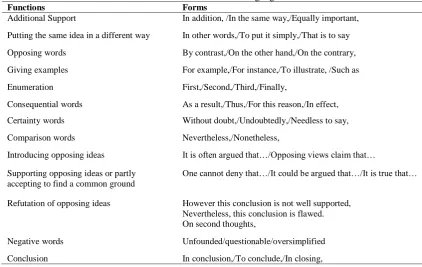
The items included in the list was selected after consulting a number of academic writing resources, such as Teaching Academic ESL Writing by Eli Hinkel (2004), English Grammar for the Utterly Confused (2003), Better Writing Right Now by Galko (2001), and some online teaching materials geared towards preparing students for TOEFL, IELTS, GRE, and academic writing. The 40-item-formulaic language list in Table 1 was composed of the items in the available reference list based on the requirements of the writing courses conducted during the present study while keeping in mind the usefulness and the relevance to the specific discourse functions intended to be taught.
Instructional procedures
A number of activities were developed to have the participants practice formulaic language items, following the studies available in the literature demonstrated to have a positive effect on learning formulaic language; these included giving a reference list of target formulaic language items (Čolović-Marković, 2012), highlighting, and using bold letters (Bishop, 2004; Peters 2012) to make the students notice formulaic language; translation exercises (Laufer & Girsai, 2008), fill in the blanks exercises (Jones & Haywood, 2004), and cloze tasks (Webb & Kagimoto, 2009) and discussions to make the students process deeply and practice formulaic language.
Finally, different topics for timed-argumentative essays were chosen for the participants’ pre-test, post-test, and delayed post-test. In discussions with the instructors of the courses, based on the rationale that the students might have sufficient background knowledge about them, and also a short survey was given to the experimental group to learn which topic they knew more, and thus, feel more comfortable and less stressed to write about during the 50-minute essay writing exam.
Instruction and data collection
alternative to assess their current level in argumentative writing.
The explicit instruction started with the presentation of the target formulaic language items through lists in Table 1 in which the targeted items were presented, then the importance, functions, and features of them were explained to draw attention of the students as awareness-raising activities. In the practice stage, the participants in the experimental group were asked to do some activities such as fill-in-the-blanks exercises, translation exercises, and cloze exercises. To provide a better understanding, the answers of the exercises were checked and discussed in the classrooms. Additionally, for their individual study, the students were encouraged to memorize the items, a suggested technique by Wray (2004) and Wray and Fitzpatrick (2008) and also to repeat the items orally and in writing as much as
possible, as suggested by Webb, Newton, and Chang (2013) and Alali and Schmitt (2012). The aforementioned activities lasted four hours in total spread over two consecutive weeks. After the instruction was completed, immediately a post-test was carried out in which the students were asked to write an argumentative essay by choosing one of the topics given.
While the experimental group was being instructed explicitly, the control group was doing some presentations related to academic writing and essay writing exercises, none of which were specifically related to the target formulaic language items. In other words, they followed the regular course syllabus. To compare the achievements of both groups, the control group was also assigned to write an argumentative essay for the post-test and a delayed post-test one month later. Table 1. 40-item-formulaic language list
Functions Forms
Additional Support In addition, /In the same way,/Equally important,
Putting the same idea in a different way In other words,/To put it simply,/That is to say
Opposing words By contrast,/On the other hand,/On the contrary,
Giving examples For example,/For instance,/To illustrate, /Such as
Enumeration First,/Second,/Third,/Finally,
Consequential words As a result,/Thus,/For this reason,/In effect,
Certainty words Without doubt,/Undoubtedly,/Needless to say,
Comparison words Nevertheless,/Nonetheless,
Introducing opposing ideas It is often argued that…/Opposing views claim that…
Supporting opposing ideas or partly accepting to find a common ground
One cannot deny that…/It could be argued that…/It is true that…
Refutation of opposing ideas However this conclusion is not well supported, Nevertheless, this conclusion is flawed. On second thoughts,
Negative words Unfounded/questionable/oversimplified
Conclusion In conclusion,/To conclude,/In closing,
Essay scoring
Three raters scored all the essays for a better interpretation of the results (Graham, Milanowski, & Miller, 2012; Penny, Johnson, & Gordon, 2000). All the raters were experienced ESL writing instructors, with one of the raters, an English-native speaker. Each essay was evaluated holistically with a rubric by these three raters separately, being scored between 1 and 4; the rubric was inspired by the TOEFL Writing Scoring Guide in accordance with the aim of the research. The inter-rater reliability of the raters with the intra-class correlation coefficient was found .65 for the pre-test, .75 for the post-test, .63 for the final test and .85 for the delayed post-test. Then the scores of the raters were averaged to get the scores of the essays, as one of the mostly advised methods (Bogartz, 2010; Penny, Johnson, & Gordon, 2000; Stemler & Tsai, 2008).
Identification of the use of target formulaic language in the students’ essays
[In other words, ]<In other words, :0> any parents can go to the parks and amusement parks with their children for pleasure .
[To conclusion,]<In conclusion, :2> big cities have every facilities to bring up a child such as education , health facilities and activities .
Then manual checking was done to correct the wrong and missing tags. Occasionally, items were mistagged because the surface form was synonymous with the target formulaic language item, as seen in the example below, in which the student used the target formulaic language item like an adjective instead of an adverb and it was rejected by adding “r” to the tag.
To begin with the [first] <first: 0r> reason why native speakers of English are best teachers is that they know the whole functions and features of their native language, …
For each correct use of formulaic language items, a score of 1 was awarded and if a deviation from the original target formulaic language item was observed, a score of 0.5 was given. Each paper was assigned type and token and percentage values based on the tags as shown below. To illustrate, the first number stands for the type of the formulaic language items used after the student’s definition part highlighted with bold characters and the second number following it stands for the token of the formulaic language items, that is to say that Student X of experimental group in the pre-test used only one target formulaic language item which was “for this reason” and he used it twice in his/her writing; Student Y of control group in the post-test used three different target formulaic language items (first, on the other hand, finally) and tokens for them in total four.
pretest_experimentalGroup_StudentX, 1, 2,
for this reason,
posttest_controlGroup_StudentY, 3, 4, first, on the other hand, finally
delayedposttest_experimentalGroup_Studen tZ, 4, 4, such as, on the other hand, for instance, to conclude
Before proceeding to analyses, all of the essays written by the participants were typed and converted to
.txt files and only spelling mistakes were corrected so as not to cause the programme to fail to identify the target formulaic language items. The scores were calculated automatically by the computer programme for the use of the target formulaic language items.
RESULTS
As for the first question which sought out to find an answer whether there is a difference in the argumentative quality of the essays before and after the treatment for the experimental group, a non-parametric Friedman Test of differences among repeated measures was conducted, since the data was observed to have a non-normal distribution. The results of Friedman Test revealed that there was a statistically significant difference in the overall argumentative quality scores of the essays before and after the instruction for the experimental group (x2=9.50; p=.02<.05). Although the control group did not receive any explicit instruction, the overall argumentative quality scores of the essays written for the post-test was higher than the ones for the pre-test, but not significantly different (x2=1.20; p=.75>.05).
The second research question sought to determine whether there were any differences in the overall argumentative quality scores of the essays written by the experimental group and the control group.
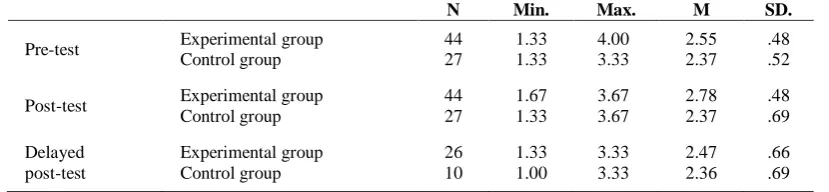
In Table 2, detailed descriptive statistics indicated that before any explicit instruction took place, although the overall quality of the writing of the experimental group was higher than that of the control group, they were not significantly different. However, after the explicit instruction, there was an increase in the overall argumentative quality scores of the writing on the experimental group’s post-test (M =2.78) while the control group’s scores stayed stable (M=2.37). As for the delayed post-test the mean of both groups decreased compared to their post-test scores, and even they were slightly below their pre-test scores. In sum, statistical findings revealed that there was only a significant difference in the overall argumentative quality scores of the post-test essays written by the experimental group and the control group (Z=-2.63; p=.00<.05).
Table 2. Descriptive statistics for the overall quality scores of the essays written by the groups at each test
N Min. Max. M SD.
Pre-test Experimental group Control group
44 27
1.33 1.33
4.00 3.33
2.55 2.37
.48 .52
Post-test Experimental group Control group
44 27
1.67 1.33
3.67 3.67
2.78 2.37
.48 .69
Delayed post-test
Experimental group Control group
26 10
1.33 1.00
3.33 3.33
2.47 2.36
.66 .69
The third question investigated whether there is a difference in the use of the target formulaic language items between the pre-test essays and the post-test
of both the types of the target formulaic language items and the tokens of the target formulaic language items.
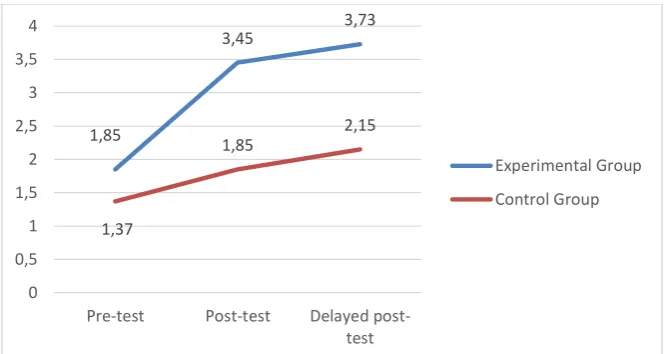
First, any missing values in the experimental group data were checked for the use of the target formulaic language items in each essay and the missing data due to the low attendance to the delayed post-test were excluded. Then, the descriptive statistics were gathered and the results indicated that the tokens of the target formulaic language items used in each essay was more than those of pre-test (M pre-test=1.85, M post-test=3.45,; M
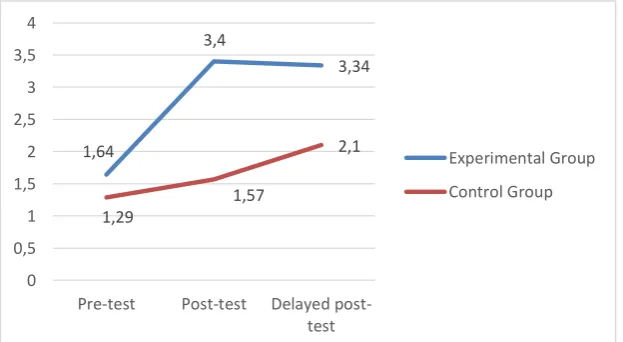
delayed post-test=3.73). Moreover, the experimental group students used more varied target formulaic language items in the post, and delayed post-test compared to the pre-test (M pre-test=1.64, M post-test=3.40,; M delayed post-test=3.34).
Figure 1 also illustrated the increase in both the type and the tokens of the target formulaic language items used by the experimental group students in each essay.
Figure 1.The types and tokens of the target formulaic language items used by the experimental group in each test A post hoc analysis with Wilcoxon signed-rank
tests was conducted with a Bonferroni correction applied, resulting in a significance level set at p<.008. The results revealed that except for the delayed post-test and the post-test, there was a statistically significant difference in the type of the target formulaic language item used between the pre-test and the post-test (Z=-4.48; p=.00<.008) and also a statistically significant difference in the tokens of the target formulaic language items used before and after the instruction (Z=-4.48; p=.00<.008).
In order to define any differences between the experimental and the control group, the descriptive statistics were utilised after checking the missing values. Figures 2 and 3 illustrated that both of the groups increased the use of the target formulaic language items. The experimental group had higher mean scores for both the type and the tokens of the target formulaic language items, though. Although a decrease was observed in the delayed post-test for both groups, regarding the types and the tokens of the target formulaic language used, the percentages were still higher than as of the pre-test.
Figure 2. The line chart for the types of the target formulaic language items used by the groups at each test
1,64
3,4 3,34
1,85
3,45 3,73
0 0,5 1 1,5 2 2,5 3 3,5 4
Pre-test Post-test Delayed post-test Types Tokens
1,64
3,4
3,34
1,29
1,57
2,1
0 0,5 1 1,5 2 2,5 3 3,5 4
Pre-test Post-test Delayed post-test
Figure 3. The line chart for the tokens of the target formulaic language items used by the groups at each test It is shown that experimental group students used
more varied target formulaic language items than the control group students in each test. In the pre, post-test the experimental group’s mean for the types of the target formulaic language items used, increased gradually, while it was falling and rising for the control group. As for the delayed post-test, the variety of the target formulaic language items used decreased for both
groups, but the means were still higher than as of the pre-test.
As can be seen in Table 3, the fourth research question sought to determine any relationship between the tokens of the target formulaic language items used and the overall argumentative quality of the essays, as well as between the type of the target formulaic language items used and the overall quality scores of the essays.
Table 3. Descriptive statistics for the types and tokens of the formulaic language items used in all of the essays
N Min. Max. M SD.
Type of the target formulaic language items used
Tokens of the target formulaic language items used
Overall argumentative quality scores of the essays
249
.00
.00
.00
6.50
18.00
16.50
2.28
3.35
3.34
.93
3.21
2.69
The results of the Spearman’s rank-order correlation test, which was run to define any relationship between the overall argumentative quality scores of the essays and the tokens of the target formulaic language items indicated that there was a strong relationship between them (r =.79, p=.00<.05); however, there was not a relationship between the overall argumentative quality scores of the essays and the type of the target formulaic language used (r=.10, p=.09>.05).
DISCUSSION
The present study investigated the effects of the explicit teaching of formulaic language on the quality of argumentative writing. The findings demonstrated that after the treatment, the overall argumentative quality scores of the essays written in the post-test by the experimental group increased significantly, while it stayed stable for the control group. Moreover, statistical findings also confirmed the significant difference between two groups in the post-test. In contrast,
Čolović-Marković (2012) yielded confliciting results that no significant difference between the students receiving treatment and the ones who did not in the quality of their essays. The discrepancy of the findings could be due to the motivations of the participants. For example, one of the low achieving students in her study stated that his major was business and not much interested in formulaic sequences; on the other hand, the participants of the present study were studying to be a language teacher, which was an important motivating factor.
It is pertinent to state the explicit teaching of formulaic language is effective to improve the overall argumentative quality of the writing as the experimental group students received higher scores for the overall argumentative quality of the essays once they used more formulaic language items in each test than their counterparts in the control group. This result is consistent with Read and Nation (2006) who examined either written or oral productions of the learners taking part in high-stakes proficiency exams such as IELTS, ECCE, and TOEFL. They compared the overall scores
1,85
3,45 3,73
1,37
1,85
2,15
0 0,5 1 1,5 2 2,5 3 3,5 4
Pre-test Post-test Delayed post-test
of the candidates to the formulaic language items used and observed that the more formulaic language items the candidates used, the higher score they received by the raters. Additionally, one might note that the positive effects of an intervention conducted for a short period were short term, since the gains decreased in the delayed post-test. In order to obtain long-term improvement, one might think to embed an explicit teaching of formulaic language into the syllabus in the long run.
The findings that the experimental group students used more type and tokens of the target formulaic language items after the treatment indicated that the explicit teaching helped them utilise formulaic language items progressively in their writing. Similarly, Peters and Pauwels (2015) who examined the recognition and spontaneous use of formulaic sequences, comparing the pre-test and post-test writing of 29 participants, observed an increase of %13 in the types and %11 in the tokens of formulaic language items. However, Cortes (2006) did not observe any progress in the number of the formulaic items in the written assignments of the participants who were native speakers of English, after the treatment including five 20-minute micro lessons during ten weeks. In her study, Cortes (2006) attributed the reasons to the short instruction period and the activities which may not be appropriate to activate autonomous use of formulaic language items by the students. Although she conducted the instruction more often than the present study, as she stated, total duration of instruction was less than as of the present study which was approximately four hours during two consecutive weeks.
In the present study, differently than the above mentioned studies, a delayed post-test was conducted as well in order to seek out the long-term effects of the explicit teaching of the target formulaic language items, if any, in the long run. The results indicated that there was a decrease in the delayed post-test; however, the mean scores were still higher than those of the pre-test. The difference between the mean scores of the students in the post-test and the delayed post-test was not found statistically significant. The reason of the decrease might have been that the students were not given any instruction or advised to revise the items during the duration between the post-test and the delayed post-test. On this point, although there was not a statistical significant difference, it could be suggestive to argue that explicit teaching fosters the students’ use of formulaic language items by raising awareness, and without explicit teaching, unconsciously encountered formulaic language items might be ignored or forgotten in time with fewer gains. This is in line with the results of Alhassan and Wood (2015) who taught formulaic language items to twelve participants over ten weeks. After the treatment, the students successfully used different types of the target formulaic language items in the post and delayed post-test instead of repeating them over and over. Moreover, between the post-test and the
delayed post-test, they did not find any significant difference, either.
Comparison of the use of the target formulaic language items by experimental group and control group also supports that the explicit teaching might be promising and a good opportunity for the students to make use of formulaic language in their writing. To illustrate, in each essay the experimental group students used more types of the target formulaic language items instead of relying the same items and more tokens of the target formulaic language items than the students in the control group who were not exposed to explicit teaching. The results can be partially linked to the study of Peters and Pauwels (2015), because they did not have two treatments group at the beginning of their study. However, at the end of the term, they decided that it was worth to compare the end of year assignment of the participants involved in their study to the ones of a class of students who was not a part of their study at the beginning. They found that the students receiving treatment used much more formulaic language items, which is similar to the findings of the present study. Due to the design of their study, Peters and Pauwels (2015) did not analyse the gain, if any, of the students not receiving treatment, for each test, but the empirical evidence in the present study also indicated that the control group also increased their use of the target formulaic language items in small numbers; however, this increase was never as remarkable as the experimental group did. There might be many reasons of this modest increase for the control group, such as their prior knowledge, peer learning, and unconscious exposure during the courses or in their social life while reading, watching, or listening. The inferential statistics, supportively, showed that there was a significant difference between the experimental and control group, regarding the type and tokens of the target formulaic language items used in the post-test conducted after the treatment, but not for the pre-test which was before the treatment and for the delayed post-test which was conducted one month later. Taken together, these statistics could be accepted as an indication of the fact that the students gained much improvement in the use of the target formulaic language items through the explicit instruction, but in the long run there might be some decrease in the tokens unless the explicit instruction was provided regularly.
higher when greater number of formulaic language items are used in the essay. In other words, the number of the formulaic language items used in the essays led the raters to score higher for the overall argumentative quality scores of the essays. The results are partially compatible with the study of Alhassan and Wood (2015) who analysed each rater individually in their study and found that the evaluation of two raters for the overall quality was strongly correlated with the variety and the repetition of the formulaic language items, but not the third rater.
CONCLUSION
The present study, focusing on the importance of formulaic language, sought out the effects of the explicit teaching of formulaic language on academic writing, specifically argumentative writing. Based on the literature and the findings of the present study, several pedagogical implications are proposed to provide insights into the explicit teaching of formulaic language. First of all, the present study indicates that more focus should be given to the formulaic language since it plays a vital role in academic writing, as the formulaic items serve specific functions. First and foremost, it is essential to raise students’ awareness of the frequency, use, and functions of the formulaic language, as it is generally lacking in salience in the input. It should be noted that raising awareness should be supported with examples and activities by employing some techniques instead of just explaining how prevalent formulaic language items are and what their functions are.
Another important implication that can be drawn from the present study is that explicit teaching is effective for students to improve their use of formulaic language and the overall argumentative quality of their writings. Thus, language teachers who want to foster formulaic language use and the overall argumentative quality of students’ essay may wish to resort to explicit teaching. However, they should be meticulous while employing explicit teaching by following such steps as noticing, retrieval, and generation which are the tree principles of vocabulary learning (Nation, 2001). To illustrate, teachers should compile a reference list empirically, for instance by using concordancers and according to the aims of the course, then provide different materials in which the formulaic language items are made noticeable and provide activities in which the students will encounter the formulaic language several times and find opportunities to exercise. In this way, it is believed to be more helpful in some ways than implicit instruction. Moreover, students may feel more confident to use formulaic language when they are taught explicitly, because through implicit instruction they may not comprehend such crucial functions as idiomaticity and discourse functions of formulaic language, and so they do not want to take the risk of making mistakes by using it.
The finding that the decrease in the tokens of the target formulaic language items used and in the overall
argumentative quality scores of the essays in the delayed post-test revealed the importance of the continuity of the explicit instruction. Thus, teaching formulaic language could be integrated into the writing classes, especially to genre-based classes, as they have distinctive characteristics across genres (Ellis, Simpson-Vlach, & Maynard, 2008; Hyland, 2008a). For instance, as in the present study, if the students are required to write an argumentative paper, then the formulaic language items which function to discuss contrasting ideas, defend own position, provide examples and so on, should be chosen and associated with the organisational structure of argumentative writing. Another finding of the present study supporting the integration of the formulaic language teaching into the writing classes is the positive correlation found between the tokens of the target formulaic language items and the overall quality scores of the essays. That is to say, the increase in the use of formulaic language items in the essays tends to lead to an increase in the overall argumentative quality scores of the essays.
All in all, the findings of the present study demonstrated that utilising the explicit teaching of formulaic language might be promising to foster formulaic language learning and improve the overall quality of the writing. Thus, it can lead all the stakeholders to having a role in the process of teaching to draw a number of conclusions pertaining to the explicit teaching of formulaic language. A longitudinal study in which the formulaic language is integrated into the course syllabus and instruction focuses more on varied exercises, can be conducted, so as to see the long-term effects of the explicit teaching of formulaic language on academic writing. Moreover, the reflection of the students can be acquired in a more systematic and empirical way like using regular reports, interviewing, or a survey to better understand the process of learning formulaic language from the learners’ perspective.
REFERENCES
Alali, F. A., & Schmitt, N. (2012). Teaching formulaic sequences: The same as or different from teaching single words? TESOL Journal, 3, 153-180. doi: 10.1002/tesj.13
Alhassan, L., & Wood, D. (2015). The effectiveness of focused instruction of formulaic sequences in augmenting L2 learners' academic writing skills: A quantitative research study. Journal of English for Academic Purposes, 17, 51-62. doi:
10.1016/j.jeap.2015.02.001
Alipour, M., & Zarea, M. (2013). A disciplinary study of lexical bundles: The case of native versus non-native corpora. Taiwan International ESP Journal, 5(2), 1-20.
Biber, D., Conrad, S., Cortes, V. (2004). If you look at …: Lexical bundles in university teaching and textbooks. Applied Linguistics, 25, 371-405. Bishop, H. (2004). The effect of typographic salience on
formulaic sequences. In N. Schmitt (Ed.),
Formulaic sequences: Acquisition, processing and use (pp. 227-248). Amsterdam/Philadelphia: John Benjamins.
Boers, F., Eychmans, J., Kappel, J., Stengers, H., & Demecheleer, M. (2006). Formulaic sequences and perceived oral proficiency: Putting a lexical approach to the test. Language Teaching Research, 10, 245-261. doi: 10.1191/1362168806lr195oa Bogartz, R. S. (2010). Interrater agreement and
combining ratings [PDF document]. Retrieved from
http://people.umass.edu/~bogartz/Interrater%20Ag reement.pdf
Byrd, P., & Coxhead, A. (2010). On the other hand: Lexical bundles in academic writing in the teaching of EAP. University of Sydney Papers in TESOL, 5, 31-64.
Chan, T., & Liou, H. (2005). Effects of web-based concordancing instruction on EFL students’ learning of verb-noun collocations. Computer Assisted Language Learning, 18, 231-251. doi: 10.1080/09588220500185769
Čolović-Marković, J. (2012). The effects of explicit instruction of formulaic sequences on second-language writers (Unpublished Doctoral dissertation). The University of Utah, the USA. Conklin, K., & Schmitt, N. (2012). The processing of
formulaic language. Annual Review of Applied Linguistics, 32, 45-61. doi:
10.1017/S0267190512000074
Cortes, V. (2002). Lexical bundles in academic writing in History and Biology (Unpublished Doctoral dissertation). Northern Arizona University, the United States of America.
Cortes, V. (2004). Lexical bundles in academic writing in History and Biology. English for Specific Purposes, 23, 397-423. doi:
10.1016/j.esp.2003.12.001
Cortes, V. (2006). Teaching lexical bundles in the disciplines: An example from a writing intensive history class. Linguistics and Education, 17, 391-406. doi: 10.1016/j.linged.2007.02.001
Durrant, P. (2008). High frequency collocations and second language learning (Unpublished Doctor of Philosophy dissertation). University of
Nottingham, the United Kingdom.
Ellis, N. C. (2012). Formulaic language and second language acquisition: Zipf and the phrasal teddy bear. Annual Review of Applied Linguistics, 32, 17-44. doi: 10.1017/S0267190512000025
Ellis, N. C., Simpson-Vlach, R., & Maynard, C. (2008). Formulaic language in native and second language speakers: Psycholinguistics, corpus linguistics and TESOL. TESOL Quarterly, 42, 375-396.
Erman, B., & Warren, B. (2000). The idiom principle and the open choice principle. Text, 20 (1), 29-62. Foster, P. (2001). Rules and routines: A consideration of
their role in the task based language production of native and non-native speakers. In M. Bygate, P.
Skehan & M. Swain (Eds.), Researching pedagogic tasks: Second language learning, teaching and testing (pp. 75-93). Harlow: Pearson. Graham, M., Milanowski, A., & Miller, J. (2012).
Measuring and promoting inter-rater agreement of teacher and principal performance ratings. The Center for Educator and Compensation Reform (CECR) [PDF document] Retrieved from http://files.eric.ed.gov/fulltext/ED532068.pdf Hyland, K. (2008a). Academic clusters: Text patterning
in published and postgraduate writing.
International Journal of Applied Linguistics, 18 (1), 41-62.
Hyland, K. (2008b). As can be seen: Lexical bundles and disciplinary variation. English for Specific Purposes, 27, 4-21. doi: 10.1016/j.esp.2007.06.001 Jablonkai, R. (2009). “In the light of”: A corpus-based
analysis of lexical bundles in two EU-related registers. WoPalp, 3, 1-27.
Jiang, N., & Nekrasova, T. M. (2007). The processing of formulaic sequences by second language speakers. The Modern Language Journal,91, 433-445.
Jones, M., & Haywood, S. (2004). Facilitating the acquisition of formulaic sequences: an exploratory study in an EAP context. In N. Schmitt (Ed.), Formulaic sequences: Acquisition, processing and use (pp. 269-292). Amsterdam/Philadelphia: John Benjamins.
Kuiper, K. (2004). Formulaic performance in
conventionalised varieties of speech. In N. Schmitt (Ed.), Formulaic sequences: Acquisition,
processing and use (pp. 37–54).
Amsterdam/Philadelphia: John Benjamins. Laufer, G., & Girsai, N. (2008). Form-focused
instruction in second language vocabulary learning: A case for contrastive analysis and translation. Applied Linguistics, 29, 694-716. doi: 10.1093/applin/amn018
Li, J., & Schmitt, N. (2009). The acquisition of lexical phrases in academic writing: A longitudinal case study. Journal of Second Language Writing, 18, 85-102. doi: 10.1016/j.jslw.2009.02.001 Liu, D. (2011). The most frequently-used multi-word
constructions in academic written English: A multi-corpus study. English for Specific Purposes, 31, 25-35. doi: 10.1016/j.esp.2011.07.002 Martinez, R., & Schmitt, N. (2012). A phrasal
expression list. Applied Linguistics, 33, 299-320. doi: 10.1093/applin/ams010
Meunier, F. (2012). Formulaic language and language teaching. Annual Review of Applied Linguistics, 32, 111-129. doi: 10.1017/S0267190512000128 Millar, N. (2011). The processing of malformed
formulaic language. Applied Linguistics, 32, 129-148. doi:10.1093/applin/amq035
Ortaçtepe, D. (2013). Formulaic language and conceptual socialization: The route to becoming nativelike in L2. System, 41, 852-865. doi: 10.1016/j.system.2013.08.006
Penny, J., Johnson, R. L., & Gordon, B. (2000). Using rating augmentation to expand the scale of an analytical rubric. The Journal of Experimental Education, 68, 269-287.
Peters, E. (2012). Learning German formulaic sequences: The effect of two attention-drawing techniques. The language Learning Journal, 40(1), 65-79. doi: 10.1080/09571736.2012.658224 Peters, E., & Pauwels, P. (2015). Learning academic
formulaic sequences. Journal of English for Academic Purposes, 20, 28-39. doi: 10.1016/j.jeap.2015.04.002
Read, J., & Nation, P. (2004). Measurement of formulaic sequences. In N. Schmitt (Ed.),
Formulaic sequences: Acquisition, processing and use (pp. 23-35). Amsterdam/Philadelphia: John Benjamins.
Schmitt, N., & Carter, R. (2004). Formulaic sequences in action: An introduction. In N. Schmitt (Ed.), Formulaic sequences: Acquisition, processing and use (pp. 1-22). Amsterdam/Philadelphia: John Benjamins.
Simpson-Vlach, R., & Ellis, N. C. (2010). An academic formula list: New methods in phraseology research. Applied Linguistics, 31, 487-512. Staples, S., Egbert, J., Biber, D., & McClair, A. (2013).
Formulaic sequences and EAP writing
development: Lexical bundles in the TOEFL IBT writing section. Journal of English for Academic Purposes, 12, 214–225. doi:
10.1016/j.jeap.2013.05.002
Stemler, S. E., & Tsai, J. (2008). Best practices in interrater reliability three common approaches. In J. W. Osborne (Ed.), Best practices in quantitative methods (pp. 29-49). Thousand Oaks, CA: Sage. Sun, Y., & Wang, L. (2003). Concordancers in the EFL
classroom: Cognitive approaches and collocation difficulty. Computer Assisted Language Learning, 16(1), 83-94. doi: 10.1076/call.16.1.83.15528
Szudarski, P, & Conklin, K. (2014). Short- and long-term effects of rote rehearsal on ESL learners’ processing of L2 collocations. TESOL Quarterly, 48, 833-842. doi: 10.1002/tesq.201
Waring, R. & Takaki, M. (2003). At what rate do learners learn and retain new vocabulary from reading a graded reader? Reading in a Foreign Language, 15, 130-163.
Webb, S., & Kagimoto, E. (2009). The effects of vocabulary learning on collocation and meaning. TESOL Quarterly, 43(1), 55-77.
Webb, S., Newton, J. & Chang, A. (2013). Incidental learning of collocation. Language Learning, 63(1), 91–120. doi: 10.1111/j.1467-9922.2012.00729.x Wood, D. (2002). Formulaic language in acquisition and
production: implications for teaching. TESL Canada Journal, 20 (1), 1-15. doi:
10.18806/tesl.v20i1.935
Wood, D. (2006). Uses and functions of formulaic sequences in second language speech: An exploration of the foundations of fluency. The Canadian Modern Language Review, 63 (1), 13-33.
Wood, D. (2009). Effects of focused instruction of formulaic sequences on fluent expression in second language narratives: A case study. Canadian Journal of Applied Linguistics, 12 (1), 39-57.
Wray, A. (2000). Formulaic sequences in second language teaching: principle and practice. Applied Linguistics, 21 (4), 463-489.
Wray, A. (2004). Here’s one I prepared earlier: Formulaic language learning on television. In N. Schmitt (Ed.), Formulaic sequences: Acquisition, processing and use (pp. 249–268).
Amsterdam/Philadelphia: John Benjamins. Wray, A., & Fitzpatrick, T. (2008). Why can’t you just