JIEM, 2012 – 5(1):133-154 – Online ISSN: 2013-0953 – Print ISSN: 2013-8423 http://dx.doi.org/10.3926/jiem.416
An approach to identify issues affecting ERP implementation
in Indian SMEs
Rana Basu
1, Parijat Upadhyay
2, Manik C. Das
3, Pranab K. Dan
11
West Bengal University of Technology,
2Globsyn Business School,
3MCKV Institute of Engineering
(INDIA)
[email protected]; [email protected]; cd
_
[email protected];
[email protected]
Received October 2011 Accepted April 2012
Abstract:
Purpose:
The purpose of this paper is to present the findings of a study which is
based on the results of a comprehensive compilation of literature and subsequent
analysis of ERP implementation success issues in context to Indian Small and
Medium scale Enterprises (SME’s). This paper attempts to explore the existing
literature and highlight those issues on ERP implementation and further to this the
researchers applied TOPSIS (Technique for order preference by similarity to ideal
solution) method to prioritize issues affecting successful implementation of ERP.
Design/methodology/approach:
Based on the literature review certain issues
leading to successful ERP implementation have been identified and to identify key
issues Pareto Analysis (80-20 Rule) have been applied. Further to extraction of key
issues a survey based on TOPSIS was carried out in Indian small and medium scale
enterprises.
Research limitations/implications:
Beside those identified issues there may be
other issues that need to be explored. There is scope to enhance this study by
taking into consideration different type of industries and by extending number of
respondents.
Practical implications:
By identifying key issues for SMEs, managers can better
prioritize issues to make implementation process smooth without disruption. ERP
vendors can take inputs from this study to change their implementation approach
while targeting small scale enterprises.
Originality/value:
There is no published literature available which followed a
similar approach in identification of the critical issues affecting ERP in small and
mid-sized companies in India or in any developing economy.
Keywords:
ERP, small and medium scale enterprise, Pareto analysis, Topsis, India
1 Introduction
amount on implementation but unable to derive benefit at all out the implementation.
Small and Medium Scale Enterprises (SMEs) are increasingly brought into focus on account of their huge growth potential and vary in magnitude, age, sector, and knowledge base with innovative capacity (Koh & Simpson, 2007; Deep, Guttridge, Dani & Burns, 2008; Helo, 2008). The SME sector in India contributes almost half of India’s GDP and is home to slew of business opportunities. SME form the large majority of industrial and service units across the world and is a source of employment (Thomson & Gray, 1999). India’s SME sector is a vibrant, dynamic, flexible and productive entity, containing as many as some 12 million units and employing almost 30 million people. The sector quickly adapted and restructured itself to face competition from global players head-on. SME embraced high technology, accepted norms of quality and competitiveness and continued to expand faster than the rest of the industrial economy (Aberdeen, 2009; Hughes, Golden & Powell, 2003).
Small and mid-size organizations, in particular, face a dilemma focusing on business drivers impacting Enterprise Resource Planning (ERP) strategies. A recent study finds SME companies focusing on growth strategies and customer service sometimes balancing between the two, but more often focusing exclusively on one or the other. As companies grow in size and improve performance, they are more likely to have invested in an ERP system that will grow with them. But growth cannot come at the expense of customer service. As mid-size companies grow, they must learn to operate in a distributed environment and often experience a proliferation of ERP and other enterprise applications.
to reap benefits of implementation. As cases of ERP failures have increased, many studies have been initiated to identify factors that could lead to ERP implementation success. This paper tries to identify certain factors that can be considered critical in context to SME’s on account of their peculiarities (Moshabbaki, 2009; Chen, 2008) with focus on Indian SMEs.
2 Literature review
2.1 Review of Literature of ERP implementation issues in Small and Medium Scale Enterprise (SME):
Several academics and practitioners have tried to capture the main reasons for failure or success of ERP implementations (Ewusi-Mensah, 1997; Stapleton & Rezak, 2004; Weightman, 2004; Anexinet, 2006; Kimberling, 2006; Ibrahim, Sharp & Syntetos, 2008; Lindley, Topping & Lindley, 2008). Most of these analyses focus on the issues that contributed to failures than those contributed to success. If all these factors are controlled and managed so that they are phrased as positive factors that contribute to success and the factors that appeared mostly on the lists include: Top level management support, User training and education, Project management, clearly defined goals and objectives, Project team competence, and Change management(Upadhyay & Dan, 2008, 2009).
SMEs either do not have sufficient resources or are not willing to commit a substantial portion of their resources, due to implementation time being longer (Proudlock, 1999) and high fees associated with it (Chan, 1999). So cost of package can also be taken as crucial issue towards successful implementation of ER The compatibility of technology and company’s need must be carefully addressed as ERP project involves a complex transition from legacy information systems and business processes to an integrated IT infrastructure (Mashari, Al-Mudimigh & Zairi, 2003).
In a research study after reviewing 28 articles identified ten success factors or issues in implementing ERP system in Malaysian companies which are: Support from top management, Clear goals and objectives, Communication, Effective project management, Business process engineering, Data accuracy and integrity, Suitability of software and hardware, Support from vendor, Education and training and User involvement (Jafari et al., 2006).
Proper package selection plays a crucial role in successful implementation of ER Normally the organization selects a package which is most users friendly, has adequate scope for scalability and covers an array of business processes where organization experiences problem. The selection of the specific ERP package is one that requires careful attention (Kraemmergaard & Rose, 2002; Yusuf, Gunasekaran & Wu, 2006; Al-Mashari et al., 2003; Somers & Nelson, 2001, 2004).
In a research study by two researchers ten success issues have been identified by analyzing ten selective articles which are: ERP teamwork and composition, Top management support, Business plan and vision, Effective communication, Project management, Appropriate business and legacy system, Software development, Testing and troubleshooting, Effective – decision making, Effective training (Nah & Lau, 2001).
Umble, Haft and Umble (2003) summarized the literatures and listed the nine critical factors towards successful implementation of ER Those includes: clear understanding of goals, support from top management, project management, change management, data accuracy, proper education and training, focused performance measures and multi-site issues.
Through a semi structured interview of the experts involved in the implementation of ERP in a major Chinese enterprise, the researchers presented six critical success factors that include: Commitment from top management, project team, proper project management, process change, proper education and training and effective communication (Woo, 2007).
3 Methodology and research objective
countries like India and on the basis of those key issues questionnaire was made for further analysis. Further to extraction of key issues a survey based on TOPSIS was carried out in Indian small and medium scale enterprises.
Issues mentioned in the literature
Number of instances cited in
the literature Percentage contribution of each issue Cumulative percentage of issues
Education & training 13 13.82% 13.82%
Top management support 12 12.76% 26.58%
Properly defined goals & objectives
11 11.70% 38.28%
Competent project team 11 11.70% 49.98%
Project management 10 10.63% 60.61%
Change management 10 10.63% 71.24%
Proper package selection 5 5.31% 76.55%
Effective communication 3 3.19% 79.74%
Vendor support 2 2.12% 81.86%
Data accuracy 2 2.12% 83.98%
User knowledge 1 1.06% 85.04%
External consultant 1 1.06% 86.10%
Improved work efficiency 1 1.06% 87.16%
IT infrastructure 1 1.06% 88.22%
Cost of package 1 1.06% 89.28%
Scalability and scope 1 1.06% 90.34%
S/W Development 1 1.06% 91.40%
Testing and troubleshooting
1 1.06% 92.46%
Effective decision making 1 1.06% 93.52%
BPR 1 1.06% 94.58%
Performance measure 1 1.06% 95.64%
User invement 1 1.06% 96.70%
Suitability of h/w & s/w 1 1.06% 97.76%
ERP importance 1 1.06% 98.82%
Multisite issues 1 1.06% 99.88%
Total 94 100%(approx) 100%(approx)
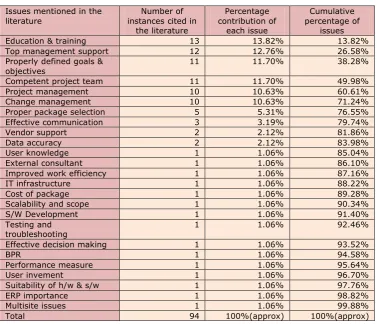
Table 1. Pareto analysis (80-20 Rule)
3.1 Survey methodology
A questionnaire was framed based on the 8 issues obtained after doing Pareto analysis. A survey based on Topsis was carried out in Indian industries and responses of expert opinion have been taken. All such organizations are SME in nature and are reaping the same benefits as mentioned earlier. Invitations to participate in the survey requested responses from implementers of ERP packages who have basically worked for SME’s based in India. The responses of the end users working in the organizations where ERP systems have been implemented were also taken. In this study the researchers made the questionnaire based on 9-point scale where 1 meant strongly disagreed and 9 meant extremely agreed. On the basis of questionnaire survey the issues were given weightage with respect to benefit criteria as well as the respondents were asked to give weight age to the benefit criteria’s. (See Table 2)
3.2 Data collection procedures
The first part of data collection phase involved the literature review and exhaustive search of many of the prime Management Information System (MIS) journals including that the researchers could access, but not limited to those that include: Journal of Information Systems, Journal of Management Information Systems, International Journal of Production Economics, Journal of Small Business & Enterprise Development, Journal of Enterprise Information Management, International Journal of Production Economics, Business Process Management journal, Communications of the ACM, IEEE journal etc. In addition to, the preceding journals, some conference papers were also accessed as well as the following databases were searched like Emerald, Science Direct, Proquest, Ebscohost, Springer, J Stor etc.
3.3 Evaluation of importance of criteria
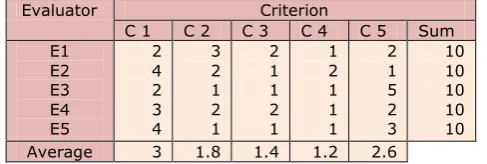
The evaluators (Expert opinion having expertise in the field of ERP) estimated the weights for each criterion using their subjective judgment. Five evaluators were taken for this purpose. As seen in the Table 2, the Evaluator 1 (E1) assigned weights of 2, 3, 2, 1, and 2 to the five criteria respectively. The sum of the weight is (2+3+2+1+2) 10, and is common to all evaluators. The averages obtained for each criterion are given in the table 2.
Evaluator Criterion
C 1 C 2 C 3 C 4 C 5 Sum
E1 E2 E3 E4 E5 2 4 2 3 4 3 2 1 2 1 2 1 1 2 1 1 2 1 1 1 2 1 5 2 3 10 10 10 10 10
Average 3 1.8 1.4 1.2 2.6
Table 2. Average per criterion
3.4 Topsis method
The TOPSIS (technique for order preference by similarity to ideal solution) was first introduced by the researchers (Hwang & Yoon, 1981). This technique suggests that the best alternative would be the one that is nearest to the positive-ideal solution and farthest from the negative ideal solution (Ertugrul & Karakasoglu, 2007). The positive-ideal solution is a solution that maximizes the benefit criteria and minimizes the cost criteria, whereas the negative ideal solution maximizes the cost criteria and minimizes the benefit criteria (Wang & Elhag, 2006). In brief, the positive-ideal solution is composed of all best values attainable from the criteria, whereas the negative ideal solution consists of all worst values attainable from the criteria. The general steps of the TOPSIS method are as follows.
Where Ai represents the alternatives, i = 1,2, . . ,m; Fj represents jth attribute or criterion, j = 1, 2,. . . , n, related to ith alternative; and ij indicates the performance rating of each alternative Ai with respect to each criterion Fj.
Step 2. Calculate the normalized decision matrix R=[rij]. The normalized value rij is
calculated as:
Step 3. Calculate the weighted normalized decision matrix by multiplying the normalized decision matrix by its associated weights. The weighted normalized
value Vij is calculated as:
Vij = wj x rij; i=1, 2 …m and j=1, 2…n;
Where wj represents the weight of the jth attribute or criterion.
Step 4. Determine the positive-ideal and negative-ideal solutions.
Where K is associated with benefit criteria and K’ is associated with cost criteria.
Step 5. Measure Euclidean distances of each alternative from the positive-ideal and negative-ideal solutions. The two separations for each alternative are respectively calculated as:
The higher the closeness means the better the rank.
4 Data analysis and findings
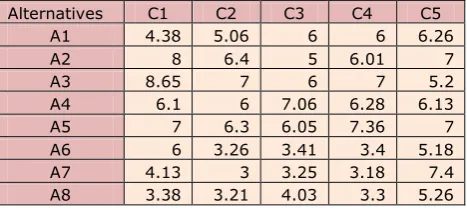
In this section we work out the TOPSIS method. The eight key issues obtained from Pareto analysis have been taken as alternatives A1, A2, A3, A4, A5, A6, A7, A8 and the five benefit criteria C1, C2, C3, C4, C5 as the evaluation criteria for these alternatives. The initial decision matrix and the normalized decision matrix with criteria weights are shown in Table 3 and Table 4 respectively.
Alternatives C1 C2 C3 C4 C5
A1 4.38 5.06 6 6 6.26
A2 8 6.4 5 6.01 7
A3 8.65 7 6 7 5.2
A4 6.1 6 7.06 6.28 6.13
A5 7 6.3 6.05 7.36 7
A6 6 3.26 3.41 3.4 5.18
A7 4.13 3 3.25 3.18 7.4
A8 3.38 3.21 4.03 3.3 5.26
Table 3. The Decision matrix
Alternatives C1 C2 C3 C4 C5
A1 0.25 0.34 0.41 0.38 0.36
A2 0.46 0.43 0.34 0.38 0.41
A3 0.49 0.47 0.41 0.45 0.3
A4 0.35 0.41 0.48 0.4 0.36
A5 0.4 0.43 0.41 0.47 0.41
A6 0.34 0.22 0.23 0.21 0.3
A7 0.23 0.2 0.22 0.2 0.43
A8 0.19 0.21 0.27 0.21 0.3
Weights 0.3 0.18 0.14 0.12 0.26
Table 4.The normalized decision matrix
In the next step we compute the weighted normalized decision matrix which is shown in Table 5.
Alternatives C1 C2 C3 C4 C5
A1 0.075 0.061 0.057 0.045 0.093
A2 0.138 0.077 0.047 0.045 0.106
A3 0.147 0.084 0.057 0.054 0.078
A4 0.105 0.073 0.067 0.048 0.093
A5 0.12 0.077 0.057 0.056 0.106
A6 0.102 0.039 0.032 0.025 0.078
A7 0.069 0.036 0.03 0.024 0.111
A8 0.057 0.037 0.037 0.025 0.078
From Table 5 we determine the positive-ideal and negative-ideal solutions as-
A+
= (0.147, 0.084, 0.067, 0.056, 0.111)
A-= (0.057, 0.036, 0.030, 0.024, 0.078)
Next we measure Euclidean distances of each alternative from the positive-ideal and negative-ideal solutions. The two separations for each alternative are represented by D+
i, D-i respectively. With the help of these distances we compute the closeness ratio as
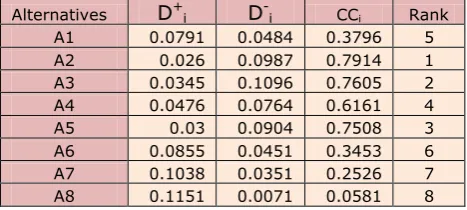
We do ranking (Table 6) of the alternatives on the basis of the closeness ratio.
Alternatives D+i D-i CCi Rank
A1 0.0791 0.0484 0.3796 5
A2 0.026 0.0987 0.7914 1
A3 0.0345 0.1096 0.7605 2
A4 0.0476 0.0764 0.6161 4
A5 0.03 0.0904 0.7508 3
A6 0.0855 0.0451 0.3453 6
A7 0.1038 0.0351 0.2526 7
A8 0.1151 0.0071 0.0581 8
Table 6. Alternatives on the basis of the closeness ratio
5 Discussion
From the above analysis the eight issues taken as alternatives were prioritized and ranked. In this section discussion has been done by taking the issues on the basis of ranking in descending order.
The support from top management not only mean of sanctioning fund and resource but to give time towards implementation process and to take care of human resource in particular.
Properly defined goals and objectives: Properly defined goals and objective is considered as one of the important key issue in proper ERP implementation process. Goals should be measurable (Al-Mashari et al., 2003) and objective should be of doing industry best practice inving for the implementation process (Al-Mudimigh, Zairi & Al-Mashari, 2001). The organization must carefully define what the need of such system is and find out what are the crucial business process the system will address (Bhatti, 2005).
Project Management: Proper and good project management plays a vital role in successful implementation of ER Individuals and group of experts’ expertise in the field of ERP are given responsibility to take the implementation project to success (Rosario, 2000). Project management should be maintained in methodical approach with proper user training and involvement of human resource participation. In a good project management the field should be properly established (Holland, Light & Gibson, 1999; Rosario, 2000) and manageable (Rosario, 2000). In this respect the scope must be clearly defined and be limited. Project management can also be considered as managing properly the implementation task in terms of proper timeline and budget. Project management not only means planning all activities, but determining the project by its milestones, critical path and individual’s responsibility (Nah & Lau, 2001). It is being considered effective project management as the most important issue from the case study based on SMEs in china (Zhang, Lee, Zhang & Banerjee, 2003). For Malaysian small and medium enterprises project management can be one of the issues towards successful ERP implementation (Noudoostbeni, Yasin & Jenatabadi, 2009).
implementation process to run smoothly without disruption. When the team becomes expertise enough are able to give training to others (Bajwa, Garcia & Mooney, 2004).
Education and training: Education and training can be considered as the novel way to provide the method of providing knowledge of the ERP as far as SME is concerned. Excellent ERP system without adequate education and training can be considered as zero, it is the best way to let the staff and employees in an organization to know about ERP as because the top management including Directors, managers and staff may not be able to understand concept, operational necessity, cost and implementing process. The main objective of education and training is that the users must be able to know the business process behind the ERP implementation procedure (Al –Mashari et al., 2003). From the published literature it has been found that many researchers agreed that proper education and training is one of the critical issues towards successful implementation of ERP (Bingi et al, 1999; Somers & Nelson, 2001, 2004; Umble et al, 2003; Zhang, Lee & Banerjee, 2002; Zhang, Lee, Huang, Zhang & Huang, 2005; Zhou-Sivunen, 2005; Yusuf et al., 2006; Xia, Lok & Yang, 2009).
Change Management: Acceptance of change brought about by the implementation of ERP system is considered as the most cited key issue towards successful implementation of ER The concept of change management is the implementation team to be ready with change management program (Nah & Lau, 2001). As part of change management program the users must be engaged in design and business process implementation and ERP, further to this end user training must be provided to help them (Bingi et al., 1999; Holland et al., 1999). Employees must be given proper training to let them understand the concept and how the system will change the business process.
selection of package some differences are observed between SME’s and large organizations. SME’s usually prefer those packages that require lesser implementation time, cost with lesser degree of customization (Everdingen, Hillergersberg & Waarts, 2000).
Effective Communication: Effective communication is critical towards successful implementation of ERP (Falkowski, Pedigo, Smith & Swanson, 1998). Management of communication, education and reliance assumes a greater importance throughout the organization (Wee, 2000). With effective communication the promotion of project team and advertisement of project progress to the organization is expected (Holland et al., 1999). Regarding scope, objectives, activities, updating and change if any must be communicated properly to the employees in advance (Sumner, 1999).
6 Conclusion
regarding purchase and implementation of an appropriate ERP package should be explored. There is scope to enhance this study by taking into consideration different types of industries and by extending number of respondents.
References
Aberdeen Report (2009). Measuring the ROI of ERP in SMB.
Al-Mashari, M., Al-Mudimigh, A. & Zairi, M. (2003). Enterprise resource planning: A taxonomy of critical factors. European Journal of Operational Research, 146, 352-364. http://dx.doi.org/10.1016/S0377-2217(02)00554-4
Al-Mudimigh, A., Zairi, M. & Al-Mashari, M. (2001). ERP software implementation: An integrative framework. European Journal of Information Systems, 10, 216.
http://dx.doi.org/10.1057/palgrave.ejis.3000406
Anexinet, R.B. (2006). Top 10 ERP implementation pitfalls. Retrieved February 11, 2010, from http://www.anexinet.com/pdfs/ERP_top10pitfalls3-2006.pdf
Bajwa, D.S., Garcia, J.E. & Mooney, T. (2004). An integrative framework for the assimilation of enterprise resource planning systems: Phases, antecedents, and outcomes. Journal of Computer Information Systems, 44, 81-90.
Bhatti, T.R. (2005). Critical success factors for the implementation of enterprise resource planning (ERP): Empirical validation. Proceedings of The Second
International Conference on Innovation in Information Technology. Available from
http://www.itinnovations.ae/iit005/proceedings/articles/F_4_IIT05_Bhatti.pdf
Bingi, P., Sharma, M.K. & Godla, J. (1999). Critical issues affecting an ERP
implementation. Information Systems Management, 7-14.
http://dx.doi.org/10.1201/1078/43197.16.3.19990601/31310.2
Buonanno, G., Faverio, P., Pigni, F., Ravarini, A., Sciuto, D. & Tagliavini, M. (2005). Factors affecting ERP system adoption: A comparative analysis between SMEs and large companies. Journal of Enterprise Information Management, 18(4), 384-426.
http://dx.doi.org/10.1108/17410390510609572
Butler, T. & Pyke, A. (2003). Examining the influence of ERP systems on firm-specific knowledge and core capabilities: a case study of SAP implementation and use. Proceedings of the Eleventh European Conference on Information Systems
Chan, R. (1999). Knowledge management for implementing ERP in SME’s. Paper presented at the 3rd Annual SAP Asia Pacific, Institute of Higher Learning Forum, and Singapore.
Chen, T.F. (2008). The creation and operation of knowledge based innovation networks in high tech SME’s. Journal of Knowledge Management Practices, 9(4).
Deep A., Guttridge, P., Dani, S. & Burns, N. (2008). Investigating factors affecting ERP selection in made to order SME sector. Journal of Manufacturing Technology
Management, 19(4), 430-446. http://dx.doi.org/10.1108/17410380810869905
Ertugrul, I. & Karakasoglu, N. (2007). Performance evaluation of Turkish cement firms with fuzzy analytic hierarchy process and TOPSIS methods. Expert Systems
with Applications, 36(1), 702–715. http://dx.doi.org/10.1016/j.eswa.2007.10.014
Everdingen, Y., Hillergersberg, J. & Waarts, E. (2000). ERP adoption by European
midsize companies. Communications of ACM, 43(4), 27-31.
http://dx.doi.org/10.1145/332051.332064
Ewusi-Mensah, K. (1997). Critical issues in abandoned information systems
development projects. Communications of the ACM, 40(9), 74-80.
http://dx.doi.org/10.1145/260750.260775
Falkowski, G., Pedigo, P., Smith, B. & Swanson, D. (1998). A recipe for ERP success. Beyond Computing, 44-5.
Harvard, N. (2007). Statistics/Research on ERPs. Retrieved November 04, 2008, from http://erp.ittoolbox.com/groups/strategy-planning/erp Project:
management/statisticsresearch-onerps-1582241#
Hayes, D.C., Hinton, J. & Reck, J. (2001). Market reaction to ERP implementation
announcements. Journal of Information Systems, 15(1), 3–18.
http://dx.doi.org/10.2308/jis.2001.15.1.3
Helo, P. (2008). Expectation and reality in ERP implementation: Consultant and solution provider perspective. Journal of Industrial Management and Data System,
108(3), 1045-1069. http://dx.doi.org/10.1108/02635570810904604
Hinton, J.E., McEwen, R.A. & Wier, B. (2002). The reaction of financial analysts to enterprise resource planning (ERP) implementation plans. Journal of Information
Hitt, L.M., Wu, D.J. & Zhou, X. (2002). Investment in enterprise resource planning: Business impact and productivity measures. Journal of Management Information
Systems, 19(1), 71–98.
Holland, P., Light, B. & Gibson, N. (1999). A critical success factors model for enterprise resource planning implementation. Proceedings of the 7th European
Conference on Information Systems, 1, 273-297.
Hughes, M., Golden, W. & Powell, P. (2003). Inter-Organizational ICT systems: The way to innovative practice for SMEs?. Journal of Small Business and Enterprise
Development, 10(3), 277-286. http://dx.doi.org/10.1108/14626000310489754
Huin, S.F. (2004). Managing deployment of ERP systems in SMEs using multi-agents. International Journal of Project Management, 22(6), 511-517.
http://dx.doi.org/10.1016/j.ijproman.2003.12.005
Hwang, C.L., & Yoon, K. (1981). Multiple attribute decision making: Methods and
application. Verlag, Berlin: Springer. http://dx.doi.org/10.1007/978-3-642-48318-9
Ibrahim, A.M.S., Sharp, J.M. & Syntetos, A.A. (2008). A framework for the implementation of ERP to improve business performance: A case study. In Z. Irani, S. Sahraoui, A. Ghoneim, J. Sharp, S. Ozkan, M. Ali & S. Alshawi (Eds.),
Proceedings of the European and Mediterranean Conference on Information Systems (EMCIS).
Jafari, S.M., Osman, M.R., Yusuf, R.M. & Tang, S.H. (2006). ERP systems implementation in Malaysia: The importance of critical success factors.
Engineering and Technology, 3, 125-131.
Kemppainen, I. (2004). Change management perspectives in an ERP implementation. Proceedings of the Twelfth European Conference on Information
Systems (Leino, T., Saarinen, T. & Klein, S. (Eds.), Turku, Finland.
Kimberling, E. (2006). 7 critical success factors to make your ERP or IT project successful Retrieved February 11, 2010, from http://it.toolbox.com/blogs/erp-roi/7-criticalsuccess-factors-to-make-your-erp-or-it-project-successful-12058
Koh, S.C.L. & Simpson, M. (2007). Could ERP creates competitive advantage for small business?. Benchmarking: An International Journal, 14(1), 59-76.
Kraemmergaard, P. & Rose, J. (2002). Managerial competences for ERP journeys.
Laframboise, K. (2002). Business performance and enterprise resource planning.
Proceedings of the Tenth European Conference on Information Systems (Wrycza S
ed.), Gdansk, Poland.
Leung, C. (2008). ERP Implementation Failure Rate. Retrieved September 25, 2008, from http://wizebiz.ca/blog/2008/04/05/erp-implementation-failure-rate/
Lindley, J.T., Topping, S. & Lindley, L. (2008). The hidden financial costs of ERP
software. Managerial Finance, 34(2), 78-90.
http://dx.doi.org/10.1108/03074350810841277
Loh, T.C. & Koh, S.C.L. (2004). Critical elements for a successful enterprise resource planning implementation in small- and medium-sized enterprises.
International Journal of Production Research, 42(17), 3433-3455.
http://dx.doi.org/10.1080/00207540410001671679
Magnusson, J., Nilsson, A. & Carlsson, F. (2004). Forecasting ERP implementation success - Towards a grounded framework. Proceedings of the Twelfth European
Conference on Information Systems (Leino, T., Saarinen, T. & Klein, S. (Eds.),
Turku, Finland.
Mandal, P. & Gunasekaran, A. (2002). Application of SAP R/3 in on-line inventory control. International Journal of Production Economics, 75, 47–55.
http://dx.doi.org/10.1016/S0925-5273(01)00180-3
Moshabbaki, S.J.A. (2009). A trust based model for knowledge sharing in ERP Adopting Organization. Journal of Knowledge Management Practices, 10(1).
Nah, F.F. & Lau, J.L. (2001). Critical success factors for successful implementation of enterprise systems. Business Process Management, 285-296.
Nandhakumar, J., Talvinen, J.M. & Rossi, M. (2004). ERP revelations: The dynamics of contextual forces of ERP implementation. Proceedings of the Twelfth European
Conference on Information Systems (Leino T, Saarinen T, Klein S eds.), Turku,
Finland.
Noudoostbeni, A., Yasin, N.M. & Jenatabadi, H.S. (2009). To investigate the Success and Failure Factors of ERP implementation within Malaysian Small and Medium Enterprises. Proceedings of the International Conference on Information
Palaniswamy, R. & Frank, T. (2000). Enhancing manufacturing performance with ERP systems. Information Systems Management, 43–55.
Proudlock, M. (1999). IT Adoption Strategies: Best Practice Guidelines for Professional SMEs,. Journal of Small Business and Enterprise Development, 6(3), 240-252. http://dx.doi.org/10.1108/EUM0000000006678
Rao, S.S. (2000). Enterprise resource planning: business needs and technologies.
Industrial Management & Data Systems, 100(2), 81-88.
http://dx.doi.org/10.1108/02635570010286078
Rosario, J.G. (2000). On the leading edge: Critical success factors in ERP
implementation projects’. Philippines: Business World.
Schubert, P. & Leimstoll, U. (2004). Personalization of E-Commerce Applications in SME’s: Conclusions from an Empirical Study in Switzerland. Journal of Electronic
Commerce in Organizations, 2(3), July-Sept, 21-39.
http://dx.doi.org/10.4018/jeco.2004070102
Schubert, P. (2003). Personalizing e-commerce applications in SME’s. Proceedings
of the Ninth Americas Conference on Information Systems (AMCIS).
Shang, S. & Seddon, P.B. (2002). Assessing and managing the benefits of enterprise systems: The business manager’s perspective. Information Systems
Journal, 12(4), 271-299. http://dx.doi.org/10.1046/j.1365-2575.2002.00132.x
Siriginidi, S.R. (2000). Enterprise resource planning: Business needs and
technologies. Industrial Management & Data Systems, 100, 81.
http://dx.doi.org/10.1108/02635570010286078
Soh, C., Kien, S.S. & Tay-Yap, J. (2000). Cultural fits and misfits: is ERP a universal solution? Association for Computing Machinery. Communications of the ACM, 43-47.
Somers, T.M. & Nelson, K.G. (2001). The impact of critical success factors across the stages of enterprise resource planning implementations. Proceeding of the 34th Hawaii International Conference on System Sciences, Hawaii.
http://dx.doi.org/10.1109/HICSS.2001.927129
Somers, T.M. & Nelson, K.G. (2004). A taxonomy of players and activities across the project life cycle. Information & Management, 41, 257-278.
Stapleton, G. & Rezak, C.J. (2004). Change management underpins a successful ERP implementation at Marathon Oil. Journal of Organization Excellence, 23(4), 15-21. http://dx.doi.org/10.1002/npr.20022
Sumner, M. (1999). Critical success factors in enterprise wide information management systems projects. Proceedings of the Americas Conference on
Information Systems (AMCIS), 232-4.
Thomson, A. & Gray, C. (1999). Determinants of Management Development in Small Business. Journal of Small Business and Enterprise Development, 6(2),
113-127. http://dx.doi.org/10.1108/EUM0000000006676
Umble, E.J., Haft, R.R. & Umble, M.M. (2003). Enterprise resource planning: Implementation procedures and critical success factors. European Journal of
Operational Research, 146, 241-257.
http://dx.doi.org/10.1016/S0377-2217(02)00547-7
Upadhyay, P. & Dan, P.K. (2008). An explorative study to identify the critical success factors for ERP implementation in Indian small and medium scale enterprises. Proceedings of the International Conference on Information
Technology, 295-299. http://dx.doi.org/10.1109/ICIT.2008.66
Upadhyay, P., & Dan, P.K. (2009). ERP in Indian SME’s: A Post implementation study of the underlying critical success factors. International Journal of
Management Innovation System, 1(2), E1.
Vogt, C. (2002). Intractable ERP a comprehensive analysis of failed
enterprise-resources-planning projects. ACM SIGSOFT, 27(2), 62–68.
http://dx.doi.org/10.1145/511152.511163
Wang, Y.M. & Elhag, T.M.S. (2006). Fuzzy TOPSIS method based on alpha level sets with an application to bridge risk assessment. Expert Systems with
Applications, 31, 309–319. http://dx.doi.org/10.1016/j.eswa.2005.09.040
Wee, S. (2000). Juggling toward ERP success: Keep key success factors high. ERP News, February, from http://www.erpnews.com/erpnews/erp904/02get.html.
Weightman, C. (2004). The top 10 ERP mistakes. Business Management,
Westrup, C. & Knight, F. (2000). Consultants and enterprise resource planning (ERP) systems. Proceedings of the Eighth European Conference on Information
Systems (Hansen HR, Bichler M, Mahrer H eds.), Wien, Austria.
Woo, H.S. (2007). Critical success factors for implementing ERP: The case of a Chinese electronics manufacturer. Journal of Manufacturing Technology
Management, 18(4), 431-442. http://dx.doi.org/10.1108/17410380710743798
Xia, Y., Lok, P. & Yang, S. (2009). The ERP implementation of SME in China.
Proceedings of the 6th International Conference on Service Systems and Service
Management, 8-10 June, 135-140.
Yusuf, Y., Gunasekaran, A. & Wu, C. (2006). Implementation of enterprise resource
planning in China. Technovation, 26(12), 1324-1336.
http://dx.doi.org/10.1016/j.technovation.2005.12.003
Zhang L, Lee M.K.O, Banerjee, P. (2002). Critical Success Factors of Enterprise Resource Planning Systems Implementation Success in China. Proceedings of the 36th Hawaii International Conference on System Sciences.
Zhang L., Lee M.K.O., Zhang, Z. & Banerjee, P. (2003). Critical success factors of ERP implementation success in China. Proceedings of the 36th Hawaii International
Conference on System Sciences. http://dx.doi.org/10.1109/HICSS.2003.1174613
Zhang, Z., Lee, M., Huang, P., Zhang, L. & Huang, X. (2005). A framework of ERP systems implementation success in China: An empirical study. International
Journal of Production Economics, 98, 56-80. http://dx.doi.org/10.1016/j.ijpe.2004.09.004
Zhou-Sivunen, P. (2005). Organizational culture impact on ERP implementation in
China. Swedish School of Economics and Business Administration. Retrieved June
22, 2008, from Academic OneFile Database.
Journal of Industrial Engineering and Management, 2012 (www.jiem.org)
Article's contents are provided on a Attribution-Non Commercial 3.0 Creative commons license. Readers are allowed to copy, distribute and communicate article's contents, provided the author's and Journal of Industrial Engineering and
Management's names are included. It must not be used for commercial purposes. To see the complete license