Chemical Kinetics
Chapter 14
Chemistry, The Central Science, 7th& 8theditions
What do we mean by
kinetics?
Kinetics refers to
the
rate
at which chemical
reactions occur.
The
reaction mechanism
or
pathway through which a reaction
proceeds.
Topics for study in kinetics
Reaction Rates How we measure rates.
Rate Laws How the reaction rate depends on amounts of reactants. Molecularity and order.
Integrated Rate Laws How to calculate amount left or time to reach a given amount of reactant or product.
Half-life How long it takes for 50% of reactants to react Arrhenius Equation How rate constant changes with temperature.
Factors That Affect Reaction Rates
The Nature of the Reactants Chemical compounds vary considerably in their
chemical reactivities.
Concentration of Reactants
As the concentration of reactants increases, so does
the likelihood that reactant molecules will collide. Temperature
At higher temperatures, reactant molecules have
more kinetic energy, move faster, and collide more often and with greater energy.
Catalysts
Change the rate of a reaction
by changing the mechanism.
Reaction Rates
The rate of a chemical reaction can be determined by monitoring the change in
concentration of either reactants or the products as a function of time.
Example 1: Reaction Rates
In this reaction, the concentration of
butyl chloride,
C4H9Cl, was
measured at various times, t.
C4H9Cl(aq) + H2O(l) C4H9OH(aq) + HCl(aq)
[C4H9Cl] M
Rate =
[C
4H
9Cl]
t
Reaction Rates Calculation
The average rate of the reaction over each
interval is the change in concentration divided by the change in time:
C4H9Cl(aq) + H2O(l) C4H9OH(aq) + HCl (aq)
Note that the average
rate decreases as the reaction proceeds.
This is because as the
reaction goes forward, there are fewer
collisions between the reacting molecules.
C
4H
9Cl(
aq
) + H
2O(
l
)
C
4H
9OH(
aq
) + HCl(
aq
)
Reaction Rate
Determination
Reaction Rates
A plot of concentration vs. time for this reaction yields a curve like this. The slope of a line
tangent to the curve at any point is the
instantaneous rate at that time.
Reaction Rates
The reaction slows
down with time
because the
concentration of the
reactants decreases.
C
4H
9Cl(
aq
) + H
2O(
l
)
C
4H
9OH(
aq
) + HCl(
aq
)
Reaction Rates and
Stoichiometry
In this reaction, the ratio
of C
4H
9Cl to C
4H
9OH is
1:1.
Thus, the rate of
disappearance
of C
4H
9Cl
is the same as the rate of
appearance
of C
4H
9OH.
C
4H
9Cl(
aq
)
+ H
2O(
l
)
C
4H
9OH
(
aq
) + HCl(
aq
)
Rate = -[C4H9Cl]
t =
[C4H9OH]
Reaction Rates &
Stoichiometry
Suppose that the mole ratio is not 1:1?
Example
H
2(g)+ I
2(g)
2 HI
(g)2 moles of HI are produced for each mole of H
2used.
Concentration and Rate
Each reaction has its own equation that gives its rate as a function of reactant concentrations.
This is called its Rate Law
The general form of the rate law is
Rate = k[A]x[B]y
Where k is the rate constant, [A] and [B] are the
concentrations of the reactants. X and y are exponents known as rate orders that must be determined
experimentally
Concentration and Rate
Compare Experiments 1 and 2:
when [NH
4+]
doubles
, the initial rate
doubles.
NH
4+(aq)
+ NO
2-
(aq)
N
2(g) + 2H
2O (l)
Concentration and Rate
Likewise, compare Experiments 5 and 6:
when [NO
2-]
doubles
, the initial rate
doubles.
NH4+ (aq) + NO
Concentration and Rate
This equation is called the
rate law
, and
k
is the
rate constant.
NH
4+(aq)
+ NO
2-
(aq)
N
2(g) + 2H
2O (l)
The Rate
Law
A rate law shows the relationship between the
reaction rate and the concentrations of reactants. For gas-phase reactants use P
A instead of [A].
k is a constant that has a specific value for each
reaction.
The value of k is determined experimentally.
Rate = K [
NH
4+][NO
2-
]
“Constant” is relative here-
The Rate
Law
Exponents tell the order of the reaction
with respect to each reactant.
This reaction is
First-order in [NH4+]
First-order in [NO2−]
The overall reaction order can be found by
adding the exponents on the reactants in the rate law.
This reaction is second-order overall.
Rate = K [NH
4+]
1[NO
2-
]
1Determining the Rate constant
and Order
The following data was collected for the reaction of substances A and B to produce products C and D.
Deduce the order of this reaction with respect to A and to B. Write an expression for the rate law in this reaction and
calculate the value of the rate constant.
[NO] mol dm-3 [O2] mol dm-3 Rate mol dm-3 s-1
0.40 0.50 1.6 x 10⁻³
0.40 0.25 8.0 x 10⁻⁴
The First Order Rate
Equation
Consider a simple 1st order reaction: A
B
Rate = k[A]
How much reactant A is left after time t? The rate equation as a function of time can be written as
[A]
t=[A]
oe
-ktLn [A]
t- Ln[A]
o= - kt
Where
[A]t = the concentration of reactant A at time t [A]o = the concentration of reactant A at time t = 0
K = the rate
First-Order Processes
Consider the process in which methyl isonitrile is converted to acetonitrile.
CH
3NC
CH
3CN
First-Order Processes
This data was
collected for this reaction at
198.9°C.
CH
3NC
CH
3CN
Does
rate=k[CH
3NC]
for all time intervals?
First-Order Processes
When Ln P is plotted as a function of time, a straight line results.
The process is first-order.
Half-Life of a Reaction
Half-life is defined
as the time
required for one-half of a reactant to react.
Because [A] at t1/2
is one-half of the original [A],
[A]t = 0.5 [A]0.
Half-Life of a First Order
Reaction
For a first-order process, set [A]t=0.5 [A]0 in integrated rate equation:
First Order Rate
Calculation
26.
Example 1: The decomposition of compound A is first order. If the initial [A]0 = 0.80 mol dm-3. and the rate
constant is 0.010 s-1, what is the concentration of [A]
First Order Rate
Calculation
Ln[A]t – Ln[A]o = -kt
Ln[A]t – Ln[0.80] = - (0.010 s-1 )(90 s)
Ln[A]t = - (0.010 s-1 )(90 s) + Ln[0.80]
Ln[A]t = -0.90 - 0.2231 Ln[A]t = -1.1231
[A]t = 0.325 mol dm-3
Example 1: The decomposition of compound A is first order. If the initial [A]0 = 0.80 mol dm-3. and the rate
constant is 0.010 s-1, what is the concentration of [A]
First Order Rate
Calculations
Example 2: A certain first order chemical reaction required 120 seconds for the concentration of the reactant to drop from 2.00 M to 1.00 M. Find the rate constant and the concentration of reactant [A] after 80 seconds.
First Order Rate
Calculations
Example 2: A certain first order chemical reaction required 120 seconds for the concentration of the reactant to drop from 2.00 M to 1.00 M. Find the rate constant and the concentration of reactant [A] after 80 seconds.
Solution
k =0.693/t1/2 =0.693/120s =0.005775 s-1
Ln[A] – Ln(2.00) = -0.005775 s-1 (80 s)= -0.462
Ln A = - 0.462 + 0.693 = 0.231
First Order Rate
Calculations
Example 3: Radioactive decay is also a first order process. Strontium 90 is a radioactive isotope with a half-life of 28.8 years. If some strontium 90 were accidentally released, how
long would it take for its concentration to fall to 1% of its original concentration?
First Order Rate
Calculations
Example 3: Radioactive decay is also a first order process. Strontium 90 is a radioactive isotope with a half-life of 28.8 years. If some strontium 90 were accidentally released, how
long would it take for its concentration to fall to 1% of its original concentration?
Solution
k =0.693/t1/2 =0.693/28.8 yr =0.02406 yr-1
Ln[1] – Ln(100) = - (0.02406 yr-1)t = - 4.065
t = - 4.062 .
- 0.02406 yr-1
Second-Order Processes
Similarly, integrating the rate law for a
process that is second-order in reactant A:
Rate = k[A]
21
[A]
t= kt +
1
[A]
oWhere
[A]t = the concentration of reactant A at time t [A]o = the concentration of reactant A at time t = 0
K = the rate constant
Second-Order Rate
Equation
So if a process is second-order in A,
a graph of
1/[A] vs. t
will yield a
Determining Reaction
Order
Distinguishing Between 1
stand 2
ndOrder
The decomposition of NO2 at 300°C is described by the equation:
NO
2 (g)NO
(g)+ 1/2 O
2 (g)A experiment with this reaction yields this data:
Time (s) [NO2], M
Graphing ln [NO2] vs. t yields:
Time (s) [NO2], M ln [NO2]
0.0 0.01000 -4.610 50.0 0.00787 -4.845 100.0 0.00649 -5.038 200.0 0.00481 -5.337 300.0 0.00380 -5.573
• The graph is not a straight
line, so this process cannot be first-order in [A].
Determining Reaction
Order
Distinguishing Between 1
stand 2
ndOrder
Second-Order Reaction Kinetics
A graph of 1/[NO2] vs. t gives this plot.
Time (s) [NO2], M 1/[NO2]
0.0 0.01000 100
50.0 0.00787 127
100.0 0.00649 154
200.0 0.00481 208
300.0 0.00380 263
• This is a straight line.
Therefore, the process is second-order in [NO2].
• The slope of the line is
the rate constant, k.
Half-Life for 2nd Order
Reactions
For a second-order process, set
[A]t=0.5 [A]0 in 2nd order equation.
Sample Problem 1: Second
Order
Acetaldehyde, CH3CHO, decomposes by second-order
kinetics with a rate constant of 0.334 mol-1dm3s-1 at 500oC.
Calculate the amount of time it would take for 80% of the acetaldehyde to decompose in a sample that has an initial concentration of 0.00750 M.
666.7 = 0.334 t + 133.33 0.334 t = 533.4
t = 1600 seconds
38.
The final concentration will be 20% of the original 0.00750 M or = 0.00150
1 .
Sample Problem 2: Second
Order
Acetaldehyde, CH3CHO, decomposes by second-order
kinetics with a rate constant of 0.334 mol-1dm3s-1 at 500oC. If
the initial concentration of acetaldehyde is 0.00200 M. Find the concentration after 20 minutes (1200 seconds)
= 0.334 mol-1dm3 s-1 (1200s) + 500 mol-1dm3
= 900.8 mol-1dm3 Solution
1 .
[A]t = 0.334 mol-1dm3s-1 (1200s) + 1 .
0.00200 mol dm-3
1 . [A]t
[A]t = 1 _____.
900.8 mol-1dm = 0.00111 mol3 dm
Summary of Kinetics
Equations
First order Second order Second order
Rate Laws
Integrat ed Rate
Laws complicated
Half-life complicated
Temperature and Rate
Generally speaking, the
reaction rate increases
as the temperature
increases.
This is because
k
is
temperature dependent.
As a rule of thumb a
The Collision Model
In a chemical reaction, bonds are
broken and new bonds are formed.
Molecules can only react if they
collide with each other.
These collisions must occur with
sufficient energy and at the
appropriate orientation.
The Collision Model
Furthermore, molecules must collide with
the correct
orientation
and with enough
Activation Energy
In other words, there is a minimum amount of energy
required for reaction: the activation energy, Ea.
Just as a ball cannot get over a hill if it does not roll
up the hill with enough energy, a reaction cannot occur unless the molecules possess sufficient energy to get over the activation energy barrier.
Reaction Coordinate
Diagrams
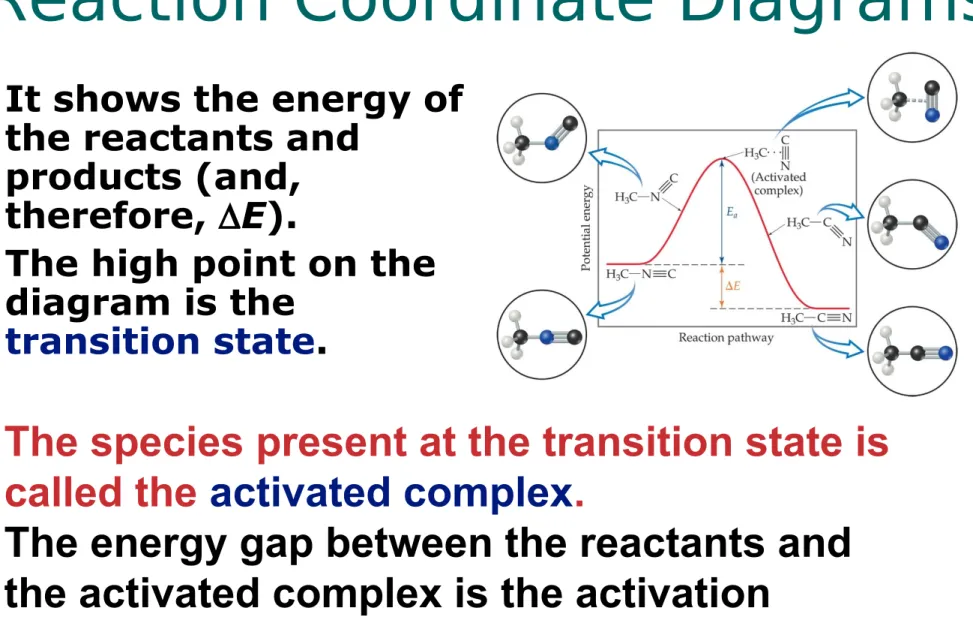
It is helpful to visualize
energy changes throughout a
process on a reaction
coordinate diagram like this one for the rearrangement of methyl
Reaction Coordinate Diagrams
It shows the energy of
the reactants and products (and,
therefore, E).
The high point on the
diagram is the
transition state.
•
The species present at the transition state is
called the
activated complex
.
•
The energy gap between the reactants and
the activated complex is the activation
energy barrier.
Maxwell–Boltzmann
Distributions
Temperature is defined as a
measure of the average kinetic energy of the molecules in a sample.
•
At any temperature there is a wide
Maxwell–Boltzmann Distributions
As the temperature increases, the
curve flattens and broadens.
Thus at higher temperatures, a
larger population of molecules has
higher energy.
Maxwell–Boltzmann
Distributions
If the dotted line represents the activation energy,
as the temperature increases, so does the fraction of molecules that can overcome the activation
energy barrier.
Maxwell–Boltzmann
Distributions
This fraction of molecules can be found through the expression:
where R is the gas constant and T is the temperature in Kelvin .
Arrhenius Equation
Svante Arrhenius developed a mathematical relationship between k and Ea:
where A is the frequency factor, a number that
represents the likelihood that collisions would occur with the proper orientation for reaction. Ea is the
activation energy. T is the Kelvin temperature and R is the universal thermodynamics (gas) constant.
Arrhenius Equation
Taking the natural logarithm of both sides, the equation becomes
1
RT
y
=
mx
+
b
When
k
is determined experimentally at
several temperatures,
E
acan be calculated
from the slope of a plot of
ln
k
vs. 1/
T
.
Arrhenius Equation for 2
Temperatures
When measurements are taken for two different temperatures the Arrhenius equation can be
symplified as follows:
Write the above equation twice, once for each of the two Temperatures and then subtract the lower temperature
Arrhenius Equation Sample
Problem 1
The rate constant for the decomposition of
hydrogen iodide was determined at two different temperatures
2HI H2 + I2.
At 650 K, k1 = 2.15 x 10⁻⁸ dm3 mol-1s-1
At 700 K, k2 = 2.39 x 10⁻⁷ dm3 mol-1s-1
Find the activation energy for this reaction.
54.
2.39 x 10⁻⁷ Ea
Ln --- = - --- x 2.15 x 10⁻⁸ (8.314 J mol-1 K-1)
Ea = 180,000 J mol-1 = 180 kJ mol-1
1 1 -- ---700K 650K
Overview of Kinetics Equations
First order Second order Second order
Rate Laws
Integrated
Rate Laws complicated
Half-life complicated
Reaction Mechanisms
The sequence of events that describes
the actual process by which reactants
become products is called the
reaction mechanism
.
Reaction Mechanisms
Reactions may occur all at once or
through several discrete steps.
Each of these processes is known as
Reaction Mechanisms
• The molecularity of a process tells how many
molecules are involved in the process.
• The rate law for an elementary step is written
directly from that step.
Multistep Mechanisms
In a multistep process, one of the steps will
be slower than all others.
The overall reaction cannot occur faster
Slow Initial Step
The rate law for this reaction is found experimentally
to be
Rate =
k
[NO
2]
2 CO is necessary for this reaction to occur, but the
rate of the reaction does not depend on its concentration.
This suggests the reaction occurs in two steps.
NO
2 (g)+ CO
(g)
NO
(g)+ CO
2 (g)Slow Initial Step
A proposed mechanism for this reaction is
Step 1: NO2 + NO2 NO3 + NO (slow) Step 2: NO3 + CO NO2 + CO2 (fast)
The NO3 intermediate is consumed in the second step.
As CO is not involved in the slow, rate-determining step, it
Fast Initial Step
The rate law for this reaction is
found (experimentally) to be
Because termolecular (= trimolecular)
processes are rare, this rate law
suggests a two-step mechanism.
Fast Initial Step
A proposed mechanism is
Step 1 is an
equilibrium
-
Fast Initial Step
The rate of the overall reaction depends
upon the rate of the slow step.
The rate law for that step would be
But how can we find [NOBr
2]?
Fast Initial Step
NOBr
2
can react two ways:
With NO to form NOBr
By decomposition to reform NO and Br
2
The reactants and products of the first step
are in equilibrium with each other.
Therefore,
Fast Initial Step
Because Rate
f= Rate
r,
k
1[NO] [Br
2] =
k
−1[NOBr
2]
Solving for [NOBr
2] gives us
k
1k
−1[NO] [Br
2] = [NOBr
2]
Fast Initial Step
Catalysts
Catalysts increase the rate of a reaction by
decreasing the activation energy of the reaction.
Catalysts change the mechanism by which the
process occurs.
Some catalysts also make atoms line up in the
correct orientation so as to enhance the reaction rate
Catalysts
Catalysts may be
either homogeneous or heterogeneous
A homogeneous
catalyst is in the same phase as the
substances reacting. A heterogeneous
Catalysts
One way a catalyst can speed up a
reaction is by holding the reactants
together and helping bonds to break.
Heterogeneous catalysts often act in this way
Catalysts
Some catalysts help to lower the energy for formation for the activated complex or
provide a new activated
complex with a lower activation energy
AlCl3 + Cl2 Cl+ + AlCl 4
-Cl+ + C
6H6 C6H5Cl + H+
H+ + AlCl
4- HCl + AlCl3
Overall reaction
Catalysts & Stratospheric Ozone
72.
In the stratosphere, oxygen molecules absorb ultraviolet light and break into individual oxygen atoms known as free radicals
The oxygen radicals can then combine with ordinary oxygen molecules to make ozone.
Catalysts & Stratospheric Ozone
The presence of chlorofluorcarbons in thestratosphere can catalyze the destruction of ozone. UV light causes a Chlorine free radical to be released
The chlorine free radical attacks ozone and converts it Back to oxygen. It is then regenerated to repeat the
Enzymes
Enzymes are
catalysts in biological systems.
The substrate fits
into the active
site of the enzyme much like a key
fits into a lock.