People and Policies
There are two meanings for the word policy. Governments have general policies, or understandings, about the way the country should be run. For example, it is the policy of the Canadian government to maintain a healthy economy. A formal policy, on the other hand, lays out a plan of action to achieve a specific goal.
Policies have the power to affect individuals and communities in many ways—both negative and positive. This chapter describes the effects of government policies on the peoples of Western Canada in the late 1800s and early 1900s. Investigating this topic might help you understand the policies that affect you and your community today.
in the West
Key
CONCEPT
▲
Government Policies and the Peoples of
the West
You may recall from earlier chapters that the National Policy was the main idea the government had for helping Canada grow strong as a nation. The National Policy was like three policies in one:
• an immigration policy—to encourage farmers to settle in the West • a transportation policy—to build a railway
• an economic policy—to help the economy grow by setting tariffs on foreign goods (encouraging Canadians to buy Canadian goods) In time, these policies achieved their goals. Along the way, they also created a new society in the West.
Was the impact of Canada’s immigration policy on each of
the peoples in Western Canada positive or negative?
Chapter
INQUIRY
Dawn looest tehkeh taapitow ni shipwepichinawn li terraen chi mishkamawk maka
ya pawt plaas ayiiwawk chiytootehk ehkwa.
Métis Grandmother
Chinese Store Owner
Many Perspectives
This chapter invites you to think about policies from the perspectives of some of the people whose lives were most affected by them: First Nations, Métis, newcomers from Eastern Europe, Chinese immigrants, Francophone Westerners, and farmers and ranchers. This organizer imagines what individuals from these groups might have said about the big changes happening in their lives at this time.
How many of these languages can you understand? What does that tell you about one of the challenges people faced as they tried to build a new society in the West? (If you’re curious about the comments you can’t read, see the translations on page 284 at the end of this chapter.)
Think
AHEAD
▲
I don’t think the government cares what happens to Prairie farmers. I’m going broke from the high cost of
shipping wheat by rail.
Homesteader from Britain
J’ai peur que notre langue et notre culture se perdent. Il y a beaucoup de nouveaux arrivants, et la majorité d’entre
eux ne parlent pas français.
Francophone Doctor
Ukrainian Girl Nehiyaw Elder
R
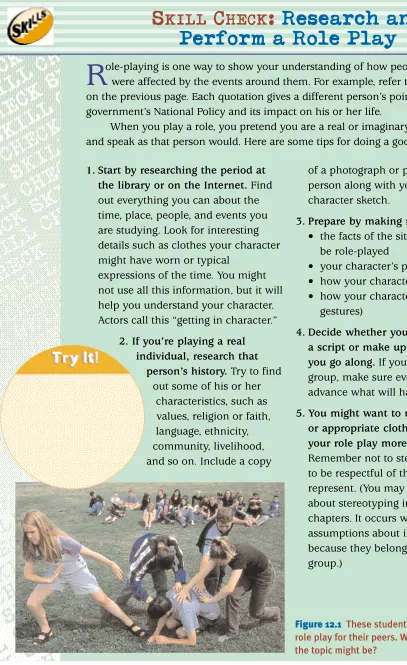
ole-playing is one way to show your understanding of how people in history were affected by the events around them. For example, refer to the organizer on the previous page. Each quotation gives a different person’s point of view on the government’s National Policy and its impact on his or her life.When you play a role, you pretend you are a real or imaginary person. You act and speak as that person would. Here are some tips for doing a good job.
1. Start by researching the period at the library or on the Internet.Find out everything you can about the time, place, people, and events you are studying. Look for interesting details such as clothes your character might have worn or typical
expressions of the time. You might not use all this information, but it will help you understand your character. Actors call this “getting in character.”
2. If you’re playing a real individual, research that
person’s history.Try to find out some of his or her
characteristics, such as values, religion or faith, language, ethnicity, community, livelihood, and so on. Include a copy
of a photograph or painting of the person along with your written character sketch.
3. Prepare by making notes.Include • the facts of the situation or event to
be role-played
• your character’s perspective • how your character feels • how your character acts (voice,
gestures)
4. Decide whether you will work from a script or make up the dialogue as you go along.If you are working in a group, make sure everyone agrees in advance what will happen.
5. You might want to use music, props, or appropriate clothing to make your role play more interesting. Remember not to stereotype and to be respectful of the cultures you represent. (You may recall learning about stereotyping in previous chapters. It occurs when we make assumptions about individuals because they belong to a particular group.)
Create a character sketch of a historical figure. You can choose someone you read about in Chapter 11, or
skim ahead and choose someone from this
chapter.
S
KILL
C
HECK
:
Research and
Perform a Role Play
Treaties in the West
T
he First Nations and Métis were the first to feel the effects of new settlement in the West. On the plains, thebuffalo had become scarce
because so many newcomers were hunting them. In the north, more and more miners and trappers were moving into First Nations territories. All across the prairies, land that was good for hunting was being turned into farms.
Europeans also brought diseases, such as smallpox and tuberculosis, that were especially dangerous for Aboriginal people.
Chapter 8 explained some of the actions the Métis took during this time. This section describes how First Nations and the federal government tried to reach
understanding through the treaty process. You’ll see that First Nations and the
Canadian government had different reasons for signing treaties. They had different understandings of what the treaties meant.
Different Reasons
From 1871 to 1921, the First Nations living between the Great Lakes and the Rocky Mountains made 11 treaties with the Canadian government. These are known as the Numbered Treaties.
The Canadian government’s main reason for making these treaties was to gain control of the land and natural resources. Government officials knew that if First Nations did not agree to allow homesteaders onto their lands, then the government’s immigration plans would fail. At the time, there were wars between First Nations and government troops in the United States. Prime Minister John A. Macdonald didn’t want that to happen in Canada. He knew it would cause great suffering. He also knew that violence would slow down his efforts to expand Canada westward.
First Nations’ main reason for agreeing to treaties was to protect their rights to their lands and natural resources. First Nations leaders realized that the future would bring even more newcomers. Also, the First Nations needed the food and money the government was promising. Many communities were threatened with starvation and disease Why did First
Nations and the government of Canada sign the Numbered Treaties?
Focus
Figure 12.2 Each treaty area includes many different First Nations. Which treaty area do you live in? Compare this map to the map of Aboriginal Language Groups and Peoples in Canada (see Chapter 1, page 7). Identify all the First Nations covered by the treaty area in which you live.
Figure 12.3 This painting is A. Bruce Stapleton’s interpretation of Isapo-Muxika speaking at the Treaty 7 negotiations. What questions might you ask about it? (You may want to refer to Skill Check: Interpret Images on page 6 for guidance.)
STUDY
CASE
Treaty Number 7
Treaty 7 involved five First Nations: the Kainai [KY-ny], the Piikani [bee-GUN-ee], the Siksika [sik-SIK-uh], the Nakoda [na-KOH-dah], and the Tsuu T’ina [tsoo-TIN-uh]. Canadian officials and leaders from the five nations met at Blackfoot Crossing on the Bow River in September 1877. For four days they talked back and forth about what would be in the treaty. The chiefs also talked among themselves. Finally, both sides reached an agreement.
• In the written agreement, the Canadian government recorded that the First Nations had surrendered 90 600 square kilometres of land in exchange for benefits such as yearly payments, reserve lands, hunting and fishing rights on unoccupied lands, salaries for teachers, and farm equipment. The Canadian government thought it now owned the land.
• The First Nations Elders recorded in memory that they had agreed to share their land with the newcomers in exchange for the government’s promises to provide for their needs. They did not think the land was sold.
Isapo-Muxika was a Siksika chief who took part in the Treaty 7 talks. He was also known as Crowfoot. The Canadian government reports on Treaty 7 include the following record of what Isapo-Muxika said at the time.
I have to speak for my people, who are numerous, and who rely upon me to follow the course which in the future will tend to their good. The plains are large and wide. We are the children of the plains, it is our home, and the buffalo has been our food always. … The advice given me and my people has proved to be very good. If the police had not come to the country, where would we all be now? Bad men and whiskey were killing us so fast that very few, indeed, would have been left today. The police have protected us as the feathers of the bird protect it from the frosts of winter. I wish them all good, and I trust that all our hearts will increase in goodness from this time forward. I am satisfied, I will sign the treaty.
Source: Alexander Morris, The Treaties of Canada, with the Indians of Manitoba and the North-West Territories(Toronto: Belfords, Clarke, 1880).
CASE
STUDY
What do you notice about each side’s understanding of the treaty? What issues might there be because it was the government that recorded Isapo-Muxika’s speech?
because the buffalo were disappearing. First Nations had other reasons for signing the treaties, as well. Some saw the treaties as a better alternative than war with the
newcomers and the government. Others decided to sign in return for help in setting up farms. Still others felt that, if they did not sign, the land would be taken from them anyway.
Through the treaties, the government promised to hold at least some land in trust for the First Nations. The First Nations peoples believed the treaty negotiations were a way to meet the government on a nation-to-nation basis. They hoped to ensure that their peoples and cultures would survive.
The Treaties
Each treaty was slightly different, but the main agreement in all of them was that the
Canadian government promised to provide First Nations with cash payments, certain goods (such as fishing gear and farm equipment), and certain services (such as education and health care). In exchange, First Nations would allow homesteaders onto their lands. Certain areas of land, called reserves, were set aside for First Nations’ sole use—newcomers could not live there.
Different
Understandings
In the Case Study of Treaty 7, you may have noticed that the Canadian government and First Nations ended up with different understandings of the treaty. This happened with every treaty that was signed. At
the time, both sides did their best to communicate clearly. However, language and cultural differences made this difficult.
Assimilation
The Canadian government had another policy in mind that it didn’t discuss at the treaty negotiations. This was a policy of assimilation. Assimilation means that one culture dies out because of the strong influence of a dominant group. Sometimes a language dies out that way, too. The Canadian government thought that, as time went by, First Nations would lose their cultures and languages. They would become more like the newcomers. To accomplish this, it targeted First Nations children. It separated them from their parents by making them attend residential schools. Here, they were forbidden from speaking their own languages or practising their own beliefs. Because these children spent much of their childhoods away from their
families, they could not benefit from their parents’ guidance and teachings—they were cut off from their roots.
Figure 12.4 Part of the Canadian government’s record of Treaty 8. How did First Nations record treaties? How could these different recording methods lead to different understandings?
To learn more about the Numbered Treaties, open Chapter 12 on your Voices and VisionsCD-ROM.
1. Refer to the Skill Check feature on page 268. In a small group, role-play a scene from the Treaty 7 negotiations. Choose actual people from history to use in your scene. You may have to do some extra research in order to develop your characters fully.
2. In your own words, describe why each side agreed to the Numbered Treaties. Think
about how the descendants of the treaty participants are doing now. How did each side benefit—or not—over time?
3. Make a chart for recording information on how Canadian government policies affected peoples and communities in the West. Here is one way you could organize your ideas. Fill in the chart as you read the rest of this chapter.
Think It
Through
▲
Policy Who was affected? How were they affected?
My thoughts and questions Effects of Government Policies
Aboriginal peoples and the government of Canada are still dealing with misunderstandings about the treaties. Many First Nations, for example, are involved in ongoing court cases. They argue that their ancestors never signed over ownership of the land. Therefore, they believe they still have rights to it. Hunting and fishing rights are another point of
disagreement. It can be hard to know the intentions of the treaty makers as time goes by. The treaties created 2300 reserves. Life on these reserves continues to pose many challenges for First Nations people. High unemployment, housing shortages, education issues, and lack of medical services are some examples. Use the library, news sources, or the Internet to try to learn more about one of the present-day impacts of the treaties or of assimilation policies. Prepare a written report or an oral presentation.
Peoples from Eastern Europe
P
eoples from Eastern Europe were one group that benefited from Canada’simmigration policies. Next to the British and Americans, Eastern Europeans formed the greatest number of newcomers to the prairies in the late 1800s and early 1900s. Poles, Ukrainians,
Romanians, and Hungarians were just some of the Eastern Europeans who came. Most settled on the
Canadian prairies. This section describes how they helped build a new society in the West.
The Push and Pull
Factors
Life in Eastern Europe around 1900 could be very hard. The people were proud of their cultures and countries. Many families, however, lived in poverty with little chance of getting ahead. In some places, a person How did
could be imprisoned or killed for practising a religion different from the one most people practised. Doukhobors, Mennonites, and Jews were some of the peoples who suffered from this kind of prejudice. The Canadian government promised immigrants free land and religious freedom. These promises drew these people to Canada, even though some of them did experience discrimination after they arrived.
Making a Home
If you’ve ever been homesick, you have some idea of what life might have been like for the Eastern European immigrants. Most of them would never see old friends, family, and familiar places again. To help ease their feelings of homesickness, many immigrants settled close to other people from their homelands. Living near others who shared their culture helped immigrants adjust to their new lives. They could talk to
neighbours in their first language and help each other with work. They could get together for common cultural celebrations.
In their new communities, people set up all the services they needed, including health care, businesses, places of worship, and schools. As these communities grew, people from different cultures began to do business together and share traditions. In this
way, people from Eastern Europe contributed to all parts of society in the West.
Contributing to the
Economy ]
Many people from Eastern Europe were farmers who settled on the land to grow food crops. The Métis and Canadiens most often had small family farms on the prairies. The Eastern Europeans preferred large wheat farms. These farms became the base of Canada’s agriculture industry. The land and climate of the prairies were very similar to what they had been used to back home. This meant they already had the skills and knowledge needed to farm in the West. Winters in Canada, however, were colder and longer than in Eastern Europe. Many European immigrants did not come prepared for the cold and snow.
Other Eastern Europeans worked in the mines and logging camps or helped to build the railways. Still others opened stores. These were just some of the ways they supported the economy that was growing in Western Canada.
Figure 12.5 The borders and names of countries in Eastern Europe have changed several times since the early 1900s. This region is home to at least 10 different countries and 15 languages.
I didn’t know a word of English when I went to school at five. I remember the first day, I started to cry, and Mr. Cameron [the teacher] put me in a chair in front of his desk, the chair he used to sit on. He gave me a book to read, and I remember looking at the pictures but the tears were coming down. The Italians, or Hungarians or whatever, they didn’t know English either, but they taught us first to sing. We sang in the morning and before noon. I learned all the Scotch songs and all the Irish songs. And of course you had to sing “God Save the King,” all for learning English.
Source: Eliane Leslau Silverman, The Last Best West: Women on the Alberta Frontier 1880–1930
(Calgary: Fifth House Publishers, 1998).
“
“
V
OICES
V
OICES
Figure 12.7 Students at Huxley School, Alberta, 1909. What similarities and differences are there with your own school population?
Education and Health []
In the early years, many families were so busy with work on the farm that schools were not the first thing on their minds. As soon as they could, however, people built schools in their communities.
For new immigrants, getting sick could be a disaster. They might not have family to
help them, and they probably could not afford a doctor if they needed one. Many areas didn’t have medical facilities of any sort. Many groups formed benefit societies. These offered a simple form of health insurance that helped members when they were sick and could not work. One example was the Hungarian Sick-Benefit Society that started in Lethbridge, Alberta, in 1901.
Cultural Activities
As soon as enough people had settled in an area, they built a church or synagogue where they could worship according to their faith. They also formed sports clubs,
musical societies, dance groups, choirs, and other organizations that allowed them to
Figure 12.8 Child’s lesson book, from about 1920. Why do you think this story is written in two languages? Dual-language lesson books like this were not common.
follow their customs and enjoy pastimes together. Many communities started newspapers in their own languages.
Culture, however, as you learned in previous chapters, involves much more than simply belonging to organizations. Culture is a learned way of life shared by a group of people. It is through common values and world views that these communities stayed strong.
Citizenship and
Identity []
People of various ethnic origins helped each other in the West. You saw in Chapter 11 how a First Nations farmer, Jim Grey-Eyes, helped a group of Doukhobors. In another example, Father Albert Lacombe brought priests to Canada who spoke various languages so they could minister to
European immigrants. These are two strong
demonstrations of active citizenship. Immigrants from Eastern Europe took advantage of their new freedoms to get involved in Canadian politics. It was not long before they were winning election to public office. For example, in 1913, Andrew Shandro was elected to the Alberta
Legislature. He was the first Canadian of Ukrainian heritage to do so. Many more Canadians of Eastern European descent were elected to office in the years following Shandro’s election.
Today more than three million
Canadians are of Eastern European heritage. Many of these people are descended from those first immigrants to the West.
Figure 12.9 Dozynki celebration, Tide Lake, Alberta, 1915. Dozynki is a Polish harvest festival. If you weren’t sure when this photograph was taken, what information in it could help you estimate a date? (You may want to refer to Skill Check: Interpret Images on page 6 for guidance.)
Figure 12.10 The Ukrainian Voicenewspaper, 1914. How can having a newspaper help a community strengthen its identity? The Voiceis still published today. What is the value of newspapers to
historians?
Discuss with a partner how you would use the primary sources in this section to give a talk on the contributions of Eastern European immigrants to Western Canada. Consider the Millie Melnyk quotation; the lesson book; the Ukrainian newspaper; and the photographs of the school children, the festival, and the church (see the Voices feature on the previous page and Figures 12.6 to 12.10). How do these documents help you see multiple perspectives?
Think It
Through
P
eople from China were among the earliest immigrants to Western Canada. The first Chinese came in 1858 with the gold rush in British Columbia. Later, thousands ofChinese men worked on the construction of the Canadian Pacific Railway (CPR). (You may recall reading about their
experiences in Chapter 9.) In this section you can read about some of the other ways Chinese newcomers helped build Canadian society. You will also discover how their lives were affected by Canada’s immigration policies.
Choosing to Stay
After the railway was finished in 1885, some Chinese returned to China. Others found jobs as cooks, storekeepers, and farmers. In British Columbia, many Chinese went to work in the salmon canneries.
Chinese people also settled on the prairies, usually in towns along the rail line. Many opened businesses such as laundries and restaurants or sold
vegetables from their gardens. There was a great need for these kinds of businesses in the growing communities. In the East, Chinese immigrants settled in Montréal, Toronto, Hamilton, and Ottawa. Very few settled in the Maritime provinces or Newfoundland.
Of the Prairie provinces, Alberta had the largest number of Chinese immigrants. As well as starting businesses, Chinese people worked in the coal mines, on sugar beet farms, and as cooks on cattle ranches.
A Change in Policies [
Male Chinese immigrants were welcome to work on the CPR. After the railway was finished, though, the federal government How did Chinese
immigrants contribute to the development of Canada?
Focus
Wong Yet
In 1895, Wong Yet came to Canada from China to work for the CPR. After a couple of years, he had saved enough to start up a laundry and restaurant. In 1903, his son Wong Pond came from China to help with the business. When the restaurant burned down in 1912, they put up another one called the Public Lunch. During the Depression, they provided food and shelter to homeless men looking for work doing chores. The Wongs became well known for their role in charity and sports projects in the community. Wong Pond owned and ran the Public Lunch for many years, and then his son took over and ran it until 1972.
Biography
Biography
Figure 12.11 Public Lunch, Olds, Alberta, about 1912. This restaurant and rooming house was just one of the businesses the Wong family owned in Olds. What businesses in your community existed at that time? How do long-lasting businesses help a community?
started passing laws to keep Asian
immigrants out. Many non-Asians believed that people from Japan, China, and India would not fit in to Canadian society. They feared the different customs of the Asian newcomers. Some non-Asians were also afraid that Asian immigrants, who were paid lower wages, would take any available jobs.
One law to keep Asians out was the Chinese head tax. This was a fee that every person from China had to pay to enter
Canada. The tax started in 1885 at $50 per person. Over the years it rose to $500. In 1923, a new policy stopped Chinese from coming to Canada at all. People could not even bring their family members to Canada. It was not until the late 1940s that attitudes started to change. Only then did Canadians of Chinese heritage begin to enjoy the same rights as other Canadians.
Chinatowns []
Like many other immigrant groups, Chinese people who came to Canada wanted to live near family and friends. As a result, they moved to certain neighbourhoods, which came to be called Chinatowns. These can be quite distinctive neighbourhoods, with many crowded shops and bustling streets.
In Alberta, the largest Chinatown was in Calgary. In Saskatchewan, the biggest was in Moose Jaw. Over the years, Chinese communities have built cultural centres in many cities, including Vancouver, Winnipeg, and Toronto.
Figure 12.12 Head tax certificate for Yip Sai Kai, issued in 1922. How much did his parents have to pay for it?
Make a poster that shows some of the contributions of Chinese immigrants to the development of Canada.
Think It
Through
▲
Figure 12.13 Chinese Cultural Centre, Calgary. The centre is a vibrant place where different aspects of Chinese culture can be enjoyed. Find out about some types of events put on at one such centre. Share them with your classmates. How do these centres help build Canadian society?
To see a photograph of one of the few early female Chinese
immigrants, open Chapter 12 on your
Voices and Visions
CD-ROM.
T
hink of Western Canada in the beginning as a movie theatre before the show starts. At first there are groups ofFirst Nations people sitting at different places around the theatre. They are joined by
Canadien and Scottish fur traders, Métis, and a few homesteaders from Ontario and Québec. Then, not long before the curtain rises, the theatre begins to fill up with newcomers. They come from many different countries. All around are people dressed in different styles of
clothing, speaking different languages, and eating different foods. But everyone is there for the same movie.
That is the kind of place Western Canada became as a result of immigration. It meant big changes for Francophone communities in the West.
A Storm Brewing
In the years after Confederation, Francophone communities existed all across the prairies. Francophone Métis and Canadiens had been at home there for many years. As you learned in earlier chapters, some Canadien migrants joined them. So did Francophone immigrants from France and Belgium. They believed in the promise of Confederation— they hoped that the West would be a bilingual society.
Francophone culture and language were strong in the West. Until the late 1800s, French was the most common European language in use in the West. Then the great numbers of non-Francophone immigrants arrived. French soon became just one of many languages spoken on the prairies. As you saw in Chapter 11, the government had a policy of advertising in non-Francophone
From Majority to Minority: Francophones
in the West
How did the arrival of so many
immigrants affect Francophone peoples in Western Canada?
Focus
countries. The government presented Canada as a country where English was the norm. Therefore, the new immigrants were expected to learn English, not French. Over the decades, they and their children became Anglophones. Anglophones became a bigger and bigger majority. As you will see, the provincial governments didn’t want to pay for education and services in two languages.
Using French in
Government []
When Canada was created in 1867, the Constitution Act guaranteed several things. It said that politicians speaking in the federal Parliament, or in the Assembly in Québec, could use either French or English. The Act also said that laws should be printed in both languages. It said that people could use either language in the courts. In other words, French and English were equal in government and the law.
In 1870, the Manitoba Act made French and English equal in the Manitoba
government. This meant that provincial government business took place in French or English. People could speak either
language in provincial courts. The Act began to fulfill the promise of Confederation. Most Francophones were pleased.
Hopes faded in 1890. In that year, the government of Manitoba made English the only official languagein the province. (A language is “official” when the right to use it is protected by law.) Franco-Manitobans could no longer use French in the Manitoba Assembly, nor could they use it in provincial courts. This situation lasted for 90 years. Then, in 1979, the Supreme Court of Canada overturned the 1890 law. Today, the Manitoba government offers services in both official languages. This matches the spirit of the Manitoba Act.
Next door, the North-West Territories (which included the areas that are now Alberta and Saskatchewan) had been officially bilingual since 1877. Then, in 1892, the Assembly passed the Haultain Resolution. This motion made English the only language of government. For almost 100 years, the provinces of Alberta and Saskatchewan gave no official status to the French language. Then, in 1988, the Supreme Court ruled that the 1892 motion was not valid. The lieutenant-governor of the time had never proclaimed the law.
This means it never was a real law. In response, both provinces quickly made
real laws. They made English their only official language.
The Manitoba
Schools Question []
Francophones in the West struggled hard to protect their language rights. The right to separate schools was a major issue. (See the text box in Chapter 10 on page 234 for types of schools.)
As the West filled with new arrivals, people set up schools for their children.
French and English have been the official languages of the federal Parliament since 1867. In 1969, Members of Parliament voted in the Official Languages Act. It ensures that every citizen has the right to federal government services in either official language. Other laws have made Canada even more bilingual. For example, one law affects the items you buy every day. It says that all product packages must give information in both French and English. Canada’s official languages are protected in sections 16 to 22 of Canada’s
Since most of the first newcomers were Roman Catholic, most of the schools were Catholic schools. As we have seen in Chapter 10, the rights to schooling in a Catholic school system were guaranteed by the 1870 Manitoba Act. Since these
newcomers were Francophone, the language of instruction was French. The teachers and students spoke French, and the students learned to read and write in French. Then newcomers of the Protestant faith started arriving. They set up their own schools. Even though the students spoke a variety of languages, the language of instruction was English.
Soon there were far more Protestant schools than there were Catholic schools. In 1890, the government of Manitoba voted to stop funding Catholic schools. It did not want the expense. Instead, it wanted a single system of schools. Protestants and Catholics would go to the same schools. Instruction would be in English.
Francophone Catholics were outraged. They knew that Confederation and the Manitoba Act had guaranteed the right to separate schools. They demanded their
schools back. Francophones in Manitoba had the support of Francophones in Québec. The legislation became a national debate! The arguments dragged on for years. The Manitoba government tried to hold on to its English-language-only policy. The
Francophones tried to stop it. The federal government had the right to enforce the constitutional guarantee of a French,
Catholic school system in the West. It chose not to. Many Francophone Catholics felt betrayed, both in Manitoba and in Québec.
Finally, in 1896, Prime Minister Wilfrid Laurier and Manitoba premier Thomas Greenway reached a compromise. Catholics did receive the right to have some religious teaching in the schools. Also, if there were ten or more Francophone students, they would be taught in French. However, Catholics did not get their separate school system back. This was not the case in Québec. There, the provincial government had always funded a separate school system for the Protestant minority. For Francophones all over the country, the outcome of the Manitoba Schools question was a great disappointment. It dealt a terrible blow to French and Catholic rights in Canada.
Using French in Schools
in the Northwest []
As you learned in Chapter 10, Francophones in the West had a similar experience. First they enjoyed their rights as a minority. Then, in 1892, the territorial government made English the language of instruction in all schools. This situation continued after Alberta and Saskatchewan were created in 1905.
It wasn’t until the Charter of Rights and Freedoms became law in 1982 that
Francophones in the West had a chance to have their education rights recognized once again. In the meantime, they were left to try
to preserve their language without assistance. They published their own newspapers, built hospitals and churches, and organized social clubs. Community members also worked hard to start French radio stations in all three Prairie provinces. This included CHFA in Alberta, for which they raised funds. Volunteers also built the needed
transmission tower.
Opening private schools was another strategy. Members of Catholic religious orders founded many schools and colleges. Collège Mathieu, for example, was founded in 1918 in Gravelbourg, Saskatchewan. It is still operating—the only private Francophone high school in Western Canada. All of these actions helped keep French in use. They helped keep alive the cultures of the Albertans, Saskatchewans, Franco-Manitobans, and Métis.
Franco-Albertan
Citizens in Action [
In 1982, the Charter of Rights and Freedoms became law. Section 23 states that all
Anglophone and Francophone Canadians who live as minorities have education rights.
They are entitled to have their children educated in the minority language.
Some provinces did not take action right away, even though they had signed the Constitution. But Franco-Albertans did not give up. They lobbied. They protested. Within two years, they convinced two school boards to open Francophone schools. The efforts of the Comité ad hoc pour l’école
française catholiqueresulted in the opening
of École Maurice-Lavallée, in Edmonton. Franco-Albertans in Calgary successfully campaigned to open École Saint-Antoine in that city.
In 1988, the Alberta government saw that it needed to change the Alberta School Act to bring it in line with the Charter. The Act was changed twice, in 1988 and 1993. It now recognizes Section 23 rights,
including the right of the minority to govern its schools through Francophone school boards. This educational right stems from the promise of Confederation—that Canada would be a bilingual nation in which the French and English languages would enjoy equal status. It helps fulfill the promise that Francophones and Anglophones would be equal partners.
Figure 12.17 These are the flags of the provincial Francophone organizations in the Western provinces. What do flags have to do with group identity?
B
y the 1920s, Canadians had been living with the ideas of the National Policy for many years. The federalgovernment and most people in Eastern Canada were happy with the way the economy was going— businesses were prospering, and trade with the other regions of Canada was good. The Canadian Pacific Railway was carrying goods, farm produce, and people from coast to coast. All across the prairies, small
communities along the rail lines were growing into busy towns and cities.
This section begins with information on how Canada grew under the National Policy. You will see how the West was affected by other government policies, too.
How did government policy affect the growth of Western Canada?
Focus
Total as % of
Year Manitoba Saskatchewan Alberta Total Canadian Population
1871 25 288 48 000 73 288 2% 1881 62 260 56 446 118 260 3% 1891 152 506 98 967 250 500 5% 1901 255 211 91 279 73 022 419 000 8% 1911 461 394 492 432 374 295 1 327 000 18% 1921 610 118 757 510 588 454 1 956 000 22%
Building an Economy
Figure 12.18 Population of the Prairie West, 1871–1921. The population of the Prairie provinces doubled almost five times within five decades. Make a bar graph to show how the percentageof Canadians living in the Prairie West changed from 1871 to 1921. Then, in point-form, explain how government policies worked to cause this change.
1. Make a cause-and-effect chart to show how Francophones became a minority in the West. Consider government policies, actions, and lack of action. (You may want to refer to Skill Check: Analyze Causes and Effects on page 76.)
2. In 1889, a group of Franco-Albertan
citizens campaigned on behalf of a Catholic school district in Edmonton. You read about this action in Chapter 10 (page 234).
About a century later, another generation of Franco-Albertan citizens took action that involved the same school board. (You read about it in Franco-Albertan Citizens in Action on the previous page.) Research these two examples of active citizenship. Make up a chart on paper or on computer to compare the two efforts and find paral-lels. Did both groups have lasting positive impacts on the face of Alberta?
Think It
Through
▲
To analyze information in charts, begin by reading the title and the caption. Next, note the column headings and any units of measurement used.
Figure 12.20 A view of 8th Avenue SE, Calgary, 1905. Speculate on how ranching contributed to the growth of Calgary.
CASE
STUDY
Ranching in Alberta
It was the North-West Mounted Police working in southern Alberta who first pointed out that cattle did well on the grasslands of this area. There was plenty for the cattle to eat, streams for water, and low hills to provide shelter.
The federal government wanted to stop American cattle companies from buying up all the land in the Canadian West. It wanted to give a boost to the Canadian cattle industry. It said that Canadian ranchers could lease 100 000 acres (about 40 000 hectares) for up to 21 years. It would cost only one cent an acre per year. The federal government also made sure there was a railway to transport the cattle to markets.
As ranches developed, they contributed to the Alberta
economy in many ways. Ranching led to businesses that processed the cattle. It led to transportation businesses that moved cattle and meat products to larger communities to be sold. Cities such as Calgary grew up as centres of meat packing and cattle shipping.
The profits were good in the cattle industry. Ranchers could afford to pay shipping costs and buy any
equipment they needed. Grain farming and the oil industry developed in the twentieth century. Nonetheless, cattle ranching remained an important part of the economy of the West. Today, southern Alberta is home to many large and thriving cattle ranches.
How did government policy
help ranching develop in the West?
How did ranching help the economy in
the West?
Respond
Figure 12.19 A Ranch in the Rockies, painted by Edward Roper about 1887–1909. What view of ranch life does this painting give? What different kinds of information do you think you would get from a photograph of the same place? (For guidance, you may want to refer to the Skill Check on page 6.)
To see a photograph of early mechanization
on a turn-of-the-century Alberta farm, open Chapter 12 on your Voices and VisionsCD-ROM.
An Unfair Policy?
As you read in Chapter 9, many Western wheat farmers believed that the federal government’s economic policies benefited Eastern Canada more than the West. The tariffs the Canadian government had put on foreign goods meant that farmers had to pay high prices for farm equipment. Some
felt that shipping their grain could end up costing more than they were getting paid for it.
In response to this situation, Western farmers took several actions. In 1901, they formed the Territorial Grain Growers
Association, at Indian Head, Saskatchewan. This led to other associations, including the United Farmers of Alberta, formed in 1909. Western farmers also formed their own marketing outfit, and began publishing their own newspaper, the Grain Growers’ Guide, in 1908.
Form an opinion about whether or not the West benefited from government policies in the late nineteenth and early twentieth centuries. Think about the perspectives of the various people you met in the opening of this chapter. Refer to other chapters to help inform your opinion. Use facts to back up your opinion. Express your opinion in a format of your choice.
Think It
Through
▲
Watch the “Schools of Agriculture” video
on the Voices and VisionsCD-ROM. It will show you how the government of Alberta promoted “new” farming technology in the West.
Tech Link
Figure 12.21 Editorial cartoon, Grain Growers’ Guide, 1910. The United Farmers of Alberta published this cartoon in their association newsletter. How is it useful historical evidence for the way wheat farmers felt about the National Policy?
Francophone Doctor (in French):
Métis Grandmother (in Michif): Ukrainian Girl (in Ukrainian):
Chinese Store Owner (in Mandarin):
Nehiyaw Elder (in Woodlands Cree):
I worry about losing our language and culture. There are so many newcomers, and not many speak French.
We keep moving west to find land, but there is no place left to go now. I’m excited to be in this new country because Father says we’ll soon have
a farm of our own. I wonder, what will that be like?
Working on the railway was hard. Now I hope I can bring the rest of my family from China and start a small business.
It is being told that there are many different peoples coming to move into our land. I wonder what will happen now?
Chapter 12
PROJECT
Television Talk Show
I
magine that a Doukhobor farmer, a Chinese restaurant owner, a Siksika hunter, a Franco-Albertan shop owner, a federal government official, and a rancher who immigrated from the United States all got together in 1900. What kind of conversation would they have about how government policies were affecting their lives? In this chapter project you can work as a group to role-play a television talk-show discussion among characters such as these.Focus
1. As a class, decide which specific policy your panel will discuss. For example, it could be an immigration policy such as the head tax. 2. As a class, decide on the different characters
you might invite as guests to your talk show. Think of six or seven guests who could have a lively discussion showing different points of view on federal government policies of the time. Give each character a name. Remember that not all people from one group will have exactly the same opinion—you might choose to have two different Francophone participants with two different views, for example.
3. Form one group for each character, including the talk-show host. Group members can work to locate information to help their character come alive. One person from each group will represent the character on the panel.
Groundwork for Various
Characters []
4. Research the specific policy that will be the topic of the talk show. Try to find out as many facts about the policy as you can: When was it announced and by whom? What was its aim? Who opposed it, who supported it, and why?
5. Decide what you need to know about your group’s character. Divide the research work among group members.
6. After you have gathered information, work together to decide what information is most important to present during the discussion. 7. As a group, help the person who will be
role-playing your character. Make notes on the facts of the situation, the character’s perspective, and how the character feels and acts.
Groundwork for the
Talk-Show Host [
In your group, you will assist one person to serve as the talk-show host. This person will open the talk show by introducing the guests, describing the policy that will be discussed, and asking questions of the panel. Complete step 4, above. Then write an introduction and prepare questions.
Prepare to Present ]
Help the presenter from your group practise by giving feedback.
Present and Reflect ]
Stage the talk show. Afterward, meet with your group to ask how you might have changed things to present your character’s point of view better.
Use a word processor to make a file on your character. Copy and paste information you find on the Internet. Then add your own comments and ideas. Don’t forget to credit all your sources of information.