http: // www.ijrtsm.com© International Journal of Recent Technology Science & Management 72
ISSN : 2455-9679
[Gayathri et al., 4(8), Aug 2019] Impact Factor : 3.340
IJRTSM
INTERNATIONAL JOURNAL OF RECENT TECHNOLOGY SCIENCE & MANAGEMENT
“
STUDY ON EFFECTIVE IMPLEMENTATION OF HUMAN RESOURCE INFORMATION
SYSTEM IN PACKAGING INDUSTRY
”
V. Gayathri
1, P. Hariharan
21 Assistant Professor, Adhiparasakthi Engineering College, Melmaruvathur 2 Final MBA, Adhiparasakthi Engineering College, Melmaruvathur
ABSTRACT
Human resource information system (HRIS) is managing human resources of an organisation through technological solutions. It allows HR activities to occur through electronically. The HR information can be accessed through online also. It helps to create, store, manipulate, update and retrieve any information of the employees in an organisation. HRIS can benefit all the process in the HR department like employee profile maintenance, recruitment, selection, payroll, etc., This system provides a clear path to plan, control and manage the human resources. This research paper helps to know about HRIS and its effective implementation to conduct information electronically.
Keyword: HRIS, Technology, HRM, HRP, Online.
I.
I
NTRODUCTIONThe last decade has seen a significant increase in the number of organization gathering, storing and analyzing human resources data using Human Resource Information System (HRIS). Strategic value can be derived using HRIS gave the information needed the strategic planners to forecast future workforce demand and supply. Considering it as a tool that helps employers in retaining the right employees. Paying them competitive salaries compared to the market, and training them to develop their skills and abilities to carry out their existing and future jobs do it.
To ensure that management practices support business needs, organizations must continually monitor changing environmental conditions and devise HRM strategies for dealing with them. Human Resource Planning is the procedure used to tie human resource issued to the organization‟s business needs.
Human Resource Information Systems (HRIS) have become one of the most important tools for many businesses. Even the small, 20-person office needs to realize the benefits of using HRIS to be efficient. Many firms do not realize how much time and money they are wasting on manual human resource management (HRM) tasks until they sit down and inventory their time. HRIS is advancing to become its own information technology (IT) field. It allows companies to cut costs and offer more information to employees in a faster and more efficient way, Especially in difficult economic times, it is critical for companies to become more efficient in every sector of their business; human resources (HR) are no exception.
http: // www.ijrtsm.com© International Journal of Recent Technology Science & Management 73
ISSN : 2455-9679
[Gayathri et al., 4(8), Aug 2019] Impact Factor : 3.340
The administrative efficiency maintains faster information processing, improved employee communications, and grater information accuracy lower HR costs and overall HR productivity improvements. The purpose of HR planning are to enable organizations to anticipate their future HRM needs and to identify practices that will help them to meet those needs it takes short or long term(three or more years to do HR planning. Its aim is to ensure that people will be available with the appropriate characteristics and skills when and where the organization needs them. The use of HR planning enables companies to gain control of their future by preparing for likely events. That is, they can anticipate change and devise appropriate courses of action. When companies learn how to capitalize on future events, their own future improves as valuable as HR planning is, many companies ignore this opportunity.
Some see it as too difficult and frustrating, while others simply do not see the need for it. However, when failing to properly plan for their human resources, employers respond to events after they occur, rather than before; they become reactive, rather than proactive. When this outcome occurs, an organization may be unable to correctly anticipate an increase in its future demand for personnel. At best, such a company recruit personnel at the last minute and may fail to find the best candidates. At worse, the company may become seriously understaffed.
HRP is to get the right number of people with the right skills, experience, and competencies in the right jobs at the right time and at the right cost. This ensures that the business production requirements are in efficient and effective manner. Having too many employees is problematic due to the risk of high labour expenses, downsizing, or layoffs, having too few employees is also problematic due to high overtime costs, the risk of unmet production requirements, and the challenge of finding the instant human resources needed to get the job done. Human resource planning links people management to the organization‟s mission, vision, goals and objectives, as well as its strategic plan and budgetary resources. A critical component of an effective HR plan is the method of forecasting refers to the interaction between the decision maker‟s perceptual and cognitive processes and the objective characteristics of their environment.
HRIS offer an alternative channel of communication with employees and line managers by carrying organization wide news stories and highlighting policy changes. As for employee and manager, self-service one of the fastest growing trends in the delivery of HR information is employee self-service. HRIS applications help employees to access and maintain HR information about them. In the organization such as ICL, Nationwide, employees are able to select their own benefits package. Similarly, manager‟s self-service provides a variety of HR tools and information for manager thereby improving managerial effectiveness, Increasingly, employee can carry out some basic HR transaction using interactive self-service application. Accuracy of the records improves when staff handles the primary responsibility for maintaining their own personal details.
II.
O
BJECTIVES OFS
TUDYTo Study the Effective Implementation of Human Resources Information System in Packaging industry.
To understand / study the importance of HRIS in the organization. To analyses the training given to the HR to use the HRIS effectively. To identify how HRIS helps the HR professional to make their work simpler. To provide necessary security and secrecy for important / confidential information.
III.
N
EED OFS
TUDYStoring information and data about every employee.
Providing a basis planning, decision making, controlling and other human resources functions. Meeting daily transactional requirement such as marking absent and present and granting leave. Supplying data and submitting returns to government and other statutory agencies.
Increase the knowledge of workers and associated information
http: // www.ijrtsm.com© International Journal of Recent Technology Science & Management 74
ISSN : 2455-9679
[Gayathri et al., 4(8), Aug 2019] Impact Factor : 3.340
IV.
R
EVIEW OFL
ITERATUREDuring this study Several Articles, Research paper and Survey Report on Human resource information System was reviewed. The objective of the research was to examine the effective implementation of HRIS and How far the HRIS under consideration actually meets the (elicited/existing) design characteristics relevant to HRIS success. The objective of the paper was to propose a general research framework of HRIS design characteristics, which allows researchers to understand and apply crucial aspects relevant to HRIS design characteristics better so that practitioners get support in developing, implementing and permanently improving successful HRIS. The use of HRIS in organizations has various advantages for managers especially in decision making processes.
V.
C
ONCEPT ANDT
HEORY2.2.1 Why HRIS? :
Entire management activity cycle revolves around human resource. The human factor enjoys the position of centrality amongst all the factors of production. The information resource, rightly used by and for this dynamic factor of production can enhance his efficiency and effectiveness. People through HRIS can help business to improve its operations, promote innovations, increase profitability and productivity and maximise satisfaction of its employees. It helps in developing and maintaining the integrated work culture and environment. HRIS supports the strategic, tactical and operational use of the human resource of an organization. To take an illustration, manpower planning and labour force tracking are many a times, considered as strategic decisions of staffing. The labour cost analysis, budgeting and turnover analysis are tactical by nature; and recruiting, workforce planning and scheduling are the operational decisions of staffing area.
2.2.2 Functions of HRIS:
Human resource information system is expected to perform following functions.
(a) Data collection functions
(b) Data management functions
(a) Data collection functions
The manner of data collection will depend upon the purpose for which data is required. After collection of data, irrelevant data should be filtered and appropriate and useful
data should be properly classified and tabulated so that it can be used easily when needed.
(b) Data management functions:
A good data management system involves following sub functions.
• Processing operations, viz., classifying, analysing, summarising and editing the data.
• Storage of data, viz., indexing, coding and filing of information.
• Retrieval of data whenever required.
• Evaluation of data, i.e. judging the usefulness of information in terms of its relevance and accuracy.
http: // www.ijrtsm.com© International Journal of Recent Technology Science & Management 75
ISSN : 2455-9679
[Gayathri et al., 4(8), Aug 2019] Impact Factor : 3.340
The data management system should be capable of giving efficient service in terms of day-to-day processing of information. At the same time, the system design should not be rigid. With the changes in conditions, demand of the information system may change. The same information may be needed in different format or different levels of aggregation. An efficient system should be able to quickly respond to these types of demands from different sources.
2.2.3 DESIGNING THE HRIS:
HR information system is the linking mechanism which connects all decision making centres in an organization. The development of an HRIS should be a well thought-out process. HRIS should consist of the following steps.
1. Planning of system:
Planning of HRIS requires the identification of objectives of the system. This, further requires a clear formulation of objectives of the organization, spelling out of the activities required to be carried out, work relationships, work patterns and their sequence; and above all, defining physical boundaries of the system. Thus, this step involves the description in generalised terms of the course of action and the limitations within which the system has to be designed.
2. Organising flow of information:
The system designer should study what is the prevailing flow of information and compare it with what should be the flow of information. He should also study how this gap could be removed. This study should be based on following premises.
• The critical deficiency under which most managers operate is the lack of relevant information.
• The manager needs the information he wants for decision making.
• If a manager has the information he needs, the decision making will improve.
• Better communication between managers will improve organizational performance.
• A manager does not have to understand how his information system works, only how to use it. It should be noted that an information system cannot work exclusively in isolation of other organizational subsystems. Otherwise, it would lead to certain deficiencies.
Therefore, the HRIS should be imbedded in overall management control system.
The system designer has to take the decision in respect of the number of files to be maintained, the equipment to be used for processing of data such as manual, electronic or automatic processing etc., the personnel to be employed for this purpose and storing the information required on an exceptional basis. Above all, a cost-benefit analysis of the system is essential.
(3) Implementation of HRIS:
This phase deals with the fitting-in of HRIS into the organization structure. The various alternatives available in this context are:
• The old information flow may be allowed to continue as it is, and new system may be installed to meet the requirement of the new operation.
• The old system may be scrapped completely and supplemented by the new one, and
http: // www.ijrtsm.com© International Journal of Recent Technology Science & Management 76
ISSN : 2455-9679
[Gayathri et al., 4(8), Aug 2019] Impact Factor : 3.340
It is important to appoint and train personnel for operating the HRIS. The procedures for actual installation of the equipment to be used and development of the support facilities are yet another major decision areas. Obtaining the printed formats and reports is the next task. The most difficult part of this phase is amalgamation of the information system and the organization structure. Since this stage is so crucial, we have taken „implementation‟ in greater depth on subsequent pages.
(4) Feedback:
The regular feedback regarding actual functioning of the HRIS is a must for the designers. This is to fill up the gap between its planning and implementation. The changes in the environment also need to be incorporated. If the HRIS is not corrected for these deviations, it will lead to malfunctioning. Hence, the system should be continuously reviewed in the light of changes in the environment both within the organization and outside it.
2.2.4 APPLICATION OF COMPUTERS IN HRIS:
The use of computers in HRIS can be as follows:
(i) Job description:
Produce printouts that describe jobs according to user specifications and information input into the system. As a minimum job description includes job title, purpose, duties and responsibilities, the computer programme should allow the authorised users to update and reform job descriptions.
(ii) HR planning:
It forecasts demand for key jobs as well as employee turnover and patterns of inter organizational mobility. It can be used to project future employee and competency needs for staffing and developing activities.
(iii) Staffing:
It refers to recruitment, selection and placement functions and can include the following modules.
• Applicant tracking: - It tracks key information on job applicants and other relevant selection process information.
• Job posting: - It provides a listing of open jobs within the organization. The listing typically identifies title of the job, job location, primary responsibilities and job requirements.
• Job requirements analysis: - This is the analysis of job duties and responsibilities to identify competencies that predict effective job performance.
• Job - person matching: - This is comparison of competency assessments of candidates with competency requirements.
(iv) Succession planning:
It reports information on the availability of competent candidates for key positions. It will help in identifying candidates for each key position and the development needs of candidates where they fall short of the requirements for a target job.
(v) Training and development record:-
This will help track recommended training for skill levels, training site availability, course schedules, enrolments, attendance, and completion of course, trainer and trainee evaluation, results etc. It includes the following:
http: // www.ijrtsm.com© International Journal of Recent Technology Science & Management 77
ISSN : 2455-9679
[Gayathri et al., 4(8), Aug 2019] Impact Factor : 3.340
• Development needs analysis: - This type of analysis helps identify employees and employee groups that will best benefit from training and development.
• Development advisor: - It provides feedback to employees by identifying gaps between an employee‟s competencies and job competency requirements of his current job.
(vi) Performance Appraisal:
Through performance appraisal, managers know about the standing of employees performance-wise, and direct them to achieve organizational objectives and develop their individual competencies. It can also help devise performance appraisal forms based on goals, standards and competencies required for a job and record appraisal rating for employees on goals accomplishment and competency assessment. This all is done through following.
• Performance assessment: - Through regular assessment of employees‟ performance the data about their competency can be kept up to date.
• Goals accomplishment: - Goals set beforehand, serve as mile stones. They help in examining employees performances.
• Reward management: - It is through performance appraisal, that compensation management can be turned scientific and judicious. Reasonability of payment of perks and perquisites is justified and internal and external pay equity is satisfactorily maintained. This ultimately helps in maintaining employee motivation and morale.
(vii) Job Evaluation:
In modem times, the computer supported job evaluation helps managers determine job evaluation points, classification levels and job hierarchies.
(viii) Culture Scenario:
Employee attitude surveys provide data on composite profiles of employee concerns etc. and help managers to take appropriate actions.
2.2.5 HRIS IMPLEMENTATION AND CONTROL:
It should now be accepted that HRIS is the prerequisite to effective and strategic HRM. Every organization looking for growth and advancement must adopt it. Further, the HRIS should be followed in tune with the overall goal of the organization. The HRD managers must play a key role in the planning and implementation of HRIS so that the organization could anticipate and prepare for HR technology transaction. They have to play, thus, the catalytic role and accept entire responsibility of ushering appropriate, effective and efficient HRIS in their organizations.
How to start and what issues be considered?:
The first and foremost issue is that of departure from whatever present information system prevails to the version of HRIS we are talking about. Necessary information will have to be collected and analysed in tune with the particular organization‟s HR strategy for transformation. Successful technological transition is only possible when programmes, alliances and strategies are accordingly developed. The management must prepare the staff and line, prior to introduction of HRIS, that they don‟t have any indication to resist the system change. All implementers and users must understand this phenomenon. All the people concerned must get ready to pour in all their efforts and energy to successfully work out the HRIS and also be conversant with its limitations and strengths. While planning the HRIS, following considerations should be made in addition.
http: // www.ijrtsm.com© International Journal of Recent Technology Science & Management 78
ISSN : 2455-9679
[Gayathri et al., 4(8), Aug 2019] Impact Factor : 3.340
(b) Understanding the HR goals of the organization clearly.
(c) Deciding about new technology and clarifying the process.
(d) Winning cooperation of employees and optimising the HRIS resources.
(e) Gradual regularisation of implementation process of HRIS.
To ensure point (e) above, the organization must take care of following considerations during implementation stage.
(1) Resourcefulness:
At the outset, it should be made sure that the organization has skills, talent and competencies to implement HRIS.
(2) Dedicated team of people:
The HR manager must locate and identify those people who have sense of commitment to put in their best on full-time basis.
(3) Streamlining the HRIS:
This demands constant watch, check, recheck and double check. It has to be an integral part of overall business process over a period of time.
(4) Embedding the system:
The cost of changes today and the cost of maintenance later will have to be seriously considered to customise the HRIS over the years.
(5) Adjustment management:
Adaptation is a great thing. Having launched the HRIS, a plan for handling subsequent changes will have to be chalked out. The plan should inundate organizational design, job design, leadership style, communication network. Training and guidance and infrastructural support issues
(6) Contingency management:
During the entire phase of implementation, a specific time frame should be fixed and likely contingency should be thought of and be prepared to successfully handle them.
http: // www.ijrtsm.com© International Journal of Recent Technology Science & Management 79
ISSN : 2455-9679
[Gayathri et al., 4(8), Aug 2019] Impact Factor : 3.340
who is a technical hand, enjoying some power and presige. This will, very shortly, lead to friction among the employees. This situation has to be visualised well in advance at the time of planning for HRIS and resolved as to how such conflicts would be addressed to.
Yet another delicate issue is in respect of organizational environment. Any over-handling or implementation is perceived as trouble making. Implementation of HRIS is also not free from this. It refers to surfing or moving from one environment to another. And that is an apple of discord. People, especially senior ones, mostly disregard change in the organization. They feel it disgusting and problematic. Such transformational problems are severe when entirely a new HRIS is introduced. Further, it is also pinching when new hardwares / softwares are required. It creates havoc when there is a doubt in success of the system. When user-groups, implementers and controllers are not defined, it will lead to confusion.
TYPES OF HRIS
Operational HRIS
Tactical HRIS
Strategic HRIS
Operational HRIS support routine and repetitive human resource decisions. Information is detailed, structured accurate and internal.
Examples of Operational HRIS:
Performance Management Information Systems
Applicant Selection and Placement Information Systems
Tactical HRIS Supports management decisions emphasizing allocation of human resources. Within the human
resource management area, these decisions include recruitment decisions; job analysis and design decisions, training and development decisions, and employee compensation plan decisions.
Examples of Tactical HRIS:
Job Analysis and Design Information Systems Recruiting information system
Employee training system
Compensation and benefits information system
Strategic HRIS Help top level managers to set goals and directions for organization Gather and manage information from within and outside organization.
Examples of Strategic HRIS
Information system supporting workspace planning
Specialized Human Resource Information Systems Software
REASONS FOR POSSIBLE FAILURES OF HRIS:
http: // www.ijrtsm.com© International Journal of Recent Technology Science & Management 80
ISSN : 2455-9679
[Gayathri et al., 4(8), Aug 2019] Impact Factor : 3.340
o Ambiguity about the systems goal.
o Failure in identifying problems in proper perspective.
o Poor infrastructure and inappropriate hardware and /or software. o Existence or evidence of high resistance by the staff for the system. o Lack of motivation and organizational support.
o Enthusiastic or misleading planning and design.
VI.
L
IMITATION OF STUDY Data is collected from the employee during their very limited leisure hours.
The Study is confined to Packaging industry
The Respondents are afraid to answer sensitive questions.
The respondents are failed to answer sensitive questions
The suggestion given by this study is valid for a short period.
Unwillingness of the respondents to give the actual information.
VII.
R
ESEARCHM
ETHODOLOGYResearch methodology is a Way to solve systematically the research problem. It explains the various step generally adopted in studying research problems.
Descriptive study is undertaken in order to ascertain and be able to describe the characteristics of the variables of interest in a situation. This study is undertaken in organizations to learn about and describe the characteristics of a group of employees. They are also undertaken to understand the characteristics of organizations that follow certain common practices.
Data required for the study have been obtained from Workers. The primary data was collected from well furnished interview schedule (questionnaire) is given. While deciding about the method of data collection to be used for the study, the researcher used primary and secondary data. The sample size is 110 for the research to be effective.
VIII.
S
TATISTICALT
OOLA
PPLIEDTo analyze the data and inter the result, the statistical tools and test used for this study are.
Simple percentage analysis Correlation
SIMPLE PERCENTAGE ANALYSIS
Simple percentage analysis is used for analysis of the data that is collected for research work.
No. of Respondent
Percentage of the Respondent = --- x 100 Total Respondent
CORRELATION:
In Statistics dependence or association is any statistical relationship, whether casual or not, between two random variables or bivariate data. There are two types of correlation positive correlation & Negative Correlation.
http: // www.ijrtsm.com© International Journal of Recent Technology Science & Management 81
ISSN : 2455-9679
[Gayathri et al., 4(8), Aug 2019] Impact Factor : 3.340
The Statistical Package for Social Science (SPSS) is used to calculate the ANOVA and correlation analysis using SPSS 16.0
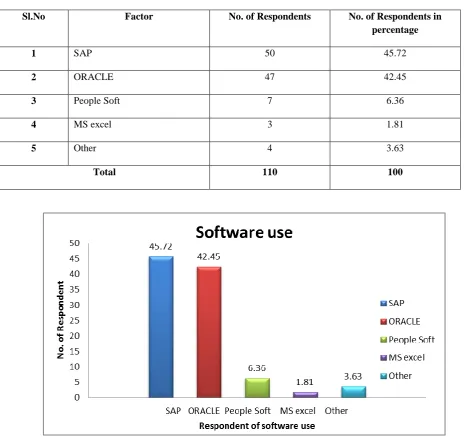
Analysis of software use
Table No: 1 Analysis of software use
Sl.No Factor No. of Respondents No. of Respondents in
percentage
1 SAP 50 45.72
2 ORACLE 47 42.45
3 People Soft 7 6.36
4 MS excel 3 1.81
5 Other 4 3.63
Total 110 100
Chart No: 1 Analysis of software use
Inference
http: // www.ijrtsm.com© International Journal of Recent Technology Science & Management 82
ISSN : 2455-9679
[Gayathri et al., 4(8), Aug 2019] Impact Factor : 3.340
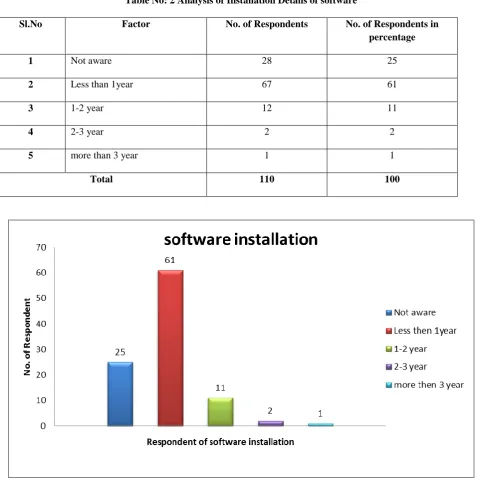
Analysis of Installation Details of software
Table No: 2 Analysis of Installation Details of software
Sl.No Factor No. of Respondents No. of Respondents in
percentage
1 Not aware 28 25
2 Less than 1year 67 61
3 1-2 year 12 11
4 2-3 year 2 2
5 more than 3 year 1 1
Total 110 100
Chart No: 2 Analysis of Installation Details of software
Inference
http: // www.ijrtsm.com© International Journal of Recent Technology Science & Management 83
ISSN : 2455-9679
[Gayathri et al., 4(8), Aug 2019] Impact Factor : 3.340
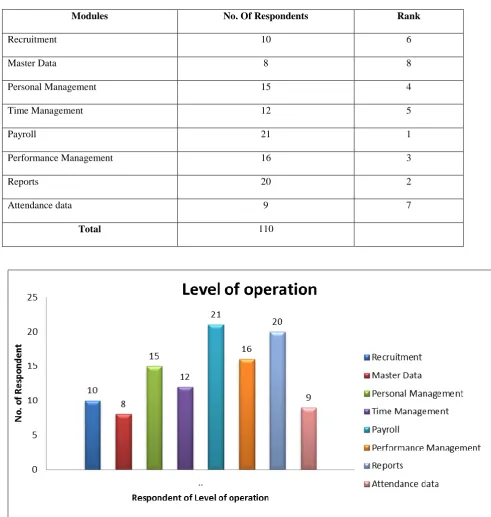
Level of operation in HRIS
Table No: 3 Level of operation in HRIS
Modules No. Of Respondents Rank
Recruitment 10 6
Master Data 8 8
Personal Management 15 4
Time Management 12 5
Payroll 21 1
Performance Management 16 3
Reports 20 2
Attendance data 9 7
Total 110
Chart No: 3 Level of operation in HRIS
Inference
http: // www.ijrtsm.com© International Journal of Recent Technology Science & Management 84
ISSN : 2455-9679
[Gayathri et al., 4(8), Aug 2019] Impact Factor : 3.340
Time management, 21% respondents opinion were payroll, 16% respondents opinion were PM, 20% respondents opinion were Reports, 9% respondents opinion were Attendance data
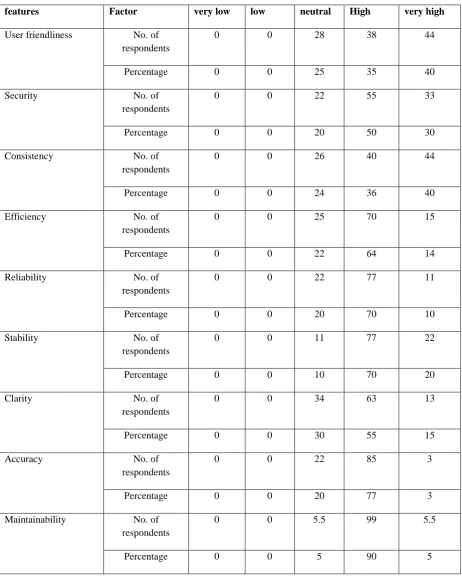
Rate the HRIS features
Table No: 4 Rate the HRIS features
features Factor very low low neutral High very high
User friendliness No. of
respondents
0 0 28 38 44
Percentage 0 0 25 35 40
Security No. of
respondents
0 0 22 55 33
Percentage 0 0 20 50 30
Consistency No. of
respondents
0 0 26 40 44
Percentage 0 0 24 36 40
Efficiency No. of
respondents
0 0 25 70 15
Percentage 0 0 22 64 14
Reliability No. of
respondents
0 0 22 77 11
Percentage 0 0 20 70 10
Stability No. of
respondents
0 0 11 77 22
Percentage 0 0 10 70 20
Clarity No. of
respondents
0 0 34 63 13
Percentage 0 0 30 55 15
Accuracy No. of
respondents
0 0 22 85 3
Percentage 0 0 20 77 3
Maintainability No. of
respondents
0 0 5.5 99 5.5
http: // www.ijrtsm.com© International Journal of Recent Technology Science & Management 85
ISSN : 2455-9679
[Gayathri et al., 4(8), Aug 2019] Impact Factor : 3.340
Chart No: 4 Rate the HRIS features
Inferences:
The above table explained about the rating of HRIS feature.
40% of respondents feel that the HRIS is highly user friendly.
It is found form the table that the data are highly secured.
40% of the respondents mentions very high in consistency,
64% of the respondents feel the HRIS is highly efficient
40% of the respondents are reliable as expected by the respondents
50% and 75% of the respondents feel that the stability and clarity of the data is high
77% and 90% of the respondents has highly accurate data and maintainability.
CORRELATION TEST
http: // www.ijrtsm.com© International Journal of Recent Technology Science & Management 86
ISSN : 2455-9679
[Gayathri et al., 4(8), Aug 2019] Impact Factor : 3.340
INTERPRETATION
Correlations
Decision statistic
mean std. deviation N
Software use
Frequent
1.13
1.27
.335
.447
110
110
Correlation
softuse frequent
Software use Pearson correlation
sig.(2-tailed)
N
1
110
.134
.164
119
frequent Pearson correlation
sig.(2-tailed)
N
.134
.164
110
1
110
INFERENCE
http: // www.ijrtsm.com© International Journal of Recent Technology Science & Management 87
ISSN : 2455-9679
[Gayathri et al., 4(8), Aug 2019] Impact Factor : 3.340
CONCLUSION
There is a strong positive correlation at 0.05 significant level between training on how to use the software and the frequency of training to the workers in the company.
FINDINGS & SUGGESTION
FINDINGS OF THE STUDY
Finally, managers can access the information they need to legally, ethically, and effectively support the success of their reporting employees. Specific benefits of such systems include:
Faster information process Accuracy in providing information
Improved planning and program development Enhanced employee communications
Reduction in cost of stored data in HR
Transparency in the system
More meaningful career planning &counseling at all levels. Better ability to respond to environmental changes. Optimum security and confidentiality
Voluminous data can be handled
Reduced labor cost compared to manual method. Excellent supervision and control
24*7 Access from anywhere
Focus on strategic activities by the Manager
Prepared to meet future challenges and changes in HRM. It is found form the table that the data are high secured.
40% of the respondent‟s feels software maintains very high consistency. 64% of the respondents feel that the HRIS is highly efficient.
40% of the respondents are reliable as expected by the respondents.
50% and 75% of the respondents feel that the stability and clarity of the data is high. 77% and 90% of the respondents has highly accurate data and maintainability.
There is a strong relationship persists between training on how to use the software and frequency of training.
The implementation of HRIS system is expensive. If the HR and employees were not given sufficient training to operate the software then it will lead a huge loss to the organisation. Poor implementation will also lead to crashing of software at anytime.
IX.
S
UGGESTION TO THE STUDY The research reveals thefollowing suggestions can be used to provide a better HRIS system:
The human resource information system has many benefits. The designing and implementation of HRIS can be made more effective with the help of computer literacy and knowledge of technology standards.
The quality of an output can be generated based on the data inputted. Only the relevant data can be inputted to avoid errors.
Proper training to the employees must be given before switching to the new system. The system conversion period must be taken into account so it will not disturb the productivity.
The respondents feels the HRIS system is user friendly to work.
http: // www.ijrtsm.com© International Journal of Recent Technology Science & Management 88
ISSN : 2455-9679
[Gayathri et al., 4(8), Aug 2019] Impact Factor : 3.340
Communication through HRIS could build up strong organisational culture.
Strategic plans of the organisation can be linked with HRIS, this will help to take decisions on merger and acquisition.
HRIS can be incorporated to ERP system to control the whole of the organization.
X.
C
ONCLUSIONThe HRIS has improved openness of communication, introduction of new methodology of task. As an overall ,the possible outcome of HRIS management system will be clarify what are the latest technology adopted by the organisation and how it helps the Human Resource team to route more effectively planning on job responsibility and expectation, enhancing individual and group productivity, developing employee capabilities to their fullest extent through effective feedback and coaching, driving behaviour to align with the organisation core values, goals and strategy. HRIS system allows employee self-service it enable employees to update personal data and address change, ect., without the intervention of HR. this allow executive and management reporting capability “on the fly ”.Manager Can access the information in a timely manner as it pertains to employee development, performance improvement, and wage details. Beside, providing a basis for making operational human capital decision (e.g., pay) and improving communication between employee and management.
REFERENCES
1) James D. Mooney, The principles of Organization Harper and Brothers, New York, 1974, p.5.
2) Jerome Renter, Management Information Systems, Prentice - Hall of India Pvt. Ltd., New Delhi, 1987, p.l. 3) Gupta P. K., Susheel Chhabra, Human Resource Information Systems, Himalaya Publishing House, Mumbai,
2004, p. 43.
4) Barkha Gupta Human Resource Information System (HRIS): Important Element of Current Scenario