
Ms. Sheetal Z Godse
Department of Quality Assurance Techniques, K C T’S R. G. Sapkal College of Pharmacy, Anjaneri,Nasik, 422213. Maharashtra, India
Email: [email protected] Address for correspondence
Access this article online www.japer.in
Techniques for solubility enhancement of Hydrophobic drugs:
A Review
INTRODUCTION
Formulation of poorly soluble drugs for orally drug delivery now represent one of the most interesting challenges to formulation scientist in the pharmaceutical industries and for formulation containing poorly soluble drugs, dissolutions is the rate limiting step in the process of drug absorption. [1-7] There are number of solubilization techniques are available but till date there is no universal excipient or technique which can be versatile enough to solubilize wide spectrum of drug molecules. During development stage many potential candidates may be eliminated because of their poor solubility and bioavailability.[8] Solubility: When excess of solid is brought into contact with liquid, molecules of the former are removed from its surface until equilibrium is established between the molecules leaving the solid and those returning to it. The resulting solution are said to be saturated at the temperature of the
experiment, and extent to which solute dissolves is referred to as its solubility. [9]
IUPAC defines solubility as the analytical composition of a saturated solution expressed as a proportion of a designated solute in a designated solvent. Solubility may be stated in units of concentration, molality, mole fraction, mole ratio, and other units.
The extent of solubility of different substances varies from almost imperceptible amount to relatively large quantities, but for any given solute the solubility has a constant value at a given constant temperature. When the purity of the drug sample can be assure, the solubility value obtained in weak acid and weak base can be assumed to be intrinsic solubility (C0) i.e. the fundamental solubility of the NCE when completely unionized.
The solubility should be ideally at two temperatures • 40C - To ensure physical and chemical stability.
The maximum density of water occurs at 40C and this leads to minimum aqueous solubility. • 370C- To support Biopharmaceutical
evaluation.[10]
Expressing Solubility and Concentration [5, 7, 9] The Solubility is usually expressed by variety of concentration that is by Quantity per quantity, Review
ReviewReview
Review ArticleArticleArticle Article
During drug discovery and development, these is estimated 40% to 70% of incidence of delay or failure for new chemical entities and major reason behind it is poor biopharmaceutical properties of the drug such as poor solubility, poor permeability and poor chemical stability . The Therapeutic effectiveness of the formulation depends on how efficiently drug is available at the site of action that is depends on the bioavailability of the drug and for good bioavailability drug must have a good aqueous solubility. For poorly soluble drug especially in case of oral formulation solubility is a critical parameter, currently number of solubility enhancement technology may provide answer for it. There are different techniques for solubility improvement that can include in to physical modification, chemical modifications of the drug substance, and other miscellaneous techniques. Most of the drug discovered are lipophilic and have poor aqueous solubility (BCS class 2) so; in this review various solubility enhancement techniques are highlighted.
Keywords: Solubility, Bioavailability, Solubility enhancement techniques, Poorly water soluble drugs
ABSTRACT ABSTRACT ABSTRACT ABSTRACT
Sheetal Z Godse1*, Mohini S Patil1, Swapnil M Kothavade1, R. B. Saudagar2
1*Department of Quality Assurance Techniques, K C T’S R. G. Sapkal College of Pharmacy, Anjaneri, Nasik, 422213. Maharashtra, India 2Department of Pharmaceutical Chemistry, KCT’S R.G. Sapkal College of Pharmacy, Anjaneri, Nashik, 422 213. Maharashtra, India.
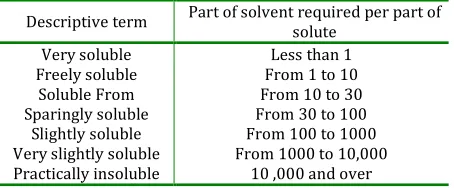
Percentage, Parts, Molarity, Molality, Mole fraction, Mill equivalents and normal solutions. This is also explained in term of parts of solvent required for 1 part of solute as explained in U. S pharmacopeia: USP and BP solubility criteria.
Table 1: Expression for approximate solubility
Descriptive term Part of solvent required per part of
solute Very soluble
Freely soluble Soluble From Sparingly soluble
Slightly soluble Very slightly soluble Practically insoluble
Less than 1 From 1 to 10 From 10 to 30 From 30 to 100 From 100 to 1000 From 1000 to 10,000
10 ,000 and over
Table 2: BCS classification according to solubility of drugs [8,10, 11]
Class 1
High solubility/hi gh permeability
Β-blockers Propranol, Metoprolol Class
2
Low solubility/hi gh permeability
NSAID’s Ketoprofen, Antiepileptic Carbazepine Class
3
High solubility/lo w permeability
Β blockers Atenolol,H2antago nist Ranitidine Class
4
Low solubility/lo w permeability
Diuretics Hydroclorthiazide, frusemide
Solubilization [3, 7]
The process of solubilization involves the breaking of intermolecular or inter-ionic bonds in the solute, the separation of the molecules of the solvent to provide space in the solvent for the solute, interaction between the solvent and the solute molecule or ion. Solubilization process occurs into three steps
Fig1: Process of Solubilization Holes open in the solvent
Molecules of the solid breaks away from the bulk
The freed solid molecule is integrated into the hole in the solvent
Table 3: Factors Affecting Solubilization [11]
Particle Size
The solubility of drug is often intrinsically related to drug particle size; as a particle becomes smaller, the surface area to volume ratio increases. The larger surface area allows a greater interaction with the solvent.
Temperature
As the temperature is increased than the solution process absorbs energy and the solubility will be increased but if the solution process releases energy then the solubility will decrease with increasing temperature. A few solid solutes are less soluble in warm solutions. For examples all
gases, solubility decreases as the
temperature of the solution increases.
Pressure
For solids and liquid solutes, changes in pressure have practically no effect on
solubilitybut for gaseous solutes, an
increase in pressure, increases solubility and a decrease inpressure, decrease the solubility. Nature of the solute and solvent only 1 gram of lead (II) chloride can be dissolved in 100 grams of water at roomtemperature while 200 grams of zinc chloride can be dissolved. The great difference inthe solubility’s of these two substances is the result of differences in their natures.
Molecular size
The solubility of the substance is decreased when molecules have higher molecular weight and higher molecular size because larger molecules are more difficult to surround with solvent molecules in order to solvate the substance.
Polymorphs
Polymorphs can vary in melting point. Since the melting point of the solid is related to solubility, so polymorphs will have different
solubility’s. Generally the range of
solubilitydifferences between different
polymorphs is only 2-3 folds due to relatively smalldifferences in free energy.
Polarity
Polarity of the solute and solvent molecules
will affect the solubility. Generally
likedissolves like means non-polar solute
molecules will dissolve in non-polar
solvents andpolar solute molecules will dissolve in polar solvents. The polar solute molecules have apositive and a negative end to the molecule. If the solvent molecule is also polar thenpositive ends of solvent molecules will attract negative ends of
solute molecules. This isa type of
intermolecular force known as dipole-dipole interaction. The other forces calledLondon dispersion forces where the positive nuclei of the atoms of the solute moleculewill attract the negative electrons of the atoms of
a solvent molecule. This gives the
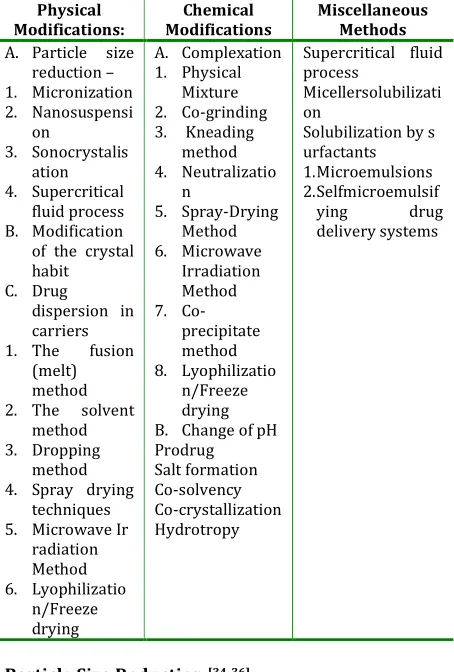
Techniques for Solubility Enhancement [19, 21, 46] Solubility improvement techniques can be categorized in to physical modification, chemical modifications of the drug substance, and other techniques.
Table 4: Solubility enhancement techniques
Physical Modifications: Chemical Modifications Miscellaneous Methods
A. Particle size
reduction – 1. Micronization 2. Nanosuspensi on 3. Sonocrystalis ation 4. Supercritical fluid process B. Modification
of the crystal habit
C. Drug
dispersion in carriers
1. The fusion
(melt) method
2. The solvent
method
3. Dropping
method
4. Spray drying
techniques
5. Microwave Ir
radiation Method 6. Lyophilizatio n/Freeze drying A. Complexation 1. Physical Mixture 2. Co-grinding
3. Kneading
method 4. Neutralizatio n 5. Spray-Drying Method 6. Microwave Irradiation Method 7. Co-precipitate method 8. Lyophilizatio n/Freeze drying
B. Change of pH
Prodrug Salt formation Co-solvency Co-crystallization Hydrotropy
Supercritical fluid process
Micellersolubilizati on
Solubilization by s urfactants
1.Microemulsions
2.Selfmicroemulsif
ying drug
delivery systems
Particle Size Reduction [34-36] • Micronization
• Nanosuspension • Sonocrystalisation • Supercritical fluid process
The solubility of drug is often intrinsically related to drugparticle size; as a particle becomes smaller, the surface isatvolume ratio increases. The larger surface area allows greater interaction with the solvent which causes increase insolubility.A conventional method of particle size reduction, such as comminution and sprays drying, relies upon mechanical stressto disaggregate the active compound.Particle size reductionis thus permitting an efficient, reproducible and economicmeans of solubility enhancement. However, the mechanical.Forces inherent to comminution, such as milling and grinding, often impart significant amounts of physical stress uponthe drug product which may induce degradation. The thermalstress which may occur during comminution and spray drying is also a concern when processing thermo sensitiveorunstable active compounds. Using
traditional approaches for nearly insoluble drugs may not be able to enhance thesolubility up to desired level.
1. Micronization
The oral bioavailability of drugs presented in a solid dosage form depends mainly on size, size distribution and morphology of particles. This is due to enhanced surface area of drug particles available for dissolution. Hence , a variety of micronization technologies such as spray-drying, freeze-drying, crystallization. It is another conventional technique for the particle size reduction. Micronization increases the dissolution rate of drugs through increased surface area, it does not increase equilibrium solubility. Decreasing the particle size of these drugs, which cause increase in surface area, improve their rate of dissolution. Micronization of drugs is done by milling techniques using jet mill, rotor stator colloid mills and so forth micronization is not suitable for drugs having a high dose
number because it does not change the saturation solu bility of the drug .These processes were applied to gris eofulvin, progesterone, spironolactonediosm in, and
fenofibrate. For
each drug, micronization improved their digestive abs orption, and consequently their bioavailability and cli nical efficacy. Micronized fenofibrate exhibited more than 10-fold (1.3% to 20%) increase in dissolution in at 30 minutes bio-relevant media.
2. Nanosuspension
Nanosuspensions are sub-micron colloidal dispersion of pure particles of drug, which are stabilized by surfactants. The advantages offered by nanosuspensionis increased dissolution rate is due to larger surface area exposed, while absence of Ostwald ripening is due to the uniform and narrow particle size range obtained, which eliminates the concentration gradient factor. Techniques for the production of nanosuspensions include Homogenization and wet milling Active drug in the presence of surfactant is defragmented by milling. Other technique involves the spraying of a drug solution in a volatile organic solvent into a heated aqueous solution. Rapid solvent evaporation produces drug precipitation in the presence of surfactants. The nanosuspension approach has been employed for drugs including tarazepide, atovaquone, amphotericin B [46], paclitaxel and bupravaquone. All the formulations are in the research stage. One major concern related to particle size reduction is the eventual conversion of the high-energy polymorph to a low energy crystalline form, which may not be therapeutically active one. Drying of nanosuspensions can be done by lyophilisation or spray drying.
Technology used for preparation of nanosuspension • Precipitation
• High pressure Homogeniza-tion • Emulsion/ Microemulsion template • Media milling
3. Sonocrystallisation
Recrystallization of poorly soluble materials using liquid solvents and anti-solvents has also been employed successfully to reduce particle size.7 the novel approach for particle size reduction on the basis of crystallization by using ultrasound is Sonocrystallisation. Sonocrystallisation utilizes ultrasound power characterized by a frequency range of 20–100 kHz for inducing crystallization. It’s not only enhances the nucleation rate but also an effective means of size reduction and controlling size distribution of the active pharmaceutical ingredients.8 Most applications use ultrasound in the range 20 kHz-5 MHz
4. Supercritical fluid process
A SCF exists as a single phase above its critical temperature (Tc) and pressure (Pc). SCFs have properties useful to product processing because they are intermediate between those of pure liquid and gas (i.e., liquid-like density, gas-like compressibility and viscosity and higher diffusivity than liquids). Moreover, the density, transport properties (such as viscosity and diffusivity), and other physical properties (such as dielectric constant and polarity) vary considerably with small changes in operating temperature, pressure, or both around the critical points. Hence, it is possible to fine tune a unique combination of properties necessary for a desired application. These unique processing capabilities of SCFs, long recognized and applied in the food industry, have recently been adapted to pharmaceutical applications
Modification of the Crystal Habit
Polymorphism is the ability of an element or compound to crystallize in more than one crystalline form. Different polymorphs of drugs are chemically identical, but they exhibit different physicochemical properties including solubility, melting point, density, texture and stability. Broadly polymorphs can be classified as enantiotropes and monotropes based on thermodynamic properties. In the case of an enantiotropic system, one polymorphs form can change reversibly into another at a definite transition temperature below the melting point, while no reversible transition is possible for monotropes. Once the drug has been characterized fewer than one of this category, further study involves the detection of metastable form of crystal. Metastable forms are associated with higher energy and thus higher solubility. Similarly the amorphous form of drug is always more suited than crystalline form due to higher energy associated and increase surface area. Generally, the anhydrous form of a drug has greater solubility than the hydrates. This is because the hydrates are already in interaction with water and therefore have less energy for crystal breakup in comparison to the anhydrates for further interaction with water. On the other hand, the organic solvates have greater solubility than the non-solvates. Some drugs can exist in amorphous form. Such drugs represent the highest energy state and can be
considered as super cooled liquids. They have greater aqueous solubility than the crystalline forms because they require less energy to transfer a molecule into solvent. Thus, the order for dissolution of different solid forms of drug is Amorphous >Metastable polymorph>Stable polymorph Melting followed by a rapid cooling or recrystallization from different solvents can produce metastable forms of a drug.
Solid Dispersion [23-33]
Solid dispersion is defined as a dispersion of one or more active ingredients in an inert carrier or matrix at solid state. In solid dispersion technique poorly water soluble drugs is dispersed in highly soluble solid hydrophilic matrix which enhanced the dissolution of the drug and can yield molecular level mixing (solid solution) and non-molecular level mixing(eutectic product).[25] eg. PEG 4000 increases the rate of dissolution. Concept of SD was originally proposed by Sekiguchi and Obi who investigate the generation and dissolution performance of eutectic melts of sulfonamide drugs and water soluble carrier in early 1960.SD is most promising aspects and simplicity of
concept it has failed to get
the popularity due to manufacturing, stability and scal e up issues.[19,23] Solubility of the Griseofulvin,[17] ,Keto profen[18], acciclofenac,[20] oxacarbazepine, [21 ]Albendazole, [22], Biforanazole, [25] is induced by SD technique.
Table 5: Classification of solid Dispersions according to generation [23, 46]
First Generation
Solid Dispersions
Second Generation Solid Dispersions
Third Generation
Solid Dispersions
•Crystalline Carriers eg. Urea Sugars Organic acids
•Amorphous
carriers eg.
Polyethyleneglycol, Povidone,
Polyvinyl acetate Polymethacrylate Cellulose derivatives
•Mixture of
surfactant and polymer
•Mixture of
polymer
•surfactant
Manufacturing process:
• Melting method/fusion method: • Traditional methods
-solution -suspension
• Optimized methods -hot stage extrusion -melt agglomeration
• Solvent evaporation method-co-precipitation - N2 steam
Melting method/fusion method [15]
The fusion method is sometimes referred to as the melt method, which is correct only when the starting materials are crystalline. Therefore, the more general term fusion method is preferred. The physical mixture of a drug and a watersoluble carrier was heated directly until it melted. The melted mixture was then cooled and solidified rapidly in an ice bath under rigorous stirring.The final solid mass wascrushed, pulverized, and sieved, which can be compressed into tablets with the help of tableting agents. The melting point of a binary system is dependent upon its composition, i.e., the selection of the carrier and the weight fraction of the drug in the system.
The first solid dispersions created for pharmaceutical applications were prepared by the fusion method. The dispersion consisted of sulfathiazole and urea as a matrix, which was melted using a physical mixture at the eutectic composition, followed by a cooling step. The eutectic composition was chosen to obtain simultaneous crystallization of drug and matrix during cooling.
Limitation to fusion method:
• Firstly, a major disadvantage is that the method can only be applied when drug and matrix are compatible and when they mix well at the heating temperature. When drug and matrix are incompatible two liquid phases or a suspension can be observed in the heated mixture, which results in an inhomogeneous solid dispersion. This can be prevented by using surfactants. • Secondly, a problem can arise during cooling
when the drug-matrix miscibility changes. In this case phase separation can occur. Indeed, it was observed that when the mixture was slowly cooled, crystalline drug occurred, whereas fast cooling yielded amorphous solid dispersions. • Thirdly, degradation of the drug and or matrix
can occur during heating to temperatures necessary to fuse matrix and drug. For example, to melt a sugar matrix of galactose a temperature of 169°C was required and in order to get the
glassy PVP in the rubbery state a temperature of about 170°C is required. Poly ethylene glycols melt at around 70°C and are therefore often used for the preparation of solid dispersions with the fusion method.
Dropping method
Hot melt extrusion is essentially the same asthe fusion method except that intense mixing of the components is induced by the extruder. Just like in the traditional fusion process, miscibility of drug and matrix can be a problem. High shear forces resulting in high local temperature in the extruder is a problem for heat sensitive materials.
The Solvent Method [17]
In this method first dissolve both the active drug and the carrier in a common solvent and then evaporate the solvent under vacuum to produce a solid solution. This enabled them to produce a solid solution of the highly lipophilic R-carotene in the highly water soluble carrier polyvinyl pyrrolidone.[3] Many investigators studied solid dispersion of meloxicam, naproxen and nimesulide using solvent evaporation technique. [39] This technique increase solubility and stability of solid dispersions of hydrophobic drugs. The main advantage of the solvent method is that thermal decomposition of drugs or carriers can be prevented because of the low temperature required for the evaporation of organic solvents.
Solvents should beselected on the basis of following criteria
• Dissolve both drug and carrier
• Toxic solvents to be avoided due to the risk of residual levels after preparation e.g. chloroform and dichloromethane[39]
• Ethanol is a less toxic alternative • Water based systems preferable
• Use of surfactants to create carrier drug solutions butcare should be taken as they can reduce the glass
• Transition point.
Some solvents may also be of interest to manufacturers of excipients, drug substances, or drug products for example, Petroleum ether, and isopropyl ether. Class III solvent have less toxic effect if they are used within limit list is as following, Acetic acid, Acetone, 1-Butanol, 2-Butanol, Butyl acetate, Dimethyl sufoxide, Ethanol, Ethyl acetate, Ethyl ether, Formic acid, Heptanes, Isobutyl acetate, Isopropyl acetate ,Methyl acetate, 3-Methyl-Butanol, Pentane, 1-Pentanol, 1-Propanol, 2-Propanol, Propyl acetate. [23] According to the ICH-Guidelines, these solvents belong to Class I, comprising the most toxic solvents. Therefore, the use of these solvents is unacceptable and impractical because the amount of residual solvent present in the solid dispersion after drying has to be below the detection limits. The last strategy for the dissolution of both drug and matrix is the use of solvent mixtures. Water and ethanol or dichloromethane and ethanol have been used for this purpose. However, dissolution of drug and matrix in these mixtures is not always possible in the required concentration or ratio.
The second challenge in the solvent method is to prevent phase separation, e.g. crystallization of drug. To dry the solutions, vacuum drying is often used. The solution is dried by the application of vacuum and moderate heating. Sometimes, the solvent evaporation is accelerated by using a rotary evaporator. Vacuum drying at elevated temperature bears the risk of phase separation because the mobility of drug and matrix decreases slowly. Another drying technique is spray drying. The solution is dispersed as fine particles in hot air. Due to the large specific surface area offered by the droplets, the solvent rapidly evaporates and the solid dispersion is formed within seconds, which may be fast enough to prevent phase separation. Moreover, the solid dispersions prepared by spray drying consist of particles of which the size may be customized by changing the droplet size to meet the requirements for further processing or application (e.g., free flowing particles or particles for inhalation). Spray drying usually yields drug in the amorphous state, however
sometimes the drug may have (partially) crystallized during processing. An alternative to these drying techniques is freeze drying.Although it is concluded in literature that this is a promising and suitable technique to incorporate drug substances in stabilizing matrices, the technique.
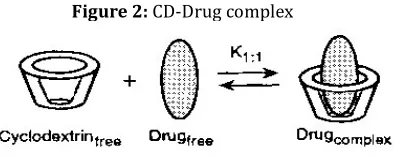
Chemical Modifications 1. Inclusion Complexation [18, 20]
This is most widely used method to enhance water solubility and increase stability of hydrophobic drugs by using cyclodextrins. Solid inclusion complexes can be prepared by using following methods.
Figure 2: CD-Drug complex
a. Kneading Technique
This method is based on impregnating the CDs with little amount of water or hydro alcoholic solutions to converted into a paste. The drug is then added to the above paste and kneaded for a specified time. The kneaded mixture is then dried and passed through sieve if required.
b. Neutralization precipitation
In this method precipitation of drug is done by neutralization technique. The alkaline solution is prepared by using sodium hydroxide or ammonium hydroxide then drug is added in this solution. Aqueous solution of CDs is mixed with alkaline solution of drug. The clear solution obtained after few seconds under magnetic agitation with controlled process parameters and protected from the light. The formed solution is neutralized using HCl solution until reaching the equivalence point. At this moment, the appearance of a precipitate with formation of the inclusion compound and it is separated by vacuum filtration and dried at room temperature.
Drug and CDs are mixed and the physical mixture is introduced in a suitable mill like oscillatory mill and grinded for suitable time.
d. Spray-Drying Method: [17, 36]
Drug is dissolved in suitable solvent and the required stoichiometric amount of carrier material like cyclodextrin is dissolved in water. Solutions are then mixed by sonication or other suitable method to produce a clear solution, which is then spray dried using spray dryer.eg. Solubility of Glipizide is increase by this method.
e. Microwave Irradiation Method
Drug and Cyclodextrins mixture is reacted in microwave oven to form inclusion. It is a novel method for industrial scale preparation due to its major advantage of shorter reaction time and higher yield of product. The drug and CD in definite molar ratioare dissolved in a mixture of water and organic solventin a specified proportion into a round bottom flask. The mixture is reacted for short time of about one to two minutes at 60 °C in the microwave oven. After the reaction completes, adequate amount of solvent mixture is added to the above reaction mixture to remove the residual, un-complexed free drug and CD. The precipitate so obtained is separated using whatman filter paper, and dried in vacuum oven at 40 °C for 48 hrs.
f. Freeze-drying technique
In this technique, the solvent system from the solution is eliminated through a primary freezing and subsequent drying of the solution containing both drug & CD at reduced pressure. Thermolabile substances can be successfully made into complex form by this method. The limitations of this technique are long time process and yield poor flowing powdered product. Lyophilization/freeze drying technique are considered as an alternative to solvent evaporation and involve molecular mixing of drug and carrier in a common solvent.
g. Supercritical Anti-solvent technique
Supercritical carbon dioxide is used as a new complexation medium because its properties of
improved mass transfer and increased solvating power. Thismethod constitutes one of the most innovators methods to prepare the inclusion complex of drug with CD in solid state. This is a non-toxic method as it is not utilizing any organic solvent, fast process, maintenance cost is low with promising results, but it requires a quite high initial cost.
Miscellaneous methods
cyclosporine A from Sandimmune®, the originally marketed formulation. [35]Emulsion droplet size is a major factor influencing bioavailability of drugs from emulsion formulations, with small droplet radii enhancing the plasma levels of drugs, in part due to direct lymphatic uptake. Since SMEDDS contain high concentration of surfactants, they should be limited to oral applications and may not be advisable for long-term use due to the potential of causing diarrhea.
Supercritical Fluid Process [11, 18]
A SCF exists as a single phase above its critical temperature (Tc) and pressure (Pc). SCFs have properties useful to product processing because they are intermediate between those of pure liquid and gas (i.e., liquid-like density, gas-like compressibility and viscosity and higher diffusivity than liquids). Moreover, the density, transport properties (such as viscosity and diffusivity), and other physical properties (such as dielectric constant and polarity) vary considerably with small changes in operating temperature, pressure, or both around the critical points. Hence, it is possible to fine tune a unique combination of properties necessary for a desired application. These unique processing capabilities of SCFs, long recognized and applied in the food industry, have recently been adapted to pharmaceutical applications.
Basic techniques in SCF technology Rapid Expansion of Supercritical Solutions
A supercritical solvent saturated with a solute of interest is allowed to expand at a very rapid rate, causing the precipitation of the solute. The rapid expansion/decompression is achieved by allowing into pass through a nozzle at supersonic speeds. This rapid expansion of supercritical solutions leads to super saturation of the solute in it and subsequent precipitation of solute particles with narrow particle size distributions. This process is also known as supercritical fluid nucleation (SFN). The SF is pumped through a pre-heater into the vessel containing the
solid solute at a particular temperature and pressure. The SF dissolves and gets saturated with the solute, and the resultant solution is introduced into a precipitation chamber by expansion through capillary or laser-drilled nozzle. Typically, by altering the pressure, the precipitation unit is maintained at conditions where the solute has much lower solubility in the SF. During expansion or decompression phase, the density and solubilizing power of the SF decreases dramatically, resulting in a high degree of solute super saturation and subsequent precipitation.
Gas Antisolvent Recrystallisation
It is a well-known phenomenon that a poor solvent of a particular solute can be added to the solution to precipitate the solute. This is called salting out and is widely used for crystallization purposes. However, disadvantages of this technique include poor control over the precipitated crystal morphology, size distribution and presence of residual solvents.
Impregnation or infusion of polymers with bioactive materials
control release dosage form to deposit thermo labile material into the polymer.
Solution enhanced Dispersion by Supercritical Fluid
This technique was developed at the University of Bradford to overcome some of the limitations of the RESS and GAS methods. The drug solution and the SF are introduced simultaneously into the arrangement causing rapid dispersion, mixing and Extraction of the drug solution solvent by SF leading to very high super saturation ratios. The temperature and pressure together with accurate metering of flow rates of drug solution and SF through a nozzle provide uniform condition for particle formation. This helps to control the particle size of the product and by choosing an appropriate liquid solvent it is possible to manipulate the particle morphology.
Floating Granules [13]
Floating Granules is a novel approach for dissolution enhancement of ibuprofen (a weekly acidic, non-steroidal anti-inflammatory drug) by preparing floating formulation. Drug having high permeability through stomach because it remain 99.9 % unionize in stomach (pKa of Ibuprofen - 4.43, pH of gastric fluid - 1.2) and mostly permeable through stomach but due to its solubility limitation it can’t enter in to systemic circulation and gastric empting time is 30 min to 2 hr. After this time ibuprofen goes in to small intestine where it is solubilized but can’t permeate through its membrane. It was logically decided to design such formulations which retain in stomach for more than 2 hrs because drug was not completely soluble within 2 hrs hence to dissolve completely in stomach region, this can be achieved by making floating dosage form. Floating ibuprofen granules were prepared by fusion method. Ibuprofen(200 mg divided in to 50 mg and 150 mg), gelucire 44/14 (350 mg melted) and ibuprofen (50 mg) added, disperse with glass road for uniform distribution of drug in tomolted carrier, remaining 150 mg ibuprofen added in to molted
Gelucire 44/14, this whole dispersion added in to molted gelucire 43/01. In optimized formulation, Granules remain floated for 3 hrs., gave 100% drug release in 150 minute in stomach region where it remain in 99.9% unionize form and absorbed to systemic circulation. [3]
Liquisolid Method [37-43]
When the drug dissolved in the liquid vehicle is incorporated into a carrier material which has a porous surface and closely matted fibersin its interior as cellulose, both absorption and adsorption take place; i.e. the liquid initially absorbed in the interior of the particles is captured by its internal structure, and after the saturation of this process, adsorption of the liquid onto the internal and external surfaces of the porous carrier particles occur. Then, the coating material having high adsorptive properties and large specific surface area gives the liquisolid system the desirable flow characteristics. Liquisolid solid system is acceptably flowing and compressible powdered forms of liquid medications. In the concept of liquisolid system, liquid drugs having low aqueous solubility dissolved in suitable non-volatile solvents, converted in to free flowing and radially compressible powder by simple admixture with selected powdered excipients referred as carrier and coating materials.Microcrystalline and amorphous cellulose and silica powders may be used as coating materials. New formulation mathematical model is provided to calculate optimum quantity of carrier and coating materials to yield liquid admixture.
Figure 3: Liquisolid method [43]
Hydrotropes are a diverse class of a chemical compound first describe by Neuberg (1916) that cause several fold increase in water solubility of sparingly soluble drugs. It is process in which large amount of secondary solute is added and it improves the solubility of water insoluble drugs. These additives are referred as “salting in” and “salting out”. Hydrotropes are characterizing by an amphiphilic molecular structure i.e. They consist of a hydrophilic part and a hydrophobic part (like surfactants) and also contain saturated hydrocarbon ring and ionic moiety. Hydrotropy is referred as salting in of non-electrolytes which are highly water soluble called as “hydrotropic salts” and a phenomenon known as “hydrotropism”. Mechanism involved in hydrotropy is a complexation in which interaction between lipophilic drug and hydrotropic agents such as urea, resorcinol, nicotinamide, sodium benzoate, caffeine, sodium cumenesulfonate, pyrogallol, sodium alginate, sodium citrate, sodium acetate etc. Hydrotropic agents can be used for the tritremetric analysis of BCS class 2 drugs.eg.Ketoprofen is analysed by using sodium citrate as hydrotropic agent. Hydrotropy is also called as type of co-solvency. The main advantagesof this method is that it does not require chemical modification of hydrophobic drugs, use of organic solvents, or preparation of emulsion system. [46]
Table 6: Classification of Hydrotropic agent [11]
Drug Example Structure
Aromatic amines
Sodium benzoate
Sodium salicylate
Sodium cinnamate
Sodium Para toluene sulphate
Aromatic cationic
Para amino benzoic acid
Procaine hydrochloride
Caffeine
Aliphatic and linear
anionic
Sodium
alkonate CH3-(CH2)X-COO-Na+
Table 7: Hydrotropic solubilization study of various poorly water-soluble drugs [17, 46]
Drug Hydrotropic agent
Cefprozil
Potassium acetate, Potassium citrate, Sodium acetate, Sodium
citrate
Hydroclorthiazide Sodium acetate, Urea
Paracetamol,Diclofenac,
Cefadroxil Urea
Theopyilline Sodium Salicylate
Nifedipine Urea, Sodium citrate
Ketoprofen
Sodium benzoate, Sodium o-hydroxybenzoate, Nicotinamide,
Sodium m-hydroxybenzoate, Sodium ascorbate, Sodium
2,5-dihydroxybenzoate Rogesterone,
Testosterone 17- β Estradiol,
Diazepam and Griseofulvin[
Nicotinamide, Isonicotinamide, Nipecotamide,N-methylnicotinamide, N, N-dimethylnicotinamide
CONCLUSION
Solubility is the most important physical characteristic of a drug for its oral bioavailability, formulation, devel opment of different dosage form of different drugs and for quantitative analysis. By using any one appropriate technique one can successfully enhance the solubility of the poorly water soluble drugs and can mask bitter taste. This makes the preparation practically feasible.
REFERENCES
1. Rote H., Thakare V.M., Tekade B.W., Zope R.P.,
Chaudhari R.Y., Patil V.R. Solubility enhancement of
glipizide using solid dispersion technique. World J
Pharm Res., 2012;1(4):1096-1115.
2. Serajuddin, A.T.M. Solid dispersion of poorly
water-soluble drugs: early promises, subsequent problems,
and recent breakthroughs. J. Pharm. Sci,1999;88:
3. Lobenberg R., Amidon G.L. Modern bioavailability bi
oequivalence and biopharmaceutics classification sy
stem: New scientific approaches to International reg
ulatory standards. Eur. J. Pharm Bio pharm, 2005;
50: 3-2.
4. Sharma, D.K., Joshi S.B. Solubility enhancement
strategies for poorly water soluble drugs in solid
dispersions: A Review. Asian J. Pharm,2007;1(1):
9-19.
5. Wahab A., Khan A., Khan G.M. Preparation and
evaluation of solid dispersions of Ibuprofen using
glucosamine HCL as a carrier. British Journal of
Pharmaceutical Research,2013;3(4): 722-733.
6. Saharan V.A., Kukkar V., Kataria M., Gera M.,
Choudhury P.K. Dissolution enhancementof
drugs.part I: Technologies and effect of carriers. Int J
Health Res, 2009;2(2):107-124.
7. Patel R.P., Nirav P., Patel N.M., Patel M.M. A novel
approach for dissolution enhancement of Ibuprofen
by preparing floating granules. Int J Res. PharmSci,
2010; 1(1):57-64.
8. Pharmaceutical composite of poorly water soluble
drugs and polymers. Int.
Application published under the patent cooperation
Treaty (PCT), WIPO.Int. Publication no.
(WO2012/085197A1): 1-58.
9. Remington: The Science and Practice of Pharmacy,
Vol.2, 21st Edition. Published by Wolter Kluwer
Health (India):196,211-229, 2005.
10. Alton’s Pharmaceutics: The design and
manufacturing of medicines, Churchill Livingstone
Elsvier.3rd edition: 322-538.
11. Sajid A., Chaudhary V.Solubility enhancement
methods with importance of Hydrotropy. Journal
of drug discovery and therapeutics,2013;
2(6):96-101.
12. Chaudhary A., Nagaich U.,Gulati N.,Sharma V.K., Khos
a R.L. Enhancement of solubilization and
bioavailability of poorly soluble drugs by physical
and chemical modifications: Journal of Advanced
Pharmacy Education & Research,2012; 2 (1): 32-67
13. Dholakiya A., Shah A.K., Jakasani P., Patel J., Garala K.
A review on solid self emulsifying drug delivery
systems and dosage forms. Inventi Rapid,2013; 3:
1-7.
14. Chaudhary N.H., Kumbhar M.N., Dighe D.A., Mujcond
P.S., Singh M.C. Solubility enhancement of
Escitalopram oxalate using hydrotope. Int. J Pham
and Pharmsci., 2013;5(1):121-125.
15. Tyagi S., Patel C.J., Dadrwal P., Mangukia D., Sojitra I.,
Nimbiwal B.K, Sigh V., Subrahmanyam K.V.A novel
concept for solublization and bioavailibility of poorly
soluble drugs: Hydrotropy. Int. J Pharm Res and Bio
Sci. 2(1):372-381, 2013.
16. Dhirendra K., Lewis S., Udopa N. Atin K. Dissolution
improvement of
Simvastatin by surface solid dispersion Technology:
Solid Dispersion. Pak.J Pharm.sci, 2009;
22(2):234-249.
17. Saharan V.A., Kukkar V., Kataria M.,Gera M.,
Choudhury P.K. Dissolution Enhancement of Drugs.
Part I: Technologies and Effect of Carriers. Int. J
Health Res, 2009, 2(2): 107-124.
18. Challa R., Ahuja A.,Ali J.,Khar R.K. Cyclodextrins in
drug delivery. AAPS Pharm Sic Tech, 2005; 6
(2):329-357.
19. Arunachalam A., Karthikeyan M., Kishore K.,
Pottabathula H.P., Sethuraman S., Hutoshkumar S.A.
Solid Dispersions. Current Pharma Research, 2010,1
(1).
20. Maheshwari R.K., Kumar S., Bhawsar N., Aansari A. Ti
trimetric analysis of Ketoprofen in the bulk of drug
sample using Sodium Citrate as Hydrotropic agent.
Int. J Pharm Bio Sci, 2013, 4(2):58-61.
21. Kapadiya N., Indrjeet S., Mehta K., Karwani G., Shrubo
J.S. Hydrotropy: A Promising Tool for Solubility
Enhancement. Int. J Drug Discovery and Resarch,
2011;3(2):26-33.
22. Dhinakaran M., Morias A.B., Gandhi N.N. Enhanced
solubility and reflection of
hydrotropy technique insegregation of m/p Aminoni
trobenze. Chem Sci.Trans, 2012; 1(2):261-268.
23. Patel P.B., Prajapati S.T., Patel N.R., Patel N.N., Patel
C.N. Solid dispersion: a method of improving
bioavailability and taste masking. Inventi Rapid:
Pharm Tech, 2012 (4):1-7.
24. Hisham Al-Obaidi, Buckton G. Evaluation of
Griseofulvin binary and ternary solid dispersions
with HPMC as. American Association of
Pharmaceutical Scientists. AAPS Pharm SciTech,
2009;10(4):1172-1177.
25. Patel K.N., Prajapati R.A., Patel M.S., Babariya K.,
evaluation of Bifonazole solid dispersion
incorporated gels. Inventi Rapid: NDDS, 2013;2: 1-6.
26. Rao M, Mandage Y, Thanki K, Bhise S. Dissolution Im
provement of SimvastatinBy Surface Solid
Dispersion
Technology.DissolutionTechnologies.2010:27-34.
27. Manimaran V., Damodharan N.,Mothilal M., Rajkumar
K, Chalackal R M. Enhancement of dissolution rate of
Glibenclamide by solid dispersion technology. Int. J
Current Pharm Res, 2010; 2(3):14-17.
28. Kumar S, Gupta S K, Sharma P K. Dissolution rate
enhancement of aceclofenac by solid dispersion
technique. Asian J Pharm and Life
Science,2011;1(4):396-400.
29. AppaRao B, Shivalingam M.R., Kishore Y.V., Reddy,
Rao S., Rajesh K., Sunitha N. Formulation and
Evaluation of Aceclofenac Solid Dispersions for
Dissolution Rate Enhancement. Int. J Pharm Sci. and
Drug Res,2010; 2(2):146-150.
30. Chavan S., Patel K., Shelar D., Vavia P. Preparation of
Oxcarbazepine Solid Dispersion by Hot Melt
Extrusion for Enhanced Dissolution: Downstream
Processing to tablets. Am. J. PharmTech Res,2013;
3(1):557-569.
31. T Kiran, Shastri N., Sistla Ramakrishna, M.S. Surface
Solid Dispersion of Glimepiride for enhancement of
dissolution rate. Int. J. Pharm Tech Research, 2009;
1(3): 822-831.
32. Patel D.A., Shukla S.M., Modi D.A. Solubility
enhancement of Albendazole by different
approaches. Inventi Rapid: NDDS, 2012 ;( 3).
33. StijnKoolen M.J., Alwin Huitema, Jan Schellens,
Beijnen J., Bastiaan Nuijen Development of an oral
solid dispersion formulation for use in
low-dosemetronomic chemotherapy of
Paclitaxel. European Journal of Pharmaceutics and
Biopharmaceutics, 2013; 83:87–94.
34. Ch. Prabhakar, K. Bala Krishna. A Review on
Nanosuspensions in Drug Delivery. International
Journal Pharma and Bio Sciences, 2011;
2(1):549-558.
35. Patel M., Shah A., Dr. Patel N.M., Dr. Patel MR, Patel
Dr. KR. Nanosuspension: A Novel Approach for Drug
Delivery System. Journal of Pharmaceutical Science
and Bioscintic Res, 2011; 1(1):1-10.
36. Patel V.R., Agrawal Y.K., Nanosuspension:an
approach to enhance solubility of drugs.J.Adv Pharm.
Tech.Res.,2011;2(2):81-87.
37. Nagabandi V.K.,Tadikonda R., Jayaveera K.N.
Enhancement of dissolution
rate and micromeritics of poorly soluble drug ketopr
ofen by liquisolid technique. Journal of Pharmaceutic
al and Biomedical Sciences, 2011;9(9):1-6.
38. Khalid M.E., Ahmed M. Samy, Mohamed I. Fetouh for
mulation and evaluation of Rofecoxib Liquisolid Tabl
ets. International Journal of Pharmaceutical Sciences
Review and Research, 2010;3(1):135.142.
39. Chandel P., Raj K., Kapoor A. Liquisolid technique: an
approach for enhancement of solubility. Journal of
Drug Delivery & Therapeutics, 2013; 3(4), 131-137.
40. Gavali S.M., Pacharane S.S., Sankpal S.V., Jadhav K.R.,
Kadam V.J. Liquisolid Compact: a new technique for
enhancement of drug dissolution. International
Journal of Research In Pharmacy And Chemistry,
2011;1(3):705-713.
41. Syed I.M., Pavani E. The Liquisolid technique: based
drug delivery system. Int. J PharmSci and Drug Resea
rch, 2012;4(2): 88-96.
42. Vajir S. Liquisolid Compct: a novel approch to
enhance bioavailability of poorly soluble drug Int. J
Pharmacy, 2012;2(3): 586-590.
43. Spiridon Spireas, Bolton S.M. Liquisolids: Liquisolid
system and methods of preparing the same. United
States Patent, 1998;1Sep.
44. Sarkar B, Tiwari S, Hardenia S.S., Kaushaluse A.Use of
Spray Dried Microspheres Technique To Enhance
Solubility Of Poorly Soluble Drug. Asian Journal Of
Pharmacy & Life Science,2011;1 (2):118-123.
45. Sharma D,Soni M.,Kumar S.,Gupta G.D.Solubility enha
ncement eminent role in poorly soluble drugs.
Research J. Pharm. and Tech,20092;(2):220-224.
46. Jain P., Goel A., Sharma S., Parmar M.
Solubility enhancement techniques with special
emphasis on hydrotrophy. International Journal of
Pharma Professional’s Research, 2010.
How to cite this article: Sheetal Z Godse1*, Mohini S Patil1,
Swapnil M Kothavade1, R. B. Saudagar2; Phytochemical and
Pharmacological Profile of lanata camara L.: An Overview; J.
Adv. Pharm. Edu. & Res. 2013: 3(4): 403-414.
![Table 5: Classification of solid Dispersions according to generation [23, 46]](https://thumb-us.123doks.com/thumbv2/123dok_us/8764884.1753908/4.612.314.546.409.524/table-classification-solid-dispersions-according-generation.webp)
![Figure 3: Liquisolid method [43]](https://thumb-us.123doks.com/thumbv2/123dok_us/8764884.1753908/9.612.322.538.581.709/figure-liquisolid-method.webp)
![Table 7: Hydrotropic solubilization study of various poorly water-soluble drugs [17, 46]](https://thumb-us.123doks.com/thumbv2/123dok_us/8764884.1753908/10.612.315.546.48.160/table-hydrotropic-solubilization-study-various-poorly-water-soluble.webp)
