APPLICATION OF VALUE ANALYSIS &VALUE ENGINEERING IN COSTREDUCTION AT AUTOMOBILE INDUSTRY: A CASE STUDY
Singh Vivek. R.1
1
Dept. of Project Management, VJTI, Mumbai.
P. M. Ravanan2
2
Dept. of Production Engineering, VJTI, Mumbai.
Abstract:-
Doing things in the right way, in a very first attempt is what today’s demand is. However, talking realistically, ultracompetitive market condition has led manufacturing sector to such a phase where continuous improvement is inevitable in terms of increasing desired profit margin in a business. With these changes comes the serious need of an efficient as well as effective development system.
Irrespective of business domain, companies must focus on speed, efficiency, cost of production, customer service, product value etc. to be globally competitive. Long-term health of any organization depends on their commitment to continuous improvement in their business, along with an optimized cost of production, mechanization of auto production also been transformed over a past century, led by the need of a faster and lower-cost of production on the supply side of the industry. Thus, reasonable cost reduction of a production without affecting the quality level could be the best way industry can attain their maximum profit level.
This paper aims at studying integrated practices embodied within cost reduction in automobile industry, that also form comprehensive industrial philosophy that strives to effectively & efficiently fulfil customer’s need, also framework management techniques that organizations can implement, in order to create knowledge necessary to advance performance at lower cost. Practice has been discussed along with case study of cost reduction at gear factory of one renowned automobile industry in India and attempts to suggest a generic assimilated Project Management model for cost reduction atmanufacturing industry.
1. Introduction
Today, irrespective of business domain, firms must focus on speed, efficiency, and customer values to be globally competitive, and long-term health of any organization depends on their commitment to continuous improvement in their business. This type of vision helps companies remain aggressive in the face of customer constantly changing and evolving expectations. Principles, practices, techniques embodied within continuous improvement form a comprehensive organizational philosophy that strives to effectively fulfil customer’s need, organization implement such programs in order to create knowledge necessary to improve performance.[1]
Mechanization of auto production has also been transformed over the past century, led by the need for faster and lower-cost production. Product innovation in the automotive industry has mainly been a response to customer demands, although product standing is a critical strategic variable for automakers.Organizational innovations have also occurred over the past century. Auto assemblers internalizes the production of critical component in an effort to minimize transaction expenses associated with late deliveries and products that were not produced to exact specifications.Rivalry among assemblers in the automotive industry, once contained within national boundaries, has evolved into global race. First movers established market dominance in the early 1900s, and their brands are still most recognized by customers today. The fact that auto producers choose market strategies based on what their competitors are doing signposts that this is an oligopolistic industry.[9]
So, to be sustained in the competitive business market & to attain the maximum outcome out of the business, its being essential for any organization, especially for the manufacturing sector, to be innovative with their work. Continuous improvement in the operational process can lead to the:
Cost Reduction Improved quality
Improved performance Reduced effort
1.1 Importance of Cost Reduction
It leads to improvement in competitive capabilities and thereby ensures its survival, growth & prosperity.
It ensures reasonable prices to customers by not passing on inefficiency of business itself. To create cash for reinvest in Research &Development.
To reduce manufacturing cost to stay competitive.
To lower cost of service in order to provide additional services. To become more efficient.[4]
Difference between Cost Control and Cost Reduction:-
Following are the main differences between cost control and cost reduction:[4] 1. Focus:-
Cost control focuses on minimization of wastage than the cost reduction. Cost reduction focuses on minimization of cost through new production process, improved plant layout, systematic material handling etc.
Cost control is routinely applied on a continuous basis. Cost reduction is realistic when an opportunity for cost reduction is identified which offers a competitive advantage for a longer period.
3. Use of Accounting Techniques:-
Cost control heavily relies on accounting techniques. Cost reduction may not involve the use of accounting technique.
1.2 Tools and techniques of cost reduction
The following are the widely used techniques of cost reduction:[2] 1. Just-In-Time (JIT) System
Aim of JIT is to produce required item, at the required quality & quantity, at the precise time they are required. JIT purchasing requires for items where too much carrying cost associated with holding high inventory level. Purchasing system reduces investment in inventories because of frequent order of small quantities.[1]
2. Target Costing
Target costing refers to the design of product, and the processes used to produce it, so that eventually the product can be manufactured at a cost that will empowerthe firm to make profit when product is sold at projected market-driven price. This estimated price is called target price.
3. Activity Based Management
Activity based management is use of activity based costing to improve operations and to exclude non-value added cost. Main goal of ABM is to identify and eliminate non-value added activities and costs.
4. Life Cycle Costing
Life cycle costing estimates & accumulates cost over product's entire life cycle in order to define whether profit earned during manufacturing phase will cover costincurred during pre/post manufacturing stage.
5. Kaizen Costing
Kaizen costing is the process of cost reduction during the manufacturing phase of an existing product. Japanese word 'Kaizen' refers to frequent and gradual improvement through small activities, rather than large or radical development through innovation or large investment technology.
6. Business Process-re-engineering
Re-engineering is a wholerestructure of process with an emphasis on finding creative new ways to accomplish an objective. Aim of business process re-engineering is to increasethe key business process in an organization by focusing on simplification, cost reduction, better-quality and enhanced customer satisfaction.
7. Total Quality Management(TQM)
8. Value Analysis and Value Engineering (VAVE)
Value Analysis is an activity that typically occurs jointly between purchasing & method engineering. This activity is aimed at modifying specification of material, part and a product to reduce their cost while reducing their original function. Their focus is placed on the value of a product.[3]
9. Bench Marketing
Bench marketing is a frequent search for the most effective method of accomplishing a task by comparing the existing approaches and performance levels with those of other organizations or other sub-units within the same organization.
10. Management Audits
Management audits, also known as performance audits, can be used to simplify cost reduction in both profit and non-profit societies. Management audits are intended to help management to do a healthier job by identifying unused, inefficient and recommending a corrective action.
1.3 Value Analysis& Value Engineering (VAVE)
Value Analysis (VA) is defined as process of systematic review that is applied to existing products design in order to obtain better &optimised commercial output.While Value Engineering (VE) is an analysis applied on process, product that are under design to obtain optimised engineering output. VAVE system is applied for enabling product improvement and achieving cost reduction.[10][3]
1. VAVE ismethodical, formal and organized process of analysis and evaluation. It is not haphazard or informal and it is management activity that requires planning, control and co-ordination. 2. Analysis concernsfunction of product to meet demands or application needed by customer. To
meet this functional requirement, review process must include an understanding of purpose to which product is used.
3. Understanding the use of a product implies that specifications can be recognised to assess level of fit between the product and the value derived by the customer.
4. To succeed, formal management process must meet these functional specification and performance standardssteadily in order to give value to the customer.
5. In order to yield benefit to company, formal review process must result in process of design improvements that serve to lower production costs of that product while maintaining this level of value through function.
VAapproach is universal & can be used to analyse products, service offered by manufacturing company. For new product, VE approach, applies same principle &VA technique to pre-manufacturing stage such as concept development, design & prototyping.VA is used to offer higher performing product or service to customer at minimal cost as opposed to substituting an existing product with inferior solution. This basic principle, of offering value at lowest optimal cost of production, is never compromised. It is a principle that guide all action within VA&allow improvement idea to be translated into commercial gain for company.[7]
Value Analysis& value engineering phases:[5]
e) Implementation phase
VAVE is more relevant than ever in manufacturing industry, as companies strive to produce better products for lower cost. This is driven by the customer expectations and often fierce commercial pressure. If company’s product are to remain competitive &maintain healthy profit, those need to be analysed for value.[10]
Rules governing application of VAVE methodology:
a) No cost can be removed if it compromises quality of products or its reliability.
b) Any activity that reduces maintainability of product increases cost of ownership to customer and can lower value attached to products.
c) Saleability cannot be compromised, as this is an aspect of product that makes it striking to market and gives it appeal value.
1.4 Types of Value Analysis& Value Engineering Exercises
1. Analysis for Existing Products – Value Analysis
One best approach to VA is simply to select existing product that is sold in relatively large volume. These product, will tend to have great deal of basic information, documented history which can be accessed quickly. Existing product unites all different managers, each with an opinion & list of complaints concerning ability to convert design into saleable product. Therefore any team that is created for a purpose of VA will understand their own problems. Their opinions regarding poor performanceare vital to the discussion. These discussion therefore allow learning to take place & allow managers to understand limitations to scope of product redesign & re-engineering activities. These issues include:[8]
Inability to change existing product design due to need of redesigning tool & expense of such an initiative.
Project team have finite duration before project is concluded, Hence time will dictate what can be achieved.
High level purchasing cost may need to engage suppliers in VA process. It will be constrained by a number of issues as time of project, location &availability of resources from supplier &other constraints.
2. Analysis for New Products – Value Engineering
For new products, team will operate in an environment that is less certain & has poor level of available information upon which to make decision. In this case,analysis & systematic process of review for new product is known as Value Engineering. The VE approach is similar to that of VA but requires much greater level of investment by organization in terms of skilled, experienced and proficient human resources.[8]
3. Analysis for Product Families- Horizontal Deployment
4. Competitive VA
VA techniques are not simply prerogative of business that designed the product. Instead VA is often used as a competitive weapon & applied to the analysis of rival’s products in order to calculate cost of other company’s products. This is often termed ‘strip down’ but is effectively areverse value analysis. Here VA team are applied for understanding the design &conversion cost of competitors product. Results of the analysis is to understand how competitor products are made, what weaknesses occur, and at what costs of production together with an understanding of what innovations have been incorporated by competitor company.
Still, it is recommended for companies with no real experience ofVA, is to select a single product that is currently in production & has long life ahead. Thisapproach offers ability to gain experience, to learn as a team, and to test the tools andtechniques with a product that has known characteristics and failings. In the short term it ismost important to develop the skills of VA, including understanding the right questions toask, and finally to develop a skeleton but formal process for all VA groups to follow andrefine.[8]
1.5 VAVE process Life Cycle:-
VAVE team have one shared goal, to carry out work for a purpose of meeting the project’s objectives. Every project has a beginning, middle period during which activities move the project toward completion, and conclusioneither successful or unsuccessful. A standard VAVE also typically has the following four major phases each with its own agenda of tasks and issues.[11][3]
1. Information phase
2. Evaluation phase 3. Development phase 4. Presentation phase 5. Implementationphase
Taken together, these phases represent the path a VAVE takes from beginning to its end and are generally referred to as “life cycle.”
1. Information Phase
During the input phase,project objective or need is identified; this can be a business problem or opportunity. In response to the need, idea generation techniques such as brainstorming, Delphi technique etc. are used to generate different solutions.All possible solutions to the need are documented in business case with recommended alternatives.
Throughout Initiation phase several sequential stages need to be followed are as described below:[8]
A)Preparation B)Generating ideas
C)Quick screening D)Second screening of ideas
E)Feasibility study F)Business plan summary
A. Preparation:-
This includes process of reviewing mission and objectives, assessing organizational strengths, understanding potential market, and building support and enthusiasm for the business development process. To develop rough set of criteria for the ideas you will be seeking.
B. Idea generation:-
Primary phase that occurs in a project initiation is project idea generation.Create a long list of enterprise ideas through a brainstorming process that involves agency clients, staff & other stakeholders.[6]
Techniques used for the idea generation are as follows:-
o Role play:
This technique encourages person to put himself into someone else’s shoes. This process is aided by sequence of questions helping user to put himself into another situation and to see things from another person’s perspective.
o Brainstorming:
Brainstorming is group creativity tool in which group tries to find solution forproblem by amassing list of ideaspontaneously contributed bymembers. Good facilitator, who sparks energy, is key toeffective brainstorming.
Brainstorming rules to be followed:[5]
1. One conversation at a time 2. Encourage wild ideas 3. Go for quantity 4. Be visual
5. Stay on topic
6. Build on the ideas of others 7. Defer judgment – no blocking
o Wishful thinking:
What do you wish for? What do you find appealing? The purpose with this technique is to identify/ imagine perfect solution/ scenario/ product. Once it has been described, analyse whether it is feasible or not.
o Find the trends and consult with experts:
Talk to people who lead that trend in terms of practise and intensity of need. New ideas come to the fore by looking for inspiration from the following sources.
o External sources:
Idea generated from customers, focused group with consumers, competitors, suppliers, acquisitions, trade fairs & conventions, published information, trade magazines, consultants, universities, GOVT., law/regulations.
o Internal sources:
Ideas generated through internal R&D, employees, shelved ideas, complaints systems, customer service, and sales representatives.
o Forced attribute:
This is divergent technique. It pushes user out of problem. The user has to think of given object and write down its attributes. Once those attributes are listed, remove the object and use the list to solve problem at hand.
C. Idea Screening:-
Idea Screening is process of comparing &contrasting new product related ideas in order to select most promising ones for a business.At some point it is important to reduce number of ideas. Not all ideas are relevant forcompany. To screen good from not so good, all ideas need to be evaluated according to criteria like strategic fit, technical difficulties, market opportunities etc. Limited available resources make it difficult to develop someproducts at a same time & successful idea screening
process contributes to more focused product development process, with higher possibility of success.
Idea screening help user to reduce amount of ideas into manageable amount, which can be developed further into prototypes. Goal is to reduce number of ideas without screening away “potential diamonds”. One way to reduce number of ideas is by roughly assessing market potential of idea & likelihood of success. For this purpose, it is useful to think of success in dimensions as described:
o The strength of the idea:-
Does this concept have market potential and a business model? Will it advance our mission either by generating lot of returns or by strengthening our service delivery?
o The fit with the organization:-
Can our organization implement this idea successfully in the current market?
Despite of the concerned policies, there are some risk associated with the idea screening stage. The two potential risks in screening as follows:-
o Dropping ideas too early means missed opportunities.
o Developing the ‘wrong’ ideas means fruitless resources, in terms of time and financial investment, and may put activities in our current portfolio at risk.
D. Feasibility study:-
In idea screening step, objective was to eliminate ideas that were either not strongly fit for organization or didn’t provide significant business or social impact. Now formal feasibility study can test key assumptions that determine whether this enterprise actually would have good chance to succeed. The feasibility study is an opportunity to refine and explain the concept, and to test market reaction.
Organizations do their feasibility study in various way. They may wish to apply for funding to hire consultant to conduct study, or eitherhave someone in theirbusiness who can do it. Feasibility breakdown is focused on understanding whether action could make enterprise work. It involves considering 4 key criteria:
Strategic Alignment – Whether enterprise supports our mission? Market Opportunity – Whether customers purchase our product? Operational Capabilities – Can we make it happen?
Financial Potential – Can we achieve our profitability goals? E. Business plan:-
The purpose of an executive summary is to quickly generate interest in idea. It is an introduction & doesn’t need to be comprehensive, but it must be compelling. Our goal is to help reader grasp unique value of what we are trying to do. Good business case shows how we are different & why we will succeed.
We can use this document to sellconcept to potential investors. These might includeboard whose members could invest time &money, or venture sponsors & financial institutions whocould invest money to help us develop business plan or to conductpilot study. It includes following:
The problem. Briefly demonstrates problem we address.
The solution. A short & compelling description of why we can solve problem better than anyone else. Potentially includes business model, strategy, why we’re more competitive than others, people who would make it work, sustainability/ profitability, and exit strategy.
The “ask” From perspective of a funder/investor, state specifically what they want. (financial help and the expertise or other resources needed from any partnership)
Social return on investment (ROI). Briefly describe how society will benefit from this investment. For venture capital/financial investors, include financial return on their investment (ROI).
2. Evaluation phase
In this phase of the VAVE project, the VA team judges the ideas developed during the orientation & information phase. The VA team ranks ideas. Ideas found irrelevant or not worthy of additional study are disregarded, those ideas that represent the greatest probable for cost savings and improvements are selected for development. A weighted evaluation is applied in some cases to account for project impressions other than costs (both capital and life cycle). Ideally, the VA team would like to estimate all attractive ideas but time constraints often limit the number of ideas that can be developed during workshop. As a result, team focuses on higher ranked ideas. This phase is designed so that the most significant ideas are isolated & prioritized.[3]
3. Development phase
In development phase, final recommendations are developed fromalternatives selected during analysis phase. Detailed technical and economic testing is conducted and probability of effective implementation is assessed.During project development, people are carrying out task& information is reported through consistent team meetings. Project manager uses this information to maintain control over direction of project by comparing progress reports with project plan to measure performance of project activities & take corrective action as needed. Status report should always emphasize anticipated end point in terms of cost, schedule, and quality of deliverables.[3]
4. Presentation phase
Presentation phase is actually presenting the best alternative or alternatives to those who have authority to implement the proposed solutions that are acceptable. It includes preparing formal value engineering proposal (VEP) that contains information needed to reach decision & implement the proposal.[11]
5. Implementation & Follow-up Phase
During the implementation and follow-up phase, management must assure that agreed recommendations are adapted into actions. Until this is done, savings to offset the cost of the study will not be realized.[3]
2. Methodology for VAVE applied
We conducted same study in gear factory of one commercial vehicle manufacturing unit in India. Our basic motive behind study was to reduce production cost and also to focus on improved quality of operations, manufacturing processes and thus performance of vehicle. For ease of the same to collect cost reduction and quality improvement suggestions, we organised the Value Analysis &Value Engineering (VAVE) workshop. In workshop, we kept each component related to gearbox in display. Also, for idea generation and to be adhere to recent inventions and technology, we displayed components of gearbox of some competitors from similar vehicle category models. Competitor’s vehicle components were intentionally displayed for the purpose of getting quick idea about cost reduction or quality expansion through visual comparison of component.
Steps that need to be followed working toward implementation of ideas are as below:-
i. Ideas that were generated through cost reduction workshop were generally ofweight reduction, functional improvement, maintenance aspects, deletion of unwanted operation, material change,
commonization of parts etc.Total suggestions that were collected through this cost reduction workshop were 439.
ii. We syndicated collected ideas on the basis of their primary feasibility study. Ideas not physically possible were neglected. Also some ideas that cannot be implemented due to functional requirement were omitted from final syndicated list. After this syndication, 193 ideas were processed further.
iii. Then, we assigned estimated potential saving for each syndicated idea. Potential saving of each idea includes rough estimation of possible weight reduction, operation cost saving and also by considering tooling cost required for idea to be implemented. Further in first stage of implementation, we generated 41 Design Change Request (DCR) applications. Those 41 DCR applications were chosen on the basis ofhighest possible potential saving among syndicated ideas.
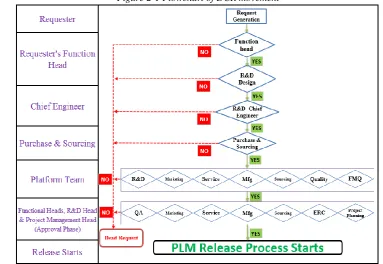
iv. DCR should be approved by each department that is related with gearbox such as quality department, product planning department, engine factory, purchase department etc. R&D department providestechnical feasibility of idea, on that basis it becomes very easy for other departments to take decision on the idea.
v. During syndication phase, ideas were sorted according to potential saving of each idea. Total annual potential saving that can be achieved is described in following table:
Number of ideas Annual saving (Crore INR)
Suggestions collected 439 -
Syndicated Ideas 193 16.73
DCR generated 41 5.83
vi. After the approval of each department, prototype with proposed changes are prepared and then the component and assembly is tested in R&D department for technical feasibility, endurance and fatigue strength of component.
vii. After the positive response from R&D and confirmation from supplier, idea is ready for implementation in factory.
3. Case Study
Among the total 41 generated (DCR’s), one idea as a case study in details is discussed below: DCR NO.:- 020
Gearbox Model:- GB-XYZ
Idea related:- Gear web thickness reduction. Current situation:-
Currently, there is excessive material present on gear face, form & base of all gear of GB-XYZ. Proposed idea:-
This extra material present on gears need to be reduced up to the permissible limit. Weight reduction can be achieved by reduction in web thickness.
Proposed/Considered Changes:- Pocket Profile modified. Pocket added from other side.
Web thickness reduced from 17.2 to 9mm. Pocket dimension increased from 6.6mm to
8.7mm.
Also, we applied similar kind of modification to other gears of GB-XYZ gearbox, on the basis of modification in 1st gear of GB-XYZ.
Followed bysuccessful mechanical analysis of proposed changes with prior approval from R&D, Product planning Department, resulted cost reduction analysis so achieved is as tabulated below.
Part Weight reductio n[Kg]
Reduced weight cost reduction[INR]
Forging conversion reduction[INR]
Total reductio n[INR]
Projected annual volume Nos.
Annual saving
INR Lacs
1st Gear 0.207 10.18 3.04 13.23 20000 2.64
2nd Gear 0.040 1.97 0.59 2.56 20000 0.51
Rev
Gear 0.140 6.89 2.06 8.95 20000 1.79
4th Gear 0.062 3.05 0.91 3.96 20000 0.79
0.449 5.73
Since, amount of cost reduction that we could achieve without affectingworking, quality and strength is significant 5.73 Lacs/Annum. Thus, we can accept proposed changes after performing several test such as load test, gear lifecycle test etc. on prototype of gears.Once, Green Report is generated after concerned gear tests from R&D indicating successful & unaffected nature in gear working. Our modified gear with approved change in design then can be implemented in regular production.
Also, as gear blank are manufactured at supplier/vendor side. Thus, after acceptance of changes, it is necessary to report to supplier and also validate to confirm changes in tool or die needed. In some cases, where supplier is not accepting changes required, in those cases, there may come necessity to search for other supplier.
4. Conclusion
VAVE methodology is a powerful tool for resolving system failure& designing improvement in performance of any process or service. Through implementation of value engineering tool in manufacturing industry, it is also possible to attain successful cost reduction. Also, in many cases it expands industry wings through quality improvement, which effects in grabbing potential market & thus resulting in high profit margin over the competitor.
References:
i. J. Kovach, E. Cudney (2011). Use of continuous improvement techniques: A survey-based study of current Practices:International Journal of Engineering, Science and Technology, Vol.3, No.7, pp.89-100
ii. Stan, L. (2012)Techniques to reduce costs sustainable quality in industrial companies: 8th International DAAAM Baltic Conference, Tallinn, Estonia19-21.
iii. Amit Sharma, R.M. Belokar (2012) Achieving Success through Value Engineering: Case Study: Proceedings of the World Congress on Engineering and Computer Science, Vol II.
iv. Barbole A., yuvraj (2013) Impact of cost control and cost reduction techniques on manufacturing sector: Indian streams research journal volume 3, issue 5
v. Chougule Mahadeo Annappa (2012) Application of value engineering for cost reduction-case study of universal testing machine: International Journal of Advances in Engineering & Technology, ISSN: 2231-1963.
vi. Andre L. Delbecq (1971) A Group Process Model for Problem Identification and Program planning: Journal of applied behavioural science.
vii. Dr. Kallurkar Shrikant Panditrao, Application of Value Engineering for Cost Reduction of Household Furniture Product - A Case Study: International Journal of Innovative Research in Science, Engineering and Technology, ISSN: 2319-8753
viii. Amit Sharma, R.M. Belokar, Application of value Engineering-Case study: International journal of marketing, financial services & management research, Vol. No. 3, ISSN 2277-3622.
ix. Xu Zhiran, Cost Reduction in the Automobile Industry-Case Studies of the Chinese market’.
x. Nick rich, Matthias Holweg (2000) Value Analysis Value Engineering: Research report at Lean Enterprise Research Centre Cardiff, United Kingdom.