Jolanta Mikołajczak, Ewa Piotrowska, Jadwiga Biernat, Joanna Wyka, Alicja
Żechałko-Czajkowska
Self-Perceived Assessment of Nutritional Status
as a Determinant of Health-Promoting
and Anti-Health-Promoting Behaviors of Adolescent Boys
Samoocena stanu odżywienia jako czynnik determinujący zdrowotne
i antyzdrowotne zachowania nastoletnich chłopców
Chair of Human Nutrition, Department of Agricultural Technology and Storage, Wrocław University of Life and Environmental Sciences, Poland
Abstract
Background.Analyses were conducted for the effect of selected elements of lifestyle determining the attitude of adolescent boys to health, care over good physical condition and own appearance against self-consciousness and the real nutritional status of their bodies.
Objectives, Material and Methods. Investigations were conducted at Collective School No. 1 in Wrocław and covered 369 boys (103 at the age of 16, 104 at the age of 17 and 162 at the age of 18) from Poland (Wrocław). The boys were subjected to anthropometric measurements and nutritional status assessment. A questionnaire survey referred to: 1) interests in own appearance, self-perceived assessment of body mass and nutritional status; 2) nutri-tional behaviors, applying a body mass-reducing diet, other “special diet” and dietary supplements; 3) the level of physical activity; and 4) the use of stimulants (cigarettes, alcohol). Data was also collected on the educational status of parents and the number of siblings, which were then analyzed for their effect on the above elements of lifestyle. Results obtained were subjected to a statistical analysis.
Results. Proper body mass (BMI between 10th and 90th percentile) was observed in 81.8% of the boys; malnutrition
(BMI < 10th percentile) in 5.7% of the boys; whereas overweight and obesity (BMI ≥ 90th percentile) in 12.5% of the
examined boys. Analyses have also shown that 34.2% of the boys were evaluating their nutritional status, whereas 19.5% did not think about it. Only approx. half the examined pupils (51.0%) considered their body mass “fine”, i.e. were satisfied with their body mass. A lack of satisfaction with their own appearance was declared by 21.4% of the boys.
Conclusions. The self-perceived assessment of body mass was observed to diverge from the results of objective analyses of the nutritional status of the boys. That factor was found to determine, to a considerable extent, behav-iors of the pupils with respect to going on a body mass-reducing diet, taking dietary supplements and smoking cigarettes. The study indicates that the nutritional status of youth should be monitored and that actions should be undertaken to increase their awareness of the principles of a healthy lifestyle (Adv Clin Exp Med 2012, 21, 2, 225–233).
Key words: boys, lifestyle, nutritional status, self-perceived assessment of body mass.
Streszczenie
Wprowadzenie.Badano wpływ wybranych elementów stylu życia określających postawę nastoletnich chłopców wobec zdrowia, dbałości o dobrą kondycję i własny wygląd wobec samoświadomości i rzeczywistego stanu odży-wienia organizmu.
Cel pracy, materiał i metody. Badania prowadzono w Zespole Szkół Nr 1 z udziałem 369 chłopców (103 – 16 lat; 104 – 17 lat; 162 – 18 lat) z Polski (Wrocław). Wykonano badania antropometryczne i oceniono stan odżywie-nia uczniów. Badaodżywie-nia ankietowe dotyczyły 1) zainteresowaodżywie-nia własnym wyglądem, samooceny masy ciała i stanu odżywienia; 2) zachowań żywieniowych, stosowania diety w celu obniżenia masy ciała, innej „specjalnej diety” oraz suplementów diety; 3) poziomu aktywności fizycznej; 4) używek (papierosy, alkohol). Zebrano informacje o wykształceniu rodziców, liczbie rodzeństwa i oceniono ich wpływ na powyższe elementy stylu życia. Wyniki poddano analizie statystycznej.
Adv Clin Exp Med 2012, 21, 2, 225–233
ISSN 1899–5276
ORIgINAL PAPERS
Adolescent youth is observed to increasingly undertake attempts to assess of their self-perceived nutritional status, the results of which are not always consistent with those achieved by objective methods of its evaluation. Attitudes to one’s own appearance, body mass and nutritional status affect eating habits and the level of physical activity in adolescents. The youth implements unhealthy principles in order to control their body mass. A lack of knowledge of rec-ommendations for rational nutritional, a low-ener-gy diet as well as those linked with daily load and the quality of physical exercise is the cause of numerous mistakes made in this respect [1, 2]. A multi-nation survey demonstrated a differentiated percentage of those slimming down depending on country and region of the world. The number of those “being on a diet” was observed to increase with age, i.e. from 12.0% in 11-year-old girls to 23% in 15-year-old girls as well as from 7.0% to 9.0% in the respective age groups of boys [3].
An ill-balanced diet, the use of stimulants and a passive lifestyle lead to disturbances in nutritional status and to development of nutrition-dependent diseases [4, 5]. Overweight and obesity are diseases that occur mainly in industrialized countries and affect an ever-increasing number of young people. Worldwide data shows that there are 155 million schoolchildren with overweight and obesity, in-cluding 22 million obese children under 5 years of age. Obesity currently affects approximately 30–45 million children and adolescents at the age of 5–17 [6]. A report in 2006 estimated that by the year 2010, one in ten children would be obese [7]. Investigations carried out amongst 5–11-year-old children from the region of seven European coun-tries and the USA demonstrated the fastest-grow-ing changes towards an increase in excessive body mass in Poland and England [6]. Apart from the health-related consequences observed in the fu-ture, including arterial hypertension, dyslipidemia, orthopedic affections, disorders in carbohydrate metabolism, bronchial asthma, fits of sleep apnea and risk of neoplasms, obese children suffer due to psycho-social problems, a lack of acceptance in their environment and low self esteem [7–9].
The health benefits resulting from regular physical activity have already been widely docu-mented [10–14]. An adolescent should spend at least an hour a day actively. Straining exercises should be performed two times a week in order to model the structure of muscles, develop flexibility and strengthen bones. Passive activities (TV, com-puter) should be limited to two hours a day [10].
The pursuit of body mass reduction may en-courage some unhealthy behaviors, including: ap-plication of laxative agents, provoking vomiting and application of drugs and stimulants as well as lead to psychological problems [15–18]. Tobacco and alcohol are the risk factors of metabolic and developmental disorders, diseases and premature death especially when their application starts at a young age [19–21]. Observations conducted in the USA have demonstrated that approximately 80% of adult smokers began their addiction in adolescence [22]. To some adolescents, smoking is a way to reduce body mass [23].
Once consumed by young people, alcohol – included amongst narcotics – inhibits the func-tion of the central nervous system and induces changes in the brain in which intellectual and emotional functions are still subject to matura-tion. In addition, it affects lipid metabolism in the body, i.e. increases the concentration of tri-glycerides, blood coagulability, and is likely to increase blood pressure, thus inducing changes which are atherogenic in character [24, 25]. The high energy value of alcoholic drinks disturbs the energy balance in the body, thus leading to over-weight and obesity. Alcohol is the most common psychoactive substance amongst Polish youth. Investigations show that 90.3% of 16-year-olds and 99.6% of 18-year-old boys have already tried alcohol [26].
The presented study was aimed at evaluating elements of lifestyle determining the attitude of adolescent boys to health, care over good physical condition and their own appearance (self-control of body mass, the use of special diets, dietary sup-plements, Food for Particular Nutritional Uses, stimulants – cigarettes and alcohol, and physical Wyniki. Prawidłową masę ciała (BMI między 10. a 90. percentylem) stwierdzono u 81,8% chłopców; stan niedo-żywienia (BMI < 10. percentyla) u 5,7%; nadwagę i otyłość (BMI ≥ 90. percentyla) u 12,5% badanej grupy. 34,2% chłopców błędnie oceniło swój stan odżywienia, a 19,5% nie zastanawiało się nad tym. Tylko około połowa uczniów (51,0%) uważająca, że waży „w sam raz” była zadowolona ze swojej masy ciała. Brak satysfakcji ze swego wyglądu wykazywało 21,4% chłopców.
Wnioski. Samoocena masy ciała odbiegała od wyników obiektywnych badań oceny stanu odżywienia chłopców. Czynnik ten w znacznym stopniu determinował zachowania uczniów w aspekcie stosowania diety odchudzającej, suplementów diety i palenia papierosów. Należy monitorować stan odżywienia młodzieży i zwiększyć świadomość zasad zdrowego stylu życia (Adv Clin Exp Med 2012, 21, 2, 225–233).
Self-Perceived Assessment of Nutritional Status in Adolescent Boys 227
fitness) depending on the self-perceived assessment of body mass and their real nutritional status.
Material and Methods
The study was conducted from February till April 2003 and from February till March 2004 in a group of 369 boys attending Collective School No. 1 in Wrocław (Poland). The school was se-lected for the study purposely as it was covered by the program “A Health-Promoting School”, thus in expectation of a greater wholesome awareness of its students. Analyses covered all boys at the age of 16–18 years. Individual consents were gathered for their participation in questionnaire surveys and biochemical analyses. The numbers of the boys in particular age groups were as follows: 103 boys at the age of 16 (27.9% of all subjects), 104 boys at the age of 17 (28.2%), and 162 of boys at the age of 18 (43.9%). Out of all boys examined, 65.6% attended the Senior Secondary School (73.8% of 16-year-olds, 60.6% of 17-year-olds and 63.6% of 18-year-olds), whereas the other subjects (34.4% of all boys) attended the Specialized Vocational Senior Second-ary School. The highest percentage of boys (30.6% of all subjects) were attending classes of the com-puter science focus, followed by the general focus (19.5%), social sciences focus (19.2%), economics and administrative focus (12.5%), technical focus (10.3%), humanities focus (6.0%) and natural sci-ence focus (1.9%). The majority of the boys (85.9%) were living in Wrocław, whereas 6.5% of the sub-jects were dwelling in neighboring small towns, and 7.6% in villages. Most of the boys (89.7%) originated from families with more than one child, 58.8% of the subjects had one sibling, 21.4% had two siblings, 5.4% had three siblings, and 4.1% had four or more siblings. The boys surveyed origi-nated from various environments, and their par-ents or caregivers were characterized by different educational status, namely: 59.3% of mothers and 46.6% of father had secondary education, 23.6% of mothers and 22.5% of fathers had university edu-cation and 17.1% of mothers and 30.9% of fathers had primary and vocational education.
The nutritional status of the boys was evaluat-ed basevaluat-ed on the computevaluat-ed individual BMI values using percentile charts and considering their age, i.e. BMI between 10th and 90th percentile – proper
body mass, BMI < 10th percentile – malnutrition,
and BMI ≥ 90th percentile – overweight and
obe-sity.
The declared amounts of alcohol beverages drunk at one time, with consideration given to their type, were evaluated according to the fol-lowing criteria: A – (1–2 beers – 0.33 l; 1 glass of
wine – 100 ml; 1 glass of vodka – 25 g) – medium amounts; B – (3–4 beers; 2 glasses of wine; 2 glass-es of vodka) – high amounts; C – (5 or more beers, 3 or more glasses of wine, 3 or more glasses of vodka) – very high amounts. Volumes of the alco-holic beverages were adopted as follows: 1 bottle of beer – 0.33 l; 1 glass of wine – 100 ml; and 1 glass of vodka – 25 g.
The questionnaire used in the study was com-posed at the Department of Human Nutrition, Wrocław University of Life and Environmental Sciences. The conducted validation enabled its verification and imparted its accuracy in individu-al and cohort studies.
The results obtained were subjected to a sta-tistical analysis using Statistica 7.1 software by StatSoft Inc. USA. Their evaluation as ordinal and nominal data was conducted by means of contin-gency values. Dependencies between the variables were analyzed with the Chi2NW test; whereas
cor-relations – with Spearman’s correlation coefficient (R); and the level of statistical significance was ad-opted at p < 0.05.
Results
Table 1 presents the results of the self-perceived assessment of body mass of the 16-18-year-old boys (n = 369) in respect of their nutritional status and elements of lifestyle. Mean body mass, expressed by the value of the 50th percentile, reached 68.0 kg
(min. 41.0; max. 111.0 kg), at a mean body height of 1.80 m (min. 1.6 m; max. 2.0 m), and BMI value for the 50th percentile reached 21.2 kg/m2 (min.
15.8 kg/m2; max. 34.8 kg/m2). Most of the boys
(81.8%) had proper body mass, whereas malnutri-tion was noted in 5.7% and overweight and obesity in 12.5% of the subjects examined. No statistically significant differences were demonstrated between the age groups compared.
Tabela 1. Samoocena masy ciała w odniesieniu do stanu odżywienia i elementów stylu życia 16–18-letnich chłopców (n = 369) [%] Lifestyle components and environmental
determinants
(Elementy stylu życia i środowiska)
p < 0.05 Opinion on own body mass
(Samoocena masy ciała) Total group
(n = 369) (Cała grupa) I’m too
thin My body mass is fine I’m too fat I don’t think about it
All group 25.7 46.3 8.4 19.5 100
Age – yearsm
(Wiek – lata) 1617 – 5.7 7.9 15.213.2 2.21.1 4.9 6.0 27.9 28.2
18 12.2 17.9 5.1 8.7 43.9
Nutritional status c,f
(Stan odżywienia) BMI < 10
th
percentile SS 2.7 1.6 0.3 1.1 5.7
BMI 10th–90th
percentile 21.4 40.9 5.4 14.1 81.8
BMI ≥ 90th
percentile 1.6 3.8 2.7 4.3 12.5
Paying much attention to own body mass c,e,f,g,h,k
(Nacisk na własną masę ciała)
yes SS 9.8 11.6 4.1 1.6 27.1
no 8.4 19.0 2.4 11.6 41.5
I have no
opin-ion about it 7.6 15.7 1.9 6.2 31.4
Satisfaction of own appearance c,d,j
(Satysfakcja z własnego wyglądu)
yes SS 17.3 40.1 4.6 16.5 78.6
no 8.4 6.2 3.8 3.0 21.4
Applying a slimming diet b, c, d,k
(Korzystanie z diet odchudzających)
yes SS 0.5 1.9 1.1 1.1 4.6
no, but I should 0.5 3.0 3.2 0.9 7.6
no 24.7 41.5 4.1 17.6 87.8
Applying a “special diet” d,j,g,f,l
(Korzystanie ze specjalnych diet)
no – 23.3 40.1 6.8 18.4 88.6
reason:
maintain-ing body mass 0.8 0.8 0.8 0.0 2.4
reason: disease 0.3 0.0 0.0 0.3 0.5
reason: religious
or ethical beliefs 0.0 0.8 0.0 0.3 1.1
reason: care over good condition and health
1.4 4.6 0.8 0.5 7.3
Dietary supplements
c,d,h,k,m
(Suplementy diety)
yes SS 6.0 13.0 0.5 3.5 23.0
no 19.8 33.3 7.9 16.0 77.0
Physical activity
(Aktywność fizyczna) yesno – 24.9 0.8 43.9 2.4 7.90.5 17.9 1.6 94.6 5.4
Frequency of alcohol
consumption a,c,j,l,m
(Częstotliwość spożycia alkoholu)
never SS 2.7 5.1 0.5 1.6 10.0
occasionally 16.3 32.2 6.0 12.5 66.9
1–2 times a week 5.4 8.9 1.1 3.8 19.2
> 5 times a week 1.4 0.0 0.8 1.6 3.8
Smoking cigarettes e,i,j
(Palenie tytoniu) yesno – 8.717.1 11.934.4 2.75.7 6.213.3 29.5 70.5
Statistical significance (SS) determined by Chi2NW (p < 0.05) correlated with: a – age of the boys, b – BMI value, c – opinion
on own body mass, d – paying much attention to own body mass, e – satisfaction with own appearance, f – applying a slim-ming diet, g – applying dietary supplements, h – physical activity, i – alcohol consumption, j – tobacco smoking, k – apply-ing “a special diet”, l – educational status of mother, m – education status of father, n – number of siblapply-ings.
Istotność statystyczna wyznaczona za pomocą testu Chi2NW (p < 0,05) korelowała z: a – wiekiem chłopców, b – wartością
Self-Perceived Assessment of Nutritional Status in Adolescent Boys 229
own appearance, claiming that they were too thin (39.2% of all subjects) or too fat (17.7%).
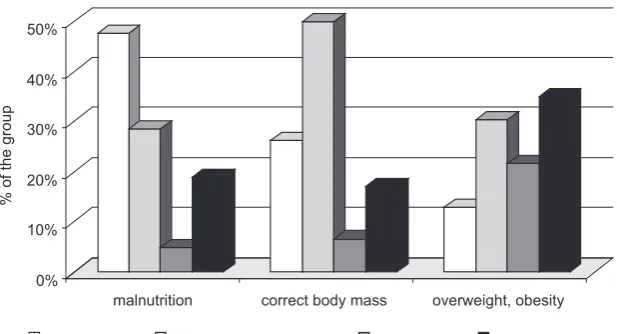
The nutritional status of the boys, evaluated by means of the BMI values with the use of percentile charts, differentiated statistically significantly (p = 0.00025) the opinion of the boys on their own figure. Many of the subjects did not assess their nutritional status correctly (Fig. 1). Only half of the boys with proper body mass claimed that their body mass was “fine”; 26.2% of them were of the opinion that they were too thin and 6.6% that they were too fat. Approximately half (47.6%) of the boys with malnutrition (BMI < 10th percentile)
correctly evaluated their figure, yet there were also some who claimed that their body mass was “fine” (28.6%) or that they were too fat (4.8%). Amongst the boys with overweight and obesity (BMI ≥ 90th
percentile) only 21.7% were aware of that fact, 30.4% claimed that their body mass was proper, and 13.0% that they were too thin.
A statistically significant (p = 0.00176) differ-ence was demonstrated between the nutritional status according to the BMI criteria and applying a body mass-reducing diet in the last 12 month be-fore the study. The most numerous group of boys with BMI ≥ 90th percentile (15.2%) were using a
low-energy diet, as compared to the boys with BMI of the 10th–90th percentile (3.0%) and those with BMI
< 10th percentile (4.8%). Approximately 15% of the
subjects with overweight and obesity were of the opinion that they should modify their eating habits in order to reduce excessive body mass.
Similar statistically significant (p < 0.00001) correlations were demonstrated between applying a slimming diet and the opinion of their own body mass. Analyses showed, that amongst the boys considering themselves as obese, approximately 13.0% were already applying diets to reduce their body mass, and as much as 38.7% of that group ex-pressed the opinion that they should go on a diet.
The BMI values and opinion of their own
body mass demonstrated a weak but statistically significant mean correlation with applying a body mass-reducing diet (R = 0.16).
Out of all the boys examined, 11.4% were ap-plying “special eating habits” due to various rea-sons: religious or ethical (1.1%), care about having a good figure (2.7%), maintenance of good physi-cal conditions and the plenitude of health (7.0%), and health condition (0.5%). Amongst the boys on a “special diet”, analyses showed significantly more frequent attacks of hunger (p = 0.0345), greater care of their own body mass (p = 0.00021), and more interests – hobbies that were being devel-oped (p = 0.0536). No significant differences were demonstrated in the use of stimulants (cigarettes and alcohol) between that group of boys and the other subjects.
Obligatory classes of physical education at school covered 4 school hours (45 min) a week. Approximately 5.5% of the examined boys had a physician’s exemption from sports classes. No statistically significant differences were found in their frequency in particular age groups. The ma-jority of boys (94.6%) were regularly attending the obligatory classes at school, including 82.7% of the boys who also participated in extra sports activities on their own (football, volleyball, basketball, gym, etc.). A statistically significant (p = 0.02569) dif-ference was demonstrated in the amount of time devoted to sports activities and using dietary sup-plements. The vitamin dietary supplements were applied exclusively by the most physically-active boys, namely those who were undertaking sports activities in addition to classes of physical educa-tion at school (p = 0.00469).
A considerable percentage of the boys exam-ined were smoking cigarettes (29.4%), including 25.2% of the 16-year-olds, 26.9% of the 17-year-olds and 34.0% of the 18-year-17-year-olds. Amongst all the boys who reported regular smoking, approxi-mately 4% were having from 1 to 5 cigarettes a day,
Fig. 1. Opinion of the boys (n = 369) on their figure vs. objective assessment of their nutritional status acc. to BMI values. Statistically significant correlation at p < 0.05
Ryc. 1. Opinia chłopców (n = 369) na temat własnej syl-wetki a obiektywna ocena stanu odżywienia wg wskaźnika BMI. Zależność istotna statystycznie przy p < 0,05
0% 10% 20% 30% 40% 50%
malnutrition correct body mass overweight, obesity
I'm too thin my body mass is "fine" I'm too fat I don't think about it
8.9% were having from 5 to 10 cigarettes, and 6.5% were smoking over 10 cigarettes a day. No statisti-cally significant differences were demonstrated in the habit of smoking as affected by the age of the respondents, educational status of their parents, their nutritional status and level of physical activ-ity. Analyses have shown, however, that amongst the group of smokers, a significant (p = 0.018) part did not have any problems with the acceptance of their own appearance (70.6%). The habit of smok-ing was demonstrated significantly less frequently (p = 0.01243) in the boys on a “special diet” linked with the maintenance of good health and condi-tion, as compared to the other subjects. In that group, the boys who reported smoking cigarettes were usually doing it occasionally (p = 0.03579).
Approximately 90% of the surveyed boys had already tried alcohol. The χ2 test demonstrated
statistically significant differences in the frequen-cy of alcohol consumption depending on the age of the respondents and educational status of their parents (p < 0.05). Alcohol was most frequently, i.e. 1–2 times a week and over 5 times a week, consumed by the 18-year-old respondents (26.5% and 4.9% of those groups, respectively), and by students whose parents had secondary or higher education. The highest percentage of the young-est boys (16.5%) reported not consuming alcohol at all. Usually, the boys were drinking alcohol oc-casionally (66.9%), yet approximately 20% of the respondents consumed alcohol 1–2 times a week, and approximately 4% more than 2 times a week. Amongst the alcohol beverages, the most popular turned out to be beer (85.4% of all answers), fol-lowed by vodka (46.3%) and wine (28.2%). The choice of beer and wine was significantly depen-dent on the age of the respondepen-dents (p < 0.05). Beer was consumed by 90.7% of the 18-year-olds, 86.5% of the 17-year-olds and by 75.7% of the 16-year-olds, whereas wine by 22.8%, 41.3% and 23.3% of the boys from the respective age groups. Although most of the boys reported drinking alcohol occa-sionally, its single ration drunk was found to be high. High single drink consumption of vodka was declared by approximately 38.0 % of the group, that of beer by approximately 23.0% and that of wine by approximately 16.0% of the respondents. Approximately ¼ of the boys reported drinking alcohol regularly. It was demonstrated that the frequency of alcoholic beverage consumption was affected by the educational status of both mother (p = 0.00565) and father (p = 0.01615). Most fre-quently, alcohol was consumed by the students whose parents had secondary education and by those whose fathers had vocational education.
Statistically significant (p = 0.01419) differ-ences were shown between the opinion of their
own body mass and the frequency of alcohol con-sumption. The boys who claimed that their body mass was “fine” (11.1%) or those claiming to be too thin (10.5%) usually did not consume alcohol at all. A very high frequency (more than 5 times a week) of alcohol consumption was demonstrated for the most numerous group of boys who claimed that they were too fat (9.7%) and for those who did not pay attention to their body mass (8.3%). In that group, there was one boy who claimed his body mass was proper. No statistically significant dif-ferences were found between opinion of one’s own body mass and the level of physical activity and the frequency of cigarettes smoking. Significant differ-ences were shown, however, between the number of smoked cigarettes and BMI value (p = 0.03493). A relatively small group of boys (16.8%) with prop-er BMI wprop-ere drinking large amounts of alcohol as compared to the boys with malnutrition (33.3%) and those with BMI > 90th percentile (30.4%).
Discussion
Youths at the age of adolescence are interested in their own appearance and often do not accept themselves. The girls are striving for a slender fig-ure promoted by the media, whereas the boys are in the pursuit of a muscular, athletic appearance. Young people are trying to reach their ideals in a variety of ways, often by means of unbeneficial, improper modifications of their daily diets, appli-cation of dietary supplements and Food for Par-ticular Nutritional Uses, the use of stimulants, and physical activity [15, 27, 28].
International investigations by the WHO – HBSC 2001/2002 [3] referring to nutritional be-havior worldwide have demonstrated that 1/
5 of
the total population of boys at the age of 11 and ¼ of the population of boys at the age of 15 were not satisfied with their appearance. Amongst the 15-year-old boys from Poland and Slovakia, that percentage has increased to as much as 35% of the population of boys at the age of 15. Results obtained in this study demonstrated that approxi-mately 20% of the examined boys did not accept their appearance, claiming that they were either too thin or too fat.
over-Self-Perceived Assessment of Nutritional Status in Adolescent Boys 231
weight and obesity affects 15–19% of children at the age of 7–11 [7, 18]. In light of these results, in the present study, the percentage of boys with ex-cessive body mass (approximately 12%) was found to be slightly lower.
A positive aspect is that the adolescents are in-terested in health-promoting changes of their life-style, which however might become detrimental to their health if introduced without sound prepara-tion, knowledge and control. Despite overweight and obesity on such a large scale, adolescents are often wrong in the self-perceived assessment of their nutritional status, and they may happen to correct it unnecessarily and inappropriately. In the reported survey, only half of the respondents with the correct body mass were aware that their body mass was “fine”. In turn, the application of a slim-ming diet was reported in approximately 5% of the boys with malnutrition and in 3% of the boys with correct BMI value.
Experiments with slimming diets are likely to pose serious health consequences. A nation-wide survey demonstrated diagnosed cases of anorexia nervosa and even 2–3-times higher incidence of bulimia in every school examined [29].
Results of international investigations have shown the United States to be the country with the highest percentage of 15-year-old boys who have tried to lose weight (20.8%). Other countries with respect to the percentage of teenagers hav-ing been on a diet included: Hungary (11.2%), Denmark (10.9%), Israel (10.7%), greece (10.3%), Malta (9.6%), and Poland (6.7%) [3]. The results of the present study confirmed lesser interest in body mass control in Poland than in other coun-tries, since approximately 5% of the respondents reported applying a slimming diet, and simulta-neously 8% of the boys were willing to undertake such actions. Research by Nystrom [28] demon-strated that 49% of the examined girls and 38% of the examined boys have tried to lose weight by modifying their diet. In that population, the intake of fruits and vegetables was observed to decrease considerably as compared to the control group. A study by Lowry [30] indicated that over the time span of years 1991 to 2001 a significant increase was noted in the population of boys undertaking attempts at body mass reduction (22.7–28.8%) and willing to maintain their current body mass (17.8– 21.5%). To this end, they were most frequently in-creasing the load of straining exercises.
The proper number of hours devoted to physi-cal activity is of crucial significance to the health and development of adolescents [10, 13, 14]. The results of the reported study demonstrated that 5% of the 16–18-year-old boys were exempted from classes of physical education. That percentage
ap-peared to be slightly higher as compared to the boys from Warsaw (3%). In a considerable per-centage of Polish children and youth (60–70%), the level of physical activity is unsatisfactory, since it is often limited to barely obligatory classes of physical education at school (4 × 45 min a week) [29–30]. The conducted study demonstrated that approximately 12% of the boys were undertaking physical activities only within school classes. An international study of the HBSC conducted in 35 countries indicated that 2/3 of the youth did not reach the recommended level of physical activity [3]. In turn, a review work by Bates [11] from in-vestigations of the Canadian Community Health Survey (CCHS) showed that in the years 2000/01 over half (56.0%) of 12–19-year-old Canadians were leading an insufficiently active lifestyle. The Canadian Fitness and Lifestyle Research Insti-tute estimated that the level of physical activity in 82.0% of Canadian adolescents did not fulfill in-ternational recommendations [31]. On the other hand, results of the Youth Media Campaign Lon-gitudinal Study (YMCLS) pointed to low physical activity in American adolescents, since 61.5% of the population of 9–13-year-olds did not partici-pate in any physical activity after school [32].
The use of stimulants poses severe health and social problems when it begins at an early age [33– 35]. In the presented study, as little as 10.0% of the 16–18-year old boys did not drink alcohol. In turn, 66.9% of the respondents reported consuming it only occasionally, however the amounts of alcohol drunk at one time appeared to be very high. Sta-tistical surveys conducted in Poland indicate that 45% of 15–19-year-olds have already drunk alco-hol. Approximately 10% of teenagers were shown to consume it 1–2 times a week, whereas 22.6% of adolescents drink it 1–3 times a month [36]. The highest percentage of 11-year-old boys regularly drinking alcohol was recorded in Israel and Italy (approximately 18% of the population), whereas amongst boys at the age of 15–16 – in Denmark (66%), greece (54%), great Britain and the Czech Republic (53%). In contrast, the lowest percent-ages of drinking adolescents were reported in Fin-land, greenFin-land, Norway and Portugal (from 0.3 to 2.7% of the population) [37].
percentage of the population of smoking 11-year-olds was reported in Latvia, Lithuania and green-land (approximately 42.0%), Estonia (37.0%), and Poland (27.2%), whereas the lowest was in greece (5.2%), on Malta and in the USA (approximately 8.5%), Belgium, Canada and Italy (approximately 12%). The habit of tobacco smoking displays an upward tendency in a number of countries. For in-stance, in Lithuania the number of smoking teen-agers increased from 15% in 1997 to 27% in 2002 [3]. In the present study, however, no correlation was confirmed between the habit of smoking and a lack of satisfaction with their own appearance and applying “a slimming diet”, which has been in-dicated in investigations of other authors [15–18].
The authors concluded that a lack of satisfac-tion with their own appearance was expressed by 21.4% of the boys examined, and 53.4% of the re-spondents claimed that their body mass was un-satisfactory. Not all the boys surveyed evaluated
their body mass consistently with results of objec-tive methods of nutritional status assessment, and the opinion on their own appearance and body mass was found to determine their behavior with respect to applying a body mass-reducing diet, dietary supplements and smoking. The boys pay-ing attention to their body mass were observed to significantly more frequently modify their eating habits, to more often use dietary supplements, es-pecially preparations containing minerals, as well as to less frequently smoke cigarettes and drink alcoholic beverages. Secondary and higher edu-cation of parents was found to significantly affect the use of dietary supplements and “special diets” by the boys examined. A considerable part of the boys were using stimulants, i.e. alcohol (90.0% of the population examined) and cigarettes (29.5%), which in their adult life might result in severe health problems, cardiovascular complication and neoplasms in particular.
Acknowledgements
None of the authors had any financial interest or support for this paper.
References
[1] Neumark-Sztainer D, Paxton SJ, Hannan PJ, Story M: Does body satisfaction matter? Five-year longitudinal associations between body satisfaction and health behaviors in adolescent females and males. J Adolesc Health 2006, 39, 244–251.
[2] Wills TA, Isasi CR, Mendoza D, Ainette MG: Self-control constructs related to measures of dietary intake and physical activity in adolescents. J Adolesc Health 2007, 41, 551–558.
[3] Currie C, Roberts C, Morgan A, Smith R, Settertobulte W, Samdal O, Barnekow Rasmussen V: Young People’s Health in Context. Health Behaviour in School-aged Children International Report from the 2001/2002 Survey EURO Nonserial Publication. WHO, 2004.
[4] WHO, Diet, Nutrition and the prevention of chronic diseases, Report of a joint WHO/FAO Expert Consultation, Technical Report Series 916. geneva. http://whqlibdoc.who.int/trs/WHO_TRS_916.pdf 2003
[5] WHO, Report – The Atlas of Heart Disease and Stroke. geneva 2005.
[6] International Obesity Task Force and The European Association for the study of obesity, EU Platform on Diet, Physical Activity and Health. Obesity in Europe. Brussels 2005.
[7] Bryl W, Hoffmann K, Miczke A, Pupek-Musialik D: Otyłość w młodym wieku – epidemiologia, konsekwencje zdrowotne, konieczność prewencji. Przeg Lek 2006, 9, 91–95.
[8] WHO, The health of children and adolescents in Europe, Fact sheet EURO/06/05. www.euro.who.int/document/ mediacentre/fs0605e.pdf 2005
[9] Oblacińska A, Jodkowska M: Otyłość u polskich nastolatków. Epidemiologia, styl życia, samopoczucie. Instytut Matki i Dziecka, Wyd. Zakład Medycyny Szkolnej, Warszawa 2007.
[10] Szostak W, Cybulska B, Szostak-Węgierek D: Otyłość wisceralna jako zagrożenie przedwczesnym rozwojem miażdżycy. Nowa Med 1997, 15, 11–15.
[11] Bates H: Daily Physical Activity for Children and Youth – A review and synthesis of the literature. Canadian Fitness and Lifestyle Research Institute, 2006. http://www.education.gov.ab.ca/k_12/curriculum/bySubject/dpa4y-outh.pdf.
[12] Biddle S, Sallis J, Cavill N: Policy framework for young people and health-enhancing physical activity. In: Young and active? Young people and health-enhancing physical activity – Evidence and implications. Eds.: Biddle S, Sallis J, Cavill N. London, Wyd. Health Education Authority, 1998.
[13] Strong WB, Malina RM, Blimke CJR, Daniels SR, Dishman RK, Gutin B, Hergenroeder AC, Must A, Nixon PA, Pivarnik JM, Rowland T, Trost S, Trudeau F: Evidence based physical activity for school-age youth. J Pediatr 2005, 146, 732–737.
[14] US Department of Health and Human Services, Public Health Service, Centers for disease Control and Prevention, National Center for Chronic Disease Prevention and Health Promotion: Physical activity and health: a report of the Surgeon general. Atlanta, gA, 1996. http://www.cdc.gov/nccdphp/sgr/sgr.htm.
Self-Perceived Assessment of Nutritional Status in Adolescent Boys 233
[16] Crow S, Eisenberg ME, Story M, Neumark-Sztainer D: Psychosocial and behavioral correlates of dieting among overweight and non-overweight adolescents. J Adolesc Health 2006, 38, 569–574.
[17] Neumark-Sztainer D, Story M, Dixon LB et al.: Adolescents engaging in unhealthy weight control behaviors: Are they at risk for other health-compromising behaviors? Am J Publ Health 1998, 88, 952–955.
[18] Rafiroiu AC, Sargent RG, Parra-Medina D et al.: Covariations of adolescent weight-control, health-risk and health-promoting behaviors. Am J Health Behav 2003 (27), 3–14.
[19] Ellickson PL, Tucker JS, Klein DJ: Reducing early smokers’ risk for future smoking and other problem behavior: insights from a five-year longitudinal study. J Adolesc Health 2008, 43, 394–400.
[20] McGill HC, McMahan A, Malcom GT, Oalmann MC, Strong JP: Effect of serum lipoproteins and smoking on atherosclerosis in young man and woman. Arterioscler Thromb Vasc Biol 1997, 17, 95–106.
[21] WHO, Reducing Risk, Promoting Healthy Life, Technical Report Series 915. geneva 2002.
[22] Preventing tobacco use among young people: a report of the Surgeon general. Atlanta, gA, US Department of Health and Human Services, Public Health Service, Centers for disease Control and Prevention, National Center for Chronic Disease Prevention and Health Promotion, Office on Smoking and Health, 1994. http://wonder.cdc. gov/wonder/prevguid/m0030927/m0030927.asp.
[23] Stice E, Martinez EE: Cigarette smoking prospectively predicts retarded physical growth among female adoles-cents. J Adolesc Health 2005, 37, 363–370.
[24] Michajlik A, Bartnikowska E: Lipidy i lipoproteiny osocza. Wyd. Lek. PZWL. Warszawa 1999.
[25] Wielkoszyński T, Bodzek D: Palenie tytoniu a miażdżyca – aktualne poglądy. Czyn Ryz 2001, 1–2, 39–49.
[26] Sierosławski J: Używanie alkoholu i narkotyków przez młodzież szkolną. Raport z ogólnopolskich badań ankieto-wych zrealizowanych w 2003 r. Alkohol a zachowania problemowe młodzieży. Opinie i badania. Wyd. Edukacyjne PARPA. Warszawa 2004.
[27] Neumark-Sztainer D, Hannan PJ, Story M, Perry ChL: Weight-control behaviors among adolescent girls and boys: implications for dietary intake. J Am Diet Assoc 2004, 104, 913–920.
[28] Nystrom AA, Schmitz KH, Perry ChL, Lytle LA, Neumark-Sztainer D: The relationship of weight-related percep-tions, goals, and behaviors with fruit and vegetables consumption in young adolescents. Prev Med 2005, 40, 203–208.
[29] Materiały konferencyjne nt. Zwalczanie otyłości i innych przewlekłych chorób niezakaźnych – priorytet Komisji Europejskiej i Światowej Organizacji Zdrowia, w ramach Narodowego Programu Zapobiegania Nadwadze i Otyłości oraz Przewlekłym Chorobom Niezakaźnym poprzez Poprawę Żywienia i Aktywności Fizycznej na lata 2007–2011 (POL-HEALTH), IŻŻ, Warszawa 2008.
[30] Lowry R, Galuska DA, Fulton JE, Burgeson CR, Kann L: Weight management goals and use of exercise for weight control among U.S. high school students, 1991–2001. J Adolesc Health 2005, 36, 320–326.
[31] Canadian Fitness and Lifestyle Research Institute. Physical Activity Monitor 2002. http://www.cflri.ca/cflri/pa/ surveys/2002survey/2002survey.html
[32] Thom T, Haase N, Rosamond W, Howard VJ, Rumsfeld J, Manolio T, Zheng Z, Flegal K, O’Donnell Ch, Kittner S, Lloyd-Jones D, Goff DC, Hong Y, Adams R, Friday G, Furie K, Gorelick P, Kissela B, Marler J, Meigs J, Roger V, Sidney S, Sorlie P, Steinberger J, Wasserthiel-Smoller S, Wilson M, Wolf P: Heart Disease and Stroke Statistics – 2006 update: A Report From the American Heart Association Statistics Committee and Stroke Statistics Subcommittee. Circulation 2006, 113, 85–151.
[33] Charzewski J: Aktywność fizyczna dzieci z dwóch skrajnych warstw społecznych. Wych Fiz Sport 2003, 47, 5–16.
[34] Retnakaran R, Hanley AJG, Connelly PW, Harris SB, Zinman B: Cigarette smoking and cardiovascular risk factors among Aboriginal Canadian youths. CMAJ 2005, 173, 885–889.
[35] Weitzman M, Cook S, Auinger P, Florin TA, Daniels S, Nguyen M, Winickoff JP: Tobacco smoke exposure is associated with the metabolic syndrome in adolescents. Circulation 2005, 112, 862–869.
[36] gUS główny Urząd Statystyczny: Stan Zdrowia Ludności Polski 2004 r. Warszawa, 2006.
[37] O’Malley PM, Johnston LD, Bachman JG: Alcohol use among adolescents. Alcoh Health Res World 1998, 22, 85–93.
Address for correspondence:
Joanna Wyka
Chair of Human Nutrition
Department of Agricultural Technology and Storage, Wrocław University of Life and Environmental Sciences Chełmońskiego 37/41
51-630 Wrocław Poland
E-mail: [email protected]
Conflict of interest: None declared