University of New Orleans University of New Orleans
ScholarWorks@UNO
ScholarWorks@UNO
University of New Orleans Theses and
Dissertations Dissertations and Theses
Summer 8-13-2014
Modern Landscapes
Modern Landscapes
Valerie Corradetti
University of New Orleans, [email protected]
Follow this and additional works at: https://scholarworks.uno.edu/td Part of the Fine Arts Commons
Recommended Citation Recommended Citation
Corradetti, Valerie, "Modern Landscapes" (2014). University of New Orleans Theses and Dissertations. 1865.
https://scholarworks.uno.edu/td/1865
This Thesis is protected by copyright and/or related rights. It has been brought to you by ScholarWorks@UNO with permission from the rights-holder(s). You are free to use this Thesis in any way that is permitted by the copyright and related rights legislation that applies to your use. For other uses you need to obtain permission from the rights-holder(s) directly, unless additional rights are indicated by a Creative Commons license in the record and/or on the work itself.
MODERN LANDSCAPES
A THESIS
Submitted to the Graduate Faculty of the University of New Orleans
in partial fulfillment of the requirements for the degree of
Master of Fine Arts In
Studio Art
by
Valerie Corradetti
TABLE OF CONTENTS
LIST OF WORK...iii
ABSTRACT...iv
INTRODUCTION...1
CONTROL...2
SYMBOLIC GESTURES...5
PROCESSING MY ENVIRONMENT...8
WALKING, LOOKING AT NATURE...9
ESCAPE TO LOST NATION...11
EXPERIMENTATION...13
PAPER MOUNTAINS...16
DRAWINGS...20
MISRACH, ANIMALS, LANDSCAPE...25
CLOSING...28
BIBLIOGRAPHY...29
LIST OF WORKS
Untitled, Landscape, pencil on vellum, 2011 1
Untitled, Landscape, pencil on vellum, 2011 2
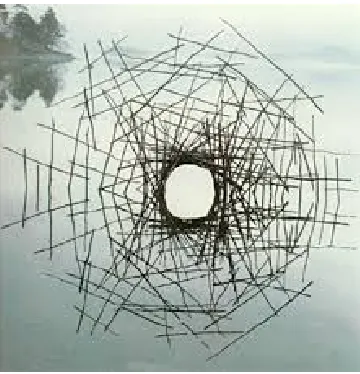
Andy Goldsworthy, Image 3
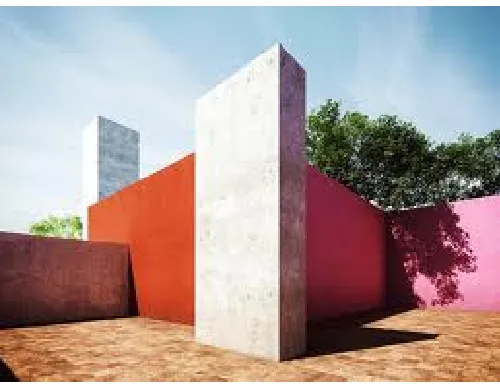
Luis Barragan, Casa Luis Barragan, 1948, Tacubaya 4
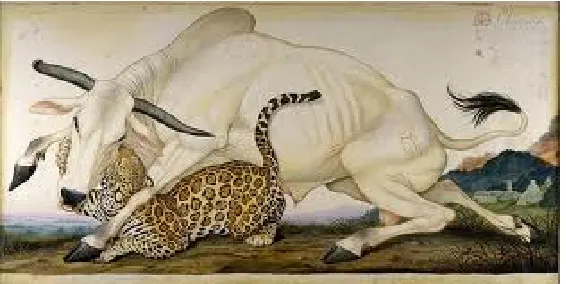
Walton Ford, Chingado, 1998 5
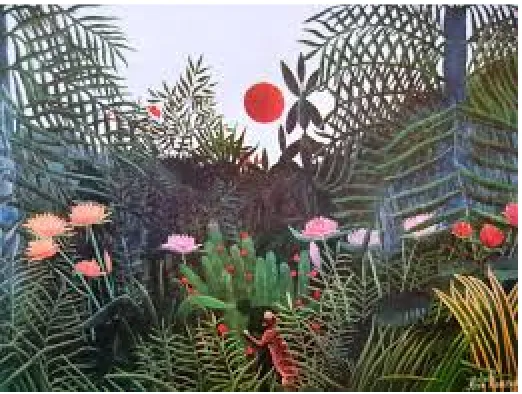
Henri Rousseau, Virgin Forest, 1907 6
Untitled, Fur Landscape, 2012 7
Untitled, Tied Fur Landscape with crushed glass, 2012 8
Paper Mountains, Dye Sublimation print, 2013 9
Untitled Fur Drawing, pencil on vellum, 2012 10
Ball, pencil on vellum, 2012 11
Hooked, pencil on vellum, 2013 12
Backwards, pencil on vellum, 2014 13
ABSTRACT
I explore nature in order to understand something that is becoming
increasingly unfamiliar. I wonder about accelerated human
transactions with nature: the control of animals, land, and resources
for pleasure, consumption or survival; and how these actions manifest
themselves visually in the modern world. Through images, I create new
ideas about my surroundings. My questions about nature are documented
through my work employing subtlety to narrate stories of contemporary
environments.
INTRODUCTION
With simplified materials I create two-dimensional representations of nature. I think about what is real and recognize the power of
imitation. I like being surprised by something unexpected but I
mostly enjoy subtlety. Through visual metaphor, I am exploring our
increasingly stressed and distant relationship to the natural world.
My hope is that through intense observation I will more fully accept
reality, whatever that may be. Nature is visually resonant in my mind
CONTROL
In 2005 I experienced a catastrophic flood from Hurricane Katrina and
levee failures that destroyed my home. When I arrived to survey the
damage, I witnessed a new kind of reality. The landscape was dead.
There were strange visual markers everywhere I looked. Massive
change, on that scale, was something that I could not comprehend and
at first glance my environment was unrecognizable. The grass lay
matted in chalky-yellow clumps on the ground, with nothing living
visible. Dust swirled in the air and white suited men walked the
streets. Every possession that I owned was piled up on the sidewalk
waiting to be carried off and buried in a landfill. Rotted books
became permanently sealed vessels, the pages ‘glued,’ the bodies arced
and curled. Day after day, sledge hammer to wood, brush to brick,
bottled water showers in the back yard, overlooking a murky,
black-bellied pool, most things took on new meaning. It is difficult to
comprehend the physicality, emotion and power of that catastrophe.
Unrecognizable images of my surroundings in combination with the
concept of this new physical and emotional reality gripped my thinking
and perception. This was not the first time in my life that the course
of reality changed so dramatically. This was just the first time that
the nature of so many things that I considered concrete changed all at
once.
The fallout from the flood is what I use to convey the meaning of what
about global climate change were now knocking at my own front door.
Katrina’s sheer size and might helped me consider what I had always
taken for granted and made real my previous understanding of
disasters. I understand now what a mass of water, wind, and power can
accomplish or destroy. This singular event and its reverberations
created an altogether new set of questions to ponder. So I’ve started
pursuing these thoughts to create images that harness those tensions
in my work, one that causes me to seek out metaphors referencing ideas
related to impermanence and control. The sublime nature of the flood
led me to focus on creating images of beauty in the wake of its
terribleness as I attempted in my own way to make nature seem more
tame and alluring.
Because the things we see and experience shape our behaviors and
expectations, the lack of control that I had experienced as a result
of the flood was met and matched by my unwavering desire to dominate
my work. The control in my artworks became compensatory to the loss
of control from the event. At the time I was completely unaware of
the natural reaction that I had to such a state of disarray. My hand
and eye wanted to flatten, perfect and meticulously control images and
marks.
In my drawing practice this process continues. I meticulously sharpen
my pencil before each stroke, beginning and ending every line with a
specific tension to the surface of the page. Hours upon hours of line
set on perfection of shape and surface. My photographic images
require preparation, not only in color selection but also lighting,
consideration of surfaces, and precise placement of objects. I use
torn nature photos of rocks, snow, ice, water and other formations
from outdoor catalogues to symbolize the ephemeral natural world.
Through visual metaphor, I am exploring our increasingly stressed and
distant relationship to the natural world. Nature has become a shadow
of its former self, so much so that we don’t really know what it is or
looks like anymore. Through controlling my still life environments, my
current work questions, the notion that everything is somehow okay.
It is a conscious decision to engage my ideas in a subtler and less
didactic way.
When I look at a natural environment what I see is most likely
affected by the human hand. The act of experiencing a ‘real’
landscape is simultaneously becoming more abstract and elusive. In
this ‘natural’ world the engineering of our wants and needs seems to
stop at nothing until the very things we need cease to exist. What
intrigues me is the process of searching only to find that my
immediately perceived reality is actually an artifice. What
distinguishes the two? Like the visual and physical experience of
walking across a field toward a horizon, my exploration leads me to a
SYMBOLIC GESTURES
When I began the graduate program at The University of New Orleans my
investigations led me to take a complete break from my former painting
practice in order to change my sense perceptions. My earlier
paintings were explorations of flat color fields referencing landscape
and figures. Searching for new ideas, I began drawing with my left
(non-natural) hand on delicate leaves of transparent paper. The
images I made were landscapes that, through minimally controlled mark
making, broke down into subtly recognizable shapes, forms and lines.
The drawn objects changed from shapes with defined edges to portraits
of color fields with blurry arrangements of form. Rocks became
scratched lines of varying thickness, a hillside turned into a lumpy
blob, and water became a suggestion of shape in pencil.
Reflecting on my newly understood inability to know anything absolute,
I was reminded of my life in a Capitalist society, where access to the
real is limited and confusion is the status quo. So, these drawings
became a way for me to reconsider my idea of what is real and the
Figure 1, Untitled Landscape, colored pencil on vellum, 2011.
Figure 2, Untitled landscape, colored pencil on vellum, 2011. Figure 1, Untitled Landscape, colored pencil on vellum, 2011.
Figure 2, Untitled landscape, colored pencil on vellum, 2011. Figure 1, Untitled Landscape, colored pencil on vellum, 2011.
Dissecting images of landscapes helped me explore symbolism and
abstraction in nature, which are things that nature itself does not
exhibit in any obvious way. After experimenting I began to reinstate
some sense of order into my images, understanding that replication of
nature with modern materials was inherently symbolic. This symbolic
gesture was the key to interpreting my confusion over the ‘real’. By
re-using modern materials (torn magazines) the act of reorienting them
as landscape and tearing them into smaller pieces became further
symbolic of the distance we have to the physical landscape and
commentary about the rate of change we’re currently experiencing.
Andy Goldsworthy is a contemporary artist who uses natural materials
symbolically by creating an abstracted language through the repetition
of line. I use replicas of nature to create an image that removes its
identity while it still remains familiar. The experience of viewing a
copy of the real is fundamentally disorienting.
PROCESSING MY ENVIRONMENT
When I make images the process is relatively slow. I oftentimes think
the slowness is a response to the rate of change in all things. My
ability to process information feels like it has become slower as I
have more access to the technology created to assist me in working and
learning faster. Our general perception of reality is manipulated by
this increase in speed. And so, drawing feels different from
technology because it is an unplugged and tactile experience.
My photographic and drawn works both generally begin by selecting a
color palette. I spend a lot of time looking first for color
references that speak to a specific mood. I gather photographs and
natural materials here and there, walking, looking and traveling to
contemplate other landscapes. I am always seeking an emotive quality
in color and image and great care goes into observing details; the way
a field of color overlaps into a new pattern or texture is something
worth noting. Luis Barragan, the architect, has a strong sense of
color in his designs and would use brightly colored walls connecting,
meeting and overlapping another in a minimally stacked balancing act.
I find his aesthetic to be pleasing and harmonious to the eye and it
is one example of what I look for in form and movement in visual
Figure 4. Luis Barragan, Casa Luis Barragan, 1948, Tacubaya.
Observation of conventional planting design is another method I use to
process landscape. I find the American garden fascinating and full of
insight. On the one hand it is fraught with obsessive control and
lack of creativity. Any McDonalds or Starbucks in the USA will
display a perfectly dull mound of mulch dotted with overused Hawthorne
or Boxwood, extremely clinical and submissive in appearance. Plants
pruned almost to death, trapped in a maze of asphalt, make me wonder,
how has this become an accepted, modern symbol of nature for our
culture?
WALKING, LOOKING AT NATURE
So, what am I seeing when I look at ‘nature’? This has become my
focus. What is actually natural and what is not? And why has the
wild animals and plants gone? In the essay “Imperial Landscape,”
W.J.T. Mitchell states,
Landscape is a medium not only for expressing value but also for
expressing meaning, for communication between persons – most radically, for communication between the Human and the non-Human. (1)
This radical communication between human and nonhuman has been seen in
the art world time and time again. For example, in the contemporary
works of painter Walton Ford, the viewer gets a chance to become
reacquainted with the beasts of nature. He makes this introduction by
telling the written stories of humans from an animal’s point of view,
visually. As possible compensation for their disappearance in the
wild, he makes them oversized, injured, attacking or under attack, in
general, a spectacle. My drawings also address this same type of
“communication” by suggesting through remnants of fur that the animals
in our landscape have practically disappeared. I am stating, subtly,
that they have faded as if a tattered, transparent, threadbare cloth.
So, what then are our actual landscapes, that we control, saying about
us?
Because I have purposely heightened experiences with nature I find
value in the fact that we are physically and psychologically
intertwined. My response to our relationship with other nonhuman
animals in the environment is to suggest visually that they are
remnants of their former selves. My fur drawings symbolize the ideal
animal as seen by modern humans: no face, no eyes, no hooves or claws,
just silent, soft and malleable. Symbolically they are unable to
invade the entire visual plane (in my drawings) and literally our
myopic human lives. We have arrived at a place where our delight in
nature has been reduced to scentless, overly manicured gardens full of
domesticated kittens and puppies that bear no threat and adore their
human companions. Any possible chance to experience the sublime is
immediately underwhelming and the wild surprises nature once had to
offer are distilled into a nonthreatening dialogue of dullness.
ESCAPE TO LOST NATION
One of the most overwhelmingly simplistic examples of fiction and
control in nature I experienced occurred in the winter of 2011 when I
took the first of several trips to Lost Nation, Iowa, to spend time
with a friend. The farmland in Lost Nation is similar to what I grew
up looking at in rural, Southern New Jersey except on a larger scale.
The landscape puzzled me as I tried to understand the symbols of the
environment. They were something other than what I immediately
thought I was seeing: The visible land was controlled by humans but
just an imprint of what I had learned formerly about landscape and not
the actual truth. The serene pastureland was tilled relentlessly,
chemically and mechanically controlled, silent, contemplative,
dominated, ‘beautiful,’ ‘natural.’ Being moved by the force of this
manufactured and exploited landscape confused me enough to want to
recreate my experience. This led to the beginning of my collection of
modern symbols, the torn sporting catalogue images that represented
nature in the promise of a grand, outdoor experience. Henri
Rousseau’s painted jungle scenes romanticized his desires of tropical
experience with nature. My use of still life drawing and torn
magazines represent a similar concept.
Figure 6. Henri Rousseau, Virgin Forest, 1907
A desire to wander, to escape, is fully manifest in the allure of
nature. I am drawn to the visual appeal of things that disappear into
the horizon – as if into thin air, or the beauty of the hidden and
discovered as it pertains to the wilderness. The art historian
He was probably the first man to express the emotion on which the existence of landscape painting largely depends: the desire to escape from the turmoil of cities into the peace of the countryside. (2)
Since Petrarch, has the modern human evolved and, in doing so
eliminated the ability to escape into nature? Unlike the experiences
of Petrarch, the world seems to follow us even to the most peaceful
places. Always waiting to connect us at a moment’s notice, our
devices feed a growing desire for more images and information. Unlike
the aimless experience of virtual wandering online, the physical
experiences of temperature, terrain, light, sound and visual
stimulation are some important features of traversing land that are
slowly becoming unfamiliar. The real experiences of time, place and
the horizon offer infinite direction in ways that cannot be mimicked
through technology. My ideas about escaping into the wild, open
pasture lands changed after recognizing that my perceptions were
confused. What I thought I was looking at in Lost Nation, IA was not
what I was actually seeing.
EXPERIMENTATION
I began experimenting with landscape and took my ideas and experiences
into the photo studio. I was reading the work of David Foster Wallace
and became intrigued by his thoughts on the profound ambivalence of
popular culture. His arguments took place in an age that was
dominated by TV and is now, since his passing, dominated by the
If nothing else to slap people kind of unpleasantly across the face and say, there may not be something wrong with 6-8 hours of television in a day but it would be very nice for you to remember that you are
essentially being offered a sales pitch and a seduction 6-8 hours a day... There’s something weird and thrice removed from the real world about it. And a lot of us don’t realize it. What’s at stake is in many ways is human agency about how we experience the world. Would I rather go muck around in the hot sun by the seashore or watch a
marvelously put together documentary about the death of Egrets? But, by the time I go to the goddamn seashore and have seen the Egrets, I have already experienced the smooth documentary so many times that it becomes quickly incoherent to talk about an extra mediated or an extra-televisual reality. Now, that fact, in and of itself is frightening and it’s that kind of almost just sort of shooting a flare into the sky inviting people to say how weird that is. I can go to the ocean that I’ve never seen before but I’ve spent a thousand hours. I mean, who would want to live when you can watch? (3)
Foster’s statement about encounters with the real vs. the idea of reality relates to postmodern life in which the actual experience
(visiting the beach) is replaced by the artifice (television). A conveyed experience is something that I experiment with in my work. I appropriate the real experience of fur by drawing copies from still
life and in my photos I repeat reality through replication of a printed image. Second hand experience can be used as a stand in for something real if the objects are treated in a way that elevates their
status. This work exhibits my idealized version of an authentic fantasy experience. My art making harnesses this idea of second-hand
Figure 7. Untitled, Fur Landscape, 2012
I also added ropes, crushed glass, reflective surface
lighting to create another type of environment that is alluring an
self-reflective.
Figure 8. Untitled, Tied Fur Landscape with crushed glass, 2012
Using fur as a stand in for animal or hillside blurs the line between the actual object and the representation of landscape. The viewer is shown the image of something familiar, used as a prop, set up
Figure 7. Untitled, Fur Landscape, 2012
I also added ropes, crushed glass, reflective surfaces and studio lighting to create another type of environment that is alluring an
Untitled, Tied Fur Landscape with crushed glass, 2012
Using fur as a stand in for animal or hillside blurs the line between the actual object and the representation of landscape. The viewer is shown the image of something familiar, used as a prop, set up
and studio lighting to create another type of environment that is alluring and
Untitled, Tied Fur Landscape with crushed glass, 2012
life format, printed in a photograph and presented as the idea of landscape.
PAPER MOUNTAINS
Experimentation with the idea of the mundane and the ordinary in
naturalism led me to photography. In general landscape is relatively
boring. It also lends itself to an immediate pictorial realism
specifically when viewed through the lens of a camera because the
camera captures a reflection. Since I’m seeking truth through nature
the camera has a tendency to represent the seeable world in all of its
ordinariness. Many have had the experience of snapping multiple
pictures of a completely useless landscape.
My interest in nature has also made me a victim of marketing; I have
been receiving outdoorsy magazines in the mail for the last few years.
They come every other month. They arrive in my mailbox, slip into a
slot through the door, and fall on the floor. Sometimes the dog jumps
up and down on them and scratches the hell out of the pages. I usually
thumb through them and toss the magazines onto a pile in my studio. I
knew that eventually I would use the images in these catalogues but
was not exactly sure how. So, I began experimenting with images
comprised of and collected from nature. In these photographs I stack
torn magazine images of mountains, clouds, rock, sea and sky, laying
out each slice of paper in a precariously perched narrative. I am
even just a fragment of a rock or the sky we still can recognize the
form. These familiar objects are the building blocks for my
experimentation with fragility, illusionism, consciousness,
self-reflection and time. Because photos convey the assumption of truth
there are things about the images that seem real. On one hand, the
images are just disposable catalogue pages created in mass to be
discarded. On the other, these catalogues are very expensive to make.
Marketing companies hire professional photographers and outdoor
athletes to capture ‘awe inspiring’ images of humans conquering
nature. Through set design and the process of photography I have
reinterpreted these forms into something that mimics the notion of
reality. It is important to use existing, highly marketed impressions
of nature because the recycled images become part of a recycled
sentiment. Like the way I process the color wheel, this is another
way to examine, dissect and recreate both my physical (magazines from
the mail) and natural (things I see outside) environment. I am
engaged in a mode of processing this environment that makes it my own
and gives me control.
My initial collection of images was based on a nostalgic inclination
toward coldness, reminiscent of my walking experience in Iowa. I
appreciate the contrast between the feeling of real physical heat of
summer and the romanticism involved with looking at images of snow. A
sweltering New Orleans summer can be overwhelmingly monotonous and
exhausting. Inserting the fantasy of snow into a humid studio is a
trip to Lost Nation in the winter, I began collecting images of the
idea of cold in nature.
Through my examination I questioned if, as a result of global warming,
the only cold remaining will be represented in a printed image? We
live on a planet that is changing rapidly and monitored glaciers are
melting away. The unfrozen water fills up land, increasing sea levels
while uprooting and displacing many things in the landscape. As a
result of this change there are many questions that come to mind and
filter into my work. Will there be a last snowfall? When will it
cease to be cold? What will landscape look like in the future and how
have we changed that process?
When I make images, nature is an endless supply of source material.
Nature is also a reservoir of random ideas and patterning. Trying to
know it is an enormous task, similar to understanding the size of a
mountain from a comfortable viewing distance. I use the image of a
mountain in the photograph Paper Mountains, 2013.
Figure 9. Paper Mountains, Dye Sublimation print, 2013
The jagged mountain image leans against another torn photo of an ice
another – in much the same way a real mountain elevates a vista. My
images access the picturesque nature of landscape as I control the
mountain by reinstating a reference of something massive and unmovable
into a staged set up. The eye thinks what it is seeing is a mountain
but in fact it is not. Hence, artifice extended - it is not just
about the artificial experience of looking at something real - it is
also about controlling and constructing that artifice.
‘Sublime images show nature at its most fearsome. Humanity is small and impotent in front of raging rivers, dizzying cliffs and canyons, ferocious animals, and violent storms. These works can also be uplifting, but in a deeply spiritual way. The Sublime emphasizes God’s dominion over humanity and considers the possible folly in mankind’s overriding confidence.’ (4)
Nature and humanity are intertwined and what happens when we engage
with nature in its most pure form – we can become terrified. The
terms “beautiful,” and “sublime” have their beginnings in 18th - 19th
century theory, particularly in the writing of Edmund Burke.
According to Burke’s theory beauty and sublime were categorized into
two distinct ways. Beauty is casual and enjoyable and the sublime can
be deadly. In my work, fear of the unknown exists and is inspired by
the sublime but it is also beauty that attracts the eye. Nature can
be dense and unfriendly and wicked and beautiful and we often seem to
be powerless against it, but is our most imminent goal an obligation
for survival? Perhaps the idealized version of nature in the sporting
magazines is the closest modern humans want to become with the great
The decision to try and mimic fur began as an experiment with shape
and texture. Initially the furs were drawn as small patches with
various color patterns that eventually
with an armature, overlapping shapes or architectural elements. My
interests in structures and the manufacturing of nature are combined
in these drawings.
Figure 10. Untitled Fur Drawing, 2012
They became shapes that spoke of volume and space instead of flesh and
blood. In the first fully realized fur drawing
of order by building an image that had a repetitive texture and line.
DRAWINGS
The decision to try and mimic fur began as an experiment with shape
and texture. Initially the furs were drawn as small patches with
various color patterns that eventually morphed into structures built
with an armature, overlapping shapes or architectural elements. My
interests in structures and the manufacturing of nature are combined
Figure 10. Untitled Fur Drawing, 2012
became shapes that spoke of volume and space instead of flesh and
blood. In the first fully realized fur drawing Ball, I used the idea
of order by building an image that had a repetitive texture and line. The decision to try and mimic fur began as an experiment with shape
and texture. Initially the furs were drawn as small patches with
morphed into structures built
with an armature, overlapping shapes or architectural elements. My
interests in structures and the manufacturing of nature are combined
became shapes that spoke of volume and space instead of flesh and
, I used the idea
Making something natural into a shape thereby ch
the material.
In my drawing practice there are events that happen because of chance
and those that occur as planned.
follows. Drawing in this way leads the image to self
form an animal / object. Unlike the circular shape in
other drawn forms seem to unveil themselves, taking on an even more
organic and living existence but one with an unpredictable framework.
Some lack of control and freedom withi
promotes experimentation in shape. Image resolution is therefore a gut
reaction to the drawing and the remaining, unfilled space on the page. Making something natural into a shape thereby changing the meaning of
Figure 11. Ball, 2012
In my drawing practice there are events that happen because of chance
and those that occur as planned. My mind wanders and the hand
Drawing in this way leads the image to self-gener
form an animal / object. Unlike the circular shape in Ball, 2013
other drawn forms seem to unveil themselves, taking on an even more
organic and living existence but one with an unpredictable framework.
Some lack of control and freedom within the surface of each drawing
promotes experimentation in shape. Image resolution is therefore a gut
reaction to the drawing and the remaining, unfilled space on the page. anging the meaning of
In my drawing practice there are events that happen because of chance
My mind wanders and the hand
generate and
Ball, 2013, the
other drawn forms seem to unveil themselves, taking on an even more
organic and living existence but one with an unpredictable framework.
n the surface of each drawing
promotes experimentation in shape. Image resolution is therefore a gut
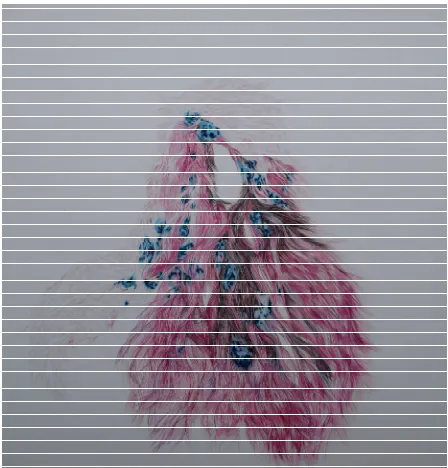
Biology informs specific areas of my drawings. Each biologic shape
becomes its own organic entity – inviting associations with other
living things. These drawn forms become tangled in the fur and poke
out here and there suggesting playfulness and disease simultaneously.
Appearing in the same way one might discover the growth of a new mole,
an illness or the unexpected presence of mold. These growths have a
will to live that mimics my desire to control them.
Figure 12. Hooked, 2013
Experiencing fur can conjure different emotional responses. Its
softness, warmth and comfort almost create an inherent desire for
more. The alluring qualities that fur has can transcend and encompass
the idea of skin or body that are familiar to me. This being one
example of a quality in nature that humans seek out. Fur addresses
the sensory experience of touch by creating, an inherently, physical
with the intimacy of drawing and the requirement of time, the viewer
can indulge in the labor of my hand through tangles of fur.
My drawings reference a similar color language used by Luis Barrigan,
by depicting what seems like a minimal palette. For example, what
might look like an overall blue or pink image is intentional.
However, in the drawings, I ultimately use several other colors to
emphasize the blueness or pinkness of the image. To create a single
blue drawing, I might use twenty different colored pencils and not all
of them blue. Creating space for color is also helpful in moving the
eye across a visual plane, so I intentionally isolate the drawing in
one area of the paper.
Humans have an insatiable appetite to control, experiment with and
possess the bodies of other animals. This I find utterly fascinating
and an ultimate form of manipulation if not used only for sustenance,
companionship or work. I have collected many real fur remnants from
thrift stores and garage sales. By dissecting and separating the
pelts from several fur coats I realized that there are many, many
mammals that went into building each garment. The nature of structure
in architecture was referenced in my earlier fur drawing experiments
and the dismantling of the coats piqued my interest. Each individual
pelt that went into creating a finished product had its own color
story and hair texture. In the drawing ‘Ball’, which preceded the
disassembling project, the image has an overall sense of unity but is
further, each line in the drawing is also very specific. Therefore
the approach to each image is built around a series of processes.
From the overall structure of each found coat, to the separation of
every pelt, the reorganization of the pelts to create a still life,
the interpretation of reality through drawing and the build up of
pencil lines as hair, the consideration of color, my system of making
images in this way fully references the idea of control that I am
investigating.
Figure 13. Backwards 2014
Originally I intended to use fake fur but then immediately realized
that observing real fur was a more effective means of representation.
I also was very drawn to the idea of a collection of bodies (fur
pelts) in my studio. This led to a search for bodies in the
landscape, the body as landscape and eventually I stumbled upon the
MISRACH, ANIMALS, LANDSCAPE
Using a View Camera, Richard Misrach collects detailed images of
various landscapes. The image Dead Animals #1, 1987, depicts piles of
dead animals scattered, tousled and rotting upon an open plane.
Figure 14. Richard Misrach, Dead Animals #1, 1987
The bodies are mainly collected toward the right side of the frame,
gathering into a dark pond full of scrap material. Like the Misrach
photographs, my work attempts to articulate the real becoming
something unnatural. Author Rebecca Solnit explains the dynamic of a
The animal pictures had taken landscape – or perhaps nature –
photography beyond where it had ever been: eliminating the horizon and the distance, describing the bloated, twisted corpses of mustang foals and Herefords and longhorns in the poetic language usually reserved for the reassuringly beautiful. These bodies which had literally been thrown away took on the sensual immediacy of the warm-hued bodies of saints and concubines in Baroque painting: (5)
In these Misrach images I recognize a familiar scene, reminiscent of
my home after the flood receded. Death can be interpreted as a
physical phase of morphing from one form to another like a hill
rolling into a valley and death in the landscape is sublime. Some
animals in Misrach’s landscape are partially buried under sand some in
a trance-like state with decayed, runny eyes that appear to be tear
stained. The knowledge of softness remains clear in an otherwise
dismal portrait. Fur is a texture that is unparalleled. Even in
death it suggests warmth, protection, comfort, desire, or maybe even
companionship. In his images there are obvious folds and shadows,
shapes and spaces that dictate land from animal from water and so on.
However the forms become one overarching shape that recites a singular
movement. The power of landscape is in its ability to represent a
full range of ideas; the reality of beauty, the mundane, a promise of
the future, the unknown and the fiction or reality of what land, and
the objects within it must endure. Whether we know for certain that
the visual narrative that can be seen or learned is fiction or
CLOSING
My art is made from my desires and struggles to see the natural world
differently. My work is derived from experiences that are comprised
of half-truth and half-fiction. By searching for escape and fantasy I
respond to all the rules, confinements and unethical decisions of
modern society. I create work that addresses my confusion through
not lost. I take into account the fact that I use complex, modern
tools, the mechanics of which I do not fully comprehend, to capture
images about the dismantling of the natural world. The manufacture of
these tools, their need to be powered and the chemicals used in photo
processing all add tension to the problems that I address and
question. Observation of things in landscape, daydreams, the marketed
American life, beauty, idealized nature and the collective self all
filter into my images. My hope is that through intense observation I
will more fully accept the presentation of reality, whatever that may
be. Nature is visually resonant in my mind because it offers an
immediate truth.
BIBLIOGRAPHY
W.J.T. Mitchell, “Imperial Landscape,” Landscape and Power, (University of Chicago Press, 1994), 15.
Kenneth Clark, Landscape Into Art (Harper & Row, Publishers, 1949), 10.
Wallace, David Foster. Interview with Geoff Ward. BBC Radio 3 Documentary, Endnotes (1995): Internet video.
University of Arizona Museum of Art, Tuscon, AZ, October 9, 2009 – March 2, 2010.
Rebecca Solnit, Savage Dreams. (University of California Press, 1994), 40.
VITA