EXPLORING A MODEL FOR CONCEPTUALIZING RHETORICAL PROBLEMS
by Janet Roser
A thesis
submitted in partial fulfillment of the requirements for the degree of
Master of Arts in English, Rhetoric and Composition Boise State University
© 2010 Janet Roser
DEFENSE COMMITTEE AND FINAL READING APPROVALS
of the thesis submitted by
Janet Roser
Thesis Title: Extending Transfer in Composition: Exploring a Model for Conceptualizing Rhetorical Problems
Date of Final Oral Examination: 10 April 2010
The following individuals read and discussed the thesis submitted by student Janet Roser, and they evaluated her presentation and response to questions during the final oral examination. They found that the student passed the final oral examination.
Heidi Estrem, Ph.D. Chair, Supervisory Committee Michelle Payne, Ph.D. Member, Supervisory Committee Dora Ramirez-Dhoore, Ph.D. Member, Supervisory Committee
iv
ACKNOWLEDGEMENTS
“Convention forbids us to express in words things that are lawful and natural; and we obey it.”
~Michel de Montaigne
Writing is a journey that is rarely undertaken alone. My research adventure on transfer this past semester would not have been complete without the assistance and encouragement of a strong committee. On that note, I would like to offer my thanks to Dr. Michelle Payne and Dr. Dora Ramirez-Dhoore. As they read through my drafts, both professors asked important questions that helped me re-envision my stance as a
researcher. Re-envisioning research and re-writing is at the heart of making meaning, which is what makes composition so valuable—we are a community of writers teaching one another, and as we teach, we learn. I offer my thanks to Dr. Payne and Dr. Ramirz-Dhoore for their willingness to teach me.
My committee would not have been as strong without the director of the first-year writing program, Dr. Heidi Estrem. I am grateful for her patience during the chaotic collapse of my writing process while I juggled many complicated aspects of the thesis as a rhetorical problem. Moreover, Dr Estrem’s foresight and openness to allow the thesis to evolve organically during the writing process was critical for its success and
v
For a qualitative study to be successful, it’s necessary to have a group of willing participants. I am grateful to the five former students from my research writing class for their generous contributions to this research. As first-year writers, they are the true teachers in the classroom.
vi ABSTRACT
This thesis explores the use of a new rhetorical problem-solving model for writing instruction to create opportunities for abstract thinking and extend the transfer of
vii
TABLE OF CONTENTS
ACKNOWLEDGEMENTS ... iv
ABSTRACT ... vi
LIST OF FIGURES ... x
INTRODUCTION ... 1
Chapter Overview ... 3
CHAPTER 1: RESEARCH WRITING, PEDAGOGY & TRANSFER ... 4
Research Writing and Transfer ... 4
Boise State First-Year Writing Goals for English 102 ... 5
Research Writing: A Pedagogical Reflection ... 6
Thesis Overview ... 9
CHAPTER 2: UNDERSTANDING WRITING & TRANSFER ... 11
Rhetorical Situation and the Rhetorical Problem: A Retrospective ... 11
Transfer: Cognitive Psychology and Educational Research ... 14
Bridging Transfer and Composition ... 19
CHAPTER 3: STUDYING TRANSFER AT BOISE STATE UNIVERSITY ... 27
Research Methods Overview ... 28
Case Study: Jen ... 30
Individual Writing Assignment ... 33
Case Study: Kathryn ... 34
viii
Case Study: Billy ... 39
Individual Writing Assignment ... 40
Initial Results ... 43
Interlude ... 45
CHAPTER 4: RE-ENVISIONING FLOWER AND HAYES’ RHETORICAL PROBLEM TO INCREASE ABSTRACT THINKING AND EXTEND TRANSFER ... 48
Viewing Transfer: A New Lens ... 50
Cognitive Research and Writing Transfer ... 52
Research Writing and Beyond ... 56
Research Writing Strategies: Foundations for Transfer ... 57
Research Writing: Missed Opportunities for Transfer ... 57
Transfer: A Continuum ... 59
Challenges for Transfer ... 62
Near Transfer: Bridging the Gap ... 67
Conclusions and Implications ... 72
Postscript ... 74
Rhetorical Analysis ... 75
CHAPTER 4: REFLECTING ON RESEARCH WRITING AND TRANSFER ... 77
English 101: Introducing the Rhetorical Problem-Solving Model ... 77
ix
Results ... 78
Designing a Rhetorical Problem: Who Am I as a Writer? ... 80
Preliminary Results ... 81
Implications for Teaching at Boise State ... 82
Final Thoughts ... 83
BIBLIOGRAPHY ... 85
APPENDIX A ... 89
Interview Questions APPENDIX B ... 91
Survey Questions APPENDIX C ... 93
Individual Interviews on the Writing Sample APPENDIX D ... 95
Consent to be a Project Participant APPENDIX E ... 98
Email Letter Soliciting for Participants APPENDIX F ... 100
Research Study APPENDIX G ... 103
x
LIST OF FIGURES
Figure 1. The Rhetorical Situation: Flower & Hayes ... 12
Figure 2. The Rhetorical Problem: Flower & Hayes ... 13
Figure 3. The Rhetorical Problem: An Academic Article ... 46
Figure 4. The Rhetorical Situation: Flower & Hayes ... 51
Figure 5. The Rhetorical Situation: Flower & Hayes ... 51
Figure 6. The Rhetorical Situation: Contemporary ... 53
Figure 7. The Re-Envisioned Rhetorical Problem ... 54
Figure 8. The Rhetorical Situation: Classroom Model ... 69
INTRODUCTION
Find your star—create your own constellation.
~Mike Mattison
My initial interest for studying transfer came about when I stepped into graduate school a few years ago; I had a difficult time adjusting to the various writing situations in my classes. Because I was an older student and had been away from academia for twenty years, I thought that my struggles were unique. However, when I started teaching
composition and working with student writers, I paid close attention to what I taught each day in the classroom. I listened to hear what students were learning, what they were struggling to understand, and I thought about how they moved among the various writing situations in our composition course, as well as their other classes. This movement through their classes gives students opportunities to transfer rhetorical knowledge from one context to the next. I wondered whether and how students transferred rhetorical strategies from composition to other academic courses. As my interest in transfer grew, I did what most teachers do, and began reading the research on transfer. After listening to the conversations taking place in the field of composition, I learned that transfer is a complicated cognitive process and is influenced by much more than daily lesson plans or writing assignments. I also learned the field of transfer research in composition is
my inquiry on transfer, I developed questions to help frame a research study to answer my questions.
The research study was also influenced by a research methods course I took my first year of graduate school. This class introduced proper research methodology,
provided an overview of research studies in the field of composition, and shaped the way I thought about research—as an exploration. Throughout the semester, Mike Mattison, our professor, led the class through a wide range of qualitative and quantitative
Chapter Overview
Chapter 1: This chapter is a reflection of my pedagogy for English 102, Boise State’s research writing course. The chapter explains what I taught as a composition instructor and what my students told me they learned, which eventually led to my inquiry and the impetus for my study on composition transfer.
Chapter 2: This chapter provides an overview of the research on transfer in composition. Initially, I revisit the writing process research of Linda Flower and John R. Hayes. In particular, I focus on their theoretical framework for the rhetorical situation and the rhetorical problem. With the research of Flower and Hayes, I make connections to David Perkins and Gavriel Salomon’s research on transfer theory, and then create additional connections to the current research on composition transfer.
Chapter 3: This chapter consists of my research methodology and my study of transfer at Boise State, and I presented the data as mini-case studies. I close chapter 3 with initial findings of my research study. The results from chapter 3 are analyzed in more detail in chapter 4.
Chapter 4: This chapter synthesizes chapters 1-3. Based upon the results of my transfer study, this chapter is an article that argues for the use of a rhetorical problem-solving model in composition to improve the transfer of rhetorical knowledge.
CHAPTER 1: RESEARCH WRITING, PEDAGOGY & TRANSFER
Research Writing and Transfer
In the spring of 2009, halfway through my first semester of teaching English 102 (a research-based writing class), I began contemplating what rhetorical knowledge my students would remember and utilize in their future courses. As a new instructor of composition, I naturally questioned my pedagogy and pondered the implications for the fifty student writers enrolled in my classes. Due to writing experiences I had encountered in my undergraduate, and graduate studies, as well as my professional life, I could
identify writing strategies and research processes that could potentially transfer to the students’ future courses of history, philosophy, anthropology, or business. Yet, how would I know if my students made these connections? This question generated further questions regarding the transfer of rhetorical knowledge. How would I know if the students would apply the writing and research processes I stressed in our English 102 class to the writing assignments required in other classes? What rhetorical knowledge (if any) would transfer to the writing they did in other course work? These questions and many others led to the research that follows.
Boise State First-Year Writing Goals for English 102
Boise State’s First Year Program goals for English 102 are similar to many research-writing courses required in first-year writing programs across the nation. The research-based first-year writing class at Boise State has the following outcomes:
understand academic work as a recursive process of inquiry, using writing and research to form new questions and pursue existing enduring question;
craft questions that guide research, making their process manageable and likely to yield insights;
find, read, evaluate, analyze, and synthesize appropriate sources;
integrate evidence in their own writing in a way that complicates (develops, refines, extends, refutes, and deepens) their own ideas;
produce research-based writing in formats appropriate to the context, purpose, genre, and audience;
implement a variety of research strategies and resources as appropriate to their inquiry;
use a variety of media (print and digital) to address different audiences, as appropriate;
understand genre expectations for some research-based writing contexts within the university;
use an academic documentation style consistently and appropriately; articulate the rhetorical choices they have made as a writer and researcher,
illustrating their awareness of a writer’s relationship to the subject, context, purpose, and audience;
produce prose without surface-level convention errors that distract from attending to the meaning and purpose of the writing.
(Boise State First Year Writing Program)
which is an effective avenue for researching, learning, and generating material for writing. This same inquiry model instigated my own questions regarding rhetorical knowledge and transfer.
Research Writing: A Pedagogical Reflection
Along with framing our learning with inquiry, the use of three books guided our course: The Curious Researcher by Bruce Ballenger, A Rhetoric of Argument by Jeanne Fahnestock and Marie Secor, and The Everyday Writer by Andrea Lunsford. We utilized these books to understand and break down the research processes, learn strategies and steps for proper research, understand the conventions of argument, and identify and use appropriate MLA formatting. To engage the students in research writing throughout our semester together, the syllabus I designed required that students write for the following three rhetorical situations:
Unit 1: Students wrote an exploratory research essay (an essay that modeled and demonstrated their inquiry and research processes) for an audience (their choice— self, teacher, classmates), about a topic of their choice. This essay required six primary and/or secondary sources.
Unit 2: Students took the research and the six sources from the exploratory essay, evaluated how the research exploratory essay exposed alternate perspectives, and then generated additional questions to research. The students then answered these new questions with their original research sources and found four additional primary (an interview when possible) or secondary sources. At this point, the students compiled their research and wrote an argumentative essay for an audience (audience of their choice) that supported their stance regarding the research. The students wrote the thesis more subtly for the argumentative essay written; the students were encouraged to consider a creative nonfiction approach (models provided) and consider other genres (journalistic article, letter, diary etc.).
Before launching into each unit, the students wrote a proposal for each rhetorical situation. These proposals required the student to consider their goals, purpose, and audience for each rhetorical situation, and articulate their strategies to accomplish the writing task. I should add that these units were the three major assignments for the course, and that all of the units had multiple research and writing activities embedded within them. And, at the completion of each unit—as is standard practice in Boise State’s first-year writing courses—the students wrote detailed reflections letters to articulate their learning. This outline of major writing projects (units) met the goals for the first-year writing program’s research writing course and allowed the students opportunities to engage in research as a community of writers: participating in peer review at every stage—drafting proposals, drafting of essays, and peer review of final unit projects.
to teach them—they told me what they needed. Over the course of the semester, as the students continued to “tell me what they needed” both verbally and in their reflection letters, my thoughts turned toward transfer. I made the decision to require a meta-narrative at the end of the semester in an attempt to learn how to improve as a writing instructor.
Boise State’s first-year writing program emphasizes revision and thus places a large percentage of a student’s final grade on the end of the semester portfolio. One of the components of the portfolio is an extensive reflection letter that allows a student to reflect on their learning over the semester, and project future applications of this rhetorical knowledge. The meta-narrative I required had these same requirements, but also required that students cite themselves in the text, quoting their statements of learning
(drawing from their semester of unit reflection letters, research and writing responses, free writes and notes) and reflect on these quotes to evaluate how their perspectives had further changed.
leads to new directions to take a topic. I see now that research is a continuous process.” There was also the realization that researching and learning changes identity; another students said, “I am constantly evolving every time I research because I am willing to take in new material and to change…I evolve every time I write.” By writing an extensive narrative, the students were applying their research strategies in a meta-cognitive approach to their own learning, a learning that equated to a shift in their thinking.
Thesis Overview
As I looked back over my experience teaching research writing and as I read the student meta-narratives at the end of the semester, I was encouraged by what they told me they had learned in the class. The students articulated changes in their attitudes on
research writing and increased confidence for writing lengthy research essays in a variety of genres. Their understanding of credible sources was clearer and they felt comfortable incorporating source material to extend their thinking and create a conversation in their writing. Reading the meta-narratives provided a sense of accomplishment for me because the students had achieved many of the goals for the research-writing class. Yet, as I thought about studying composition transfer, I wondered what rhetorical knowledge they would still remember in their fall semester and what they would find applicable for writing in other courses. Teaching research writing and interacting with student writers was the impetus for this thesis—to research studies on composition and transfer.
Like most instructors of composition, every time I complete a lesson and exit the classroom, I reflect on the insights my students provide for how I can modify my
CHAPTER 2: UNDERSTANDING WRITING & TRANSFER
Rhetorical Situation and the Rhetorical Problem: A Retrospective.
In this chapter, I introduce and provide an overview of some of the relevant scholarship on writing and transfer. However, before I launch into the scholarship on transfer, I revisit the early writing-process research of Linda Flower and John R. Hayes. Their theoretical research provided a unique lens for the way I eventually interpreted the results of my own research project on transfer. After reviewing the rhetorical problem solving research of Flower and Hayes, I then move into the educational transfer research of David Perkins and Gavriel Salomon, who developed a theoretical framework for discussing types of transfer. The goal for this next chapter is to share my lens for viewing transfer. This lens evolved from the connections I made with the research of Flower and Hayes, Perkins and Salomon, and current composition scholars studying transfer. This literature overview will also allow you see how these scholars informed the design of my Boise State transfer study in chapter 3.
Back in the late 1970’s and early 1980’s, research on the composing processes of writers emerged in the field of rhetoric and composition. Extending studies from
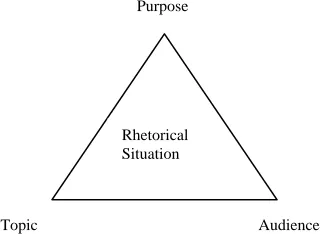
cognitive psychology to composition, Linda Flower and John R. Hayes were key contributors to revelations of the composing processes of writers. In “The Cognition of Discovery: Defining a Rhetorical Problem,” Flower and Hayes (1980) analyzed, through protocol analysis, the composing processes of both expert and novice writers. In this study, Flower and Hayes recorded the composing processes of expert writers and novice writers as they worked on the following task: “write about your job for the readers of Seventeen magazine, 13-14 year-old girls” (23). The expert or experienced writers were teachers of writing and rhetoric, and the novice writers were college students. By doing protocol analysis (think aloud protocols, where researchers observe, record, and read the writers work as they compose), Flower and Hayes discovered an important difference in the way that expert and novice writers use rhetorical strategies for a given writing task. The novice writers, who were more limited in their rhetorical knowledge, limited their writing focus to the rhetorical situation (fig. 1), which Flower and Hayes defined as the assignment (topic), audience and the writer’ writing process for generating ideas (24).
Figure 1. The Rhetorical Situation
When Flower and Hayes observed the novice writers in the act of “writing about their jobs to the readers of Seventeen magazine,” they found these writers referred back to the assignment and attached themselves to the topic, never really moving beyond the “sketchy conventional representation of audience and assignment with which they
Assignment (topic) Audience
started” (26). This emphasis on the topic resulted in writing that was underdeveloped and flat. The novice writers in Flower and Hayes study are very similar to many first-year writers; their rhetorical knowledge and writing experience is limited and as I have observed in my classroom, the students attach themselves to their topics. Flower and Hayes found novice writer’s attachment to the topic kept the student focused on the rhetorical situation. The emphasis that novice writers placed on the rhetorical situation is an aspect I will refer back to after looking at the expert writers in Flower and Hayes’ study.
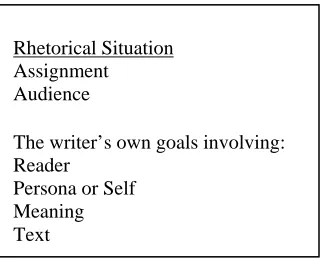
In their observation of expert writers, Flower and Hayes found they relied on their rhetorical knowledge or “stored problem representations” to create and solve a more complicated rhetorical problem than the student writers (25). The rhetorical problem, defined by Flower and Hayes (figure 2), encompasses the rhetorical situation, but it also includes the writer’s purpose or specific goals and sub-goals the writer sets for
accomplishing the writing task.
Figure 2. The Rhetorical Problem
Rhetorical Situation Assignment Audience
The writer’s own goals involving: Reader
These goals referred to in the rhetorical problem are complex with writers actively thinking about their affect on audience, their imagined persona, the text or genre
conventions, and the meaning they are trying to make with their writing (27-29). Within the rhetorical problem, expert writers spent more time thinking about and commenting on their specific goals as they composed while the novice writers spent more time in the rhetorical situation (in particular their topic and writing process). In their results, Flower and Hayes found that expert writers represent a problem as a complex network of abstract goals and “respond to all aspects of the rhetorical problem” (377, 29-30). For example, they considered how to connect to the audience of 13-14 year old girls, how the reader might perceive their writing (persona), the genre conventions of the magazine, along with the purpose and subject matter. The ability to think abstractly is a critical link in the studies of transfer, as you will see in the next section, because it demonstrates the ability to transfer knowledge. Expert writers have far more writing experience that enables them to create abstract goals and apply them to a new writing task. They draw upon their knowledge base, goals, writing process, and audience awareness to write within and solve the entire rhetorical problem, which is a skill novice writer’s lack. In the next section, as we evaluate transfer in composition, I will use Flower and Hayes’ research and theories on the rhetorical situation and rhetorical problem as a means of framing and sharing the lens through which I view transfer studies.
Transfer: Cognitive Psychology and Educational Research
in the last ten years. It is for this reason that I will begin my overview of transfer with educational and psychological research before introducing transfer research in the field of rhetoric and composition. In addition, the scholarship of transfer has several different theoretical perspectives and each researcher has their own language for discussing their theoretical perspective of transfer. When I delved into composition studies on transfer, I found many scholars relied on the research of David Perkins and Gavriel Salomon. Because Perkins and Salomon’s work is well recognized and frequently cited, I will also use their research for discussing transfer.
and together, these two strands of scholarship provide the lens through which I view transfer.
To place Perkins and Salomon theories into the context of composition, I will draw from two of their studies, “Teaching for Transfer” and “The Transfer of Learning.” From these studies, Perkins and Salomon would categorize a student’s ability to write an argumentative essay learned in composition and their ability to apply this rhetorical knowledge for writing an argumentative essay in history as “high road” or “far” transfer. This type of transfer “depends on deliberate mindful abstraction of skill or knowledge from one context for application in another” and these contexts “on appearance, seem remote and alien to one another (25, par.6). In this case, writers must be able to take their rhetorical knowledge for writing an argumentative essay from the context of composition and apply “abstract” this knowledge to the new context of history. The ability to move from one context to another has what Perkins and Salomon refer to as “reflective thought in abstracting from one context and seeking connections with others,” which results in far transfer (26).
knowledge to move beyond the rhetorical situation and make connections from one context to another that “might on appearance seem remote or alien to one another” (26).
The other type of transfer Perkins and Salomon define is “low road” or “near” transfer. Near transfer “reflects the automatic triggering of well-practiced routines in circumstances where there is considerable perceptual similarity to the original learning context” or stated more simply, “transfer between similar contexts” (25, par. 6). I will use the example of an annotated bibliography taught frequently in composition to discuss near transfer since many instructors across the disciplines assign research papers that require an annotated bibliography. Students who learn how to write an annotated bibliography in composition will usually approach this writing task the same way in a history class. Even though the student has moved from composition to the new context of history, there is still “considerable perceptual similarity to the original learning context” (25). To connect near transfer to Flower and Hayes’ theories, writing an
annotated bibliography resides within a similar rhetorical situation because the rhetorical strategies that the writer transfers to the history class are the writing process, topic and audience for the writing task, whether they are in composition or history. By Flower and Hayes’ definition, these components of the writing process, topic and audience for the task are within the rhetorical situation.
framework of King Beach. Therefore, before I shift from transfer theories to transfer studies in composition, I should briefly clarify Beach’s theory and language. Beach uses different language for describing his theories and advocates a shift away from the transfer metaphor toward thinking of transfer as a socially cultural interaction where “learners and social organizations exist in a recursive and mutually constitutive relation to one another across time” (111). Beach found transfer to be a complex set of generalizations that consists of a set of interrelated social and psychological processes. His theory originated from his research analyzing arithmetic reasoning with adolescents, and adults
transitioning from school to work in rural Nepal. Similar to Perkins and Salomon’s “far” transfer, Beach observed a type of “general” knowledge transfer occurring between contexts that, on appearance, “seem[ed] remote and alien to one another” (Perkins 3, Beach 112). Beach also found “local” transfer occurred when a student/adolescent/adult (depending on the study) was working within a new but similar context, which again is similar to Perkins and Salomon’s definition of “near” transfer (111). Although Perkins, Salomon, and Beach have theoretical similarities on transfer, they would not equate “far” to “generalizing” and “near” transfer to “local,” but because their perspectives are
Bridging Transfer and Composition
A helpful starting point for exploring learning, transfer, and writing is Julie Foertsch’s 1995 study, “Where Cognitive Psychology Applies.” Although there are earlier studies alluding to transfer, Foertsch bridges cognitive psychology theories regarding transfer to composition instruction. Foertsch defines transfer as “using information learned through problem solving in one context to solve a conceptually similar problem in a new context,” which connects with the early rhetorical problem solving research of Flower and Hayes as well as Perkins and Salomon’s definition of far transfer and King Beach’s definition of general transfer (371). In Foertsch’s study, she explores how and why students write for various situations, and the necessity for teaching writing on both a local (near) and general (far) knowledge level to stimulate the students’ problem solving abilities(emphasis mine). Foertsch draws from the analogical
Although it might be easy to assume that at the very least we would observe that basic writing knowledge transfers from one rhetorical situation to the next (similar contexts), this is not always the case (Wardle 2007, Kutney 2008). Lucille McCarthy’s 1985 study, “A Stranger in Strange Lands: A College Student Writing Across the Curriculum,” followed the writing of a single college student for two years. The subject of her study, Dave, failed to recognize rhetorical similarities and interpreted the writing assignments in each of his classes as different even though they were quite similar (243). Through observations, text analysis, compose aloud protocols, and interviews, McCarthy found Dave struggling to recognize similar rhetorical situations as he moved through different discourse communities.
writing assignments, reading requirements, and their writing samples. Although each of these students performed well in the bridge course, when the students stepped into English 102, Hassel found the students failed to make connections and meet expectations due to their lack of rhetorical connection and adaptability (29-30). Rhetorical
adaptability, goal setting, and problem solving were the missing links for students who failed to make connections and transfer rhetorical knowledge.
troublesome areas documented in their student writers: student compartmentalization of knowledge and lack of connections, understanding the thesis and support for writing in a variety of genres, time limitations for instructors to write more extensively in classes, student lack of motivation, and vocabulary within a given discourse community (223-226). Like McCarthy, Flower and Hayes, and Hassel, Nelms and Dively demonstrate a similar lack of “rhetorical adaptability” when writing outside of composition courses.
Due to the lack of rhetorical knowledge transfer from composition to other disciplines or discourse communities, David Smit argues for writing instruction to occur solely within the disciplines. In his aptly titled book, The End of Composition Studies, Smit claims that “students have learned what teachers have taught and evaluated, that in effect, writing teachers get what they teach for, instruction in particular kinds of
knowledge and skill, not broad-based writing,” demonstrating a lack of rhetorical problem solving ability (120). As with the findings of McCarthy, Nelms, and Hollis, Smit claims that composition students have learned something (like the annotated bibliography example) that “can be applied only in very limited circumstances, [which are] similar to those in which they learned that knowledge in the first place” (49).
showed that students’ beliefs and attitudes significantly affected their interpretation of the contexts in which transfer can take place, and their attitudes impaired their awareness of possible connections to writing in other courses (171-174). Driscoll also noted that bringing a student’s background knowledge and attitudes to the forefront of the learning situation and building from them could help bridge connections for transfer. With the instructors in this study, who taught similar pedagogies, the qualitative results indicated that explicit teaching about future writing contexts and building connections for the students can foster transfer of writing knowledge (179). Driscoll (with Anne Beaufort) took the results of her dissertation and designed a composition curriculum for building rhetorical connections and teaching for transfer.
Anne Beaufort has examined writers’ learning processes, the rhetorical connections they make, and the implications for composition instruction. In a recent book, College Writing and Beyond: A New Framework for University Writing
Instruction, Beaufort offers yet another perspective on transfer and proposes a writing curriculum for teaching for transfer. Beaufort’s 2007 study followed a single student, Tim, through his First Year Composition (FYC) courses, as well as his history,
engineering, and post-college writing situations. In Beaufort’s case study, she found Tim was a bright and motivated student; he had a strong sense of his writing processes,
argument, Beaufort found the requirements for the academic writing in his first year were not as rigorous as requirements in other courses, in particular juggling multiple sources and writing to support his thesis. Tim’s initial history essays “revealed a lack of ability to sustain a clear focus” (80). She found he lacked connections for applying writing
strategies for both rhetorical situations (although not every situation) and rhetorical problems, but his greatest deficiency was with meta-awareness of discourse communities and genre knowledge (77).
Beaufort is careful not to over-generalize from this case study, but she offers suggestions for designing a conceptual framework for writing expertise to test in other settings. The results of her study promote teaching discourse community knowledge, which offers a broader lens for learning. Under the umbrella of discourse community knowledge, Beaufort includes four sub-categories: writing process knowledge, subject matter knowledge, rhetorical knowledge, and genre knowledge. All four of these “knowledge domains” offer specific information for researching, understanding, and teaching for transfer (19). This framework, teaching discourse community knowledge and providing opportunities for the students to study and evaluate writing, has the potential to improve their ability to solve rhetorical problems like the expert writers in Flower and Hayes’ study.
the nature of the activity system in which the problems and the learner’s interpretations are embedded that makes the difference in whether people generalize learning” (68). Wardle followed (and continues to follow) seven of her students from a FYW honors English class. Wardle found her students had near transfer occur within the domains of writing process knowledge (planning generating material, organizing), subject matter (research), the rhetorical situation, but failed to make the connections for solving rhetorical problems. From her preliminary results, Wardle, like Beaufort, advocates using a meta-lens and teaching composition as an “Introduction to Writing Studies” to enhance students’ ability to problem solve as writers.
The most surprising aspect of Wardle’s study was the type of writing required of the students during their second year while completing courses in other disciplines. They wrote very little—far less than I would expect, and far less than Tim in Beaufort’s study, Dave in McCarthy’s study, or the original fourteen writers Hassel followed. When the students in Wardle’s study did write, they “did only what was necessary to earn the grade” and made many personal choices to “avoid challenging assignments…because they were unwilling to put forth the effort required to generalize previous writing experiences, knowledge, and abilities” (73). From Wardle’s interviews, she found students lacked motivation for writing and that teachers assigned fewer writing tasks. Even though these honors students conveyed they didn’t write as much and weren’t as engaged in writing, the interviews and conversations Wardle had with them assisted in illuminating some transfer connections for rhetorical situations.
CHAPTER 3: STUDYING TRANSFER AT BOISE STATE UNIVERSITY After reading some of the research on transfer and composition, I am more convinced that we should explore avenues for improving the transfer of rhetorical
knowledge. I value writing as a mode of thinking and learning, and I want my students to reap the benefits of writing in courses outside of composition. So, how do we do this? As an instructor I want to find a way to help my students conceptualize rhetorical
connections that will allow them to take their rhetorical knowledge and adapt it to writing in other courses. Because the study of transfer is a relatively new field, the research potential is unlimited, which means that my students can add to the conversation and possibly provide a missing link to improve composition instruction and increase transfer. I am not in the classroom with students to pass the time; I want to provide students with rhetorical knowledge that moves beyond the walls of our classroom. The study that I have designed to look at rhetorical transfer is simple, but the student voices that speak are complex. This study on transfer is an opportunity to listen and learn from the voices of student writers.
Wardle’s study evaluated seven extremely competent students from a competitive honors program, Beaufort followed a single student, and Hassel evaluated three
underprepared writers. Because I teach first-year writing to all incoming students, I chose to study five students placed in the English 102 class required for all these
their courses for writing, but I also be evaluated their responses on transfer through Flower and Hayes’ rhetorical problem solving lens. The questions I focused on are:
What rhetorical knowledge do students remember from English 102-research writing?
What rhetorical knowledge do students recall and use in their courses? What kind of writing are students doing in their courses?
What are the connections/disconnections between writing tasks in English 102-research writing and their current courses?
Research Methods Overview
My goal for this study was to determine what rhetorical knowledge, writing strategies, and writing techniques my students learned in English 102, and if they applied this knowledge to writing assignments in their other courses. In order to answer these questions, I designed a qualitative study generating questions from my own teaching instruction and the studies of Wardle (2008), Beaufort (2007), and McCarthy (1987). Each of these researchers demonstrated how generative both group and individual interviews were for composition studies on transfer. Beaufort also stressed the
importance of collecting a writing sample with the instructor’s assignment guidelines to evaluate a student’s interpretation of a writing task. Consequently, I conducted the study using qualitative data collected through interviews, writing samples, and assignment guidelines for the writing sample. The 3-5 base questions I used for interviews (appendix A and B), were specific, but open-ended, which allowed the students to recall and
elaborate on various writing strategies utilized in their courses.
participate in this study on transfer (appendix D and E). I designed the study to collect data from cluster interviews (which involved two or more students), individual
interviews, a writing sample, and an online survey. In the interviews, I asked about the writing strategies they remembered from our research-writing class and also asked them to elaborate on how they were using those strategies in their classes (appendix A and C). Gathering and collating the data from the interviews illuminated the need to redirect the research project. During the cluster interviews, for example, the students elaborated on writing tasks in their various courses, which provided unexpected insights on rhetorical connections and disconnections pertaining to our research-writing class and transfer. The cluster interviews instigated conversations on a variety of writing tasks that could be connected to the students’ recall of rhetorical knowledge, the rhetorical situations encountered for writing in English 102-research writing and, at times, the individual interview and writing sample. Therefore, the first necessary change was to spend additional time with the interview conversations (transcripts).
The other change in my data collection occurred with the online survey. Initially, I thought the anonymous online survey would provide triangulation for the study.
Along with adjusting the processing of qualitative data for the study, I
encountered two other complications. Sam removed himself from the study because he did not have a writing sample to submit. In addition, Carl wrote business letters and several personal opinion pieces, but did not have any research writing during the fall semester. Due to the modifications of the participants and data collection, I focus on the conversations with Jen, Kathryn, and Billy in the cluster interviews, individual
interviews, and the discussion of the writing sample. In this chapter, I present each student as a mini-case study. For each case study, I reviewed the transcripts from the cluster interview to look at each student’s recall of rhetorical knowledge: what did they remember from our research writing class? Then I reviewed the application of this knowledge for writing in their courses. Finally, I reviewed the student’s individual interview discussing a specific writing sample (chosen by the student), evaluated the writing sample for rhetorical connections, triangulated these data points back with the cluster interview (students invariably discussed the individual assignment in both
interviews) and again, made connections/disconnections to English 102-research writing course. Following the presentation of each case, I close this chapter with a brief
summary of the results.
Case Study: Jen
Jen, a journalism/communications major, entered my research writing class overly confident in her writing abilities, which made her a tough customer for inquiry and
Additionally, when given the opportunity this past fall to participate in the study on transfer, she was more than willing to contribute.
In the cluster interview, Jen recalled the following list of rhetorical knowledge from our research-writing course (questions in appendix A).
writing research
knowing credible/legitimate research (search engines/academic premier) rewriting and rewriting
doing additional research
changing the perspective of what we’re writing about looking at things from different aspects
To find out which of the above research strategies Jen applied in her current courses, I asked her to “describe the writing you are doing in other classes this semester.” This question, during the cluster interview, provided an example of how generative interviews are for gathering data on transfer. Jen elaborated on an assignment in her journalism course, which eventually required a change in stance or perspective by the writer. The students in the class had interviewed one another for learning the craft of writing a personal interview. Jen interviewed a classmate and wrote her story. Then, Jen had an opportunity to re-interview the student and rewrite the story.
The rhetorical situation that Jen describes is similar to an assignment we did in our research writing class; the assignment was an argumentative essay. The emphasis for our class assignment was good research writing, but also rereading the sources to
reconsider their original stance and write the essay as a creative nonfiction piece. Yet, although the rhetorical situation of changing your perspective or stance with your
I asked about connections she might make with our research writing course, Jen
responded, “it’s not like the writing we did…it’s very different from the writing that we did that involved researching and rewriting from different perspectives.” As I
encouraged Jen to discuss the journalism assignment further, she did recognize some rhetorical similarities: rewriting and writing a journalistic creative nonfiction piece. Yet again, Jen interpreted the revision as “different,” she continued, “I’m doing a lot of rewriting and revision, but it’s different from the rewriting and revision that we did with our research papers.”
Jen did acknowledge the interview as a source of research: “there’s one time we got to interview them [the classmate] further, but for the most part, she [the instructor] has us change the way we write the story based on the same notes that we took. So we are rewriting and redoing things, but it’s at a stagnant point.” The implication of her response is that Jen considered the interview a limited source of research, or that the additional interview did not offer new insights for her research. The question that arises is why didn’t Jen see the similarities between these two writing assignments? The rhetorical situations are very similar, but Jen is recognizing a difference she is unable to articulate. I should note that in our research writing class, Jen worked with up to ten sources in the argumentative essay, which was very different from a single interview and could explain her disconnect with altering stances and the limitations of working with a single source. Additional information (the instructor’s assignment sheet and the final writing sample of the interview) could provide clarification for connections to the
Individual Writing Assignment
The next writing assignment Jen chose to share was from her theatre class, which we discussed and evaluated in several ways: through the cluster interview, individual interview, the writing assignment, and the writing sample. For this informal writing assignment, the students were required to attend and write a critique on a theatre performance. In the cluster interview, Jen shared that the instructor was very explicit about restrictions; because she had so many students, she did not want any more information than necessary in the critique.
She [the instructor] gave us very strict guidelines as to each paragraph...first paragraph was our introduction with our thesis, the second paragraph, plot summary, the third—discuss the acting in the play, the fourth and fifth, pick two design elements and discuss, and the sixth paragraph was just our conclusion with our thesis restated.
In describing her process for writing this paper, Jen shared that she attended the theatrical performance a week before the paper was due, wrote down a few notes after she saw the performance, and wrote the final paper two days before it was due:
So then I sat down and figured out the two design elements that I wanted to use, which were the songs, and the lighting they used was very distinct. And I had really strong feelings about the acting in the play. And so it really wasn’t that difficult for me to discuss any of it. So I just kind of came up with a thesis and let it roll from there and then…it was really quick, it was only six paragraphs.
there wasn’t really a lot of like, what do I want to say...thought...it wasn’t that difficult.” Consequently, in Jen’s critique, “A Question of Talent,” she modeled the paper exactly as the instructor required; it is an analysis/critique of a play, and contains all the components as specified in the guidelines.
Case Study: Kathryn
Kathryn’s curious smile and quiet confidence was a welcome presence in our research writing class. Kathryn, like Jen, was comfortable as a student. She understood hard work, and by the end of the semester discovered, she actually “liked” research writing. Over the course of our interviews together, Kathryn was pleased as she reflected on our research writing class and stated that by having each student research a topic for the entire semester, it allowed her to become “a kind of expert on a topic” (her topic was arachnophobia).
When I asked Kathryn what she remembered learning in English 102-research writing, she stated the following:
preplanning
writing rough drafts
editing
quick writing
incorporating quotes
knowing data bases and how to use them relying on credible sources
choosing a topic building a web site
stepping back to look at my writing looking at multiple perspectives (topic)
evaluating perspectives, stances, arguments showed limitlessness of writing spending an entire semester becoming a kind of expert about a topic
Kathryn elaborated on an anthropology paper. For this informal writing assignment, the students researched old and new world dig sites. Although Kathryn never mentions the word inquiry in the above list, she applied inquiry to a research assignment in her anthropology course. In doing so, she said, “I applied a lot of the researching, and credible sources.” As she moved into the research process, she adds:
I shortened the process…I did brainstorming…not just jumping into one topic or one idea. Originally, I said, I guess I’ll just write about Stonehenge, but everyone knows about Stonehenge. Instead, I ended up doing an older site that wasn’t very well known and it made it fun for me to write about…I learned something new and had a new understanding for it.
Here Kathryn articulates her understanding that research is about inquiring beyond the obvious—learning, and expanding perspectives on topics. She used the following rhetorical strategies: preplanning to decide on an interesting topic, databases and search engines for credible sources, and revising. Using the transfer definitions of Perkins and Salomon, these rhetorical strategies are a type of near transfer and reside within Flower and Hayes’ rhetorical situation, where the writer spends time with their writing process (generating ideas and rewriting), and the topic.
Individual Writing Assignment
procrastinating and writing this paper two days before it was due. Although short on time, Kathryn applied many rhetorical strategies from our research writing class and refers to these strategies as she talks through her writing process.
Well, brainstorming...that was a huge thing I took from 102, because before I would write something…it would be the first thing I picked. If I started writing and didn’t like anything about it, I would still try to write it just to get it over with. But, rough brainstorming and just coming up with as many ideas as you can and narrowing down the ones that catch your interest the best and then narrowing those down further and also outlining was a huge …I actually outlined a lot for this paper just in the sense that going through all the articles. There were only four articles that they gave us and I went through all four and looked at the different aspects, outcomes, what happened and the ethics that were violated, so that was a big thing.
Kathryn’s writing process demonstrates a fair amount of preplanning (brainstorming, outlining, and narrowing her topic choice). She also articulates the desire to find something interesting to write about rather than writing just to ‘get it over with.’ Once again, Kathryn is sharing rhetorical strategies of the writing process that are transferring to this engineering class. She is preplanning for generating ideas and evaluating the sources provided by the instructor. The rhetorical situation of evaluating sources and generating ideas are similar to what we did in our research writing class. Kathryn
continues discussing the details of her writing process and describes sitting down to write the paper this way:
why does it matter? …She [instructor] wasn’t very concerned about formatting, so I didn’t have to worry about introduction, body, conclusion, thesis statement or anything like that...
Like many writers aware of their processes, Kathryn spills everything, ‘a first draft’ before returning to rewrite and she is able to make connections that transfer from our research writing class: generating ideas, integrating sources as a conversation, articulating her rhetorical choices, and writing as a recursive process. But, Kathryn is also very aware of her audience; she’s actively thinking about her reader and the effect her persona will have on her audience. These are some of the goals expert writers draw upon for solving rhetorical problems. As you’ll see below, Kathryn is thinking abstractly and is working through a rhetorical problem. This is far transfer. This meta-awareness of her persona is also present in the following passage. I asked Kathryn what makes her go back and revise, and this is how she responded:
I changed the introduction entirely and I changed a few parts of the …just because the first introduction that I wrote was a kind of filler …so I did a few edits, but nothing drastic…Well, the introduction I wanted to change cause the first one I wrote wasn’t anything that would grab anybody’s attention…it was just was really just stating what I needed to get done in the paper based on the guidelines. So I went back to create a more “attention getting” introduction and then….I added a bunch of facts [sources] into the body and then I just took some fluff out…repetitive sentences, making sure there wasn’t anything in there that was being stated over and over.
The details regarding Kathryn’s writing process and her awareness of these processes as well as use of research strategies strike me as an exceptional. Kathryn’s meta-awareness of rhetorical choices demonstrates her ability to juggle the rhetorical situation of the writing process, topic, audience, and also move into the rhetorical
she has transferred rhetorical strategies from our research writing class and moved beyond a similar rhetorical situation into a new context—far transfer.
Kathryn spoke above about writing a more “attention getting” introduction for her essay, which is another rhetorical strategy that she learned in our research writing class. Indeed, examining the individual writing sample, Kathryn has a more engaging
introduction, putting the reader in media res: “Imagine your-self sleeping soundly on normal December night.” Immediately after setting the scene, Kathryn begins to elaborate on the accident at Union Carbide Bhopal, retelling the story in a journalistic fashion, incorporating quotes, and blending these quotes of the disaster with her
language. Kathryn incorporated five quotes from two sources in her first six paragraphs. After giving an overview of the disaster, Kathryn made a choppy transition to discuss the ethical implications of the disaster. The purpose of the assignment was to evaluate the ethical violations by Union Carbide. Yet, the ethical analysis is weak and Kathryn cites a single quote to support her claim that Union Carbide was negligent. The essay is only 703 words and most of the support for claims is in the first half of the paper as Kathryn describes the disaster in scene and incorporates quotes, with little emphasis on the ethical responsibilities.
This assignment to construct an essay that explores the ethical implications of the disaster at Bhopal’s Union Carbide plant is similar to the rhetorical situation of our unit 2 argumentative essay from English 102-research writing. However, Kathryn’s stance on the disaster minimally addressed the ethical implications or responsibilities. It is
that “expert” ability to consider her persona and affect on audience. Yet, in the final writing product, she failed to thoroughly connect the ethical aspects and responsibilities of engineers to the disaster and support this stance. The interviews with and the
evaluation of Kathryn’s essay demonstrate a tremendous amount of awareness and transfer—she is juggling many aspects of Flower and Hayes’ rhetorical problem.
Case Study: Billy
In our research writing class, Billy was quiet, soft-spoken, and reserved. I was grateful that he chose to sit in the front row of our research writing class. Due to his shyness and reluctance to speak out during class, sitting in the front row assured Billy’s voice was heard when he contributed to class conversations. As a research writer, Billy was cautious. Having moved from China to the United States at the age of eight, Billy’s command of the English language as a speaker and a writer was strong, but his cultural background and his shy personality significantly inhibited his participation in class.
As we spoke in the cluster interview, Billy recalled the following rhetorical strategies from our English 102-research writing class:
using and quoting sources (using sources wisely to support a point) structure of the paper/MLA formatting
rough drafts building web sites
writing long papers (7-10 pages)
different ways of writing (web sites, creative nonfiction)
was minimal, Billy elaborated on his history course. In this class, the students had several exams where they were required to write essay responses and support their answers with research sources. Billy said:
Basically, I have to do exactly what he [instructor] tells me to do. He has these requirements that you have to quote and use the sources to answer the questions and MLA, 12pt. font, title, whatever…For the quizzes; each answer has to be like 350 words. Four questions or so… [for each exam]
In this passage, Billy is focused specifically on the assignment requirements of the rhetorical situation. Billy says when he writes these take home exams, he is able to create rough drafts and revise several times.
Individual Assignment
When Billy and I met to discuss an individual writing sample, he chose to continue the conversation on the essays exams for his history class and submitted a sample exam including the questions and guidelines from the instructor. For this take home exam, the instructor was very explicit regarding what to include in each essay. The following are the instructions for the exam Billy took in history.
Billy was required to choose one question from each section of the test (these contained multiple questions).
Billy had to answer all the components of the question to obtain full credit. Billy had to use only the class textbooks and handouts for sources (no outside
sources were allowed)
Billy had to quote and used the sources to answer the questions (700-word maximum for answering two essay questions).
With every exam Billy has taken, (this is his third) the instructor’s specifications for the essay exam are very directive. Billy paid close attention to the directions for the
I just answer the questions that he assigns, for example [pointing to the assignment sheet], like these questions…answers these questions and use the sources or something to quote them to back up the answers… Basically, he [the instructor] knows exactly what we have to work with [for sources…the instructor provides all the readings] we don’t need a works cited. We have a book and handouts that he assigns us, that’s all we need. He [instructor] can’t keep track of something else [referring to outside sources].
This passage shows Billy’s attention to the rhetorical situation, specifically the
assignment, answering the questions and using the sources provided by the instructor to support these answers. I next asked Billy what he does after reading the questions and answering them. Here, Billy provides a few more details into his writing processes and research processes for completing the exam.
…if I read each part to the question… [reading off the sheet…showing me] I’ll answer that and if I don’t know the answer, I’ll go read it or look for the answer, maybe somewhere in this page or something. When I find it, maybe I’ll use a quote from that part to answer it and then talk about it a little bit or something. I go through every part of the question until I am done; I answer every part to it. [Then], I go back and see if it makes sense or not. Am I leaving something out? Or am I leaving something hanging or something? To see if it makes sense or not…cause he says proofread the text or something…try and make sure I don’t have any errors or something.….if I say something and I didn’t really explain it very well, just randomly come out or something… does it connect well to
this…like….how do you say this… [Picking up his essay] like I started answering part and then…does it sound good? It can’t just be all rambling.
Billy for preplanning, drafting process, incorporating sources to support his answers to the questions, and connecting or clarifying his answers.
As I evaluated the writing sample for this exam, I see Billy accomplishes the main goals for the assignment: answers the questions and incorporates quotes (primary sources only—no paraphrasing). Perhaps because his instructor was so explicit with the exam guidelines, the essay reads like a scripted list of answers to the questions. There are no introductions or transitions between the answers to questions. Billy begins writing each sentence with the copied text from the question as instructed and answers it, and then incorporates a quote to support his response. Yet, even though both exam-opening questions read, “Discuss the long-term contacts between the Late Roman Empire… [and] discussthe causes and effects of the “Black Death” in mid-14th century Europe,” there’s no evidence or an attempt to discuss or synthesize the information while answering the questions. I am not sure what Billy’s history instructor means by the word “discuss” in his assignment sheet, but my interpretation and what I taught in the research writing class is that the writer creates a conversation with their sources.
This assignment, as Billy says, was ‘almost similar’ to the writing we did in our English 102-research writing class, ‘except different requirements.’ The assignment is certainly similar to the rhetorical situation of the argumentative essay when the students took a stance and supported their claims with sources. However, with the history exam, Billy simply answered the questions and used the sources to support his claims,
disregarding introducing and reflection on the quote/source. At one point in our
the quotes of ten primary sources and only offers a reflection on one of them. Billy wrote a 970-word essay, which could be a maximum of 1400 words. With an additional 400 words, there were many opportunities to discuss and elaborate on the answers to the questions (for both short essays), introduce quotes, reflect on quotes, and create
transitions, yet this particular style of integrating quotes (that we stressed in English 102) didn’t transfer to the writing task in history. For this writing task, Billy stays within the rhetorical situation, focusing on the writing assignment and his writing process. There are no indicators for abstract thinking (at least not revealed in our conversations).
Initial Results
I began this study on transfer as an attempt to answer several questions. What rhetorical knowledge do students remember from English 102-research
writing?
What rhetorical knowledge do students recall and utilize in their courses? What kind of writing are students doing in their courses?
What transfers from English 102-research writing and to writing tasks in other courses?
As described in the case studies, students did indeed learn and retain rhetorical strategies from their English 102-research writing class. The rhetorical recall varied between each of the students, from engaging in research and knowing how to use
research processes (specifically searching data bases), the case studies still provide useful data for evaluating rhetorical recall and writing processes. In particular, in the
interviews, students articulate their research and writing processes, which provides insight on transfer. Also, by comparing the interviews on individual assignments and the writing sample, connections and/or disconnections are illuminated.
So what specifically transferred? What rhetorical knowledge did students learn in English 102 research writing and utilize in their other courses? Jen, Kathryn, and Billy are each transferring rhetorical strategies that are useful for writing in other classes such as generating ideas, rewriting, evaluating and incorporating sources, and having a meta awareness of their rhetorical choices. These rhetorical strategies are key markers for near transfer because they were utilized with writing tasks that triggered “well-practiced routines” where there was “perceptual similarity to the original learning context,” (Perkins, 25). Now the question is: how do we build off these markers of near transfer and extend students’ rhetorical knowledge to unfamiliar contexts—far transfer? I hope to answer this question as I evaluate the results of my study more closely in chapter 4.
extend near transfer to far transfer. In chapter 4, I will demonstrate the use of this new rhetorical problem-solving model.
Interlude
Thus far, inquiry on composition pedagogy and listening to the voices of student writers for insight on transfer has been driving the narrative arch of this thesis project. As I move into chapter 4, the narrative arch will change as I enter into a new conversation that entails writing an academic article. During the process of writing this thesis, I have actively engaged in my own rhetorical problem. Working through the thesis, it has been necessary for me to contemplate the assignment (my topic of transfer), the audience (my committee members), and to read, write, generate, and organize material. There has been a constant awareness of the genre of the thesis: what are the conventions? How will I enter the conversation? What language will I use to connect with my reader? This demonstration of abstract thinking and drawing upon rhetorical knowledge from my previous writing experiences to this new context is an example of the rhetorical problem solving I argue for in chapter 4. In making this argument, chapter 4 is written as a completely new rhetorical problem—an academic article. You may ask, why do this?
Writing Program Administrators. Stepping into the academy is an essential opportunity to maneuver through William Perry’s scheme and contribute to the scholarship on transfer in composition. Second, solving a new and challenging rhetorical problem enables me to experience frustrations similar to the ones my students experience when assigned a different writing task. Finally, chapter 4 allows you to observe my struggles as a graduate student writer negotiating the complex task of solving an unfamiliar rhetorical problem of writing an academic article—a rhetorical problem that feels daunting.
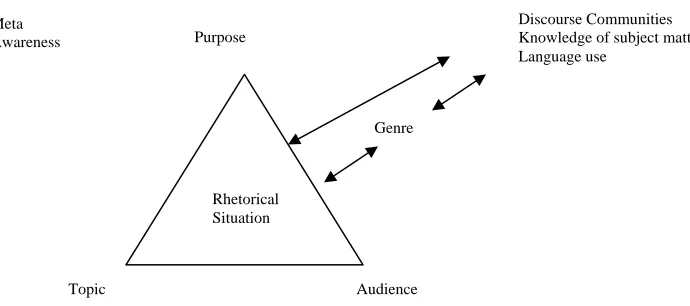
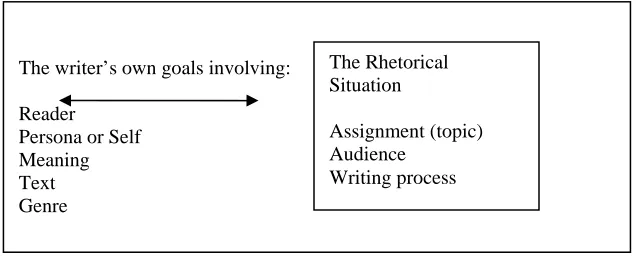
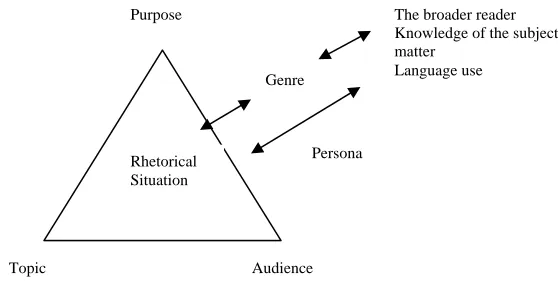
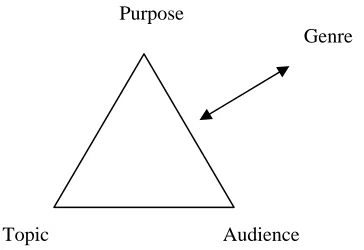
Below is the rhetorical problem solving model I argue for implementing in composition instruction. I will demonstrate the use of this model by writing a paper for chapter 4 of this thesis.
Figure 3. The Rhetorical Problem: An Academic Article.
Purpose: The purpose of chapter 4 is to write an article arguing for the use of the rhetorical problem-solving model for writing instruction to increase abstract thinking and extend/improve the transfer of rhetorical knowledge to new contexts.
Rhetorical Situation Purpose
Audience Topic
Genre
Discourse Communities Knowledge of subject matter Language use
Audience/Discourse Community:The audience for this article is complex. The immediate audience includes my committee members and myself, but the purpose of the article pushes me to consider a broader audience—the discourse
community of scholars, which consists of academic scholars studying transfer. The audience members heavily influence the persona I’m trying to conjure for myself as a writer. I want to sound intelligent and informed, but respectful of those scholars who have far more knowledge on transfer. The audience and discourse community force me to abstract to a new context for writing. Topic: The topic for this article is rhetorical knowledge transfer, which is the
result of my inquiry question—what rhetorical knowledge from English 102-research writing transfers to writing tasks in other classes beyond composition? Genre/Structure: The genre for this is an academic article that uses the
conventions of argument. The structure of the article is modeled loosely after the research articles I have read in Writing Program Administrators. The article is structured in the following way,
o open with my thesis (addressing the remix of Flower and Hayes’ and how I will contribute to the conversation on transfer)
o step into my research findings immediately
o discuss these findings with the ideas of other scholars researching transfer o illuminate the remix of the rhetorical problem and its applications for
classroom instruction
Subject matter knowledge: The subject matter is theories of transfer and research on transfer in composition. This ties in closely with my broader audience because I’m aware that their subject knowledge depth is greater than my own.
Language: In an academic article discussing transfer, I have to move away from the vernacular and use the terms and foundational language on transfer to
communicate with my audience (again, a broader scholarly audience). Here, I am also considering my persona and my ability to articulate my ideas with the
language of the academy.
Meta-awareness: This rhetorical problem-solving proposal points out some of the dynamic interactions that occur between the elements of the problem. As I write this article, I will reevaluate various aspects of the rhetorical problem and attempt to work through this complex writing task.