The objective of the present research was to study the effect of two different types of polymer such as HPMCK4M and Eudragit RS 100 in formulation of a sustained release (SR) matrix tablet of stavudine. Stavudine and polymer compatibility studies were performed using Fourier transform infrared spectroscopy (FT-IR) and Differential scanning calorimetry (DSC). The pre-compression mixture formulation was evaluated for flowability and compressibility. The tablets were prepared by direct compression method. The effect of concentration and type of polymer on In-vitro drug release and release kinetics was studied extensively. The optimized formulation was subjected to stability testing. FT-IR and DSC studies revealed no interaction between stavudine and polymers. Flowability and compressibility study of pre-compression powder formulation showed that these formulations were within the theoretical range for processing into tablet dosage form. In-vitro release studies exhibited that the drug release was sustained up to 12 h for SR matrix tablets prepared with HPMCK4M whereas EudragitRS100 based SR matrix tablets could not sustain the release for more than 6 h. Incorporation of PVPK90 as a dry binder assisted in maintaining matrix integrity of Eudragit RS100 based SR matrix tablet and sustained the release up to 12 h. Stability studies showed no significant change in drug content for both strip packed and unpacked tablets. Hence both type of polymers mentioned above can be used for the preparation of SR matrix tablets of stavudine.
Keywords: HPMCK4M, Eudragit RS100, PVPK90, In vitro drug release
ABSTRACT
Submitted: 15/06/2012 Accepted: 28/03/2013INTRODUCTION
Stavudine, 2',3'-didehydro-3'-deoxythymidine (D4T) is a thymidine analog approved for the treatment of HIV
1
infection like other member of this class of antiretrovirals, its purported active metabolite, D4T-5'-triphosphate, is an inhibitor of the HIV reverse transcriptase and acts as a chain
2
terminator during DNA synthesis . Stavudine is currently approved by US-FDA for the treatment of patients who have become intolerant to or failed to respond to zidovudine, didanosine or zalcitabine therapy. This is the fourth antiretroviral drug in the market. Stavudine is absorbed rapidly following oral administration producing peak plasma concentration within 1 h with 86 % bioavailability. Elimination half life is 1 to 1.5 h following single or multiple
3
dose . It is given twice daily 40 mg. Main dose related adverse effect is peripheral neuropathy. Converting twice daily regimen of stavudine into once daily formulation enhances the effectiveness of antiretroviral therapy.
To reduce the frequency of administration and to improve patient compliance a sustained release formulation of stavudine is desirable. Stavudine is soluble in water and hence judicious selection of release retarding excipients is pivotal. The most common method of modulating drug release is to
4
include it in a matrix system . Hydrophilic polymer matrix
Formulation Development and Evaluation of SR Matrix Tablets of Stavudine
Ch. Niranjan Patra*, Sasmita Padhy, Tamaghna Sen, Somrita Bhattacharya, Suryakanta Swain, Jammula Sruti
and Bhanoji Rao M.E
PG Department of Pharmaceutics, Roland Institute of Pharmaceutical Sciences, Berhampur-10, Odisha, India.
*Address for Correspondence:
Dr. Ch. Niranjan Patra, Professor, Roland Institute of Pharmaceutical Sciences, Berhampur-760010, Ganjam, Odisha.
E-mail: [email protected]
systems are widely used for designing oral controlled drug delivery system because of the flexibility to provide a desirable drug release profile, cost effectiveness and broad
5
regulatory acceptance .
Hydrophilic polymers selected for the present study were HPMCK4M (hydrophilic and water swellable) and Eudragit RS-100 (hydrophilic, water insoluble, pH independent with
6
low water permeability) . Cellulose derivatives have been used in the formulation hydrogel matrices for controlled drug delivery. Among them, HPMC is the most widely used, because of its ease of use, availability and low toxicity. HPMC is a hydrophilic polymer with high gelling capacity. When these polymers meet water there is a rapid hydration of the macromolecules in the solid liquid interface followed by
7
formation of a viscous layer .The matrix tablets produced by using HPMC can pass along the gastrointestinal tract without breaking up and releasing the active ingredient for prolonged period of time. Eudragits are polymers belonging to the family of polymethacrylates and can be used to produce inert and plastic matrix tablets. Eudragits have been used successfully to obtain appropriate sustained-release matrix
8
formulations of different active materials . In these matrix tablets, drug is embedded in a spongy network of Eudragit (hydrophilic but water insoluble), which controls the diffusion of dissolved drugs through the pores, channels and capillaries of matrix tablets.
MATERIALS AND METHODS Materials:
Stavudine was obtained as gift sample from Aurovindo Pharma Ltd, India. Eudragit RS100 was a gift sample from Evonik Degussa India Pvt. Ltd., India. HPMCK4M was a gift sample from Colorcon Asia Pvt. Ltd., India. Lactopress spray dried and PVPK90 were received as gift samples from Ranbaxy Laboratories ltd., India. Talc was purchased from S.D fine chemicals. All other chemicals and reagents used were of analytical grade.
Methods:
Fourier Transform Infra-red (FT-IR) analysis:
Drug-polymer interactions were assessed by FTIR spectroscopy. FT-IR spectra of stavudine and formulations containing HPMCK4M, Eudragit RS100 and PVPK90 were recorded on IR Affinity-1, (Shimadzu, Japan) using KBr discs. The instrument was operated under dry air purge and the scans were collected at scanning speed of 2 mm/sec with
-1 -1
resolution of 4 cm over the region 4000-400 cm .
Differential scanning calorimetry (DSC):
The DSC measurements were performed on a DSC-60 (Shimadzu, Japan) with thermal analyzer to study drug polymer interaction. All accurately weighed samples of stavudine and formulations containing HPMC K4M, Eudragit RS100 and PVP K30 were placed in sealed aluminum pans before heating under nitrogen flow (20 ml/min) at a scanning rate of 10 °C/min from 25 to 250 °C. An empty aluminum pan was used as reference.
Analytical Method:
Standard curves for stavudine was prepared in phosphate buffer pH 7.4. The absorbance of standard solutions prepared in the concentration range of 5-30 µg/ml was measured at 267
9
nm (ƛ max) using UV-Visible spectrophotometer UV-1800 (Shimadzu, Japan).
Preparation of Direct compression formulation:
The drug, polymer and other excipients were passed through sieve no. 40 and then dry mixed for 15 minutes in a cube mixer (Shakti Pharma, India). A batch of 200 gm was mixed for each formulation.
Flowability and compressibility:
Powder formulation ready for direct compression were subjected to measurement of densities (bulk and tap densities), angle of repose, Carr's Index and Hausner's ratio as
10
per standard procedure .
Preparation of SR Matrix Tablets:
The SR matrix tablets of Stavudine containing the HPMC
K4M and Eudragit RS100 were prepared as per the formulae given in table no. 1. The SR tablets were prepared by direct compression method. The formulations were compressed in a flat, round punch of 8 mm diameter using minipress-II, (karnavati India). Batches of 200 tablets were prepared for each formulation.
Evaluation of SR matrix tablets:
Quality control tests for the SR matrix tablets, such as hardness, friability and mass variation were determined using the reported procedure. Mass variation was determined by weighing 20 tablets individually, hardness was determined by taking 6 tablets from each formulation using a digital tablet hardness tester (Electro lab Ltd, India), friability was
®
determined using 10 tablets in a Roche friabilator (Electrolab Pvt. Ltd., India), which was rotated for 4 min at 25 rpm and the thickness of tablets was determined using a digital screw gauge (Mitutoyo, Japan), taking five tablets from each batch. Drug content was determined by taking ten weighed tablets from each formulation and finely powdered. The powder equivalent to 25 mg of Stavudine was weighed and taken in a 25 ml volumetric flask, extracted with phosphate buffer (pH 7.4). The mixture was then filtered and 1 ml of the filtrate was
9
s u i t a b l y d i l u t e d a n d a n a l y z e d a t 2 6 7 n m spectrophotometrically.
In vitro drug release:
Release of Stavudine from SR matrix tablet formulations were determined by using USP dissolution Tester TDT-06L (Electrolab, India) at 100 rpm. The dissolution rate was studied using 900 mL of Phosphate buffer pH 7.4. The temperature was maintained at 37 ± 0.2 °C. Samples of 5 mL each were withdrawn at different time intervals, i.e., 30, 60, 90, 120, 180, 240, 360, 480, 600 and 720 min, filtered through Whatman filter paper No. 1 (AurocoPvt Ltd, Thailand) and replaced with an equal amount of fresh dissolution medium. Samples were suitably diluted and analyzed for stavudine content spectrophotometrically. Release studies were conducted in triplicate.
In vitro Release Kinetics:
The rate and mechanism of release of stavudine from the prepared SR matrix tablets were analyzed by fitting the dissolution data into the zero-order equation:
Q=K t ... (1)O
Where Q is the amount of drug released at time t and k0 is the zero order release rate constant, first order equation:
In (100-Q) = In100 - K t ... (2)1 Where k is the first order release rate constant and1
11
1/2
Q = K t ... (3)
Where K is the diffusion rate constant.
Drug release data was further analyzed by the Peppas
12
equation
n
M = K t ... (4)t
M
Where n is the release exponent indicative of the mechanism of release, Mt/M∞ is the fractional release of the drug, t is the release time, k is the kinetic constant.
Stability study:
Strip packed and unpacked tablets of the optimized formulation of HPMCK4M and Eudragit RS100 were subjected to stability studies for a period of 3 months as per
0
ICH guidelines at 40 C and 75 % RH conditions in a humidity controlled oven (TH90 S/G, Thermolab, India). The samples (strip packed and unpacked) were withdrawn at 0, 15 days, 1,
9
2 and 3 months and evaluated for drug content .
RESULTS AND DISCUSSION
Fourier Transform Infra-red (FT-IR) analysis:
Infrared spectra of stavudine and formulations containing HPMCK4M, Eudragit RS100 and PVPK90 are presented in Fig. 1. Stavudine shows major peaks at 1114.36, 1456.26,
-1
1685.79, 2891.30, 3427.51 and 3043.6 cm assigned to OH beding alcohol, C = C stretching aromatic, C = C stretching alkene, CH stretching alkane, NH stretching and NH stretching aromatic respectively. These major peaks remained unchanged in case of formulations prepared with HPMCK4M, Eudragit RS100 and PVPK90. Hence there is no
interaction between stavudine and polymers used in the present research.
Differential Scanning Calorimetry (DSC):
DSC studies were performed for testing the compatibility between stavudine, HPMC K4M, Eudragit RS100 and PVP
0
K30. DSC study showed endothermic peak at 167.8 C for pure drug stavudine and formulations. The peaks also indicate that stavudine does not form complex with polymers used in the study as the endothermic peaks do not change or broaden (Fig. 2). Thus compatibility studies proved that stavudine is compatible with polymers used in the study.
Analytical method:
Standard curve prepared for the determination of drug
2
concentration in samples was linear with R > 0.999. Absorbance of sample was measured spectrophotometrically using phosphate buffer pH 7.4 as blank.
Flowability and compressibility:
0
The values of angle of repose (21- 25 ), C.I (16-19 %) and H.R (1.16-1.21) for all formulations revealed that the flowability and compressibility were within the theoretical range for processing into tablet dosage form (Table 2). Better flow property indicates that direct compression formulations are non-aggregated, spherical with reduced interparticle
13
friction .
Evaluation of HPMCK4M based SR tablets
Quality control tests:
All the batches were produced under similar conditions to avoid processing variables. The SR matrix tablets of Stavudine were prepared with HPMCK4M at the percentage
Fig. 1: A) Fourier transform infrared spectrograms of pure drug stavudine B) Formulation containing HPMCK4M,
C) Eudragit Rs100 and D) both Eudragit RS100 and PVPK90.
of 50, 75, 100, and 125 % of the drug as shown in table 1. The
2
hardness of the tablets was in the range of 5.5 to 5.8 kg/cm indicating that the prepared tablets were mechanically stable. Mean thickness was 3.33 ± 0.1 mm and friability values were in the range of 0.3 % and 0.9 %, which ensures loss of material from the surface or edge of tablets was within the permissible limit and it also suggests good handling properties. All the formulations passed weight variation test which is an indicative of good flowability. The drug content was estimated and the percent of drug content values of each tablet were given in table 3. Higher drug content for all formulations indicates uniform mixing of drug with polymers and excipients.
In vitro release characteristics of Stavudine from HPMCK4M based SR tablets:
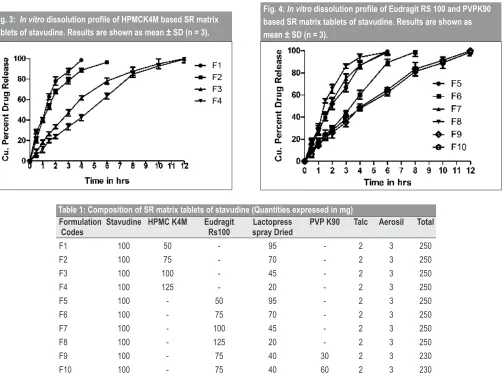
Formulations containing stavudine (100 mg) were prepared by direct compression method using HPMCK4M. The effect of HPMCK4M concentration, on the release of water soluble drug stavudine was studied for SR matrix tablets containing 50, 75, 100 and 125 % of HPMCK4M (F1 to F4). The release rate was found to be decreasing as the concentration of
polymer increased. Formulation F1, F2, F3 and F4 were able to sustain the release upto 4,6,12 and 12 h respectively (Fig. 3). Formulations F1 and F2 underwent erosion before complete swelling could take place, resulting in drug release initially and then sustained the drug release upto 4 and 6 h respectively. In this case, stavudine is a water soluble drug which allows quicker penetration of dissolution fluid into the SR matrix tablet, resulting in quicker release of drug and therefore large amount of polymer was required to sustain the release for 12 h. On increasing the proportion of HPMCK4M (F3 and F4) prolonged release was achieved up to 12 h. The reason for this can be attributed to the formation of a stronger gel layer around the tablet, with few interstitial spaces
14
between the microgels . All the four HPMCK4M based SR matrix tablet formulations showed burst release in first hour. This was due to surface erosion and initial disaggregation of the SR matrix tablet, which occurs due to formation of the gel
15
layer around the tablet core . Formulation F3 was selected as the best formulation keeping in view the minimum amount of HPMCK4M required for sustaining the release up to a period of 12 h.
Formulation Stavudine HPMC K4M Eudragit Lactopress PVP K90 Talc Aerosil Total
Codes Rs100 spray Dried
F1 100 50 - 95 - 2 3 250
F2 100 75 - 70 - 2 3 250
F3 100 100 - 45 - 2 3 250
F4 100 125 - 20 - 2 3 250
F5 100 - 50 95 - 2 3 250
F6 100 - 75 70 - 2 3 250
F7 100 - 100 45 - 2 3 250
F8 100 - 125 20 - 2 3 250
F9 100 - 75 40 30 2 3 230
F10 100 - 75 40 60 2 3 230
Table 1: Composition of SR matrix tablets of stavudine (Quantities expressed in mg)
Fig. 3: In vitro dissolution profile of HPMCK4M based SR matrix
tablets of stavudine. Results are shown as mean ± SD (n = 3).
Fig. 4: In vitro dissolution profile of Eudragit RS 100 and PVPK90
In vitro release kinetics:
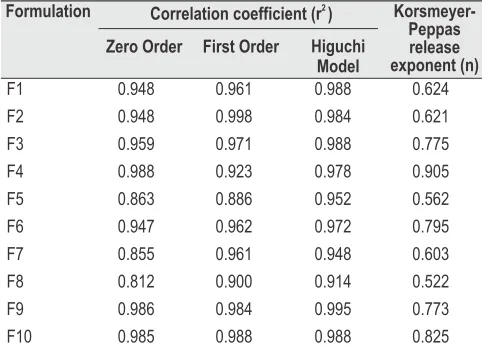
In this selected formulation F3, the calculated regression coefficients for higuchi, zero order and first order models were 0.988, 0.971 and 0.951 respectively. Therefore the release seems to fit the higuchi model. To explore the release pattern, results of the In Vitro dissolution data were fitted to
stable. Mean thickness was 3.4 mm and friability values were in the range of 0.7 % and 0.9 %, which ensures loss of material from the surface or edge of tablets was within the permissible limit and it also suggests good handling properties. All the formulations passed weight variation test which is an indicative of good flowability. The drug content was estimated and the percent of drug content values of each tablet were given in table 3. Higher drug content for all formulations indicates uniform mixing of drug with polymers and excipients. Incorporation of PVPK90 to the above Eudragit RS 100 based formulations exhibited a slight increase in the hardness of the SR tablets (Table 3).
In vitro drug release Eudragit RS100 based Stavudine SR tablets:
Stavudine release from Eudragit RS100 SR matrix tablet was studied in the phosphate buffer pH 7.4 for 12 h. Varying concentrations of Eudragit RS100 (F5, F6, F7, F8) was incorporated in SR tablets. The formulation F5 containing 50 % Eudragit RS100, sustained the drug release only up to 4 h but when the amount of Eudragit RS100 was increased to 75 %, the drug release was further sustained up to 6 h (Fig. 4). This may be attributed to decreased penetration of the solvent
*Mean ± SD, n = 6
Formulation Hardness* Thickness * Friability *Drug Content *Weight
2
(Kg/cm ) (mm) (%) (%) variation
F1 5.5 ± 0.4 3.38 ± 0.6 0.3 ± 0.1 99.38 ± 0.15 249 (4.56) F2 5.8 ± 0.6 3.33 ± 0.5 0.8 ± 0.1 98.89 ± 0.19 251 (3.38) F3 5.6 ± 0.6 3.33 ± 0.4 0.7 ± 0.2 98.23 ± 0.17 248 (3.19) F4 5.7 ± 0.5 3.33 ± 0.4 0.9 ± 0.1 99.38 ± 0.15 250 (2.34) F5 5.5 ± 0.4 3.43 ± 0.6 0.9 ± 0.1 100.38 ± 0.15 249 (4.15) F6 5.8 ± 0.6 3.43 ± 0.5 0.8 ± 0.1 98.89 ± 0.19 248 (2.68) F7 5.7 ± 0.5 3.43 ± 0.4 0.7 ± 0.1 99 ± 0.17 251 (5.32) F8 5.7 ± 0.5 3.43 ± 0.4 0.7 ± 0.2 99.38 ± 0.15 252 (4.21) F9 6.3 ± 0.4 3.43 ± 0.6 0.9 ± 0.1 99.38 ± 0.15 253 (3.89) F10 6.2 ± 0.6 3.43 ± 0.5 0.8 ± 0.1 98.89 ± 0.19 248 (4.36)
Table 3: Physical characterization of SR tablets of Stavudine
Formulation Angle of Hausner's Carr's Index
codes Repose (θ)* Ratio (H. R)* (C.I)*
Stavudine 30.7 ± 1.2 1.32 ± 0.08 23.45 ± 1.34 F1 25.46 ± 0.32 1.17 ± 0.02 18.89 ± 0.54 F2 24.39 ± 0.21 1.17 ± 0.02 19.92 ± 0.53 F3 23.69 ± 0.34 1.19 ± 0.03 16.23 ± 0.67 F4 21.03 ± 0.98 1.18 ± 0.02 18.96 ± 0.59 F5 23.62 ± 0.02 1.16 ± 0.01 18.01 ± 0.49 F6 22.89 ± 0.11 1.16 ± 0.01 17.14 ± 0.51 F7 23.32 ± 0.87 1.18 ± 0.02 19.97 ± 0.43 F8 21.41 ± 0.78 1.18 ± 0.02 19.21 ± 0.46 F9 21.81 ± 0.07 1.17 ± 0.01 18.47 ± 0.51 F10 24.12 ± 1.54 1.21 ± 0.05 18.56 ± 1.2
Table 2: Micromeritic properties of direct compression formulations
*Mean ± SD, n = 6
F1 0.948 0.961 0.988 0.624
F2 0.948 0.998 0.984 0.621
F3 0.959 0.971 0.988 0.775
F4 0.988 0.923 0.978 0.905
F5 0.863 0.886 0.952 0.562
F6 0.947 0.962 0.972 0.795
F7 0.855 0.961 0.948 0.603
F8 0.812 0.900 0.914 0.522
F9 0.986 0.984 0.995 0.773
F10 0.985 0.988 0.988 0.825
Formulation
Zero Order First Order Higuchi Model
Korsmeyer-Peppas release exponent (n)
2
Correlation coefficient (r )
Table 4: In-Vitro release kinetics of Stavudine from SR matrix tablets
Korsmeyer and Peppas equation, which characterizes the transport mechanism. The value of the release exponent for the optimized formulation F3 was 0.775 indicating release governed by non-fickian diffusion. The details are summarized in table 4.
Evaluation of Eudragit RS100 based Stavudine SR tablets
Quality control tests:
All the batches were produced under similar conditions to avoid processing variables. The SR matrix tablets of Stavudine were prepared with Eudragit RS 100 at the percentage of 50, 75, 100, and 125 % of the drug as shown in table 1. The hardness of the tablet was in the range of 5.5 to 6.3
2
*Mean ± SD, n = 6
Formulation Type of packagings Drug Content (%)*
0 days 15 days 1 month 2 month 3 month
F3 Strip packed 98.23 ± 0.17 98.32 ± 0.35 98.32 ± 1.11 97.82 ± 0.65 97.92 ± 0.45 unpacked 98.23 ± 0.17 98.22 ± 0.67 98.42 ± 0.38 98.72 ± 0.78 99.12 ± 0.29 F9 Strip packed 99.38 ± 0.15 99.38 ± 0.87 99.38 ± 0.73 99.56 ± 0.26 99.59 ± 1.13 unpacked 99.38 ± 0.15 99.13 ± 0.39 99.13 ± 0.65 98.93 ± 0.56 99.67 ± 0.56
Table 5: Stability data of the optimized formulations F3 and F9*
molecules in the presence of the hydrophobic polymer, leading to reduced diffusion of the drug from the matrix. Further, when the amount of Eudragit RS 100 was increased as in formulation F7 and F8, interestingly the drug release increased instead of decreasing. The reason might be that its large hydrophobic molecules imposed a discontinuity in the
16
gel-structure leading to formation of a weaker barrier . These tablets could not maintain their matrixintegrity for more than 4 h and was not able to sustain the release of stavudine. Hence a dry binder PVPK90 was added to the above formulation F6 in two different proportions i.e. 30 and 60 % to improve the matrix integrity of the stavudine SR matrix tablet. The formulations with PVPK90 (F9 and F10) showed sustained release upto 12 h. Addition of PVPK90 assisted in maintaining matrix integrity and contributed in sustained release of stavudine up to 12 h. Hence keeping in view the minimum amount of PVP K90, formulation F9 was selected as the best formulation.
In vitro release kinetics:
In this selected formulation F9, the calculated regression coefficients for Higuchi, Zero order and first order models were 0.995, 0.986 and 0.984 respectively. Therefore the release seems to fit the Higuchi model. To explore the release pattern, results of the In vitro dissolution data were fitted to Korsmeyer and Peppas equation, which characterizes the transport mechanism. The value of the release exponent for the optimized formulation F9 was 0.773 indicating release governed by non-fickian diffusion. The details are summarized in table 4.
Stability analysis:
Stability studies as per ICH guidelines showed that there is no significant change in drug content of the optimized formulations F3 and F9 in strip packed and unpacked conditions. Statistically no significant difference was observed in drug content of F3 (p < 0.05, F cal = 0.1581 and F crit 6.3882) during 3 months of stability study. Similarly no significant difference was observed between the drug content of strip packed and unpacked SR tablets (p < 0.05, F cal = 2.5417 and F crit 7.7086). In case of formulation F9 statistically no significant difference was observed in drug
content (p < 0.05, F cal = 1.407 and F Crit 6.3882) during 3 months of stability study. Similarly no significant difference was observed in the drug content between strip packed and unpacked SR tablets (p < 0.05, F cal = 2 .865 and F crit 7.7086).
CONCLUSION
Results of the present study demonstrated that SR matrix of stavudine prepared with HPMC K4M could control the release effectively for 12 h. But Eudragit RS 100 based SR matrix tablets could not sustain the release for more than 6 h. Incorporation PVPK 90 as a dry binder to the above formulations of Eudragit RS100 proved to be useful to control the drug release for 12 h. Hence both HPMCK4M and Eudragit RS100 can be used suitably to sustain the release of hydrophilic drug stavudine for 12 h.
REFERENCES
1. Lea AP, Faulds D. Stavudine: A review of its pharmacodynamics and pharmacokinetics properties and chemical potential in HIV infection. Drugs 1996;51(5):846-64.
2. Huang P, Farquhar D, Plunkett W. Selective action of 2',3'- didehydro-2',3'-dideoxythymidine triphosphate on human immuno deficiency virus reverse transcriptase and human DNA polymerases. J. Biol. Chem 1982; 267(4):1817-22.
rd
3. Sweetman SC, Martindale: The complete reference. 33 ed. London: Pharmaceutical Press; 2002. 641.
4. Salsa T, Veiga F, Pina ME. Oral controlled-release dosage forms. I. Cellulose ether polymers in hydrophilic matrices. Drug Dev Ind Pharm 1997;23(9): 929-38.
5. Alderman DA. A review of cellulose ethers in hydrophilic matrices for oral controlled-release dosage forms. Int J Pharm Tech Prod Mfr 1984; 5(3):1-9.
th 6. Rowe RC, Showsky PJ. Hand book of pharmaceutical excipients. 6
ed. Pharmaceutical Press, 2011. 326-29.
7. Fu XU, Wang GP, Liang WQ, Chow MSS. Prediction of drug release from HPMC matrices: effect of physicochemical properties of drug and polymer concentration. J Control Rel 2004; 95(2):209–16.
9. USP Asian edition, USPNF The official compendia of standards Vol-1 2008. 362-4.
10. Wells JI, Aulton ME. Pharmaceutical Preformulation. In: Aulton ME. (eds) Aulton's Pharmaceutics. The design and manufacture of
rd
medicines.3 ed. New York: ELBS Churchill Livingstone Elsevier; 2007. 355-7.
11. Higuchi T. Mechanism of sustained-action medication. Theoretical analysis of rate of release of solid drugs dispersed in solid matrices. J Pharm Sci 1963; 52(12): 1145–9.
12. Korsmeyer RW, Gurny R, Docler E, Buri P, Peppas NA. Mechanism of solute release from porous hydrophilic polymers. Int J Pharm 1983;15(1) 25–35.
13. Jain SK, Awasthi AM, Jain NK, Agrawal GP. Calcium silicate based microspheres of repaglinide for gastroretentive floating drug delivery: Preparation and in vitro characterization. J Control Rel2005; 107(2): 300– 9.
14. Jivraj M, Martini LG, Thomson CM. An overview of different excipients useful for direct compression of tablets. Pharm. Sci. Technol. Today 2000; 3(2): 58-63.
15. Ebude NK, Hikal A, Wyandt CM, Beer DC, Miller LG, Jones AB. Sustained release of acetaminophen from heterogenous matrix tablets: Influence of polymer ratio, polymer loading and co-active on drug release. Pharm Dev Technol 1997; 2(2): 161-70.
16. Enayatifard R, Saeedi M, Akbari J, Tabatabaee HY. Effect of Hydroxypropyl methylcellulose and Ethyl cellulose content on release profile and kinetics of diltiazem HCl from matrices. Trop J Pharm Res 2009; 8(5):425-32.