University of New Orleans University of New Orleans
ScholarWorks@UNO
ScholarWorks@UNO
University of New Orleans Theses and
Dissertations Dissertations and Theses
Fall 12-2014
Security Analysis on Network Systems Based on Some Stochastic
Security Analysis on Network Systems Based on Some Stochastic
Models
Models
Xiaohu Li [email protected]
Follow this and additional works at: https://scholarworks.uno.edu/td
Part of the Applied Statistics Commons, Industrial Engineering Commons, Probability Commons, Risk Analysis Commons, and the Systems Engineering Commons
Recommended Citation Recommended Citation
Li, Xiaohu, "Security Analysis on Network Systems Based on Some Stochastic Models" (2014). University of New Orleans Theses and Dissertations. 1931.
https://scholarworks.uno.edu/td/1931
Security Analysis on Network Systems
Based on Some Stochastic Models
A Dissertation
Submitted to the Graduate Faculty of the University of New Orleans
in partial fulfillment of the requirements for the degree of
Doctor of Engineering and Applied Science in
Mathematics
by
Xiaohu Li
Ph.D. University of New Orleans, 2014
Acknowledgments
I would like to give my sincere gratitude toward Professor Linxiong Li, who generously
spent numerous afternoons in the past two years on discussing lots of details in this
dissertation. Professor Li also read through the earlier draft of this dissertation with
great patience and presented many valuable suggestions, without which, I believe, there
is still a long way for it to take the present form. As a respectable professor, Dr. Li taught
me quite a lot in statistical science; As a faith-worthy friend, Dr. Li also helped me to
deal with other things in my campus life.
I would like to thank other four committee members,
Professor Tumulesh Solanky Department of Mathematics, College of Sciences, Uni-versity of New Orleans
Professor Jairo Santanilla Department of Mathematics, College of Sciences, Univer-sity of New Orleans
Professor Xiaorong Li Department of Electrical Engineering, College of Engineering, University of New Orleans
Associate Professor Nikolas I. Xiros Department of Naval Architecture and Marine Engineering, College of Engineering, University of New Orleans
I would like to extend my thank to those faculties who brought me into the world of
statistics and engineering through teaching the interesting graduate courses. Besides, I
want to address the gratitude to several of graduate students in China, their studious
effort to pursue academic excellence is always the main driving force of my research work
in reliability, security and risk management.
Finally, I am deeply grateful to my wife, Xiao Zhou, for her continuous support, kind
assistance and great patience and to my brother and sisters for taking care of my parents
in the past two decades. I dedicate this dissertation to my parents.
Xiaohu Li
Department of Mathematics
University of New Orleans
New Orleans LA 70148
Contents
Abstract viii
1 Introduction and Preliminaries 1
1.1 Introduction . . . 1
1.1.1 Peer to peer network . . . 2
1.1.2 Vulnerable network . . . 4
1.2 Preliminaries . . . 8
1.2.1 Important notations . . . 8
1.2.2 Several aging properties . . . 8
1.2.3 Some stochastic orders . . . 9
1.2.4 The k-out-of-n structure . . . 11
1.3 Archimedean copula . . . 12
1.4 Summary . . . 14
2 Resilience Analysis of P2P Network Systems 15 2.1 Introduction . . . 15
2.2 Model description . . . 16
2.3 Resilience analysis . . . 19
2.4 Reliability analysis . . . 24
2.4.2 Stochastic monotonicity . . . 26
2.5 Interdependence among users lifetimes . . . 27
2.6 Identifying the NWUE order . . . 29
2.6.1 Graphical method based on TTT plot . . . 30
2.6.2 A nonparametric test . . . 35
2.6.3 Concluding remarks . . . 39
3 Security Analysis of Compromised-Neighbor-Tolerant Networks 41 3.1 Introduction . . . 41
3.2 The model . . . 43
3.3 Main analytical results . . . 47
3.3.1 Equation of the probability to be compromised . . . 47
3.3.2 Impact of topology on vulnerability graph . . . 51
3.4 Probability bounds . . . 57
3.5 Concluding remarks and future work . . . 64
A R codes 66 A.1 Codes to produce TTT plot in Figure 2.4 . . . 66
A.2 Codes to produce TTT plot in Figure 2.5 . . . 67
B Mathematica codes 69 B.1 Codes to plot upper/lower bounds in Figure 3.2 . . . 69
B.2 Codes to plot lower bounds in Figure 3.2 . . . 70
B.3 Codes to plot upper bounds in Figure 3.3 . . . 70
Bibliography 79
List of Figures
1.1 A server based network . . . 3
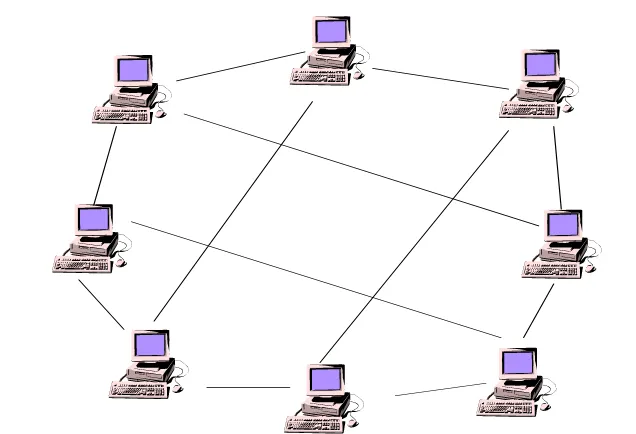
1.2 A P2P based network . . . 3
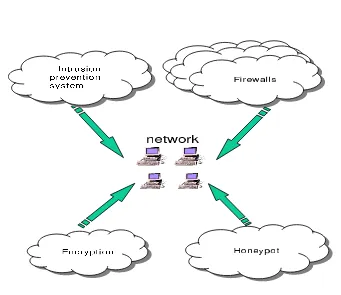
1.3 A depiction of a vulnerable network with security components . . . 5
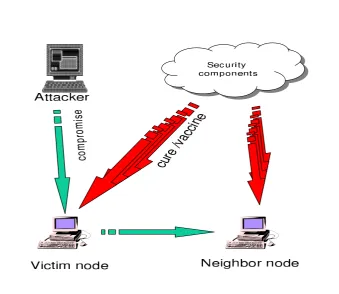
1.4 A depiction of a vulnerable network with security components . . . 7
2.1 A typical depiction of a node with 3-out-of-6 structure . . . 17
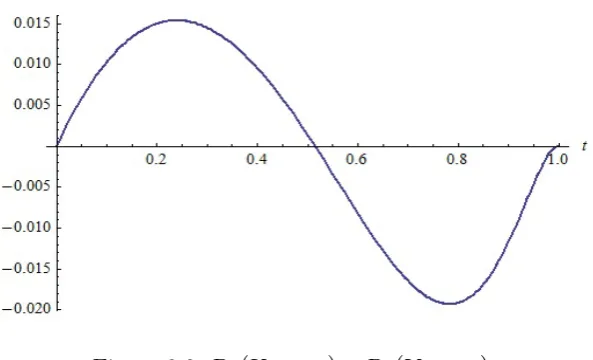
2.2 Pr(U2:3 ≤t ) −Pr(V2:3 ≤t ) . . . 30
2.3 Scaled TTT plots of Pareto distributions withα= 100, 5, 2, 1.25 . . . 31
2.4 TTT plots of air-conditioning systems in airplane: 8045 (◦), 7909 (•) . . . 32
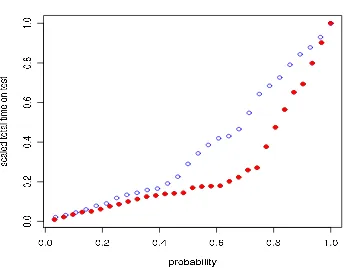
2.5 TTT plots of network chatting systems: Yahoo (◦), Skype (•) . . . 34
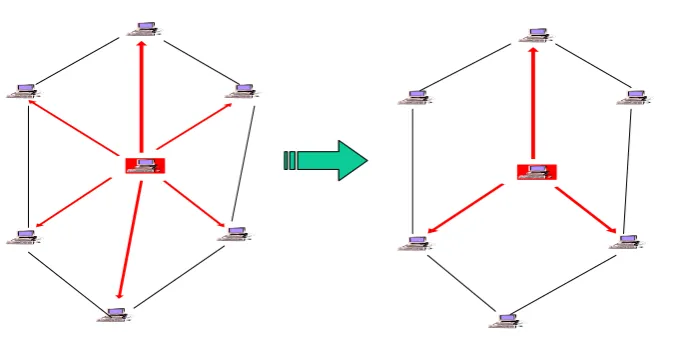
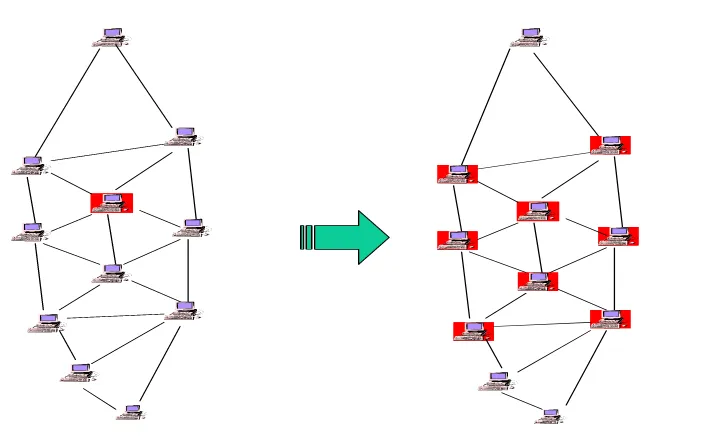
3.1 A depiction of the evolving process of a vulnerable network . . . 44
3.2 Upper bound (top) and lower bound (bottom) by (3.5) . . . 62
List of Tables
2.1 Life times of air-conditioning systems of planes . . . 32
2.2 Times user spend in chatting systems . . . 34
2.3 Statistics on data sets of air-conditioning and network chatting systems . . . 39
Abstract
Due to great effort from mathematicians, physicists and computer scientists, network
science has attained rapid development during the past decades. However, because of the
complexity, most researches in this area are conducted only based upon experiments and
simulations, it is critical to do research based on theoretical results so as to gain more
insight on how the structure of a network affects the security. This dissertation introduces
some stochastic and statistical models on certain networks and uses a k-out-of-n tolerant
structure to characterize both logically and physically the behavior of nodes. Based upon
these models, we draw several illuminating results in the following two aspects, which are
consistent with what computer scientists have observed in either practical situations or
experimental studies.
Suppose that the node in a P2P network loses the designed function or service when
some of its neighbors are disconnected. By studying the isolation probability and the
durable time of a single user, we prove that the network with the user’s lifetime having
more NWUE-ness is more resilient in the sense of having a smaller probability to be
iso-lated by neighbors and longer time to be online without being interrupted. Meanwhile,
some preservation properties are also studied for the durable time of a network.
Addition-ally, in order to apply the model in practice, both graphical and nonparametric statistical
methods are developed and are employed to a real data set.
network systems based on their vulnerability graph abstractions. A node loses its designed
function when certain number of its neighbors arecompromised in the sense of being taken over by the malicious codes or the hacker. The attack compromises some nodes, and the
victimized nodes become accomplices. We derived an equation to solve the probability
for a node to be compromised in a network. Since this equation has no explicit solution,
we also established new lower and upper bounds for the probability.
The two models proposed herewith generalize existing models in the literature, the
corresponding theoretical results effectively improve those known results and hence carry
an insight on designing a more secure system and enhancing the security of an existing
system.
Key words: Durable time; Exponential distribution; Harmonic mean; Increasing convex order;
Isolation probability; Jackknifing;
k-out-of-n; NWUE;
Pareto distribution; Power law distribution;
Stochastic orders; Random graph;
TTT plot; U-statistic
1
Introduction and Preliminaries
1.1 Introduction
Computer and network security has become a rather popular and important topic in
the past two decades. A simple Google search based on the keyword “computer and
network security” showed 27.8 million items on September 25, 2014. In general, network
security mainly aims to protect the entire infrastructure of a network system as well
as its corresponding services from unauthorized access. There are several fundamental
components in network security:
(i) Security-specific infrastructures, such as hardware- and software-based fire-walls and
physical security approaches;
(ii) Security polices, which include security protocols, users authentications,
authoriza-tions, access controls, information integrity and confidentiality;
(iii) Detection of malicious programs, including anti-viruses, worms, or Trojan horses,
and spyware or malware;
(iv) Intrusion detection and prevention, which encompasses network traffic surveillance
Since the topic of network security links a great number of research areas and
disci-plines, we will investigate the role the infrastructures of a network plays in the system’s
security based upon some stochastic models. For an overall introduction on network
se-curity, including key tools and technologies used to secure network access, please refer to
Malik (2003) and Laet and Schauwers (2005).
1.1.1
Peer to peer network
As a decentralized structure, a Peer-to-Peer (P2P) computer network utilizes diverse
connectivity among users participating a network and the cumulative bandwidth of them
rather than conventional centralized resources where a relatively low number of servers
play the key role in providing a service or application.
P2P networks, which are usually used for connecting nodes through largely ad hoc
connections, are useful for many purposes. Sharing content files containing audio, video,
data or anything in digital format and real time data. P2P networks can be classified by
what they can be used for: (i) file sharing, (ii) telephony, (iii) media streaming (audio,
video), and (iv) discussion forums etc.
A pure P2P network does not have any clients or servers but only equal peer nodes
that function as both “clients” and “servers” simultaneously to the other nodes in the
network (see Figure 1.1.1). This structure of network differs from the client-server model
where communication is mostly between the node and a central server (see Figure 1.1.1).
As a typical example, an FTP server transfers file in a manner totally different from
that a P2P network does. Actually, the client and server programs in an FTP server are
quite distinct, the clients initiate the download/uploads, and the servers offer the service
according to these requests.
Besides the pure P2P network, there are quite a lot of Hybrid P2P networks. For
Figure 1.1: A server based network
a client-server form. To disseminate Usenet news articles over the entire Usenet network,
news servers communicated with each other. However, the news server system acts in
a client-server style when individual users access a local news server to deal with news.
As another example, in an SMTP email system, the core email relaying network of mail
transfer agents from a P2P model while the periphery of Mail user agents and their
direct connections is client-server. On the other hand, some other networks, for example,
Napster, OpenNAP and IRC, use a client-server structure for some tasks (e.g. searching)
and a P2P structure for others.
Currently, P2P structure rapidly evolves and is widely used in distributed networks
not only computer to computer but also human to human. Without any server, a node in
P2P network mainly relies upon connections from its neighbors to operate correctly and
losing some connections implies the failure of this node, it is very important to study its
resilience and reliability. Leonard et al (2007) built the lifetime model for a P2P network,
it is assumed that the node is isolated when it is physically disconnected from all its
neighbors, that is, all connections are broken. In Chapter 2, we study the resilience of
the pure P2P network through a new lifetime model, which is a generalization of that
proposed by Leonard et al (2007) in the sense that a node loses the function and service
if and only if some of its neighbor nodes are disconnected, this enable the new model
to include both physical and logical isolation and hence to be more useful in practical
situations. We derive the probability for a node to be isolated and the expected dural
time, and show that the more heavier the tail of probability of the lifetime is, the more
resilient the P2P network is.
1.1.2
Vulnerable network
With the rapid development of computer, this world gets more involved into networks.
network and hence result in hazardous loss in business. In fact, the past two decades
witnessed numerous such kind of cases. This fundamentally attributes to vulnerability of
networks and it is rather urgent to study the network security so as to effectively defense
the network from being invaded.
Network security usually consists of those provisions made in an underlying computer
network topology, policies adopted by the network administrator to protect the network,
the network-accessible resources from unauthorized access, and consistent and continuous
monitoring to measure its effectiveness.
Figure 1.3: A depiction of a vulnerable network with security components
Network security originates from authenticating all user a username and a password.
After the authentication, a fire wall is employed to enforce access policies which control
from being accessed without being authorized, however, this component fails to check
potentially harmful contents such as computer worms and virus being disseminated over
the network. In order to screen these malicious codes, an intrusion prevention system
(IPS) (see Mirkovic et al, 2004) is designed to detect and prevent such malware from
invading the network. Additionally, IPS also monitors for suspicious network traffic for
contents, volume and anomalies so as to protect the network from being attacked by
denial of service. On the other hand, to keep privacy, communication between two host
nodes in the network is encrypted as well. Meanwhile, all individual events occurred in the
network are tracked and audited for a later high level analysis. Besides, as surveillance and
early-warning tools, Honeypots (see Grimes, R. A., 2005) essentially decoying
network-accessible resources is also deployed in a network. Techniques employed by attackers
attempting to compromise any decoy resources are studied during and after an attack to
keep an eye on those new exploitation techniques. Such analysis could be used to further
tighten security of the actual network being protected by the honey pot.
For a comprehensive summary of standard concepts and methods in network security,
please refer to Curtin (1997) and Simmonds et al (2004), which presents all notions and
techniques in the form of an extensible ontology of network security attacks.
In Chapter 3, the network is abstracted as a vulnerable graph, which is composed
of nodes (users) and edges (connections). In order to model the infrastructure of the
network, a node of the graph is always assumed to have a random degree representing its
neighbors. Since our aim is to investigate how the random degree has an impact on the
network security, an attack outside the network is supposed to attempt to compromise
nodes all the time and any compromised nodes become his accomplices in the sense
of having the capability of compromising their neighbors. On the other hand, due to
these security components deployed over the network, the attacker only penetrates the
after being compromised and hence become secure after being disinfected. Likewise, to
make our model more multifunctional, it is also assumed that a node is compromised only
when at lease some prefixed number of neighbors are infected. This model is an substantial
extension of that studied by Li et al (2011). In effect, we proved that the probability for a
node to be compromised is increasing as the random degree grows in the increasing convex
order. Among others, new lower and upper bounds are also built for the probability to
be compromised, evaluations reveals that they are better than those developed in Li et
al (2011). The main result shows that power law graph is more vulnerable than both the
random graph and the regular graph.
1.2 Preliminaries
For ease of references, let us recall some fundamental yet important concepts on aging
property and stochastic ordering, which will be employed to characterize network systems
in the following chapters.
Throughout this dissertation, the term increasing is used instead of monotone non-decreasing and the term decreasing is used instead of monotone non-increasing. We also assume that all random variables under consideration have 0 as the common left end
point of their supports, and all random variables are implicitly assumed to be absolutely
continuous.
1.2.1
Important notations
1.2.2
Several aging properties
For a nonnegative random variable X with distribution function F and the reliability
function ¯F = 1−F, let
Xt =X−t|X > t
be the residual lifetime of X at time t≥0, the mean residual lifetime
µF(t) = E[X−t|X > t] =
∫ ∞
t
¯ F(x) dx ¯
F(t) .
Definition 1.2.1 A random lifetime X is said to be of
(i) increasing failure rate (IFR) if the cumulative failure rate −ln ¯F(t) is convex with respect tot ≥0;
star-shaped with respect to t≥0, that is, −1tlog ¯F(t) is increasing int ≥0;
(iii) decreasing mean residual life (DMRL) if µF(s)≥µF(t) for all t≥s≥0;
(iv) new better than used in expectation (NBUE) if µF(t)≤µF(0) for all t≥0.
Reversing the monotone property and the inequality above, we get their dual versions:
DFR (decreasing failure rate), DFRA (decreasing failure rate in average), IMRL
(increas-ing mean residual life) and NWUE (new better than used in expectation). The follow(increas-ing
chain of implications is well-known,
IF R(DF R) =⇒IF RA(DF RA) =⇒DM RL(IM RL) =⇒N BU E(N W U E).
For more details on these nonparametric aging properties, please refer Barlow and
Proschan (1981), Lai and Xie (2006).
1.2.3
Some stochastic orders
For two nonnegative random variableX andY with distribution functionsF and G, and
reliability function ¯F = 1−F and ¯G = 1−G, denote F−1 and G−1 the corresponding
right continuous inverses ofF and G respectively.
Definition 1.2.2 X is said to be smaller than Y in the
(i) hazard rate order (denoted byX ≤hr Y) if ¯F(t)/G(t) is decreasing in¯ t ≥0;
(ii) stochastic order(denoted as X ≤st Y) if Pr(X > t)≤Pr(Y > t) for allt;
(iii) increasing convex order (denoted as X ≤icx Y) if
∫ ∞
t
Pr(X > x) dx≤ ∫ ∞
t
(iv) harmonic mean residual life order (denoted by X ≤hmrl Y) if, for all t ≥0, [ 1 t ∫ t 0 1 µF(u)
du ]−1
≤ [ 1 t ∫ t 0 1 µG(u)
du ]−1
,
for which the expectations exist.
(v) convex order (denoted by X ≤cx Y) if E[ϕ(X)]≤E[ϕ(Y)] for any convex ϕ.
It holds evidently that
X ≤hrY =⇒X ≤st Y =⇒X ≤icx Y =⇒X≤cx Y.
Kochar and Wiens (1987) proposed a partial order to compare the NBUE-ness of two
life distributions. Since NBUE and NWUE are dual with each other, for convenience, we
call it the NWUE order.
Definition 1.2.3 X is said to be more NWUE than Y (denoted byX ≥nwue Y) if
µF
(
F−1(v)) µG
(
G−1(v)) ≥
µF
µG
, for all v ∈(0,1). (1.1)
As a function of v ∈(0,1),
∫ F−1(v)
0
¯ F(t) dt
is the well-known total time on test (TTT) transform of the distribution F of a random lifetime X. The scaled TTT transform
φ−F1(v) = 1 µF
∫ F−1(v)
0
¯ F(t) dt
plays an important role in characterizing aging property of random lifetime. One may see
Recently, Kochar et al. (2002) proposed a new partial order: X is said to be larger
than Y in the total time on test transformorder (denoted by X ≤tttY) if
∫ F−1(v)
0
¯
F(x) dx≥
∫ G−1(v)
0
¯
G(x) dx, for all v ∈(0,1).
These two stochastic orders mentioned above have a close relation in the sense that when
E[X] =E[Y], X ≥nwueY is equivalent to X ≥ttt Y.
Readers may refer to M¨uller and Stoyan (2002), Shaked and Shanthikumar (2007),
and Li and Li (2013) for more details on these stochastic orders.
1.2.4
The
k
-out-of-
n
structure
Let X1, X2,· · ·, Xn denote n independent component lifetimes with Xi,n being the i-th
order statistic, here i = 1,· · · , n. A k-out-of-n system of these components functions if
and only if at leastkcomponents function. Whenk =n, the system has a series structure
with lifetime
Xn,n = min{X1,· · · , Xn};
whereas for k = 1, it reduces to a parallel structure with lifetime
X1,n = max{X1,· · · , Xn}.
Thus, ak-out-of-n system is more general than either a series or a parallel structure. The
lifetime of this system is simply given by the order statistic Xn−k+1:n.
As a fault-tolerant structure, the k-out-of-n system is widely used in many
practi-cal situations, including, for example, electronic engineering, manufacturing and defense
industry etc. One may refer to Kuo and Zuo (2006) and Lai and Xie (2006) for
to describe a network which is tolerant to some compromised neighbors due to anti-virus
software.
1.3 Archimedean copula
Mutual independence among multiple random variables is common in reliability and risk
management. The interdependence among components’ lifetimes, random risks, and
po-tential loss/returns etc. cannot be ignored in practical situations. In classical statistical
theory, Pearson’s correlation coefficient is usually utilized to measure the dependence
among random variables. In Chapter 2 we will instead employ copula, a functional
mea-sure, to characterize the association among network users’ lifetimes.
For a random vector X = (X1, . . . , Xn) with joint distribution function F, survival
function ¯F and univariate marginal distribution functionsF1, . . . , Fn, itscopula is defined
as
CX(u1,· · · , un) = F
(
F1−1(u1),· · · , Fn−1(un)
)
, 0< u1,· · ·, un <1.
In parallel, thesurvival copula is b
CX(u1,· · · , un) = ¯F
(¯
F1−1(u1),· · · ,F¯n−1(un)
)
, 0< u1,· · ·, un <1.
Since the copula does not contain any information of marginal distributions, it provides
us with a rather convenient way to impose a dependence structure onto predetermined
marginal distributions in practice. Actually a large number of excellent applications
of copulas can be found in various areas, and so far copula has become more or less
a standard tool in risk management, finance, econometrics and actuarial science etc.
Recently, Copulas are being used for reliability analysis of complex systems of machine
and Hong (2003), and copula functions have been successfully applied to the database
formulation for the reliability analysis of highway bridges, and to various multivariate
simulation studies in civil, mechanical and offshore engineering, see for example Thompson
and Kilgore(2011). In literature on statistics, there are a large number of copulas depicting
various dependence structures, Hutchinson and Lai (1990) and Nelsen (2006) provide a
wide range families of bivariate copulas along with their properties. In the past twenty
years, Archimedean copulas became particularly popular because of its mathematical
tractability and the capability of capturing wide ranges of dependence. Notably, since
the statistical inference on Archimedean copulas has got well developed in this decade,
excellent applications are coming to the fore in various areas.
Definition 1.3.1 (McNeil and Ne˘slehov´a (2009)) For a non-increasing and contin-uous function ϕ : [0,+∞) 7→ [0,1] such that ϕ(0) = 1 and ϕ(+∞) = 0, let ψ = ϕ−1 be
the pseudo-inverse,
Cϕ(u1,· · · , un) =ϕ
(
ψ(u1) +· · ·+ψ(un)
)
, for (u1,· · · , un)∈[0,1]n, (1.2)
is called anArchimedean copulawith the generatorϕif (−1)kϕ(k)(x)≥0 fork= 0, . . . , n−
2 and (−1)n−2ϕ(n−2)(x) is non-increasing and convex.
The generatorϕis said to be strict ifϕ(+∞) = 0. As is well-known, the Archimedean family contains a plenty of useful copulas, including some well-known ones. For example,
the independence (product) copula C1(u) =
∏n
i=1ui with the generator ϕ(t) = e−t, the
Clayton copula
C2(u) =
(∏n
i=1
with the generator ϕ(t) = (θt+ 1)−1/θ for θ≥0, and the Ali-Mikhail-Haq (AMH) copula
C3(u) =
(1−θ)
n
∏
i=1
ui
n
∏
i=1
(1−θ+θui)−θ n
∏
i=1
ui
.
with the generator ϕ(t) = e1t−−θθ for θ∈[0,1). For more on copula and its applications, we
refer readers to Joe (1997) and Nelsen (2006).
1.4 Summary
Resilience analysis of P2P network
By studying the isolation probability and the durable time of a single user, we conduct
resilience and reliability analysis of the P2P network, which is widely used in
commu-nication systems in recent several years due to the decentralized property. It is proved
that the network with the user’s lifetime having more NWUE-ness is more resilient. Both
graphical and nonparametric statistical methods are developed to test the NWUE order
between two real data sets.
Security analysis of networks
A stochastic model is introduced to investigate security of network systems based on
their vulnerability graph abstractions. Instead of doing traditional security analysis, we
employ the increasing convex ordering to study the underlying vulnerability graph, the
main theoretical results carry an insight on designing a more secure system and enhancing
2
Resilience Analysis of P2P Network
Systems
2.1 Introduction
Peer-to-Peer (P2P) internet network allows a group of computer users equipped with the
same networking program to connect with each other for the purpose of directly accessing
files from one another’s hard drives. A P2P network functions by connecting individual
computers together to share files instead of going through a central server. P2P networks
can be classified by what they can be used for, for instance, content delivery, file sharing,
telephony, media streaming (audio, video) and discussion forums etc. In the current study
of P2P networks, Kaashoek and Karger (2003) and Stoica et al. (2001) investigate the
single-node isolation, Aspnes et al. (2002), Ganesh and Massoulie (2003), Gummadi et al.
(2003), and Massouli´e (2003) etc discuss the disconnection of the entire graph. Bhagwan
et al. (2003) is among the first to pay attention to the more realistic P2P failure models, in
which the intrinsic behavior of internet users is taken into account and the departments
of users depend on more complex factors including their attention span and browsing
habits, and so on, other than the traditional simple binary metric. In order to investigate
model based on users’ lifetimes and studies the stochastic resilience of P2P networks, in
which an user stays online for random periods of time till all his neighbors go off line or
he leaves the network on his own initiative. In this model, the random lifetime that an
arriving user will stay on line reflects both the behavior of the user itself and the duration
of its service to the entire P2P network community.
This chapter proposes a more general P2P network model, in which an user is isolated
only when a number of its neighbors leave the network and hence the P2P model in
Leonard et al. (2005) is included as a special case. We further investigate both the
stochastic resilience and reliability properties of this new model. It is proved that the
network with the user’s lifetime having more NWUE-ness is more resilient. The rest
of this paper is organized as below: Section 2 introduces the new P2P network model.
Section 3 studies the stochastic resilience by using the isolation probability of a single
user, and Section 4 discusses some reliability properties of the available time of a single
user in the network. Finally, both graphical and nonparametric methods are developed
in section 5 to detect the NWUE order between two data sets. All main conclusions are
consistent with those obtained through experiments in the literature.
2.2 Model description
In this section, we describe our P2P network model in details and present its rationality.
For an internet user, let X, a nonnegative random variable, be the lifetime that stays
online in the network for his own purpose or providing services to other peers. Saroiu et al.
(2002), Bustemante and Qiao (2003) pointed out that the distribution of an user’s lifetime
in practical P2P network very well accords with Pareto distribution, which possesses of
the well-known new worse than used in expectation (NWUE) property (they called it the
found that the distribution of the lifetime of an UNIX process is also Pareto, it was named
there as used better than new in expectation(UBNE) instead of NWUE. Here, we assume a general type of the distribution of the user’s lifetime other than Pareto law so that the
new model not only is suitable for human-based P2P networks but also can be applied to
non-human network systems.
For a new internet user with random lifetime X having the distribution function F,
assume
Figure 2.1: A typical depiction of a node with 3-out-of-6 structure
(i) the P2P network system has operated so long that there is no transient effect, that
is, the expected lifetime of the new user is negligible in contrast to the age of the
whole P2P system;
(ii) when entering the system, the new user randomly (in the sense that each existing
user has the same probability to be selected) picks k neighbors from the existing
nodes in the system as soon as it enters into the system;
(iii) the selection of neighbors is independent of both the lifetime X and the neighbors’
(iv) the time that a new user will spend in the system is independent of those of his
neighbors.
Since the P2P network has operated for a sufficiently long period when the new user
joins the system, it is reasonable to suppose that all those selected neighbors have ˜X, the
equilibrium renewal excess lifetime ofX, as their common residual lifetime, that is,
FX˜(t) =
1 µF
∫ t
0
¯
F(x) dx,
where µF =E[X] and t≥0.
For 1 ≤ r ≤ k, denote ˜Xr the residual lifetime of the r-th neighbor. According to
David and Nagaraja (2003), the order statistic ˜Xr,k, which gives the residual lifetime of
the r-th failed neighbor, has the reliability function
¯
FX˜r,k(t) =
r−1
∑ i=0 ( k i )
[FX˜(t)]i
[¯ FX˜(t)
]k−i
=r (
k r
) ∫ 1
FX˜(t)
ur−1(1−u)k−rdu
and the probability density function
fX˜r,k(t) =
r µ ( k r ) ¯
F(t) [FX˜(t)]r−1
[¯ FX˜(t)
]k−r
.
In the study of passive model in Leonard et al. (2005), a node is considered as isolated
after its last surviving neighbor fails. However, in many realistic environments, neighbors
of a node usually fail to service due to lower performance and in fact it reaches the isolation
state only if there are1 ≤ r ≤ k neighbors in failure. An instantiation of such a case is
that this node is sharing an animation file with its neighbors. Under the condition that
a fraction of its neighbors (not necessary all its neighbors) fail to service, the display of
the animation file is so incoherent that this node can be considered as disconnected. As
or disconnected only when more than r−1 neighbors fail to service. This is in fact the
famous r-out-of-k structure and thus the passive model in Leonard et al. (2005) is the
special case with r =k.
We will investigate the stochastic resilience of this P2P model by using the isolation probability
πr(X) = Pr
(
X >X˜r,k
)
, (2.1)
which denotes the probability that the new node outlives the residual lifetime of itsr-th
neighbor before it decides to leave the system. It is obvious that larger isolation probability
means worse resilience of the P2P network. On the other hand, we will employ
Tr(X) = min
{
X,X˜r,k
}
(2.2)
rather than ˜Xr,k to measure the durable time of a new node in a P2P network. It should
be marked here that Leonard et al. (2005) studies P2P networks by using ˜Xk,k, the time
that all k neighbors of the new node are simultaneously in failure state before it decides
to leave the system. However, as a competition between the lifetime X and the lifetime ˜
Xr,k, Tr(X) takes into account both the failure due to neighbors and that due to the new
user itself, it is more reasonable to serve as a metric to measure the stochastic resilience
of P2P networks.
2.3 Resilience analysis
Resilience analysis of random graphs and various types of deterministic networks has
attracted considerable interest of researchers during the past several decades. For more
details, please refer to Bollob´as (2001), Burtin (1977), and Leighton et al. (1995). Along
the network appears disconnection or demonstrates noticeably lower performance to its
users. Assuming uniformly random node failure, Stoica et al. (2001), Bollob´as (2001),
Gummadi et al. (2003) derive the conditions from different points of view under which
the networks stay connected after some nodes fail.
In this section, we study the resilience of P2P network systems by evaluating the
isolation probability for any given user. As described in Section 2, a node with lifetimeX
is forced to disconnect from the system only if X is greater than ˜Xr,k, 1≤ r≤k. Then,
the isolation probability is
πr(X) = Pr
(˜
Xr,k< X
)
= ∫ ∞
0
Pr(X > t)fX˜r,k(x) dt
= r µk ( k r ) ∫ ∞ 0 ¯ F2(t)
(∫ t
0
¯ F(u) du
)r−1(∫ ∞
t
¯ F(u) du
)k−r
dt. (2.3)
As illustrations, isolation probabilities corresponding to the three popular lifetime
distributions are evaluated in the following examples.
Example 2.3.1 (Pareto distribution) Suppose the user has a lifetimeX with proba-bility distribution
G(x) = 1− (
1 + t β
)−α
, t >0, α >1, β > 0.
Then, for any 1≤r ≤k, the isolation probability
πr(X) =r
( k r
) ( α−1
β
)k∫ ∞
0
( 1+t
β
)−2α[∫ t
0 ( 1+u β )−α du
]r−1[∫
∞ t ( 1+u β )−α du ]k−r
dt = ( k r )
r(α−1) β
∫ ∞
0
( 1 + t
β
)−2α[
1− (
1 + t β
)1−α]r−1(
1 + t β
)(1−α)(k−r)
= (
k r
)
r(α−1) β ∫ ∞ 0 [ 1− ( 1 + t
β
)1−α]r−1(
1 + t β
)(1−α)(k−r)−2α
dt
=r (
k r
) ∫ 1
0
tk−r+αα−1 (1−t)r−1dt (2.4)
= k! (k−r)!
Γ(k−r+ 1 + α α−1
)
Γ(k+ 1 + αα−1) , for any 1≤r≤k.
Example 2.3.2 (Exponential distribution) Suppose the user has a lifetime Y with distribution
F(x) = 1−e−λt, t≥0.
According to (2.3), any new node has the isolation probability
πr(Y) = r
( k r ) λk ∫ ∞ 0
e−2λt λr−1
(
1−e−λt)r−1 1 λk−r
(
e−λt)k−r dt
= r ( k r ) λ ∫ ∞ 0 (
e−λt)k−r+2(1−e−λt)r−1 dt
= r (
k r
) ∫ 1
0
tk−r+1(1−t)r−1dt (2.5)
= k!
(r−1)!(k−r)!
(r−1)!(k−r+ 1)! (k+ 1)!
= k−r+ 1
k+ 1 , for any 1≤r≤k.
Example 2.3.3 (Uniform distribution) Suppose the userZ has a lifetime with uni-form distribution on the interval (0,2µ), that is, the distribution function
H(x) = t
Then, the isolation probability is
πr(Z) =
( k r ) r µk
∫ 2µ
0
( 1− t
2µ
)2[∫ t
0
( 1− u
2µ )
du ]r−1
· [∫ 2µ
t
( 1− u
2µ )
du ]k−r
dt = r µ ( k r
) ∫ 2µ
0
( 2µ−t
2µ )2[
1− (
2µ−t 2µ
)2]r−1(
2µ−x 2µ
)2(k−r)
dt
= r (
k r
) ∫ 1
0
tk−r+12(1−t)r−1dt (2.6)
= k! (k−r)!
Γ(k−r+32) Γ(k+3
2
) , for any 1≤r≤k.
From (2.4), (2.5) and (2.6), we observe the following:
(i) All of the three probabilities of isolation are independent of the expectation of
the user’s lifetime. So, it seems that property of the distribution instead of the
expectation has direct impact on the isolation probability.
(ii) The isolation probability corresponding to Pareto lifetime is the smallest one, the
uniform distribution achieves the largest isolation probability. Thus, we may
con-clude that the P2P network that users has Pareto lifetime is the most resilient one.
Based upon the above two facts, one may wonder whether the isolation probability
preserves some stochastic order on user’s lifetime, that is, πr(X) < πr(Y) holds for X
smaller than Y in some stochastic sense. As a positive answer, Theorem 2.3.4 below
asserts that a P2P network with users’ lifetime having a stronger NWUE property is
Theorem 2.3.4 Suppose that X and Y are two nonnegative random variables which represent user lifetimes of two different P2P systems, respectively. Then, X ≥nwue Y
implies πr(X)≤πr(Y).
Proof: For any 1 ≤r≤k, the isolation probability πr(X) can be rephrased as
πr(X) = Pr( ˜Xr,k< X)
= ∫ ∞
0
FX˜r,k(x) dF(x)
= r ( k r ) ∫ ∞ 0
∫ FX˜(x)
0
ur−1(1−u)k−rdudF(x)
= r (
k r
) ∫ φ−F1(v)
0
ur−1(1−u)k−rdudF(x)
= r (
k r
) ∫ 1
0
∫ φ−F1(v)
0
ur−1(1−u)k−rdudv,
here the scaled TTT transform
φ−F1(v) = 1 µF
∫ F−1(v)
0
¯ F(t) dt.
Likewise, the isolation probability
πr(Y) = r
( k r
) ∫ 1
0
∫ φ−G1(v)
0
ur−1(1−u)k−rdudv.
Note thatX ≥nwue Y if and only if, for all v ∈(0,1),
1 µF
∫ F−1(v)
0
¯
F(u) du≥ 1 µG
∫ G−1(v)
0
¯
G(u) du,
the desired result follows immediately.
For the three distributions in Examples 2.3.2, 2.3.1 and 2.3.3, it is easy to verify that
As a result, it holds that X ≥nwue Y ≥nwue Z. According to Theorem 2.3.4, we have
πr(X)≤πr(Y)≤πr(Z), which can also be verified directly in Examples 2.3.1, 2.3.2 and
2.3.3.
2.4 Reliability analysis
The mean durable time of a user entering into a P2P network system is derived as below.
Proposition 2.4.1 For a P2P network system with user’s lifetime X,
E[Tr(X)] =
r µF
k+ 1, for all r= 1,· · · , k.
Proof: Since Tr(X) is nonnegative, it holds that
E[Tr(X)] =
∫ ∞
0
Pr(min{X,X˜r,k
}
> x)dx
= ∫ ∞
0
¯
F(x) ¯FX˜r,k(x) dx
= r ( k r ) ∫ ∞ 0 ¯ F(x) [∫ 1
FX˜(x)
ur−1(1−u)k−rdu ] dx = r ( k r
) ∫ 1
0
ur−1(1−u)k−r
[∫ F−˜1
X (u)
0
¯ F(x) dx
] du = µr ( k r
) ∫ 1
0
ur−1(1−u)k−r
[∫ F−˜1
X (u)
0
dFX˜(x)
] du = µr ( k r
) ∫ 1
0
ur(1−u)k−rdu = r µF
k+ 1, for any 1≤r ≤k.
The above proposition reveals that the durable time of a new user in P2P network
distribution, the expected time it stays online depends upon the user’s lifetime distribution
only through its expectation.
2.4.1
Preservation of aging properties
The next result asserts that the durable time of the user in P2P system preserves both
IFR and IFRA properties of the user’s lifetime distribution.
Theorem 2.4.2 If X is IFR (IFRA), then Tr(X) is also IFR (IFRA).
Proof: IFR implies DMRL. It is known that the DMRL property of X is equivalent to the IFR property of ˜X. Since IFR property is preserved by thek-out-of-n structure with
i.i.d units, it follows that ˜Xr,k is IFR. On the other hand, IFR property is also preserved
by series system with independent components. So, we obtain the preservation of IFR.
Since IFRA property is preserved for coherent structure (see Barlow and Proschan
(1981)), the rest proof is the same as before.
As an application of Theorem 2.4.2, we build a lower bound of reliability of the durable
time of the user in P2P network.
Corollary 2.4.3 Let X be a nonnegative random variable which represents the user’s lifetime of P2P network system. If X is IFRA with mean µ, then, for all 1≤r≤k,
¯
FTr(X)(x)≥ (
1−(k+ 1)t rµ
)
+
, for all t≥0,
where x+= max{x,0}.
Proof: Theorem 2.4.2 guarantees that Tr(X) is IFRA and hence NBUE. By Hu et al
(2001), it holds that X is NBUE if and only if ˜X ≤st X, which implies
FTr(X)(x)≤
1
E[T (X)] ∫ t
¯
FTr(X)(u) du≤
for all 1≤r≤k and t≥0. This completes the proof.
2.4.2
Stochastic monotonicity
Hu et al. (2001) characterized some stochastic orders in terms of other stochastic orders
between their corresponding equilibrium versions. Especially, it is proved thatX ≤hr (≤st
)Y if and only if ˜X ≤hr (≤st) ˜Y. Based on this and the fact that both the order ≤hr and
the order ≤st are closed fork-out-of-n structure with independent units (see Shaked and
Shanthikumar (2007)), it is easy to obtain the proposition below, which asserts that the
durable time of the user in P2P network preserves both the hazard rate order and the
stochastic order of the parent distribution.
Proposition 2.4.4 If X ≤hr (≤st)Y, then Tr(X)≤hr (≤st)Tr(Y).
At the beginning of this section, we have concluded that the durable time of the
user in P2P network is distribution free. In other words, we cannot distinguish the
difference between P2P network systems with different types of user lifetime distributions
by contrasting the mean durable times of users. In this subsection, we will present a
convex order result on Tr. Precisely, the durable times of the user of two different P2P
network systems are ordered in the sense of the convex order if their respective parent
distributions are of common mean and ordered in the sense of the harmonic mean residual
life order. Let us first recall a useful lemma due to Shaked and Shanthikumar (2007).
Lemma 2.4.5 Suppose E[X] =E[Y]. Then, X ≤cx Y if and only if
∫ ∞
x
¯
F(u) du≤ ∫ ∞
x
¯
G(u) du, for all x.
Theorem 2.4.6 Suppose E[X] =E[Y]. If X ≤hmrl Y, then Tr(X)≤cx Tr(Y).
Proof: For all 1≤r≤k and t≥0, it holds that ∫ ∞
t
¯
FTr(X)(x) dx = ∫ ∞
t
¯
F(x) ¯FX˜r,k(x) dx
= µr ( k r ) ∫ ∞ t [∫ 1
FX˜(x)
ur−1(1−u)k−rdu ]
dFX˜(x)
= µr (
k r
) ∫ 1
FX˜(t)
[∫ 1
v
ur−1(1−u)k−rdu ]
dv.
Similarly, we have, for all 1≤r ≤k and t ≥0,
∫ ∞
t
¯
FTr(Y)(x) dx=µr (
k r
) ∫ 1
FY˜(t)
[∫ 1
v
ur−1(1−u)k−rdu ]
dv.
In view of the equivalence betweenX ≤hmrl Y and ˜X ≤stY˜, it follows from the assumption
of X ≤hmrl Y that FX˜(x)≥FY˜(x) for all x≥0 and hence
∫ ∞
t
¯
FTr(X)(x) dx≤ ∫ ∞
t
¯
FTr(Y)(x) dx, for all t≥0.
On the other hand, E[X] = E[Y] = µ implies E[Tr(X)] = E[Tr(Y)] =
rµ
k+ 1. Thus, the desired resultTr(X)≤cx Tr(Y) can be validated by Lemma 2.4.5 again.
LetX,Y andZ be Pareto, exponential and uniform random variables with a common
expectation µ. It is easy to verify that X ≥hmrl Y ≥hmrl Z. Thus, from Theorem 2.4.6 it
follows immediately that Tr(X)≥cx Tr(Y)≥cx Tr(Z).
2.5 Interdependence among users lifetimes
In previous subsections we investigate the resilience and reliability of the P2P network
the order statistics ˜Xr,k plays the very important role in characterizing both isolation
probability (2.1) and the durable time (2.2). Note that the discussion over there is
de-veloped under the framework of mutual independence among users’ lifetimes. Here we
introduce the statistical dependence by equipping the users’ lifetimes with the well-known
Archimedean copula and then explore the effect due to statistical dependence among users’
lifetimes.
Assume (X1,· · · , Xk) and (Y1,· · · , Yk) have their Archimedean copulasCϕ1 and Cϕ2,
respectively. Let E[Xi] =E[Yi],i= 1,· · · , k. Denote Wi the random variable such that
ϕi(t) =E
[
e−tWi], for t≥0 and i= 1,2.
We next present the following theorem to throw a light into our P2P network systems.
Theorem 2.5.1 Suppose W1 ≤st W2 and ψ1( ¯FX˜(t)) ≤ ψ2( ¯FY˜(t)) for all t ≥ 0. Then,
Tr(X)≥stTr(Y).
Proof: Note that W1 ≤st W2 and ψ1( ¯FX˜(t)) ≤ ψ2( ¯FY˜(t)) for all t ≥ 0. From Theorem
3.9 of Rezapour and Alamatsaz (2014) it follows immediately that
˜
Xr,k ≥st Y˜r,k, for r= 1,· · · , k. (2.7)
Additionally, W1 ≤st W2 impliesϕ1(t)≥ϕ2(t) for all t ≥0 or equivalently,
ψ1◦ψ2(u)≥u, for all u∈(0,1).
Also,ψ1
(¯ FX˜(t)
) ≤ψ2
(¯ FY˜(t)
)
for all t≥0 implies that
As a consequence, we have ¯FX˜◦F¯Y˜−1(u)≥ufor allu∈(0,1). Equivalently, ¯FX˜(t)≥F¯Y˜(t)
for all t ≥ 0. Take E[X] = E[Y] into account we have ¯FX(t)≥ F¯Y(t) for all t ≥ 0. That
is, X ≥st Y. Now, in combination with (2.7) we get
Tr(X) = min
{
X,X˜r,k
}
≥st min
{ Y,Y˜r,k
}
=Tr(Y).
That is the desired result.
In accordance with Theorem 2.5.1, reliability engineers may improve the reliability of
the P2P network system through (i) strengthen the interdependence among users’
life-times and (ii) choosing much more dispersed lifetime distribution for users. Note that
the generator ϕ determines the degree of corresponding dependence, one may naturally
wonder whether we can improve the resilience of the network by imposing stronger
inter-dependence among its users. The following example serves as a negative answer.
Example 2.5.2 Consider two 3-dimensional random vectors (U1, U2, U3) and (V1, V2, V3)
both with uniform marginals on [0,1]. Assume that they have Clayton copulas with
generators
ϕ1(t) = (2t+ 1)−1/2 and ϕ2(t) = (t+ 1)−1,
respectively. Note thatψ1◦ϕ2(0) = 0 andψ1◦ϕ2 = ((1 +t)2−1)/2 is convex and hence
super-additive. However, as is shown in Figure 2.2, Pr(U2:3 ≤ t
)
−Pr(V2:3 ≤ t
)
is first
positive then negative on the interval [0,1], indicating that there is no stochastic order
between U2:3 and V2:3.
2.6 Identifying the NWUE order
As is seen in previous section, NWUE property of a random lifetime plays an important
Figure 2.2: Pr(U2:3 ≤t
)
−Pr(V2:3 ≤t
) .
build some methods to detect the strict NWUE order based upon two samples
Xn= (X1, . . . , Xn), Ym = (Y1, . . . , Ym)
from independent populations X and Y with continuous distributions, respectively.
2.6.1
Graphical method based on TTT plot
Define
φ−F1(v) = 1 µF
∫ F−1(v)
0
¯
F(t) dt, v ∈(0,1),
the scaled total time on test (TTT) transform (see Barlow and Campo (1975)) of the distribution F of a random lifetimeX. Since F and φ−F1 uniquely determine each other, TTT transform is convenient to be used to judge the aging properties of X. Bergman
(1979) showed that X is NWUE if and only if φ−F1(v)≤v for all v ∈(0,1).
Example 2.6.1 (Pareto distribution) For the distribution in Example 2.3.1, it holds that
∫ G−1(v)
0
¯
G(t) dt = β α−1
[
1−(1−v)1−1/v], v ∈(0,1).
0.2 0.4 0.6 0.8 1.0 0.2
0.4 0.6 0.8 1.0
shape parameter=100, 5, 2, 1.25
Figure 2.3: Scaled TTT plots of Pareto distributions with α = 100,5, 2, 1.25
φ−G1(v) = 1−(1−v)1−1/v, v ∈(0,1).
It is evident that shape parameter α has a direct impact on the degree of NWUE
property whilst the scaled TTT transform is independent of the scale parameter β. As
can be seen in Figure 2.6.1, the smaller the shape parameter α, the more far below the
diagonal the scaled TTT transform, and hence the more NWUE the distribution is.
Let Fn(t) be the empirical distribution function, X1:n ≤ · · · ≤Xn:n be order statistics
and ¯X = 1n∑ni=1Xi be the sample mean ofX1,· · · , Xn. Then, for i= 1,· · · , n,
φ−Fn1 (
i n
) = 1¯
X
∫ Fn−1(i/n)
0
¯
Fn(t) dt= i
∑
j=1
Xj:n+ (n−i)Xi:n
n
∑
j=1
Xj:n
,
gives the sample version of the scaled TTT transform, which converges to the population
if its scaled TTT plot
( i n, φ
−1
Fn (
i n
))
, i= 1,· · · , n,
lies below the diagonal line.
Example 2.6.2 (Proschan, 1963) Lifetimes (in hours) of the air-conditioning systems in two different planes are recorded in Table 2.6.2 below. TTT plots based upon these
plane’s type sample
8045 14,14,27,32,34,54,57,59,61,66,67,102,134,152,209,230 7909 10,14,20,23,24,25,26,29,44,44,49,56,59,60,61,62,
70,76,79,84,90,101,118,130,156,186,208,208,310
Table 2.1: Life times of air-conditioning systems of planes
lifetimes are listed in Figure 2.4. Apparently, they both are not below the diagonal line
Figure 2.4: TTT plots of air-conditioning systems in airplane: 8045 (◦), 7909 (•)
As a matter of fact, it is also quite convenient to identify the NWUE order by
com-paring the two TTT plots. It may be derived from (1.1) directly that
X ≥nwue Y if and only if φ−F1(v)≤φ−
1
G (v) for all v ∈(0,1).
Therefore, it is reasonable to identify the NWUE order through checking whether
( i n, φ
−1 Fn ( i n ))
, i= 1,· · · , n,
the TTT plot based onX1,· · · , Xn, lies below
( j m, φ
−1 Gm ( j m ))
, j = 1,· · · , m,
the TTT plot based onY1,· · · , Ym, here, forj = 1,· · · , m,
φ−G1m (
j m
) = 1¯
Y
∫ G−m1(j/m)
0
¯
Gm(t) dt= j
∑
k=1
Yk:m+ (m−j)Yj:m
m
∑
k=1
Yk:m
,
Y1:m ≤ · · · ≤ Ym:m are order statistics and ¯Y is the sample mean corresponding to
Y1,· · · , Ym.
Example 2.6.3 (Skype and Yahoo) The users’ times (in seconds) of the network chat-ting systems are recorded in both Skype and Yahoo network chatchat-ting systems in Table
2.6.3.
As can be seen in Figure 2.5, the two TTT plots lie far below the diagonal
demon-strating the obvious NWUE property. Further, TTT plot of Skype system is below that
System sample
Yahoo 6,9,13,18,24,28,38,44,48,54,57,69,86,120,150,176, 198,206,234,306,400,447,502,604,708,800,1005,1560 Skype 2,5,8,11,12,15,19,22,26,30,34,36,39,40,41,52,55,57,
56,70,83,108,117,209,306,409,530,602,845,1203,1882
Table 2.2: Times user spend in chatting systems
2.6.2
A nonparametric test
In literature, some partial orders were introduced to measure various common aging
prop-erties, such as IFR, IFRA, NBU, DMRL and NBUE. However, they can not be accurately
detected without the parametric forms of survival functions. As a result, engineers resort
to statistical methods in practical applications. In the past decades, nonparametric
pro-cedures were proposed to test the IFR order, IFRA order, NBU order and DMRL order,
respectively. One may refer Aly (1993), Ahamed and Kochar (1990), Kusum et al (1986),
Hollander et al (1982) and Gerlach (1986), and Lai and Xie (2006) for more details. Here,
we propose a nonparametric test for the strict NWUE order.
According to Kochar and Wiens (1987), X ≥nwue Y and X ≤nwue Y (written as
X ∼ Y) if and only if ¯F(t) = ¯G(θt) for all t ≥ 0, where θ = µG/µF, µG = E[Y] and
µF = E[X]. That is, two random lives have same degree of NWUE-ness if and only if
their survival functions differ by at most a positive scale factor. In order to test the
following hypothesis
H: X ∼Y versus K: X ≥nwueY strictly,
it is necessary to build some testing statistic and derive its (asymptotic) null distribution.
Let
β(Y) = ∫ ∞
0
¯
G2(t) dt, β(X) = ∫ ∞
0
¯
F2(t) dt.
The following lemma helps to build a testing statistic for H versus K.
Proposition 2.6.4 If X ≥nwueY, then
∆(X, Y) = β(X) µF
− β(Y) µG
the strict inequality holds when X is strictly more NBUE than Y, that is, X ≥nwueY but
not X ∼Y.
Proof: X ≥nwueY impliesµF(F−1(s))≥θ−1µG(G−1(s)) for all 0≤s≤1. Then,
∫ 1
0
∫ ∞
F−1(s)
¯
F(y) dyds = ∫ 1
0
µF(F−1(s)) ds
≥ 1
θ ∫ 1
0
µG(G−1(s)) ds
= 1 θ
∫ 1
0
∫ ∞
G−1(s)
¯
G(y) dyds. (2.9)
By Fubini’s theorem, ∫ 1
0
∫ ∞
F−1(s)
¯
F(y) dyds = ∫ ∞
0
∫ F(y)
0
¯
F(y) dsdy
= ∫ ∞
0
¯
F(y)F(y) dy
= E[X]− ∫ ∞
0
¯
F2(y) dy;
Likewise,
∫ 1
0
∫ ∞
G−1(s)
¯
G(y) dyds =E[Y]− ∫ ∞
0
¯
G2(y) dy.
So, (2.9) implies
∫ ∞
0
¯
F2(y) dy− 1 θ
∫ ∞
0
¯
G2(y) dy≥E[X]− 1
θE[Y] = 0,
irrespective of the two meansµF and µG.
According to Proposition 2.6.4, ∆(X, Y) = 0 when X ∼ Y, and ∆(X, Y) > 0 when
X ≥nwue Y strictly. So, it serves as a reasonable measure for the deviation from the null
Let
β(Xn) =
( n 2
)−1∑n
i̸=j
min{Xi, Xj}, β(Ym) =
( m
2
)−1∑m
i̸=j
min{Yi, Yj}.
According to the theory of U-statistic (Hoeffding, 1948), if E[X4]<∞, then, as n→ ∞,
√
n(β(Xn)−β(X)
)
2σX
L
−→ N(0,1),
where
σX2 =E[E[min{X1, X2}|X1]−β(X)]2.
By Slutsky’s theorem, it holds that, as n→ ∞, √
n [
β(Xn)
¯
X −
β(X) µF
]
2σX µF
L
−→ N(0,1). (2.10)
Likewise, as m→ ∞,
√ m
[
β(Ym)
¯
Y −
β(Y) µG
]
2σY µG
L
−→ N(0,1), (2.11)
where
¯ Y = 1
m
m
∑
i=1
Yi, σ2Y =E[E[min{Y1, Y2}|Y1]−β(Y)]2.
Combining (2.10) and (2.11), we reach the asymptotic distribution of
∆(Xn,Ym) =
β(Xm)
¯
X −
β(Yn)
¯ Y .
Proposition 2.6.5 Suppose E[X4],E[Y4]<∞, and m