327
A NEW HUMAN FACE AUTHENTICATION TECHNIQUE
BASED ON MEDIAN-ORIENTED PARTICLE SWARM
OPTIMIZATION AND SUPPORT VECTOR MACHINE
1 HAIDAR ABDUL WAHAB HABEEB, 2 HASANAIN ALI HUSSEIN , 3 MOHAMMED HASAN
ABDULAMEER
1University Kufa-Information Technology Research and Development Center, Iraq 2 University Kufa-Information Technology Research and Development Center, Iraq 3Department of computer science, Faculty of education for girls, University of kufa, Iraq,
E-mail: 1[email protected], 2[email protected], 3[email protected]
ABSTRACT
One of the main complications in face recognition applications, it is non-linearity. Support vector machine is one of the most significant classification techniques in last a few years which can determine the global finest solutions in many complicated problems with minor number of training samples. However, selecting the ideal parameters for SVM is a major challenge especially when SVM used in face recognition applications. Numerous methodologies are utilized to manage this issue, for example, PSO, OPSO, AAPSO and AOPSO. Nevertheless, there is a room of upgrades still exists respects this sort of enhancement process. Recently, an enhanced version of PSO has been introduced called Median-oriented PSO (MPSO) with a few favorable benefits: simple to execute, insensitive to variable dimension, and no requirement for any calculation particular parameters. In this study, a new face recognition technique based on a combination of Median-oriented particle swarm optimization and support vector machine is proposed. The proposed scheme is called (SVM) and we introduced it as a face recognition technique. In MPSO-SVM, MPSO is utilized to discover the optimal parameters of SVM. Two human face datasets: SCface dataset and CASIAV5 face dataset are used as a part of the experimentation to assess the proposed MPSO-SVM in recognizing the human faces. The proposed technique is compared with PSO-MPSO-SVM, OPSO-MPSO-SVM and AAPSO-SVM and the results showed that the proposed MPSO-SVM has higher face recognition accuracy than the other approaches.
Keywords: Face recognition, SVM, PSO, Optimization, MPSO
1. INTRODUCTION
In the last decades, face recognition is became an essential research path for pattern recognition field. “Face recognition” is utilized for two main tasks: verification which is based on “one-to-one matching” and identification which is based on “one-to many” matching [1][2][3]. There are various application areas that uses face recognition for security purposes. An examples of those areas: security in ATM machines, entree control to important buildings, and border checkpoints. In addition to that, in one of the most important
applications which is the
surveillance and in all purposes of identity
verification. Mostly, verification based on face recognition is widely applied nowadays.
328 Support vector machine (SVM) is a new technique belongs to machine learning approaches which is works based on the principle of "structure risk minimization". it can precisely provide global optimal solutions for nonlinear problems with small number of training samples [5[6][7]. but, the determination of the required training parameters of SVM is heavily affects the execution of SVM. Lately, Particle swarm optimization (PSO) is introduced by Kennedy and Eberhart in 1995 [8], which is motivated by individual social behavior such as the flying creatures blocking or the fish gathering. The technique is applied effectively to search for the ideal or close ideal parameters of SVM [9].
In addition, numerous improvements of SVM using PSO are presented, for example, OPSO-SVM [10], AAPSO-SVM [11] and AOPSO-SVM [12]. Newly, a predominant form of PSO has been presented named as Median-situated PSO (MPSO) [13] which is characterized by it is simplicity in execution, variable measurement insensitivity, and it doesn’t need for any specific parameters.
Therefore, a novel face recognition technique based MPSO and on support vector machine is presented in this paper. The MPSO method is adopted to search for the optimal parameters of SVM.
2. RELATED WORKS
There are numerous investigations in face recognition field and some of them are focused on support vector machine as a method to achieve classification process, some of recent developed face recognition techniques are:
In [14], an extension to SVM has been introduced named as “SVM+NDA model” for non-normal data by combining some kind of partial global information, specifically, the discriminate information in the ordinary direction to the decision margin. In the same time, the proposed model can be considered as an extension to the NDA by incorporating local information and that lead to make the support vectors enhance the selection of k-nearest neighbors on the decision margin. It can be obvious their proposed model is an extension to both techniques “SVM and NDA”.
In order to deal with non-linear problems, they introduced KSVM+KNDA which is a kernel extension of the model. An extensive comparison
have been carried out among their proposed SVM+NDA, combined SVM+LDA, LDA, SVM, HLDA and NDA with different face recognition data sets. Depends on the attained results in their approach, their method SVM+NDA was outperform the other methods in classification process. Although their method achieved good results, it is clear to notice that in linear case, the SVM+NDA computationally was very high than the other methods.
An additional technique based on SVM has been introduced by [15] which is called “multi-objective uniform design (MOUD)” which is a search model and they have adopted this enhanced SVM classifier scheme in face recognition applications. Previously, Model selection using “uniform design” was successfully lessen the computational cost issue, but the limitation in uniform design was that it uses a single objective principle which can lead to unsurely generalization capacity. Due to changing the single objective principle with multi-objective principle and utilizing uniform design to search for investigational points that consistently distribute on entire trial domain, the MOUD model was able to decrease the computational cost and increase the ability for the classification concurrently. Nevertheless, using LDA method for feature extraction method made their proposed method computationally high [16] and it suffers from the “small size problem (SSS)” because it depended on restricted quantity of high dimensional training instances [17].
329 numerous problems that might happen in support vector machines (SVMs) when used to the face recognition applications. Hence, they have developed a new classifier called “total margin-based adaptive fuzzy support vector machines (TAF-SVM)”. The proposed TAF-SVM solved many problems in SVM such as it corrected the slope of the best splitting hyperplane that could occur due to the imbalanced datasets via adopting different cost algorithm. Another problem has been solved which is the overfitting problem that caused from the outlier with the method of fabrication of the penalty. The TAF-SVM was suggested and reformulated for linear and nonlinear cases. Although the researchers succeeded to introduce effective classifier for linear and non-linear cases, they could not avert the problem of small size problem that seemed clearly in their work. A face detection method termed as FDA-SVM has been introduced by the researchers in [20] using an adjusted Kernel FDA with SVM. In their technique, the adjusted kernel based FDA categorizes the input pattern into face, non-face and uncertain class. The SVM categorizes the treated input pattern as face or non-face category. Lastly, the entire united FDA-SVM categorizes the unresolved pattern as face or non-face category. Recently, particle swarm optimization algorithm has been used to search for the optimal parameters of SVM. The investigators in [9] have developed a new face recognition technique that gathered between PSO and SVM. The real challenge that they faced is the nonlinearity of face recognition. They used PSO to search for the finest parameters of SVM. They adopted one face dataset which is FERET human face dataset to test the method in face recognition performance and they compared PSO-SVM with the conventional SVM and Back Propagation Neural Network. The experimental results showed that the PSO-SVM achieved upper face recognition accuracy than the conventional SVM and BPNN. However, one dataset is not enough in the testing process to show the stability of the proposed method. Moreover, the ideal parameters of SVM are as yet not ideal entirely since it is an optimization process and the PSO-SVM has limits in random particle generation in the standard PSO approach. Hence, and to evade one of the drawbacks of PSO which is the random generation of populations, am improved face recognition method is proposed (OPSO-SVM) by [10]. In OPSO-SVM, the populations are created in two different ways: the first way is as same as the normal PSO algorithm in random generation of population and the additional way is opposition
generation of population. They adopted two human face datasets which are FERET and YALE in order to examine the performance of their method (OPSO-SVM). The OPSO-SVM is compared with the predefined PSO-SVM and with the conventional SVM techniques. Although OPSO-SVM has dealt with the random generation of the population issue and achieved higher accuracy than PSO-SVM, the OPSO-SVM has another limitation in selecting the velocity coefficients which is fixed value =2.
To solve the limitation of choosing the velocity coefficients in the standard PSO, the researchers in [11] have presented a new approach called “adaptive acceleration particle swarm optimization and support vector machine (AAPSO-SVM)”. They depended on fitness values of the particles to calculate the velocity coefficients instead of number 2 the static value. They used face datasets which are CASIA and YALE and human iris datasets which is UBIRIS. The SVM parameters are optimized with the proposed AAPSO method during the training and testing process and the velocity coefficients are calculated by the particle fitness values. The results showed that the optimized parameters of SVM which are improved by AAPSO, perform powerfully in terms of recognition with the different types of datasets. A comparison process between their proposed AAPSO-SVM and the original PSO-SVM technique has been carried out. Although AAPSO-SVM has achieved high recognition accuracy than PSO-SVM, the computational complexity of the method was high. In order to get more reliable and effective technique, a hybridization between OPSO-SVM and AAPSO-SVM has been introduced by [12] and they called their approach as (AOPSO-SVM). The idea behind that hybridization is to take the advantages of both OPSO and AAPSO. However, the AOPSO-SVM needs high computational time to search for the optimal parameters of SVM.
330 section 4, and the conclusions that latest section which is section 5.
3. THE PROBLEM STATEMENT
The related works section has reviews the latest works associated to the process of face recognition via SVM approaches. “Support vector machine (SVM)” is one of the new approaches that is classify as machine learning approach and it is works based on the principle of minimization construction risk . It can finds the global finest solutions that arise from complications in non-linear cases, minor training trials and high dimensionality. However, the substantial impact on the execution of SVM is selecting the training parameters.
4. THE PROPOSED FACE RECOGNI TION
TECHNIQUE
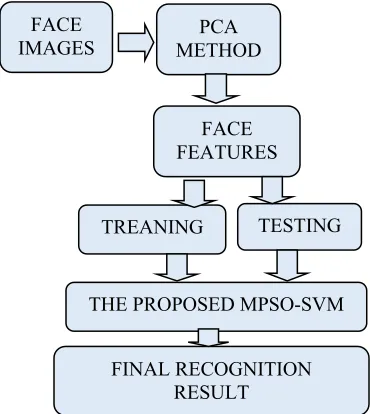
The proposed study performs a hybrid technique in order to recognize the human face images in different situations. The accurate face classification procedure is accomplished by the hybridization of MPSO and SVM together. The proposed scheme principally contained of different phases which are:
(i) Support Vector Machine (SVM)
(ii) Face feature extraction via principle component analysis
(iii) Median-oriented PSO (MPSO) method (iv) The optimization of SVM by MPSO.
These organization of the whole proposed face technique is explained in the figure 2:
[image:4.612.96.281.507.714.2]
Figure 1: the structure of face recognition technique
4.1 SVM classifier
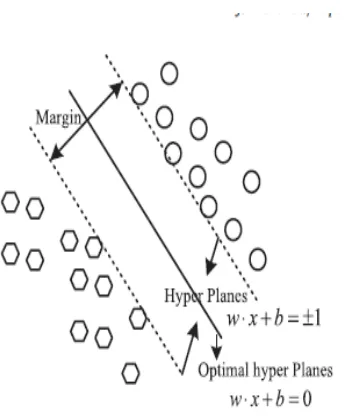
SVM classifier is belongs to the supervised learning methods which is depends on the principle of statistical learning. The objective of SVM is to decide a hyperplane that ideally isolates two classes by exploiting trained datasets [9]. Suppose that the training dataset , since is represents the input vector while the class label is . In addition, the hyperplane is computed by , since is denotes to a point located on the hyperplane, defines the positioning of the hyperplane while b represents the bias of the distance from the origin to hyper plane. As presented in the Fig. 1, the best splitting hyper plane can be established by minimizing under the restriction
Therefore, finding of ideal hyperplane is essential to answer the optimization problem that specified via:
(1)
The “positive slack variables” are suggested to exchange the optimization problem, then the approach can be expanded to permit to “nonlinear decision surfaces”. The expanded optimization problem is assumed as:
(2)
In the previous equation, C is indicate to the “penalty parameter”, that directing the tradeoff between the two challenging criteria of margin expansion and “error minimization”. Accordingly, the decision function of the classification becomes:
(3)
In the over mentioned equation, is denote to
the “Lagrange multipliers” and
is represents to the kernel function. The kernel function able to map the data to a “higher dimensional space” via nonlinear mapping functions “Radial basis function FACE
IMAGES METHOD PCA
FACE FEATURES
TREANING TESTING
THE PROPOSED MPSO-SVM
331
(RBF)” is defined as is
[image:5.612.112.284.158.367.2]denotes to a real number that is positive . RBF is usually adopted in the previous works for the purposes of images classification. Therefore, we used RBF in SVM construction.
Figure 2: SVM classification process
4.2 Face feature extraction via PCA
The extracted feature can have a significant impact on the recognition results, so that we need precise feature extraction algorithm. “Principal Component Analysis (PCA)” is a well-known technique used for dimensionality-reduction by transforming the dataset that is high-dimensional to a subspace in a less dimensional [21]. Primarily, the PCA algorithm developed by Pearson in 1901 for the mechanics field then it was discretely improved in 1930s and termed as PCA by “Harold Hotelling”. The PCA work can be summarized into a brief steps:
1. Take the entire dataset disregarding the class names
2. Calculating the “d-dimensional mean vector” 3. a) Scatter Matrix Computing
b) Covariance Matrix computing
4. Calculating “eigenvectors” and identical “eigenvalues”
examining the calculation of eigenvector-eigenvalue
eigenvectors visualizing
5. 1. Eigenvectors sorting via reducing eigenvalues 2. Picking k “eigenvectors” with the biggest
“eigenvalues”
6. Samples transforming to the new “subspace”.
4.3 Median-oriented PSO (MPSO) method
PSO is a recent developed “global optimization” approach consists of simple members called particles which have local interactive behaviors with each other and as well as interacting with their environment [22]. The local interaction and the random interaction amongst the particles are drove to a global smart behavior in order to find the best solutions. Every particle is defined by a collection of vectors represented as in a “d-dimensional search space”, where and are represent the location and velocity of the ith particle that can be defined as:
(1)
(2)
represents the ith particle personal best position which can be founded by the following :
(3)
Likewise, the best location reached by the whole swarm population ( ) is calculated to upgrade the particle velocity:
(4)
From and , the subsequent velocity and location of ith particle are attained via the equations (5) and (6):
332
Moreover, and is considered as
a set to a constant depends on the limits of solution space determine by the users. To deal with the local optimum problem in the conventional PSO, and to speed up the convergence in PSO, the MPSO method merged some terms into over mentioned equations in PSO. In MPSO method, every particle is described by , in a “d-dimensional search space”. The particle location, , and velocity, , the individual best position, and the best location discovered by total particles in the swarm, , are described as the equations. (1)- (4). Similar to the conventional PSO, we consider two methods of selecting identified as gbest and lbest models. The subsequent model is known as LMPSO which is presented in this study. Every particle upgrade its velocity using this equation (7):
(7)
where and are the subsequent and existing velocity correspondingly. Moreover, represents the “median-oriented acceleration” which is represented as follows:
(8) where, represents a random variable that has “uniform distribution” between the interval 0 and 1. is the existing location, and are the individual best location of ith particle and the global finest location discovered until now by the population, besides, is the existing median location of the swarm in the dth dimension. is indicates to the acceleration factor as:
(9)
(10)
denotes to the fitness value of the
particle i, and are the
present maximum and median fitness values of swarm:
(11) (12)
The knowledge and social terms in PSO shift the particle to the preferable solutions depends on the experience of the particle and the best solution that provided by the swarm in the search space.
Furthermore, in conventional or “Newtonian’s mechanics”, the location vector of a particle subject to the constant acceleration throughout the interval
is calculated by [27]:
(13) In the previous equation, and are primary and final location, and denote to the particle’s acceleration and velocity correspondingly. Therefore, these terms are adopted to update the subsequent particle location in MPSO. In other meaning, the knowledge and social terms in PSO is utilized in MPSO as particle acceleration to upgrade the subsequent particle location, , and equation (13) in MPSO is represented as:
(14) The MPSO approach are clarified in the figure below:
No
yes
Figure 3: flowchart of MPSO
Starting
Initialize the velocity and positions of population randomly
Use Eq. (14)to Update the positions of the subsequent
Particle fitness evaluation for i=1, 2,..,N
If fittness i < fitness Oi for i=1, 2,..,N update Oi
If fittness i < fitness Og for i=1, 2,..,N update Og
Use Eq. (8) to Compute Mi (t) for i =1, 2, . . ., N
Use Eq. (7) to update the velocities of the next particles
end of condition Meeting?
333 4.4 The optimization of SVM by MPSO.
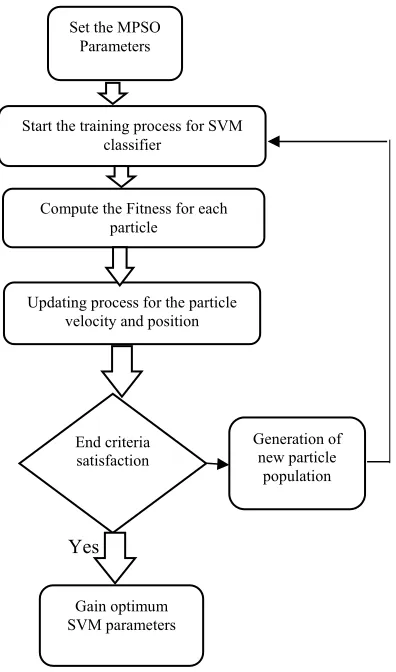
To construct SVM, RBF kernel function is adopted. The constructed SVM has two parameters specified by the user, the parameters are C and . The particles is made out of these parameters. The figure 4 outline the optimization mechanism of SVM via the suggested MPSO.
[image:7.612.320.515.131.251.2]Yes
Figure 4: Optimization process of SVM parameters by MPSO.
5. EXPERIMENTAL RESULTS
In this paper, two human face datasets are utilized: SCface face dataset [23] and CASIA V5 [24] face dataset in order to examine the performance of the proposed MPSO-SVM as face recognition technique. At first, the face features are extracted by the PCA algorithm and then are sent to the propose MPSO-SVM technique for the recognition. Ten folds cross validation (n=10) is used to validate the proposed technique through folding operation under different circumstances such as different illumination and different POSE.
An examples of face images from SCFace dataset and CASIAV5 face dataset are shown in figure 5:
(a) Sample from SCface dataset
(b) Sample from CASIAV5 face dataset
Figure 5: (a) SCface face sample (b) CASIAV5 face sample
5.1 Experiment on SC face dataset
SCface is a database for human faces images were taken in uncontrolled indoor environment. The Images have been taken by five video monitoring cameras which were in different qualities. The database comprise 4160 fixed images (in infrared spectrum and in visible) from 130 persons. The Images in SCface database attempted to mimics the real world circumstances through utilizing various quality cameras .hence, the resulted images might be enable powerful face recognition approaches in testing process, emphasizing different monitoring use situation scenarios in law enforcement. In the experimentation process, the database are splitted in to two groups of images (training and testing images) and 500 images are utilized. Furthermore, the images are splitted into 50% for training and 50% testing. to validate the proposed technique, n-fold cross validation is adopted to verify from the proposed technique performance and the accuracy measurement are utilized.
Set the MPSO Parameters
Start the training process for SVM classifier
Compute the Fitness for each particle
Updating process for the particle velocity and position
End criteria satisfaction
Gain optimum SVM parameters
Generation of new particle
[image:7.612.96.294.197.533.2] [image:7.612.321.514.289.390.2]334
5.2 Experiment on CASIAV5 face dataset
The CASIA V5 Face version 1 Database is a well-known face image database and it comprises 4,000 facial pictures of 1,000 persons. Logitech USB camera is used to capture the face pictures of "FA-TestV1” in one session. Similarly, the images are separated to training and testing images and 500 images are used in the testing process. The images are equally divided (50% in training and 50% in testing).
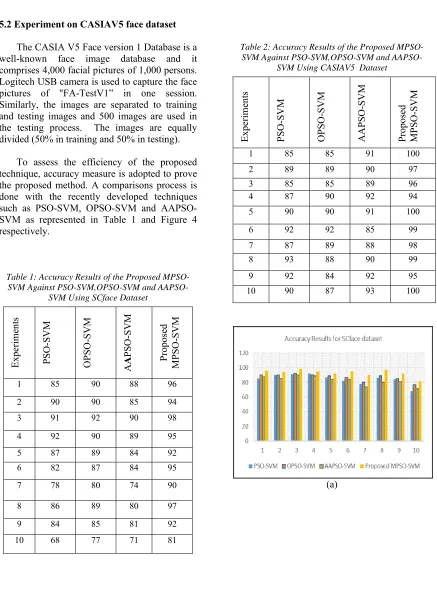
[image:8.612.91.528.87.702.2]To assess the efficiency of the proposed technique, accuracy measure is adopted to prove the proposed method. A comparisons process is done with the recently developed techniques such as PSO-SVM, OPSO-SVM and AAPSO-SVM as represented in Table 1 and Figure 4 respectively.
Table 1: Accuracy Results of the Proposed MPSO-SVM Against PSO-MPSO-SVM,OPSO-MPSO-SVM and
AAPSO-SVM Using SCface Dataset
Ex
peri
me
nt
s
PSO-S
VM
OPS
O
-S
V
M
A
A
PS
O-S
V
M
Pr
opo
sed
MPS
O
-S
VM
1 85 90 88 96
2 90 90 85 94
3 91 92 90 98
4 92 90 89 95
5 87 89 84 92
6 82 87 84 95
7 78 80 74 90
8 86 89 80 97
9 84 85 81 92
10 68 77 71 81
Table 2: Accuracy Results of the Proposed MPSO-SVM Against PSO-MPSO-SVM,OPSO-MPSO-SVM and
AAPSO-SVM Using CASIAV5 Dataset
Ex
peri
me
nt
s
PSO-S
VM
OPS
O
-S
V
M
AA
PS
O-S
V
M
Pr
opo
sed
MPS
O
-S
VM
1 85 85 91 100
2 89 89 90 97
3 85 85 89 96
4 87 90 92 94
5 90 90 91 100
6 92 92 85 99
7 87 89 88 98
8 93 88 90 99
9 92 84 92 95
10 90 87 93 100
[image:8.612.322.528.128.582.2]335 (b)
Figure 5: Accuracy results (a) SCface dataset (b) CASIAV5 face sample
5.3 Discussion
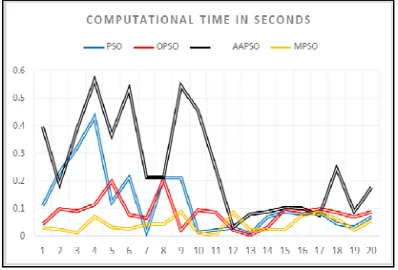
From the aforementioned tables (1-2) and figure 5, it is very clear that the proposed MPSO-SVM technique has obtained greater accuracy score than the newly developed methods which are (PSO-SVM, OPSO-SVM and AAPSO-SVM). In addition to that , the figure 6 below indicate to the computational time needed to implement MPSO to search for the best parameters of SVM compared with the computational time of the other methods.
[image:9.612.89.288.478.613.2]Based on the figure, it can be infer that the suggested MPSO is faster than the other methods where it needs lesser computational time to discover for the optimal parameters of SVM.
Figure 6: Computational time in seconds for 20 images
6. CONCLUSION
A new human face authentication technique based on MPSO and SVM methods was proposed in this paper.
The NPSO approach is adopted to instantaneously optimize the training parameters of SVM in MPSO-SVM, which can professionally discover the optimal, or at least near optimal solutions in huge search spaces. The feature extraction process was done by PCA method and the resulted features is sent to the proposed MPSO-SVM technique. The MPSO was used to search for the optimal parameters of SVM. To test the performance of the proposed MPSO-SVM technique, we have used two human face databases: SCface database and CASIAV5 face database.
To show the effectiveness of the proposed MPSO-SVM, two types of comparisons have been made with the most recent methods such as PSO-SVM, OPSO-SVM and AAPSO-SVM methods. The first comparison was in term of accuracy performance and the other in term of computational time.
The results revealed that the MPSO-SVM was better than the PSO-SVM, OPSO-SVM and AAPSO-SVM methods in term of accuracy performance. Furthermore, the computational time was good in most cases. Besides, the MPSO led to increase the convergence speed better than the standard PSO.
REFERENCES
[1] S.Terence, K. Takeo, "An introduction to biometric recognition," IEEE Transactions on Circuits and Systems for Video Technology, 14(1), 2004, pp. 4-20.
[2] E.Winarno, A. Harjoko, A. M., Arymorthy and E. Winarko, "Development of face recognition system and face distance estimation using stereo vision camera,” Journal of Theoretical & Applied Information Technology, 67(3), 2014, pp. 652-657
[3] H. Kusuma, and A. Soeprijanto, "Face recognition against varying lighting condition using oriented phase congruency image features," Journal of Theoretical & Applied Information Technology, 88(1), 2016, pp.115-122
336 [5] C. Gold, and P. Sollich "Model selection for
support vector machine classification," Neurocomputing, 55(1–2), 2003, pp. 221- 249
[6] F. Lauer and G. Bloch, “Incorporating prior knowledge in support vector machines for classification: A review,” Neurocomputing, 71(7–9), 2008, pp.1578–1594.
[7] C. Sanchez-Hernandez, D. S.Boyd, G. M. Foody, “Mapping specific habitats from remotely sensed imagery: Support vector machine and support vector data description based classification of coastal saltmarsh habitats,” Ecological Informatics, 2(2), 2007, pp.83–88.
[8] V. Kalivarapu, J.-L.Foo, and Winer, “Synchronous parallelization of particle swarm optimization with digital pheromones,” Advances in Engineering Software, 40(10), 2009, pp.975–985.
[9] J. Wei, Z. Jian-Qi and Z. Xiang, “Face recognition method based on support vector machine and particle swarm optimization,” Expert Systems with Applications, 38(4), 2011, pp.4390-4393. [10] M. Hasan, S.N.H.S. Abdullah and
Z.A.Othman, “Face recognition based on opposition particle swarm optimization and support vector machine,” IEEE International Conference In Signal and Image Processing Applications (ICSIPA), October , Malaka, Malaysia , 2013, pp. 417-424
[11] M. H. Abdulameer, S.N.H.S. Abdullah and Z.A.Othman, “Support vector machine based on adaptive acceleration particle swarm optimization,” The Scientific World Journal, 2014.
[12] M. H. Abdulameer, D.Mohammed, , S. A. Mohammed, M., Azawi, Y. M. H. Al-Mayali, and I. A. Alameri, “Face recognition technique based on adaptive opposition particle swarm optimization (AOPSO) and support vector machine (SVM),” ARPN Journal of Engineering and Applied Sciences, VOL. 13(6), (2018), pp.2259-2266
[13] Z. Beheshti, S.M.H. Shamsuddin, and S. Hasan,“MPSO: median-oriented particle swarm optimization,”Applied Mathematics and Computation, 219(11), 2013, pp.5817-5836.
[14] N.M. Khan, R. Ksantini, I.S. Ahmad, and B. Boufama, “A novel SVM+ NDA model for classification with an application to face recognition,” Pattern Recognition, 45(1), 2012, pp.66-79.
[15] L.Weihong, L.Lijuan and G.Weiguo, “Multi-objective uniform design as a SVM model selection tool for face recognition”, Expert Systems with Applications, 38(6), 2011, pp. 6689–6695, [16] R. Zhi, Q. Ruan, "Two-dimensional direct and weighted linear discriminant analysis For face recognition," Neurocomputing ,71 (16-18) , 2008, P P.3607-3611.
[17] L. F.Chen, M. L. Hong-Yuan, K. Ming- Tat, L. Ja-chen, Y. Jwo-jong, "A new LDA-based
face recognition system which can solve the small sample size problem," Pattern Recognition, 33(10), 2000, pp.1713-1726. [18] L.Zhifeng and T.Xiaoou,“Using Support
Vector Machines to Enhance the Performance of Bayesian Face Recognition”, IEEE Transactions on Information Forensics and Security, 2(2), 2007, pp. 174- 180,
[19] L.Yi-Hung and C.Yen-Ting “Face Recognition Using Total Margin-Based Adaptive Fuzzy Support Vector Machines”, IEEE Transactions on Neural Networks, 18(1),2007, pp. 178-12
[20] H. T. Reddy, K. Karibasappa, and A. Damodaram, “Face detection using
modified FDA-SVM method”,
International Journal of Machine Intelligence, 1(2), 2009, pp. 26-29
[21] I.T. Jolliffe “Principal Component Analysis”, Series: Springer Series in Statistics, 2nd ed., Springer, NY, 2002, 487 p. 28 illus. ISBN 978-0-387-95442-4 [22] C. Wei-neng and Z.Jun, "A novel set-based
particle swarm optimization method for discrete optimization problem". IEEE Transactions on Evolutionary Computation, 14(2), 2010, pp. 278–300
[23] M. Grgic, K. Delac, and S. Grgic, “SCface– surveillance cameras face database”, Multimedia tools and applications, 51(3), 2011, pp.863-879.