VOLUME 36, ARTICLE 6, PAGES 173
−
226
PUBLISHED 11 JANUARY 2017
http://www.demographic-research.org/Volumes/Vol36/6/ DOI: 10.4054/DemRes.2017.36.6
Research Article
The forest and the trees: Industrialization,
demographic change, and the ongoing gender
revolution in Sweden and the United States,
1870–2010
Maria Stanfors
Frances Goldscheider
This publication is part of the Special Collection on “Finding Work-Life Balance: History, Determinants, and Consequences of New Bread-Winning Models in the Industrialized World,” organized by Guest Editors Trude Lappegård, Fran Goldscheider, and Eva Bernhardt.
©2017 Maria Stanfors & Frances Goldscheider.
This open-access work is published under the terms of the Creative Commons Attribution NonCommercial License 2.0 Germany, which permits use, reproduction & distribution in any medium for non-commercial purposes, provided the original author(s) and source are given credit.
1 Introduction 174
2 Industrialization and its implications 176 2.1 Industrialization, women, and the family 176
2.2 Sweden and the United States 178
3 Theoretical considerations:
Broadening the standard economic model to include the family
179
4 Data and methods 182
4.1 Data 182
4.2 Measurement issues 182
5 Industrialization and the growth of paid activity 185 5.1 The emergence of the ‘separate spheres’ construct 186
5.2 Women at work 191
5.2.1 Better jobs 191
5.2.2 Married women’s labor force participation 193
6 Explaining the first break in the separate spheres 196
6.1 Women’s improving wages 197
6.2 The impact of the demographic transition on women’s lives 198 6.2.1 Mortality developments in Sweden and the United States 198 6.2.2 Fertility developments in Sweden and the United States 199
7 Men in the home: The second break in the separate spheres? 201
7.1 Explaining the delay 201
7.2 Explaining changes in housework hours in Scandinavia and the United States
203
7.3 Explaining changes in childcare 205
7.4 Family leave in Sweden and the United States 206
8 Concluding discussion 208
The forest and the trees: Industrialization, demographic change,
and the ongoing gender revolution in Sweden and
the United States, 1870–2010
Maria Stanfors1 Frances Goldscheider2
Abstract
BACKGROUND
The separate spheres, in which men dominate the public sphere of politics, arts, media, and wage work and women dominate the private sphere of unpaid production and caring, is a powerful configuration in much social theory (including Parsons, Becker, and Goode), which posited that with industrialization, family structures and activities would converge towards the nuclear family with strict gender roles.
OBJECTIVE
This paper examines the major trends unraveling the gender division of family support and care that reached its peak in the mid-20th century, often called the ‘worker-carer’ or the ‘separate spheres’ model, by comparing the experiences of Sweden and the United States.
METHODS
We use data that includes time series of macro-level demographic and economic indicators, together with cross-sectional data from censuses and time use surveys.
RESULTS
The unraveling of the separate spheres began with the increase in the labor force participation of married women and continues with the increase in men’s involvement with their homes and children, but its foundations were laid in the 19th century, with industrialization. We show that despite short-term stalls, slowdowns, and even reverses, as well as huge differences in policy contexts, the overall picture of increasing gender sharing in family support and care is strongly taking shape in both countries.
1
Centre for Economic Demography and Department of Economic History, Lund University, Sweden. E-Mail:[email protected].
2
CONTRIBUTION
By doing a comparative, in-depth analysis, it becomes clear that the extreme role specialization within the couple that divided caring from ‘work,’ though theoretically important, applied only for a limited period in Northern Europe and the United States, however important it might be in other regions.
1. Introduction
What are the origins of the ‘separate spheres’ approach to the activities of men and women, which reached its apogee in the 1950s and 1960s in most of the industrialized world? How did it happen that men came to dominate the public sphere of politics, arts, media, and, above all, market work for wages? And women to dominate the private sphere of the home where unpaid caring, nurture, maintenance, and also unpaid production take place? This is not a new question (Cott 1977; Engels 2004 [1884]), but it has rarely been addressed in the context of the recent family changes of increasing ages at marriage and parenthood, declining fertility, and rising rates of cohabitation, unmarried parenthood, and union dissolution, often called the second demographic transition (SDT) (Lesthaeghe 2010).
that began to emerge in the 1950s and 1960s3 and strengthened greatly during the 1970s and 1980s: a change that from the beginning created great anxiety about the family (e.g., Hoffman and Nye 1974). To understand recent family changes, and perhaps why Goode was originally so wrong about women’s roles, requires re-examining his question of how industrialization has affected the family.
In this paper we place our analysis within an economic theoretical framework, which is broadened to incorporate family care; but we take a multidisciplinary approach, adding demographic and sociological perspectives to our analysis. We begin the narrative with the establishment of the separate spheres, as industrialization moved men out of the household-based agricultural economy into industrial and commercial occupations, thereby enormously expanding the ‘public sphere’ of non-family activities.4 This left women behind in the ‘private sphere,’ initially managing the home, kitchen gardens, and small animals, with the help of the children. We continue the historical story past the 1950s, when the separation between the spheres was challenged radically first by married women’s labor market activity and then by the emerging increase in male domestic activity. By comparing historical data from Sweden and the United States, two quite dissimilar countries that differ both in the timing and the extent of men’s move into the public sphere and the speed with which women joined them, not to mention the ambition and extent of the welfare state in supporting workers and families, we will show that although the patterns and their timings vary, the trends are very similar.
By taking this broad brush approach to gender change, we will see that the many studies that focus on the ‘trees,’ i.e., only on married women’s inroads into paid work, or only on what seems like the glacial pace of change in men’s family roles as well as on the resistance to such change, are missing an understanding of the ‘forest.’ This comparison will also suggest that later industrializing countries may follow quite different gender paths as the structures of their separate spheres weaken. Some might cling to their gendered roles, maintaining a gender “essentialist” role structure (Brinton and Lee, forthcoming); others may minimize their gender differentiation, despite the strong impetus towards the separate spheres provided by the early industrializers (Boserup 1970; Garey and Townsend 1996; Thornton 2005). Even the early industrializers are making rapid headway towards much more equal gender roles, i.e., toward the complete destruction of the separate spheres.
3
Nearly 20 years later, however, Goode (1982) recognized many of the revolutionary implications of the rise of married women’s labor force participation.
4
2. Industrialization and its implications
The story of the Industrial Revolution is frequently told (e.g., Ashton 1970; Floud and McCloskey 1981; Pollard 1981; Mokyr 1985), but its connection to the activities of
men and women, and to the family, is a less frequent subject.5 Nearly all the
foundational studies are profoundly male-biased, based primarily on the measurement of men’s activities.6 Although economic historians agree that the onset of the Industrial Revolution is the most important event in history since the agrarian revolution, the focus is mainly on its implications for production and its contribution to economic growth and increasing living standards (e.g., Ashton 1970; Hartwell 1971; Lindert and Williamson 1983; Crafts 1985). Yet it has had many other effects.
2.1 Industrialization, women, and the family
In particular, in addition to raising living standards, industrialization has had far-reaching impacts on individuals and families, that is, on the social relations between individuals within families, not just on their economic activities. One impact that is acknowledged by demographers and family historians is critical to our narrative − the demographic transition from high to low mortality and fertility − as it is this set of changes, in conjunction with a transformation of women’s opportunities to undertake paid work outside the home, that has revolutionized the productive roles of women. Thus, the Industrial Revolution not only fueled economic transformation, radically altering men’s productive lives as subsistence farmers, but also contributed to the transition to the much longer life spans and smaller families that first transformed women’s reproductive lives (Thompson 1929; Davis 1945; Notestein 1945; Demeny 1968) and then their productive lives.
These demographic changes, however, were not understood as changing women’s roles. Reduced fertility was simply assumed to change their activities as housewives and mothers from caring for quantities of children to improving the quality of their children (Becker and Lewis 1974): Any other extra time was assumed to be devoted to
5 Humphries (2010) questions a longstanding belief about family structure before and during the Industrial
Revolution and argues that the male breadwinner model better describes the majority (i.e., working-class) of families during this period than Tilly and Scott’s (1975) family economy and DeVries’ (2008) industrious household: the typical working-class family was dependent on the father’s earnings, women were less likely to work, and children were the secondary earners (Humphries 2010: 85, 95).
6
higher quality housekeeping, volunteer work, redecorating, and furthering their spouse’s career. Hence, there was considerable surprise when married women chose to use their new time to help their families by adding at least occasional paid employment to their role set, but with initially little impact on men’s roles, and even more surprise when family change erupted in the 1970s, including delays in taking on the highly committed family roles of marriage and parenthood, together with increases in union instability, likely in reaction to the new pressures on women that many men did not offset by taking on some of women’s domestic tasks. These trends, the SDT, also include dramatically reduced fertility and great increases in both non-marital cohabitation and childbearing. They are often linked with rising rates of female labor force participation (Lesthaeghe 1983, 2010; van de Kaa 1987; Cherlin 1996).
We agree with this link between female labor force participation and family change, although it is contested (Johnson and Skinner 1986; Sayer and Bianchi 2000), because the rise in female employment is the opening crack in the separate spheres construction of the family, and thus in our view the first half of the gender revolution. In this paper we add a gender frame to the ongoing story of industrialization and family change by studying trends in two highly industrialized but quite different countries, Sweden and the United States. We undertake a systematic comparison of long-term trends in non-agricultural employment for men and for married women, examining the gender sphere gap that emerged when men joined the public sphere (notably via industrial employment) while married women largely concentrated on private (domestic) sphere activities. We then examine the way the gap narrowed over time as women joined men in the public sphere. Finally, we examine trends in men’s contribution to the family in terms of domestic tasks, the final shattering of the separate spheres construction of gender roles.
Most studies focus on shorter time periods, on single-country experiences, and/or only on one gender. Thus studies that focus on women find rapid and dramatic increases in their involvement in the public sphere, particularly labor force participation but also education, with little change among men, seeing the ‘trees’, as it were. From our longer-term vantage, together with our focus on two countries, the ‘forest’ dominates the view. Only by analyzing men and women jointly can we get a true sense of change over time: change that is nothing less than a total gender revolution.
2.2 Sweden and the United States
Our analysis, as a result, is both comparative and in depth, and hence gains the advantages of both approaches. As we note above, single-country studies, while allowing in-depth analysis, make it difficult to see what is general and what is unique, while most comparative studies include many cases and focus on only a single issue. Sweden and the United States exhibit both many similarities and great differences. Like all industrializing countries, these two countries have experienced economic transformations that have greatly increased both living standards and dramatic changes in the family. Neither the United States nor Sweden was among the earliest industrializers: in each, modern economic growth took off in the mid-19th century, and the period after 1870 marks the most rapid increase in industrialization and growth in both countries. They benefited from favorable resource endowments and from latecomers’ advantages based on technological and organizational advances made elsewhere. Innovations and new technologies, machines, and materials appeared throughout the last half of the 19th century and culminated in the early 20th century with electrification, capital-intensive industry, mass production, and the emergence of big business (Landes 1969; Chandler 1977).
There were, of course, differences. American industrialization was compressed into a shorter period of time and around 1900 the United States became the world’s industrial leader with many progressive features, while Sweden has more recently (since around 1970) become a leader in supporting gender equality and the family. Sweden industrialized more slowly and became a mature industrial economy somewhat later than the United States (Schön 2011),7 yet women’s entry into the public sphere was more rapid once it began. The two countries are also quite different from each other in size, institutional structure, social policy goals, and the historical treatment of women. Should trends regarding men’s and women’s involvement in paid and unpaid
7
activities converge in such disparate settings vis-à-vis both gender and the family, this makes a pretty strong case that what we observe is a general phenomenon, one that is undoubtedly already unfolding in many countries.
Our study focuses on the 140-year period between 1870 and 2010, a period of rapid growth that also includes the development of democratic welfare states and the growth in social spending (Lindert 2004).8 In the sections that follow we outline our theoretical approach and the data and methods we employ, followed by our analysis of the trends that together have been shattering the separate spheres: the move of women into paid employment and of men into domestic tasks.
3. Theoretical considerations: Broadening the standard economic
model to include the family
In order to understand the patterns of change we observe, we must place this portrait of women’s move into the labor force and then men’s emerging move into the home in a theoretical framework. We take our point of departure from economic theory by broadening the standard economic model of labor supply, in which paid employment is modeled as an alternative to leisure and is hence a male life course, according to the separate spheres, i.e., a life course in which men have no responsibility for family beyond providing. The standard economic model is, at least in its design, gender-neutral, but not neutral regarding family responsibilities and therefore limited both for women and for men with family tasks.
The factors that affect the decision to work for pay in the standard economic model are the market wage offered, own preferences for work versus leisure, and unearned, non-labor, income. In this traditional (male) approach to labor supply, an individual will work one more hour (and therefore reduce leisure by one hour) as long as the market values this hour more than the individual does. The wage rate reflects market time valuation; the opportunity cost of not working is the market wages foregone. The value of leisure time depends on how the individual is willing to trade off work and leisure. A higher wage causes both an increase in paid work hours, as work becomes more attractive through the substitution effect, and a decrease in work hours through the income effect, as the need to work is weaker – although the net effect of these two
8 Although the United States and Sweden share features of industrialization, perhaps the biggest difference is
effects is uncertain. A change in wages contrasts with a change in unearned, non-labor-related income, where only the income effect operates.
We extend the standard economic model to show that the choice function vis-à-vis the labor supply decision for those with family responsibilities (e.g., women under the separate spheres) is more complex. It is shaped not only by potential earnings, preferences, and unearned income (predominantly the husband’s earnings and transfers), but also by the costs of outsourcing household production (Jacobsen 2007; Blau, Ferber, and Winkler 2013). Hence, more realistically, it is a trade-off between three uses of time instead of two: work, leisure, and home care.
What the best choice is depends on context and necessarily changes with economic conditions. For example, increases in unearned income, perhaps due to rising earnings of the partner (henceforward the man), will reduce the other’s (henceforward the woman’s) labor force participation through the income effect. If women’s wages rise, particularly if the female-to-male ratio increases, women’s labor force participation should increase, although how much depends on the relative strength of the income and substitution effects.
For women who are outside the labor force, female wage increases can only exert substitution effects, making their time in employment relatively more valuable. Because children require time, reducing both paid work and leisure among parents, fewer children will lower the value of time in home production and increase labor force participation, in the sense that more women will work, and those who already are in the labor force will work more hours.
If we put theory together with the economic constraints and opportunities associated with industrialization, we can summarize by saying that increasing wages for women increased the value of work time and the opportunity cost of not working, and thus increased female labor force participation. Increasing male wages not only increased living standards but also decreased the value of paid work for married women by reducing the marginal utility of their economic contribution, and hence pulled in the opposite direction, reducing female labor force participation. Similarly, increasing productivity in domestic production reduced the value of a (marginal) hour of work in the home, so that could be devoted to other activities such as market work, which increased married women’s labor force participation.
and this is the second change we need to consider within our theoretical framework. To do so, we need to address Becker’s economic specialization theory.
Becker’s (1965) theory on specialization applies to couples’ allocation of market work and family work, assuming that men’s and women’s roles are complementary and that decisions about the allocation of time are made based on efficiency (i.e., the partners’ comparative advantages in either type of work).9 Typically, men are assumed to be more productive in market work while women are assumed to be more productive in non-market activities such as housework and childcare, and thus the model predicts a gender-based division of labor. According to Becker, specialization and trade at the household level create mutual dependence between partners and stabilize marriage (Becker 1973, 1974, 1985).
Becker’s assertion is similar to that of Parsons (1953, 1959), who added a further sociological advantage of specialization: the prevention of disruptive competition between spouses. These early researchers assumed that increasing female labor force participation decreased gains to marriage and would increase the likelihood of divorce, although empirical evidence on whether married women’s employment actually is disruptive is mixed.10
Both Becker’s and Parson’s theories of specialization were developed against the backdrop of the male breadwinner model, which dominated Western countries during the 1950s and 1960s. In this context, many household goods and services were still produced in the home, and productivity differences between men and women were real. Growing consumer aspirations and the tendency to buy goods and services (childcare included) reduced the gains from specialization, and, together with many other changes, made female employment and dual breadwinning relatively more desirable (Oppenheimer 1988, 1997; de Vries 2008). In essence, women responded to changing economic incentives as men had done before, but took into account the extent of domestic tasks, as men increasingly have to do.
9 Small biological or human capital differences between men and women can be sufficient for this
specialization (Becker 1981: 23). We note that however stable biological differences within couples have remained, increasingly human capital differences have reversed, rendering the likelihood of specialization increasingly indeterminate.
10
4. Data and methods
In this paper we draw on a variety of data sources, both primary and secondary. Our approach is particularly useful when addressing the kinds of ‘how’ and ‘why’ questions we are interested in. It is also appropriate when making a historically informed and empirically based argument about long-term change.
4.1 Data
The data we exploit in our analysis includes time series of macro-level demographic and economic indicators, together with cross-sectional census data and data from various time use surveys. When dealing with these kinds of data, we try to maximize consistency across time and across our two geographic contexts. The time series are mainly taken from printed public statistics or publications, but some data is extracted from primary archival sources. Moreover, some of the figures relating to Swedish census data are new estimates. To the extent that we use already published secondary data, we re-examine and re-interpret it in a critical way.
4.2 Measurement issues
Research on women’s changing role in the public sphere, and particularly on men’s changing role in the private sphere, is relatively recent. In each case there are major measurement issues that cloud consideration of trends. Regarding public sphere activities, the concepts ‘employment’ and ‘labor force participation’ are difficult to measure and compare over a long period of time, particularly when the focus is on gender difference. The difficulties mainly derive from problems in data collection and from the way the collected data is categorized and defined. This has largely to do with the meaning of work and how work has been counted in the past. Measurement issues make studying change in the private sphere even more challenging.
‘farm laborers.’11 Female heads of household were often widows who took over proprietorship of bakeries and other shops, but also pharmacies and farms, after their husband’s death (Goldin 1990: 46−50). Few women worked outside of agriculture and, when involved in non-agricultural activities, were either self-employed or unpaid labor in various family enterprises (Carlsson 1968; Richards 1974). Their productive activities were less regular than men’s, seasonal, part-time, and commonly combined with unpaid care and domestic activities (Abel and Folbre 1990; Goose 2007; Atkinson 2012). Hence, they were ordinarily ignored.12
Relatively few men worked outside of agriculture as well, but because the activities they were involved in counted as gainful employment, most men were defined as in the labor force. For a farm couple, the husband was typically coded by census takers as a farmer, the wife as a housewife (or much more rarely, as an ‘assisting/unpaid family worker’), and hence as not economically active: neither with a ‘gainful occupation’ (thru 1930 for the United States and 1945 for Sweden) nor, thereafter, ‘in the labor force.’ Thus in the past censuses have underreported women’s economic activity. Women’s productive work was invisible before the separation of the domestic sphere and the market in early industrializing countries like Britain, across countries experiencing later industrial breakthroughs like the United States and Sweden, and in most poor countries today (Durand 1975; Goldin 1995; Mammen and Paxson 2000).
The undercounting of women’s contribution to production is clearly a problem. It resulted not only from conceptual ambiguities regarding what work is but also from the practical difficulties of collecting data (Waring 1988). Although attempts have been made to remedy the problem of undercounting overall female labor force participation (see Humphries and Sarasúa 2012), there is no consensus on how to overcome the problem in a consistent manner.
As a result of this gender asymmetry in the official sources, we will focus on a less contested area by examining the growth of non-agricultural employment. This is measured directly for men, and can be compared with measures of women’s labor force participation, which we assume is essentially non-agricultural, given the great
11
Censuses were big costly projects to undertake. In Sweden they were justified in pre-industrial and early industrial periods by the need to list tax payers and estimate military reserves, while in the United States they were mandated in the constitution. Humphries and Sarasua (2012: 45) argue that the designation ‘worker’ had strong connotations, first in terms of political and property rights, and later in terms of social rights and benefits. For these reasons, men were considered as workers more than women. There is a large literature covering how definitions and practices among census enumerators undercounted women’s work (see Humphries and Sarasúa (2012) for a review).
12
undercounting of women’s agricultural work. Further, this will allow us to compare the longer-term changes for the genders directly, making census data, despite its deficiencies, useful.
Measurement issues are even more problematic for our understanding of change in men’s and women’s contributions to the private sphere. Housework and childcare were not only unpaid, so that hours were not tracked (as paid work in the public sphere has normally been), but were also defined as women’s core adult role, especially with the emergence of the separate spheres.
This has made it very difficult to ascertain trends over time in unpaid productive private-sphere activities, challenging scholars to attempt to reconcile different approaches. Cain (1984), for example, determined after “new calculations” and “adjustments to the existing data” that previous research that had found little change in American women’s domestic work hours (e.g., Vanek 1974) were incorrect, and that between 1890 and 1975−1976, married women’s housework decreased by 41% and their total work time (including paid work) by 22% (Cain 1984, cf. Ramey 2009).
There were a few early efforts at measuring women’s activities in the United States (see sources in Ramey 2009) and in Sweden (SOU 1939: 6; SOU 1947: 46), as well as the unpaid activities of both men and women (Morgan, Sirageldin, and Baerwaldt 1966 for the United States; SOU 1965: 65 for Sweden). The measurement of domestic activities began to expand rapidly in the 1970s (see Marini and Shelton 1993 for a useful review of this early expansion) and the study of men’s share of housework and childcare is now a sizeable and growing area of research, both for these specific countries (e.g., Björnberg 2004; Evertsson and Nermo 2007; Dribe and Stanfors 2009 for Sweden; Sayer 2005; Aguiar and Hurst 2009, Ramey 2009 for the United States) and comparatively across industrialized countries (Baxter 1997; Hook 2006; Sayer et al. 2009; Cooke and Baxter 2010; Treas and Drobnic 2010; Gimenez-Nadal and Sevilla-Sanz 2012).
For the United States between the mid-1960s and the early 2000s, the development of reasonably standardized time use surveys has contributed greatly to our understanding of trends in paid work, domestic tasks, and leisure, at least for primary (or main) activities.13 Juster and Stafford (1985) examined change between 1965 and 1975, and Robinson and Godbey (1999) extended that analysis by adding the results of the 1985 survey and included new data for the early 1990s in their second edition. To date, the most comprehensive analysis, historically, is that of Aguiar and Hurst (2007).
13
Trends in the time men spend on domestic tasks have been much less well documented for Sweden. Swedish time use studies did not begin until 1990, with another survey performed in the early 2000s and a third wave completed in 2010/2011. The other Nordic countries have longer series, with Denmark starting to take time use surveys in the 1960s, Norway in the early 1970s, and Finland in the 1980s. As we will show, Scandinavian trends have been extremely similar, and this will allow us to use them interchangeably.
5. Industrialization and the growth of paid activity
We begin our analysis by showing trends in first men’s and then married women’s entry into the public sphere of non-agricultural employment. In this section we build on already extant evidence for the United States, primarily that presented by Goldin (1990) and Costa (2000a), and construct parallel analyses for Sweden. We document factors that contributed to married women’s entry into paid activity, including demographic change and the narrowing of the gender wage gap. We also discuss the growth of ‘good jobs’ and the spread of household technology, and assess how these factors affected married women’s employment. We then go beyond the classic accounts of women in the labor force (e.g., Oppenheimer 1970; Goldin 1990) by examining the growth of men’s tasks in the home.
Our documentation of the growth in non-agricultural activity starts in the 1870s, when both countries industrialized rapidly.14 It is only after this industrial breakthrough that we have census statistics that enable us to map out the productive activities of the population by industry with any certainty. As noted above, only a small fraction of married women in either country were counted as part of the regular (i.e., paid) labor force in 1870. In this year most of the population was still involved in agriculture, though the US economy at this time was considerably more diversified than the Swedish, and a larger share of the US labor force was in sectors other than agriculture. As we have noted, the many women who undertook various activities on the family farm as farmers’ wives did not usually count as gainfully employed in the censuses (but unmarried women hired at other farms were reported as agricultural workers). In the agricultural household economy, men and women would typically share work and family responsibilities, differentiated by age and normally subject to a gender-based
14
division of labor, although temporary reassignments were fairly common (Löfgren 1974; Osterud 1991).
With industrialization, new jobs emerged in manufacturing and services – in firms and factories − that offered better economic returns than agriculture. While this was true for both men and women, the transfer of women’s work from the household to paid employment in centralized workplaces was not as simple as men’s, complicated as it was not only by women’s reproductive responsibilities but also by discrimination and social taboos against the employment of married women (Goldin 1990). Hence, the growth of men’s non-agricultural employment during the latter half of the 19th century created a new gender-based division of work and family responsibilities, leading to the emergence of the construct of ‘separate spheres.’ As men were drawn into workplaces away from the home and women were left in the home with full responsibility for the domestic sphere, men became ‘breadwinners’ and women ‘homemakers.’ With the rapid growth in men’s non-agricultural employment, the concentration of men and married women in separate spheres continued to increase during the first half of the 20th century and peaked around 1950−1960 in both Sweden and the United States. This is shown graphically in the two panels of Figure 1.
5.1 The emergence of the ‘separate spheres’ construct
Figure 1a: The gender transition in employment: Change over time in the percentage of married men and women engaged in non-farm occupations, 1870−2010 and beyond, Sweden
Note: Figures for 1870−1960 for married women age 15 and over, figures for 1965−1985 married women 15−64, figures for the years
1990 and onwards include both married and cohabiting women, since the Swedish Labor Force Survey was EU-harmonized in 2005 the figures for 2010 denote women 16−74. Should that group be used, there would have been a decrease due to the inclusion of older non-working women in the population. Instead we use married/cohabiting women with at least one child 19 or younger in the household in the year 2010. Figures for years beyond 2010 are based on extrapolations on the most recent rate of growth in labor force participation.
Sources: Statistics Sweden, Swedish Censuses (Folkräkningarna) 1870−1960 (own estimations); Swedish Labor Force Surveys
1970−2010. 0 25 50 75 100
1870 1920 1970 2020
P e rc e n t w it h n o n -f a rm o c c u p a ti o n s
Men (sphere gap) Women 1840−1890
*Emergence of "separate
spheres" *Early growth in male non-agr.employment
1890−1950 *Maximum separate spheres *Continued rapid growth in male non-agr. employment
1990−2040 *Emergence of
new gender balance *Continued rapid growth in
female non-agr. employment 1950−1990
*Separate spheres under strain * Early growth in
Figure 1b: The gender transition in employment: Change over time in the percentage of married men and women engaged in non-farm occupations, 1870−2010 and beyond, United States
Note: Figures for 1890−1980 are for married women age 15 and over, figures for 1990−2000 are for married women age 16 and
over. Because of the inclusion of increasing numbers of women above retirement age (65 and over) due to ageing of the population, the overall figures stall after 1990 due to the inclusion of older non-working women in the population. Instead we use married women with at least one child 18 or younger in the household in the year 2010.
Sources: Men are the fathers of children in Hernandez 1993, p. 103; married women (age 15 and older in years 1890−1980) are from
Goldin 1990, Table 2.1; married women (age 16 and older in years 1990−2000) and married women with children under 18 (age 16 and older in 2010) are from U.S Bureau of Labor Statistics. Figures for years 1870−1880 and beyond 2010 are based on extrapolations on the closest rate of growth in labor force participation.
Hence, this figure shows that as late as 1870 most men (and women) still worked in agriculture in each country. Effectively, in both countries most men and women occupied the same sphere, the household farm economy, where home and workplace were one. Thereafter, men took on non-agricultural jobs while married women, however productive they may have been, were still counted as inactive. Hence, the divide between men’s and women’s productive activities expanded, reaching its maximum in each country about 1950, the peak of the separate spheres.
Two important things should be noted. First, although the countries are different in many ways, looked at broadly the patterns of growth in men’s and women’s employment are extremely similar. The main conclusion from the graphs is that the
0 25 50 75 100
1870 1920 1970 2020
P e rc e n t w it h n o n -f a rm o c c u p a ti o n s
Men (sphere gap) Women 1840−1890
*Emergence of "separate spheres" *Early growth in male
non-agr.employment
1890−1950 *Maximum separate spheres *Continued rapid growth in male non-agr. employment
1990−2040 *Emergence of new gender balance *Continued rapid growth in female non-agr. employment 1950−1990
*Separate spheres under strain * Early growth in
emergence of the separate spheres and the growing sphere gap between men and married women occurred in the same period and followed similar lines in Sweden and the United States. It should be noted that industrialization in the United States was earlier and more comprehensive than in Sweden, with more extensive non-farm
employment for both men and women from 1870 until well into the 1950s (Table 1).15
It is not until the 1960s that differences start to emerge between the two, as married women’s move into the labor force developed quite differently, partly related to the different role of the state and the public sector (for employment and provision of services) in the two countries.
Second, men’s move from the household economy to work in the public sphere of manufacturing and services was just as revolutionary as the more recent changes for women. Men’s move is normally described simply in terms of industrial change. However, it was also a serious move away from their families. In histories of men and family there is a general consensus that men were very engaged in family life prior to the Industrial Revolution and particularly in the practical and moral education of their children (Rotundo 1991; LaRossa 1997).16 In her book on child labor, Jane Humphries argued that industrialization and associated trends (e.g., empire building, waging wars) reduced fathering and impoverished the idea of fatherhood (Humphries 2010: chapters 3 and 5) as fathers became increasingly absent and distant figures. The early male breadwinner family was frail, as high mortality rendered many families fatherless and thereby poor. Work away from home separated men from their wives and children, and not all fathers were reliable, deserting their families. However, we have not been able to find much historical material on how men and their families experienced their greater separation. No doubt the fact that mothers remained in the home eased the effect on families of men’s (partial) withdrawal.
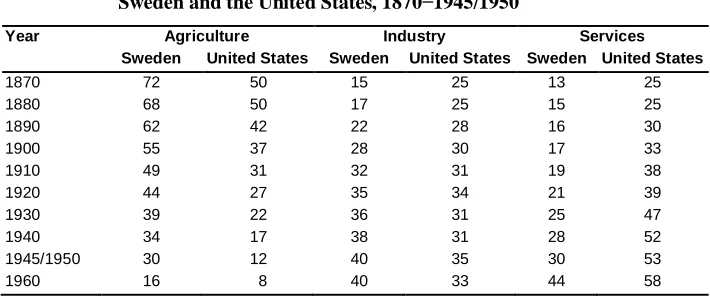
15 Table 1 denotes both sexes and illustrates sectoral displacement from agriculture to industry and services
over time. It does not capture the sphere gap illustrated in Figure 1.
16 Historian Grey Osterud, based on her study of family farming in New York State (1991, 2012), reported in
Table 1: Industrial development of the labor force (both sexes): Sweden and the United States, 1870−1945/1950
Year Agriculture Industry Services
Sweden United States Sweden United States Sweden United States
1870 72 50 15 25 13 25
1880 68 50 17 25 15 25
1890 62 42 22 28 16 30
1900 55 37 28 30 17 33
1910 49 31 32 31 19 38
1920 44 27 35 34 21 39
1930 39 22 36 31 25 47
1940 34 17 38 31 28 52
1945/1950 30 12 40 35 30 53
1960 16 8 40 33 44 58
Note: Figures in the 1945/1950 row denote 1945 for Sweden and 1950 for the United States.
Sources: Kuznets (1957), Appendix Table 4, panels J (Sweden) and V (United States) for years 1870−1945/1950; Bureau of Labor
Statistics (2005) for 1960.
It is clear from Figure 1 that by taking a long-term perspective, similar patterns emerge for both countries regarding men’s and women’s paid activity, and, in particular, a separate spheres gap emerges clearly and simultaneously. It provides a good picture of gender differences in labor force participation outside agriculture, because by focusing on the gap between men and married women we target the most significant labor market change that has taken place. As Figure 1 shows, married women’s employment was extremely low at the onset of industrialization. The sphere gap, while already noticeable, expanded as men moved out of the agricultural sector, and then grew substantially as industrialization continued.
Similarly to when men joined the industrial workforce, the growth in married women’s labor force participation changed both family life and the labor market. According to Figure 1, in both countries a particularly noticeable growth in married women’s non-agricultural employment began around 1960. Although different in pace, the process was similar in many other industrialized countries and put the logic of the separate spheres under strain. More married women were now part of the labor force, and stayed so for increasingly longer periods of their lives.
technologies, together with the reduced price of such appliances. Housework became easier with the development of canned food, stoves, and sewing machines, followed by the diffusion of basic utilities such as running water, electricity, and central heating and then by the spread of household appliances such as refrigerators, vacuum cleaners, and washing machines (Hagberg 1986; Matthews 1987; Greenwood, Seshadri, and
Yorukoglu 2005).17 This served to decrease married women’s reservation wage and
increase female labor supply despite a substantial gender wage gap, as we will see below.
5.2 Women at work
The sequencing of how women’s work opportunities changed over time relative to men’s has shaped the way married women’s labor force participation changed (see Figure 1). Improvements in men’s paid work opportunities and wages without corresponding improvements in married women’s paid work opportunities and wages reinforced a sphere gap that only declined when women’s labor came to be more in demand, their earnings rose enough to outsource many of their domestic tasks, and when family and other domestic responsibilities such as child rearing became more compatible with paid work activities. This primarily came about because of shorter working hours, which occurred in both countries. In Sweden, the development of leave schemes and daycare facilities further reduced work-family incompatibility, which also contributed to making mothers’ employment more socially acceptable.
5.2.1 Better jobs
The industrial breakthrough of the late 19thcentury accelerated the move of workers from agriculture to industry and eventually to services (see Table 1). Whereas in 1870 more than 70% of Swedish workers were agricultural, this dropped over the following 90 years to about 15% by 1960, with concomitant growth in industry (from 15% in 1870 to 40% in 1960). Services grew even more over the period. The move out of agriculture was both faster and more complete in the United States, which hence had an earlier and more comprehensive expansion of these sectors than Sweden.
17
From a gender perspective, the move out of agriculture in the 19th century was more extensive among men than among women, particularly in Sweden (compare the levels for the total in Table 1 to those for women in Table 2). This led to the segregation of men and women into different sectors of the economy. Whereas men moved into better-paying industrial jobs, women (primarily young and single) more commonly worked in low-paying jobs in agriculture and domestic service.18 This applies to both countries, although around the turn of the last century (i.e., 1890/1900), agriculture was much more important for the few employed Swedish women (62%, 19% in the United States) and domestic service was more important in the United States (18% in Sweden, 29% in the United States).
Table 2: Industrial development of the female labor force:
Sweden and the United States, 1870−1960, in percentages
1870 1890/1900 1930 1960
Sweden US Sweden US Sweden US Sweden US
Agriculture 79 na 62 19 34 8 5 2
Manual and other (manufacturing and transport)
2 na 10 34 23 30 35 33
Domestic service 16 na 18 29 16 18 6 9 White collar (sales, public
administration, and services)
3 na 10 18 27 44 54 56
Total 100 100 100 100 100 100 100
Ratio female/male
participation rate 0.36 na 0.34 0.23 0.43 0.29 0.42 0.44
Note: Figures denote women 14 years old and older prior to 1947, thereafter women 16 years old and older in the United States, but 15 years old and older in Sweden. Column 4 denotes year 1900 (Sweden) and column 5 denotes 1890 for the United States. Source: Carlsson (1966), table 24; U.S. Bureau of the Census (1975), series D 11-25, D 26-28, D 29-41, D 182-232.
During the early decades of the 20th century, new white collar jobs opened up (particularly in services such as sales, banking and insurance, and public administration) that attracted women by providing ‘nice’ work, with better working conditions than elsewhere. The shift to white collar work for women was particularly
18
remarkable in the United States. There was also expansion into manual and other jobs (manufacturing and transport), at least in Sweden.19
This evolution in the nature of jobs is clearly one of the important new factors underlying women’s emergence in the public sphere. Other factors, particularly changes in the gender wage ratio and demographic changes, were also underway during this period, which we will discuss later. But perhaps the most important new factor that transformed women’s (and men’s) family lives was the emergence of married women’s employment.
5.2.2 Married women’s labor force participation
Marital status had for a long time provided an important dividing line in the activities of women, particularly their labor force participation. Census figures for all women hide significant changes in the labor force participation of married women. To clarify these changes during the 20th century we present labor force participation rates for women of working ages in Sweden and the United States, separately for the married and the unmarried (Table 3).
Table 3: Female labor force participation rates by marital status in Sweden and the United States, 1890−1990
Sweden
1890 1900 1920 1930 1940 1950 1960 1970 1980 1990
Total 17.8 19.1 26.9 30.7 29.3 29.5 32.0 59.3 75.2 82.3
Married 1.0 1.5 3.8 8.0 9.3 14.1 23.3 56.1 66.2 86.8
Single 48.8 51.7 52.4 56.8 58.2 61.7 53.8 65.9 74.4 73.6
United States
1890 1900 1920 1930 1940 1950 1960 1970 1980 1990
Total 18.9 20.6 23.7 24.8 25.8 29.5 35.1 41.6 51.1 57.5
Married 4.6 5.6 9.0 11.7 13.8 21.6 30.6 39.5 50.1 58.4
Single 40.5 43.5 46.4 50.5 45.5 50.6 47.5 51.0 61.5 66.7
Note: For Sweden, the years 1890−1960 refer to women older than 15; years 1970−1990 refer to women above 16 years. In 1990
the category ‘married women’ is expanded to include cohabiting women. The United States figures for 1890−1960 refer to women older than 15, while years 1970−1990 refer to women above 16 years.
Source: Statistics Sweden, Swedish Censuses (Folkräkningarna) 1870−1960; Swedish Labor Force Surveys
(Arbetskraftsundersökningarna) 1970−1990. Figures for the United States 1890−1980 are from Goldin (1990: Table 2.1). Those for 1990 are from Handbook of US Labor Statistics (1999).
In all years, a large fraction of unmarried women in Sweden and the United States worked for pay. The labor force participation rates of single women were higher than
those of married women well into the 1970s in Sweden and throughout the years in the United States. Single women were more likely to be gainfully employed in Sweden than in the United States. During the period 1890−1920 single women were driving the growth in female labor force participation, especially in Sweden, because they became increasingly urban and more likely to work for pay in industry and services.20
By contrast, the participation rates for married women were extraordinarily low. Circa 1900, about 1% of married women in Sweden were in the labor force, a rate that did not surpass 10% until 1950. Participation rates for married women in the United States were slightly higher for the major part of the period of our comparison. Sweden does not stand out as a country with exceptionally high rates of female labor force participation in the past; rather, their rates, while lower, were comparable to those in the United States from the late 1800s to 1960.21The rapid increase that was to take Sweden to a world-leading position in female labor force participation did not take off until the latter half of the 1960s.
The low participation rates of married women suggest that in both countries most women left the labor force at marriage. This is in line with the existence of a marriage bar, i.e., the practice of restricting married women’s employment, or terminating contracts upon marriage (or the birth of the first child). This was common in the early 1900s across Western nations, and primarily affected service professions and occupations (Cohn 1985; Goldin 1990: 171−177; Jacobsen 2007: 417). The reasons given for marriage bars include norms reflecting patriarchy (Kessler-Harris 1982), and market forces in that they encourage turnover to employers where wages rise more rapidly than individual productivity, but also to the advantage of employees if there are rules (and not individual employers) that determine when such turnover will happen (Goldin 1990).22 Using rates by marital status, we calculated an assumed proportion of
20
It should be noted that the aggregate figures hide distinct differences between urban and rural areas in both Sweden and the United States. Goldin notes that keeping urbanization constant makes the participation rate relatively stable for the period 1890−1960 (Goldin 1990: 54). This is curious, because the American school system expanded rapidly between 1890 and 1930 through the high school movement (Goldin and Katz 2008). Increased education among young single women should have decreased their participation in paid employment. The same holds, in principle, for Sweden, though there was no high school movement and the expansion of education above primary education was more limited (Stanfors 2003: chapter 6).
21 In the case of married women, different war experiences matter a lot, as a sizeable number of American
women were drawn into the labor force during mobilization, some temporarily and others permanently (Fernandez, Fogli, and Olivetti 2004), whereas Sweden, neutral during World War II, never mobilized officially, with war time having limited impact on married women’s employment. However, US censuses missed most of this phenomenon, which in any case was fairly brief (1942−1945).
22
employed women who left employment after marriage, by following Goldin’s exercise in her classical study of women in the US labor market (1990: 16).23 Figure 2 shows that in the late 19th century and well into the 20th, the vast majority of women (70%−90%) left the labor force in connection with marriage, both in Sweden and the United States, with Swedish women more prone to exit the labor market upon marriage than women in the United States well into the 1960s. That behavior declined rapidly between about 1940 and 1970, reflecting changes both in supply and demand. There was a shortage of young single women with more of them in education and marrying young, and an increasing demand for older married women reflecting a change in attitudes favoring this group (because of their reliability) alongside the expansion of jobs in services (Oppenheimer 1970). By the late 20th century, dropping out of the labor force at marriage had become a marginal phenomenon (about 10%); by 1990 it had vanished in Sweden, where marital status no longer affected labor force participation.
Figure 2: Women leaving the labor force in connection with marriage in Sweden and the United States, 1890−1990, in percent
Source: Table 3.
23
The calculations were made as follows: By referring to the figures in Table 3 we see that in 1890 about 50% of all single women were in the labor force, compared to only 1% of married women, across ages. Assuming that these are women moving across their own life courses, ignoring that there may be differences in participation by age in combination with marital status, 98% (that is (50-1)/50) of these women would have left the labor force upon marriage. The corresponding figure for 1920 is 93%, and for 1950 and 1960 is 77% and 57%, respectively.
0 10 20 30 40 50 60 70 80 90 100
1890 1900 1920 1930 1940 1950 1960 1970 1980 1990
Sweden
6. Explaining the first break in the separate spheres
So far we have provided an overview of how the separate spheres construct emerged with the growth in men’s non-agricultural labor force participation and have examined the expansion in female labor force participation that followed, emphasizing the growth in better (white collar) jobs at the expense of worse ones (in agriculture and domestic service). In addition, we have showed the gradual breakdown of the once sharp distinction between being single and married in women’s labor market participation. We are left with the big question: why the change?
There is no simple explanation for such an extensive change. We nevertheless establish a reasonably coherent narrative as to why married women first were left in the private sphere with responsibility for family and care but then after many decades broke out and joined men in the public sphere. By so doing they challenged the gender division of family support and the care structure that was established in the 19th century upon industrialization.
In order to understand women’s increasing involvement in paid activity in the labor market (and men’s later involvement in the home), we need to think about incentives to work and the forces promoting/discouraging work for pay outside the home. For men, this is relatively straightforward. Industrialization provided work opportunities in factories where wages were higher and meant a higher market time valuation, pulling men out of agriculture into industry. Their primary alternative time allocation was leisure, which on the family farm included parent-child interaction and home improvement, but, increasingly, for many men in the late 19th century agricultural work also implied under- or unemployment and low income, which affected the leisure time valuation negatively.
For women, the decision-making process was more complex and the incentive structure different from that of men. Married women had reproductive responsibilities and there was a social stigma attached to their working, as it indicated having an unsuccessful husband. When women made decisions concerning labor supply they needed to consider more factors than men, including their productivity both in the home and the labor market, their own wage and their husband’s income, not to mention the well-being of other household members.24 If we are to understand the drivers behind the increase in married women’s labor force participation we need to consider improving wages, declining fertility, and gains in life expectancy.
24 Along with standard theory, Chichilnisky (2008) points to the interdependency of the family and the firm,
6.1 Women’s improving wages
Industrialization provided substantial improvements in wages in both Sweden and the United States. Real wages grew throughout most of the 20th century in both countries, with higher and more stable growth rates than previously. Like real wages, the female-to-male relative wage also increased during the 20th century in both Sweden and the United States. The relative wage increased in a more consistent manner, especially during the 1970s and 1980s. The average hourly wage of female Swedish workers in manufacturing was 58% of the corresponding male wage in 1913. By 1995 it had reached 90% (Figure 3).25
Figure 3: Female-to-male hourly wage ratio in manufacturing in Sweden and the United States, 1913−2009
Note: The wages are full-time equivalent earnings adjusted for gender composition of different industrial branches with different wage levels.
Source: For Sweden, the data series on wages rest on computations by Lars Svensson and Maria Stanfors from Statistics Sweden, Social Reports (Sociala meddelanden) 1915−1927; Statistical Yearbook of Wages (Lönestatistisk Årsbok) 1928−1951; Wages (SOS) 1952−1999; Statistical Yearbook (Statistisk Årsbok) 2000−2009. For the United States, information on wages comes from Goldin (1990: Table 3.1) and the Bureau of Labor Statistics (www.bls.gov).
25
This figure is high in international comparison. During the 1990s, Swedish women earned one of the highest percentages of men’s earnings in the world (see overviews in Blau, Ferber, and Winkler 2013 and Jacobsen 2007 for comparisons).
The long-term process of gender wage equalization is similar for both countries (although the US series suffers from inconsistency and few data points). It includes periods of rapid rise as well as periods of stability and even small declines, but the overall trend is an equalizing one. Although manufacturing has only made up a limited part of women’s labor market (see Table 2) the same pattern of wage equalization has been observed for other sectors of the economy, at least in Sweden (Stanfors 2003: chapter 3). Thus we assume that gender wage equality in manufacturing is a good benchmark for overall gender wage equality. Blau (1998) has found that the overall wage structure in a country has an important impact on the gender wage gap. In fact, it explains most of the differences in the gender pay gap between Sweden and the United States. What distinguishes Sweden from the United States in Figure 3 is the more rapid narrowing of the gender wage gap, which provided women in Sweden with more incentives to work, particularly during the 1960s and 1970s.
6.2 The impact of the demographic transition on women’s lives
The demographic transition also contributed to women’s entry into paid employment by restructuring their adult lives. In the new equilibrium that emerged in the mid-20th century after the mortality and fertility transitions, caring for the young was no longer a life-long, full-time career for women, as it had been until well into the 20th century, because they had longer life expectancy and smaller families. Demographic changes thus contributed to the first breakdown in the separate spheres.
6.2.1 Mortality developments in Sweden and the United States
In the agricultural economies of Sweden and the United States in the 19th century, lives were not very long. Although much of the overall gain in life expectancy between the late 19th and mid-20th centuries was due to the massive decline in infant and early childhood mortality, much was not. Young adults led increasingly long lives.
By the peak of the baby boom 80 years later (1951−1960), however, when young adults married and had children at very young ages, structuring a life around home and family no longer fitted the years the demographic transition had given them (Watkins, Menken, and Bongaarts 1987). If women married at age 20, as many American women did in the 1950s (Haines 1996), and quickly had several children, when their last child left home they were still in their early- to mid-40s and could expect to live many more years, with a similar pattern for Sweden.
The major analyses of the growth of female labor force participation conclude that this growth was driven by economic changes creating increasing demand for women’s labor (see Oppenheimer 1970 and Goldin 1990 for the United States, and Durand, 1975 for a comparative analysis). Nevertheless, demographic changes made women more able to meet this new demand. Goldin (2006) argues that the extended time horizon was important for women’s human capital investment. The change from short- to longer-term decision-making was not limited to the highly educated and thereby had vast consequences for women’s family lives. The choice to marry and have children later, as well as to divorce, makes more sense when life seems long.26 Women’s move into the public sphere was the result of many economic and demographic changes, but, whatever the combination of reasons, the result has been that the vast majority of women in both Sweden and the United States expect to spend the majority of their adult years employed for pay, and most men expect them to do so (Goldscheider and Kaufman 2006; Thomson and Bernhardt 2010).
6.2.2 Fertility developments in Sweden and the United States
Like the industrial and mortality revolutions, the fertility decline profoundly changed the lives of women as they transitioned from bearing six or so children to two, or even
one. At the beginning of the 20th century, while men were leaving agriculture and
married women remained home, fertility was declining, ending in the 1920s−1930s, followed by a pattern of cyclical fertility variation. Although the long-term fertility trends are similar in many countries, these two cases show dramatic wave-like movements and variations and shifts in levels (Figure 4).
Both countries experienced a baby boom after World War II, although in the United States it was more extensive. These baby booms coincided with the 1950’s peak of the separate spheres in each country. At that time, psychologists considered families in which the husband worked and the wife stayed home to be the healthiest, sociologists
26
considered them the most stable, and economists thought them the most efficient. In the 1960s, however, coinciding with increases in married women’s employment, fertility fell in both countries, raising concern but also challenging these interpretations.
Since the late 1960s the US total fertility rate has been one of the highest among Western countries (around the replacement level of 2.1), while Swedish fertility has varied more, closely connected to variations in the business cycle. Female labor force participation, especially that of married women and mothers, has nevertheless continued to increase in both Sweden and the United States. In parts of the Western world, however, the drop in fertility rates following women joining the labor force has been more dramatic.27
Figure 4: Total fertility rates in Sweden and the United States, 1913−2010
Source: Swedish total fertility rates from Statistics Sweden, Population movements (SOS Befolkningsrörelsen) 1913−1960;
Population changes (SOS Folkmängdens förändringar) 1961−1967; Population changes (SOS Befolkningsförändringar. Del 3) 1968−1990; Population statistics (SOS Befolkningsstatistik. Del 4) 1991−2010. Total fertility rates for the United States come from the National Center for Health Statistics. Help from Mark Mather is gratefully acknowledged.
Moreover, in Sweden highly educated dual-career couples are more likely to continue childbearing (and are less likely to separate) than other couples, despite the expected higher opportunity costs of childbearing and smaller gains to specialization (Dribe and Stanfors 2010). It seems to be the case that female labor force participation
27
In some Southern and Eastern European countries, fertility rates have dropped to such an extent that Kohler, Billari, and Ortega (2002) introduced the concept of ‘lowest-low’ fertility to describe heretofore unheard of low levels of fertility. Countries like Greece, Italy, and Spain have had sustained periods with total fertility rates below 1.3.
is negatively associated with fertility in developing countries with under-developed welfare states (cf. Stycos and Weller 1967), while positively related to fertility in countries that are more developed welfare states, such as Sweden. This puts into perspective the much-feared destabilizing impact of married women’s and mothers’ labor force participation on the family, as proposed in the 1960s and 1970s.
7. Men in the home: The second break in the separate spheres?
While female employment rates and women’s time in paid work increased substantially in the 1970s and 1980s, their time spent in unpaid work, although it declined a great deal, remained far higher than men’s domestic time (e.g., Bianchi 2000; Gauthier, Smeeding, and Furstenberg 2004). As a result, women came to be seen as doing a ‘second shift’ of unpaid work, giving them less time for leisure than men (Hochschild and Machung 1989; Sayer 2005), although differences in combined paid and unpaid work hours were small, given that employed men usually worked more hours than employed women and had longer commuting times (Aguilar and Hurst 2007). Nevertheless, men were not increasing their household work very much, leading many to characterize men’s lack of response to the increase in female employment as a ‘stalled revolution,’ which was unlikely to advance further (e.g., England 2010). In this section, we attempt to analyze trends and determinants of men’s slow move into the home and its tasks, the final crack in the separate sphere.
7.1 Explaining the delay
Nevertheless, whatever the explanatory power of gender display and game theory in the early years of women’s entry into the public sphere, men’s roles did not really need to change, and hence did not. Both employed and non-employed women rapidly dropped the time they spent in housework. Between 1965 and 1975 they reduced
housework by five hours per week (Aguiar and Hurst 2009).28 Women were responding
to new opportunities by adding new roles while streamlining old ones. If anything, between the 1940s and the 1960s – which marked the height of the single-worker family, yet with few children at home, given the low fertility of the 1930s – housewives had much less actual work to do than men, and men began to notice. In both fictional and non-fictional works, women were accused of “momism,” meaning that they were using their extra time to become over-involved with their children, particularly with their male children (Wylie 1942; Strecker 1946; Friedan 1963; Roth 1969).29
A more serious impediment was that men were far less prepared to break the separate spheres, in their turn, than women were. Women increasingly expected to work while they remained single, which encouraged them to obtain at least some education and made the marriage bar increasingly problematic, particularly for childless married women. By contrast, the socialization of men to avoid tasks in the private sphere began at an early age. As fathers’ chores in the household economy withered, so did those of their sons. Even as school hours and years for boys and girls became more or less the same, children’s housework hours differed sharply by sex (Goldscheider and Waite 1991; Hofferth and Sandberg 2001). An even more serious problem is that tasks in the domestic sphere are of low status because they are unpaid (or outsourced to poorly paid women), with none of the benefits of tasks in the public sphere (e.g., vacations, raises), and hence are much less attractive to men than the jobs women were taking on in the public sphere were to them. It is likely that this asymmetry in the ease/difficulty of women and men breaking their separate spheres gave rise to many of the phenomena associated with the second demographic transition. Nevertheless, men have finally begun to share family tasks. How did this happen?
28 Aguiar and Hurst’s (2009) is one of several major studies of Americans’ time use between 1965 and 2005,
published late in the first decade of the 21st century. Other examples include Gershuny and Robinson (1988),
Fisher et al. (2007), Ramey (2009), Kan, Sullivan, and Gershuny (2011), and Gimenez-Nadal and Sevilla-Sanz (2012). Ramey uses somewhat different definitions, consistent with her goal of covering the entire 20th
century; Fisher et al. focus more on the rich contextual information in the historical diary accounts, particularly concerning who else was present during an activity and when or where the activity occurred, while Gimenez-Nadal and Sevilla-Sanz and Kan, Sullivan, and Gershuny focus on cross-national comparisons.
29
7.2 Explaining changes in housework hours in Scandinavia and the United States
Pressure on men to contribute more to the well-being of their families finally began to increase by adding family care to their adult roles. Although increased uncertainty in the labor market put more pressure on men to provide, it also increased the need for couples to have two incomes in case one failed (Oppenheimer 1997). If wives’ employment had once been primarily insurance (Warren and Tyagi 2004), it became a necessity for many families in order to meet consumer aspirations (cf. deVries 2008). As a result, between 1975 and 2005 more women became economically active, and although they shed another five hours of weekly housework time, the great increase in intensive parenting (Bianchi, Robinson, and Milkie 2006; cf. Dribe and Stanfors 2009; Neilson and Stanfors 2016) meant that they increased their time in childcare by nearly as much (Aguiar and Hurst 2009), so women’s leeway to combine work and family on their own vanished.30 They needed fathers to help with both childcare and household chores.
The clearest picture of the great increase in men’s share of domestic work can be gleaned from a study on changes in combined housework and childcare hours for several countries between the 1960s and the early 2000s (Kan, Sullivan, and Gershuny 2011). We calculated ratios of male-to-female hours for the Nordic countries (Denmark, Finland, and Norway, as well as Sweden), and added parallel information for the same period for the United States (Aguiar and Hurst 2009). The results are powerful (Figure 5).
In the 1960s, given women’s many and men’s few housework hours, men were spending less than 30% of women’s time in the United States and only 20% in Denmark. Men’s share increased slowly in the early 1970s, but there was a rapid increase to between 43% and 48% in the late 1970s to early 1980s (with Finland joining the series at the high end), which continued to near 50% and even 60% in the late 1980s. Sweden joins the series in the early 1990s, just above Norway (all just below 60%). After that the rate of increase continued vigorously for Norway, Sweden, and the United States, reaching almost 70% in Sweden and around 60% for the others, as a result of women’s declines and men’s increases. The ratio of female-to-male labor force participation has even more closely approached equality: by 2012 it reached 90%‒95% in the Scandinavian countries and over 80% in most of the rest of Europe. This ratio reached 78% even in Southern Europe, which continues to have the lowest level of female labor force participation in Europe (Oláh 2015).31
30 Both qualitative and quantitative research report that parents have been spending more time with their
children while cutting back on partner time (Hays 1996; Daly 2001; Dew 2009).
31