R E S E A R C H A R T I C L E
Open Access
Reported
Drosophila
courtship song rhythms are
artifacts of data analysis
David L Stern
Abstract
Background:In a series of landmark papers, Kyriacou, Hall, and colleagues reported that the average inter-pulse interval ofDrosophila melanogastermale courtship song varies rhythmically (KH cycles), that theperiodgene controls this rhythm, and that evolution of theperiodgene determines species differences in the rhythm’s frequency. Several groups failed to recover KH cycles, but this may have resulted from differences in recording chamber size.
Results:Here, using recording chambers of the same dimensions as used by Kyriacou and Hall, I found no compelling evidence for KH cycles at any frequency. By replicating the data analysis procedures employed by Kyriacou and Hall, I found that two factors - data binned into 10-second intervals and short recordings - imposed non-significant periodicity in the frequency range reported for KH cycles. Randomized data showed similar patterns.
Conclusions:All of the results related to KH cycles are likely to be artifacts of binning data from short songs. Reported genotypic differences in KH cycles cannot be explained by this artifact and may have resulted from the use of small sample sizes and/or from the exclusion of samples that did not exhibit song rhythms.
Keywords:Artifacts, Biological rhythms, Courtship song,Drosophila
Background
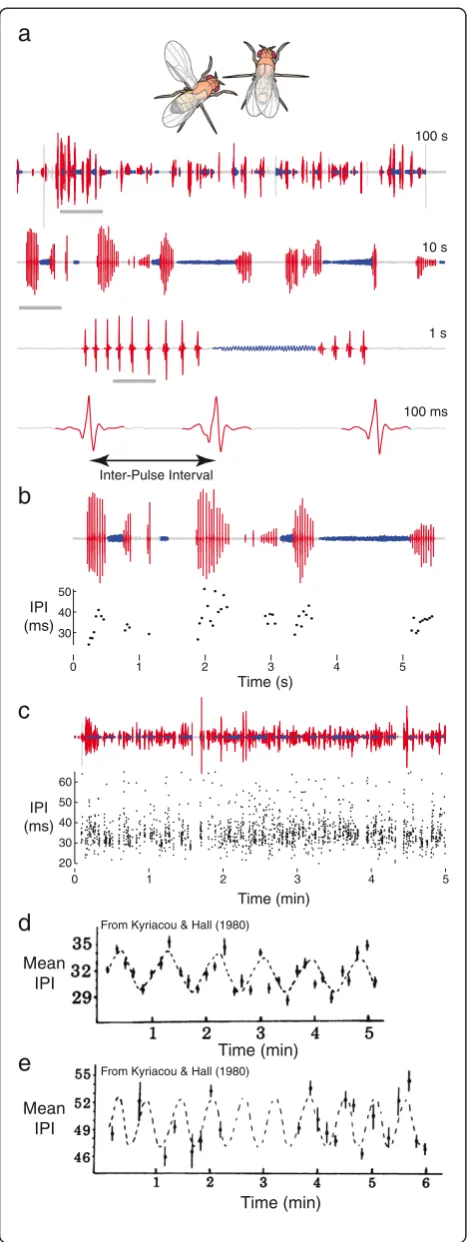
Males of the vinegar fly, Drosophila melanogaster, flap one wing at a time to sing a courtship song to females [1,2] (Figure 1a). This song consists of trains of an ap-proximately sinusoidal‘sine song’and a series of discrete pulses, called ‘pulse song’, often concatenated into song bouts [3] (Figure 1a). The time interval between individ-ual pulses, called the inter-pulse interval (Figure 1a), tends toward a characteristic interval for each species of Drosophilathat sings pulse song, and inD. melanogaster this inter-pulse interval is approximately 35 to 40 ms. However, the inter-pulse interval is variable at multiple time scales (Figure 1b,c): within a single train of pulses, between trains of pulses, between different individuals of a strain, and between different strains [3-5].
In 1980, Kyriacou and Hall [6] reported that, on aver-age, the inter-pulse interval cycled with an amplitude of approximately 3 ms and a period of approximately 1 min (0.017 Hz) in D. melanogaster(Figure 1d) and 30 s (0.03 Hz) inD. simulans(Figure 1e). Following tradition, I will call this periodicity KH cycles. In the same paper,
they reported that mutations in theperiodlocus that in-creased, dein-creased, and ablated periodicity of the circa-dian rhythm had similar effects on KH cycles. Later papers reported that transformation of the period locus into individuals carrying a null allele of theperiod gene restores KH cycles to arrhythmic males [7]; that females of D. melanogaster and D. simulans mate faster when presented with artificial songs that contain the species-specific inter-pulse interval and KH cycles than when presented with heterospecific songs [8]; that the differ-ence in KH cycles between D. melanogaster and D. simulans is controlled by a locus or loci on the X chromosome (where the period gene resides) [9]; that hybrid females ofD. melanogaster andD. simulans pre-fer songs with a combination of intermediate inter-pulse interval and KH cycles [9]; that D. simulans KH cycles can be transferred intoD. melanogasterby genetic trans-formation of theD. simulans periodlocus into aD. mel-anogaster strain carrying a period null mutation [10]; and that this effect of theperiodlocus can be mapped to a 700 bp region of the largest exon ofperiod, which con-tains a threonine-glycine repeat region that differs in length betweenD. simulansandD. melanogaster[10]. Correspondence:[email protected]
Janelia Farm Research Campus, Ashburn, VA 20147, USA
This series of papers has been heavily cited and dis-cussed in the secondary literature, in part because this is one of only two examples of a species-specific behavioral difference that has been traced to a genetic difference. (Variation in vasopressin V1A receptor expression likely contributes to differences in affiliative behavior between vole species [11,12]). Given the importance of this work, it would be of great interest to follow-up on these initial studies and to identify the molecular mode of action of periodin courtship song cycles. However, no other genes have been implicated in control of KH cycles and the molecular mechanism by which variation in the period locus influences KH cycles has not been identified. In fact, there have been no papers published since 1991 providing further evidence for the mode of action of the period gene in courtship song rhythms. In particular, there is still no satisfactory explanation for how the periodgene, whose expression cycles approximately di-urnally and whose protein product is degraded during daylight hours [13], could contribute to rhythms that cycle on the order of 30 to 60 s. This fact contrasts strongly with the significant progress over the past 20 years revealing the molecular basis for circadian rhythms [14,15].
There are two possible reasons for the recent absence of published work on this problem. First, the tools avail-able over the past 20 years may have been insufficient to allow more detailed investigation. For example, tools to allow high throughput analysis of courtship song and de-tailed analysis of neural circuits in Drosophilahave only recently become available [3,16]. Second, it is possible that KH cycles are not real phenomena, but instead are an artifact of the methods of data collection or analysis utilized in earlier papers. This possibility was raised ori-ginally in the late 1980s, when two independent groups reported that they were unable to detect KH cycles [17,18]. (Also see [19-22]). In addition, my colleagues and I were unable to detect significant evidence for KH cycles in five wild-type strains of D. melanogaster [3]. However, one independent group has reported that they can detect KH cycles [23]. As statisticians have noted, it is likely that in most of the early studies too few pulse events were sampled to allow robust estimates of rhythms with
100 s
10 s
1 s
100 ms
Inter-Pulse Interval
IPI (ms)
IPI (ms)
Time (s)
Time (min)
Mean IPI
Mean IPI
Time (min) Time (min)
a
d
c
b
e
0 1 2 3 4 5
30 40 50
0 1 2 3 4 5
20 30 40 50 60
From Kyriacou & Hall (1980)
From Kyriacou & Hall (1980)
Figure 1Courtship song and putative courtship song rhythms. (a)An example of a segmented single recording is shown at multiple scales, from 100 s to 100 ms. Each subsequent clip is derived from the region highlighted with the grey bar. A single inter-pulse interval (IPI) is illustrated in the 100 ms clip.(b)The IPI varies over an order of approximately two on a short timescale, even within a single pulse train. The example song trace is shown above and the IPI values are shown below.(c)The IPI displays similar high variation over a 5 min interval. The song trace is shown above and the IPI data below.(d, e)
Examples of KH cycles produced byD. melanogaster(d)andD.
periods on the order of 60 s [24]. Nonetheless, there has been no reasonable explanation for the fact that Kyriacou and Hall and at least one other group have consistently found evidence for KH cycles.
In apparent further support for the existence of Kyriacou and Hall rhythms, Ritchie and colleagues showed that female D. melanogasterprefer synthesized courtship song containing KH cycles over song that does not contain this rhythmicity [25]. This may imply that females have the ability to detect KH cycles in courtship song. However, there is an alternative explanation for their observations. Normal D. melanogaster song contains complex, non-random dynamics of the inter-pulse interval on the scale of seconds [3] (Figure 1b). Ritchieet al. compared synthesized song that contained KH cycles with synthesized song con-taining either randomly patterned inter-pulse intervals, constant inter-pulse intervals, or silence. Remarkably, fe-males showed very similar preferences for randomly pat-terned song, constant song, and silence, even though females are known to prefer song over silence [26]. It is possible that the randomly patterned song and constant inter-pulse interval song in this experiment did not accur-ately mimic wild-type song. Most importantly, this experi-ment is missing an additional critical control, song with natural patterns of inter-pulse intervals. Without this con-trol, it is premature to conclude that females prefer song containing KH cycles to song without cycles. It is possible that D. melanogaster females prefer some modulation of inter-pulse interval over song with a constant inter-pulse interval — since variation in the inter-pulse interval is a common feature of real song—but this has not yet been demonstrated.
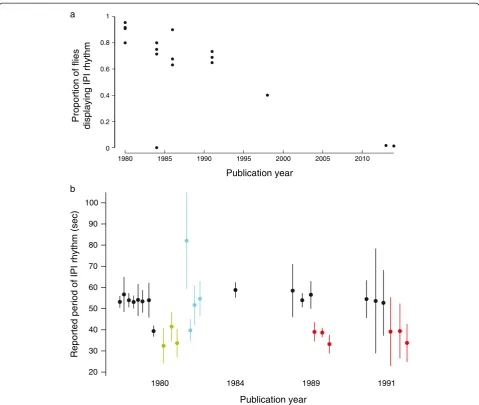
It is worth noting that, in all studies on this subject, investigators have reported that KH cycles can be de-tected in some, but not all, individuals. Songs not displaying rhythms were not included in further analysis. Curiously, the proportion of positives detected in each study has declined steadily since the initial report (Figure 2a, Additional file 1: Table S1). This trend exists in the face of reportedly improved methods for detecting KH cycles [22,23]. Estimates of the periodicity of KH cy-cles vary somewhat between reports, but most values fall between approximately 25 and 65 s, corresponding to frequencies of 0.04 to 0.0154 Hz (Figure 2b). While the original reports appear to demonstrate strong differences between different genotypes (in part by plotting standard errors of the means), reconstruction of the 95% confi-dence intervals for the original data ranges illustrates that the different genotypes exhibit considerable overlap (Figure 2b, Additional file 2: Table S2).
Since KH cycles are a fascinating phenomenon with implications for speciation and evolutionary biology, I had hoped to follow-up on earlier reports to study the molecular and neurobiological mechanisms regulating
KH cycles. Despite efforts to match earlier experimental conditions as closely as possible, I was unable to detect KH cycles. As I show, however, non-significant rhythms of the inter-pulse interval in the frequency range re-ported by Kyriacou and Hall are generated by binning the data of short songs. These results suggest that KH cycles do not exist and that previous reports reflect arti-facts of data analysis.
Results
I searched for KH cycles first by attempting to replicate the experimental paradigm used by Kyriacou and Hall as closely as possible. Unlike many earlier attempts, I employed recording chambers with dimensions that matched those used by Kyriacou and Hall. I recorded song from wild-typeD. melanogaster and D. simulans flies and mutants of the period locus (null, short and long). I recorded each courting male for approximately 45 min and, to avoid possible artifacts arising from limited sample sizes, I discarded recordings that in-cluded fewer than 1,000 pulses.
Testing for rhythmicity in time series of biological data presents multiple challenges [27,28]. One classical method for detecting rhythmicity is to calculate the Fourier trans-form of the time series, which essentially transtrans-forms the time series into the frequency domain by representing the original wave form as the sum of a series of sinusoids of dif-ferent frequencies, power, and phase. Power can then be plotted for each frequency in the form of a periodogram and periodicity can be detected as peaks of strong power. However, the Fourier transform requires equally spaced data. With unequally spaced data, or data sampled regularly but with missing values, the Fourier transform does not have well-defined properties and can generate biased peri-odograms [27,29]. Furthermore, the statistical significance of values in these periodograms cannot be determined. Everyone who has worked on KH cycles was aware of, and made efforts to ameliorate, these limitations of classical per-iodogram analysis [23,30].
KH cycles when the signal-to-noise ratio is at least one (Additional file 3: Figure S1). Therefore, I used the Lomb-Scargle periodogram to search for rhythmicity in the inter-pulse interval.
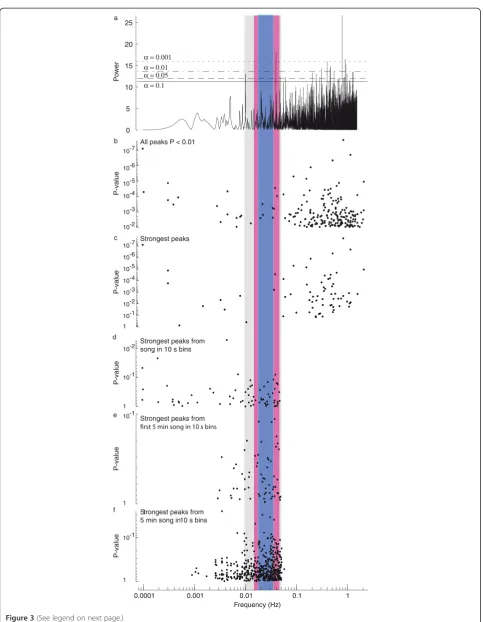
An example of a Lomb-Scargle periodogram for a single Canton-S male is shown in Figure 3a. The statistically sig-nificant peaks (P<0.01) in the Lomb-Scargle periodograms across all Canton-S flies are shown in Figure 3b. It is clear that many time series contain evidence for relatively high frequency rhythms (on the order of seconds), but relatively little evidence for rhythms in the ranges reported by Kyriacou and Hall (the grey, red, and blue bands in Figure 3). Recordings of males carrying period mutations
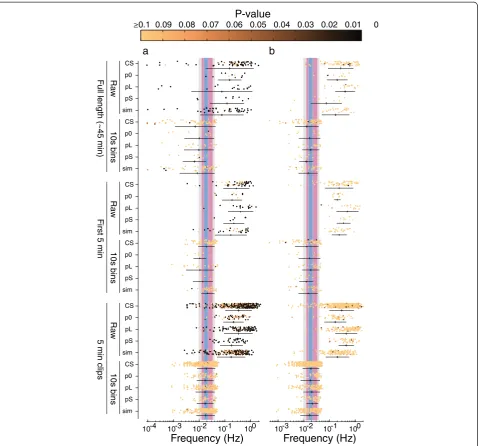
and ofD. simulansmales displayed a similar distribution of significant Lomb-Scargle peaks (Figure 4a). These high fre-quency rhythms are distributed across a wide frefre-quency range and probably result from modulation of inter-pulse intervals by males over short time scales (c.f. Figure 1b,c). Recordings ofD. simulansmales displayed a weak tendency to produce relatively lower frequency periodicity than did D. melanogaster recordings (Figure 4a), which is opposite to the observations of Kyriacou and Hall (Figure 1e) [6,9,10]. There is no evidence that these rhythms are con-strained to a narrow frequency range. Thus, statistical ana-lysis of long recordings of courtship song provides no support for the existence of KH cycles.
20 30 40 50 60 70 80 90 100
Reported period of IPI rhythm (sec)
Proportion of flies
displaying IPI rhythm
1984
Publication year
Publication year
1989 1991
1980
b a
1980 1985 1990 1995 2000 2005 2010 1
0 0.2 0.4 0.6 0.8
Po
w
e
r
a
1 0.1
0.01 0.001
Frequency (Hz) 0.0001
0 5 10
P
-value
b All peaks P < 0.01
10-7
10-6
10-5
10-4
10-3
10-2
15 20 25
α = 0.001 α = 0.01 α = 0.05 α = 0.1
c Strongest peaks
10-7
10-6
10-5
10-4
10-3
10-2
10-1
1
d
Strongest peaks from song in 10 s bins
Strongest peaks from
10-2
10-1
1
f Strongest peaks from 5 min song in 10 s bins e
10-1
1 10-1
1
P
-value
P
-value
P
-value
P-v
a
lu
e
KH cycles observed by previous authors might have resulted from the specific analysis techniques or sam-pling procedures employed in earlier studies. In different papers, authors used different spectral analysis tech-niques to search for rhythms, so it is unlikely that KH cycles resulted from any specific analytical technique. However, there are two parameters that are common to most published studies: inter-pulse interval data were binned into 10 s intervals and most recordings were ap-proximately 5 min long or shorter (Additional file 1: Table S1). In addition, most studies did not incorporate a robust method of assessing the statistical significance of rhythmicity [8]. Thus, often the periodogram peak with greatest power was taken as the best estimate of rhythmicity. Sampling just the peaks representing the greatest power in the Lomb-Scargle periodograms did not obviously alter the distribution of frequencies from the sample of all peaks with P < 0.01 (Figure 3c). How-ever, 10 s binning of inter-pulse intervals dramatically al-tered the distribution of strongest signals in the Lomb-Scargle periodograms, forcing many values to be within the frequency range reported for KH cycles (Figure 3d, compare with colored columns), although few of these signals were statistically significant. This truncation of the high frequency range of the spectrogram resulted simply from the fact that the highest frequency that can be estimated in any time series is equal to half the sam-pling rate, or 0.05 Hz (1/20 s) for 10 s bins [35].
To more precisely replicate the data used in previous studies, I analyzed the first five minutes of song follow-ing the first train of pulse song. I also sampled non-overlapping 5 min clips from across the entire duration of recordings. Both samples of 5 min of song resulted in poor estimation of low frequency rhythms, forcing ap-proximately 65% of the maximal rhythms to be within the range reported for KH cycles (Figure 3d,e). This is similar to the proportion of songs with KH cycles that was reported in the later publications from Kyriacou and Hall (Figure 2a), suggesting that these reported KH rhythms could be fully explained as artifacts of binning short songs. In addition to these manipulations, I also tested many other manipulations of the data described
in [30], including multiple methods for estimating values for empty bins. None of these other manipulations had a large effect on the distributions illustrated in Figure 4 (not shown).
The pattern observed for the wild-type Canton-S strain of D. melanogaster was also observed for a wild-type strain ofD. simulansand for the threeperiod muta-tions (Figure 4a). Binning short songs constrained the maximal rhythmicity close to the range reported by Kyr-iacou and Hall (Figure 4a). It is important to note that binning the data, but not shortening the songs, reduced the power of this rhythmicity, resulting in much lower statistical significance for the maximal periodogram peaks (Figure 4a). In fact, fewer than two percent of the maximal periodogram peaks observed in binned data reached a threshold for statistical significance ofP<0.05. That is, binning did not generate statistically significant rhythms, it simply constrained the maximal peak of peri-odograms so that they were more likely to fall in the range reported by Kyriacou and Hall. Since most previ-ous studies did not incorporate robust methods of esti-mating the statistical significance of the maximal peaks, it is likely that their reported maximal peaks were, like the ones I found, not statistically significant.
Randomizing inter-pulse interval data produced pat-terns of maximal periodogram peaks similar to the ori-ginal data, but the statistical significance of the peaks was much lower on average in the randomized data than in the original data (Figure 4b). This provides further evidence that the statistically significant high frequency rhythms detected in the original data reflect real fluctua-tions in inter-pulse intervals on the order of seconds.
Discussion
While it may be impossible to prove that a phenomenon does not exist, the foundations of science rest upon re-peatable observations. KH cycles cannot be replicated. Perhaps more importantly, we now have an explanation for why Kyriacou, Hall and colleagues observed court-ship song rhythms in a particular frequency range. Peri-odogram peaks with periods on the order of 60 s are an artifact of binning data from short songs into 10 s (See figure on previous page.)
intervals. Most of this apparent rhythmicity does not reach any sensible level of statistical significance. KH cycles appear to represent fluctuations of noise, which is supported by their similarity to patterns generated by randomized data.
My observations do not explain why Kyriacou and Hall observed that different genotypes appeared to pro-duce KH cycles with slightly different average periods nor why females of different species appeared to prefer KH cycles with periods matching that of their own P-value
b a
0.09
0.1 0.08 0.07 0.06 0.05 0.04 0.03 0.02 0.01 0
Ra
w
F
ull length (~45 min)
10s bins
CS
p0
pL
pS
sim
CS
p0
pL
pS
sim
5 min clips
R
a
w
10s bins
CS
p0
pL
pS
sim
CS
p0
pL
pS
sim
F
irst 5 min
Ra
w
10s bins
CS
p0
pL
pS
sim
CS
p0
pL
pS
sim
Frequency (Hz) 10-1 10-2 10-3
10-4 100 10-3 10-2 10-1 100
Frequency (Hz)
Figure 4Lomb-Scargle periodogram analysis of multiple genotypes.Each datum represents the frequency with maximum power in a single song. The P-value for each value is pseudocolored according to the colorbar shown along the top of the figure. The mean ± 1 standard deviation is shown below each cloud of points. Each row contains data from a different genotype (D. melanogasterCanton-S (CS),period[Null] (p0),period[Long] (pL),period[Short] (pS), orD. simulans(sim)) analyzed in different ways. On the top, full-length (45 min) recordings were ana-lyzed either as raw inter-pulse interval data or with data summarized as the means of 10 s bins. In the middle, the first 5 min after a male started singing were analyzed for each recording. This mimics most closely the analyses performed in most previous studies. On the bottom,
species [9]. One possibility is that the observed average differences between genotypes represented random sam-ples from the full distribution of rhythms generated arti-ficially by the analysis techniques, and that by using relatively small sample sizes (N = 8 ± 3.9 (mean ± stand-ard deviation); Additional file 2: Table S2), Kyriacou and Hall fortuitously observed frequencies consistent with their hypotheses. This possibility is emphasized by the extensive overlap seen in the reconstructed ranges of periods reported in earlier studies (Figure 2b). This small-sample-size effect may have been exacerbated by the exclusion of many songs that did not exhibit rhyth-micity (Figure 2a, Additional file 2: Table S2), which was common practice in all papers on this subject.
Conclusions
For decades, the work of Kyriacou and Hall has ap-peared far ahead of its time and their evidence for the role of theperiodgene in behavioral evolution has stood as a shining example of how genetic evolution can gen-erate a species-specific behavior. Unfortunately, it ap-pears highly likely that this example is not true. This case highlights some of the challenges inherent in identi-fying the genetic causes of behavioral evolution. Behav-ior is often variable on multiple time scales and as a result of multiple genetic and environmental influences. Scoring behavior and detecting species-specific differ-ences requires objective methods for quantifying behav-ior. Given that most behaviors are likely to have evolved as the result of evolution at multiple loci [36], large sam-ples of individuals must be assayed. Satisfactory method-ologies have only recently become available for scoring a handful of fly behaviors [3,37-40]. There is now at least some hope that these questions can be addressed in a rigorous manner.
Methods
Virgin males and females were collected from the Canton-S strain ofD. melanogasterand from a wild-type strain ofD. simulans collected in Princeton, NJ, USA in 2009. Indi-vidual males were isolated in single wells of a 96-well Scienceware™96 deep-well plate (Bel-Art, Wayne, NJ, USA) containing approximately 1 mL of standard cornmeal-based fly food covered with an AirPore Tape Sheet (Qiagen, Hilden, Germany). Males were aged for 5 to 10 days in a 25°C incubator with a 12 hour:12 hour light:dark cycle. Females were group housed in standard Drosophila vials and maintained in the same incubator with males for 1 to 3 days prior to pairing with males for recording.
We built 20 × 10 × 3 mm recording chambers from acrylic, which matched the specifications reported in [6] and which could be fitted in our 32-channel recording system [3]. Data were collected and segmented as re-ported previously [3].
Data analysis
Following Kyriacou and Hall, inter-pulse intervals were defined as times between pulse events that were between 15 and 65 ms long. I excluded songs with fewer than 1,000 pulses and time series were initiated at the pulse train that contained at least 10 inter-pulse intervals, as described in [30]. Data were analyzed using the Lomb-Scargle periodogram with the MATLAB script ‘lomb’ written by Saragiotis and available from [41]. Data were binned by calculating the mean inter-pulse interval for 10 s intervals that each contained at least 10 pulses, as described in [30]. Five-minute clips were generated by dividing 45 min recordings into 5 min segments. For the randomization test, all times between pulses were calcu-lated (including the pauses between pulse trains), and these values were shuffled without replacement. This procedure generated time series that resembled real song, but both the initiation time of pulse trains and the inter-pulse intervals were shuffled. All other analyses were performed using custom MATLAB scripts. The raw song data are available at [42]. The segmented inter-pulse intervals for all individuals are available as individ-ual CSV files at [43]. Complete details of the analysis pipeline, including step-by-step instructions to replicate the results reported here, are provided in a file called AnalysisPipeline.rtf together with all required MATLAB scripts in the zipped folder available at [44].
Additional files
Additional file 1: Table S1.Statistics of data underlying reported KH cycles from previous publications.
Additional file 2: Table S2.Values of reported KH cycles from previous publications, with back-calculated standard deviations.
Additional file 3: Figure S1.Power of the Lomb-Scargle periodogram to detect simulated KH cycles in courtship song time series.
Competing interests
The author declares that he has no competing interests.
Acknowledgements
I thank Elizabeth Kim for building the new recording chambers and for assistance collecting and recording flies; Michael Young for providing flies carrying alleles of theperiodlocus; and Justin Crocker, Yun Ding, Andrew Lemire, Joshua Mast, Ella Preger, Troy Shirangi and Ben Arthur for helpful discussions. I thank Ben Arthur, Jessica Cande, Roian Egnor, Mala Murthy, Troy Shirangi, and three reviewers for helpful comments on the manuscript.
Received: 13 February 2014 Accepted: 20 May 2014 Published: 26 June 2014
References
1. Ewing AW, Bennet-Clark HC:The courtship songs of Drosophila.Behaviour 1968,31:288–301.
2. Greenspan RJ, Ferveur JF:Courtship in Drosophila.Annu Rev Genet2000,
34:205–232.
3. Arthur BJ, Sunayama-Morita T, Coen P, Murthy M, Stern DL:Multi-channel acoustic recording and automated analysis of Drosophila courtship
4. Kawanashi M, Watanabe TK:Genetic variation of courtship song of Drosophila
melanogaster and D. simulans.Japan J Genet1980,55:235–240.
5. Turner TL, Miller PM:Investigating natural variation in Drosophila
courtship song by the evolve and resequence approach.Genetics2012,
191:633–642.
6. Kyriacou CP, Hall JC:Circadian rhythm mutations in Drosophila
melanogaster affect short-term fluctuations in the male’s courtship song.
PNAS1980,77:6729–6733.
7. Zehring WA, Wheeler DA, Reddy P, Konopka RJ, Kyriacou CP, Rosbash M, Hall JC:P-element transformation with period locus DNA restores
rhythmicity to mutant, arrhythmic Drosophila melanogaster.Cell1984,
39:369–376.
8. Kyriacou CPP, Hall JC:The function of courtship song rhythms in
Drosophila.Anim Behav1982,30:794–801.
9. Kyriacou CP, Hall JC:Interspecific genetic control of courtship song
production and reception in Drosophila.Science1986,232:494–497.
10. Wheeler D, Kyriacou CP, Greenacre ML, Yu Q, Rutila JE, Rosbash M, Hall JC:
Molecular transfer of a species-specific behavior from Drosophila
simulans to Drosophila melanogaster.Science1991,251:1082–1085.
11. Young LJ, Nilsen R, Waymire KG, MacGregor GR, Insel TR:Increased affiliative response to vasopressin in mice expressing the V1a receptor
from a monogamous vole.Nature1999,400:766–768.
12. Lim MM, Wang Z, Olazabal DE, Ren X, Terwilliger EF, Young LJ:Enhanced partner preference in a promiscuous species by manipulating the
expression of a single gene.Nature2004,429:754–757.
13. Young MW, Kay SA:Time zones: a comparative genetics of circadian
clocks.Nat Rev Genet2001,2:702–715.
14. Nitabach MN, Taghert PH:Organization of the Drosophila circadian
control circuit.Curr Biol2008,18:R84–R93.
15. Hardin PE:The circadian timekeeping system of Drosophila.Curr Biol 2005,15:R714–R722.
16. Jenett A, Rubin GM, Ngo TT, Shepherd D, Murphy C, Dionne H, Pfeiffer BD, Cavallaro A, Hall D, Jeter J, Iyer N, Fetter D, Hausenfluck JH, Peng H, Trautman ET, Svirskas RR, Myers EW, Iwinski ZR, Aso Y, DePasquale GM, Enos A, Hulamm P, Lam SC, Li HH, Laverty TR, Long F, Qu L, Murphy SD, Rokicki K, Safford T,et al:A GAL4-driver line resource for Drosophila
neurobiology.Cell Rep2012,2:991–1001.
17. Ewing AW:Cycles in the courtship song of male Drosophila
melanogaster have not been detected.Anim Behav1988,36:1091–1097.
18. Crossley SA:Failure to confirm rhythms in Drosophila courtship song.
Anim Behav1988,36:1098–1109.
19. Ewing AW:Identification of cycles in the courtship song of Drosophila
melanogaster - comment.Anim Behav1989,37:860–861.
20. Kyriacou CP, Hall JC:Failure to detect cycles in Drosophila mating songs
-comment.Anim Behav1988,36:1110.
21. Crossley SA:On Kyriacou and Hall's defense of courtship song rhythms in
Drosophila.Anim Behav1989,37:861–863.
22. Kyriacou CP, Hall JC:Spectral analysis of Drosophila courtship song
rhythms.Anim Behav1989,37:850–859.
23. Alt S, Ringo J, Talyn B, Bray W, Dowse H:The period gene controls
courtship song cycles in Drosophila melanogaster.Anim Behav1998,
56:87–97.
24. Logan IG, Rosenberg J:A referee’s comment on the identification of
cycles in the courtship song of Drosophila melanogaster.Anim Behav
1989,37:860.
25. Ritchie MG, Halsey EJ, Gleason JM:Drosophila song as a species-specific mating signal and the behavioural importance of Kyriacou & Hall cycles
in D. melanogaster song.Anim Behav1999,58:649–657.
26. Bennet-Clark HC, Ewing AW:Pulse interval as a critical parameter in
courtship song of Drosophila melanogaster.Anim Behav1969,17:755.
27. Ruf T:The Lomb-Scargle periodogram in biological rhythm research:
analysis of incomplete and unequally spaced time-series.Biol Rhythm
Res1999,30:178–201.
28. Van Dongen HP, Olofsen E, VanHartevelt JH, Kruyt EW:A procedure of multiple period searching in unequally spaced time-series with the
Lomb-Scargle method.Biol Rhythm Res1999,30:149–177.
29. Lomb NR:Least-squares frequency analysis of unequally spaced data.
Astrophys Space Sci1976,39:447–462.
30. Kyriacou CP, van den Berg MJ, Hall JC:Drosophila courtship song cycles in
normal and period mutant males revisited.Behav Genet1990,20:617–644.
31. Scargle JD:Studies in astronomical time series analysis. II - Statistical
aspects of spectral analysis of unevenly spaced data.Astrophys Journal,
Part 11982,263:835–853.
32. Glynn EF, Chen J, Mushegian AR:Detecting periodic patterns in unevenly spaced gene expression time series using Lomb-Scargle periodograms.
Bioinformatics2006,22:310–316.
33. Bohn A, Hinderlich S, Hütt M-T, Kaiser F, Lüttge U:Identification of rhythmic subsystems in the circadian cycle of crassulacean acid metabolism under
thermoperiodic perturbations.Biol Chem2003,384:721–728.
34. Deckard A, Anafi RC, Hogenesch JB, Haase SB, Harer J:Design and analysis of large-scale biological rhythm studies: a comparison of algorithms
for detecting periodic signals in biological data.Bioinformatics2013,
29:3174–3180.
35. Nyquist H:Certain topics in telegraph transmission theory.Trans AIEE 1928,47:617–644.
36. Robinson GE, Fernald RD, Clayton DF:Genes and social behavior.Science2008,
322:896–900.
37. Dankert H, Wang L, Hoopfer ED, Anderson DJ, Perona P:Automated
monitoring and analysis of social behavior in Drosophila.Nat Methods
2009,6:297–303.
38. Kabra M, Robie AA, Rivera-alba M, Branson S, Branson K:JAABA: interactive
machine learning for automatic annotation of animal behavior.Nat Methods
2013,10:64–70.
39. Mendes CS, Bartos I, Akay T, Márka S, Mann RS:Quantification of gait parameters in freely walking wild type and sensory deprived Drosophila
melanogaster.Elife2013,2:e00231.
40. Giancardo L, Sona D, Huang H, Sannino S, Managò F, Scheggia D, Papaleo F, Murino V:Automatic visual tracking and social behaviour analysis with
multiple mice.PLoS One2013,8:e74557.
41. Lomb normalized periodogram.[http://www.mathworks.com/
matlabcentral/fileexchange/22215-lomb-normalized-periodogram]
42. Raw data from this paper.[http://research.janelia.org/sternlab/rawData.tar]
43. Segmented inter-pulse interval data from this paper.[http://research.
janelia.org/sternlab/IPIs.zip]
44. MATLAB analysis scripts used in this paper.[http://research.janelia.org/
sternlab/KHSongAnalysis.zip]
doi:10.1186/1741-7007-12-38
Cite this article as:Stern:ReportedDrosophilacourtship song rhythms are artifacts of data analysis.BMC Biology201412:38.
Submit your next manuscript to BioMed Central and take full advantage of:
• Convenient online submission
• Thorough peer review
• No space constraints or color figure charges
• Immediate publication on acceptance
• Inclusion in PubMed, CAS, Scopus and Google Scholar
• Research which is freely available for redistribution