Geschke Center
Doctor of Nursing Practice (DNP) Projects Theses, Dissertations, Capstones and Projects
Spring 5-19-2016
Utilizing TIGER Competencies to Improve
Informatics Practice
Kwun Ying M. Fung
University of San Francisco, [email protected]
Follow this and additional works at:https://repository.usfca.edu/dnp
Part of theOther Nursing Commons
This Project is brought to you for free and open access by the Theses, Dissertations, Capstones and Projects at USF Scholarship: a digital repository @ Gleeson Library | Geschke Center. It has been accepted for inclusion in Doctor of Nursing Practice (DNP) Projects by an authorized administrator of USF Scholarship: a digital repository @ Gleeson Library | Geschke Center. For more information, please [email protected].
Recommended Citation
Fung, Kwun Ying M., "Utilizing TIGER Competencies to Improve Informatics Practice" (2016).Doctor of Nursing Practice (DNP) Projects. 76.
Utilizing TIGER Competencies to Improve Informatics Practice
Comprehensive DNP Project
Mark Fung, MSN, DNP-c, RN, ACCNS-P
University of San Francisco
Juli Maxworthy, DNP, MBA, RN, CNL, CPHQ, CPPS, CHSE
Committee Chair
Susan Prion, EdD, MEd, MSN, BSN, BS, RN, CNE
Committee Member
Lisa Radesi, DNP, CNS, MSN-Ed, RN, CEN, CPEN
Table of Contents
Abstract ... 5
Introduction ... 6
Background Knowledge... 6
Local Problem ... 8
Intended Improvement ... 10
Review of the Evidence ... 11
NI competencies... 11
NI in nursing education. ... 14
NI at the bedside. ... 17
EHR and Patient Safety. ... 18
Professional development and older nurses. ... 20
Conceptual and Theoretical Frameworks ... 21
Data-Information-Knowledge-Wisdom ... 21
Attention Relevance Confidence Satisfaction (ARCS) theory. ... 22
Methods ... 24
Ethical Issues ... 24
Setting ... 26
Planning the Intervention ... 29
Cost/Benefit analysis. ... 31
Responsibility/accountability. ... 35
Implementation of the Project ... 36
Project timeline. ... 36
Planning the Study of the Intervention ... 41
Gap analysis. ... 41
Work breakdown structure. ... 43
Methods of Evaluation ... 45
SWOT analysis. ... 45
Return on investment. ... 50
Analysis... 53
Results ... 55
Program Evaluation/Outcomes ... 55
Discussion ... 58
Summary ... 58
Relation to other evidence ... 59
Barriers to Implementation/Limitations ... 60
Interpretation ... 62
Conclusions ... 65
Funding ... 66
References ... 67
Appendix A – List of TIGER NI Competencies ... 77
Appendix B – Literature Review Chart ... 89
Appendix C – Project Budget ... 93
Appendix D – Cost/Benefit Analysis ... 94
Appendix E – Accountability/Communication Matric ... 95
Appendix F – GANTT Chart ... 96
Appendix G – Organization Letters of Support ... 97
Appendix H – Lesson Plans ... 99
Appendix I – Class Handouts ... 106
Appendix J – Gap Analysis ... 128
Appendix K – Work Breakdown Structure ... 129
Appendix L – SWOT Analysis ... 130
Appendix M – Return on Investment ... 131
Appendix N – Survey Tool ... 132
Abstract
Nursing Informatics (NI) is quickly becoming an essential part of nursing. From the classroom,
to the bedside, and to the boardroom, nurses across the nursing continuum are expected to use NI
in their practice with the hopes of delivering better quality care to their patients. However, the
training and education of NI provided to all levels of nurses is unable to keep up with the pace of
technology. This project seeks to improve the NI competency of the nursing workforce at a
pediatric hospital through an educational course using NI competencies identified by the
Technology Informatics Guiding Educational Reform (TIGER) Initiative (2009). The value of
this project is that it addresses the gap in NI education and competencies at a 265-bed pediatric
hospital and creates a NI curriculum that is relevant, timely, and teaches nurses the essential
skills to use NI to provide quality care and become a driver of patient quality outcomes.
Introduction
Background Knowledge
The field of Nursing Informatics (NI) requires nurses to move beyond the standard
nursing model and integrate computer science, information management, and cognitive science
into the nursing process to create a field of study that will have a profound impact on healthcare
delivery. The American Nurses Association’s (ANA) defines NI as:
A specialty that…[communicates] data, information, knowledge, and wisdom in nursing
practice. NI supports consumers, patients, nurses, and other providers in their
decision-making in all roles and settings. This support is accomplished through the use of
information structures, information processes, and information technology (2015, p 1-2).
NI has become an integral part of nursing science in the past decade. However, NI was essential
from the very beginning of formal nursing science. Florence Nightingale recognized the
potential power of NI to improve the quality of patient care. She “called for standardized clinical
records that could be analyzed to assess and improve care processes and patient outcomes”
(Ozbolt & Saba, 2008, p. 199). Nightingale’s early recognition of the important role of NI would
be fully realized with the passage of the Health Information Technology for Economic and
Clinical Health (HITECH) Act of 2009 (HealthIT, 2015) and the publication of the Technology
Informatics Guiding Education Reform (TIGER) Initiative (2009). In addition, the Institute of
Medicine of the National Academy’s Future of Nursing report (IOM, 2010) calls for nurses to
not only become equal drivers of health policy, but to also create an atmosphere of continuous
learning.
The HITECH Act, the TIGER Initiative, and the IOM’s report serve as a clarion call for
data. With a better understanding and use of NI, nurses can use those data to radically alter the
delivery of patient care and elevate the quality to a degree undreamt of by Nightingale.
According to the National Council of State Boards of Nursing (2016), over half the
national nursing workforce is over the age of 50. According to Hwang et al (2011) nurses over
the age of 50 tend to score lower on computer proficiency tests than younger nurses. These
nurses are considered “digital immigrants”: nurses who did not grow up with technology and
learned to use it later in life (Byrne, 2012, p. 42). Undergraduate nursing students, who tend to
be younger, are considered “digital natives”; they grew up using the internet and smartphones
(Byrne, 2012, p. 42). These students have been found to be more adept at basic computer skills;
but they have had little exposure to healthcare informatics systems (Choi & De Martinis, 2012).
New graduate nurses report that the NI education they received was inconsistent, taught
by instructors that demonstrated a diminished understanding of NI, and the NI skills taught in
these classes did not transfer well to the workplace (Bembridge, Levett-Jones, & Jeong, 2011).
This disparity in computer skills and NI in both new graduate and experienced nurses puts not
only patients at risk for delayed or suboptimal care, but also places another stressor on nurses
who are expected to demonstrate improved patient outcomes by using an EHR system. With the
HITECH Act’s Meaningful Use (MU) provisions requiring healthcare organizations to
demonstrate they are using EHR in a meaningful way to improve patient care, the onus is on the
health system and nurses, to learn how to become more efficient users of EHR.
As of April 2015, 95% of eligible hospitals in the United States have implemented or
upgraded their EHR (Office of the National Coordinator for Health Information Technology,
2015). With such widespread adoption rates, nurses today will encounter some form of an EHR
competencies necessary to perform their job duties, and have the ability to take those informatics
skills and apply them to meet the challenge of improving quality care effectively and efficiently.
Local Problem
The project took place at a 265 bed, not-for-profit, Magnet-certified pediatric hospital in
the Central San Joaquin Valley of California (referred to as “the organization” throughout this
paper). The organization utilizes the MEDITECH Client/Server 5.66 EHR system for their
inpatient departments and the Emergency Department. The organization’s Clinical Informatics
(CI) Department consists of four full-time and two part-time nurses who audit patient charts,
identify incomplete and erroneous documentation, maintain and update clinical nursing
documentation. The Clinical Education (CE) Department is responsible for creating and
disseminating education to the 1,000 nurses throughout the organization. The Nursing
Informatics Council (NIC) reviews and approves any change proposals and revisions to the
nursing clinical documentation. The members of the NIC consist of twenty nurses from the
various patient care areas in the organization. The Clinical Informatics Workgroup (CIW) is a
clinical stakeholder group with representatives from the Laboratory, Imaging, and Pharmacy
departments, and Ambulatory clinics, as well as four physicians representing the hospitalist,
intensivist, hematology/oncology, and surgical medical groups. The CIW serves as the change
management body of the EHR.
The organization has two prescient EHR initiatives occurring within the next two years.
The immediate initiative is an incremental upgrade to the current inpatient EHR system from
Meditech ClientServer 5.66 to 5.67 in June 2016. This incremental EHR upgrade will add new
functionality and change current workflow processes for all healthcare providers and ancillary
platform. Currently, the organization is utilizing two independent EHR systems between their
inpatient care areas and ambulatory clinics. This has created a parallel medical record for
patients who are seen in the organization’s specialty clinic and inpatient care areas. This dual
EHR environment has necessitated a lengthy change management process and maintaining a
consistent patient record has become difficult. The move to a single EHR platform is seen as a
way to address the widening practice gaps between the ambulatory and inpatient care areas. A
single record for each and every patient at the organization will potentially ensure that vital and
critical information is communicated effectively across all care areas that interact with that
patient. Nurses serve as the frontline personnel to not only the patient, but to their clinical
documentation.
The organization will be experiencing a large amount of change and the nursing
workforce will be the largest group impacted. This gap in NI competency will only be
exacerbated in the coming months and years due to the organization’s short and long term EHR
initiatives. Giving nurses the proper tools and competencies to manage this change effectively
will not only prepare them for the organization’s EHR initiatives, but will allow them to
effectively use technology for the rest of their careers.
The organization employs over 1,000 nurses with a variety of NI exposure and
competency. The average age of the nursing workforce at the organization is 41 years, and
61.4% of the nurses have a Bachelor of Nursing degree (C. Coakley, personal communication,
March 1, 2016). The organization’s last EHR initiative was in 2010 when they implemented full
clinical documentation for physicians and nurses, and computerized order entry for their all their
inpatient care areas. There are no formal written NI competencies at the organization nor are
or department level. During new employee orientation, nurses are given a brief overview of the
various computer systems used by the organization such as email and self-scheduling programs.
Currently, clinical documentation education is done at the bedside, with the new
employee’s preceptor. This at-the-bedside training consists of clinical documentation, care
planning, order entry, medication administration, and medication reconciliation. Once
orientation is complete, nurses are assessed on the timeliness and accuracy of their clinical
documentation annually during their performance review. There is no formal remediation course
if a nurse is found to have deficient NI competencies. The CI nurses handle issues with clinical
documentation on an individual basis. Currently, the organization utilizes email updates to
disseminate updates to EHR functionality and clinical documentation.
With such monumental changes in motion in the short and long term, NI competency
will be essential to not only nursing success, but to the success of the organization as well.
Training over 1,000 nurses with varied levels of NI competency and without guiding principles
or frameworks will potentially lead to a difficult EHR transition and may endanger the
organization’s short and long term goals of providing improved patient care.
Intended Improvement
The aim of this project is to improve NI competency by developing, implementing, and
evaluating a NI curriculum for organization’s nursing workforce. The TIGER Initiative’s NI
competency set is the guiding framework for curriculum development. The upcoming EHR
initiatives over the next two years necessitates that the organization prepare an appropriate
education plan to improve NI competencies throughout the nursing workforce to create more
well-informed and efficient nurses now and into the future. With this proposed training plan in
the EHR transition. Nurses who complete the class should be able to demonstrate an increase in
self-reported proficiency in NI competencies identified by TIGER Initiative. See Appendix A for
a complete list of TIGER NI competencies.
Review of the Evidence
A review of the literature using the CINAHL, PubMed, EBSCO, and ScienceDirect
databases was conducted prior to the start of the project. Key words used in the searches
included: nursing informatics, nursing informatics competencies, education, and curriculum
development. The main purpose of the literature review was to examine what has been done by
others in the development and implementation and evaluation of nursing informatics
competencies in nursing education. The search returned 18 studies between the years 2011 and
2016. The research articles were assessed on their quality using the Johns Hopkins Nursing
Evidence-Based Practice Research Evidence and Non-Research Rating Scales (Dearholt &
Dang, 2012). Articles were selected based on their contribution to the study and advancement of
NI competencies in nursing education. See Appendix B for the Literature Review Summary.
Literature on EHR and its effect on patient safety as well as professional development for older
nurses were also sought out to provide background information.
NI competencies. NI competencies has received much attention in the last decade.
Since the passage of the HITECH Act in 2009, nearly 95% of the hospitals in the United States
has upgraded or implemented some form of EHR (Office of the National Coordinator for Health
Information Technology, 2015). Although EHR systems have been readily adopted across the
nation, the same cannot be said for the level of NI proficiency among the nursing workforce.
their own set of priorities. However, there is little consensus on a standardized set of NI
competencies (Gonçalves, Wolff, Staggers, & Peres, 2012).
Staggers, Gassert, and Curran published the first major set of NI competencies in 2001.
They created their list by integrating computer skills with nursing skills and a focus towards the
bedside nurse. Their competency list spanned four levels of practicing nurses: Beginner,
Experienced, Informatics Nurse Specialist, and Informatics Innovator (Stagger et al., 2001). The
same research group also validated their competency list by submitting their 305 competency list
to an expert panel of advanced-degree nurses who had at least 5 years of NI practice experience.
Three rounds of Delphi study were needed to arrive at 285 NI competencies with greater than
80% agreement (Staggers, Gassert, & Curran, 2002). This set of NI competencies has gone on to
serve as the basis for other NI competencies.
The next set of NI competencies came from the TIGER Collaborative. Comprised of
nursing stakeholders, this group’s vision was to develop NI as the method to improve nursing
practice, education, and patient care delivery (TIGER, 2009). Their model is comprised of three
areas: basic computer competencies, clinical information literacy, and clinical information
management. Each of these three areas aligns with other internationally recognized governing
bodies. Basic computer competencies align with the International Computer Driver’s License
(ICDL) Foundation, a certifying body that provides structured computer educational courses
(ICDL, 2016). Clinical information literacy competencies align with the information literacy
competency standards set by the American Library Association (TIGER, 2009). Clinical
information management competencies align with two groups: The International Computer
Driving License for Health and Health Level Seven, a not-for-profit standards developing body
Figure 1: TIGER NI Competency Model (TIGER, 2009)
Schleyer, Burch, and Schoessler (2011) described the organic creation of a set of NI
competencies in an acute care organization. This organization recognized the knowledge gap
between bedside nurses’ perceptions of NI and the relationship to improve patient care. Working
over a three-year period, the organization overhauled their professional development program to
define clinically relevant informatics competencies and implement them across their professional
development (Schleyer et al., 2011). The organization created a work group that blended the
Data-Information-Knowledge-Wisdom framework with Benner’s Novice to Expert nursing
model to create a set of NI competencies that could easily integrate into the existing nursing
professional development system.
Nagle et al (2014) created a set of NI competencies that could quickly be integrated with
the Canadian Association of Schools of Nursing (CASN) curriculum standards. These
entry-to-practice set of NI competencies was first proposed by the Competency Development Workgroup
by reviewing established NI competencies from the TIGER Initiative, Staggers et al (2001), the
Canadian Nurses Association, the American Association of Colleges of Nursing (AACN), and
the College of Nurses of Ontario (Nagle et al., 2014). The workgroup arrived at 30 competency
statements, which were then submitted to nursing stakeholders at a national symposium.
Through this collaborative effort, the NI competencies were organized into three headings:
Component of the Model Standard Source (Standard-Setting Body)
Basic Computer Competencies
European Computer Driving License
European Computer Driving License Foundation
www.ecdl.org
Information Literacy Information Literacy Competency Standards
American Library Association www.ala.org
Information Management Electronic Health Record Functional Model – Clinical Care Components
International Computer Driving License – Health
Health Level Seven (HL7) www.hl7.org
European Computer Driving License Foundation
Information and Knowledge Management, Professional and Regulatory Accountability, and
Information and Communication Technologies (Nagle et al., 2014). The researchers found that
the level of engagement from the stakeholders helped build consensus around NI competencies
and awareness to integrating those competencies into the nursing curriculum was essential.
Chang, Poynton, Gassert, and Staggers (2011) created a set of NI competencies for
nurses in Taiwan. The authors identified that Taiwan hospitals and medical centers have
state-of-the-art technology installed, but the nurses lacked the requisite NI competencies to utilize
those systems effectively (Chang et al., 2011). Starting with the Staggers et al (2001) NI
competencies, an initial list of NI competencies was given to 23 nursing educators and 9 nurse
administrators across 39 nursing schools and 15 medical centers/hospitals (Chang et al., 2011).
After three Delphi rounds, 318 out of 323 NI competencies reached a consensus of 97.8%. A
total of 45 new competencies were added to the list, reflecting newer technologies available to
nurses. With this master NI competency list, Taiwan nursing schools and organizations can now
integrate a standardized education plan around NI competency and prepare nurses for improved
NI utilization at a national level.
NI in nursing education. Although many authors and experts have created NI
competency lists, there are still opportunities for these NI competencies to be integrated into the
nursing curriculum. De Gagne, Bisanar, Makowski, & Neumann, (2012) conducted a literature
review between 2000 and 2010. After reviewing 19 studies, they found a “lack of consensus
between computer, technology, and information literacy” was present in the nursing curriculum
(2012, p. 677). They go on to recommend that basic computer skills be a pre-requisite for
incoming nursing students, and that higher order NI skills such as knowledge of simulation
baccalaureate program. Such early exposure to these skills during their nursing education will
better prepare new graduate nurses for the technology-rich workplace.
Tellez (2012) suggests that utilizing the change management process from the field of
Information Technology (IT) could be a way to quickly enact change to nursing curriculum. The
change management process utilizes five phases: assessment, feedback, strategy development,
implementation, and reassessment (Tellez, 2012). Using this style of change can help nursing
educators rally support from the nursing faculty and create change at a pace that keeps up with
the pace of technology.
Choi and De Martinis (2013) surveyed 289 nursing students using a self-assessment of
nursing informatics tool. The results showed that nursing students in both undergraduate and
graduate programs rated themselves as competent in basic computer knowledge, clinical
informatics attitude, and wireless device skills (Choi et al., 2012). In other study by Choi (2012)
three groups of students in pre-licensure, Registered Nurse (RN) to Bachelor of Science (BSN),
and Accelerated BSN programs were asked to assess their level of NI competency. Choi found
that the pre-licensure and RN-to-BSN students had a significant difference in their overall NI
competency, and that the students felt they were lacking in competency in the applied computer
skills and Clinical Informatics role (Choi, 2012).
An additional study conducted by Choi and Zuker (2013) asked 132 DNP students to rate
themselves on NI competencies. Students from the post-MSN and post-BSN tracks were
assessed in three areas: computer skills, informatics knowledge, and informatics skills. The
researchers found that DNP students, regardless of their track, did not rate themselves as
studies suggest that there is still room for improvement in developing curriculum that addresses
NI competency growth throughout the nursing curriculum.
Shiffitt and Effken (2012) recommend that threading informatics through an educational
program in innovative and creative ways will better engage nursing students in developing a
foundation of NI competency that they can use in the workplace. The recommend that DNP
programs offer more than just a single informatics course, and integrate NI into clinical and
nonclinical coursework to better reflect the way informatics is practiced in the workplace.
Stephens-Lee, Lu, and Wilson (2013) described a project in which NI could be threaded
into a baccalaureate nursing program. The authors examined one Canadian BSN program and
mapped the TIGER (2009) NI Competencies together. The BSN program nursing model was
comprised of five abilities-based outcomes: Knowledge and its Application, Skills of
Analysis/Critical Thinking, Communication, Professional Identity and Ethics, and Social
Justice/Effective Citizenship (Stephens-Lee et al., 2013). The authors and nursing educators
found that many of the basic computer competencies outlined by the TIGER Initiative were well
covered prior to program entry. Clinical information literacy and clinical information
management skills could be taught by having students examine a case study, paying specific
attention to how patient data is entered and interpreted. This practical application would closely
mirror the expectations of the workplace and give nursing students the opportunity to actualize
NI concepts.
Borycki, Frisch, Kushniruk, McIntyre, and Hutchinson (2012) described an innovative
double degree Master’s program in Nursing and Health Informatics. The authors partnered with
the Schools of Nursing and Health Information Science at the University of Victoria, Victoria,
learning and cooperative education experiences in developing health information systems to
better solidify didactic learning with the practical world (Borycki et al., 2012). This program has
garnered much attention from prospective nurses who see the value in developing both advanced
nursing leadership skills with a focus on healthcare informatics.
Beckham and Reidford (2014) describe the development of a novice-level informatics
course for the noninformaticist specialist nurse. The design of the course was based on the
AACN informatics standards. During the course, the authors found that student often failed to
understand the individual role they placed in information determination (Beckham et al., 2014).
To better engage the students, the instructors used a variety of instructional methods:
asynchronous online coursework, group assignments, case studies, and online peer discussion
(Beckham et al., 2014). The authors found that skill rehearsal played in integral part in helping
the students translate concepts taught in class to the practical setting. While nursing education is
adapting and integrating NI and NI competencies into their curriculum, there still are
approximately 3 million nurses working at the bedside that have had a varied level of exposure to
NI and NI competencies.
NI at the bedside. Addressing this gap in NI competency in the nursing workforce can
also have some measurable benefits. Remus and Kennedy (2012) identified that nursing leaders
can help lead organizations to better utilize technology to help healthcare organizations make
better informed decisions and create a knowledge-driven healthcare system. Creating a set of NI
competencies that address the specific needs of nurse leader and executives could have a
downstream benefit to improving other NI competencies that are essential for the bedside nurse
Hwang and Park (2011) surveyed nursing groups at two teaching hospitals in Korea and
found that the level of NI competency in both groups rated themselves as below average. The
nurses rated themselves as proficient in basic computer skills, but below average at higher level
NI competencies such as knowledge management, information management, and clinical
information systems (Hwang et al., 2011). The lack of confidence in NI competency among
these nurses demonstrates that nursing educators need to integrate NI into the curriculum during
school and in the workplace in order to develop a workforce ready to use technology
appropriately and successfully.
EHR and Patient Safety. Since the rapid adoption of EHRs by the healthcare industry,
much attention has been given to the effects that EHRs have on the quality of patient care.
Rinner, Grossman, Sauter, Woltz, and Gall (2015) examined the effect EHRs had on drug-drug
interactions (DDI), duplicate warnings, and their effect on patient safety. After analyzing over
27 million prescriptions between 2006 and 2007, the researchers found that severe DDI warnings
would have been detected on 20% more patients when utilizing an EHR (Rinner et al., 2015).
An increase in DDI warning indicates that EHR functionality can help care providers in
identifying more patients at risk for DDI and thus negative patient outcomes.
Reed, Huang, Graetz, Brand, Hsu, Fireman, and Jaffe (2012) examined the staggered
implementation of an EHR across 17 medical centers and found that the implementation of an
EHR improved the rates of medication treatment and follow-up care in a high-risk patient
population with diabetes. They found that after EHR implementation, patients received more
intensive care and tracking, which ultimately led to a reduction in their HgbA1C and LDL-C
Enriquez, Lemos, Parikh, Simon, Thomas, Wang…and Das (2015) compared three
groups of patients treated at facilities with full, partial, and no EHR systems. The patients
treated at facilities with a fully implemented EHR had fewer heparin overdosing errors, a higher
incidence of receiving guideline-recommended care, a lower risk of major bleeding, and a lower
risk of mortality (Enriquez et al., 2015).
Kutney-Lee and Kelly (2011) surveyed 16,352 nurses across 316 hospitals in 4 states and
found that nurses reported that poor patient safety and quality indicators happened less
frequently in the presence of a basic EHR. Nurses working with an EHR report a perception of
increased efficiency and knowledge of their patients and their readiness for discharge
(Kutney-Lee et al., 2011). This study underlines the synergistic relationship between EHRs and the
nurses who use them in improving patient care.
Artur Ferreira de Sousa, Teresinha Marcon Dal Sasso, and Couto Carvalho Barra (2012)
conducted a literature review of 64 studies and found that EHRs built with standardized language
and nursing terminologies can help with improving the quality of patient care. Those EHRs
without standardized nursing language were found to be deficient in describing meaningful
patient data (Artur Ferreira de Sousa et al., 2012). By involving nurses in the creation of nursing
specific data points, the EHR can develop into a system that supports an improved practice
environment, patient satisfaction, patient results, and nursing efficiency (Artur Ferreira de Sousa
et al., 2012).
Focusing on improving NI competencies has measurable benefits for nurses, but
organizational culture and success can also benefit from improved NI competency. Lin, Hsu,
and Yang (2014) described in their survey of 454 nurses, that nursing NI competency had a
competencies will have a greater impact on a successful EHR implementation than a
well-constructed EHR system (Lin et al., 2014). The implications of this study indicate that focusing
on developing NI competencies in the nursing workforce will create a positive feedback loop by
improving EHR documentation and improve the quality of patient care.
Professional development and older nurses. Within the organization, the average age
of the nurse is 41 years old (C. Coakley, personal communication). Special attention must be
paid in developing educational courses that acknowledges the different learning styles of nurses
based on their age. Lammintakanen and Kivinen (2012) surveyed 653 nurses and found that the
nurses had different learning practices related to their age. Younger nurses (< 39 years old) were
more eager to share their knowledge with others, while older nurses (> 51 years old) sought out
more solo opportunities to learn (Lammintakanen et al, 2012). The challenge for organizations is
to engage all nurses, regardless of age, in obtaining the necessary NI competencies to perform
their duties effectively and efficiently.
Poole, Poell, and Cate (2015) interviewed 21 nurses from three age groups and found that
their learning needs changed in accordance with their age. In the middle age group (ages 37-48)
were primarily concerned with balancing their work-life with their personal-life; while older
nurses (ages 54-61) wanted to maintain their level of work and had clear, explicit learning goals
(Poole et al., 2015). What is important is that professional development also take into account
the various educational needs of their nurses with respect to age. The one common theme
between all age groups was the desire to learn activities to improve the daily patient care, extra
tasks, and other job roles (Poole et al., 2015).
In an earlier study, Poole, Poell, and Cate (2013) examined nurses’ and managers’
interviewing 22 nurses and 10 nurse managers, the researchers described six differences in the
professional development of younger vs older nurses: (1) level of focus, (2) creating
possibilities to leave the bedside, (3) ambitious young nurses, (4) same resources, different
requirements, (5) ceiling in courses for older nurses, and (6) social status and self-esteem (Poole
et al., 2013). The nurses and managers also identified three drivers of professional development
across the ages: purpose, level of formality of learning activities, and scope of
development (Poole et al., 2013). Much like the previous study, the researchers suggest that
educational offerings need to be varied those three areas to engage nurses from across the age
spectrum.
Conceptual and Theoretical Frameworks
Data-Information-Knowledge-Wisdom. The Data-Information-Knowledge-Wisdom
(DIKW) theory of nursing science is the guiding framework for this project. Expanding upon the
work done by Blum (1986) and Graves and Cocoran (1989) on the Data-Information-Knowledge
theory of NI, the DIKW theory has been widely adopted by the NI community and formally by
the ANA NI Scope and Standards of Practice (Matney, Brewster, Sward, Cloyes, & Staggers,
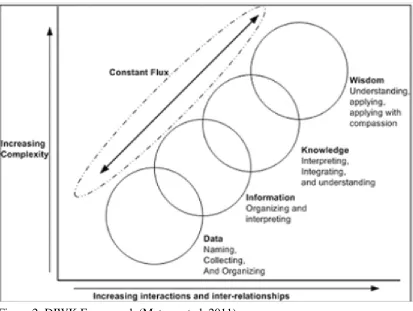
2011; ANA, 2015). The DIKW is a hierarchy of metastructures: Data, Information, Knowledge,
and Wisdom (Matney et al., 2011; ANA, 2015). The theory defines data as the smallest unit
within the framework. They are products or representations of observable “objects, events, and
their properties” (Matney et al., 2011, p. 7). Information is placing discrete units of data within a
context. Knowledge is the synthesis of information into relationships. Wisdom is the ethical use
of Knowledge to solve problems (Matney et al., 2011). The DIKW formalizes the critical
Translating the DIKW to the bedside, the nurse analyzes and contextualizes data from the
EHR and uses their knowledge of related EHR systems to plan patient care that is personalized
and respects the wishes and preferences of the patient; all while leveraging the ability of the EHR
to present and analyze patient data at a level that would be undoable in the paper chart era. The
course curriculum in this project seeks to enlighten students to the interplay between the
metastructures of Data, Information, Knowledge, and Wisdom and how the EHR serves as not
only a data repository, but also a tool to help them make better patient care decisions throughout
nursing school and reinforced at the bedside.
Attention Relevance Confidence Satisfaction (ARCS) theory. In addition to the
DIKW model, Keller’s ARCS theory can help describe the framework for providing the course
relevance, confidence, and satisfaction (Gatti-Petito, Lakatos, Bradley, Cook, Haight, & Karl,
2013). The learner’s motivation to learn can be improved by engaging these four aspects.
According to Keller (2010), capturing a learner’s attention involves leading students to focus on
stimuli related to learning objectives. Relevance means taking esoteric topics and adapting them
to the learner so they become personally invested in learning.
Learner confidence with the learning topics are potentially increased with successful
application of concepts taught; and satisfaction is achieved when learning is reinforced through a
positive learning experience (Gatiti-Petito et al, 2013; Keller, 2010). Capturing the learners’
attention includes presenting clinical problems encountered by the nurses in the course of their
day. One example includes documenting an IV insertion, site assessment, and IV infiltration.
Many of the nurses in the organization cite IV documentation as a source of frustration. This
workflow is highly relevant to the nurses since they document IVs multiple times a day. The CI
and NIC nurses also note that IV documentation is a chronic and persistent issue with the staff as
evidenced by erroneous and incomplete IV documentation identified during chart audits.
Providing solutions to improve IV documentation such as presenting the correct documentation
workflow and having students demonstrate that workflow can help to improve nurses’
confidence and satisfaction when they have to document an IV assessment. The nursing
workforce is comprised of various traditional and non-traditional staff with a variety of
technology exposure that presents a unique challenge for nurse educators (Min, Khin, Razak, &
Xia, 2014). Using the ARCS model in tandem with the DIKW framework can help describe the
main components that motivate adult learners and provide a guide to shape complex NI ideas
and clinical information management competencies will be taught in an engaging method to
stimulate older nurses to retain these concepts and help them become more comfortable with NI.
Methods
Ethical Issues
Utilizing the ANA’s Code of Ethics for Nurses (ANA, 2015) as a starting point, nurses
need to consider the challenges to patient information and privacy presented by a world that is
increasingly becoming interconnected and online. For example, Provision 2 of the ANA’s Code
of Ethics state that the “primary commitment is to the patient” (ANA, 2015, p.49). With the rise
of EHRs, the nurse’s commitment to the patient now includes considering the implications of
patient data collection in an interconnected, electronic world. This includes maintaining the
privacy and security of all patient health information from others, including other healthcare
providers who have no legal right to a patient’s records.
The nurse now needs to be more vigilant in accessing patient information in an electronic
world. According to the United States Department of Health and Human Services Office of
Civil Rights, there were 21 breaches in 2015 that affected more than 76,000 patient records
(2016). With the rise of social media, nurses must understand the legal and ethical implications
of posting pictures and videos of patient information. Cronquist and Spector (2011) state that
such violations of a patient’s privacy can result in punitive damages and disciplinary action from
federal and state regulatory agencies. Not only are individual nurses held potentially liable for
breaches of patient information, but organizations can also be held liable. The largest case to
date involves the New York and Presbyterian Hospital and Columbia University settling with the
U.S. Department of Health and Human Services for $4.8 million dollars for failing to adequately
In a world of instantaneous information retrieval, nursing beneficence, or the act of
taking positive action to help others, is done at the speed of a mouse click. With an EHR, the
nurse has the ability to view trends and patterns at an instantaneous speed. Using this wealth of
patient information allows the nurse to quickly identify early signs of deterioration and activate
the healthcare team to intervene sooner, providing a better patient outcome.
Utilizing EHRs for early identification and tracking of serious conditions, such as
hospital-acquired pressure ulcers, patient falls (Dowding, Turley, & Garrido, 2012) and
pediatric-specific conditions such as supracondylar fractures, cleft lip/palate, and voiding
dysfunction (Carberry, Landman, Xie, Feeley, Henderson, Fraser Jr., & Fraser, 2016), can
provide nurses with vital information sooner and can help guide practice to improve patient
outcomes, improve the quality of patient care, and shorten hospital stays. As the coordinator of
care, the nurse is especially positioned to be the first responder to critical information and
dramatically influence the patient’s clinical course. However, without better awareness of NI and
the role that it plays in clinical decision-making, the nurse cannot realize their full potential as an
active driver of patient care.
Nonmaleficence, or the avoidance of harm or hurt, can be improved through the use of
clinical decision support (CDS) that is embedded in many of the EHRs in use today. One
example of this CDS is when a nurse uses medication scanning to administer medication. If any
one piece of that medication administration is incorrect (i.e. wrong patient, wrong medication,
wrong time, wrong route, etc.) then the nurse is alerted to that fact. Without a strong foundation
in NI, the nurse could choose to ignore those warnings, due to alert fatigue or distrust of the
EHR, and administer that medication anyways, resulting in an adverse drug event and potentially
NI and EHRs cannot only help individual patients, but whole patient populations as well.
Utilizing NI and EHR empowers nurses to enact justice, or the fair and equal distribution of
resources, on a larger scale. Through tracking patients and their nursing utilization,
organizations can utilize their resources more effectively and efficiently in real time. For
example, in the Emergency Department, tracking patient arrival times can help lead to staffing
plans that respond to patient surges and can help the staff care for their patients more efficiently
by providing the sufficient staff to cover the influx of patients, decreasing wait times, and
improving patient throughput. Another example is integrating standardized nursing care
terminologies, data models, and information structures into the EHR. By doing this, researchers
and nursing can exact data to improve patient care not only at the local level, but at the global
stage as well (Keenan, 2014; Westra, Latimer, Matney, Park, Sensmeier, Simpson, & ... Delaney,
2015). Utilizing this Big Data approach can help organizations distribute their care effectively,
efficiently, and with the most impact.
Setting
The project took place at a 265-bed pediatric hospital located in the Central San Joaquin
Valley of California. This pediatric hospital is a not-for-profit, independent, Magnet-certified,
teaching hospital that serves 12 counties ranging from the central coast, through the central San
Joaquin Valley, to mountain areas of California. The organization has 265 licensed inpatient
beds, the Emergency Department sees over 100,000 patients annually, and has over 30 pediatric
subspecialty clinics. There are seven inpatient care areas in the organization, each with its own
unique patient population. The care areas consist of a pediatric intensive care unit (PICU), a
care area, and three medical/surgical units divided by diagnoses (respiratory, pre- and
post-surgical, and general medical).
The organization currently uses the Meditech ClientServer 5.66 EHR platform for
inpatient and Emergency Department clinical documentation; the ambulatory clinics are utilizing
the Athena EHR platform. Nursing care planning, patient clinical data order entry, medication
administration, blood administration, physician documentation, and discharge planning are fully
electronic. Moderate clinical decision support is utilized, but is limited to physician functions
like medication order entry, drug-drug interactions, drug-allergy interactions, and standardized
order sets. New nurse employees go through basic computer training during new employee
orientation consisting of instruction on how to log onto the computer, accessing email, and
accessing the organization’s intranet portal.
Clinical documentation education is currently done at the bedside with the new
employee’s preceptor. Each preceptor must complete an 8-hour class focused on the art of
preceptorship, but there is no formal training for preceptors on NI competency. There are
currently no policies in place addressing NI competencies. EHR education updates are
disseminated via email to the nursing staff on a monthly basis. Employees are assessed on the
timeliness and accuracy of their documentation as part of their annual performance review.
However, there is no formal remediation or classroom time available to nurses to improve or
remediate their NI competencies. Thus, there appears to be little consistency in the quality of
instruction in NI competency.
The organization’s CI department is comprised of four full time and two part time nurses.
The CI department oversees maintenance of the nursing clinical documentation within the EHR.
Applications group in designing and building clinical documentation screens to meet the various
needs of the organization and specialty units at the organization. The CI nurses work in tandem
with the CE clinical educators in creating educational materials for the monthly updates.
Updates include changes to nursing practice and/or clinical documentation to reflect a missing
process, gaps in policy/nursing practice, or introduce new EHR functionality.
The CI nurses are also tasked to review charts that have come to the attention of other
departments such as Revenue Integrity, Patient Quality and Safety, or Executive Practice
Council. The CI members are part of the Nursing Informatics Council (NIC), a nursing council
that is comprised of nursing representatives from each of the inpatient care areas at the
organization. This council reviews and discusses requests to create or change clinical
documentation. The CE department at the organization is comprised of six nurse educators who
coordinate, plan, and implement the nursing educational offerings.
The nursing workforce at the organization have worked with the current EHR system
since 2010. Prior to that time, only the Emergency Department fully utilized an EHR for nursing
documentation, computerized order entry, and medication administration. Inpatient
documentation was done on paper charts, with the exception of medication administration, which
was done using an electronic medication administration record. With the transition to an EHR in
2010, the inpatient nurses have become accustomed to working in the electronic environment,
but there are still many opportunities to improve NI competency among the nursing workforce.
The nursing workforce has made many strides in improving the quality of their documentation,
but many nurses still complain that the quality of their patient care has diminished since moving
task to task, having a cursory knowledge about their patient, and are frustrated with the
complicated EHR system.
In response to this frustration, nurses come up with workarounds: alternate or parallel
processes that have to potential to create duplicative or erroneous documentation, or even create
a situation where a patient could be harmed. The CI nurses and NIC members help with
correcting these workarounds by addressing issues on an individual basis or by emailing
just-in-time educational bulletins to the staff, but problems still persist.
Planning the Intervention
The aim of this project is to improve NI competencies of the organization’s nursing
workforce through the development, implementation, and evaluation of an NI curriculum
developed amongst a team of interested stakeholders by March 30, 2016. The curriculum
utilized the TIGER NI competencies as a guiding framework. The intended outcome was that
nurses will feel more knowledgeable about how use the EHR and therefore have increased their
NI competency. The goal of this project was to improve inpatient nurses’ NI competencies by
the end of the course as demonstrated by improved NI self-assessment scores. NI competency
was tracked via two self-assessment surveys administrated pre- and post-class. By being better
and more efficient users of the EHR, nurses can create patient-centric care plans and be more
informed about the individual care needs of their patients. By becoming more competent in NI,
they can see clinical documentation not as a task, but as a tool to create a more holistic patient
history and medical record.
In 2010, the organizational structure did not see the importance of CI as a separate
department from ITS. It was not until 2012 that the organization implemented CI into the
it taken place during this period of organizational uncertainty. Without the organization’s EHR
initiatives, the focus on improving the nursing workforce’s NI competency would have not have
been one of the major focus points of the organization. This additional time also allowed the
author to gain more experience in the field of clinical and nursing informatics and to experience
firsthand the application of NI at the bedside.
Project budget. The budget for the project and pilot class was $4,120. The project
budget included the preparatory work from the project author conducting research, literature
review, project planning, and working with the CI nurses in developing the lesson plans (34
hours total), and as the lead instructor for the class (2 hours). The total expense for the project
author is $2,160 (36 hours x $60/hour). The three CI nurses spent eight hours between planning
meetings with the project lead in curriculum development and attending the technical dress
rehearsal for a total of $1,440. The initial student enrollment was four students. For the pilot
phase of the project, the average paid time per student is estimated at $50 per hour for a total of
eight hours of instruction time. The total amount for student education was $800 (4 students x 2
hours education time x $50/hour). Funds for each student came from their home department’s
education budget.
One ITS staff person was needed for creating training patients in the TEST version of the
EHR, a separate and parallel EHR system used for training and testing purposes. This person
would be responsible for creating a practice patient for each student to document on during the
class. The ITS staff person would enter medications for the nurses to administer, reported home
medications for medication reconciliation, and enter clinical nursing and physician
this activity was estimated at two hours at $60 an hour. Total ITS support would be two hours
for a total of $120 (2 hours x $60/hour). See Appendix C for Project Budget.
Cost/Benefit analysis. A cost/benefit analysis was conducted to describe the potential
benefits relative to the cost of the project. Although the project budget was small, the benefits of
implementing this intervention across the organization would be beneficial in helping the
organization meet the core requirement of the HITECH Act, avoid financial penalties associated
with adverse drug events, and decrease nursing overtime.
As an example of how increasing the NI competency of the nursing workforce could
affect/effect the organization’s “bottom line”, as part of the HITECH Act, organizations who use
an EHR system must demonstrate to the Centers for Medicare and Medicaid Services (CMS)
Department that they are utilizing EHR in meaningful way to receive financial incentives.
Meaningful Use (MU) represents one of the “most profound opportunities…to document and
quantify the value of nurses’ critical thinking” (Simpson, 2011, p. 83). MU is divided into 3
stages and Stage 2 of MU is a set of sixteen required core measures and ten additional menu
objectives, of which the organization can select three to submit data to CMS (CMS, 2012). The
organization has successfully completed attestation to Stage 1 of MU and will be ready to submit
data for Stage 2 of MU by the end of FY2016.
One of the required core objectives for Stage 2 is to demonstrate that the organization
performs medication reconciliation on greater than 50% of their patients and failure to meet the
threshold of any of these actions makes the organization ineligible for financial incentives. The
financial incentive for the organization can range from a base amount of 2 to 6.3 million dollars.
Additional funds are added to the base amount by calculating the organization’s Medicare Share
payments (CMS, 2016). The maximum financial incentive is 6.3 million dollars for meeting
Stage 2 MU.
Nurses play in integral role in the medication reconciliation process. At the organization,
the nurses collect home medication information: last taken date and time, and dose of the
patient’s home medication, discontinue old or expired prescriptions, and flag any home
medications for further review by the physician. Home medication information collected by the
nurse flows to the physician’s electronic documentation where they would reconcile the home
medications prior to discharge. This workflow was initiated at the organization in January 2016
in preparation for attestation to Stage 2 MU later this year.
Currently, the organization’s medication reconciliation compliance for nurses is 30% of
all patients. At this compliance rate, the organization would fail to meet the core requirement of
medication reconciliation being performed on 50% of all patients. With the initial rollout of
medication reconciliation, there was an increase in compliance during the first month of the
rollout. Education and Super Users (SU) were deployed for the first month to educate and help
staff with any issues. However, after the SU and support went away, nursing compliance has
steadily decreased to a level below the MU threshold. The organization has addressed
compliance with focused reeducation, but this addresses the symptoms and not the root cause of
the decline in compliance.
Improving NI competency would potentially help the nurses utilize the EHR and increase
their medication reconciliation compliance to meet Stage 2 MU and help the organization meet
the criteria necessary for financial incentives. So by nurses becoming more competent in NI
there is a hope that they in turn would be able to improve and meet the medication reconciliation
Understanding of course that there are multiple variables that will impact the success or failure
of meeting Stage 2 MU requirements.
In addition to the potential financial incentives of meeting Stage 2 MU, there are other
more day to day tangible benefits from improving NI competency. According to the Agency for
Healthcare Research and Quality (AHRQ), adverse drug events (ADE) occur at a rate of 51 per
10,000 discharges (AHRQ, 2011). The cost of an ADE can range from $3,511 for a preventable
ADE up to $8,116 for a life-threatening ADE (Hug, Keohane, Seger, Yoon, & Bates, 2012). As
the administrator of most medications, the nurse is the last check against a medication error.
However, an EHR does not absolve the nurse from the responsibility of critically thinking about
the mediation they are about to administer.
Solely relying on the EHR to ensure error-free medication administration has set up
nurses, clinicians, and organizations for potential failure (Linsky & Rogers, 2014; Moore,
Artmitage, Wright, Dobrzanski, Ansari, Hammond, & Scally 2011). By improving NI
competency, nurses hopefully would be able to think more critically about the systems they use
every day to administer medications and that increased awareness could prevent an ADE. The
organization had 490 preventable ADEs in FY 2015 (C. Kozub, personal communication, April
20, 2016). By having a better understanding of how to use the technology to their benefit, the
reduction of 49 preventable ADEs across the organization ($3,511 x 49 = $172,039) would help
to offset the cost to train the staff (1,000 nurses x $50/hour x 8 hours = $400,000).
With better NI competency, the organization will see an improvement in the accuracy and
timeliness of nursing documentation. The organization currently uses some nursing
documentation for charge capture. Currently, if nurses omit or forget some of that
administration and could potentially miss reimbursement for that day or even the whole patient
stay. In addition to improved nursing documentation, nurses will potentially become more
efficient at their job by extracting information from the EHR more efficiently than before. The
time gained from this efficiency could be used to provide more patient-centered care and
improve the quality of nursing care.
There is also the potential with better efficiencies in practice to achieve a reduction in
nursing overtime (OT). The organization pays, on average, $1.87 million in nursing over time
annually. If nurses were more efficient with their time, as demonstrated by utilizing the EHR
more efficiently after taking the course even a small 10% decrease ($187,000) in nursing
overtime across the organization would be a positive financial impact to the organization’s
bottom line.
With improving NI competency among the nurses, the organization is poised to realize
significant financial incentives and avoid penalties. In total, the cost to implement this
educational program throughout the organization is estimated to cost $523,600. This amount is
divided into two categories, development and implementation. The one-time development costs
include the research and planning time by the project author and CI nurses (4 nurses x $60 hour x
60 hours = $3,600) and the cost to have ITS staff to load patient data into the EHR is estimated at
$30,000 ($60/hour x 250 hours. Implementation costs include student education time and
instruction time. It is estimated that 125 classes of eight students each will be needed to train all
the organization’s nursing workforce. The cost to educate all 1,000 nurses in the organization is
$400,000 (1,000 nurses x $50/hour x 8 hours) and instructional time for the project author is
Potential benefits include meeting Stage 2 MU criteria for a financial incentive between 2
and 6.3 million. Reducing the preventable ADE incidence by 10% annually could save the
organization up to $172,039 plus the reduction in nursing overtime of $187,000 annually, the
organization could realize significant savings with a minimal investment. See Appendix D for
Cost/Benefit Analysis.
Responsibility/accountability. The project author maintained responsibility and
accountability of meeting all project tasks and milestones. During the design phase of the
project, the project author consulted with the CI group to select relevant TIGER NI competencies
and to create the lesson plans for the pilot study. The project author was the responsible party to
submit the lesson plans to both the CI and CE departments for approval. Once approval of the
lesson plans was obtained from both departments, the project and lesson plans were presented to
the NIC and the CI nurses were again consulted in revising the lesson plans with the suggestions
of the NIC.
During the Implementation phase of the project, the project author was accountable and
responsible for providing course objectives to the CE department to post the class on the
organization’s education system. Advertisement content for the pilot course was created by the
project author and the CI nurses were consulted and approved the document. The CI Director
was kept informed of the project’s process during both the Design and Implementation phases.
Pre-class surveys were created, electronically distributed, and analyzed prior to the class by the
project author. The results of the survey were utilized to make adjustments to the curriculum to
ensure appropriate content was covered for future implementations of this curriculum. The
Class evaluations and post-class surveys were administered and analyzed by the project
author. The CI Director was informed of the results of the class and further discussions were
held to use the curriculum in the upcoming SU training for the EHR upgrade in April 2016.
After consulting with the CE department, this education plan will not be utilized for the EHR
upgrade planned for June 2016 as education plans for the EHR upgrade were already created and
approved by the CE department prior to the design and implementation of this project. However,
there are plans to submit this curriculum and for the larger EHR platform upgrade in two years.
This two year timeline will allow for the organization to become familiar with the new EHR
platform and tailor the curriculum to reflect the workflow and functionality of the new EHR
platform. See Appendix E for Accountability/Communication Matrix.
Implementation of the Project
Project timeline. Assessing the project’s progress was accomplished by creating a
GANTT chart with project milestones. See Appendix F for GANTT chart. After consideration
by the HLI department, this project was deemed to be an evidence-based change in practice
project. Soon after, the author contacted the CI and CE departments to discuss the
implementation of the project and plan a date to hold the training sessions. Both the CI and CE
departments expressed enthusiastic support for the project. Approval for the project was granted
by both the CI and CE departments. See Appendix G for the organization’s Letter of Support.
Meetings with this workgroup were conducted between October 2015 and January 2016.
During this time, planning sessions were held with the CI nurses to assess the degree of NI
education needed by the nursing staff. This group was the project content workgroup and was
led by the project author. It was integral to the project to include the CI nurses; combined they
EHR and can have a dual perspective of a nursing informaticist and that of a bedside nurse.
They work closely with beside nurses and know firsthand the frustrations the nursing workforce
feels in interacting with the EHR.
The first task was to identify essential TIGER NI competencies to guide the curriculum.
All of the TIGER NI Competencies were reviewed by the project content workgroup. From the
initial 303 TIGER NI Competencies, 47 were found to be essential by the workgroup. Each of
the NI competencies was selected based on their relevance to the nursing workflow across all
care areas in the organization. After coming to agreement on the NI competencies, the project
author drafted two lesson plans, one covering basic computer competencies and information
literacy competencies (Lesson Plan I), and the other covering clinical information management
competencies (Lesson Plan II).
The CI nurses provide invaluable insight and perspective to the unique needs of each
department and provided a holistic view of the course content. They identified opportunities to
improve NI competency across the whole nursing workforce, irrespective of patient care area.
This made the lesson plans more generalizable to the large nursing workforce and focusing on
global NI competencies would help the nurses be adaptable to the dynamic technological
environment.
Lesson Plan I served as an introduction to basic computer competencies and gives the
nurses the tools to better navigate the organization’s unique information system. The only other
time nurses are trained on the information system was during new employee orientation. There
is no formal class at the organization that offers training or remediation in basic computer
competencies for the nurses. Learning outcomes for Lesson Plan I included:
Demonstrate appropriate methods of logging off, shutting down, and restarting the
computer
Demonstrate on how to create, move, edit, and copy a text file on the local machine
Demonstrate how to move files from local machine to the network drive
Identify computer security practices
Demonstrate management of single sign on credentials
Demonstrate how to select and connect to network printer
Demonstrate how to search for Policies and Procedures, Just-in-Time training materials,
Discharge Instructions using the intranet
Demonstrate how to conduct a literature search using a database
Each learning outcome aligns with at least one TIGER NI competency in the basic computer
competencies and information literacy domains. These outcomes were selected by the project
workgroup as essential for the nursing workforce to function efficiently at the organization.
Students were expected to demonstrate competency of these skills during the class utilizing
return demonstrations. This allows for the student to turn didactic information into practical
knowledge through immediate application of the skills taught (Gatiti-Petito et al, 2013; Keller,
2010).
Lesson Plan II covers navigation of the organization’s EHR. Learning objectives for this
class included:
Demonstrate how to navigate the EMR and locating pertinent assessment documentation
using the Care Activity, Order History, and Other Reports
Demonstrate how to review and demonstrate efficient workflow when starting an IV,
assessing the site, charting infiltration, and documenting in IV Spreadsheet
Demonstrate how to review approved order sources, walk through how to order a
medication and nursing order. Have one student demonstrate how to order a mediation
based off a physician’s written order
Demonstrate appropriate method of adding a reported medication, discontinue an expired
prescription, flag a reported medication for physician review
Discuss barriers to timely documentation, review methods to improve documentation in
an efficient and timely manner, provide egregious examples of chart audits and late
documentation
Each of these objectives aligns with at least one TIGER NI competency in the clinical
information management domain. Students were expected demonstrate learning objectives by
return demonstration to the class by performing a simulated patient handoff using the EHR in
front of the class. This hands-on approach helps the students summarize the concepts taught in
class and creates linkages in a supportive, safe environment. See Appendix H for lesson plans
and Appendix I for class handouts.
Draft lesson plans created by the workgroup were submitted to the CI and CE
departments at the end of January 2016 for review and approval. Both departments granted
approval of the lesson plans the beginning of February 2016. The CI director recommended that
the project be presented at the February NIC meeting to inform the NIC members of the class
and to gather any suggestions as to the topics that may not have been addressed within the